• Skip to primary navigation
  • Skip to content
  • Skip to primary sidebar

IZA Newsroom

IZA – Institute of Labor Economics

  • Home
  • Archive
  • Press Lounge
  • DE
  • EN

IZA Network finds new home at Luxembourg’s LISER

August 26, 2025 by Mark Fallak

The IZA Network, a leading global community in labor economics, will continue its work at a new institutional home: the Luxembourg Institute of Socio-Economic Research (LISER). The transition will take effect on January 1, 2026, following the closure of the Bonn-based IZA Institute at the end of this year.

This move guarantees the seamless continuation of the IZA Network’s flagship activities—most notably the IZA Discussion Paper Series and the IZA World of Labor. These platforms have long been trusted sources for high-quality economic research and accessible, policy-relevant insights for decision-makers and educators worldwide. Key events such as the IZA Summer School, thematic workshops, and a visiting fellows program will also remain at the heart of the network.

Founded in 1989, LISER is an international, multilingual research institute with over 200 staff from more than 30 countries. Deeply embedded in Europe’s research landscape and policymaking circles, LISER works closely with EU institutions, universities, and policy practitioners. Its strong ties with Germany, along with its strategic location in Luxembourg, make it a natural fit for hosting and expanding the IZA Network’s reach.

In their joint announcement, LISER CEO Aline Muller and IZA CFO Martin T. Clemens emphasized the significance of this step:

“Our most important priority is to ensure the continuity of the network’s valuable contributions to labor economics and related areas of research.”

They also stressed the broader mission behind the move:

“At a time of growing threats to academic freedom and evidence-based policymaking, we aim to maintain a beacon for open, collaborative, and impactful social science research in Europe and beyond.”

With LISER’s stewardship, the IZA Network is set not only to preserve its established activities but also to expand accessibility and strengthen its European policy footprint—ensuring that cutting-edge labor research continues to inform public debate and real-world decision-making for years to come.

Filed Under: IZA News

Strategic Shift at DPS: Implications for IZA

February 24, 2025 by Mark Fallak

On February 24, 2025, the Deutsche Post Foundation released the following statement:

+++

Strategic Realignment of the Deutsche Post Stiftung: Prioritizing Climate and Sustainability

Following the end of funding from DHL Group (formerly Deutsche Post AG), the Deutsche Post Stiftung (DPS) is undergoing a strategic realignment. Under its new name, Stiftung Globale Nachhaltigkeit (SGN), it will focus on climate, nature, and sustainability issues.

As part of this transition, DPS will become a grant-making foundation, supporting external projects and organizations through the Stiftungsfonds Umweltökonomie und Nachhaltigkeit (SUN). This means it will no longer operate its own research institutes. In this context, DPS has made the difficult decision to discontinue operations at the Forschungsinstitut zur Zukunft der Arbeit (IZA) as of December 31, 2025.

At the same time, DPS recognizes the importance of the international IZA research network, which has established itself as a leading and highly respected global hub for labor market research. To preserve this legacy, efforts are underway to explore alternative funding sources, partnerships, and organizational models for the network. The IZA Network Advisory Panel, who were not part of the decision, will be asked to assist in this. The goal is to present the results in June 2025.

DPS fully recognizes the uncertainty this transition creates for all employees at the Bonn-based institute. Individual agreements will be developed to avoid compulsory redundancies and to help minimize the impact on employees’ careers and livelihoods.

The foundation expresses its deep appreciation for the exceptional dedication of all researchers and staff who have shaped IZA over the years. Their work has not only advanced research and international collaboration in labor economics but has also provided valuable contributions to labor market and social policy debates worldwide. Looking back on more than 25 years of achievements supported by the private funding and general leadership of DPS, we are incredibly proud of what has been accomplished. As we move forward, we are committed to supporting efforts to ensure that the spirit and impact of this research community continues into the future.

The President and the Board of Trustees

+++

Filed Under: IZA News

Award-winning research on the labor market impact of artificial intelligence

February 17, 2025 by Mark Fallak

We are delighted to announce that the paper AI, Task Changes in Jobs, and Worker Reallocation (IZA DP No. 17554) by Christina Gathmann (LISER and IZA), Felix Grimm (LISER), and Erwin Winkler (University of Erlangen-Nürnberg and IZA) been selected for the 2025 IZA Award for Innovative Research on a Pressing Public Issue (IRPPI). As AI continues to transform industries worldwide, the IRPPI Award recognizes research that deepens our understanding of these rapid technological shifts.

The study provides a crucial analysis of how artificial intelligence is reshaping labor markets, focusing on the reallocation of workers due to AI-driven changes in job tasks. It addresses one of today’s most critical economic concerns: the impact of AI on employment structures and worker transitions.

Using novel patent-based measures of AI and robot exposure, the authors analyze individual survey data on job tasks and administrative data on worker careers to understand these shifts. The study finds that while robots primarily reduce routine tasks, AI has a distinct impact by reducing non-routine abstract tasks, such as information gathering, while increasing the demand for ‘high-level’ routine tasks like monitoring processes.

These task shifts mainly occur within detailed occupations and become more pronounced over time. Although displacement effects are relatively small, workers respond by switching jobs, often moving to less AI-exposed industries. The study also highlights differences in wage effects: while low-skilled workers tend to experience wage losses due to AI-induced changes, high-skilled incumbent workers generally see wage gains.

The award-winning research “represents the best of modern labor economics,” according to the selection committee consisting of Kristina McElheran (University of Toronto) and Andrew Oswald (IZA and University of Warwick). The award comes with a prize of 5,000 euros.

+++
Download the paper here: AI, Task Changes in Jobs, and Worker Reallocation

For more information on the labor market implications of AI, see also:

IZA Spotlight newsletter special issue on Automation and AI: The Future of Work?

IZA World of Labor article by Nick Drydakis on AI and Labor Market Outcomes

Filed Under: IZA News Tagged With: AI, artificial intelligence

In Memoriam: Richard A. Easterlin

December 19, 2024 by Mark Fallak

IZA mourns the loss of Richard A. Easterlin, a visionary economist whose pioneering research transformed how we think about economic growth, happiness, and human well-being. A valued member of the IZA community, Easterlin’s insights and contributions have left an indelible mark on the field.

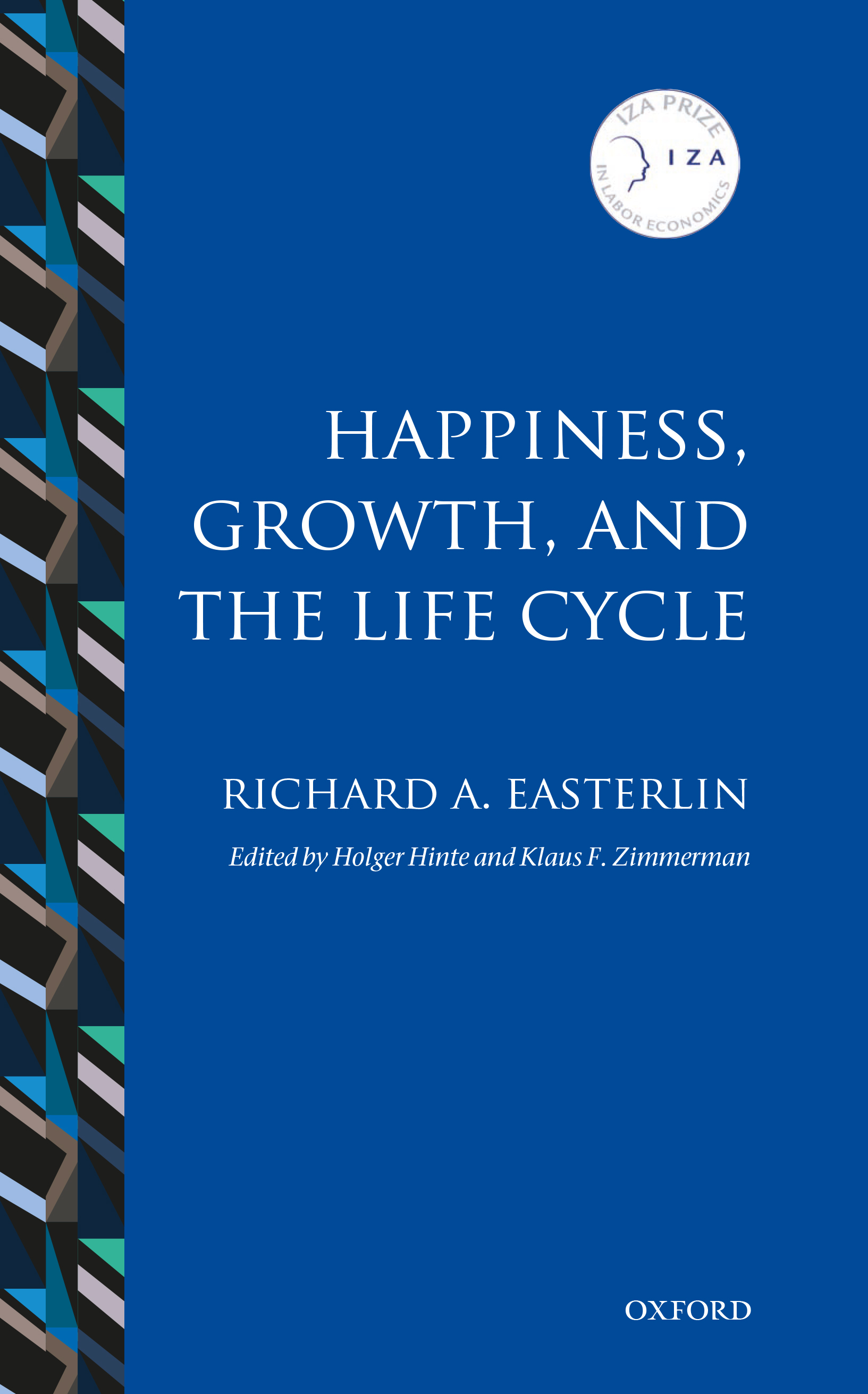
In 2009, Richard Easterlin was honored with the IZA Prize in Labor Economics, recognizing his groundbreaking work on the relationship between demographic trends, economic outcomes, and subjective well-being. To celebrate his achievements, IZA published the IZA Prize Book, “Happiness, Growth, and the Life Cycle”, which remains a landmark in happiness research.

As an IZA Fellow for 25 years, Easterlin collaborated extensively with the institute, contributing more than two dozen IZA Discussion Papers, including his most recent work in 2023 at the remarkable age of 97. His seminal Easterlin Paradox, which demonstrated that rising income does not necessarily lead to increased happiness, challenged traditional economic assumptions and continues to shape global policy debates.

Andrew Oswald, Chair of the IZA Network Advisory Panel, described him as “a hugely innovative scholar and an inspiration to generations of economists, demographers, and behavioral scientists.” Easterlin’s ability to address complex societal questions with clarity and originality set a new standard for interdisciplinary research.

Beyond his academic achievements, Easterlin was known for his kindness, generosity, and dedication to mentoring young researchers. His work with IZA and the broader academic community reflected a life devoted to fostering inquiry and inspiring future generations.

The IZA community extends its deepest sympathies to Richard Easterlin’s family, friends, and colleagues. His legacy as a groundbreaking economist and compassionate mentor will endure, influencing the study of human well-being for years to come.

Rest in peace, Richard Easterlin. Your contributions will continue to guide and inspire us.

Filed Under: IZA News Tagged With: happiness

Daron Acemoglu co-wins 2024 Nobel Prize in Economic Sciences

October 14, 2024 by Mark Fallak

We are thrilled to announce that IZA Research Fellow Daron Acemoglu (MIT) has been awarded the Sveriges Riksbank Prize in Economic Sciences in Memory of Alfred Nobel 2024 alongside his MIT colleague Simon Johnson and James A. Robinson (University of Chicago). Acemoglu is the fifth Nobel laureate from the IZA Network in the past four years alone, following in the footsteps of Claudia Goldin (2023) and Joshua Angrist, David Card and Guido Imbens (2021).

According to the Prize Committee’s press release, this year’s laureates have provided new insights into why there are such vast differences in prosperity between nations. One important explanation is persistent differences in societal institutions. By examining the various political and economic systems introduced by European colonizers, the Nobel laureates have been able to demonstrate a relationship between institutions and prosperity. They have also developed theoretical tools that can explain why differences in institutions persist and how institutions can change.

When Europeans colonized large parts of the globe, the institutions in those societies changed. This was sometimes dramatic, but did not occur in the same way everywhere. In some places the aim was to exploit the indigenous population and extract resources for the colonizers’ benefit. In others, the colonizers formed inclusive political and economic systems for the long-term benefit of European migrants.

The laureates have shown that one explanation for differences in countries’ prosperity is the societal institutions that were introduced during colonization. Inclusive institutions were often introduced in countries that were poor when they were colonized, over time resulting in a generally prosperous population. This is an important reason for why former colonies that were once rich are now poor, and vice versa.

Some countries become trapped in a situation with extractive institutions and low economic growth. The introduction of inclusive institutions would create long-term benefits for everyone, but extractive institutions provide short-term gains for the people in power. As long as the political system guarantees they will remain in control, no one will trust their promises of future economic reforms. According to the laureates, this is why no improvement occurs.

However, this inability to make credible promises of positive change can also explain why democratization sometimes occurs. When there is a threat of revolution, the people in power face a dilemma. They would prefer to remain in power and try to placate the masses by promising economic reforms, but the population are unlikely to believe that they will not return to the old system as soon as the situation settles down. In the end, the only option may be to transfer power and establish democracy.

“Reducing the vast differences in income between countries is one of our time’s greatest challenges. The laureates have demonstrated the importance of societal institutions for achieving this,” says Jakob Svensson, Chair of the Committee for the Prize in Economic Sciences.

Filed Under: IZA News Tagged With: Nobel Prize

Apply now for a postdoc position at IZA

October 2, 2024 by Mark Fallak

IZA invites applications for Postdoctoral Researcher positions at our local institute in Bonn. We are seeking talented researchers specializing in applied economics (e.g., labor, education, or environmental economics), behavioral economics, or the intersection of these fields.

Your Profile

Ideal candidates are either nearing the completion of their Ph.D. or have finished it within the last four years. We value research agendas with high societal relevance and a desire to contribute to public discourse. A strong team spirit and active engagement in IZA’s vibrant intellectual environment are essential.

Why Join IZA?

At IZA, you’ll be part of a dynamic research atmosphere focused on applied and behavioral economics. You’ll have the opportunity to:

  • Engage with our global network of over 2,000 economists from 60 countries.
  • Collaborate closely with the Economics Department at the University of Bonn.
  • Participate in our active international guest and event program.

We offer flexible appointments ranging from 1 to 3 years, with competitive compensation, including a travel budget. Importantly, there are no teaching obligations, allowing you to focus on research.

About IZA

IZA is dedicated to advancing high-quality research in applied and behavioral economics. Our mission includes providing scientific policy advice, fostering knowledge transfer, and promoting emerging talent through our unique combination of local campus and global network.

Application Process

To apply, please submit the following materials:

  • Cover Letter
  • Curriculum Vitae (CV)
  • Job Market Paper
  • Research Proposal
  • Two Letters of Reference

+++ Apply online via http://www.econjobmarket.org/ by November 17, 2024 +++

Contact for questions: Sarah Assili (assili@iza.org)

Filed Under: IZA News

IZA establishes new award for innovative research on a pressing public issue

April 16, 2024 by Mark Fallak

We are pleased to announce the IZA Award for Innovative Research on a Pressing Public Issue (IRPPI), established on the initiative of the IZA Network Advisory Panel. Continuing the spirit of the previous IRECC award, the IRPPI award will be for innovative economics research on a topic of current public concern.

While IZA as an institute primarily focuses on fundamental, long-run scientific research, we also remain deeply concerned with immediately pressing problems. The IRPPI award underscores our commitment to the relevance of policy and to the careful analysis of widely debated public issues.

This annual award, including a €5,000 prize, will be given to the authors of the best IZA discussion paper, submitted over a calendar year, on the chosen topic of public concern. The IRPPI topic for the next three years (2024-2026) is Artificial Intelligence (AI).

Filed Under: IZA News Tagged With: award, innovative research, public policy

25th IZA Summer School: Applications open!

March 11, 2024 by Mark Fallak

Fostering the next generation of researchers is a cornerstone of IZA’s mission. The IZA Summer School provides an unparalleled opportunity for PhD students to gain insights from leading international researchers on cutting-edge advancements in their fields. It’s a vibrant platform for discussing research, interacting with faculty, and building relationships with fellow students.

In celebration of its 25th anniversary (July 15-19, 2024), the IZA Summer School will embark on a new chapter. The program will now alternate its main focus between labor economics and behavioral economics each year.

This year’s group of lecturers include highly renowned international economists working at the intersection of both fields:

  • Stefano DellaVigna is a Professor of Economics and Business Administration at UC Berkeley and Co-Director of the Initiative in Behavioral Economics and Finance. He is also a co-editor of the American Economic Review.
  • Ernst Fehr is a Professor of Economics at the University of Zurich. He is a pioneer in behavioral economics and co-founder of the Zurich Center for Neuroeconomics.
  • Ulrike Malmendier is a Professor of Economics and Finance at UC Berkeley and Co-Director of the Initiative for Behavioral Economics and Finance. She is also a Member of the German Council of Economic Experts.
  • Andrew Oswald is a Professor of Economics and Behavioural Science at the University of Warwick. He is also an honorary Senior Research Fellow in the Wellbeing Research Centre at Manchester Harris College, University of Oxford, and Chair of the IZA Network Advisory Panel.
  • Amelie Schiprowski is an Assistant Professor of Economics at the University of Bonn and a faculty member of the ECONtribute Cluster of Excellence. She is also an Alumna of both IZA and the IZA Summer School.
  • Florian Zimmermann is a Professor of Economics at the University of Bonn, member of ECONtribute and IZA Research Director, having served in this capacity at the briq Institute of Behavior & Inequality before its reintegration into IZA.

+++

Applications for the 25th IZA Summer School are now open until March 31, 2024.

Filed Under: IZA News

Award-winning research in the economics of climate change

March 6, 2024 by Mark Fallak

To foster research into the nature and implications of climate change, IZA gives an award for “Innovative Research in the Economics of Climate Change” (IRECC) for the two best topical IZA Discussion Papers of the previous year. Worth 10,000 euros, the IRECC Award recognizes important new insights into the broader, often underestimated consequences of climate change and the effects of environmental policies on society and the labor market.

Real-world willingness to pay for carbon offsets

One of the two papers selected for the 2024 IRECC Award is “Willingness to Pay for Carbon Mitigation: Field Evidence from the Market for Carbon Offsets” (IZA DP No. 15939). In this study, Matthias Rodemeier sheds light on a crucial question: how much are people truly willing to pay to protect the environment? He does so by analyzing real-world behavior rather than hypothetical surveys.

Rodemeier examines the choices of over 250,000 German delivery service customers that were offered voluntary carbon offsets. Interestingly, consumer demand for offsets increased when prices were subsidized but not when the compensated amount of carbon was matched by the delivery service. However, transparency was key. When explicitly informed that the delivery service is matching the offsetting of emissions on its own costs, consumer behavior shifted dramatically. A salient 300% match of emissions boosted offset demand by 22%.

Thus, a simple intervention that advertises the firm’s participation in the offsetting costs makes subjects sensitive to the impact of carbon mitigation. The implied willingness to pay (WTP) for carbon mitigation increased from practically zero to €16 per tonne of CO2 (tCO2).

Two additional surveys reveal that the increase in WTP due to the firm’s contribution is mostly driven by fairness preferences and not by a higher intrinsic valuation for carbon mitigation.

This research further exposes a significant gap between what people say they would pay in surveys (hypothetical WTP) and what they actually do (revealed preferences). In this case, hypothetical WTP averaged €238/tCO2 – a staggering 1,338% higher than revealed preferences. This highlights the importance of using real-world behavior to understand true environmental values.

Long-term economic and social effects of climate change

The second award-winning paper, “The Effects of Climate Change in the Poorest Countries: Evidence from the Permanent Shrinking of Lake Chad” (IZA DP No. 16396) by Remi Jedwab, Federico Haslop, Roman Zarate, and Carlos Rodriguez Castelan, tackles a neglected aspect of climate change: its slow, gradual effects on societies. The research uses the dramatic decline of Lake Chad – once the world’s 11th largest – as a case study.

Lake Chad shrunk by 90% between 1963 and 1990 due to external factors. While water supply decreased, land supply increased, which could in theory generate both negative and positive economic effects. The researchers innovatively compiled population data for nearby regions across four African nations (Cameroon, Chad, Nigeria, and Niger) spanning from the 1940s to the 2010s.

Their findings are concerning. Population growth near the lake slowed significantly only after the shrinkage began. This implies limited ability for communities to adapt. Furthermore, the negative impacts on livelihoods – fishing, farming, and herding – outweighed any potential benefits from the newly exposed land.

The study employs a spatial model to estimate welfare losses, considering potential adaptation. The results show an overall decline of 6%, with Chad experiencing the most significant impact (9%). The model further explores the potential effects of various policies – migration, land use, trade, infrastructure, and urbanization – to understand how these factors might influence the situation.

The limited effectiveness of adaptation strategies in this case underscores the vulnerability of the poorest countries to climate change. These findings have broad implications for designing policies to support these nations in facing the challenges of a changing climate.

+++

The IRECC winners “represent the best of modern applied-economics research,” according to the award committee made up of Susana Ferreira (University of Georgia) and Andrew Oswald (IZA and University of Warwick).

Filed Under: IZA News Tagged With: climate change, IRECC

A dataverse for labor economics

February 14, 2024 by Mark Fallak

The IZA Research Data Center (IDSC) has recently launched the IDSC dataverse as a new service to improve the accessibility of research data along the FAIR principles (data is to be: Findable, Accessible, Interoperable and Reusable).

As part of a project funded by the German Federal Ministry of Education and Research (BMBF), the IDSC and IZA’s ICT group collaborated on migrating its IDSC research data repository to a version of the well-known IQQS Dataverse software. This BMBF project aims at developing tools for Trusted Data Custodians in data-driven research.

The new repository offers various models for depositing data, meta-data or code to meet the diverse needs of researchers, such as publication and funding requirements, as well as standards set by journals, projects, or organizations. Researchers or organizations that store a dataset with the IDSC dataverse can choose an availability status that meets their needs.

Options include datasets, which can be downloaded either anonymously or by registered users, a dataset under embargo or a dataset that is not available for download at all. Instead, this dataset can be processed against using Josua. In all cases, the depositors receive an IDSC-issued DOI for the proper citation of their dataset and any associated publications.

Data hosted on the IDSC Dataverse is accessible for academic purposes, including secondary research, replication, and teaching in a variety of ways. For clarity, here are examples illustrating different access modes:

  • An example of satisfying a difficult publication requirement. On the one hand the dataset is proprietary and may not be placed online for public download – even in anonymized form – and on the other hand the Journal requires the data be made available for replication as a prerequisite for publication. The IDSC Dataverse hosts replication files and replicators can run their replications using Josua, a code-to-data solution developed at the IDSC, both the proprietor and the Journal accept. Kuhn, P.J. & Shen, K. (2022). What Happens When Employers Can No Longer Discriminate in Job Ads? Research Data Center of IZA (IDSC). Version 1.0. doi:10.15185/w1405.1
  • An example of satisfying publication requirements as well but data is made available through the download of anonymous scientific and public use files after registration. Institute of Labor Economics (IZA). Global Climate Change Survey. Research Data Center of IZA (IDSC). https://dx.doi.org/10.15185/gccs.1
  • An example of a sub-dataverse within the IDSC dataverse: https://dataverse.iza.org/dataverse/G2LM-LIC which contains replication files for various research projects  funded by the G2LM-LIC project with downloadable data.
  • An example of a dataset whose availability status is “embargo” which expires on January 31, 2027 used, for example, by projects to create the container where replication files will be deposited upon completion to comply with funding and publication requirements: https://dataverse.iza.org/dataset.xhtml?persistentId=doi:10.15185/glmlic.596.1

For more information please contact idsc@iza.org

Filed Under: IZA News Tagged With: data repository, IDSC

  • Page 1
  • Page 2
  • Page 3
  • …
  • Page 9
  • Next Page

Primary Sidebar

© 2013–2025 Deutsche Post STIFTUNGImprint | Privacy PolicyIZA