• Skip to primary navigation
  • Skip to content
  • Skip to primary sidebar

IZA Newsroom

IZA – Institute of Labor Economics

  • Home
  • Archive
  • Press Lounge
  • DE
  • EN

Beijing’s caution on reforms makes sense – for now

November 11, 2013 by admin

By Eswar Prasad

Cataloguing China’s economic risks has become a popular parlour game. In the past decade, a steady drumbeat of warnings has predicted imminent collapse. Rising state and local government debt, a weak financial system and multiplying inefficiencies in the economy certainly pose big risks. The reforms needed to maintain growth and improve its quality have been painfully slow.

Despite these problems, the size of China’s economy and the per capita income of its citizens have quadrupled in the past 15 years, pulling millions out of poverty. Still, the country cannot outrun its problems forever. Unbalanced growth has led to widening inequality and environmental degradation.

China’s leaders often talk of the need for broad reforms but their actions are, critics say, plodding and hypercautious. This issue is in the spotlight as expectation builds that next month’s party plenum in Beijing will yield a range of reforms. Some warn, however, that such hopes will be disappointed.

Yet, for all the criticism, certain aspects of China’s cautious approach to economic reforms, which is likely to continue, might actually prove an object lesson to other countries.

Consider the proposal to eliminate the ceiling on interest rates paid on bank deposits. The ceiling has stifled competition among lenders, resulting in households receiving minuscule real returns on their deposits for much of the past decade.

Removing the ceiling would have its dangers. Weaker, poorly regulated banks might offer higher rates to compete for deposits, make riskier loans and set themselves up for failure. An explicit deposit insurance system, rather than the implicit state guarantee that now covers all deposits, would impose market discipline.

Since such a system would take time to put in place, the government has chipped away at the ceiling by allowing the proliferation of other saving products with higher returns. This approach has its own risks but helps catalyse interest rate reforms.

Small, indirect changes, even if inefficient, elicit less opposition, pose fewer risks and make course corrections easier. A big-bang approach might harm the cause of reform in the long term by inviting stronger opposition from those keen to maintain the status quo.

Many countries have undertaken big changes when they face a crisis; reforms are harder without such pressure as they invariably involve disruption and risks. The rhetoric surrounding proposed measures then turns out to be crucial in determining their political fate. In the US, the benefits of the Affordable Care Act have been subverted by the false narrative that it would socialise healthcare and destroy jobs.

In emerging markets, the notion that reforms benefit the economic and political elite is a powerful obstacle. Foreign investment in India’s retail sector has been stymied by the narrative that it profits global corporations, destroying small retailers’ livelihoods. In reality, it would help the poor by improving food distribution channels, reducing waste and keeping costs down.

Beijing has proved effective at creating narratives that build broad support and provide a framework for communicating the logic and desirability of individual reforms.

Given its under-developed financial markets, capital account liberalisation would be premature. But this objective highlights areas where reforms would be in China’s own interest: broader and better regulated financial markets, as well as a more flexible exchange rate.

This year, Beijing announced a plan to reduce inequality. This would be a dubious policy goal if it emphasised redistributive policies. In fact, the proposals are exactly the reforms needed – financial market liberalisation, reform of state-owned enterprises and freer labour mobility. All are worthy in themselves but the narrative helped emphasise that the benefits would be widespread rather than accruing to the select few.

Narratives must be translated into action. China does not have the luxury to postpone all reforms until the conditions are ripe. Its leadership may have to take greater risks to advance much-needed steps. But critics should appreciate that Beijing’s approach might reflect its economic and political savviness rather than a lack of commitment.

This article was initally published in the Opinion section of the Financial Times.

Filed Under: Opinion Tagged With: China, economic risk, financial system, foreign investment, government debt, growth, interest rates, reforms

How much unemployment insurance do we need?

October 23, 2013 by admin

By Rafel Lalive, Camille Landais and Josef Zweimüller

Rafael Lalive
University of Lausanne and IZA

The global crisis that erupted in 2008 has put millions of worker out of a job. The US, for instance, experienced an unprecedented increase in unemployment from around 4 percent to more than 10 percent during the Great Recession. Unemployment remained stubbornly even when the economy started to recover again.

Governments throughout the world have responded by making their unemployment insurance systems more generous (OECD, 2012). Some observers argue that US unemployment would have returned much faster to normal levels if the US had not expanded the duration of benefit payments from 26 to 99 weeks. Were UI extensions too generous? What is the optimal level of unemployment insurance (UI)? How much money should job seekers receive and for how long?

Camille Landais
LSE

In theory, economists have a simple answer to these questions. UI should be set optimally, i.e. such that adding a dollar to UI generosity produces as much benefit as it costs (Baily 1978). But how does one go about finding the right amount of UI in practice? Actual policy needs to be based on sound evidence. Chetty (2008) discusses a new approach to finding the optimal amount of UI. The key idea of his “sufficient statistics” approach is to combine credible evidence on the benefits and costs of more generous insurance with a plausible theoretical framework to back out the optimal level of UI.

But, what is the evidence regarding the costs and benefits of UI extensions? The costs of more generous UI are the total costs to taxpayers. The total costs have two components: direct and additional. The direct costs are those paid to job seekers who exhaust their regular benefits. Additional costs arise because more generous benefits induce job losers to stay longer on UI benefits or enter unemployment more frequently. Interestingly, a growing number of studies give us well-identified measures of the costs at the individual level. Card and Levine (2000) find that adding 13 weeks of benefit payments will prolong the duration of benefit claims by about one week in the U.S. Since their data only cover unemployment spells until benefit exhaustion, the implied impact of extended benefits on total unemployment durations (including unemployment periods after benefit exhaustion) are larger. Lalive and Zweimüller (2004) find that 13 weeks of benefits prolong unemployment duration by one week for older workers in Austria. Lalive, van Ours, and Zweimüller (2006) discuss benefit level and duration and find that raising the benefit level is less costly than prolonging benefit duration.

Josef Zweimüller University of Zurich and IZA

Economists have spent less effort in estimating these benefits. UI benefits individuals if it helps to better smooth consumption between employment and unemployment. Gruber (1997) finds that job seekers experience a drop in consumption of 6 percent compared to when they were still employed. His estimates suggest that the drop in consumption would have been almost four times larger (22 percent) without UI. This study therefore shows that UI does what it is designed to do: insure people.

However, UI generosity does not only affect individual workers’ search effort, it may also affect the competition for jobs. The idea is simple: when generous UI induces all other workers to search less intensively, it become easier for me to find a new job. This means that optimal UI needs to account for search externalities. Existing studies on the effects of extending unemployment benefits do not take these externalities into account. If these externalities are empirically relevant micro studies miss an important part of the picture.

Landais, Michaillat & Saez (2013) provide a theoretical analysis of optimal UI in the presence of search externalities. They set up a search and matching model which shows that stronger search externalities increase the socially desirable generosity of UI. An important implication of this result is that UI should be more generous during recessions when jobs are scarce and externalities are strong. Conversely, UI should be less generous during booms when jobs are plentiful and externalities are weak.

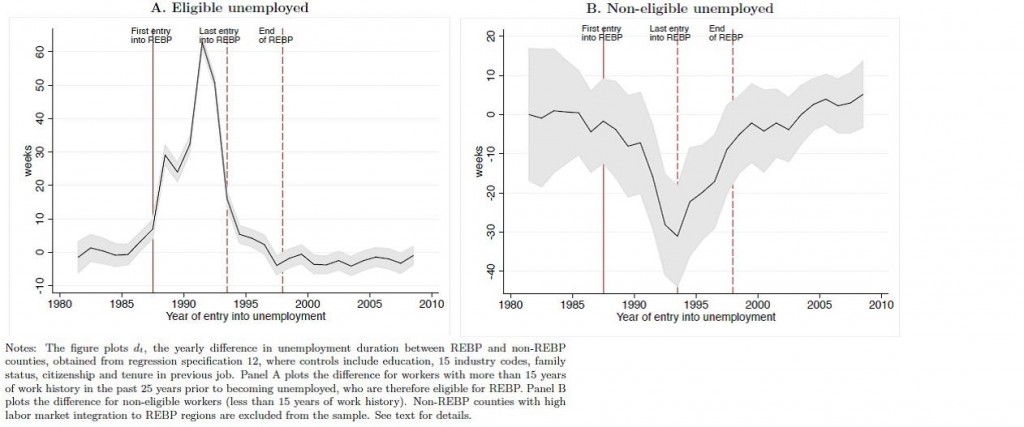
Yet are search externalities really empirically relevant? Lalive, Landais and Zweimüller (2013) provide evidence for search externalities in a quasi-experimental setting. They study a program that extended UI benefits from one to four years for certain workers in certain regions of Austria during the period 1988 to 1993. They show that this massive benefit extension led to a substantial increase in unemployment durations among eligible job seekers (Figure 1A). It also led to a substantial reduction in unemployment durations among non-eligible job seekers (Figure 1B). This evidence indicates that the effects of benefit extension programs on overall unemployment will be smaller than suggested by existing micro studies. Benefit extension programs reduce competition for jobs. Since the program induces eligible job seekers to search less hard, non-eligible job seekers face lower competition and find jobs more easily.

Figure 1: Difference in unemployment durations between eligible and ineligible counties by year of entry into unemployment

Interestingly, recent studies conclude that the US benefit extension programs of the Great Recession increased unemployment significantly but by less than half a percentage point (Rothstein 2011; Farber and Valletta 2013). This evidence suggests that the UI extensions in the US were less costly than previously thought.

Filed Under: Opinion Tagged With: Austria, benefit duration, generosity, Great Recession, job seekers, search effort, unemployment benefits, unemployment insurance, United States

Welfare benefits are no magnet for migrants

October 21, 2013 by admin

EU commissioner Laszlo Andor has been under fire since he claimed last week that welfare tourism is “neither widespread nor systematic.” However, the newly published International Handbook on the Economics of Migration, co-edited by Amelie F. Constant and Klaus F. Zimmermann from IZA, confirms Andor’s position.

Anti-immigration sentiment is on the rise in Europe. The UK has recently joined Germany and several other EU member states in projecting a rather reserved position when it comes to access of immigrants to their labor markets and welfare systems.

Reviewing the state of the art in economic research, the handbook chapter on welfare migration concludes that “fears about immigrant abuse of welfare systems are unfounded or at least exaggerated.” Robust evidence shows that even if some relationship between immigration and welfare generosity is found, it is rather exiguous.

“In fact, recent research suggests that immigration may lead to increased welfare generosity,” explains Corrado Giulietti, one of the contributing authors. According to a research paper by an IZA team that came out in International Journal of Manpower earlier this year, the economic situation or presence of relatives or other contacts in receiving countries are some of the much more important pull factors. The main goal of migrants from new member states coming to the old EU states is employment, according to the Handbook.

Immigrants have been scapegoated, and not only by rising anti-immigrant parties in countries such as France or the Netherlands, also for their alleged abuse of social benefits. An earlier study by IZA and the Economic and Social Research Institute (ESRI, Dublin) shows that in most EU member states immigrants are in fact less likely to use the welfare system than natives.

“Analysis of hard data reveals that even for unemployment benefits immigrants are equally and in several countries less likely recipients than comparable natives,” asserts Martin Kahanec, co-author of the study. “We need a paradigm shift, from the debate about abuse to a debate about lack of access to social benefits and services,” he adds.

Aging and crisis-stricken Europe needs to tap on all available resources. Mobile workers can provide the much-needed flexibility and skills where they are needed. “The role of migration is ever more, and not less, important in times of economic crisis. Mobility can not only absorb some of the negative shocks, but also contribute to recovery through increased efficiency,” concludes IZA Director Klaus F. Zimmermann.

For more information on the International Handbook of the Economics of Migration, see the Handbook’s homepage and a video of the Handbook’s Presentation with statements of the editors.

Filed Under: Opinion, Research Tagged With: anti-immigration movement, demographic change, employment, Europe, European Union, Germany, immigration, migration, UK, welfare migration, worker mobility

America’s children are the silent victims of the Great Recession

October 16, 2013 by admin

By Miles Corak

Miles Corak
University of Ottawa and IZA

The Great Recession has disrupted the lives of families and their children in an unprecedented way.

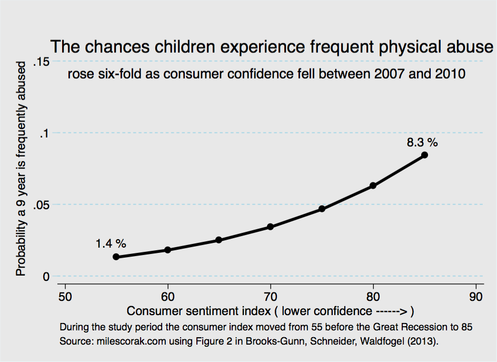
It has changed everyday life in some ways that can be measured by money, but in others that cannot, and at the extreme it has even led to a six-fold increase in the risk children will be physically abused.

Lost jobs, falling incomes, and foreclosures will likely compromise the capacity of children to become all that they can be, with the effects of the recession echoing not just across years, but also across generations.

Recessions do not normally figure into the way economists think about the factors determining the adult prospects of children. Unemployment spells are usually short, temporary events. In gauging the capacities of families to invest in and promote the capabilities of their children, it is important to look past the changes in incomes that result, and focus on the long-term, more permanent, resources available to parents.

Family income measured in any single year is, for example, not a good predictor of the adult incomes of children, but an average over, say, 10 years offers a better picture of family wealth, and is much more strongly associated with adult outcomes.

Economic theory teaches us, that people base their spending decisions, along a whole host of dimensions, on their expected long-run earnings prospects.

Certainly buying a home is made on this basis, young couples entering into debt because they expect their earnings to grow over the decades with more and more job experience. Investing in your children is no different: which schools and colleges they attend, what vacations to go on, what other extra-curricular expenditures and care arrangements to make, are all decisions that need not be rethought if income decreases, or for that matter increases, temporarily for a short period of time. Borrowing, drawing down savings, or government support can make up the difference, and maintain a customary life style.

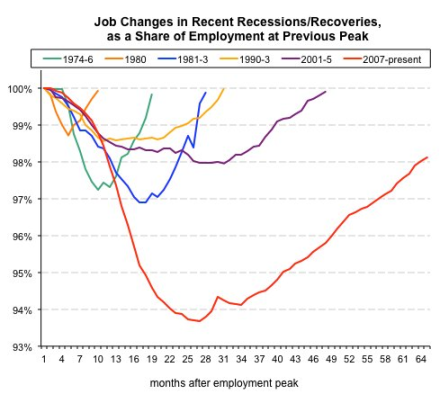
But the Great Recession, unleashed with full force in the autumn of 2008 and from which the American economy has yet to fully recover, has shattered both reality and expectation.

Source: Catherine Rampall (2013), Economix Blog, The New York Times, May 3rd.
http://economix.blogs.nytimes.com/2013/05/03/comparing-jobs-in-recessions-and-recoveries-2/

Its severity and duration calls us to rethink this rather sanguine point of view.

Research has shown that losing a job with no prospects of getting recalled lowers the incomes of long-tenured workers by as much as 25%: the new jobs these workers eventually find rarely pay as much as the old jobs they lost.

Just as importantly, this has a long-term impact on children.

The loss in income matters, but so do the other accompanying changes that will also influence the way they lead their lives. The Great Recession has certainly caused major, long-term income losses for many families, but this matters all the more because it was associated with the bursting of a housing bubble that unleashed an unprecedented number of foreclosures.

This means some children are not only living in poorer families, but that they also face the disruptions associated with changing schools, neighbourhoods, and even cities. Frequent moves and a repeated loss of friends and networks lowers high school graduation rates, and the adult incomes kids will ultimately earn.

The Great Recession didn’t just deplete bank accounts and disseminate home equity; it also ushered in a major crisis of confidence. Family life, even among those who did not experience job loss, is much more stressful, making parenting a bigger challenge.

Children benefit most from a so-called “authoritative” parenting style, a loving and warm relationship that also offers clear expectations of behaviour and accomplishment. But financial strain, whether subjective or not, taxes the energies of parents, and raises the likelihood of “authoritarian” behaviour, which involves strict adherence to rules, and unfair punishment to enforce them.

A telling, if extreme, example is a recent finding that during the Great Recession children have been more likely to fall victim to physical abuse.

A soon to be published research paper by Jeanne Brooks-Gunn, William Schneider, and Jane Waldfogel, researchers at Columbia University and the London School of Economics, shows that the drop in consumer confidence beginning in 2007 is associated with a six-fold increase in the chances that mothers will hit their children frequently (on about at least a monthly basis).

Before the recession, less than two per cent of the nine year-olds they studied in America’s major cities were at risk of being abused in this way, but when the drop in consumer confidence reached is nadir, close to 8% were.

A recession is usually a short, temporary event, something that can even be planned for, or at least weathered by a combination of personal savings, insurance, and income support. But the Great Recession was deeper, has lasted longer, and has unleashed a whole host of long-term changes. These will most likely scar some children by compromising the quality of their home life, making them the silent victims of these turbulent times.

This is a reblog of the original article published at milescorak.com.

Filed Under: Opinion Tagged With: children, crisis, Great Recession, income shocks, unemplyoment

  • Previous Page
  • Page 1
  • …
  • Page 3
  • Page 4
  • Page 5

Primary Sidebar

© 2013–2025 Deutsche Post STIFTUNGImprint | Privacy PolicyIZA