• Skip to primary navigation
  • Skip to content
  • Skip to primary sidebar

IZA Newsroom

IZA – Institute of Labor Economics

  • Home
  • Archive
  • Press Lounge
  • DE
  • EN

Peer mentoring enhances university choices and performance for high school students

December 1, 2024 by Mark Fallak

In a recent IZA discussion paper, Stefania Bortolotti and Annalisa Loviglio examine the effects of a peer-to-peer mentoring program on high school students’ university field selection and performance. The randomized controlled trial, conducted among Italian high school seniors, connected students with mentors enrolled in quantitative fields like STEM and Economics.

Through one-on-one meetings, mentors provided personalized guidance, covering topics such as curriculum details, enrollment procedures, study techniques, and career prospects. These tailored interactions encouraged mentees to ask questions, making the mentorship process responsive to each student’s needs.

The results indicate that students who engaged with mentors were 14-22 percentage points more likely to choose their mentor’s field, a shift that could raise prospective wages by 3.1-3.7%. The study reveals that the mentoring program not only nudges students toward higher-earning fields but does so without harming academic performance. Students in the treatment group were more inclined to select competitive programs, yet they maintained academic performance on par with their peers.

These findings underscore the value of personalized guidance during high school, highlighting how peer mentoring can shape future educational paths and, potentially, career outcomes.

Filed Under: Research

Political polarization undermines individuals’ rule-following behavior

November 28, 2024 by Mark Fallak

A new IZA Discussion Paper by Christoph Feldhaus, Lukas Reinhardt and Matthias Sutter investigates how political polarization affects individuals’ willingness to adhere to rules imposed by others. The researchers conducted an experiment involving 1,300 supporters and opponents of Donald Trump to explore the impact of group identity on compliance with restrictions.

Experiment with Trump supporters and opponents

Participants were asked to make decisions in three contexts: prosociality (e.g., altruism), risk preferences, and time preferences. Each participant was presented with a choice restriction imposed by an “interventionist” who either shared or opposed their political views on Trump. For example, in the altruism context, participants decided how to split a sum of money under restrictions such as being required to share at least a certain amount. In the risk context, participants chose between lotteries with differing probabilities and outcomes, some of which were restricted. In the time preference context, choices between immediate and delayed payouts were limited by the interventionist.

Participants could pay a small cost to lift the restrictions, allowing researchers to measure the extent to which compliance depended on the political alignment of the interventionist. Importantly, the restrictions themselves were identical across treatments, ensuring that only the perceived identity of the interventionist varied.

Outgroup members are perceived as more malevolent

The study found that participants were significantly more likely to pay to lift restrictions when they were imposed by someone from the opposing political group (outgroup) than when they came from someone with similar views (ingroup). This effect was consistent across all decision-making contexts but was strongest in prosocial and time preference tasks.

Further analysis revealed the mechanism behind this behavior: participants perceived restrictions imposed by outgroup members as more malevolent. They believed outgroup members were more likely motivated by a desire to harm or exert power rather than to protect or assist. When controlling for these perceptions, the difference in compliance between ingroup and outgroup interventions disappeared, emphasizing the role of perceived intent in driving resistance.

Factual arguments may have limited effectiveness

The research sheds light on the challenges of maintaining compliance and rule-following behavior in polarized societies. Resistance to identical rules based on the identity of the enforcer suggests that factual arguments or compromises on policy content may have limited effectiveness in bridging divides. Instead, fostering shared or overarching group identities could improve acceptance of rules and policies, regardless of political affiliation.

Filed Under: Research Tagged With: economic preferences, experiment, outgroup, political polarization, social identity

Fewer exam retakes, better results?

November 13, 2024 by Mark Fallak

University exams are crucial in shaping students’ academic journeys, serving not only as a measure of knowledge but also as a source of feedback, an incentive for deeper study, and a means to develop critical skills needed for future challenges. However, the way exams are organized—particularly the number of retakes allowed—can significantly impact student performance.

In a recent IZA discussion paper, Massimiliano Bratti, Silvia Granato, and Enkelejda Havari provide new evidence on the effects of reducing the number of exam retakes at university. Their research examines a policy change introduced in 2010 at the Faculty of Economics of the University of Bologna, which reduced the number of allowed exam retakes per subject per year from six to three.

Challenges for higher education in Italy

In Italy, students enjoy considerable freedom in managing their university studies, with an average of five or more exam attempts per subject each year. They can also decline an exam grade and retake it. Despite these flexible arrangements, Italy faces challenges: it has lower continuation rates in higher education, high university dropout rates, and prolonged graduation times compared to most OECD countries. In fact, Italy ranks near the bottom of the OECD for the percentage of the population aged 24–35 with a university degree, at just 29.2%. This context makes it an ideal setting to explore whether reducing student flexibility in exam retakes, in line with international practices, can improve academic outcomes.

The Faculty of Economics at the University of Bologna aimed to address this issue by revising its exam policies. For example, in the United States, retakes are generally not allowed; in the United Kingdom, students typically have only two attempts; and in Sweden, students are usually limited to three attempts per academic year—similar to the new policy in Bologna. This policy change provided an opportunity to study how limiting exam retakes affects student performance.

The researchers compared the performance of students in degree programs that adopted the new rules (those in the Faculty of Economics) with those in programs that did not. They found that the reform led to significant improvements in first-year student outcomes. The probability of first-year dropout decreased by 4.2 percentage points (pp), while students earned an average of 11.2 additional credits and passed about one more exam.

No negative effect on grades

Looking at a longer time horizon, the study also documented a 5.7 pp (7%) increase in the probability of graduation and a 9.1 pp (22%) increase in on-time graduation. Remarkably, the faster degree completion did not negatively affect students’ final graduation marks, which was a major concern for many.

Further analysis based on family background, specifically whether students attended a vocational track in secondary education, revealed that those from lower socio-economic backgrounds—who were more likely to be working—benefited significantly from the reform.

Overall, the study suggests that revising how university exams are organized can be an effective policy tool to improve educational outcomes and address the long-standing issue of prolonged graduation times for Italian university students.

Filed Under: Research Tagged With: exams, Italy, retakes, student outcomes, university

Rising temperatures hurt Europe’s economy

November 11, 2024 by Mark Fallak

A recent IZA discussion paper by Nicola Gagliardi, Elena Grinza and François Rycx highlights the significant productivity challenges European firms face due to global warming. The authors analyzed firm-level data from 14 European countries, revealing that rising temperatures adversely affect Total Factor Productivity (TFP), primarily through declines in labor productivity.

The study utilized a comprehensive dataset combining detailed firm-level information with high-resolution temperature data. This approach enabled the assessment of temperature anomalies—deviations from historical average temperatures—and their impact on productivity. By employing fixed-effects models, the researchers isolated the effects of temperature changes on productivity, accounting for various firm-specific factors such as size, sector, and geographic location. This robust methodology identified temperature-induced productivity losses, particularly in sectors more sensitive to climate variations.

Key findings indicate that a 1°C increase in temperature anomaly leads to a 0.3% to 0.4% decrease in TFP, with more severe effects observed when anomalies exceed 1.5°C—a threshold linked to the Paris Agreement targets. The impact is especially pronounced in firms engaged in outdoor activities, such as agriculture and construction, as well as in manufacturing sectors with high capital intensity and a large proportion of blue-collar workers.

Regional and firm-size disparities

Geographically, firms in temperate and Mediterranean climates are more adversely affected, highlighting regional disparities in the economic impact of climate change. Smaller firms, particularly micro and small enterprises, are also more vulnerable to the effects of rising temperatures.

The study underscores the urgent need for targeted climate policies and adaptation strategies that address the specific needs of different sectors and regions to mitigate the economic risks associated with global warming. The authors call for a stronger policy response to curb the potential adverse implications of climate change on European productivity and economic growth.

Filed Under: Research Tagged With: climate change, Europe, global warming, productivity

Air pollution cuts job seekers’ wage demands

November 4, 2024 by Mark Fallak

A new IZA paper by Mariët Bogaard, Steffen Künn, Juan Palacios and Nico Pestel investigates the impact of air pollution on the wage expectations of unemployed job seekers in Germany. Using detailed survey data from unemployed individuals randomly exposed to varying levels of air pollution during interview times, the researchers found that increased exposure to fine particulate matter pollution (PM10) significantly reduces the so-called “reservation wage”—the lowest level of compensation a job seeker is willing to accept when searching for jobs.

Specifically, an increase in PM10 levels by one standard deviation (around 12 µg/m³) led to a reduction in reservation wages by approximately 1.2%. The magnitude of this effect is comparable to the influence of factors such as personality traits or wealth on individuals’ wage expectations, underscoring the significant impact of ambient air pollution on unemployed job seekers.

Reduced search intensity, lower patience, decreased risk tolerance

The study highlights several mechanisms driving the effect on reservation wages. Poor air quality was found to reduce job seekers’ search intensity, meaning they put less effort into finding employment, which in turn might lower their wage expectations.

Additionally, exposure to higher pollution levels was linked to decreased risk tolerance and reduced patience. As job seekers become more risk-averse and less patient, they are more likely to accept lower wages rather than continue their job search under uncertain conditions. This could push them into lower-paid jobs, which might increase the likelihood of recurring unemployment and reduced job satisfaction over the long term.

These findings emphasize the broad social cost of air pollution, suggesting that environmental factors can directly impact economic outcomes. This is particularly important given the disproportionate exposure to air pollution for (unemployed) individuals with less financial means. Therefore, this study provides another argument for policy why environmental policy and economic growth as well as inequality are likely to reinforce (instead of contradicting) each other.

Financially disadvantaged unemployed more exposed to air pollution

Whereas previous research has largely centered on the effects of air pollution on the working population, particularly regarding labor supply and productivity, this study sheds light on its consequences for the labor market’s most vulnerable group: the unemployed. This focus is crucial, given that financially disadvantaged individuals face higher exposure to air pollution.

Thus, the study offers policymakers additional evidence that environmental policies are likely to reinforce, rather than conflict with, objectives of economic growth and reducing inequality.

Filed Under: Research Tagged With: air pollution, job search, reservation wage, unemployed

Do salary history bans really help level the playing field?

October 31, 2024 by Mark Fallak

Salary history bans are laws or policies that prohibit employers from asking job applicants about their past salaries during the hiring process. These bans aim to reduce wage inequality and eliminate the perpetuation of pay disparities, especially those based on gender, race, or other biases.

A recent IZA paper by Bo Cowgill, Amanda Agan and Laura Katherine Gee examines the impact of salary history bans on job seekers and employers in the United States. Specifically, the authors investigate whether the success of these bans is undermined when job candidates voluntarily disclose their previous salaries, even when not prompted by employers.

The key findings reveal that a significant proportion of workers (28%) disclose their salary histories unprompted, despite bans preventing employers from asking. An additional 47% would disclose their salaries if they believe other candidates are doing so. This behavior is more prevalent among men, who are 12 percentage points more likely than women to disclose their salaries without being asked. This creates a situation where the stigma of silence pressures all candidates to disclose, undermining the intended effects of the bans.

The study suggests that voluntary disclosure is driven by well-paid candidates who have incentives to share their salary history to signal their value to potential employers. However, this also means that non-disclosing candidates might be perceived as having lower salaries, which could negatively impact their job prospects.

The policy implication of these findings is that salary history bans may not fully achieve their goal of promoting pay equity. Instead, the pressure to disclose voluntarily could perpetuate existing pay inequalities, like the gender wage gap. Therefore, the authors call on policymakers to consider additional measures to ensure that salary history bans effectively reduce pay disparities without being circumvented by voluntary disclosures.

Filed Under: Research Tagged With: compensation, hiring, inequality, information economics, salary history bans, statistical discrimination, voluntary disclosure

NHS trainee doctors quit due to unfavorable working conditions

October 17, 2024 by Mark Fallak

A new IZA discussion paper by Marco Mello, Giuseppe Moscelli, Ioannis Laliotis and Melisa Sayli reveals the significant impact of contractual changes on the attrition of NHS trainee doctors. The 2016 reform of the NHS contract for junior doctors increased their base salary by 10.5%, but controversially reduced the pay for night and weekend shifts—referred to as “unsocial hours.” The findings suggest that these changes have had far-reaching negative consequences for both trainee retention and patient care in England’s National Health Service (NHS).

The shortage of healthcare workers has been a growing concern in many developed OECD countries, including the UK, where trainee doctors—medical graduates in their post-graduate training phase—are crucial for the continuity of the healthcare workforce. The proportion of NHS trainee doctors who transitioned directly into specialty training dropped from 71.3% in 2011 to 37.7% in 2018, raising alarms about the sustainability of medical staffing levels.

The 2016 contractual reform, which cut maximum weekend pay supplements from 50% under the 2002 contract to 15%, was aimed at rebalancing pay structures but has unintentionally exacerbated the loss of trainee doctors. An analysis of administrative payroll data from NHS hospitals found that the reform led to a 6.7% increase in the annual number of junior doctors leaving the NHS. Further insights from the NHS Staff Survey indicated that dissatisfaction with pay has become a significant factor in doctors’ intentions to leave the healthcare sector, with a notable rise in dissatisfaction since the contractual changes were implemented.

The consequences of increased trainee attrition are not limited to workforce dynamics—they extend to patient outcomes as well. By linking payroll data with patient admission and mortality records from NHS hospitals, the researchers examined how fluctuations in trainee numbers affected patient care. They found a positive association between the monthly attrition of trainee doctors and subsequent increases in patient mortality, particularly among emergency cases. The study used risk-adjusted metrics to ensure accuracy, accounting for confounding factors like patient age, co-morbidities, and seasonal variations.

The study highlights the crucial role of trainee doctors in the NHS—they serve as first responders in assessing patient severity and provide essential support to tenured medical staff. Reduced retention of trainee doctors therefore not only impacts staffing but also the quality of patient care, especially in emergency situations where timely assessments are vital.

The authors conclude that policy-makers must consider the implications of altering compensation structures, particularly when it comes to unappealing aspects of medical work such as unsocial hours. Changes that reduce incentives for these challenging shifts may undermine both staff retention and the quality of hospital services. The evidence suggests that careful design of pay schemes is essential to maintaining a robust and motivated healthcare workforce capable of delivering high-quality care.

Filed Under: Research Tagged With: doctors, employee attrition, hospitals, job contracts, on-the-job training, patient mortality, pay satisfaction

50 years of breakthroughs and barriers: Women in economics, policy, and leadership

October 8, 2024 by Mark Fallak

Over the past 50 years, women have made significant strides in education and professional fields, breaking through barriers and challenging traditional gender roles. Yet, despite these advances, a persistent gender gap remains in leadership positions across academia, government, law, medicine, and business.

An IZA discussion paper by Francine D. Blau and Lisa M. Lynch, in honor of late IZA Research Fellow Rebecca M. Blank, examines this complex issue, highlighting the progress women have made and the obstacles that continue to hinder their advancement into senior roles. While women now make up the majority of bachelor’s, master’s, and doctoral degree recipients, their representation in top positions still lags behind that of men in many fields.

The study points out that while women have achieved near parity in some areas, such as assistant and associate professorships, they are still underrepresented at the highest levels. For instance, women constitute just 35% of full professors across all fields and only 18% in economics. Similarly, despite gains in political leadership and corporate governance, women remain a minority in top roles, such as Fortune 500 CEOs and U.S. Senators.

Family and career

The paper explores the complex reasons behind these persistent gender gaps. The evidence suggests that differences in qualifications and noncognitive skills between men and women play a role. Women often face greater challenges in balancing professional responsibilities with family life, especially in demanding fields that require long hours or inflexible schedules.

Research cited in the paper shows that having children can significantly impact women’s career trajectories, influencing decisions around labor force attachment, occupation, and career advancement. For example, women in high-skilled jobs face high penalties for shorter hours or career interruptions, which can lead to slower progress up the professional ladder.

Discrimination and subtle barriers

However, Blau and Lynch emphasize that even when accounting for these factors, discrimination and stereotyping continue to contribute significantly to the gender disparities in leadership and high-level positions. Studies indicate that both conscious and unconscious biases influence hiring, evaluation, and promotion processes. Women are often perceived as less competent or suitable for leadership roles, especially in male-dominated fields, which leads to higher scrutiny and more frequent questioning of their abilities. For instance, experimental studies have shown that women may receive less favorable evaluations than men for similar performance and are often subjected to higher standards and greater scrutiny.

Furthermore, subtle barriers and roadblocks, such as exclusion from informal networks, lack of mentorship, and fewer role models, exacerbate these disparities. The paper cites evidence that women who exhibit assertive behavior, often necessary for leadership roles, can be penalized for not conforming to traditional gender norms. This double bind can discourage women from pursuing or advancing in certain fields.

Filed Under: Research

Matching workers and jobs online

October 1, 2024 by Mark Fallak

In today’s digital era, many types of markets—including labor markets—are moving online, transforming the way supply and demand are matched. This trend offers new opportunities to leverage internet data for social science research, particularly in labor economics, which is central to the mission of IDSC, IZA’s research data center.

When markets operate online, digital technology becomes a powerful tool for optimizing the matching of supply and demand—one of the core challenges of any market. The digital nature of these transactions allows researchers to efficiently generate, collect, and analyze data, essentially enabling them to “rewind and replay” market activities for better understanding. As technologies like AI-assisted matching continue to evolve, they offer promising new solutions to traditional labor market challenges while also presenting fresh complexities and research questions.

The 7th IDSC Workshop, co-organized by Nikos Askitas, Peter J. Kuhn, and Christina Gathmann (Labor Market Department Director at LISER), focused on these emerging dynamics of the virtual labor market. Hosted at LISER’s Belval campus in Luxembourg, this was the first face-to-face meeting since the COVID-19 crisis. The venue—a mix of modern facilities and historical industrial landmarks on the grounds of an old blast furnace—provided an inspiring environment for the workshop.

This year’s event was supported by the Luxembourg National Research Fund and LISER, with organizational help from IZA’s events team. Keynote speakers included Amanda Agan (Cornell University), Thomas Le Barbanchon (Bocconi University), and Barbara Petrongolo (University of Oxford). Alongside these keynote presentations, the workshop featured a roundtable with local stakeholders, a poster session, and a diverse set of papers representing research from 11 countries.

The workshop addressed a variety of relevant themes, including:

  • Algorithms and AI in the Matching Process
  • Networks, Social Media, and Mindfulness
  • Helping Workers Find Jobs
  • Crafting Job Ads: Ad Content and Applicant Behavior

Selected Presentations

Automating Automaticity (Amanda Agan, Cornell University)
Amanda Agan explored how algorithms that customize user content can unintentionally reinforce biases. Through a combination of field and lab experiments, she demonstrated that algorithms trained on automatic user behaviors—like quickly scrolling past a social media post—tend to encode in-group biases. In contrast, slower, more deliberate user actions, such as adding a new contact, exhibit fewer biases. These findings suggest that job boards and other platforms could minimize the spread of unconscious biases by training algorithms with more conscious, higher-stakes user decisions.

Traditional vs Machine Learning Methods (Sabrina Mühlbauer, IAB)
Sabrina Mühlbauer and her co-authors used comprehensive administrative data from Germany to predict job matching quality in terms of job stability and wages, using both traditional econometric techniques and machine learning (ML) methods. The study found that ML outperformed traditional methods in pattern recognition, data handling, and reducing prediction errors. By combining ML insights with algorithms that provide ranked job recommendations tailored to individual characteristics, the research shows significant promise in supporting job seekers and caseworkers to refine job search strategies.

Wage Information and Applicant Selection (Marc Witte, VU Amsterdam and IZA)
In a field experiment in Addis Ababa, Ethiopia, Marc Witte and co-authors examined how wage transparency in job advertisements affects workers’ application decisions. The experiment highlighted the role of recruiters’ choices in job ad content in shaping recruitment outcomes. Unlike the vast body of field experiments focused on employers’ responses to resume content, this study offers a rare insight into how job seekers respond to vacancy details—highlighting an essential part of the recruitment process that influences where individuals choose to apply.

With these and other presentations, the 7th IDSC Workshop offered critical insights into how technological advances are reshaping labor markets. From AI-driven matching processes to understanding the effects of wage transparency, the discussions underscored the dual nature of these advances: while they provide new tools for improving labor market efficiency, they also introduce new challenges that require careful exploration. This event highlighted the value of continued research in guiding policy and improving practices in the evolving landscape of labor economics.

Filed Under: Research Tagged With: algorithms, job platforms, machine learning, matching

Introducing the IZA/Fable SWIPE Consumption Index

September 30, 2024 by Mark Fallak

A pioneering tool for tracking consumer behavior, the IZA/Fable SWIPE Consumption Index is a product of collaboration between the IDSC (IZA’s Research Data Center) and Fable Data, Europe’s top aggregator of credit card transaction data. By merging IDSC’s “It’s all about data” philosophy with Fable’s “Data for Good” initiative, the index offers an innovative, data-driven way to monitor consumer spending. Data flows seamlessly each night from Fable’s systems to IDSC’s computational infrastructure, ensuring the index remains continuously updated.

Germany’s first big-data consumer indicator, introduced by IDSC Head Nikos Askitas alongside Fable coauthors Anoop Bindra Martinez and Fabio Saia Cereda in the Journal of Economics and Statistics, offers a valuable complement to traditional survey-based indices. While established methods focus on measuring “propensity to purchase,” the SWIPE Index provides near real-time insights. Published monthly as a public resource, it benefits economists, policymakers, journalists, and the general public alike.

Consumption and the Labor Market

Household consumption drives more than half of Germany’s GDP, underscoring its crucial role in economic growth and its significant influence on the labor market. The relationship between consumption and the labor market forms a dynamic feedback loop that can either accelerate or hinder economic progress. When consumption increases, it stimulates economic growth, boosting labor demand, raising wages, and enhancing consumer confidence—creating a cycle of further spending. On the other hand, declining consumption can slow growth, weaken labor demand, and depress wages, which in turn erodes consumer confidence and reduces consumption even further.

Several key factors demonstrate this interdependency:

  • Job Security: Workers confident in their job stability are more inclined to spend, whereas those fearing job loss tend to save more, reducing overall consumption.
  • Wage Growth: Rising wages fuel spending on discretionary goods, while stagnant or declining wages constrain purchasing power, limiting consumption.
  • Unemployment: Income loss due to unemployment or underemployment directly reduces spending.
  • Job Types: Higher-paying jobs support greater consumer spending, while lower-wage employment restricts it.

Correlation with Eurostat Consumption Data

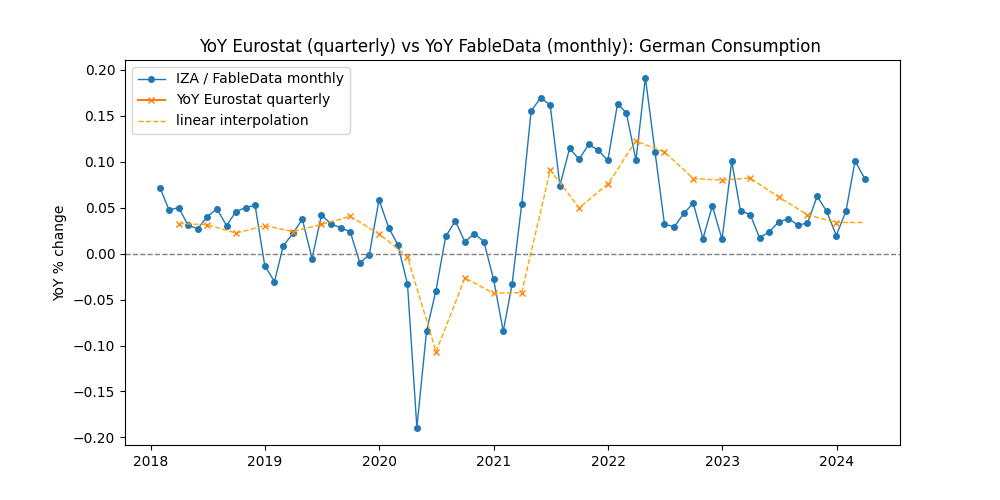
The IZA/Fable SWIPE Consumption Index closely aligns with official quarterly data from Eurostat, as shown in the figure below. Since our index is updated monthly and in near real-time, it serves as a useful tool for forecasting official consumption data.

How the Index Works

The IZA/Fable SWIPE Consumption Index tracks monthly credit card spending, comparing each month’s data to the same month of the previous year, effectively accounting for seasonal variations. Given the nature of the data (an unbalanced panel), the index focuses on year-on-year changes in aggregate spending from consumers who were active in both periods. This approach ensures a more accurate reflection of underlying consumption trends.

Interpreting the Index is straightforward:

  • Positive values indicate year-on-year consumption growth, where any value above zero signals a positive trend in consumer spending.
  • Negative values reflect a year-on-year contraction in spending, meaning values below zero suggest a decline in economic activity.
  • An upward trend signals accelerating spending, while a downward trend indicates a slowdown.

A preliminary index value for each month is released around mid-month, with continuous updates based on incoming daily data. The final value is published two to three days after the end of the month.

To monitor the index or embed it on your website (as demonstrated below), visit the IZA/Fable SWIPE Consumption Index website. We are also expanding the index to include data for the UK and France in an upcoming phase.

Filed Under: Research Tagged With: big data, consumption

  • Previous Page
  • Page 1
  • …
  • Page 3
  • Page 4
  • Page 5
  • Page 6
  • Page 7
  • …
  • Page 69
  • Next Page

Primary Sidebar

© 2013–2026 Deutsche Post STIFTUNGImprint | Privacy PolicyIZA