• Skip to primary navigation
  • Skip to content
  • Skip to primary sidebar

IZA Newsroom

IZA – Institute of Labor Economics

  • Home
  • Archive
  • Press Lounge
  • DE
  • EN

Motivated cognition drives discriminatory beliefs

September 18, 2024 by Mark Fallak

New research by Lasse Stötzer and IZA Research Director Florian Zimmermann sheds light on how motivated cognition—where self-interest influences perception—can foster discriminatory beliefs. Now published in Games and Economic Behavior, the study investigates the connection between self-serving motives and the formation of negative stereotypes.

The researchers conducted a carefully designed survey experiment involving a representative sample of 1,200 German adults. Participants were randomly assigned to one of two experimental conditions. In the main treatment, participants had the opportunity to personally benefit by taking money from a 50 EUR donation intended for a pro-immigrant organization. For every euro taken, participants received 50 cents.

After this decision, they were asked to estimate the percentage of refugees who believe that women should not have equal rights in a democracy. The control group, on the other hand, could only reallocate the donation between two pro-immigration organizations, with no financial gain for themselves.

Justifying selfish behavior by devaluing out-groups

The results were striking. Participants who could financially benefit by taking money away from refugees were more likely to express negative beliefs about them. Specifically, these participants estimated a higher percentage of refugees holding regressive views on women’s rights, compared to those in the control group. This suggests that self-interest can lead individuals to justify their selfish behavior by devaluing out-groups—in this case, refugees.

The study further revealed that this effect was significantly more pronounced among lower-income participants. Those with below-median household incomes were more likely to adopt negative beliefs about refugees when given the opportunity to profit at their expense. In contrast, higher-income participants showed no significant change in their beliefs across the different conditions.

These findings contribute to the debate on the roots of racism and discrimination, suggesting that economic and social self-interest may significantly shape prejudicial attitudes. By showing how motivated reasoning can lead to discriminatory beliefs, the research highlights the need to address these underlying self-interests to challenge and combat harmful behaviors toward marginalized groups.
Filed Under: Research Tagged With: discrimination, motivated cognition, self-interest

How do unequal opportunities impact support for redistribution?

September 16, 2024 by Mark Fallak

The impact of circumstances beyond people’s control has been rising in the United States, yet support for redistribution policies remains stagnant. This puzzling trend contradicts experimental findings that suggest people generally favor meritocratic fairness—tolerating income differences due to effort but supporting redistribution when disparities result from luck.

A new IZA discussion paper by Marcel Preuss, Germán Reyes, Jason Somerville and Joy Wu sheds light on this apparent disconnect by examining how different types of luck influence attitudes toward redistribution.

The authors conducted an experiment involving 2,400 workers who completed a real-effort task and randomly paired them to compete for a fixed prize in a winner-takes-all environment. Then, 1,170 impartial “spectators,” recruited from the New York Fed’s Survey of Consumer Expectations, decided how to allocate earnings between worker pairs.

Lucky outcomes vs. lucky opportunities

Spectators were randomly assigned to either a “lucky outcomes” scenario (where the winner of each pair was determined by coin flip or task performance) or a “lucky opportunities” scenario (where the winner was determined by task performance multiplied by a random productivity factor). This design allowed the authors to compare redistribution decisions across different luck environments while controlling for the overall impact of luck on outcomes.

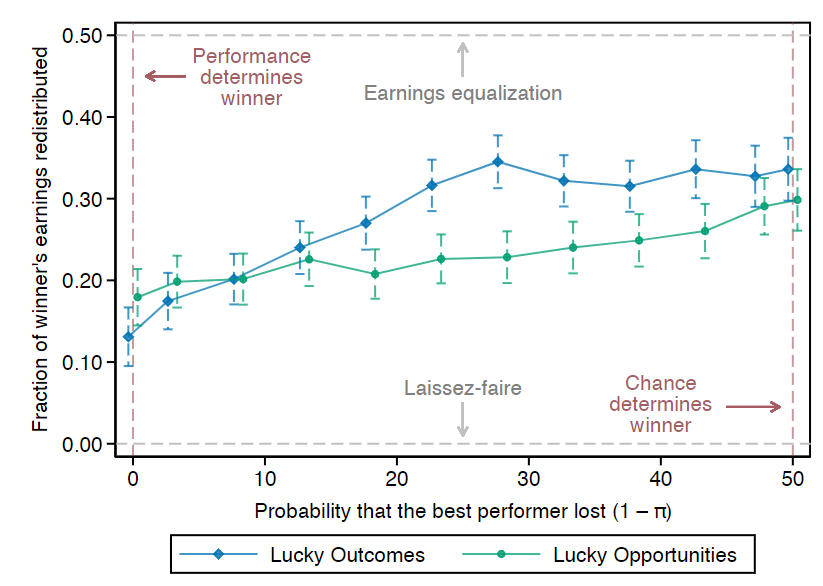
The authors found that spectators redistributed significantly less earnings when inequality arose from lucky opportunities compared to lucky outcomes. On average, they redistributed 27.6% of earnings under lucky outcomes but only 23.3% under lucky opportunities.

This redistribution gap emerged only when there was uncertainty about whether the higher-performing worker lost. As the probability that earnings inequality was due to luck increased, redistribution increased more strongly in the lucky outcomes scenario compared to the lucky opportunities scenario (Figure 1).

Figure 1:
Average redistribution and the probability that earnings inequality is due to luck

Note: This figure shows the average share of earnings redistributed between workers (from the higher-earning winner to the lower-earning loser) relative to the likelihood that the best performer lost.

To understand why spectators redistribute less under lucky opportunities, the researchers examined how spectators use information from the different luck environments. They found that under unequal opportunities, spectators tended to respond linearly to differences in productivity multipliers. While intuitive, this behavior often leads to underestimating how even small differences in opportunities can substantially impact worker outcomes.

To further investigate this phenomenon, the researchers conducted an information intervention where they directly provided spectators with the probability that the best performer won. This intervention significantly reduced the redistribution gap between lucky outcomes and lucky opportunities scenarios.

Difficulty in assessing the true impact of luck

When given explicit information about the role of luck, spectators in both scenarios became more responsive to changes in the likelihood that earnings inequality was due to luck. This finding suggests that spectators faced difficulties in accurately assessing the impact of unequal opportunities on earnings inequality.

These findings have important implications for understanding attitudes toward inequality and designing effective redistribution policies. They suggest that people may be more tolerant of inequality arising from unequal opportunities, partly due to the difficulty in assessing the true impact of luck in such situations. This could help explain why support for redistribution in the U.S. has remained stagnant despite increasing inequality of opportunity.

The results highlight the need for clear communication about the role of luck in determining economic outcomes and suggest that models of redistribution preferences should account for how people process information about different sources of luck.

Filed Under: Research Tagged With: inequality, luck, opportunity, redistribution

Employee Stock Ownership Plans boost job satisfaction in U.S. manufacturing sector

September 9, 2024 by Mark Fallak

A new IZA Discussion Paper by Adrianto, Avner Ben-Ner, Jason Sockin, and Ainhoa Urtasun reveals that employees in U.S. manufacturing firms with Employee Stock Ownership Plans (ESOPs) — the most common system in the United States for implementing broad-based employee ownership — experience significantly higher job satisfaction compared with their counterparts in conventional firms. The research draws on nearly 200,000 employee reviews from the online platform Glassdoor, providing a detailed analysis of the impact of employee ownership on worker well-being.

The study finds that workers in employee-owned firms report greater overall job satisfaction, with particularly strong results in areas such as company culture and work-life balance. The overall job satisfaction premium is significant, amounting to approximately 0.10 stars higher on a 5-star scale, equivalent to nearly one-tenth of a standard deviation.

Collective bargaining contributes to a more positive work environment

One of the key findings of the research is the role of collective bargaining in amplifying the benefits of employee ownership. ESOPs that are the result of collective bargaining agreements show even higher satisfaction levels, suggesting that the collaborative process between unions and management contributes to a more positive work environment. Firms in which employees own larger shares of the company report greater satisfaction, indicating that the degree of ownership matters for employee well-being as well.

The research highlights that this satisfaction premium is not limited to specific groups of employees. Both managerial and non-managerial, as well as current and former, employees report higher satisfaction levels in employee-owned firms. Employees who have since left the firm in particular report having had higher job satisfaction in the presence of an ESOP.

Non-pecuniary aspects of work play a crucial role

Further analysis suggests the elevated satisfaction in ESOP firms is not merely a result of greater compensation. Instead, the non-pecuniary aspects of work, such as a supportive culture and effective leadership, play a crucial role. This underscores the idea that employee ownership can produce a more engaged and motivated workforce, in turn contributing to a more productive and harmonious workplace.

Overall, the study provides robust evidence that employee ownership can significantly improve employee well-being in the manufacturing sector. By fostering a sense of ownership and aligning the interests of workers with those of the company, ESOPs create a work environment where employees are more satisfied, more invested in their work, and more likely to experience a positive work-life balance. This research adds to the growing body of literature demonstrating there are non-wage benefits to workers from participating in employee ownership.

Filed Under: Research Tagged With: career, collective bargaining, culture, employee ownership, ESOP, job satisfaction, leadership, work-life balance

AI and automation: How should we tax the future?

September 4, 2024 by Mark Fallak

The rapid rise of artificial intelligence (AI) and automation is driving profound changes in the way we work, produce goods, and generate wealth. But as machines take on more tasks traditionally done by humans, how should governments adapt their tax systems? This question is at the heart of a recent IZA Policy Paper by Spencer Bastani and Daniel Waldenström. Their research on the implications of AI and automation for taxation in advanced economies offers insights into how these technologies might reshape labor markets, income distribution, and the broader economy.

A new economic reality

AI and automation are not just futuristic concepts; they are already transforming industries around the globe. From self-checkout machines to AI-driven financial advice, these technologies are beginning to replace human labor in various sectors. This shift raises significant concerns about job displacement and wage stagnation for some workers, while others, particularly those skilled in AI-related fields, may see substantial productivity gains.

The central challenge, as Bastani and Waldenström point out, is how governments should tax labor and capital in this new economic reality. If AI leads to more wealth being generated by machines rather than people, should the tax burden shift from labor to capital? And if so, how can we do this without stifling innovation or economic growth?

Bridging theory and evidence

To tackle these questions, the researchers combined empirical evidence with theoretical models of optimal taxation—a field that seeks to design tax systems that balance fairness with economic efficiency.

The paper begins by reviewing the latest empirical studies on AI’s impact on labor markets, productivity, and income inequality. For instance, the researchers analyzed how the introduction of AI in various industries has affected job postings and wage growth, drawing on data from the United States and other advanced economies. They also examined shifts in the distribution of income between workers and capital owners, a key concern as AI and automation advance.

Next, Bastani and Waldenström explored the theoretical frameworks that guide tax policy. They looked at how optimal taxation models, which traditionally focus on labor income, need to adapt to a world where capital income—profits from AI-driven innovations—plays an increasingly dominant role. These models help policymakers understand the trade-offs between taxing labor and capital, and how different tax structures can impact economic growth and inequality.

Implications for tax policy

The findings of the paper suggest that while AI and automation could indeed shift more of the national income towards capital, this does not necessarily mean that a wholesale rebalancing of tax systems is required—at least not yet. Contrary to some predictions, labor’s share of income in many advanced economies has remained relatively stable, with notable exceptions like the United States, where a decline has been observed.

However, the researchers caution that as AI technologies continue to evolve, this balance could change. If capital starts to dominate national income, it might become necessary to increase taxes on capital to maintain government revenues. But this approach has its risks. Overly progressive taxation could deter investment in AI and other technologies that drive economic growth.

The study also touches on the controversial idea of a Universal Basic Income (UBI) as a response to potential mass unemployment caused by AI and automation. While UBI is often presented as a simple solution, the researchers argue that it could reduce incentives for work and education, potentially harming long-term economic welfare.

Beyond taxes: The role of regulation

Interestingly, the paper suggests that some challenges posed by AI might be better addressed through regulation rather than tax policy alone. For instance, if AI leads to greater industry concentration and monopolistic practices, competition policies might be more effective than tweaking tax rates.

Moreover, the authors highlight the potential of AI to improve tax administration itself. AI could streamline tax collection and compliance, reducing costs for both governments and taxpayers. This is already happening in some countries, where AI is being used to enhance audit processes and manage tax inquiries.

A balanced approach

In conclusion, the researchers advocate for a measured approach to tax policy in the age of AI and automation. While there is no immediate need for dramatic changes, they emphasize the importance of staying flexible and responsive to future developments. As AI continues to transform economies, governments must carefully consider how to balance the need for revenue with the imperative to foster innovation and ensure fair distribution of wealth.

This study offers valuable insights into the complex interplay between technology, economics, and public policy, underscoring the need for thoughtful, evidence-based approaches to the challenges of the future.

[Editor’s note: In line with the focus of the study, this summary was generated with the assistance of ChatGPT.]

Filed Under: Research Tagged With: AI, automation, inequality, taxation

Female economists outshine males in shaping public opinion

September 2, 2024 by Mark Fallak

A recent IZA discussion paper by Hans H. Sievertsen and Sarah Smith reveals that female economists are more effective than their male counterparts in influencing public opinion. The research, conducted through a survey experiment with over 3,000 US participants, tested the effect of opinions expressed by senior economists from leading US universities on topical issues.

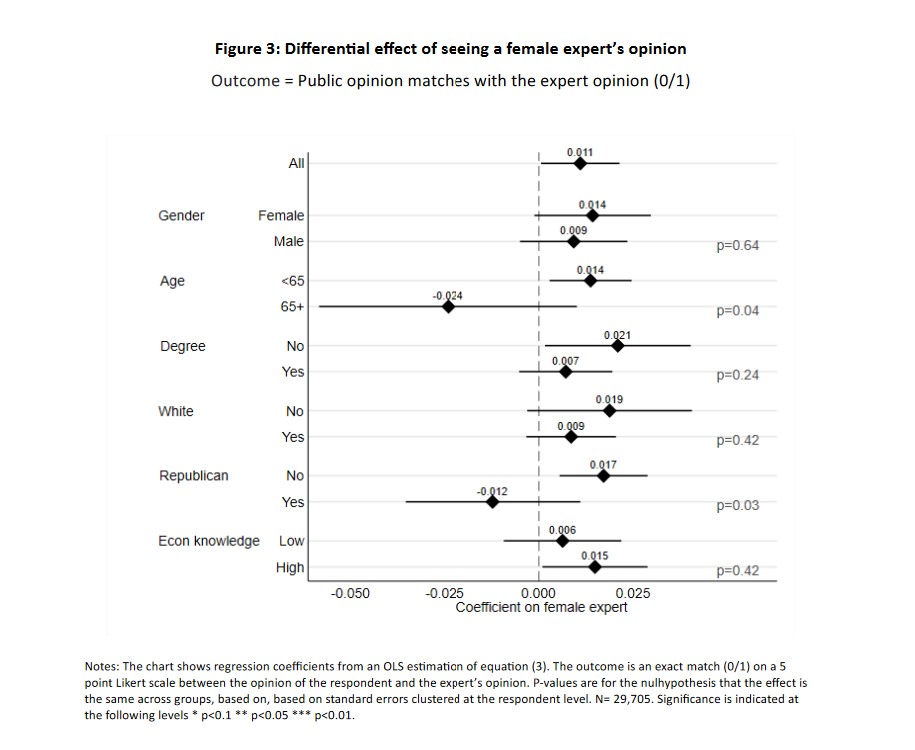
The study found that while both male and female experts could sway public opinion, the same opinions were more persuasive when expressed by female economists. Specifically, the influence of female experts was about 20% greater than that of male experts. This effect was consistent across different topics, including AI, climate change, and economic policies.

The research further indicated that the higher persuasiveness of female economists was not attributed to identity concordance, such as gender alignment between the expert and the respondent. Instead, the credentials of female experts seemed to play a significant role in enhancing their perceived credibility.

However, the study noted that this persuasiveness was less pronounced among more conservative respondents, particularly older individuals and those aligned with the Republican Party (see figure below).

The findings challenge existing stereotypes about gender and economic expertise, suggesting that women, despite (or perhaps even due to) their underrepresentation in the media as economic experts, wield significant persuasive power in public discourse.

Filed Under: Research Tagged With: economic expertise, gender, persuasion, stereotypes, survey experiment

How underconfidence contributes to the gender wage gap

August 22, 2024 by Mark Fallak

A recent IZA Discussion Paper by Anna Adamecz and Nikki Shure investigates the role of non-cognitive traits, specifically underconfidence, in explaining the persistent gender wage gap. Using data from the British Cohort Study 1970, the researchers find that overconfidence contributes to around 5.5% of the gender wage gap at age 42. Notably, this is driven by women being more underconfident rather than men being more overconfident.

The study highlights a significant wage penalty for underconfident individuals, regardless of gender, though women are disproportionately affected due to their higher likelihood of being underconfident. This underconfidence results in lower wages, primarily due to occupational sorting, poorer pre-university educational outcomes, and a lower probability of pursuing high-earning degrees such as those in STEM fields.

Interestingly, the research suggests that interventions to boost women’s workplace confidence may be insufficient, as much of the damage occurs earlier in life. The authors argue for earlier interventions targeting educational and career choices, pointing out that workplace-based confidence-building measures may come “too little, too late.”

This research adds a new dimension to understanding the gender wage gap, emphasizing that confidence—or the lack of it—plays a substantial role in shaping labor market outcomes.

Filed Under: Research Tagged With: gender gap, gender wage gap, overconfidence, underconfidence

Children’s honesty influenced by social environment and upbringing

August 15, 2024 by Mark Fallak

A 2021 IZA discussion paper, now published in The Economic Journal, found that a child’s propensity to lie is significantly influenced by their social environment and upbringing. The study highlights that children from higher socio-economic backgrounds tend to be more honest than those from less privileged settings. Additionally, a compassionate parenting style and a high level of trust within the family are linked to greater honesty in children.

The research team, comprising Johannes Abeler, Armin Falk and Fabian Kosse, utilized a simple die-rolling experiment to measure honesty. Children were asked to predict the outcome of a die roll and received a small reward if their prediction was correct. The unmonitored nature of the experiment allowed children to lie without fear of being caught. Statistically, only about 16.7% of honest predictions should be correct, but the study found that over 60% of children claimed to have predicted correctly, indicating widespread dishonesty.

The study also explored how these honesty preferences could be altered. It found that participation in a mentoring program led to a lasting increase in honesty among children from disadvantaged backgrounds. The program, Balu und Du, pairs children with volunteer mentors who spend one afternoon a week engaging in social activities with them for a year. This exposure to a role model positively impacted the children’s honesty long after the program ended.

The data for this study was collected from over 700 families in Cologne and Bonn, who participated in a panel study starting in 2011. Families provided detailed information about their socio-economic status, parenting styles, and household dynamics. From this group, 212 children from disadvantaged backgrounds were randomly selected to participate in the mentoring program, while 378 similar children formed a control group.

The results were clear: only 44% of children in the mentoring program lied, compared to 58% in the control group. This significant reduction in dishonesty, akin to the differences observed between genders in previous studies, underscores the effectiveness of the mentoring program.

Overall, the study demonstrates that early interventions can positively influence children’s social and moral behaviors, suggesting that structured mentoring programs could be a valuable tool in promoting honesty and integrity from a young age.

Filed Under: Research Tagged With: honesty, lying, mentoring, preferences, socioeconomic status

Soft skills can mitigate hiring discrimination

July 30, 2024 by Mark Fallak

As socio-emotional skills like teamwork, leadership, and empathy become increasingly important in hiring decisions of firms, a recent IZA discussion paper by Yashodhan Ghorpade and co-authors examine what role these skills play in a labor market marked by the presence of ethnic discrimination.

The authors conducted an audit experiment in Malaysia, a multi-ethnic, upper-middle income economy with some indications of ethnicity-based discrimination in hiring. The study involved sending fictitious job applications to around 3,000 employers through a job portal, randomly varying signals of ethnic and gender identity, and two soft skills – teamwork and leadership – in candidate CVs.

Discrimination by ethnicity, not by gender

The paper finds that applications of male and female candidates are equally likely to get callbacks, and as previous studies in this context have also shown, Malay and Indian-ethnicity candidates are systematically less likely to be contacted than Chinese-ethnicity candidates. However, signaling teamwork skills (by mentioning collaborative teamwork experience in an internship and in hobby groups, and highlighting teamwork skills in the application summary) reduced the discrimination experienced by Malay and Indian ethnicity candidates by 40 percent.

Signaling leadership, however, does not appear to affect the likelihood of discrimination. This suggests that if ethnicity is used by employers as a proxy of skills they cannot observe in CVs, acquiring and signaling soft skills, especially teamwork can reduce the extent of discrimination faced by disfavored groups.

Labor market competition matters

The study also finds that firms that face greater competition are less likely to discriminate based on ethnicity and that when there are fewer high-quality candidates for a given position, Malay and Indian candidates are less likely to be discriminated against.

These findings have important policy implications: Firm competition can be promoted as a measure to reduce discrimination in the labor market. On the supply side, a better matching of worker quality to job positions can improve hiring opportunities of discriminated groups.

Filed Under: Research Tagged With: competition, discrimination, ethnicity, hiring, soft skills

Larger, all-male groups most prone to lying

July 17, 2024 by Mark Fallak

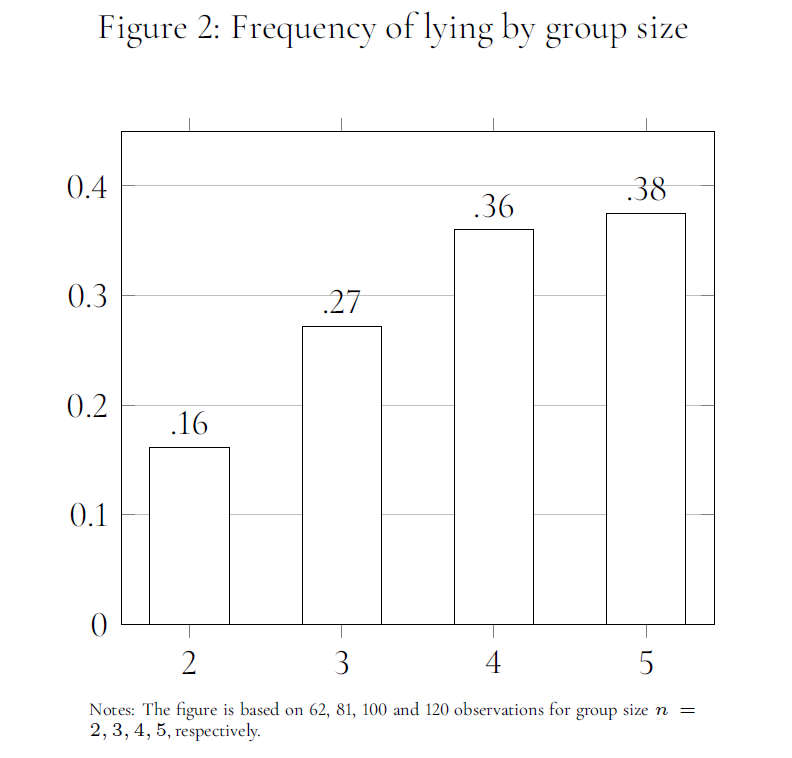
Many business decisions are made by teams, with experts recommending groups of 4-6 for optimal performance. However, corporate scandals raise concerns about unethical choices made within groups. A recent IZA discussion paper by Gerd Muehlheusser, Timo Promann, Andreas Roider and Niklas Wallmeier delves into this issue, examining how group size, gender composition, and individual honesty influence overall group truthfulness.

The research involved over 1,600 participants from England and America, divided into groups of 2-5 with varying gender ratios. In each scenario (except one), participants could increase their earnings by lying about the outcome of a die roll.

Guilt sharing: How group size fuels dishonesty

The results revealed a worrying trend: the likelihood of lying grew with group size. Doubling the group size from 2 to 4 saw dishonesty rates double as well (see figure below). The researchers attribute this to diffusion of responsibility, or “guilt sharing,” where individuals feel less responsible for a dishonest decision because others in the group could have intervened.

The gender factor: Why women promote honesty

Interestingly, gender composition also played a significant role. All-male groups consistently displayed lower levels of honesty compared to mixed-gender or all-female groups. The difference was stark, with all-male groups lying up to 35% more frequently than their counterparts for similar group sizes.

However, the study revealed a fascinating twist: having even one woman in the group significantly shifted the dynamic towards honesty. This phenomenon, dubbed the “first female effect,” suggests that women might be perceived as valuing honesty more highly, making men less likely to lie around them. Alternatively, men might be more concerned about appearing dishonest in front of women than other men.

Beyond individual honesty: The complexities of group dynamics

To further explore the link between individual and group honesty, the researchers conducted a separate experiment. While men showed a general tendency towards less truthfulness on their own, the findings were surprising. Even all-male groups comprised entirely of honest individuals lied more often than comparable female groups. This suggests that individual honesty isn’t the sole factor at play.

Overall, this study sheds light on the complex interplay between group size, gender composition, and individual characteristics in influencing group decision-making honesty. The findings offer valuable insights for promoting ethical behavior in team settings, particularly by encouraging diversity and fostering an environment where individuals feel accountable for their actions.

Filed Under: Research Tagged With: decision making, gender, groups, honesty, lying, unethical behavior

Parents tend to steer sons towards traditional careers

July 15, 2024 by Mark Fallak

Despite efforts to promote gender equality, a new IZA discussion paper by Stefan Wolter and Thea Zöllner reveals a hidden hurdle: Swiss parents may unintentionally push their sons towards traditionally male careers.

The authors conducted a large survey experiment with nearly 6,000 adults in Switzerland. Participants were presented with a realistic scenario: choosing a vocational training path for their hypothetical child (son or daughter) from two different options. Notably, participants weren’t told the gender distribution of these careers.

The surprising finding? Parents displayed no bias when advising daughters, but showed a strong preference for male-dominated fields when guiding their sons. This bias held true across different age groups and even for those without children, suggesting a deeper societal pattern.

This research highlights the need to address unconscious biases to ensure young people have the freedom to pursue their true career aspirations, regardless of gender stereotypes.

Filed Under: Research Tagged With: career advice, education, gender, occupational choice, vocational training

  • Previous Page
  • Page 1
  • …
  • Page 4
  • Page 5
  • Page 6
  • Page 7
  • Page 8
  • …
  • Page 69
  • Next Page

Primary Sidebar

© 2013–2025 Deutsche Post STIFTUNGImprint | Privacy PolicyIZA