
• Skip to primary navigation
  • Skip to content
  • Skip to primary sidebar

IZA Newsroom

IZA – Institute of Labor Economics

  • Home
  • Archive
  • Press Lounge
  • DE
  • EN

It matters if you’re black or white – on Australian buses!

April 3, 2013 by admin

Rosa Parks

Almost 60 years after the famous Montgomery Bus Boycott triggered by black civil rights activist Rosa Parks, a new IZA discussion paper by Paul Frijters and Redzo Mujcic investigates whether there is still racial discrimination in buses by conducting a natural field experiment in Queensland, Australia. The authors sent trained testers who differed in ethnic appearance to bus stops asking the driver for a free ride on the basis that their bus pass was faulty (which it was). In total, they obtained 1,552 observations of testers either allowed a free ride or not, in each case recording the characteristics of the bus driver, the tester, and the circumstances. The paper shows strong evidence of discrimination against black-skinned individuals.

White testers were accepted during 72% of the interactions versus only 36% for black testers. Indian testers were let on 51% of the time and Asian testers (mainly Chinese) were let on 73% of the time. Favors were more likely to be granted when the bus driver and tester were of the same ethnicity, and when there were fewer people in the bus. Patriotic appearance matters in that testers wearing army uniforms were accepted at a rate of 97% if they were white and 77% if they were black. Status appearance also mattered in that black passengers in business attire were just as likely to be favored as casually dressed white testers. When bus drivers were confronted with hypothetical situation of granting a free ride using photos taken of the real testers, 86% responded they would let on black passengers, more than double the actual number accepted, indicating dishonest self-reporting on this topic.

Filed Under: Research Tagged With: discrimination, natural field experiment, racial bias

What happens to the careers of European workers when immigrants “take their jobs”?

March 29, 2013 by admin

A new IZA Discussion paper by Cristina Cattaneo, Carlo V. Fiorio and Giovanni Peri evaluates the effect of immigrants on the career of natives. The authors follow native individuals who have been exposed to competition of immigrants in European countries. In countries and occupations with more competition between native and immigrants they find that natives are pushed to faster occupational upgrades towards jobs using more sophisticated skills, requiring higher education and paying higher wages. Natives are also more likely to undertake enterpreneurial activities in response to larger immigrant competition. This implies that immigrants “push up” natives in the labor market and the overall effect on wages and income of natives is small and usually positive. The implications of these findings are that immigrants do not hurt native labor market opportunities but rather create incentives for their improvement. By filling manual and less-skilled occupations immigrants encourage native careers. More open immigration policies, combined with flexible labor markets, could result in better opportunity for the career of natives.

Filed Under: Research Tagged With: employment, Europe, immigration, labor market career, mobility, self-employment

Eat sugar and make better choices

March 25, 2013 by admin

Formal economic models rarely consider the mental conditions of individuals when analyzing their behavior and the decisions they make. In reality, people do this all the time: it seems common sense not to ask friends, family or colleagues to perform important tasks when they’re tired or hungry, and to avoid making important decisions ourselves under those conditions. This intuition has been confirmed by a number of recent studies by psychologists, which show that temporary conditions such as prior performance of a cognitively demanding task or a low level of blood glucose can alter decisions, especially decisions involving the exercise of willpower.
A new IZA Discussion Paper by IZA Visiting Research Fellow Peter J. Kuhn, Michael A. Kuhn and Marie Claire Villeval studies the effects of mental fatigue and sugar consumption on patience a laboratory experiment. In particular, the authors ask whether performing a task that can be considered cognitively depleting affects subsequent intertemporal choices and whether administering a sugar supplement can act as a remedy on the consistency of choices.

Surprisingly, the authors do not find that mental fatigue makes subjects more impulsive. Instead the paper shows that individuals who have recently completed a cognitively demanding task are more patient. Asking the participants to drink either a placebo beverage or a sugared beverage ten minutes prior to the time task also increases the patience of individuals, and does so by raising lower-school test-score subjects’ sensitivity to high prices. These findings suggest that ‘attention-focusing’ tasks and remedying energy deficits may help stimulate the active choice of individuals. This emphasizes the need to help consumers make active and aware choices whenever possible.

Filed Under: Research Tagged With: behavioral economics, cognitive skills, laboratory experiment, patience, time preferences

Star Wars: The Empirics Strike Back

March 22, 2013 by admin

Most academic disciplines use a statistical threshold to decide whether a hypothesis is likely to be true. If a test statistic is below this threshold, the finding is too uncertain to be suggested to be true. An unintended consequence of having thresholds is that researchers know the conventional statistical threshold and consider it as a stumbling block for their ideas to be considered since positive findings are more likely to be published.

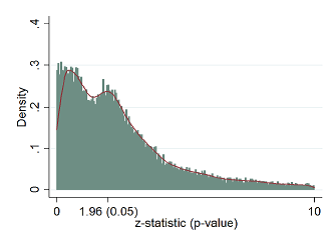
Abel Brodeur, Mathias Lé, Marc Sangnier, and Yanos Zylberberg collected the value of tests statistics published in three of the most prestigious economic journals over the period 2005-2011. The distribution of test scores shows a hole just before the threshold, that is in the region where results are too uncertain to be called true, and a surplus after it.

This finding suggests that researchers may be tempted to present tests with higher statistics in order to increase their chances of being published. For example, imagine that there are three types of results: green lights are findings which are very likely to be true. Red lights are findings where effects are too uncertain (or too small) to be considered. Amber lights are in-between. The paper argues that researchers would mainly paint amber lights green, rather than in the initially red and green cases. According to the authors’ calculations ten to twenty percent of tests published are misallocated.

The following graph shows the distribution of test scores where a z-statistic of 1.96, which normally corresponds to a p-value of 0.05, is the conventional threshold used in economics. Tests with z-statistics lower than 1.96 are usually regarded as too unconvincing. The picture shows the hole in the distribution just below the conventional threshold and the excess mass above, which hints at a systematic misallocation.

Test score distribution

The study also identifies several papers’ and authors’ characteristics that seem to be related to this misallocation, such as being a young researcher in a tenure-track job. There is no indication of misallocation of tests for randomized control trials. Surprisingly, data and code availability do not seem to be associated with substantially less misallocation.

Results presented in this paper may have interesting implications for the academic community. Even though it is unclear whether these biases should be larger or smaller in other journals and disciplines it raises questions about the importance given to values of tests and the consequences for a discipline to ignore negative results. Suggestions have already been made in order to reduce this trend. Journals have been launched with the ambition of giving a place where authors may publish negative findings. There is also more and more pressure for researchers to submit their methodology before doing an experiment.

Filed Under: Research Tagged With: economics, significance, statistics

Women do better and seem less anxious in all-female classes

March 19, 2013 by admin

Nowadays more women attend university than men. Yet, women are still under-represented in the highest levels of technical subjects such as mathematics, physics or engineering, which eventually translates to an under-representation in high-tech sectors of the workforce. One potential mechanism to overcome this gender gap is single-sex education, that is classes which are strictly for women and classes that are only for men.

A new IZA Discussion Paper by Alison L. Booth, Lina Cardona Sosa and Patrick J. Nolen investigates the effects of single-sex classes in a randomized university experiment. The authors randomly assign students to all-female, all-male, and coed classes. The study shows that one hour a week of single-sex education benefits females: females are 7% more likely to pass their first year courses and score 10% higher in their required second year classes than their peers attending coeducational classes. Yet, the authors do not find an effect of single-sex education on the probability that a female will take technical classes and there is no effect of single-sex education for males, either.

The authors explain the positive effect on exam scores with a reduction in the so-called ‘stereotype threat’ for females. This threat work as follows: If women are exposed to the stereotype that they are worse at economics than males, they may be afraid to speak up in class in order to avoid embarrassment. Furthermore, they may face anxiety when taking tests because they have been conditioned to believe they are worse at economics. Thus, the findings of the study suggest that females enrolled in an all-female class are more willing to participate in classroom discussions and feel less pressure when taking exams.

Filed Under: Research Tagged With: education, gender, schooling, single-sex classes, test scores

Ten years of “Agenda 2010”

March 14, 2013 by admin

A decade ago the German labor market was regarded as a sick patient. Today it is performing exceptionally well and has been remarkably resilient to the financial and euro crisis. This must be attributed at least in part to the courageous “Agenda 2010” labor market reforms, which were introduced – against massive resistance – in March 2003. From the very beginning, IZA has constructively supported and scientifically evaluated this reform process. Today, ten years later, it has become obvious that the “Agenda 2010” project has left a lasting positive mark on the German labor market.

Let’s go back in time: On March 14, 2003, then German Chancellor Gerhard Schröder of the Social Democrats announced a series of concrete measures to reform the labor market, the social security system and public finances. A committee led by Peter Hartz (then board member for human resources at Volkswagen) worked out proposals to improve the public employment services and to design more efficient labor market policies. These were enacted in what came to be known as the “Hartz Laws I-IV”.

Key elements of the reform package were: (1) reform of active labor market policy instruments, (2) restrictions on welfare benefits for the unemployed, (3) modernization of the employment agencies, (4) stronger activation of the unemployed through the principle of “supporting and demanding” (Fördern und Fordern), (5) merging of unemployment aid and welfare benefits into basic income support for job seekers, (6) liberalization and expansion of flexible forms of employment such as temporary work, fixed-term contracts and small-scale employment (“mini jobs”).

A number of studies by IZA experts show that these measures have in many areas improved the functioning of the German employment system and the effectiveness of policy programs (IZA DP 2055, IZA DP 2605). As a result, the employment rate has risen substantially since the mid-2000s, particularly with many new jobs created in the service sector. This would not have been possible without a more flexible labor market and a consistent activation of the unemployed.

IZA has contributed its expertise in various ways: Beyond publicly supporting the reform process (e.g. by initiating calls of economists) and providing policy advice, IZA researchers have extensively studied the effectiveness of several reform components. In light of the predominantly positive results, IZA experts are highly critical of recent plans by policymakers to roll back some of the reforms.

Among the active labor market policy instruments analyzed by IZA were various measures to promote self-employment. In addition to the bridging allowance (Überbrückungsgeld) established in the mid-1980s, the Hartz reforms introduced a start-up allowance (Existenzgründungszuschuss, “Ich-AG”) in order to help a larger group of people find their way into self-employment. Long-term analyses conducted by IZA find that both programs are effective at integrating participants in the labor market and improving their incomes. The subsidized start-ups also create additional jobs for other (previously unemployed) individuals (IZA DP 3880). Given these positive findings, it is difficult to understand why the successful start-up programs were recently cut again.

Another subject of investigation by IZA was the new strategy initiated by the Hartz reforms in the area of subsidized further training. The certification of service providers, the increase in competition caused by the introduction of a voucher system, and the improved selection of program participants made the programs significantly more effective and efficient (IZA DP 2069, IZA DP 3910, IZA Research Report 10).

In addition, IZA analyzed the so-called transfer programs, include a short-time work allowance (Transfer-Kurzarbeitergeld), which aim at supporting and facilitating the job transition for employees facing layoff due to corporate restructuring. While the evidence found no evidence of positive effects, the reforms at least mitigated the negative effects that were previously found (IZA Research Report 10). However, considering the limited effectiveness and the high costs of these programs, they should be critically reviewed.

A widely debated element of the Hartz reforms was the expansion of small-scale employment (mini/midi jobs). An IZA study found that these jobs had negative fiscal effects and tended to displace regular employment (IZA Research Report 47). On the other hand, they had a positive impact on the search behavior of unemployed individuals, who are able to complement their income during unemployment spells by working up to 15 hours per week. Lower social security contributions provide an incentive to take up this form of employment, which is particularly attractive for the long-term unemployed (IZA DP 6499). Thus, small-scale employment contributes at least indirectly to improving reintegration prospects.

Beyond the overall positive findings with regard to active labor market policies, another IZA study showed that unemployed individuals with a perceived high probability of joining a program lowered their reservation wages and increased their search efforts (IZA DP 3825). In other words, the existence of a program alone has a “deterrent” effect in a positive sense. Further research will need to examine whether this affects the quality of subsequent employment.

Other IZA studies on German labor market trends since the mid-2000s concentrated on the role of “standard employment contracts” and “atypical employment” (IZA Research Report 22, IZA Research Report 23, IZA Research Report 25). Flexible forms of employment account for a large share of the newly created jobs. This was particularly beneficial for the previously underdeveloped German service sector. There are now more jobs, but also more types of jobs.

In analyzing these issues, IZA was able to draw on the expertise of its strong research network, the largest network of labor economists worldwide. IZA research fellows and affiliates contributed a number of studies on German labor market policies and, in particular, activation programs. For example, macroeconomic studies empirically confirm that the reforms have reached their main goal to shorten individual unemployment spells (IZA DP 2470). Job placement became much faster and more efficient. The “Agenda 2010” also increased the overall effectiveness of active labor market policy in Germany (IZA DP 2100).

In sum, the Hartz reforms and the “Agenda 2010” mark the beginning of a new area in German labor market policy with a long overdue redesign of the German employment model. The outstanding performance of the German labor market during the current crisis is owed, at least in part, to the “Agenda 2010” (IZA DP 6250, IZA DP 6625).

Now that the important parameters of active labor market policy have been adjusted, policymakers and scientific advisors must focus on how to prepare the German labor market for the dramatic consequences of demographic change. Improving education and “life-long learning” are just as essential as establishing family-friendly workplace practices and additional measures to promote female employment. Other aspects include more individual scope in shaping one’s working life and retirement, as well as enhancing Germany’s attractiveness for high-skilled immigrants. IZA will continue to accompany these necessary reforms in a critical and constructive manner.

Filed Under: Research Tagged With: active labor market policy, Agenda 2010, atypical employment, crisis, Germany, IZA, labor market reform, labor policy, long-term unemployment, short-time work, start-ups, training

Germany, the North Star of labor policy

March 12, 2013 by admin

Germany has not only successfully managed to escape the unemployment trap it was caught in for a couple of decades, it also performed exceptionally well during and after the Great Recession. The country now appears to be the North Star of labor policy. In terms of long-term unemployment, for example, the current situation in Germany is very similar to the one in the United States. This is very surprising when considering that the two countries were at strikingly different starting points in the early 2000s. It is thus not surprising that the concepts underlying the “German model” are now viewed as a possible reference model for other countries with labor market turmoil.

A new IZA study by IZA Deputy Director of Research Ulf Rinne and IZA Director Klaus F. Zimmermann assesses the potential of the German success story as a model for effective, evidence-based policymaking. The specific combination of a flexible management of working time (through overtime, short-time work, working time accounts and labor hoarding), social cohesion and controlled unit labor costs, combined with a rigid, incentive-oriented labor policy supported by effective program evaluation, provide a set of guiding principles for labor market policies. Although one should resist the temptation of believing in a one-size-fits-all solution, other countries should closely investigate these features. In this context, however, austerity and spending cuts for their own sake were never the “German style,” as it is now widely, but falsely believed. Download the full discussion paper here. An earlier contribution specifically analyzing the German labor market during the Great Recession can be found here.

Filed Under: Research Tagged With: austerity, crisis, Germany, labor market institutions, labor policy, long-term unemployment, short-time work

U.S. budget cuts likely to aggravate income inequality

March 9, 2013 by admin

The U.S. budget cuts bear large economic and political risks for U.S. citizens as they will aggravate income inequality. This is the conclusion of researchers of the Institute for the Study of Labor (IZA) who analyzed the effects of past tax reforms on the income distribution. They find that tax reforms of the last 30 years did not compensate for the rising inequality in market incomes. Against this background, the researchers suggest not to extend the 2001 tax cuts for high income families and caution about a further increase in income inequality caused by the announced cuts in discretionary spending.

The U.S. budget cut imposed by the debt ceiling contain two core elements – taxes are not to be raised, whereas spending is to be reduced. A new IZA discussion paper by Olivier Bargain, Mathias Dolls, Herwig Immervoll, Dirk Neumann, Andreas Peichl, Nico Pestel and Sebastian Siegloch shows that the deal will heavily affect the income distribution in the United States.

The team of researchers of IZA and the World Bank has analyzed the effect of U.S. tax reforms on the income distribution from 1978 to 2009. They show that the Bush tax cuts from 2001 and 2003 had an inequality-increasing effect. If these tax cuts are not withdrawn and transfers to the poor are additionally reduced, as it is discussed at the moment, income inequality will significantly increase. Given that the United States is among the industrialized countries recording the largest levels and increases in inequality, a further rise could – at some point – put at risk the solidarity among U.S. citizens.

Methodologically, the researchers separate the pure redistributive effect resulting from tax reforms from effects due to changes in the pre-tax income distribution. This distinction is of crucial importance as tax burdens and their impact on the income distribution are determined by both tax schedule and tax base. For instance, a given progressive income tax schedule redistributes more when the distribution of taxable incomes becomes more dispersed, and very little if everybody earns about the same. By conducting detailed simulations, the researchers are able to isolate the direct impact of U.S. tax policy of the last 30 years on inequality.

An important result is that over the whole time period U.S. tax policy did very little to alleviate the increase in inequality. The Reagan reforms in the 1980s favored in particular high income families, whereas the reforms in 1990 and 1993 under George Bush Sr. and Bill Clinton counteracted the trend of growing inequality. In contrast, the Bush Jr. tax cuts from 2001 and 2003 again had an inequality-increasing effect. Finally, provisions of the American Recovery and Reinvestment Act 2009 to some extent mitigated the strong increase in pre-tax inequality caused by the Great Recession. Thus, the researchers detect large differences in partisan politics. Under Democratic administrations tax policy mainly had an equalizing effect, whereas under Republican ones it was primarily disequalizing due to tax cuts for high income families.

Against the background of current debt cuts, the authors argue that a phase out of the 2001/2003 tax cuts would have beneficial effects not only for revenues, but also with regard to inequality. This effect should not be neglected as a large part of the spending cuts will be placed on poor and middle-class households.

Filed Under: Research Tagged With: austerity, crisis, debt, inequality, tax policy, U.S. economy

Smoking bans make (some) smokers happy

February 20, 2013 by admin

A recent IZA Discussion Paper by Reto Odermatt and Alois Stutzer shows that smoking bans increase the happiness of smokers who recently failed to quit smoking. Other than that bans are not related to subjective well-being. The authors analyze data for 40 European countries and regions between 1990 and 2011 and exploit the staggered introduction of bans to tease out the effect of smoking base on individual well-being. They also find that higher cigarette prices reduce the life satisfaction of likely smokers.

Filed Under: Research Tagged With: cigarette prices, happiness, subjetive well-being

Economists agree on key economic questions

February 20, 2013 by admin

Ask two doctors and you get two opinions, ask two economists and you get three. It often seems that professional economists are not even able to agree on key economic questions: Is immigration beneficial? Are ethanol requirements in gasoline fuel-inefficient? Could the financial crisis in Greece trigger bank runs in peripheral countries of the Eurozone? Recent evidence evaluated by Roger Gordon and Gordon B. Dahl suggests that this perception is wrong: The authors find a broad consensus on many different economic issues, particularly when the past economic literature on the question is large. Moreover, they do not find that partisan preferences have an impact on an economist’s answer.

Filed Under: Research Tagged With: economics, immigration

  • Previous Page
  • Page 1
  • …
  • Page 66
  • Page 67
  • Page 68
  • Page 69
  • Next Page

Primary Sidebar

© 2013–2025 Deutsche Post STIFTUNGImprint | Privacy PolicyIZA