• Skip to primary navigation
  • Skip to content
  • Skip to primary sidebar

IZA Newsroom

IZA – Institute of Labor Economics

  • Home
  • Archive
  • Press Lounge
  • DE
  • EN

Why are wages often set at round numbers?

July 1, 2024 by Mark Fallak

A fundamental question in labor economics is how wages are determined. To shed light on this, we can ask a smaller but tractable question: Why are so many wages round numbers? This might seem trivial, but actually, round-numbered wages (like $40,000 or $50,000) make up a disproportionate share of all wages—much larger than what standard economic models predict. Therefore, understanding this pattern can teach us about how companies decide what to pay their workers.

This puzzling behavior can be explained by non-standard behavior of workers (e.g., firms may pay round-numbered wages to exploit worker behavioral biases, such as left-digit bias) or by non-standard behavior of firms. A recent IZA discussion paper by Germán Reyes, which is now forthcoming in the Review of Economics and Statistics, shows that this wage bunching is partly driven by firms’ non-standard behavior, specifically their uncertainty about the fully optimal salary. The study provides evidence that many firms use simple heuristics and round numbers when setting wages, a practice the author calls “coarse wage-setting.”

Wage clustering around round numbers

Using data from over 200 million new hires in Brazil, the study establishes that contracted salaries tend to cluster at round numbers. About a third of new hires’ contracted salaries are round numbers (as a benchmark, the share would be 10 percent if the last digit of wages was uniformly distributed). Some firms (named “bunching firms”) hire workers exclusively at round-numbered salaries.
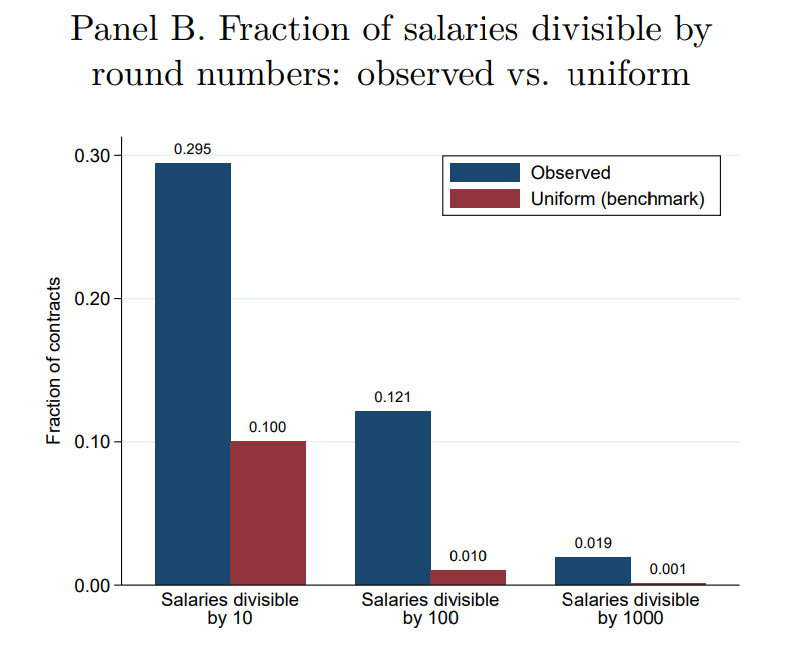
To understand what drives bunching firms to pay round-numbered salaries, the study explores several key questions:

  1.     What are the characteristics of these bunching firms? They tend to be younger, smaller, have less hiring experience, are less likely to have an HR department, and their managers have fewer years of schooling—all characteristics typically associated with less sophisticated business practices.
  2.     Do bunching firms have better market outcomes (as one might expect if the wage-setting was to exploit a worker bias)? The answer is no. These firms tend to experience worse outcomes, including higher employee turnover, lower job growth rates, and a lower survival rate.
  3.     Do bunching firms behave in “non-standard” ways in other decision-making contexts? Yes, they do. These firms also rely on coarse figures for salary increases, such as using integer percentages or round monetary values.

Understanding coarse wage-setting

These results suggest that bunching firms don’t pay round salaries to exploit a worker bias. An alternative explanation is they pay round-numbered salaries as a simple but coarse approximation because they simply don’t know what the fully-optimal salary is. Indeed, when hiring a new worker, firms face considerable uncertainty about a worker’s productivity, a key factor in determining the ideal wage.

Estimating a worker’s productivity requires answering complex questions: What are all of the possible tasks that the new hire will perform? How does each of these tasks affect the firm’s bottom line? How likely is the prospective employee to successfully accomplish each of these tasks? Answering these questions is challenging not only for occupations that involve varying and unstructured tasks—such as a neuroscientist or a physician—but even for relatively regimented jobs, such as a security guard or a truck driver.

Rather than gathering all the information needed to compute worker productivity, some firms may rely on rules of thumb or heuristics—a practice the paper calls “coarse wage-setting.” The study develops a model based on this idea and finds support for its predictions.

Implications of coarse wage-setting

The findings of this study have implications for our understanding of labor markets and economic policy. Since round-numbered wages make up a disproportionate share of all wages, understanding this phenomenon sheds light on overall firm wage-setting practices and can inform economic models. Research methods that infer parameter values from firm optimality conditions might yield biased estimates due to coarse wage-setting. Finally, coarse wage-setting can have downstream consequences for important economic outcomes, like within-firm wage inequality or wage stickiness.
Filed Under: Research Tagged With: wage setting

Gender differences in graduate degree choices affect early-career earnings

June 26, 2024 by Mark Fallak

While women are historically underrepresented in science, technology, engineering, and math (STEM) fields at the undergraduate level. A recent IZA discussion paper by Judith Delaney and Paul Devereux suggests the gap widens even further for postgraduate programs. The authors analyzed administrative data from Ireland to explore how men and women choose postgraduate programs and how those choices affect their careers.

The results reveal a significant disparity in overall postgraduate enrollment, with women 17% less likely than men to pursue further studies. This gender gap becomes even more pronounced in STEM fields. Women with similar academic backgrounds to men were found to be about 20% less likely to choose a STEM graduate program. Interestingly, the study didn’t find a significant gender difference in business and economics majors at the postgraduate level.

While men were more likely to continue in STEM fields, women gravitated towards programs in education and health. This trend suggests that even after overcoming initial hurdles in undergraduate STEM programs, women may be less likely to pursue advanced degrees in these high-earning fields. Even with similar academic performance, a gender earnings gap of 8% persists at age 33 for graduates. The choice of postgraduate program explains roughly 15% of this disparity.

Filed Under: Research Tagged With: gender gap, graduate study, higher education, STEM

Experts divided on climate risk pricing

June 14, 2024 by Mark Fallak

Financial markets shape the allocation of resources in our economy. With a rapidly unraveling climate crisis and a seemingly slow-moving economic adaptation to the challenges and risks of climate change, views on how climate risks are reflected in stock prices may have important implications for sustainable investment practices.

A recent IZA discussion paper by Rob Bauer, Katrin Gödker, Paul Smeets, and Florian Zimmermann provides new insights on expert beliefs, based on a comprehensive online survey of nearly 2,000 CFA-certified finance professionals.

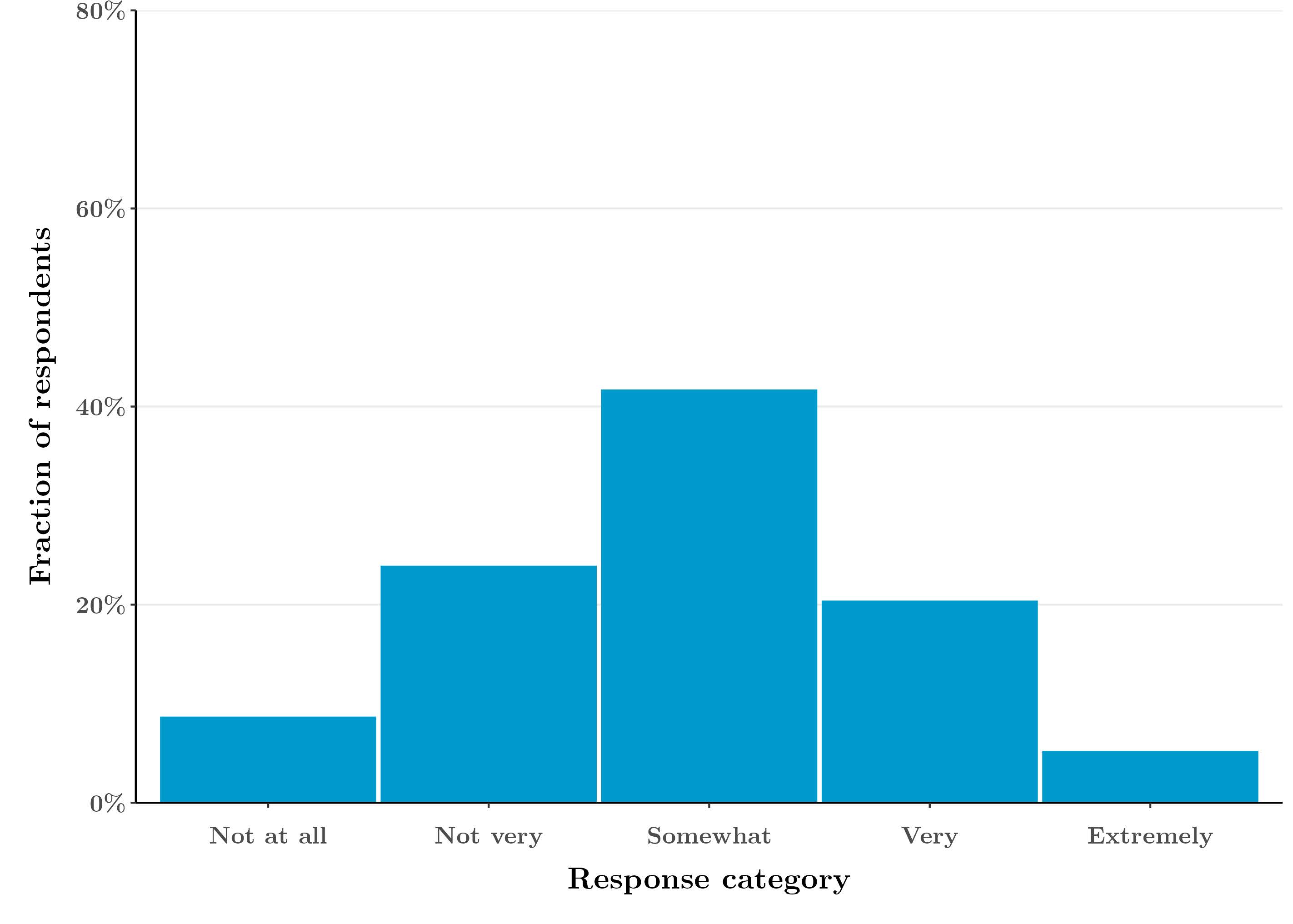
The findings reveal that the majority of financial experts (68%) believe climate risks are underpriced in the stock market, while 14% said climate risk was overpriced and only 18% found current levels adequate. However, experts are almost evenly split in their assessment of how important climate risks are for the pricing of stocks (see figure below).

Respondents’ beliefs about the importance of climate risks for the pricing of stocks

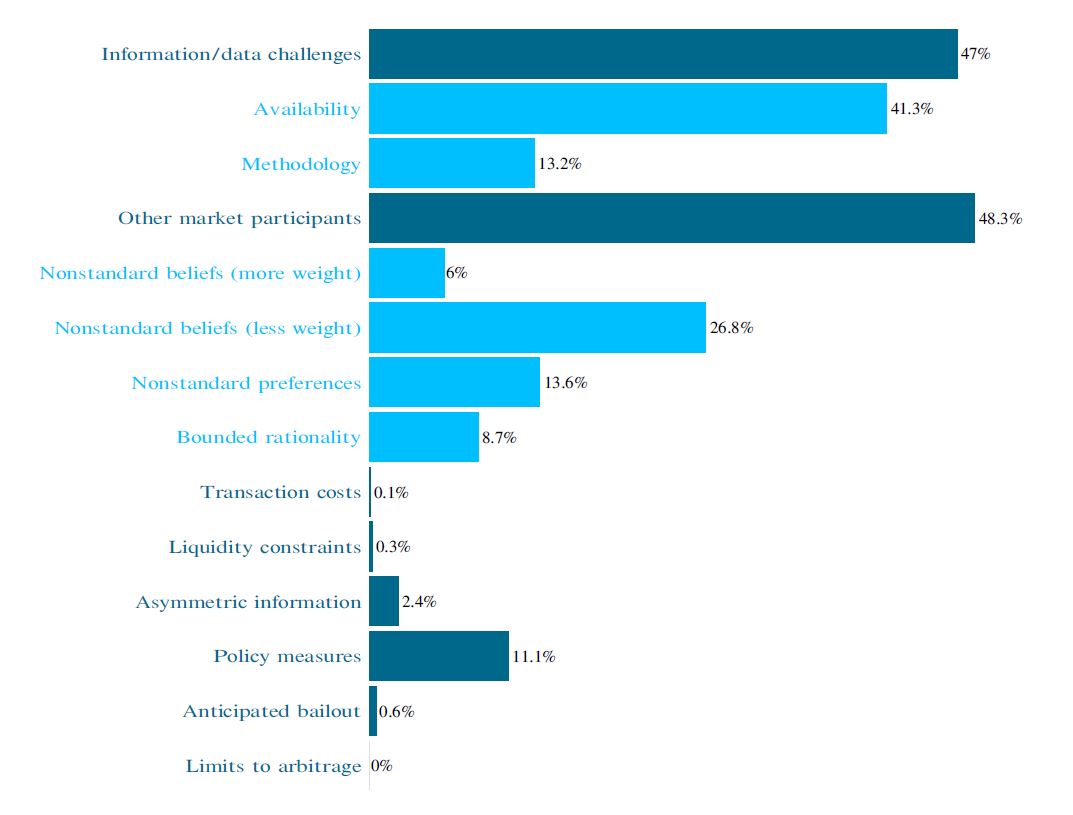
There is also significant variation in their beliefs about why mispricing of climate risks occurs and how long it will persist. The study identifies distinct mental models among the experts, which are influenced by informational constraints and second-order beliefs—how experts think other market participants perceive climate risks (see figure below).

Frequency of factors mentioned in text responses by expert survey participants

Political orientation shapes mental models among U.S. experts

The analysis shows that these mental models significantly affect experts’ return expectations for climate-focused indices, such as the MSCI World Climate Action Index. Additionally, political leanings and geographic location were found to shape these mental models. In the U.S., left-leaning experts are more likely to believe that other market participants underestimate climate risks, while right-leaning experts often think others overstate these risks.

An experimental component of the study demonstrated that altering second-order beliefs can causally change return expectations. By providing information that shifts these beliefs, the researchers observed changes in expectations for the returns of climate-conscious indices relative to general market indices.

The empirical findings of the study underscore that the market’s ability to correct the mispricing of climate risks will remain a challenge. Most experts are rather skeptical that this can be resolved in the near future.

Filed Under: Research Tagged With: beliefs, climate, mental models, risk

Work arrangements matter for the child penalty

June 11, 2024 by Mark Fallak

Newborns require significant time, often leading mothers to drastically reduce work hours. Can giving mothers more control over their work schedules mitigate this drop in labor supply and earnings (known as the “child penalty”)? And do fathers step up with childcare and housework when mothers work more?

A new IZA Discussion Paper by Ludovica Ciasullo and Martina Uccioli explores these questions. They analyze the impact of Australia’s 2009 Fair Work Act, which granted parents the right to request a change in work arrangements. Their findings? Specific work arrangements with greater control over work hours do reduce the child penalty for mothers. However, fathers did not contribute more to housework when mothers worked more.

Regular schedules more appealing than casual contracts

Before 2009, many Australian mothers opted for casual contracts (no guaranteed hours) to reduce work hours. The Fair Work Act allowed them to request reduced hours within their existing permanent contracts, maintaining a predictable schedule. This predictability was highly sought after: 70% fewer women transitioned from permanent to casual contracts after childbirth compared to before the legislation.

More hours worked, same time spent with children

The option to maintain permanent contracts led to increased work hours for mothers. In the most exposed group, the option to request this work arrangement led to an increase in labor supply by eight hours per week. This increase in work hours came at the expense of housework, but not of childcare: affected mothers spent similar amounts of time with their newborns compared to similar mothers before the legislation. This suggests mothers weren’t neglecting their children for work.

Earnings up, housework share unchanged

The law significantly impacted mothers’ labor supply and earnings. Mothers in the most exposed group increased their share of household income by eight percentage points. Yet, their relative contribution to housework and childcare remained unchanged. This suggests that relative earnings aren’t the only factor in how tasks are split within couples, highlighting the potential role of gender norms.

Filed Under: Research Tagged With: child penalty, household division of labor, mothers, work arrangements

Unequal workloads: Global gender divide in market, domestic, and care work

May 27, 2024 by Mark Fallak

A recent IZA Discussion Paper by Charles Gottlieb, Cheryl Doss, Douglas Gollin, and Markus Poschke sheds light on how women and men in various countries allocate their time across market work, domestic work, and care work. For a consistent comparison, they built a new harmonized dataset encompassing high-quality time-use data for 50 countries across the income spectrum.

Stark gender imbalances across the globe

The analysis exposes significant gender disparities in how married couples distribute these work categories. On average, women globally dedicate only half the hours to market work compared to men. However, in wealthier nations, they shoulder twice the burden of domestic and care work compared to men. This disparity becomes even starker (three to five times) in low- and middle-income countries.

Income level doesn’t tell the whole story

A particularly striking finding is the wide variation in the gender division of market and domestic work even among countries with similar income levels. Among middle-income countries like China and India, there’s a substantial discrepancy (up to a factor of three) in women’s market work hours.

Understanding the Why: A model for gendered work division

To delve into the root causes of these differences, the authors constructed a model of household time use. This model examines how factors like the gender wage gap, social norms, harassment at work or while commuting, and childcare accessibility influence the division of work between men and women.

Non-wage factors drive the wedge

Their analysis uncovers that non-wage, gender-specific factors – primarily those that discourage women’s participation in market work and men’s involvement in domestic work – account for most of the variation in work division across countries. The influence of these factors is particularly pronounced in certain countries and closely linked to measures of gender norms and gender-biased laws.

Policy implications: Focus on gender norms

Overall, the study provides compelling evidence that factors like gender norms have the most significant impact on how work is divided between genders across countries, with considerably less influence from factors like wage gaps or childcare availability. These findings offer valuable insights for policymakers aiming to create targeted interventions to achieve a more balanced work distribution or, more specifically, to promote greater female participation in market work.

Filed Under: Research Tagged With: care work, gender inequality, gender norms, home production, labor supply, time use

How associative memory influences our financial decisions

May 22, 2024 by Mark Fallak

Economic decisions are often driven by beliefs, not just cold, hard facts. People don’t simply analyze the data in front of them when forming opinions and expectations. Instead, they tap into their memory banks, drawing on relevant past knowledge and experiences. This interplay between memory and economic belief formation is the central focus of a five-year research project funded by an ERC starting grant and led by IZA Research Director Florian Zimmermann.

In a new paper now published in the Journal of Financial Economics, co-authored with Benjamin Enke and Frederik Schwerter, Zimmermann presents the first findings from this project. The research provides experimental evidence that associative memory can lead to a systematic overreaction of beliefs crucial for navigating markets. These findings challenge traditional economic models that rely on the assumption of purely rational belief formation and decision-making.

Memory and investment decisions

Our memories work by association, making it easier to recall past experiences that are similar to the contexts of current situations. In the stock market, these contexts can be positive news stories or images of rising charts. When forming investment beliefs, we rely on readily available memories, which can lead to skewed assessments. For example, a string of good news articles might trigger memories of past market booms, even if the current situation isn’t exactly the same.

Experiments reveal overreaction

The researchers conducted two experiments. The first analyzed how associative memory impacts how we evaluate companies. Participants received information about hypothetical companies over two time periods. Their opinions about the companies were more heavily influenced by news that resembled information they received earlier, suggesting associative recall plays a role in overreactions to real-world financial news.

The second experiment, a controlled betting market, showed that this distorted perception translates to market behavior. Prices reacted much more strongly to positive or negative news when these news remind people of similar news from the past.

Beyond rationality

These findings provide evidence for the significant role associative memory plays in shaping economic beliefs and decisions. While real-world decision-making is complex, this research sheds light on the psychological foundations that shape how we react to information and how this reaction can influence market outcomes.

Filed Under: Research Tagged With: beliefs, decision making, memory, rationality

Most Ukrainian refugees plan to return

May 15, 2024 by Mark Fallak

Russia’s full-scale invasion of Ukraine on February 24, 2022, triggered the largest refugee crisis in Europe since World War II. Over 4 million Ukrainians currently reside in the European Union with temporary protection status. A new IZA Discussion Paper by Joop Adema, Cevat Giray Aksoy, Yvonne Giesing, and Panu Poutvaara examines their return plans, actual return experiences, and integration outcomes during the war.

Unique panel survey of refugees

In June 2022, the authors partnered with the survey company Verian (formerly Kantar Public) to launch a Europe-wide survey of Ukrainian refugees. Respondents are repeatedly asked about their current location, return plans, and integration experiences. These answers are linked to geocoded data on conflict intensity in their home municipalities. This approach allows the researchers to estimate the causal effect of local conflict on actual return, return plans, and integration outcomes.

Most Ukrainians plan to return home

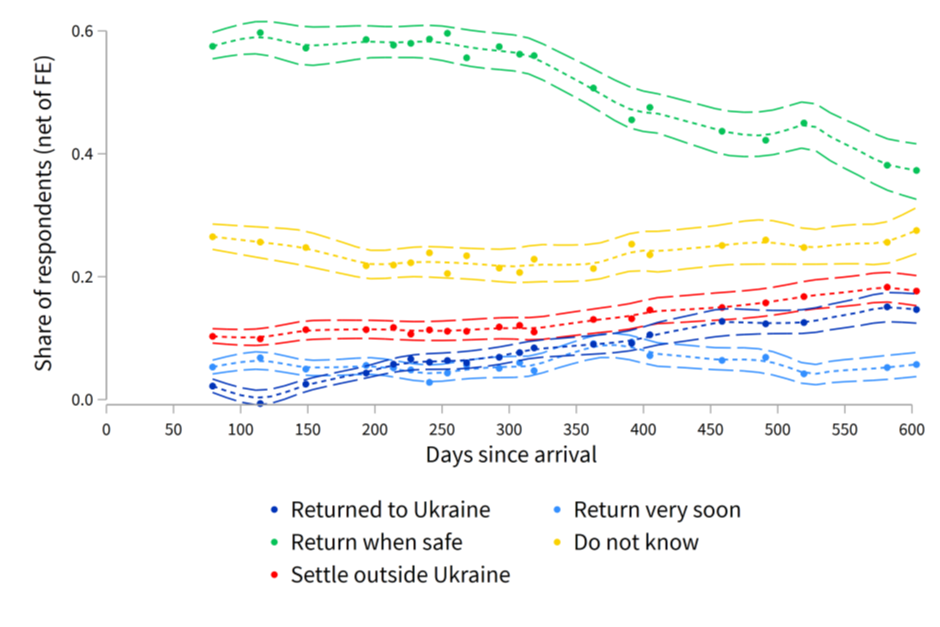
In the first wave of the survey conducted in 2022, roughly two-thirds of Ukrainian refugees expressed an intention to return either soon or when conditions became safe. Only one in ten planned to settle permanently abroad. Return plans strongly predicted actual return: one-third of those who initially intended to return soon had done so by the follow-up interview. Conversely, none of those who planned to settle permanently outside Ukraine had returned. This is calculated over the average period of 268 days between the first and last interviews. The following figure illustrates the change in return intentions and actual return rates of participants over time since arriving in host countries. The average return rate to Ukraine is 2.7 percentage points per 100 days. The average net increase in planning to settle outside Ukraine is 1.6 percentage points per 100 days.

Liberation of home district increases return

Approximately 8 percent of respondents originated from districts liberated by Ukraine between their initial and follow-up interviews. Liberation of the home district increased the probability of returning to Ukraine by 5 percentage points.

Local fighting reduces return to hometown but not overall return

A higher intensity of local conflict in the home municipality reduces the likelihood of returning there specifically, but not to Ukraine overall. However, it does slightly increase the probability of starting to plan for permanent settlement outside Ukraine.

The effect of war expectations

Ukrainians’ war expectations have become more pessimistic over time. Between September 2022 and January 2023, 71 percent of participants expected the war to end with Ukraine liberating all occupied territories by the end of 2024. This share dropped to 36 percent by October-November 2023. Notably, the proportion of respondents who have either returned to Ukraine or plan to do so has decreased considerably less, from 66 percent to 54 percent. At the individual level, more pessimistic war expectations predict a 5 percentage point higher probability of starting to plan to settle outside Ukraine.

Integration outcomes

Local conflict intensity, liberation of the home district, and more pessimistic war expectations do not have a statistically significant effect on the likelihood of working in the host country. Liberation of the home district slightly reduces the probability of being in training, which aligns with the idea that higher return intentions decrease investment in host-country specific training.

Implications

The success of post-war reconstruction and development efforts in Ukraine will critically depend on the quantity and quality of available human capital. The Ukrainian population had already been declining even before the Russian invasion. Furthermore, widespread corruption and low confidence in the judiciary – underscored by Ukraine’s ranking of 104th out of 180 countries in the 2023 Corruption Perceptions Index – act as deterrents to return migration. A critical challenge for Ukraine will be to leverage the sense of national unity fostered by the war to drive broader institutional and cultural reforms. By addressing these challenges, Ukraine can enhance the appeal of returning for refugees and effectively utilize their human capital in the post-war rebuilding process.

Filed Under: Research Tagged With: conflict, integration, migration, refugees, return migration, Ukraine

AI capital boosts employment prospects for economics graduates

May 6, 2024 by Mark Fallak

As artificial intelligence (AI) transforms the labor market, new skills are becoming increasingly important for job seekers. A recent IZA discussion paper by Nick Drydakis investigates how incorporating AI education into an economics student’s skillset can boost their employability in the UK.

The study introduces the concept of “AI Capital,” encompassing the knowledge, skills, and potential productivity gains from understanding AI. To assess the impact of AI capital, Drydakis conducted a controlled experiment. He sent out real CVs of four economics students (two male, two female) to over 1,300 private sector firms for entry-level positions. All students were from the same university year with similar backgrounds. The key difference? Only one applicant in each pair had taken an “AI in Business” module, highlighted on their cover letter.

The results are compelling. Candidates with AI capital had a 22.7 percentage points higher chance of landing a job interview than their counterparts. This effect was even stronger for larger firms (35.9% advantage), suggesting their greater focus on AI implementation. Additionally, students with AI skills were invited to interviews for higher-paying jobs, with an estimated 10.5% salary premium.

While specific to the UK and a particular sector, this study highlights the significant advantage AI knowledge can give job seekers, particularly in economics.

Filed Under: Research Tagged With: artificial intelligence, employment prospects, higher education, human capital, job applications

Frontier technologies are likely to accelerate the de-routinization of work

April 12, 2024 by Mark Fallak

The rapid evolution of new technologies, particularly artificial intelligence (AI), has sparked questions about whether these emerging frontier technologies might increasingly substitute employees performing complex tasks. In contrast to such fears, a new IZA discussion paper by Melanie Arntz, Sabrina Genz, Terry Gregory, Florian Lehmer and Ulrich Zierahn-Weilage finds evidence of a deepening de-routinization along with an increase in between-firm inequality.

To examine how the diffusion of new technologies at the firm level contributes to aggregate occupational changes, the authors collect novel firm-level data on the actual adoption of frontier technologies and link this to administrative data records from the German Federal Employment Agency. A key advantage of the data: it allows distinguishing between non-adopters, digital adopters, and frontier adopters.

Strong de-routinization of the German workforce between 2011 and 2016

The study starts by documenting a substantial decline in routine cognitive and manual jobs by about 2.4 percentage points among the German workforce from 2011 to 2016. The data further shows that the share of routine occupations fell the most in firms adopting frontier technologies, followed by those adopting digital technologies.

Based on a decomposition approach, the authors are able to show how the inequality between firms within the group of frontier adopters explains their contribution to overall de-routinization. The key insight: the adoption of frontier technology does not lead to a widespread replacement of routine jobs within firms. Rather, only a subset of larger firms is responsible for the de-routinization among frontier adopters.

Adoption in frontier technologies in larger firms boosts de-routinization

Delving deeper into the mechanisms behind the findings, the authors reveal that the aggregate decline in the routine employment share among workers employed at frontier adopters occurs because initially larger frontier adopters reduce their routine employment share in contrast to smaller frontier adopters (the authors call this the “scale effect”). The mechanisms are explained with differences in how firms adopt frontier technologies, reflected in changing skill demands and training needs.

Frontier adopters with larger non-routine cognitive shares grow faster

As an additional reason, the authors demonstrate that initially less routine-intensive firms experience stronger employment growth (“composition effect”). In other words, firms that already have a higher share of non-routine cognitive workers are better positioned to gain benefits from technology adoption and thus grow faster. Altogether, the study indicates that the routine-replacing effect of frontier technologies hinges on having the right skills – either from the start or by investing in upskilling the workforce.

Filed Under: Research Tagged With: automation, capital-labor substitution, decomposition, tasks, technology

Major replication project re-analyzes over 100 economics and political science articles

April 10, 2024 by Mark Fallak

Replication and reproduction of research findings are crucial for scientific progress. These processes allow the scientific community to assess the reliability of research outcomes, fostering a self-correcting mechanism and informing policy decisions.

A new IZA discussion paper by Abel Brodeur and over 350 coauthors investigates the reproducibility of findings in leading economics and political science journals (2022-onwards). The study computationally reproduces and conducts sensitivity analyses for 110 articles. Small teams of “replicators” – PhD students, postdoctoral fellows, faculty, and researchers with PhDs – collaborated on analyzing individual studies. Each team computationally reproduced the results, identified coding errors, conducted sensitivity analysis, and wrote a report shared with the original authors.

High rate of reproducible results, but many coding errors

The study finds a high rate (over 85%) of fully computationally reproducible results. This means the provided code by the original authors can be run and produce the same numerical results reported in their articles. This is likely due to data and code availability policies enforced by the journals, which often include a data editor.

However, having fully reproducible results does not guarantee the absence of coding errors. Excluding minor issues, the study identified coding errors in about 25% of studies. While not all errors affect the final conclusions, some major ones were found, including a large number of duplicated observations, incomplete interaction in difference-in-differences regressions, miscoding of the treatment variable, and model misspecification.

Are the results robust?

Replicators conducted 5,511 re-analyses, involving changes to the weighting scheme, control variables, estimation methods, or using new data.

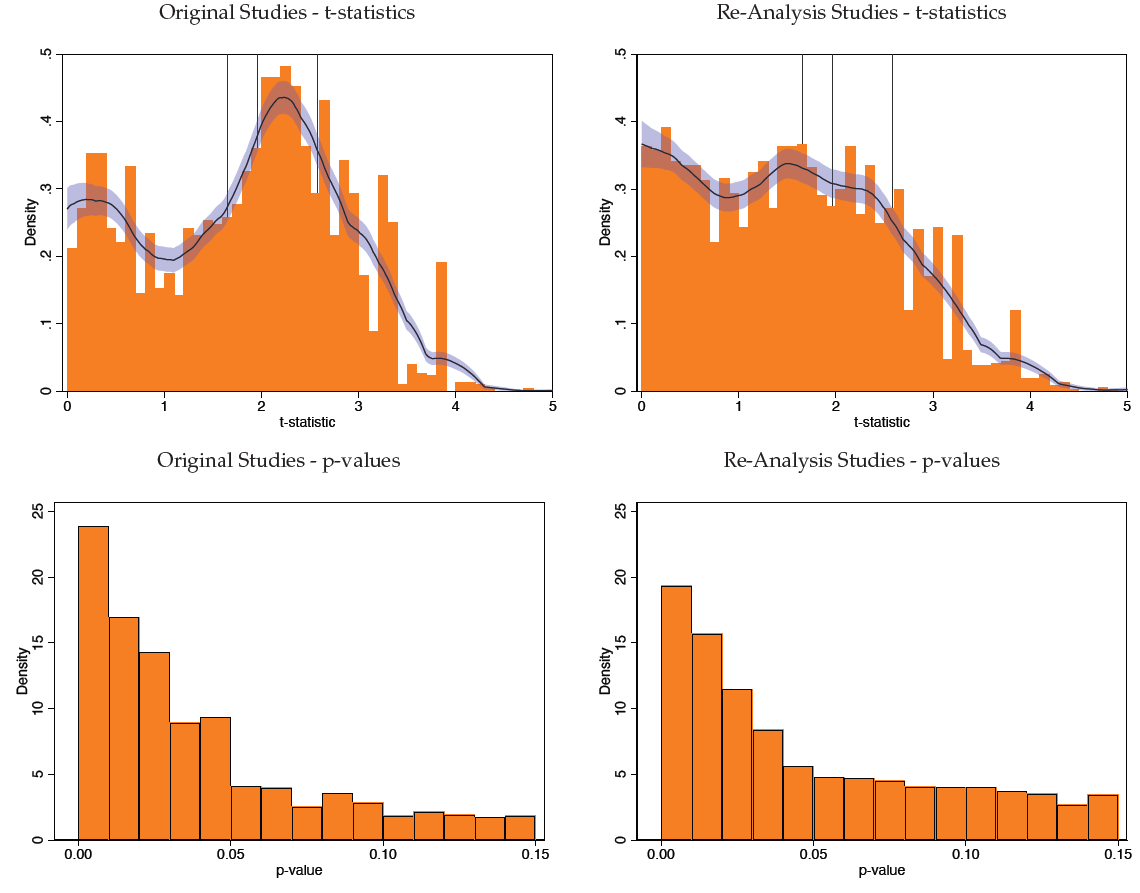
A visual analysis of the test statistics distribution (see figure below) shows a large shift in the mass of test statistics from the just statistically significant at the 5% level region to the statistically insignificant and 10% significance regions after re-analysis. This suggests re-analyses decrease the statistical significance of many originally published test statistics.

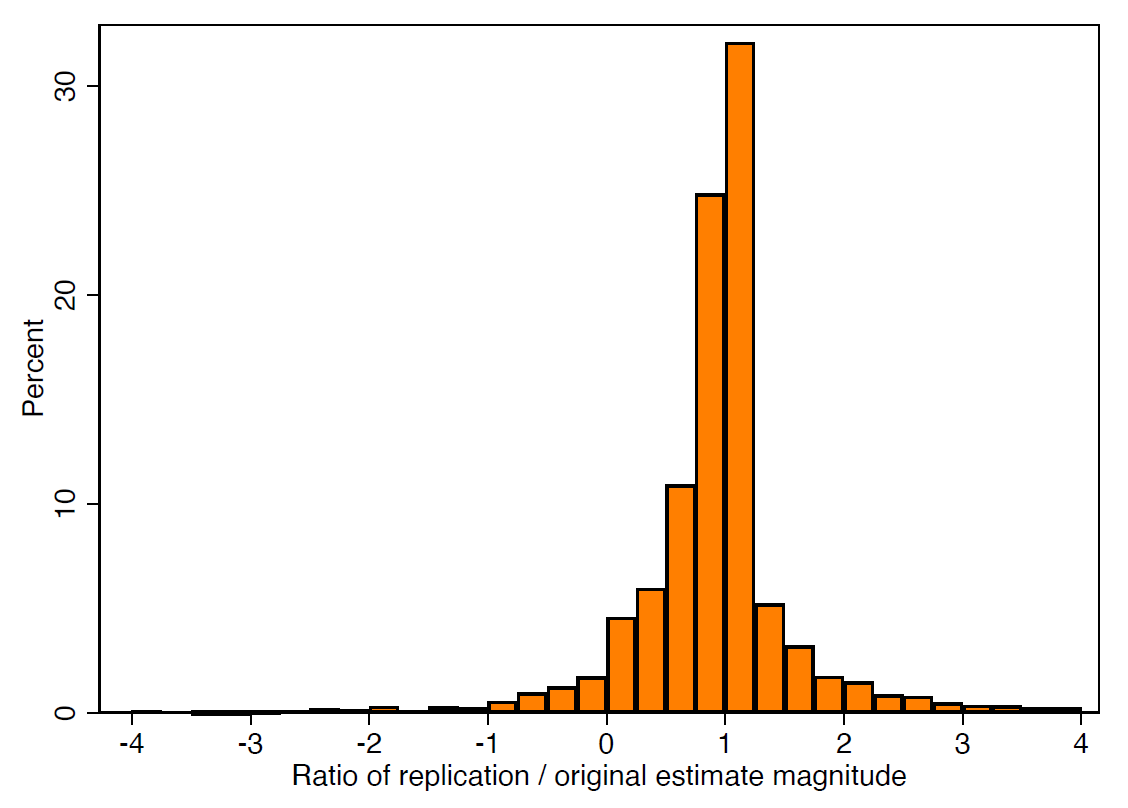
In terms of relative effect size, most re-analyses cluster around one, with about 17% being smaller or equal to 0.5. Around half report a ratio greater than one, suggesting potential conservatism from the original authors.

The study defines robustness reproducibility as having the same sign and remaining significant at the 5% level after re-analyses. Using this definition, a robustness reproducibility of about 70% is found. Additionally, half of original point estimates significant at the 10% level (but insignificant at the 5% level) become statistically insignificant at the 10% threshold with the replicators’ robustness checks. For original estimates significant at the 5% level (but insignificant at the 1% level), over a quarter of re-analyses become insignificant at the 10% threshold.

Which robustness checks matter more?

The study’s robustness checks can be broadly categorized into eight groups. Robustness reproducibility rates were found to be lower when replicators changed the dependent variable (45%) and the sample (64%), while introducing new data yielded the highest rates (87%). The remaining categories, including changing control variables, estimation methods, inference methods, main independent variable, or weighting scheme, offered robustness rates around 75%.

Barriers to reproducibility

The lack of raw data significantly restricted replicators’ abilities across all analysis categories. Raw data limitations hindered robustness checks for 19% of teams and re-coding key variables for 18%. Additionally, 12% and 13% of teams believed the lack of raw data impeded their ability to perform replications and extensions, respectively. Furthermore, 7% of teams felt the original paper was unclear to the point of hindering robustness checks.

Conclusion

The large scale of this ongoing project has the potential to influence research norms and researcher behavior by promoting more rigorous methodologies and discouraging questionable research practices.

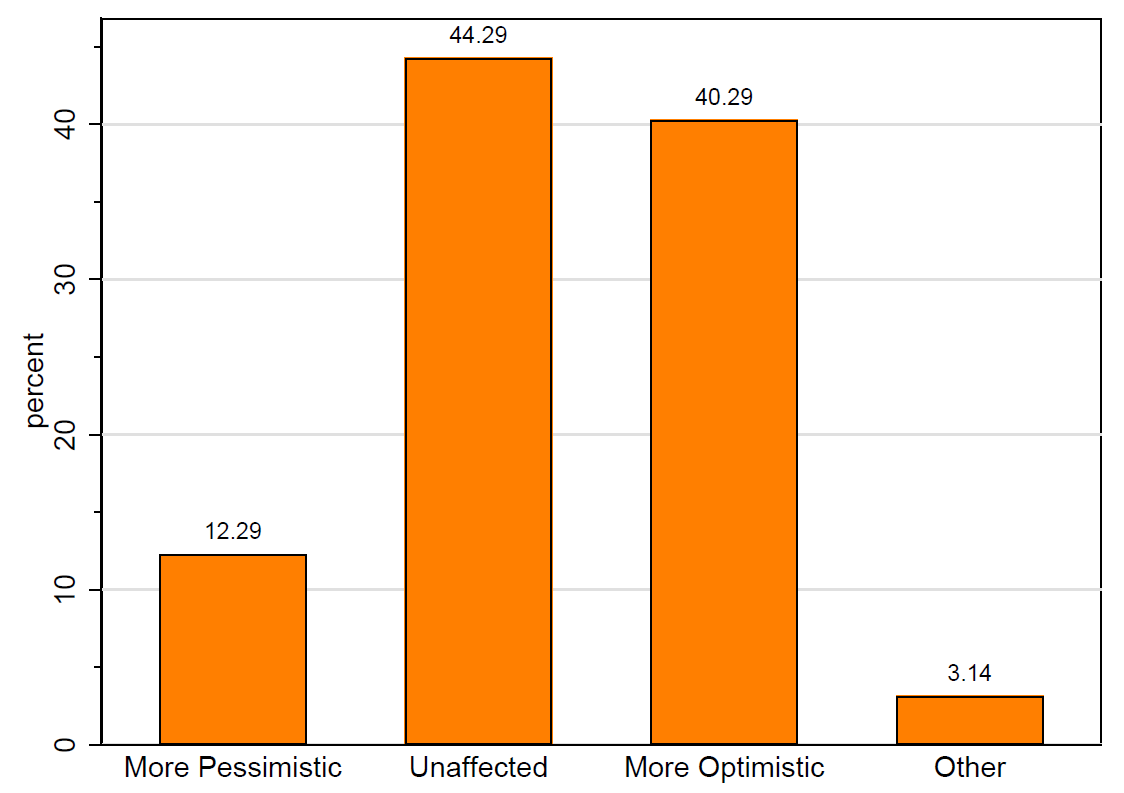
On a positive note, over 40% of replicators reported a more optimistic view of the discipline due to the quality of the replication packages they reproduced.

Filed Under: Research Tagged With: open science, replication, research transparency

  • Previous Page
  • Page 1
  • …
  • Page 5
  • Page 6
  • Page 7
  • Page 8
  • Page 9
  • …
  • Page 69
  • Next Page

Primary Sidebar

© 2013–2025 Deutsche Post STIFTUNGImprint | Privacy PolicyIZA