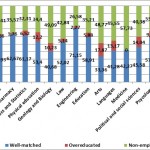
Nobel laureate Chris Pissarides suggests that in times of recession it’s good for young people to acquire more education. Nonetheless, this remedy may be risky if later on young people find a job for which they are overeducated or overskilled. A new IZA Discussion Paper by Floro Ernesto Caroleo and Francesco Pastore provides the first available evidence based on AlmaLaurea graduates in Italy that for a large number of them the educational mismatch is not a transitory phenomenon: as shown in the figure (click to enlarge), five years after graduation 11.4% and 8% of graduates still experience overeducation and overskilling, respectively. Most arts degrees and social sciences, but also Geology, Biology and Psychology are associated with both types of mismatch. Moreover, the non-employment share is dramatically high for most degrees, with an average of 40%. It ranges between a minimum of 27% in the case of Engineering and a maximum of about 50% in the case of Geology and Biology.
Why are so many graduates non-employed or overeducated/overskilled? The main factor is certainly the low demand for skills typical of the Italian economy, still largely based on traditional manufacturing and services. Nonetheless, keeping constant the level of demand, is there any unexploited component of it which could be reactivated intervening on the supply side? A recent strand of the literature tends to see overeducation/overskilling as consistent with, rather than in contrast to the human capital theory. In other words, overeducation would not be a signal of excess schooling, but rather of a lack of the work-related component of human capital, which makes it hard for firms to employ young graduates. Alternatively, overeducation could be consistent with the job competition model or of the strong competition for jobs in presence of a constant demand for skills that leads graduates to accumulate more and more education to an extent that is in some cases more than that requested to get a job.
Overall, the evidence provided in the paper is consistent with the hypothesis of a low demand for skills typical of the job competition explanations. Nonetheless, overeducation/overskilling is clearly strongly associated also with a very low quality of human capital, while being reduced by curricula including some work related skills. In other words, while increasing in the educational dimension, the human capital of Italian graduates does not sufficiently develop in terms of the competences which are directly requested in the labor market. In turn, this tends to reduce the ability of graduates to access high quality jobs and might hence suggest that there is a potential demand for job specific competences in the labor market which remains unexploited. Some injection of the German dual principle might hence be useful to reduce the educational mismatch.
 Despite increasing female labor market participation, gender differences in labor market outcomes persist: men earn more, have better employment perspectives and better access to top positions. One explanation for the persisting gender gap is that women are more reluctant to engage in competition. A new IZA discussion paper by
  The Toll Index for the month of November is just out (download the data from the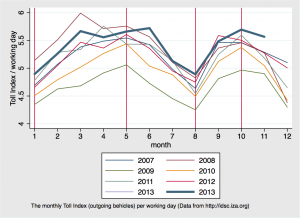
 While more and more women with children work in OECD countries, less than a half of them have a full-time position, which has negative consequences on future career opportunities. In the public debate, after-school child care facilities are seen as one key element to help women with children to increase their working hours. Yet, it is still unclear whether the availability of after-school care really stimulates the employment of mothers. Similarly, it is unknown how fathers’ employment reacts to an increase in the provision of supplementary school care. A new IZA discussion paper by
  Does adoption of broadband internet in firms enhance labor productivity and increase wages? And is this technological change more beneficial for for high-skilled workers? A new IZA discussion paper by
  The bride price payment is a key element of the marriage contract in many sub-Saharan African countries, and particularly in Senegal. Contrary to a dowry payment, where the bride and her family give the marriage payment to the groom and his family, a bride price payment is defi
ned as the money or wealth transfer given by or on behalf of the groom to the bride and her family upon the marriage of the couple. Such a bride price system raises several concerns related to the economics of the marriage market, gender empowerment and intra-household bargaining power.
The bride price payment is a key element of the marriage contract in many sub-Saharan African countries, and particularly in Senegal. Contrary to a dowry payment, where the bride and her family give the marriage payment to the groom and his family, a bride price payment is defi
ned as the money or wealth transfer given by or on behalf of the groom to the bride and her family upon the marriage of the couple. Such a bride price system raises several concerns related to the economics of the marriage market, gender empowerment and intra-household bargaining power. Several empirical studies have attempted to assess whether private schools provide better education than public schools. This question is crucial both for educational policy and parents’ school choice. Advocates of school competition often base their arguments on evidence suggesting positive effects of private schooling on educational outcomes. Indeed many studies have demonstrated a positive correlation between Catholic school attendance, which account for the largest share of private schools, and educational outcomes. Yet, a causal interpretation of this relationship is only valid if there are no other unobserved characteristics, such as student ability, that affect school choice and educational outcomes.
 In Italy, as in many other European countries, apprenticeships and on-the-job training have been gaining popularity. Although being only of temporary nature and exhibiting a relatively low level of employment protection, apprenticeships are widely believed to be a successful form of employment as they may eventually lead to permanent contracts. A new IZA discussion paper by
  Does playing sports or going to the gym help your career? In a new IZA discussion paper,