• Skip to primary navigation
  • Skip to content
  • Skip to primary sidebar

IZA Newsroom

IZA – Institute of Labor Economics

  • Home
  • Archive
  • Press Lounge
  • DE
  • EN

Mark Fallak

IZA 25th anniversary event in Berlin

July 7, 2023 by Mark Fallak

On July 5 and 6, IZA celebrated its 25th anniversary with a research conference and policy panel featuring Hubertus Heil (German Federal Minister of Labor and Social Affairs), Monika Schnitzer (Chair of the German Council of Economic Experts), Uta Schönberg (University College London) and Jason Furman (Harvard Kennedy School), moderated by Christian Odendahl (The Economist). The panelists discussed such issues as the consequences of past labor market reforms and the future of the welfare state in Germany, the need for a comprehensive strategy to alleviate the labor market impact of demographic change, as well as the ramifications of digitalization and AI for occupational profiles and skills demand.

Opened by IZA Director Simon Jäger, the research conference (see full program) comprised presentations by 15 scholars and a poster session covering the full range of modern labor economics research. Keynote speeches were given by Aysegül Sahin (University of Texas at Austin) on new insights into the dual U.S. labor market, and by Patrick Kline (University of California, Berkeley) on an innovative grading scheme for hiring discrimination.

 
(pictured left to right: Simon Jäger, Aysegül Sahin, Patrick Kline)

For more impressions of this fantastic event, see also a photo gallery with all speakers and lively informal discussions among participants during the breaks, as well as a video recording of the policy panel (mostly in German):

As a prelude to the anniversary celebration, the annual IZA Summer School in Labor Economics took place on the outskirts of Berlin, giving about 25 participants from around the world the opportunity to take part in lectures, student presentations and discussions on current issues in labor economics:

All in all, this memorable week offered a glimpse of future cutting-edge labor market research and evidence-based policy advice to come from IZA in the next 25 years.

Filed Under: IZA News

What drives high self-employment in poor countries?

July 1, 2023 by Mark Fallak

Labor markets in poor countries differ fundamentally from those in richer ones. A central distinguishing feature consists in their very low levels of wage employment, and high self-employment. For instance, in countries with GDP per capita below $5,000 (in 2017 int. $), the average urban self-employment rate is 45%, which exceeds the average wage employment rate of only 43%. The discrepancy is even larger in rural areas. In the United States, in contrast, wage and salary workers account for about 85% of the labor force, and own-account workers make up only about 5% of employment.

Because of these stark differences, the creation of wage jobs has been identified as a key development challenge, and the wage employment rate is part of the United Nations Millennium Development Goals. But why is wage employment so low, and self-employment so high, in developing countries?

Most existing work on the topic has focused on factors related to self-employment, like the ease of entry or lack of regulation. In a new IZA discussion paper, Markus Poschke proposes a different channel: the study links the high self-employment rate in poor countries to the functioning of labor markets. This connection is motivated by two new facts shown in the study: (1) Although the unemployment rate is not higher in poor countries, this is entirely due to their high levels of self-employment. Relative to wage employment, unemployment is significantly higher in poor countries, implying that wage jobs are either harder to find or likely to last less long. (2) On top of this, self-employment is generally higher in countries with high unemployment relative to wage employment.

Self-employment as the lesser evil?

These patterns suggest a simple mechanism: when wage employment jobs are less attractive or harder to find, the unemployed may opt for self-employment instead – even if self-employment per se is not very attractive either.

Because a direct empirical investigation of this mechanism is elusive, the study evaluates its  importance by developing a new model and combining it with new data on labor market flows across countries. This new data set, which has just recently been assembled by Kevin Donovan, Will Lu and Todd Schoellman, comprehensively reports how many individuals move between wage employment, unemployment and self-employment every quarter in 37 countries spanning a wide range of income per capita. The countries covered include Brazil, Mexico, France, South Africa and the United States.

The new model builds on canonical models of “search” in the labor market, which analyze individual choices about labor market states, like job search, job to job moves etc., in response to fundamental characteristics of the economy, like the volatility of jobs and the difficulty of finding them. It extends existing models by also considering self-employment. As a result, the new model can account for all movements among wage employment, unemployment and self-employment in the 37 countries in the data set. Integrating self-employment into the model is essential for understanding labor markets in poor countries, where self-employment is much more prevalent than unemployment.

Frequent labor market shocks

The unemployed in the model face a choice: should they opt for job search or become self-employed? How many of them enter self-employment naturally depends on the characteristics of each economy. Once the model has been estimated for 37 countries, it turns out that a particularly important such characteristic are shocks to firms. Where shocks are more frequent, there is a greater risk that a job will end. This is why such shocks are an important determinant of the unemployment rate, as is well known from the existing literature.

The new study finds an important additional effect: on average, greater shocks raise the self-employment rate just as much as the unemployment rate, since they make job search less attractive compared to self-employment. This effect is particularly strong in countries where self-employment is already high for other reasons, like lower costs of entry, or lower regulation or taxation of the self-employed compared to employers.

In a comparative analysis, the study also sheds light on factors contributing to differences in unemployment and self-employment rates across countries. Countries with high self-employment and high unemployment relative to wage employment (like many poor countries) mostly exhibit cheap self-employment entry, frequent shocks to jobs, and greater difficulty in determining whether a worker and a job are a good fit (screening).

Negative effect on output

This analysis thus shows that the forces governing job creation and destruction, like the difficulty of hiring and shocks to jobs, also affect self-employment – and may even affect it more strongly than the unemployment rate. In addition, they affect overall income in an economy: where jobs are less attractive, individuals are willing to pursue self-employment opportunities that would not be worthwhile elsewhere. As a consequence, output declines by much more than indicated by the change in unemployment alone.

The study highlights the interdependence of different labor market states for understanding any of them. In particular, it is impossible to understand high rates of self-employment in poor countries in isolation, since they are an outcome of the broader situation in the labor market.

Filed Under: Research Tagged With: Developing Countries, labor market frictions, occupational choice, productivity, self-employment, unemployment, wage employment

Why upward mobility from poverty is particularly low in the United States

June 28, 2023 by Mark Fallak

Poor children are more likely to become poor adults, but less so in some countries compared to others. A new IZA discussion paper by Zachary Parolin, Rafael Pintro Schmitt, Gøsta Esping-Andersen and Peter Fallesen investigates cross-national differences in how experiencing poverty as a child leads to higher likelihood of poverty in adulthood.

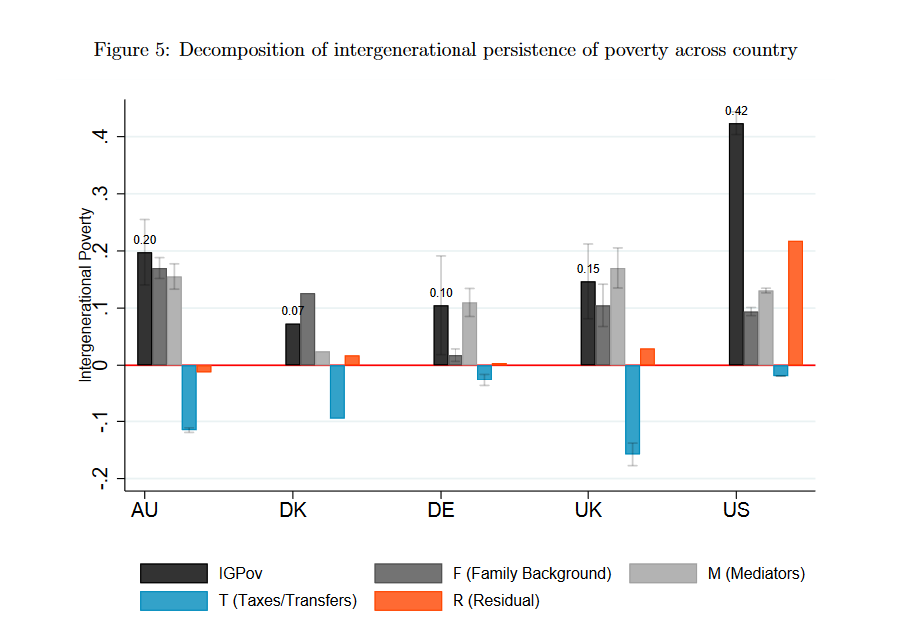
Comparing the U.S., UK, Australia, Germany, and Denmark, the authors find that intergenerational poverty in the U.S. is four times stronger than in Denmark and Germany, and twice as strong as in Australia and the UK. Specifically, spending one’s entire childhood in poverty in the U.S. is associated with a 42 percentage point increase in the mean poverty rate in early adulthood (ages 25 to 35).

Note: The black, labeled bar plots the intergenerational persistence of poverty (IGPov). The subsequent bars plot the contributions of the four sub-components. See the paper for more details.

The comparatively high poverty persistence in the U.S. is not channeled through characteristics of the families in which poor children grew up, differential access to higher education, neighborhood effects, or racial/ethnic discrimination. Instead, the American welfare state does less than peer countries to reduce the disadvantages of having lower education or being jobless in adulthood.

The study’s authors emphasize the significant implications for promoting upward mobility from poverty. They contend that if the U.S. were to adopt a more generous welfare state approach akin to that of the United Kingdom, the persistence of intergenerational poverty could decrease by over one-third.

Filed Under: Research Tagged With: poverty, social mobility

How wildfires affect labor income

June 16, 2023 by Mark Fallak

Recent media coverage of air pollution in New York City resulting from wildfires in Canada has heightened awareness of the detrimental impact that drifting wildfire smoke can have on populations located far from the actual fires. In a 2022 IZA discussion paper (forthcoming in the Review of Economics and Statistics), researchers have quantified this effect, estimating the associated welfare cost of income losses attributable to exposure to air pollution.

Approximately 20 percent of the fine particulate matter emitted in the United States is caused by wildfires. The impact of ambient air pollution on human well-being has been well-documented, particularly in terms of health, such as increased hospital visits and premature mortality among children and the elderly. But air pollution exposure can also reduce adult labor supply and productivity. This can occur through health-related impacts or by causing individuals to undertake costly avoidance or defensive actions. Survey research on wildfire smoke specifically has revealed various behavioral responses, including spending more time indoors and missing work.

Challenges in measuring the causal effect

Measuring the causal effect of air pollution on nationwide labor market outcomes presents a key challenge. It requires identifying geographically widespread pollution fluctuations that are not driven by factors directly affecting economic activity. For example, the establishment of a new factory may create jobs but also worsen air quality. Simply comparing employment and air pollution before and after the factory’s construction would likely underestimate the negative effects of air pollution on labor market outcomes.

The study by Mark Borgschulte, David Molitor and Eric Zou argues that wildfire smoke traveling thousands of miles serves as exogenous variation in local air pollution, meaning it is unconnected to local economic factors such as industry and regulations. This allows them to estimate the causal effect of wildfire smoke and air pollution on income and employment.

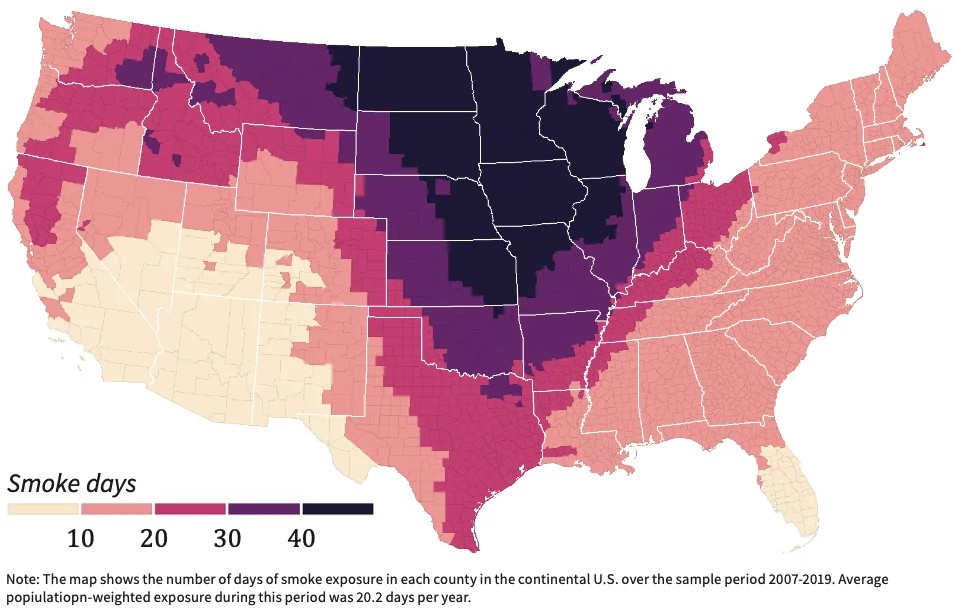
The analysis relies on three primary data sources from 2007 to 2019: high-resolution remote sensing data from satellites showing the locations of wildfire smoke plumes in the United States, air quality data from ground-level pollution monitors, and labor market data for all counties in the continental United States.

Decrease by nearly 2 percent of annual labor income

The study demonstrates that exposure to wildfire smoke leads to statistically and economically significant losses in labor income and employment. The authors estimate that each day of smoke reduces quarterly per capita earnings by $5.2, or approximately 0.10 percent. Multiplying this effect by the average number of smoke days each year, they calculate that wildfire smoke decreases earnings by nearly 2 percent of the annual U.S. labor income (equivalent to $125 billion in 2018 dollars) on average between 2007 and 2019.

The impact of smoke is more pronounced among older workers, suggesting that age and related poor health may amplify the negative labor market effects of air pollution. An additional day of smoke exposure reduces employment by 80 employees per million residents aged 16 and older, which explains 13% of the total earnings effect of smoke exposure.

The study’s examination of plausibly exogenous variation in wildfire smoke exposure provides one of the first national estimates of the causal effect of ambient air pollution exposure on labor market outcomes. The baseline estimates suggest that a 1 µg/m3 increase in quarterly ground-level fine particulate matter concentrations reduces per capita earnings in the quarter by $103 and employment by 1,750 workers per million residents aged 16 and older.

Regulation should also take labor market costs into account

Notably, the pollution variation studied in this paper primarily falls below the regulatory standards set by the Environmental Protection Agency. However, the findings indicate that such pollution may significantly reduce labor market earnings. Failure to consider labor market costs may result in inefficient pollution standards and regulations, the authors argue.

Their paper contributes to the growing body of evidence on the effects of climate change, particularly increasing heat exposure, on labor market outcomes. For instance, an earlier IZA dscussion paper demonstrated that rising temperatures in California have increased the occurrence of workplace injuries.

Filed Under: Research Tagged With: air pollution, climate change, labor income, wildfires

Did the minimum wage in Germany improve allocative efficiency?

June 12, 2023 by Mark Fallak

Accompanied by intense public and academic debates, Germany introduced a national minimum wage 2015. Initially set at EUR 8.50 per hour, the minimum wage had a substantial impact on the wage distribution. As it was implemented during a period of sustained economic growth, the minimum wage did not result in significant job losses but rather led to a redistribution of employment towards higher-paying firms.

Is the burden of the minimum wage then borne by employers or consumers? Or do productivity gains offset the costs associated with the minimum wage? If employers cannot pass on the costs to their customers, their profits may decline, and economic rents may be lost. However, if the minimum wage stimulates productivity improvements within affected firms, any negative effects on workers, employers, or consumers can be mitigated or even turned into positive outcomes. A new IZA discussion paper by IWH researchers Mirja Hälbig, Matthias Mertens and Steffen Müller examines these questions of productivity and price adjustments.

Beyond the firm level, little is known about the overall impact of the minimum wage on market-level productivity. Aggregate productivity changes may arise from employment reallocation between firms with varying levels of productivity, potentially coupled with asymmetric productivity changes based on initial size or productivity level. Despite extensive minimum-wage research, no studies have analyzed the aggregate productivity effects of the minimum wage using microdata on firm productivity. A prominent previous study reports that employment reallocation occurred towards firms with higher predicted initial productivity, leading to improved allocative efficiency. However, direct observation of productivity remains elusive.

Productivity responses to the minimum wage are often overlooked

The new study reveals robust positive effects on wages per full-time equivalent (FTE) worker in both the manufacturing and service sectors. Accompanied by minor negative effects on employment in these industries, the total wage bill has increased. Notably, the impact on labor productivity (measured as value added per FTE) is even more substantial, with labor productivity effects of 5.6% and 10.6% observed in the manufacturing and service sectors, respectively.

These significant productivity improvements in affected firms have likely mitigated any adjustments in employment and output prices. Thus, understanding why the introduction of the German minimum wage has had minimal employment effects at the macro level relies heavily on comprehending these productivity enhancements.

It is worth noting that economists who anticipated substantial negative effects of the German minimum wage largely overlooked the potential productivity responses. Importantly, half of the strong difference-in-difference effect observed in the service sector can be attributed to a sudden reduction in labor productivity within the control group, suggesting that the labor inflow induced by the minimum wage resulted in a decline in average productivity for those firms.

Labor productivity can be boosted by gains in total factor productivity (TFP) or increased reliance on non-labor inputs. The authors do not find any effects of the minimum wage on investments per FTE. However, they observed that affected firms, compared to those in the control group, became more reliant on intermediate inputs. This increased outsourcing may partly explain the rise in productivity.

The detailed firm-product-level data for the manufacturing sector reveals that the direct effect of the minimum wage on firms’ revenue TFP (TFPR) amounts to 3.1%, while quantity TFP (TFPQ) increased by an additional 2.2% in the treated group compared to the control group. Consequently, output prices rose approximately 1% more in the treatment group. Taking price effects into account, the researchers conclude that firm-level labor productivity gains are primarily driven by improvements in true efficiency (TFPQ).

No evidence of increased allocative efficiency

With these firm-level findings established, the authors further investigate how reallocation affects aggregate productivity within industry-region cells. The notion that factor reallocation serves as a key driver of growth is prominent in various growth and trade models. Reallocation can be beneficial when production factors shift from less productive to more productive firms, ultimately raising aggregate productivity.

Consistent with previous research, the new study finds no employment effects at the level of aggregate industry-region cells. While the aggregate effects on wages and productivity are close to zero in the service sector, they are positive in German manufacturing. For every percentage point increase in wages needed to meet the minimum wage requirement, there is a 1.4% increase in manufacturing labor productivity. These aggregate productivity gains are entirely driven by within-firm productivity improvements. The study finds no evidence indicating that the minimum wage induces productivity-enhancing reallocation or increased allocative efficiency.

Filed Under: Research Tagged With: factor reallocation, firm productivity, Germany, minimum wage, output prices

Does winning an ERC grant improve scientific productivity in the long run?

May 15, 2023 by Mark Fallak

Governments allocate a considerable portion of their budget to support basic research in various disciplines. Several European countries, following the US tradition, assign research funds through competitive grants like ANR grants in France and SNSF in Switzerland. Despite these significant investments in research, the evidence on their impact on scientific output or researchers’ careers is generally limited. This limitation could be due to the lack of data or assignment mechanisms that are suitable to pin down causal effects.

In a recent IZA Discussion Paper, Corinna Ghirelli, Enkelejda Havari, Elena Meroni, and Stefano Verzillo provide novel empirical evidence on the long-term effects of winning a European Research Council (ERC) grant. The main goal of the ERC, founded in 2007, is to stimulate scientific excellence by funding the very best creative researchers of any nationality and age to run projects in any EU country or associated member countries. ERC grantees have won prestigious international awards, including seven Nobel Prizes, four Fields Medals, and five Wolf Prizes. Furthermore, they have published 6,100 articles in top journals.

To find out whether obtaining an ERC grant has an impact on winners’ productivity, the authors used data on all ERC applicants from 2007 to 2013 and combined it with data from the Scopus database to track their publication records up to nine years after obtaining the grant. They also leveraged the fact that each year, applicants are evaluated and ranked by a panel of experts, depending on the type of grant (Starting or Advanced). A cut-off applies to the ranking list based on the budget available, and only the highest-ranked proposals are offered the grant until the call’s budget has been exhausted. This approach allowed the authors to firstly use a regression discontinuity design (RDD) to estimate the impact of an ERC grant by comparing the outcomes of winning and non-winning applicants around the cut-off.

Productivity effects of ERC grants vary by field

Using RDD, the authors find that overall, obtaining an ERC grant does not significantly improve researcher productivity, except for Physics in the Starting grants scheme, but it increases the probability of receiving other EU grants. This phenomenon is known as the “Matthew effect” in the literature.

Given that RDDs help identify a local effect (only observations around the cut-off point are used), the authors conducted a difference-in-differences (DID) analysis using the time series of bibliometric indicators available and widened the population of reference in this way. Using DID, they found that Advanced and Starting Grants increase research productivity and help applicants receive other EU grants in the nine years after grant assignment. These positive long-term effects on productivity and excellence hold for the fields of Chemistry, Universe and Earth Sciences, Institutions and Behaviors, Human Mind Studies, and Medicine.

Regarding the ability to obtain other EU funds, strong evidence in favor of the Matthew effect is found for winners in all disciplines and types of grants.

Finally, the authors split the ERC winners’ group into bottom-rank and top-rank and compared them with the non-winners to find that the results are positive and significant only for the second group. This result means that top-ranked winners are the ones driving the positive outcomes.

Selection mechanism may not be optimal for applicants at the margin

The findings of the study confirm that receiving ERC funds significantly improves standard bibliometric outcomes, such as scientific productivity, impact, and research funding, for top-ranked winners. However, the authors only found suggestive evidence of such an effect for winners who score near the funding threshold, with positive but not statistically significant coefficients, if any.

These results have practical implications for improving the management of ERC funds to increase their effectiveness as policy instruments. One possible solution could be to improve the selection process of the ERC project, which can be expensive. While this approach may be justified for top-ranked winners, it may not be necessary for those close to the threshold score since the authors found no evidence of a positive and significant effect of obtaining ERC funds for these applicants.

As a result, the standard selection mechanism based on peer-review may not be optimal for applicants with scores slightly above and below the funding threshold. The results of recently launched and ongoing projects that focus on partial-randomization of research funding may provide insights into the potential benefits and disadvantages of these new selection practices. This could help us better understand if this approach could be a way forward, at least for those applicants at the margin.

Filed Under: Research Tagged With: ERC, EU funds, research grants, scientific productivity

Smart, simple, and fair: New proposal for immigration to Germany

April 28, 2023 by Mark Fallak

Due to demographic developments resulting in a shrinking pool of domestic workers, the German labor market will be facing significant shortages of skilled and unskilled workers. Increased labor migration, particularly from non-EU countries, will be a crucial factor in stabilizing the country’s labor force potential. However, the generous immigration offers for skilled workers from outside Europe have so far received little response.

In a new policy brief, experts from IZA in Bonn, Berlin and the international network suggest a significant simplification of immigration requirements for third-country nationals seeking to work in Germany. This proposal links the issuance of a temporary work permit for this target group to a job or training offer in a company that is bound by collective bargaining agreements. This linkage provides important incentives for strengthening the German collective bargaining system and the country’s model of social partnership – a key pillar of the social market economy.

This proposal would provide an additional incentive for precisely those companies that should see little downside in joining an employer association: highly productive and innovative firms that are expanding, seeking employees, and offering higher wages. The changing dynamics of employer associations resulting from the accession of these companies can also have positive effects on innovation and growth.

By linking simplified immigration to collective bargaining, employees can directly benefit from the growth dividend resulting from increased labor and skilled worker immigration. Minimum standards in terms of wages and working conditions also help prevent the risk of labor market segregation, where certain jobs are only or predominantly filled by immigrants at low wages and precarious working conditions.

The IZA team’s proposal, published in the IZA Standpunkte series (in German) and covered in Süddeutsche Zeitung, aims to contribute to labor immigration and fair participation in the labor market.

Filed Under: IZA News

Generous unconditional cash transfers may reduce short-term labor force participation

April 25, 2023 by Mark Fallak

Governments worldwide use financial transfers to address poverty and social exclusion. In developing countries, unconditional support programs have become increasingly popular. Removing any conditions on beneficiaries’ actions is often motivated by arguments such as lower program costs and the psychological benefits of self-determined spending. Evaluations have shown that such programs improve health, education outcomes, and psychological well-being, but their labor supply effects are small or absent.

While the impacts of unconditional transfer programs in developing countries are well documented, little is known about their effectiveness in higher-income countries. This could be due to differences in labor markets and economic institutions and the existence of extensive safety nets.

In a recent IZA discussion paper, Timo Verlaat, Federico Todeschini, and Xavier Ramos studied the employment effects of a generous and unconditional cash support program called B-MINCOME, targeting economically vulnerable households in disadvantaged neighborhoods of Barcelona. The cash transfer, which depended on household income, size, and composition, averaged roughly €500 ($792 PPP) per month, which is about half the monthly statutory minimum wage and approximately 90 percent of households’ monthly income before the start of the program. Beneficiaries were assigned to different activation plans and benefit withdrawal rates. This antipoverty program was implemented using a two-year randomized controlled trial.

The researchers found that the program has significant and adverse employment effects on average. Two years after the start of the program, main recipients in treatment households are 20 percent less likely to work compared to their counterparts in control households. Likewise, treatment households are 14 percent less likely to have at least one member working compared to households assigned to the control group. Notably, adverse employment effects persist six months after the last payment.

Since the program randomly assigns different withdrawal rates to beneficiaries, the researchers examined whether the rate at which earned income reduces cash benefits affects their employment decisions. They found that a more lenient benefit reduction rate attenuates but does not eliminate the negative employment effects of the unconditional cash transfer. This result conforms with the predictions provided by standard labor supply models, where a more severe withdrawal regime provides stronger work disincentives.

These results differ from the negligible employment effects found for similar programs in Finland and Italy. A possible reason could be the large income effect brought about by comparatively generous transfers. B-MINCOME transfers range from 70 percent (€564 ($894 PPP)) per month for single-person households to 130% of the statutory minimum wage (€1,062 ($1,683 PPP)) per month for households with five or more members. In contrast, the Finnish basic income experiment simply replaced minimum unemployment benefits with an unconditional transfer of equal size while cash transfers in the Turin program ranged from €2,500 to €3,500 per year. Moreover, B-MINCOME effects were possibly amplified by substitution effects, as transfers were subject to a withdrawal scheme.

These adverse effects seem to be driven by households with care responsibilities. While employment effects are largely absent among households without children, they are significant and negative among households with children living at home. Hence, a potential mechanism explaining the results is that recipients substitute labor for care tasks. If this is so, improvements in children’s outcomes, such as education, health, or risky behaviors, may be expected. Follow-up research is needed to examine program effects in such domains and to come to conclusions about broader welfare effects. Further research should also examine employment effects longer than six months after the last payment.

Filed Under: Research Tagged With: cash transfer, labor force participation, poverty, social inclusion, unconditional basic income, welfare

How Covid changed women’s risk aversion

April 16, 2023 by Mark Fallak

The Covid-19 shock of spring 2020 was unexpected and had severe impacts, including a decline in living standards and increased economic anxiety. In several sub-Saharan African countries, restrictive economic measures have been strictly implemented, despite the low number of sick and dead cases.

A growing body of research points out that shocks (such as economic, climate, or conflict shocks) can alter personality traits and individual preferences, thus contradicting the assumptions of standard microeconomic theory. The results of this literature vary considerably from article to article, but have identified mechanisms such as changes in attitudes to risk due to the negative consequences of shocks and emotional responses to stress and fear.

Risk and time preferences permanently affected

A recent study by Delphine Boutin, Laurene Petifour and Haris Megzari shows that the impact of the Covid-19 shock was severe, as it permanently affected people’s risk and time preferences, which are fundamental in any decision-making process. It also shows that the emotional channel overrides more concrete explanations, and that preference changes persist over time.

More specifically, this empirical study examines the impact of the Covid-19 crisis on the risk and time preferences of women working in the informal sector in Ouagadougou, Burkina Faso. The original data were first collected in January 2020, before respondents were aware of the imminent Covid crisis. Two more waves of data collection on the same respondents took place immediately after the end of the restrictive economic measures (June 2020) and 18 months later (January 2022).

The empirical identification strategy is based on a before-and-after comparison that includes individual fixed effects to isolate the variation in risk and time attitudes in response to the Covid-19 shock. Two time horizons are examined: a short-term impact on a balanced panel of 871 women interviewed twice (in January and June 2020), and a medium-term effect on a sample of 366 women interviewed three times (in January and June 2020 and in January 2022). To elicit information on risk attitudes and time preferences, hypothetical games on a series of lotteries were used.

Higher loss aversion in lotteries

The analysis reveals a short-term increase of 12% in risk aversion when lotteries are presented as monetary gains. This means that individuals become more risk-averse when presented with the possibility of winning money. Furthermore, the study showed that 18 months later, risk aversion in the domain of gains had not returned to its pre-Covid level, as there was an 11% increase between the baseline (January 2020) and the endline (January 2022), once time-varying characteristics were taken into account.

The study also shows that the instability of risk aversion is greater when lotteries are presented in terms of losses, with risk aversion decreasing by 47% in the short term. It remained at this level in the medium term, as there was also a 46% drop between the baseline and the endline. The reversal of the sign of the effect as a result of framing is consistent with Kahneman and Tversky’s (1979) reflection effect, which postulates that preferences are reference-dependent, inducing risk aversion for gains and risk-seeking when presented with the possibility of losing money. Furthermore, the present preference increased by 20% over the short-term period and by 15% over the medium-term.

Overall, the study suggests that the Covid-19 crisis significantly impacted individuals’ risk and time preferences. The medium-term analysis shows that the short-term effects persisted over time. Although the role of other determinants of preference changes cannot be completely ruled out as the time horizon widens, this analysis indicates that the Covid-19 crisis has lasting effects on risk and time preferences.

Effect driven by emotions

The researchers aim to identify the transmission channels that caused changes in risk and time preferences following the Covid-19 crisis. They compare changes in preferences based on individuals’ self-reports of their actual Covid-19 experiences (such as contamination of the individual or someone close to them, loss of a job, or difficulties in fulfilling basic household needs during the lockdown period) and their concerns about the pandemic.

The results suggest that the actual consequences of Covid-19 (such as job loss, lower wages, or poor health) do not significantly affect preference instability. In contrast, preference instability is exacerbated when the respondent expresses concerns about the Covid-19 crisis, particularly economic concerns and catastrophic scenarios such as the economy’s collapse.

Exposure to different media types reinforces emotional responses, increasing risk perception and anxiety. As a result, the most informed individuals showed greater changes in their preferences over the study period (although it is impossible to know the type of information assimilated or its veracity).

The researchers also found that social networks, as the primary source of information, exacerbate preference instability. Traditional media such as television, radio, newspapers, and discussions with family and friends do not affect preference variation. Taken together, these results suggest that the emotional channel is dominant in Covid-19-related short-term variation in risk and time preferences.

Policies should account for instability of preferences

The study has several implications, both in terms of empirical analysis and policy. The stability of preferences is a fundamental principle of economic theory, and a practical one from an empirical perspective since it implies that preferences can be considered exogenous to any outcome of interest. If preferences change in response to life shocks, any empirical analysis involving preferences is subject to potential reverse causality and simultaneity bias.

Moreover, policies based on the assumption of stable risk and time preferences cannot predict appropriate behavioral responses in a post-shock period. When individuals exhibit greater impatience and a more risk-friendly attitude toward losses following a shock, they are potentially less likely to use insurance. Given the low uptake of voluntary insurance in developing countries, the results could lead to advocacy for insurance models that encourage people to enroll, such as mandatory enrollment.

Finally, the study provides causal evidence that preferences can change rapidly in response to a shock and remain permanently at that new level. This non-return to normal is surprising, given that the emotional channel is identified as the primary driver of these changes. In contrast to previous literature, the study suggests that the emotional response to the Covid-19 crisis altered, at least in the medium run, global and/or contextual risk perception.

Filed Under: Research Tagged With: COVID-19, emotions, impatience, media exposure, risk attitudes

Better housing leads to better health

March 31, 2023 by Mark Fallak

Understanding the impact of public renovation programs in the housing sector is highly relevant for policymakers, especially given the current plans in Europe and the United States to retrofit a significant proportion of their housing stock as part of their energy transition plans. The Renovation Wave program, under the European Green Deal, aims to double the annual energy renovation rate of residential and non-residential buildings by 2030 through an injection of approximately EUR 275 billion per year. Similarly, recent legislation in the US includes substantial public funding to upgrade the energy efficiency of the US building stock.

As these investment programs are significant, it is essential for public authorities to know all the benefits associated with housing upgrades to incorporate them into cost-benefit calculations. While existing evaluations of home energy retrofit programs have focused on household energy savings, the effects on individual well-being and health are still unclear. In a recent IZA discussion paper, Steffen Künn and Juan Palacios present new findings that quantify the health effects of large-scale housing upgrades, using the renovation wave in East Germany in the aftermath of the German reunification as a case study.

Insulation and heating can save lives

Upgrading housing infrastructure through improvements in building insulation or heating systems has the potential to reduce the exposure of occupants to environmental threats associated with increased mortality and morbidity. In particular, building insulation and well-functioning heating and cooling equipment can limit household exposure to extremely cold or hot temperatures, which have been linked to an increased risk of cardiovascular disease and heat stroke. This is exacerbated by the ongoing energy poverty crisis, which limits the ability of households to defend themselves against outdoor temperatures, with many reporting being unable to keep their homes adequately warm.

In the 1990s, the reunified German government dedicated significant financial resources to bring the housing portfolio in East Germany up to western standards, providing subsidized loans and tax credits to the real estate industry to modernize existing dwellings. The KfW weatherization program, the main program, allocated a total of EUR 40 billion over a period of seven years to renovate 3.6 million dwellings in East Germany, which was roughly 50% of the existing stock. The upgrades included improving the building envelopes and heating systems. The new study analyzes the health implications of this program to enhance our understanding of ongoing weatherization programs in western countries.

Housing upgrades reduce the demand for health care

Using population-representative household data (SOEP) and administrative records of hospital admissions, the authors were able to make causal statements and investigate effect dynamics over time, as well as the underlying effect mechanisms. The results show a clear pattern that housing upgrades sustainably reduce the demand for health care among residents by reducing hospital admissions among the elderly population. An increase in subsidized loan take-up by EUR 100 per inhabitant reduced admissions of older patients (45 years and older) to the hospital with circulatory problems by about 2%. This effect resulted in total cost savings of about EUR 180 million due to reduced hospital admissions. The analysis of effect mechanisms supports the hypothesis that the renovation program led to an improved quality of buildings with better protection against outdoor conditions, resulting in fewer hospital admissions due to extreme cold or hot days.

These findings have significant implications for policymakers when evaluating and planning public renovation programs in the housing sector, particularly given recent developments regarding the implementation of large-scale renovation programs within the European Union or the US. Alongside the reduction in greenhouse emissions, the study clearly demonstrates that renovation programs also yield considerable health benefits, enriching the cost-benefit analysis of such programs.

Filed Under: Research Tagged With: health, housing quality, renovation, weather

  • Previous Page
  • Page 1
  • …
  • Page 10
  • Page 11
  • Page 12
  • Page 13
  • Page 14
  • …
  • Page 30
  • Next Page

Primary Sidebar

© 2013–2025 Deutsche Post STIFTUNGImprint | Privacy PolicyIZA