
• Skip to primary navigation
  • Skip to content
  • Skip to primary sidebar

IZA Newsroom

IZA – Institute of Labor Economics

  • Home
  • Archive
  • Press Lounge
  • DE
  • EN

IZA Fellow Aaron Sojourner serves at U.S. President Council of Economic Advisers

August 26, 2016 by admin

Aaron Sojourner

IZA Research Fellow Aaron Sojourner (University of Minnesota Carlson School of Management) has been appointed as a senior economist on President Barack Obama’s Council of Economic Advisers (CEA). He will serve a one-year term beginning this summer, remaining in the role following the change of administrations next January. His duties include helping to prepare briefings for the president on labor market and education topics, and contributing to the annual Economic Report of the President. One regular task will be to help interpret the “jobs report” that is published each month by the Bureau of Labor Statistics.

Established by Congress in 1946, the CEA is charged with offering the president and his staff objective economic advice on the formulation of both domestic and international economic policy. The council is supported by up to 10 senior economists who focus on different aspects of the economy, selected on the basis of their research expertise and the needs of the council.

Labor markets and education systems critical for prosperity

Sojourner serves as a senior economist specializing in labor economics. His academic research focuses on three areas: policies to promote efficient and equitable development of human capital through investments in early childhood and K-12 education, impacts of labor market institutions, and behavioral consumer finance. The IZA Newsroom recently featured his work on the impact of reputation in the “gig economy” and on the benefits of high-quality early childcare.

“I became a labor economist because I believe well-functioning labor markets and education systems are critical foundations of prosperity for families, communities, and for our nation,” says Sojourner. “Federal policy can strongly influence how well these systems work. I am excited and humbled by this opportunity to serve our country and to help bring our field’s best theory and evidence into policy discussions at this level.”
Filed Under: IZA News Tagged With: behavioral consumer finance, Council of Economic Advisers, early childhood investments, education, labor market institutions

Now over 10,000 papers in the IZA DP series!

June 27, 2016 by admin

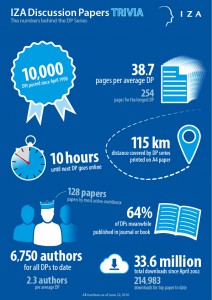
Established in 1998, starting with 100 papers in the first two years, the IZA Discussion Paper series now includes more than 10,000 working papers authored by IZA researchers and network members. On average, a new IZA DP goes online every ten hours. Covering a wide range of topics in labor economics and related fields, our papers are freely available online through the IZA website and various online databases. About two-thirds of the papers have meanwhile been published in refereed journals and volumes. Click on the image for more facts&figures!

From the CEO…

“The IZA discussion paper series has had an enormous impact on establishing IZA’s reputation as a top-level research institution in labor economics – and it will continue to play a key role. Providing an efficient platform for researchers to disseminate their work at an early stage, the IZA discussion papers stimulate constructive feedback from peers. They serve as an invaluable device of scientific quality control, and I dare say this series has its own merits in shaping labor economics as an important sub-discipline within economics.”

— Hilmar Schneider (CEO of IZA)

Or as the IZA network coordinator puts it…

“The first IZA Discussion Paper appeared in April 1998. While not there yet, the IZA Discussion Paper series is now much nearer to being, “… as the stars of the heaven, and as the sand which is upon the seashore….” [Genesis 22:17] And like the stars of the heaven, the Discussion Papers have illuminated very wide areas. They are central to the lives of professional economists, experts on labor and increasingly journalists and policy makers, and are a testimony to the usefulness of the IZA Network of scholars and experts.”

— Daniel S. Hamermesh (Chief Coordinator of the IZA Network)

Here’s what our fellows say…

“Throughout its history, the IZA Discussion Paper series has been a major outlet for new research in labor economics and related fields such as family economics, demographic economics and the methodology that supports serious empirical research. It provides an opportunity for very diverse scholars and methodologies to share ideas, to take fresh approaches to old problems and to pose new problems free of the threat of censoring, publication bias, or club membership bias. The series deserves the highest praise for disseminating a variety of good ideas and path-breaking analyses, and helping make economics an open and vigorous field.”

— James J. Heckman (University of Chicago), 84 IZA DPs

“Over the years the IZA Discussion Paper series has been an invaluable resource for labour economists worldwide, and many papers have subsequently appeared in the economics profession’s leading academic journals. To me, they have proven to be a great outlet both for my own work and for getting early previews of cutting edge research being undertaken in labour economics.”

— Stephen Machin (University College London & LSE)

“The IZA Discussion Paper series has been instrumental in ensuring that my work always has the greatest visibility among the world’s best economists. Over time, the stock of knowledge contained in this series has become quite extraordinary. It’s an invaluable resource when reviewing what is happening not only in labor economics research, but in economics research more generally.”

— Deborah A. Cobb-Clark (University of Sydney)

“The IZA DP series is an ever growing ocean of knowledge about labor economics issues. The series is interesting for students who want to learn about state of the art research. The series is also interesting for experienced researchers who want to remain up-to-date with the research output of colleagues. Contributing to the series means that your work will be read and cited. I think the IZA DP series is an asset for the research community in support for the advancement of science.”

— Jan C. van Ours (Tilburg University)

“The IZA DP series is both a prompt and permanent way to disseminate your research outcomes. It is prompt since your fresh research results can be immediately transmitted to the relevant scientific community within a few weeks; it is permanent since IZA DPs are so well diffused and reputed globally that they keep on being read and downloaded for years, sometimes more read and cited than regular journal articles.”

— Marco Vivarelli (Università Cattolica del Sacro Cuore – Milano),
co-author of the all-time top downloaded IZA DP

What the 10,000th IZA DP is all about…

IZA DP No. 10000 by Rasmus Landersø and James J. Heckman compares intergenerational social mobility in Denmark and the US. Denmark has a far more generous welfare state than the US. In terms of after tax and transfer income, Denmark has far greater intergenerational mobility. In terms of education, differences are especially strong at the top of the income distribution. Denmark and the US are equally mobile.

The generous welfare state of Denmark with its free education and universal childcare improves the cognitive test scores of comparably disadvantaged children. However, it weakens the incentives of those children to acquire schooling. These impaired incentives joined with the sorting of advantaged and disadvantages families into neighborhoods and schools explain the near parity in educational mobility across the two societies.

Stay informed…

More than 4,000 subscribers receive e-mail alerts with new papers 2-3 times a week. For better structuring and readability, new papers are sent out in batches of 4-5 papers each, grouped by similar topics.

To receive e-mail alerts announcing new IZA Discussion Papers, subscribe here.

Filed Under: IZA News, Research Tagged With: labor economics, publications, research

IZA Prize goes to Claudia Goldin

May 15, 2016 by admin

The 2016 IZA Prize in Labor Economics goes to Claudia Goldin, the Henry Lee Professor of Economics at Harvard University. Professor Goldin has been awarded the IZA Prize for her career-long work on the economic history of women in education and the labor market.

The award ceremony at which the Prize will be conferred formally will be held during the annual meeting of the Allied Social Science Associations in Chicago, IL, USA on January 6, 2017.

The decision on awarding the Prize was made by the IZA Prize Committee, which consists of six distinguished economists, five of whom are previous Awardees.

Read more about Claudia Goldin, her impressive vita, her “detective work” as an economic historian and labor economist, and her insights on the gender gap:

  • Claudia Goldin (Interview in Econ Focus, 2014)
  • “Reassessing the Gender Wage Gap” (Interview in Harvard Magazine, May 2016)
  • “The True Story of the Gender Pay Gap” (Freakonomics, 2016)
  • “Goldin Demystifies Gender Economics” (The Harvard Crimson, 2007)
  • “Exploring the Present Through the Past” (Interview in World Economics, 2007)
  • “The Economist as Detective” [doc file] (brief autobiographical essay, 1998)
  • Harvard profile page | IZA profile page

[more about the IZA Prize]

Filed Under: IZA News Tagged With: economic history, education, gender wage gap, Harvard, IZA Prize, labor market, women

From a global perspective: Assessing the effects of labor market reforms

April 13, 2016 by admin

Since the 2008/09 global recession unemployment and inequality have been on a rise. Reforms of labor markets have been one prominent feature in different countries and regions over the last years, not least in the context of the 2008/09 global recession. There has also been a continued debate in both the academia and policy circles about the effects of labor market reforms and regulation.

There are some who argue that labor market reforms and regulation have adverse effects on employment growth, increase in temporary/part-time or informal forms of employment and that it leads to higher unemployment especially among youth. However, the empirical evidence has been quite mixed and the direction remains unclear. Along with labor market reforms, a wide range of active labor market policies were also introduced in both advanced and emerging economies to get the working age people off benefits and into during the crisis. Many of these policies or programs were defined and implemented differently across countries and the extent to which they were successful also differed.

Addressing inequality has been another objective for many countries since the economic crisis. There is a renewed interest since the 2008 economic crisis on minimum wages as a useful and relevant policy tool as more and more countries experience increase in both income and wage inequality. A number of emerging and developing economies have been more active in revising the minimum wages on a regular basis. Even in advanced countries, such as Germany, the UK, and the US, minimum wages have gained importance to address income inequality.

Finally, collective bargaining is a labor market institution that has long been recognized as a key instrument for addressing inequality in general and wage inequality in particular. A number of countries across the different regions also introduced non-contributory social security schemes to provide income to the poor and to reduce inequality.

Discussing labor market reforms (from the left): Werner Eichhorst (IZA), Guy Rider (Director-General, ILO), and Moazam Mahmood (Head of ILO Research Department)

To achieve a better understanding of the effects of labor market reforms and the effectiveness of public policies, a conference was hosted jointly by the ILO and IZA in March 2016 at the ILO headquarters in Geneva (see program). Co-organized by Werner Eichhorst on behalf of IZA, the conference provided the forum for a broad debate about the design and the effects of reforms affecting labor market institutions.

From the presentations it became clear that evidence on significant positive short-run effects of flexibility-enhancing reforms, e.g. with respect to employment protection on job creation is scarce. At the same time many speakers stressed the importance of a positive macro-economic environment to realize the full positive potential of labor market reforms instead of creating more instability in the labor market.

This is particularly true for reforms expanding unemployment benefits and active labor market policies while lowering employment protection. This flexicurity approach might be desirable as it reduces the risks of persistent unemployment and provides sufficient support for job seekers (see the most recent IZA paper by Eichhorst, Marx and Wehner) – however, job finding opportunities and funding requirements depend on economic dynamism.

[Click here to watch the panel discussion video]

Filed Under: IZA News, Research Tagged With: active labor market policy, flexicurity, inequality, labor market, labor market institutions, labor market reforms, post-crisis reforms

A note from the new Editor-in-Chief: Daniel Hamermesh about IZA World of Labor

March 1, 2016 by admin

I have just begun my tenure as Editor-in-Chief of IZA World of Labor (WoL), and I am thrilled to be part of this enterprise. I have devoted a 50-year career to labor economics, a field increasingly growing in importance and one in which we have accreted a large, new knowledge base over this last half-century. The importance of WoL lies in the fact that it provides an understandable and accessible way of exposing and exploring that knowledge base. Furthermore, by linking that base to policy, it enhances the possibility that what we know will be used to inform policy and—at least as important—will enhance the background knowledge of ordinary citizens, the latter being so important in determining which policies are instituted.

The “one-pagers”—the Elevator Pitch, the Pros and Cons, and the Author’s Main Message—that constitute the front of each article provide a unique format. They enable the reader to grasp, nearly at a glance, the essence of the discussion and evidence on the particular labor issue on which the article focuses. As such, they provide a succinct and easy means of understanding how a policy or more general labor-market issue should be approached.

I refer to “the reader,” but who are the readers at whom is this project is aimed? The majority of WoL entries should be readable by any individual with a secondary-school education. They are NOT designed as technical pieces aimed solely at an audience of specialists. Rather, they are meant to be used by:

  1. Policymakers and their staffs. Whenever a policy issue related to labor markets and labor issues arises, these people should immediately think of WoL and use it to access easily the essential information underlying the policy issue of concern, and advice on how to resolve the issue.
  2. Employers, union leaders and members. These agents are repeatedly called upon to react to policy proposals, often on short notice and quickly. WoL allows them to do this by presenting the best available thought on specific topics.
  3. Journalists spend much of their time finding “experts” to interview about the topic on which they are writing. This potentially costly search often leads them to rely on local experts or other “familiars”, who often are not the leading authorities on the topic. WoL greatly reduces the costs of searching for experts by summarizing expert opinion and providing ready access should the journalist wish to interview the expert.
  4. Intelligent laypeople who wish to learn about a specific labor policy. More citizens have realized that the cost of acquiring information on things that pique their interest has dropped. Accordingly, more are seeking information about these issues, out of general curiosity, out of a desire to be able to speak in an informed manner about an issue with their peers, and out of an interest in becoming better-informed voters. WoL provides the most readily accessible and understandable source of information on these issues of increasing interest.

My ambitions as the new Editor-in-Chief are to refine the remaining topics, to fill in gaps in the existing articles by inviting submissions from new authors on pre-selected topics, and to ensure that the four groups of readers understand how useful and important these articles are to them.

—
Daniel S. Hamermesh, Editor-in-Chief, IZA World of Labor and
Professor of Economics, Royal Holloway University of London

Filed Under: IZA News, Opinion, Videos Tagged With: evidence-based policy advice, IZA World of Labor

  • Previous Page
  • Page 1
  • …
  • Page 7
  • Page 8
  • Page 9

Primary Sidebar

© 2013–2025 Deutsche Post STIFTUNGImprint | Privacy PolicyIZA