• Skip to primary navigation
  • Skip to content
  • Skip to primary sidebar

IZA Newsroom

IZA – Institute of Labor Economics

  • Home
  • Archive
  • Press Lounge
  • DE
  • EN

How to create livable and productive working habitats

July 28, 2025 by Mark Fallak

These days, the role of paid work is being questioned—not only from the perspective of economic and technological change but also from the viewpoint of individuals. There is a lot at stake for work in general and for all those who must cope with their jobs to make a living. This holds true for both the structure and quality of work, as well as its boundaries with non-work life.

The enduring importance of paid employment

The empirical account presented in my recent book, The Future of Work Environments: Creating Livable and Productive Working Habitats (Edward Elgar, 2025), makes it clear that, for the foreseeable future, paid work will remain essential for nearly everyone. Gainful employment under capitalism is here to stay. While we need not fear the end of work itself, we must pay close attention to the kind of work we do—and the conditions under which it is performed.

Human labor continues to grow where it is least similar to what machines can do—where it complements, uses, or opposes automation. This is even more pronounced in the era of rapidly advancing technologies, including artificial intelligence. The domain of human work now lies along a narrow frontier between automation and uniquely human capabilities. To expand this domain, human work must be increasingly distinct from what intelligent machines can replicate. People shape their work and, when conditions are right, become less and less replaceable.

Imagining different futures of capitalism

Although paid work continues under capitalism, it’s important to recognize there is not just one form of capitalism. We face various possible scenarios in this critical phase: optimistic, pessimistic, and ambiguous. One is a model of radical, unrestrained capitalism, marked by a rigid hierarchy and a complex periphery—combining old bureaucratic structures with a new, tightly managed regime focused on human capital. The other path imagines a more egalitarian, humane capitalism. This would involve a well-functioning labor market, better organizations, and empowered individuals flourishing in supportive environments.

Of course, reality may unfold somewhere in between—ambivalently, with gains for some and setbacks for others. Still, imagining these pathways helps us define what kind of future we want to strive for.

The triple embedding

To create good working habitats, I propose a triple embedding—bringing public policies, firm-level organization, and individual capabilities into coherence so they can reinforce one another. A more horizontal, egalitarian sphere of work—and a more humane capitalism—could form the foundation for livable and productive environments for all.

Reducing inequalities would mean weaker incentives for destructive competition. People could survive, and even thrive, at reasonable standards without an extreme concentration of advantage. Good institutions are key. Built and maintained through adaptation, they enable conditions where people can work and live well—with as much freedom as possible. They are essential for creating working habitats that are both productive and humane.

The role of public policy in shaping work

Public policies can help chart pathways toward more habitable forms of work—especially work that is non-routine and uniquely human. These policies define outer boundaries, shape power dynamics, and support access to employment. They help ensure income security, foster human capital, and enhance individual bargaining power. This benefits not just select groups, but society as a whole.

While policy cannot control every detail of how work evolves, it can provide essential infrastructure—dykes and dams that shape the flow without blocking it. Good policy is, in itself, a productive factor—supporting wages, social benefits, education, lifelong learning, and mechanisms for participation. All of this helps reduce hierarchy and foster more egalitarian labor relations.

Firms as collaborative workspaces

In the best-case scenario, companies become places of collaborative, joint productive work. This means fewer management layers, less rigid control, and more cooperation among equals. While such settings demand strong self-management and individual initiative, they also allow for diversity, creativity, and meaningful participation.

However, this model only works if the necessary skills and capital are widely distributed—not confined to a privileged few. The effort is still real, but work feels less superfluous or absurd. Instead of being extended unnecessarily, it becomes more purposeful.

Human capitalism and the boundary of work

In the era of “human capitalism,” everyone becomes a kind of human capitalist—whether they like the term or not. This system depends on expertise, self-organization, and the ability to cooperate and adapt. It also requires awareness of the boundary between work and its “hinterland”—the essential non-work sphere that sustains us.

Maintaining some distance from the constant demands of work helps preserve mental well-being. People have a remarkable capacity to not just endure difficult conditions, but to shape them, to craft their jobs, and to manage boundaries—especially when supported by a conducive overall environment.

A future worth building

I argue that we can look to the future with relative confidence—especially if the settings we create help individuals shape their own working habitats. When positive complementarities between policy, firms, and individuals reinforce one another, truly livable and productive work environments can emerge.

Still, the future will never unfold exactly as we imagine it—and that’s a good thing. Complete predictability would be stifling. Today’s uncertainty is a sign of the future’s openness. The more is at risk, the more is uncertain—and the more important the idea of a working habitat becomes.

An attractive working habitat—good for both work and non-work—can offer a sense of rescue and refuge. As good as it can get.
+++

Filed Under: Opinion Tagged With: future of work

Would you read a story written by a machine?

March 14, 2025 by Mark Fallak

By Martin Abel and Reed Johnson

While much recent research has focused on how people say they prefer creative works made by humans over AI, we don’t yet know whether these stated preferences translate into consumer behavior. And, as the saying goes, talk is cheap. But for the millions of people worldwide employed in creative industries, the concern of whether people will be willing to pay more for human-made art is more than an idle academic question. Amidst the coming avalanche of AI-generated work, it is a question of real livelihoods—and more broadly, a question of what will remain ours in this most human of endeavors.

An experiment with AI-generated creative writing

To investigate these questions, we turned to AI-generated creative writing. We asked OpenAI’s GPT-4  to generate a short story in the style of the critically acclaimed author Jason Brown. We then recruited a nationally representative sample of over 650 people and asked participants to read and assess this story. Crucially, only half the participants were told that the story was written by AI, while the other half were misled into believing it was the work of Jason Brown. This design allows us to isolate the effect of (perceived) authorship and to test if consumers value human over AI writing.

After reading the first half of the AI-generated story, participants were asked to rate the quality of the work along various dimensions, such as whether they found it predictable, emotionally engaging, atmospheric, etc. We also measured participants’ willingness to pay in order to read to the end of the story. To capture a fuller picture of participants’ investment in the story, we included both monetary measures (giving up a portion of their pay for participating) and time measures (their willingness to work doing a routine transcription task).

Subjective assessments vs. actual behavior

So, were there differences between the readers who knew the work was AI-generated versus those who didn’t? The short answer: yes. But a closer analysis reveals some startling results.

To begin with, the group that knew the story was AI-generated had a much more negative assessment of the work, rating it more harshly on dimensions like predictability, authenticity, and atmosphere. These results are largely in keeping with a nascent but growing body of research that shows bias against AI in areas like visual art, music, or poetry. It seems that, at least at present, consumers reflexively ascribe lower judgments of quality to AI-labeled work.

However, notwithstanding these perceptions of lower quality, participants were ready to invest the same amount of money and working time to finish reading the story, whether or not it was labeled as AI. Participants also did not spend less time actually reading the AI-labeled story. When asked afterwards, almost 40% of participants said they would have paid less if the same story had been written by AI versus a human, highlighting that many are not aware of the discrepancies between their subjective assessments and actual choices.

Implications for the future of the creative industry

These findings provide timely evidence that widely documented professed AI biases may not be reliable indicators of willingness to pay for human creative labor. The potential implications for the future of human-created work are profound, especially in market conditions where AI-generated work can be orders of magnitude cheaper to produce. With the technology still in its infancy, AI-made books are already flooding the market, recently prompting the Authors Guild to instate its own labeling guidelines. However, our research raises questions about whether these labels are effective in stemming the tide.

True, attitudes toward AI are still forming, and we may well see a backlash against AI-generated creative works. After all, similar shifts occurred in the wake of mass industrialization, such as the Arts and Crafts Movement. This response may take the form of market segmentation, where some consumers will be willing to pay more based on the process of creation, while others may be interested only in the product.

Regardless of how these scenarios play out, our findings indicate that the road ahead for human creative labor might be more uphill than previous research suggests. At the very least, we see that, while consumers may hold beliefs about the intrinsic value of human labor, many seem unwilling to put their money where their beliefs are.

Filed Under: Opinion Tagged With: AI, arts, crafts, creative writing, creativity, willingness to pay

Flash IZA/Fable SWIPE Consumption Index above six percent in November 2024

November 21, 2024 by Mark Fallak

By Nikos Askitas and Ingo Isphording

The IZA/Fable SWIPE Consumption Index, a monthly measure of private consumption trends in Germany based on credit card transactions, shows a flash value of 6.34% year-on-year growth for November 2024, continuing a string of positive readings. This preliminary estimate offers an early insight into actual consumption behavior and is informed daily by fresh incoming data. It can be tracked via our embeddable, interactive graph shown below.

Clear insights needed 

Understanding household economic behavior—particularly spending and consumption patterns—is crucial for both policymakers and business leaders. Private consumption accounts for over 50% of German GDP, making it a key indicator for tracking economic resilience, overheating, or potential recessions. It also serves as a foundation for designing forward-looking economic and fiscal policies.

Traditionally, consumption trends have been assessed through survey-based sentiment indicators, such as the HDE-Konsumbarometer or the GfK-Konsumklimaindex, which measure consumer confidence. However, these sentiment indicators often fail to align with actual spending behaviors, as they capture perceptions and subjective expectations rather than concrete actions.

Moreover, methodological challenges—such as the sensitivity of survey-based economic sentiment to survey modalities—can further distort results. A recent example is the artificial pessimism introduced in the University of Michigan Survey of Consumer Sentiment by switching from telephone to online interviews.

Innovative approach

The IZA/Fable SWIPE Consumption Index provides objective metrics based on real spending data from credit card transactions. Complementing sentiment-based indicators, this index offers timely, reliable insights into consumption behavior. It correlates closely with Eurostat’s private expenditure data, making it a valuable tool for measuring consumption trends.

Despite Germany’s credit card penetration rate of 56.5%—ranking only 18th out of 121 countries—the index effectively captures aggregate spending patterns across a wide range of expenditure categories. This robustness is highlighted in a recent IZA discussion paper by Winfried Koeniger and his University of St.Gallen colleagues, Peter Kress and Jonas Lehmann.

Divergence between subjective and objective measures 

Subjective sentiment measures and objective spending data may not always follow similar time trends. Several factors can explain this discrepancy. For instance, financial constraints or the inelastic demand for essential goods may lead households to maintain steady spending levels, even when they express pessimistic sentiment.

Additionally, more subtle behavioral phenomena can contribute to this divergence. One example is the “lipstick effect,” where consumers opt for small, affordable luxuries during economic downturns. Another is the negativity bias produced by the dynamics of news supply and demand, which can skew reported sentiment away from actual spending behavior.

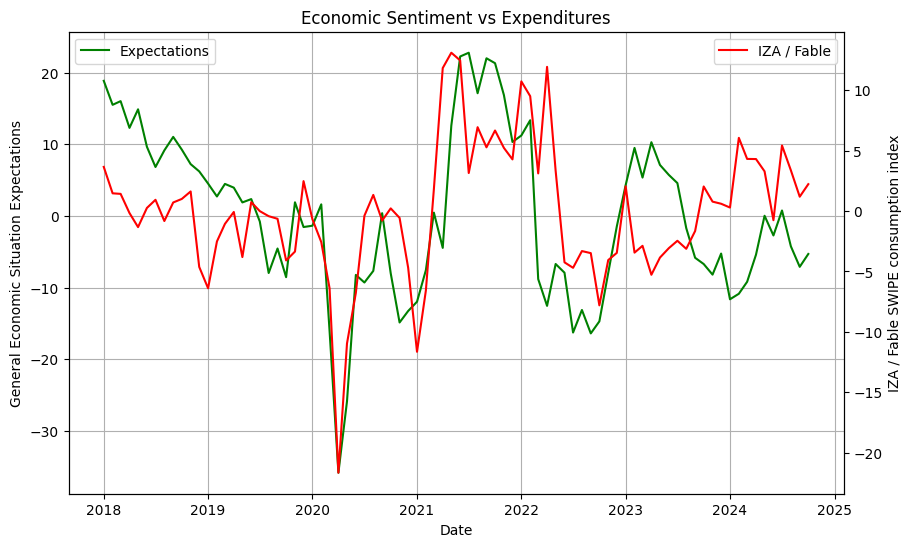
Figure 1 below illustrates the correlation dynamics of the IZA/Fable SWIPE consumption index and economic sentiment sourced from Eurostat, both adjusted for inflation. The figure highlights episodes of both decoupling and alignment between the two measures. During 2018–2019, economic sentiment steadily declined, reflecting growing pessimism, while actual spending, as captured by the SWIPE index, remained largely stable. This suggests that consumption patterns exhibited resilience despite deteriorating sentiment.

A similar divergence reemerged from early 2023 onward: while sentiment declines and stabilizes at a lower level in 2024, year-on-year consumption rates become increasingly positive in the same year. These contrasting trends, along with the broader disconnect between economic fundamentals and sentiment, may point to structural shifts in consumer behavior, the influence of financial constraints, or behavioral adaptations that sentiment indicators fail to capture.

In contrast, the period from 2020 to 2022—dominated by the pandemic, recovery efforts, and the onset of the Ukraine crisis—shows a more parallel movement of the two measures. This alignment likely reflects the heightened responsiveness of both sentiment and consumption to shared external shocks, such as fiscal interventions and global uncertainties.

Another related IZA discussion paper by Winfried Koeniger and Peter Kress provides a deeper analysis of the Fable data, illustrating how consumers responded to Germany’s temporary value-added tax (VAT) cut in 2020, implemented as a policy response to the pandemic.

Figure 1: Comparison of (both inflation adjusted) Sentiment vs. IZA / Fable SWIPE Consumption Index. While sentiment dropped in 2018-2019, consumption remained largely steady; in 2024, consumption grew year-on-year in almost all months despite a pessimistic outlook. (Source: Eurostat’s dataset EI_BSCO_M, variable M.BS-GES-NY.SA.BAL.DE).

Combining measures improves analysis

The patterns of divergence and convergence highlighted above underscore the importance of integrating subjective and objective measures to fully understand the interplay between consumer sentiment, actual behavior, and their impact on the business cycle. Tools like the SWIPE Index complement sentiment data, offering a more comprehensive framework for economic analysis.

Relying exclusively on sentiment-based forecasts risks underestimating the resilience of consumption. For example, Germany’s recently published third-quarter GDP growth, primarily driven by private and government consumption and described as “surprising” by the German media, closely aligned with SWIPE Index trends, which consistently indicated year-on-year growth in private spending for nearly every month of 2024. These insights from the SWIPE Index may even challenge the validity of the recently released official economic forecast for 2024.

Filed Under: Opinion Tagged With: consumption, index

“Higher wages or better working conditions can resolve labor shortages”

February 8, 2023 by Mark Fallak

In an interview with SPIEGEL Online, IZA’s new CEO Simon Jäger comments about the labor shortages that many German industries are complaining about, and suggests a simple solution. Below is an English translation of the German interview.

SPIEGEL: Mr. Jäger, companies are unable to fill around two million vacancies. Teachers, daycare staff, nurses and IT specialists are desperately needed. And you claim there is no labor shortage?

Simon Jäger: Yes, these labor shortages are essentially a myth.

Firms have been complaining about a shortage of skilled workers for the past 40 years.

SPIEGEL: What makes you think that?

Jäger: In the debate, we have to distinguish between two situations: now and in the future. Currently, there are more people in work in Germany than ever before – 45.9 million people who are better educated than all previous cohorts. Firms have been complaining about the shortage of skilled workers for the past 40 years. However, there is a simple market-based solution: higher wages. If a company offers higher wages or better working conditions, it becomes more attractive.

SPIEGEL: And if employers can’t afford that?

Jäger: Of course, in the case of hairdressers, for example, it depends on what price customers are willing to pay. But that doesn’t change the fact that there is no shortage of workers overall, they are just elsewhere. In this respect, the crucial question is: Who works where? We know from various studies that people move to jobs – or stay in jobs – that offer good wages and working conditions. So there is a simple market-based solution.

If firms want to find or retain workers, they will need to pay more or create better working conditions.

SPIEGEL: So the market takes care of everything?

Jäger: If firms are looking for workers or want to retain them, they will need to pay more or create better working conditions. But what we saw last year were massive real wage losses for employees, while at the same time employment was at a record high. That doesn’t fit with claims of labor shortages. In economic terms, we have an unusual situation: workers are in high demand, but real wages have fallen. Incidentally, this perceived shortage of skilled workers and the price signals sent by the market may also be socially desirable.

SPIEGEL: What do you mean?

Jäger: Over the last 30 years, we see that real incomes in the low-wage sector have stagnated on average, even though overall productivity has risen sharply. For a long time, lower incomes have hardly benefited from economic growth. But the low-wage sector is precisely where the pressure is now felt most.

SPIEGEL: Demographic change will reduce the number of workers available to the labor market in the future. Won’t skilled workers then be in short supply?

Jäger: We are an aging society. In the long term, the labor force potential will decline sharply. However, it is possible to take effective countermeasures.

SPIEGEL: The German government’s skilled labor strategy calls for higher female labor force participation, a modern immigration policy and targeted training measures. Are these the right steps?

An efficient allocation of the labor force is essential.

Jäger: Society must decide what answers to give. That’s a political decision. If we want to prevent the labor market in Germany from shrinking, a variety of measures could be effective. Highly mobile, international skilled workers can choose to go to the U.S., Sweden or Switzerland. For Germany to stand a chance in the fight for talent, we will need higher wages, better working conditions and long-term prospects for immigrants. And the system of joint income taxation of married couples still stands in the way of higher female labor force participation.

SPIEGEL: Measured against the demand for labor, there will still be a shortage in the future.

Jäger: If workers are in short supply, we must ensure that they are deployed where they create the greatest added value. An efficient allocation of the labor force is essential.

SPIEGEL: Can you give an example?

Jäger: Teachers are a good example. Working conditions in schools are not enticing, and teachers are frustrated. Qualified workers often don’t switch from the private sector to the teaching profession even if they would like to work at a school. Part of the problem is that we under-resource our schools.

The perceived shortage of skilled workers is just a symptom of the underlying problem.

SPIEGEL: Higher wages in daycare centers, nursing homes or in the public sector lead to higher daycare fees, health insurance contributions or tax payments.

Jäger: This discussion lacks openness. In fact, the labor shortage debate is essentially a societal debate about the areas in which we want to deploy our resources. Everything comes at a cost. That’s what it comes down to. The perceived shortage of skilled workers is just a symptom of the underlying problem: the distribution of scarce resources.

SPIEGEL: In 2022, 19 percent of employees worked in the low-wage sector, earning less than 12.50 euros per hour. Is there a way out for these people?

Jäger: In our research, we show that, especially in the low-wage sector, many employees in Germany underestimate how much money they could earn elsewhere. So they are actually paid less than they think. When they are informed about what comparable employees earn, they increasingly look for another job or renegotiate. So the low-wage trap at the bottom end of the wage distribution also has something to do with the transparency of wages.

SPIEGEL: In Austria, employers must indicate a wage floor in job ads. Does this transparency help employees earn higher wages?

Jäger: Studies from several countries suggest that such wage transparency leads to more competition, and companies tend to raise wages as a result.

SPIEGEL: Generation Z, born from the late 1990s onward, has a different perspective on gainful employment than previous generations: part-time is in demand, overtime less so. Time is precious, the future is uncertain, and the standard of living of one’s parents seems unattainable anyway. What can we do if people simply don’t want to work as much in the future?

Jäger: It helps to give people more flexibility in their working lives. A doctoral student of mine studied the impact of flexible working hours in Australia: Young mothers are more likely to work, and they work more. Also, the “motherhood penalty” has shrunk. That means the income gap between men and women after the birth of their first child has narrowed. The reform is a good example of how total hours worked could increase if people are given more working-time flexibility.

SPIEGEL: Until now, employment contracts have been rather rigid in Germany – it’s common to work either 20 or 40 hours.

Jäger: Many companies in Germany already have flexible working-time models, often in successful cooperation with the works council. In the future, it would be good to have additional options especially for older workers. Employees and employers could flexibly agree on the scope of work between zero and 100 percent. Some people would choose 80 percent, others 60 percent. Older workers could then, for example, care for their grandchildren more often and continue to work. Overall, more flexibility could lead to more hours worked in total.

SPIEGEL: Would that also be an alternative to raising the retirement age?

Jäger: Making working hours more flexible could at least calm down the debate about the retirement age a little. Employees could work longer – but with fewer hours per week. Many people feel the desire to meet colleagues at work, to engage in fulfilling activities or to pass on their knowledge to young colleagues. Those who decide independently and flexibly to work less will still remain in the labor market. To stabilize the pension system in the long run, however, the option of raising the retirement age must remain on the table.

Filed Under: Opinion Tagged With: Germany, labor shortage, skilled labor, wages, working conditions

“Some market interventions are efficient”

October 10, 2022 by Mark Fallak

On October 1, 2022, Germany raised the nationwide minimum wage to 12 euros. In an interview with Frankfurter Allgemeine Zeitung, IZA’s new CEO Simon Jäger explains why he thinks that was the right thing to do – and why the shortage of workers may not be such a big problem after all. Below is an English translation of the  German interview.

Mr. Jäger, as of October 1st, the statutory minimum wage will increase to 12 euros per hour. What consequences do you expect for the labor market?

Despite the energy crisis, the circumstances are favorable in several respects: With 45 million people in work, employment in Germany is higher than ever, and at the same time labor demand is very strong. On the other hand, employees are currently experiencing massive losses in real wages due to inflation – across all groups of workers the loss is more than 4 percent compared to the previous year. This is something that hasn’t happened in the past 50 years.

At 12 euros, the minimum wage is 25 percent higher than a year ago. Is it the right thing to do now?

Predictions are always difficult, especially in these uncertain times. But past experience and recent research can give us clues. My expectation is that, on balance, we don’t need to fear major job losses. But we are likely to see a reallocation of jobs from less productive to more productive firms. How to judge this trend is ultimately a political question.

How exactly does this reallocation occur?

Let’s take small restaurants or corner shops, for example. Their business model might no longer work above a certain minimum wage level. Such firms would then disappear. At the same time, however, more workers are available for other firms in other sectors, such as manufacturing, that can afford to pay higher wages. Whether that’s good or bad is for society to decide. The question is, to what extent should firms still exist if they cannot pay a minimum wage?

When the minimum wage of 8.50 euros was introduced in 2015, Germany was in the midst of an economic upswing. Now we are at the brink of recession. Doesn’t this make a difference?

More recent minimum wage research actually suggests that a moderate minimum wage won’t have major employment effects, even in times of higher unemployment. Besides, unemployment in Germany is still rather low by historical and international standards.

Passing a law to raise the minimum wage must be seen as an insult to the minimum wage commission, which had previously been considered free and independent. You don’t think that’s a problem?

That’s a political rather than an economic question. Essentially, setting minimum wages is always political, regardless of whether or not you have a commission with representatives of employers and unions. But legislative intervention seems justified also in light of the fact that Germany still has one of the largest low-wage sectors in Europe. The problem is not just that many people have low labor incomes. On a macroeconomic level, the negative externalities are huge.

What do you mean by “negative externalities” of the low-wage sector?

A prime example of negative externalities is the 49-euro flight ticket to Mallorca, but the same goes for the purchase of cheap Russian gas over many years: The prices do not correspond to the true costs, here in terms of climate and security policy, and that distorts both our way of life and our economic structure in a harmful way.

What does the low-wage sector have to do with it?

If it is too easy for firms to succeed with business models based on low wages, then too many resources are allocated to less productive sectors – while at the same time there is a shortage of workers in productive sectors. A higher minimum wage can help avoid such misallocation. We also know from research that people with good jobs are more committed to society and less susceptible to political extremes. The dogma used to be that the labor market is efficient when left alone. Today it can be said that certain government interventions are also efficient.

Is it efficient for the state to set wages because then unions and employers no longer have to engage in agonizingly long collective bargaining?

It’s not a matter of either/or and conflicting goals. Collective bargaining coverage has decreased significantly in Germany over the past few decades. And most importantly, the labor market has become increasingly segregated: On the one hand, there are highly productive firms that are bound by collective agreements and pay good wages. But while cleaning staff and porters used to be employed directly by those firms, their work is now being outsourced to cleaning and security services, with less favorable collective agreements, working conditions and profit-sharing opportunities. A higher minimum wage reduces the incentive to outsource these activities.

But these service industries are exactly where unions have a hard time recruiting new members in order to push through better collective agreements. Why is that?

The structures for a functioning collective bargaining policy are often lacking. Where employers do not form employers’ associations, trade unions find it difficult to negotiate with them on sectoral collective agreements. And the rise of precarious work, for example through short-term contracts, makes it more difficult for people to commit to a common cause.

Should employers offer collective agreements if employees do not even organize themselves into unions?

Of course, both belong together. And I don’t want to assign any blame. I only note that there is a change in the institutional framework that has contributed to the decline in collective bargaining coverage. This applies, for example, to the instrument of declaring collective agreements to be binding for the entire sector.

Should the state compensate for the organizational weaknesses of the trade unions?

This is primarily a political question. Let me just say that up until the 1990s, for example, it was common practice to declare collective agreements in the very large retail sector to be generally binding. After conflicts among employers, this system broke down. That’s one of the causes of reduced collective bargaining coverage.

The biggest problem of the German labor market is the lack of skilled workers and service personnel. How can this be remedied?

I beg to disagree with that diagnosis.

Why? There is hardly any café or bakery that’s not looking for staff.

Right. But don’t forget that we currently have more employees than ever before. So the workforce hasn’t disappeared, it’s just somewhere else. Workers have left places where working conditions are poor or wages are low.

So it’s economically efficient if the wait staff at the café is reduced from five to two and the service is poor?

Possibly, yes. This creates pressure to increase wages, to automate certain activities and to align working conditions with the needs of employees. In Bonn, for example, a hairdresser has been flooded with job applications after offering a four-day workweek, even though many hairdressers are desperately looking for staff. This may lead to an upward pressure on consumer prices, but it doesn’t have to be bad for society if we previously had conditions that could only exist with a huge low-wage sector and all the associated externalities.

With the recession, unemployment is likely to rise again. Should employees be kept in their jobs with short-time work benefits like in the pandemic?

When the house is on fire, you grab the fire hose. In the current situation, I consider the short-time allowance to be a very important tool for securing jobs. But we shouldn’t overlook the considerable costs.

Such as?

Some companies take advantage of the short-time allowance even though they don’t need it at all. It also tends to inhibit structural change. Positive and negative forces have to be cleverly balanced. Unfortunately, that’s not so easy in Germany: We are flying blind when it comes to economic and labor market policy.

And why is that?

We simply don’t have the necessary data to analyze these important questions. In Switzerland or Italy, for example, data from official labor market statistics can be linked with firm-level data. And it turns out that in areas with a lot of short-time work, less productive firms survive, while more productive firms experience slower growth. This is hardly surprising if you consider that the software developer whose job at a medium-sized automotive supplier is saved with short-time work benefits is not available to any start-up. My policy advice: As the largest industrialized country in Europe, we must end this blind flight. We have a lot of data in different silos. But the federal government must create the legal basis so that they can finally be brought together. This is the prerequisite for excellent research and thus also for evidence-based policymaking.

The government is trying to make progress with a new “opportunity card” to attract more foreign skilled workers to the country. Does Germany even stand a chance in competing with the U.S. and other countries?

I think so. Many people want to live where there is strong social cohesion and where the rule of law is still largely intact. This is where Germany has a locational advantage. And Germany is also attractive when it comes to science, research and innovation.

Apparently attractive enough for you to interrupt your scholarly career at MIT in your mid-30s to head the IZA Institute of Labor Economics in Bonn.

This is an exciting and important task. Almost all major social debates of our time are also reflected in the labor market. Thanks to new research methods, we can now provide much better answers than 20 or 30 years ago and thus provide valuable input into social and political debates. With this in mind, I am very excited to lead an institute which does excellent research and has an outstanding international network. We want to build bridges between scientific research and policymaking. That’s why we will also set up a branch in Berlin.

With Ulrike Malmendier, another top researcher is coming back from America, at least as a member of the German Council of Economic Advisors. Is it a new trend that excellent young researchers also want to have more influence on practice?

I think there is a lot of interest because the challenges of our time are gigantic. Many truths about the stability of liberal democracies are being shaken. In my generation, I see a strong motivation to not just do basic research, “l’art pour l’art”, but also contribute directly to tackling social challenges with relevant research.

Filed Under: Opinion Tagged With: collective bargaining, employment, Germany, labor shortage, low-wage sector, minimum wage

Babel’s Curse or Babel’s Blessing?

September 20, 2022 by Mark Fallak

By Juliana Bernhofer and Mirco Tonin

Polyglot curricula and applicants with international experience have long been considered the gold standard for managerial and executive positions in the private and in the public sector, and rightly so. However, acquiring these skills also entails significant costs in terms of higher effort and lower exam grades. Considering our findings, governing bodies of education institutions should develop targeted policies to avoid inequalities during higher education.

+++

Over the last decades an ever-growing number of students take degrees in a language other than their mother tongue. According to Open Doors, the number of international students in the United States increased from 1.7% in 1970 to 5.5% in 2019. Even though the pandemic has decelerated the trend, internationalization of higher education is increasing.

Students move for diverse reasons: to get into better, international universities, to enhance personal growth and cross-cultural awareness or to achieve a better placement in the labor market. Also international migration and the increasing popularity in many countries of degrees with English as medium of instruction, for the purpose of attracting talented foreign students and academics, add to the picture. But is it really all plain sailing? Does it only pay off to study in a language which is not the native one or does the additional cognitive effort of having to learn in a second language have a noteworthy impact on academic success? To answer these questions, we analyze the academic performance of students at the Free University of Bozen-Bolzano in South Tyrol, a multilingual province in Northern Italy where the majority of the population has either German or Italian as mother tongue.

A trilingual university as the ideal institutional setting

In our paper “The Effect of the Language of Instruction on Academic Performance”, published in the scientific journal Labour Economics (in Open Access), we study the impact of learning in a second language by looking into administrative data from the Free University of Bozen-Bolzano. Most of the students are Italian or German native speakers who follow a mandatory trilingual study program (German, Italian and English). This represents the ideal institutional setting for a study of this kind, in which students of different linguistic backgrounds are required to take exams both in their first language and the other two languages. As an example, an economics student may take Introduction to Management in German, Microeconomics in Italian, and Econometrics in English. Each course is offered in only one of the three languages, with the aim of providing a balanced language share for each student.

Conversely, analyzing data from monolingual universities – comparing local and incoming students from other countries – would be likely to suffer from a selection bias since better students might on average have a higher tendency to undertake studies abroad. This cognitive advantage may then lead to higher average grades, potentially concealing negative foreign language effects, thus providing uninformative results.

Lower grades, higher failure rates and second-language dodging

We divide our sample of almost 3,000 students into cohorts who attend the same degree in the same year, thus facing the same curriculum. By looking at exam results of German and Italian native speakers who take exams in German, Italian and English, we find that grades of tests in a second language are on average 9.5% lower than grades achieved in the native language. Also, the likelihood of failing an exam is higher for exams taken in a foreign language.

Language proficiency, even at a very high level (C1 or C2 on the Common European Framework of Reference for Language Skills or Levels 3 or 4 on the Interagency Language Roundtable scale) partly closes this gap, but does not eliminate it entirely. The reason for this residual disadvantage is likely due to what psycholinguists and neuroscientists call language-switching costs. Some behavioral studies as well as functional magnetic resonance imaging of the brain show that students who mentally retrieve information they previously acquired in a different language than the learning language face an additional cognitive cost, even when they are perfectly bilingual. An example relevant to our results would be high school math’s skills which have been acquired in the student’s native language and which she or he now needs to retrieve for the exam in Microeconomics, offered in a second language.

Learning in a non-native language might also slow down mental processes overall and lead to information retrieval interferences during language processing, adding to the costs of engaging in multilingual studies. It therefore does not come as a surprise that we also observe some students trying to avoid the policy of mandatory non-native learning by postponing some exams waiting for them to be taught in their mother tongue, or by taking them in more favorable conditions abroad, for example as part of international student mobility programs such as Erasmus+.

Should you stay or should you go?

Do we claim students should avoid international mobility and studying in a foreign language? Far from it! Numerous scientific studies stress the advantages of language skills in the labor market and a wide body of anecdotal evidence in recruitment processes show that international curricula are among the main requirements for managerial positions. It is not only sheer multilingual proficiency that matters. The experience gained from the immersion into a foreign language and culture signals an applicant’s wider horizon and her or his ability to adapt to new situations and challenges.

The investment in terms of additional effort when engaging in a degree taught in a non-native language is likely to pay off eventually from a personal and a professional viewpoint. However, it is not always an easy route and expectations should be formed based on facts, negative as well as positive. Governing bodies should also grant fair access to schooling and higher education by trying to smooth out inequalities between students of diverse linguistic backgrounds. This can be achieved for example by balancing out the additional cost of non-native learning, in terms, for instance, of longer duration, with financial incentive schemes and by offering targeted tools to overcome linguistic differences more smoothly.

Filed Under: Opinion Tagged With: academic performance, education, language

Coping with the COVID-19 labor market crisis: Views from the Netherlands

October 28, 2020 by Mark Fallak

In a series of IZA Newsroom interviews, renowned international labor market experts comment on how their country has been coping with the COVID-19 labor market crisis and how they expect the situation to evolve. The IZA Crisis Response Monitoring provides a detailed assessment of different policy measures in selected countries. To learn more about the Dutch experience, we asked Egbert Jongen and Paul Verstraten from the CPB Netherlands Bureau for Economic Policy Analysis to share their inside views.

How do you assess the current labor market situation in the Netherlands and the impact of government policies?

Egbert: Given the sharp drop in economic activity, we have seen a rather limited drop in employment in persons and a rather limited rise in unemployment. The unprecedented policy interventions probably played a major role in this; during the period March-May one in every three employees was working in a firm that received short-time work subsidies and a large share of self-employed claimed special benefits for self-employed. Together with other policy interventions, like tax deferrals, this has prevented a sharp drop in employment in persons and a massive surge in unemployment.

What is your outlook for the next six to twelve months?

Paul: On September 15th we published our Macro Economic Outlook 2021 in which we look towards 2021, as well as the remaining quarter of 2020. In our baseline projection the unemployment rate continues to increase to 4.3% in 2020 on average (the unemployment rate was historically low with only 2.9% in February) and to approximately 6% in 2021. The unemployment figure for 2021 is about half a percentage lower than estimated in our August projection. This is partly because the Dutch government recently decided to continue the short-time work program until July of next year. It should be noted, however, that also a much worse scenario can unfold. In our second-wave scenario, which triggers a second lockdown, the unemployment rate is projected to rise to 10% in 2021.

The Dutch government recently decided to continue the short-time work program until July of next year.

Egbert: Indeed, and we are already into a second wave, where the recent surge in cases in the Netherlands does not bode well for the coming period, ‘Winter is coming’. The government has already implemented additional restrictions over the past weeks, and put out a warning that more restrictions will follow if we do not bend the curve regarding the number of cases. The next economic forecast of the CPB, which takes these recent developments into account, will be published on the 26th of November.

What policies would be best suited to support the recovery of employment?

Egbert: Given that this is not a V-shaped recession, and some sectors may witness a permanent drop in activity (less travel to and for work, more online shopping), the focus has to shift from maintaining current less productive matches to reallocation towards more productive sectors and jobs. Indeed, so far this has been an asymmetric shock, some sectors still have a shortage of workers, like the education, health and more technical sectors. We have to make sure that workers and firms have enough incentives for reallocation, while at the same time supporting them when it comes to retraining and job search. Policy is also moving in this direction.

The focus has to shift from maintaining current less productive matches to reallocation towards more productive sectors and jobs.

Which aspects of the Dutch crisis response in do you find most remarkable?

Paul: The development of bankruptcies in the Netherlands is one of the most counterintuitive figures I have seen so far. This number has steadily decreased since April and in August we saw the lowest number in 21 years. I think this shows that the generous support measures do not only preserve firms that are hit by COVID-19 but also firms that are in economic distress for other reasons. In the next 9 months the support policies will be gradually dismantled, so it will be interesting to see how this situation will evolve.

Egbert: Next to remarkable policies, and the speed at which they were implemented, the shift from working mostly in the office to working mostly from home has also been remarkable. Working from home will probably remain much more common even after the pandemic, in general the link between where you live and where you work will become more diffuse, which opens up a lot of opportunities.

How has the COVID-19 crisis personally affected you?

Paul: Both Egbert and I work at the CPB – an independent economic institute of the Dutch government. And since our jobs are particularly well-suited for remote work, we mostly work from home. I must admit that I was quite lucky to have my vacation in February this year. So for me there was not much to cancel during the summer. I did however receive a cancellation from a conference in London. I was planning to present one of my papers there. Let’s hope things look better next year.

Egbert: In my personal life, we have been rather lucky. None of my family or close friends has been seriously ill, and me and my wife both have permanent contracts in sectors that are rather unaffected by the crisis. It has been a bit more challenging for our children, education online is (even) less fun. I especially feel for our son, finishing high school and starting student life is not the same during a pandemic. Regarding work, I enjoy working from home, and having less and shorter meetings, but the social fabric of my team and our institute is suffering from the lack of in-person interaction. Also, work has been busier than ever, making scenarios and doing ‘run-and-gun’ corona analyses, next to preparing for the analysis of the election proposals coming winter. Also at the university it has been rather busy, moving most of the teaching and exams online.

Filed Under: Opinion Tagged With: COVID-19, Netherlands

Coping with the COVID-19 labor market crisis: Views from Canada

October 13, 2020 by Mark Fallak

In a series of IZA Newsroom interviews, renowned international labor market experts comment on how their country has been coping with the COVID-19 labor market crisis and how they expect the situation to evolve. The IZA Crisis Response Monitoring provides a detailed assessment of different policy measures in selected countries, so far not including Canada. To learn more about the Canadian experience, we asked Steven Tobin from Canada’s Labour Market Information Council to share his inside views.

How do you assess the current labor market situation in Canada and the role that government policies have played so far?

In terms of the initial impact on the job market, we haven’t seen anything like this in recent history. In March and April of 2020, Canada lost more than three million jobs. That’s more total job losses than the three previous recessions combined, and over a much shorter period. For context, in 2008–2009, employment in Canada fell by half a million over eight months.

Since May we have quickly regained much of this ground. In fact, between May and September employment grew by nearly 2.3 million. In other words, employment is now within 720,000 (–3.7%) of its pre-COVID (February 2020) peak.

The federal government’s response to date has been swift and aggressive, introducing new programs and expanding existing ones for both individuals and businesses. Of particular note are the Canada Emergency Response Benefit (CERB) and the Canada Emergency Wage Subsidy (CEWS). CERB ran for 28 weeks (to the end of September) and provided a taxable benefit of $2,000 every four weeks for eligible workers — those who stopped working or whose work hours were reduced due to COVID-19. For eligible businesses, CEWS provides up to 75% of a worker’s wages, to a maximum of $847 per week. More details on these and other programs have been made available to the public in the Federal Government’s COVID-19 Economic Response Plan.

How did the Canadian approach differ from other countries, especially the U.S.?

A few things stand out in terms of Canada’s response. First is the speed with which relief measures were put in place. Most programs were up and running by April. And while there were a few glitches along the way, given that many of these measures were entirely new, the fact that programs were in place so quickly was quite remarkable. Second is the breadth of measures introduced. The government recognized that the crisis was hitting households and small businesses alike. The introduction of both CERB and CEWS, among other responses, acknowledged the importance of providing an income bridge to both people and firms.

What would you consider the most probable labor market scenario in six to twelve months from now?

 The strong job gains of the past four months are largely attributable to the re-opening of provincial economies across the country. And as impressive as those gains have been, we remain well below pre-crisis levels with employment levels still down by just over 1 million. The pace of gains has also slowed in recent months.

Moreover, since we are now in a second wave of COVID-19, restrictions on mobility and gatherings have returned. The most likely short-term outlook is that gains will continue to slow or even reverse and thus it will take some time to recuperate the remaining third of jobs lost.

Which aspects of the crisis response in Canada do you find most remarkable?

Most remarkable to me has been the important interplay between politicians and public health authorities. Across federal, provincial and territorial governments — regardless of the political party in power — the advice of public health authorities was consistently at the forefront. Politicians of all stripes largely based their responses to the pandemic on the evidence presented to them by unelected officials.

This evidence-based response has been a great strength. I began to wonder whether this could be a sign that politicians would increasingly defer to experts, even in areas such as (labour) economics, which is often considered “the dismal science.”

What policies would be best suited to support the recovery of employment?

Our priority must continue to be protecting the health and safety of people. As we grapple with the implications of the second wave and consider economic recovery efforts, we must recognize that this crisis is unlike past ones.

To do so, first we must focus our job recovery strategies on supporting those individuals and businesses most affected by job losses and business closures. Otherwise, we run the risk of worsening long-term inequality and social outcomes.

Take for instance, the “shovel-ready” infrastructure projects that proved so successful during the 2008–2009 “Great Recession.” While such programs can provide a much-needed boost with positive spillover effects, they have not traditionally been structured to benefit women and youth — two groups particularly hard hit by the current pandemic. Building public infrastructure should, of course, be part of our recovery efforts (and our ambitions of an environmentally stable recovery); however, policies and programs designed to help those most affected return to meaningful employment should take center stage.

Second, several structural weaknesses in our economy and our workforce have been revealed by this pandemic. In other words, simply helping people back to their previous jobs will not be enough. Many of the jobs affected by COVID-19 could change or disappear altogether. The pandemic has revealed, for instance, that many jobs are associated with a certain level of vulnerability, such as essential workers with limited access to benefits. One of our overall strategies must be to improve the working conditions of these jobs. Essentially, we must reconsider the value of work itself.

Third, since many jobs will disappear and others will shift dramatically, we must develop a workforce strategy that helps workers transition to more sustainable, higher-quality jobs. Upskilling and re-skilling workers to take advantage of these evolving opportunities — while providing much needed income support to bridge the gap — must be the heart of this initiative. Easier said than done, but not impossible. Such an approach requires the following key elements — data, skills and training:

  • We need better data about the skills requirements of emerging jobs. We must improve our understanding of the needs of employers and how they evolve in near real-time.
  • We must support initiatives that help workers, employment service providers and career practitioners to evaluate existing skills and how they can be applied, as well as what new skills training might be needed.
  • We must provide schools and training institutions with the knowledge and capacity to help people transition effectively through demand-driven skills and training, toward meaningful, quality, sustainable employment.

Overall — and I cannot stress this enough — we must shake off the notion that we can get back to “business as usual” as we seek out our “new normal.” Instead, we need to understand that this pandemic can teach us critical lessons about how to re-imagine our economy and our society, and how to do better. Better for seniors, better for workers, better for businesses, better for the environment, better for our own economic stability, better for public health, better for all. If we ignore these lessons, then to paraphrase Albert Einstein, we will have missed the opportunity that lies within this crisis.

How has COVID-19 personally affected you?

With COVID-19 primarily being a health crisis, my initial concern focused on the well-being of family, friends and colleagues. My loved ones were mostly unaffected, so I feel extremely lucky, especially considering that over one million people have lost their lives to the pandemic as of October 2020. As the second wave starts to take hold in Canada, I am hopeful that we have learned some important lessons from the first wave. By following the recommendations of public health authorities, we can limit the health-related (and knock-on) effects of this virus.

From a professional perspective, our organization was able to respond quickly and have been working from home since early March. As an organization, we adopted new ways of working that ensured that staff were both engaged and safe. We also had the opportunity to work on several projects that helped Canadians navigate the crisis, such as our Now of Work Annotated Bibliography, which synthesizes the latest research findings related to work and COVID-19. We were – and remain – highly motivated to make a difference.

I would give myself a passing grade in terms of my success in working from home. Call me old school, or maybe just old, but I miss the daily interactions with my colleagues. I also realize that, as much as I missed them — and often struggled with this new virtual way of working — I never forgot that I am one of the privileged workers who managed to keep their job throughout the crisis. Millions of other Canadians were not so lucky.

Filed Under: Opinion Tagged With: Canada, COVID-19

Coping with the COVID-19 labor market crisis: Views from Austria

September 15, 2020 by Mark Fallak

In a series of IZA Newsroom interviews, renowned international labor market experts comment on how their country has been coping with the COVID-19 labor market crisis and how they expect the situation to evolve. These experts have also contributed to the ongoing IZA Crisis Response Monitoring, which provides a detailed assessment of different policy measures. Austria has achieved tragic international fame when the virus spread from an Austrian ski resort across Europe, but the country has since then been coping relatively well with the crisis. We asked René Böheim and Thomas Leoni to share their inside views on the labor market impact of the pandemic in Austria.

How do you assess the current labor market situation in Austria and the role that government policies have played so far?

RB: We still have record numbers of unemployed persons and extensive use of short-time work, which has been extended at least until the end of March 2021. I am concerned that we might face a substantial number of firm closures which were somewhat postponed by the support programs. Certain sectors, e.g., tourism or cultural institutions, were particularly badly hit by the crisis. The summer season did not help.

We might face a substantial number of firm closures which were somewhat postponed by the support programs.

TL: Policies certainly played a major role in stabilizing employment, this is particularly true for the short-time work scheme, which was implemented at an unprecedented scale. The number of workers on short-time has dropped substantially in the last months and about half of those who lost their job during the lockdown are back in employment. These are encouraging signs. At the same time, flows back into employment have clearly been insufficient to compensate for the job losses during the lockdown and there is a backlog of persons who were already in search of a job before the start of the crisis.

What would you consider the most probable labor market scenario in the next six to twelve months?

RB: High unemployment rates and continued short-time work. The risk of unemployment will continue to be high, in particular for young people and those with little or no formal skills as well for workers with health problems.

TL: The economy and the labor market are recovering from the momentous lockdown shock, but this process is slow and uneven. Some sectors, such as tourism, transport and some manufacturing industries, will continue to struggle in months to come. Moreover, we see that vulnerable groups face additional challenges to find employment. Thus, even though the economy is headed in the right direction, it will be a very bumpy road and some groups risk being left behind.

What policies would be best suited to support the recovery of employment in Austria?

RB: In my view, we now need also well-targeted job creation programs (to avoid dead-weight loss); training and qualification programs. I am also in favor of coupling short-time work more with continued education programs.

The crisis should provide an opportunity to implement innovative schemes.

TL: I would add that the crisis should provide an opportunity to implement innovative schemes, including well-targeted forms of employment subsidies for vulnerable groups and attractive models to reduce working hours. It will be important to take a sectoral perspective and some measures could be set at the industry level as part of the collective bargaining process, which is very comprehensive in Austria. In a macroeconomic perspective, it will also be important to address the drop in investment which has already taken place in the private sector and is likely to take place at the local level, as municipalities are experiencing a severe fall in revenues which will constrain their budgets.

Which aspects of the crisis response in Austria do you find most remarkable?

TL: I am impressed by the speed and flexibility with which firms, organizations and individuals adapted to the circumstances during the lockdown and beyond. This concerns particularly the ability to transfer work processes from the real to the virtual world, an experiment that I think will have some lasting effects on how we organize work. On a more personal note, it was also interesting to witness how fast children have learned to meet with friends online.

Filed Under: Opinion Tagged With: Austria, COVID-19

Coping with the COVID-19 labor market crisis: Views from Sweden

September 1, 2020 by Mark Fallak

In a series of IZA Newsroom interviews, renowned international labor market experts comment on how their country has been coping with the COVID-19 labor market crisis and how they expect the situation to evolve. These experts have also contributed to the ongoing IZA Crisis Response Monitoring, which provides a detailed assessment of different policy measures. Sweden’s less restrictive approach has been controversial, drawing both praise and criticism from international observers. We asked Lena Hensvik and Oskar Nordström Skans, who are both economics professors at Uppsala University, to share their insider views on the labor market impact of the pandemic in Sweden.

How have you been personally affected by COVID-19?

Lena: After the outbreak of the pandemic, all teaching in Swedish universities moved online. All university employees were instructed to work from home to the extent possible, and stay at home if experiencing any flu-like symptoms. In addition, kids should also be kept at home if showing any kinds of symptoms.

So I’ve been working home from March onwards. Being quite used to online meetings and remote work, I don’t think that the pandemic has changed the very nature of my job. However, working from home while my husband was at home on parental leave with our one-year-old son at the same time has been challenging. I also believe that being physically disconnected from the department for such a long time is costly – it’s just very hard to substitute physical contacts with PhD students and fellow scholars with online interactions.

It’s very hard to substitute physical contacts with PhD students and fellow scholars with online interactions.In terms of my own research, my co-authors and I had just started a randomized control trial on automatic job recommendations at Sweden’s largest job board (Platsbanken) when the pandemic hit, which encouraged us to start documenting the impact of COVID-19 on online job search behavior and vacancy listings. Working on the impact of the crisis has helped me to keep focus in these uncertain and scary times.

Oskar:  Like Lena, I have been confined to working from home throughout the period and been teaching on zoom. It has all worked out reasonably well, but from now on I will work from the office a few times a week – and it is just excellent. Workwise, the crisis has called for a lot of policy work and media attention, making it hard to progress with research. My children have been attending school throughout, which we all appreciated. Obviously, all holiday plans had to be cancelled.

Not being able to meet with older family members has been the hardest part of it all.

Personally, not being able to meet with older family members has been the hardest part of it all. When domestic travel was allowed at the onset of summer, we were able to travel to my parents who live in the north of Sweden and arrange to meet them outside, which was great. Since my wife’s family live in Finland, we have not yet been able to visit them, however.

How do you assess the current labor market situation in Sweden and the role that government policies have played so far?

Lena: The situation was very dramatic initially, in Sweden as elsewhere. One needs to understand that the Swedish restrictions, although formally presented as “recommendations that all must follow” rather than a legally enforced lockdown, had a massive impact on people’s behavior early on during the crisis. For example, restaurants remained open (with restrictions), but their sales dropped by 70 percent from one week to the next. This does not happen without a serious impact on the economy. But the situation is gradually improving.

Oskar: The short-time work scheme that was set up in response to the crisis seems to have helped a lot. Together with some other targeted policies and guarantees for loans (that often were not used), these policies seemed to have put firms in a position where they were able to wait and see how the crisis unfolded, rather than shredding their workers or going into bankruptcy.

In terms of the health impact, we have clearly fared worse than our closest neighbors.

In comparison with the rest of Europe, the Swedish economy seems to have fared slightly better, but on the other hand, the economic impact is not very different from that in our neighboring countries, where health restrictions were somewhat stricter. In terms of the health impact, we have clearly fared worse than our closest neighbors, although probably not as bad as the UK and some southern European countries that used even stricter measures than our neighbors. Overall, comparing these things – in particular the health part on which we are not experts – at such an early stage remains difficult, but it is clearly important to evaluate all of this when going forward.

What would you consider the most probable labor market scenario in the next six to twelve months?

Lena: We expect the market to gradually improve for the most part. Hopefully, many of the jobs that suffered from the impact of early recommendations can gradually resume business as usual. The resumption of activity is perhaps a more gradual process than in other countries, since restrictions are less formal.

The only hope for a swift labor market rebound is the resumption of previous businesses.

Oskar: We expect some sectors, such as event organizers, cultural workers, or travel agencies, to continue to suffer for an extended period of time, but there is some hope that other affected service sectors can fare better. This is important as the only hope for a swift labor market rebound is the resumption of previous businesses – creation of new jobs and restructuring is always more time-consuming.

What policies would be best suited to support the recovery of employment in Sweden?

Oskar: In our view, it is important to use more active support, in particular to firms. Just as when granting benefits to individuals, there is a tension between accurate targeting and incentives when subsidizing firms. Benefits, such as short-time work schemes, that grant money to firms if and only if they reduce production obviously risk prolonging the recession by subsidizing inactivity.

We would like to see targeted support to firms that leave the short-time work scheme prematurely.

Instead, we would like to see targeted support (e.g. lower payroll taxes) to those firms that leave the short-time work scheme prematurely. Similarly, we would like to see a resumption of the coinsurance and monitoring parts of the sickness insurance system for all except those with certified Covid-19 infection. This will help reduce absence, and increase the speed of recovery.

Lena: The same principles should apply to active labor market policies. Everything that encourages early resumption of productive economic activity should be prioritized.

Which aspects of the crisis response in Sweden do you find most remarkable?

Oskar: As in other countries, there were some remarkable and extremely costly public support systems for firms set up in just a few weeks. And there are some interesting examples where firms managed to retrain their staff (e.g. flight attendants) into health care staff in just one or two weeks. These are important lessons for the future.

Lena: It is also interesting to see the adjustments made on the worker side. As an example, there has been a 30 percent increase in applications of prospective students to nursing programs at universities, which is very good news as this is a profession where the lack of skilled workers is particularly salient.

Job-seekers’ willingness to search for other jobs than in “normal times” is encouraging.

Similarly, together with some co-authors I published a recent IZA Discussion Paper which shows that job-seekers seem willing to make job search adjustments by directing their search efforts towards vacancies from the more resilient occupations. This willingness to search for other jobs than in “normal times” is encouraging because it means that workers will respond to policies aiming to bring workers and available jobs closer together.

Filed Under: Opinion Tagged With: COVID-19, Sweden

  • Page 1
  • Page 2
  • Page 3
  • …
  • Page 5
  • Next Page

Primary Sidebar

© 2013–2025 Deutsche Post STIFTUNGImprint | Privacy PolicyIZA