• Skip to primary navigation
  • Skip to content
  • Skip to primary sidebar

IZA Newsroom

IZA – Institute of Labor Economics

  • Home
  • Archive
  • Press Lounge
  • DE
  • EN

Early support, lasting impact: A new model for refugee integration in Europe

December 12, 2025 by Mark Fallak

As the global refugee crisis continues to deepen—with the number of displaced people tripling between the early 2010s and 2022 to 36 million—Europe has become a primary destination, hosting roughly one-third of the world’s refugees by 2023. While many newcomers aim to rebuild their lives, they often face significant barriers to employment: language difficulties, delays in obtaining work permits, and a lack of recognition for previous education or work experience. These early obstacles can lead to prolonged joblessness or informal, low-skilled employment, resulting in skill loss, stalled careers, and limited social inclusion.

Targeted approach: Early, individualized support

In response to these pressing issues, an IZA discussion paper by Giovanni Abbiati, Erich Battistin, Paola Monti, and Paolo Pinotti evaluates FORWORK, an innovative program in Italy designed to support asylum seekers during the critical early stages of their stay. This group, typically facing bleak job prospects and limited access to services, was the focus of an intervention offering personalized job mentoring, assistance with job searches, and access to subsidized internships.

The effectiveness of FORWORK was rigorously assessed through a randomized controlled trial conducted across 260 reception centers in Northern Italy, with half implementing the program and the other half continuing with existing services. The results, eighteen months after the program’s inception, demonstrate significant positive impacts on both employment and broader integration outcomes.

Participants in FORWORK were 20 percentage points more likely to be employed than those in the control group, representing an impressive 61 percent increase over the baseline employment rate of 33 percent. Even excluding subsidized internships, the employment boost remained substantial at 10 percentage points, a 30 percent increase over baseline. The quality of employment also saw marked improvement, with participants more likely to secure fixed-term or open-ended contracts, offering enhanced security and legal protections compared to informal work. These gains in job quality translated into a 30 percent increase in labor earnings over 18 months.

Beyond jobs: Language skills, social trust, and inclusion

While both men and women benefited, women experienced particularly significant relative gains, with their employment rising by 67 percent compared to a 39 percent increase for men, albeit from a lower starting point. Beyond employment, the program fostered wider social and economic integration. Participants doubled their baseline Italian language scores and reported three times more interactions with Italian residents, alongside increased trust in the host community. These findings suggest that integrating work and social support can yield complementary benefits extending beyond the labor market.

The success of FORWORK can be attributed to three key elements: early intervention to prevent prolonged inactivity and skill loss; individualized support tailored to participants’ specific needs; and an emphasis on practical work experience over traditional classroom-based training. With a cost ranging between €2,080 and €3,171 per person, comparable to other European active labor market programs, FORWORK offers a scalable solution without excessive financial burden. Furthermore, by reducing reliance on informal work, the program mitigates the risk of exploitation, improves job stability, and may even ease community tensions by promoting smoother integration.

For countries like Italy, often serving as the first point of arrival for refugees and asylum seekers, programs like FORWORK represent a promising strategy for building more inclusive and resilient societies. The study provides compelling evidence that early, personalized labor market support can profoundly impact the lives of asylum seekers, offering a practical and replicable model for enhancing refugee integration across Europe and beyond.
Filed Under: Research Tagged With: asylum, Italy, job mentoring, labor market integration

Are economics students more influenced by source authority than argument substance?

November 19, 2025 by Mark Fallak

An IZA discussion paper by Mohsen Javdani and Ha-Joon Chang examines the extent to which the dominant, ideologically narrow discourse in mainstream economics—embedded in its educational practices under the guise of objectivity and value-neutrality—biases the views of economics students.

Drawing on a large-scale online randomized controlled experiment with 2,735 economics students from 10 countries, the authors explore how hidden ideologies and power structures in economics shape students’ evaluations of statements on a range of economic issues. By interrogating the ideological dimensions of economics education, they aim to shed light on its broader social and intellectual implications—a subject of growing concern.

The Authority Bias Effect

When the source attributed to a statement is randomly switched from mainstream to non-mainstream, or removed entirely, students’ reported agreement drops significantly. Despite 67% of students claiming to assess arguments solely on their substance, this pattern suggests they rely heavily on the perceived authority and ideological alignment of mainstream sources.

These biases intensify with academic progression. PhD students show more than twice the bias against non-mainstream sources compared to undergraduates and master’s students. This reflects how prolonged exposure to mainstream ideas—and a self-selection process that rewards those who “think like an economist”—entrenches the very biases economics claims to avoid through its emphasis on neutrality.

The Paradox of Advanced Education

Ironically, PhD students also present themselves as the most committed to critical thinking and independence: 76% endorse judging arguments solely on substance, compared to 62% of master’s students and 55% of undergraduates. Yet their evaluative behavior suggests otherwise—those who claim to be most resistant to bias appear the most influenced by it.

Political ideology further amplifies these biases, particularly among right-leaning students. Political orientation significantly shapes agreement levels, even when statements are attributed to mainstream sources. Across all academic levels, a shift from far left to far right consistently reduces agreement with mainstream-attributed statements. Right-leaning students are more likely to reject views that challenge or diverge from orthodoxy—even when such views originate within the mainstream. Political orientation also interacts significantly with students’ ideological and authority biases, provoked by changes in attributed sources.

Political and Gender Dimensions

These effects are present across all academic levels but are most pronounced among PhD students. On the far left, switching to a non-mainstream source reduces agreement among PhDs by 18.6% of a standard deviation—compared to 1.2% among undergraduates and 9.6% among master’s students. Among PhD students at the political center, the reduction is 38%; on the far right, it rises to 64%—a 230% increase from the far-left effect. These results point to the increasingly dominant role political orientation plays in shaping how advanced students engage with non-mainstream ideas.

Gender is another critical dimension of these biases. Male students exhibit substantially stronger reactions to source changes. Switching from a mainstream to a non-mainstream source reduces agreement among male students by 20% of a standard deviation, compared to 7.5% for female students—a 62% smaller effect. When source attribution is removed entirely, the reduction is 37% for men and 27% for women—a 25% smaller effect. These gender differences persist even after accounting for potential systematic variation in political ideology, pointing to deeper, gendered dynamics in how economic knowledge is received and processed.

Implications for Economics Education

The study contributes to the growing debate about the narrow ideological framework of economics education and calls for greater pluralism. By identifying a concrete manifestation of ideological and authority bias, the findings highlight how economics’ rigid discourse shapes pedagogy, socializes students into a particular mindset, and reproduces institutional power dynamics that define disciplinary norms. These forces limit students’ ability to think independently and critically engage with the content of their education.

The implications extend beyond the classroom. Given the generative nature of ideology, these biases are likely to influence students’ future research, policy preferences, and broader civic and professional outlooks. According to the authors, economics education is in urgent need of reform.

The Path Forward: Embracing Pluralism

Their findings suggest that a more pluralistic approach—one that integrates diverse theoretical traditions, methodological frameworks, and real-world contexts—would provide students with a deeper, more critical understanding of economic life. Such an approach would expose students to non-mainstream traditions (such as institutional, feminist, post-Keynesian, Marxian, and ecological economics) and foster engagement with the historical, political, and ethical dimensions of economic decision-making.

Recognizing the value-laden and ideological aspects of economics discourse is crucial for cultivating a more inclusive and pluralistic discipline—one capable of addressing real-world complexities. This awareness also benefits students, encouraging them to approach their studies with epistemic humility and critical thinking, rather than passively accepting the dominant paradigm as universal truth. True pluralism demands openness to fundamentally different perspectives, not just minor adjustments to the neoclassical framework and its ideological foundations.

Filed Under: Research Tagged With: authority bias, economics education, economics students, ideological bias, ideology, plurality in economics

Firms overestimate local competitiveness, but still prefer to stay

November 5, 2025 by Mark Fallak

A recent IZA discussion paper by Sebastian Blesse, Florian Buhlmann, Philipp Heil, Davud Rostam-Afschar shows that firms’ perceptions of their location’s competitiveness shape satisfaction and investment plans–and that these perceptions are often inaccurate. Surveying executives in Germany, the authors find that many firms overrate the competitiveness of their municipality compared to others.

An experiment providing municipality-specific information corrects these misperceptions: firms receiving negative feedback about their local tax or infrastructure conditions reduce their satisfaction with the location. Yet, despite this, most still prefer to invest locally, suggesting a strong home bias. Reactions to information vary. Firms with high location flexibility respond strongly to positive tax news by reducing planned investments in other municipalities. Information about local tax burdens has a greater effect on investment plans than information on infrastructure, such as highway access. These findings carry important implications for local economic policy and our understanding of firm location decisions.

Methodology

The study uses a survey experiment embedded in the German Business Panel (GBP), with over 3,000 randomly selected firm managers. Participants first rated the perceived efficiency of public spending and estimated their local business tax rate and average distance to the nearest highway. They also guessed how their municipality ranked nationally in both aspects. Firms were then randomly assigned to one of four groups: a control group, and three treatment groups receiving information about the actual tax ranking (TAXATION), highway access (INFRASTRUCTURE), or both (TAXATION-INFRASTRUCTURE). After receiving this data, firms rated their satisfaction with their location and their likelihood of investing locally or elsewhere.

Findings

Firms Misjudge Competitiveness: Firms are fairly accurate in estimating their absolute tax burden and highway distance, but they systematically overrate their municipality’s competitiveness. On average, they overestimate tax competitiveness by 28 percentage points. Nearly 80% believe their tax position is better than it is, and similar patterns appear for infrastructure. This indicates substantial misperceptions in comparative assessments.

Information Affects Perception, But Not Always Behavior: Providing accurate information significantly changes how firms assess their location–but not always in the same way. Firms receiving negative news on taxes or infrastructure reduce their satisfaction, while those receiving positive news show little change. In infrastructure, satisfaction only drops if firms had overestimated their access; it remains stable otherwise.

Tax News Influences Investment Plans: Tax information affects investment plans more than infrastructure information. Firms that learn their municipality is more tax competitive are less likely to invest elsewhere. Those receiving negative tax news are more likely to consider investing outside their current location. These effects are statistically significant when comparing over- and under-estimators, though not always in comparisons across all groups. In contrast, learning about infrastructure conditions–whether positive or negative–has no significant impact on investment decisions. This may indicate that firms assume a basic infrastructure level or place more weight on tax conditions in short-term planning.

Heterogeneous Effects: Responses vary across firms. Firms in more mobile sectors adjust investment plans more strongly when receiving positive tax news. Corporations are more responsive than partnerships, likely because partnerships can partially offset business tax against income tax. Interestingly, when firms receive both tax and infrastructure information, responses are muted–perhaps reflecting a view that taxes are a price for local infrastructure.

Key Takeaways

Despite being informed of less favorable conditions, most firms still prefer to invest at their current location. This home bias may reflect high adjustment costs, such as relocating skilled labor or breaking local networks. Uncertainty about alternative locations could also play a role. Overall, the study highlights that firms often misperceive the competitiveness of their location, particularly in tax and infrastructure comparisons. These misperceptions influence satisfaction and, in some cases, investment decisions. Addressing information gaps through targeted communication could be a valuable tool in local economic policy.

Filed Under: Research Tagged With: firm location, infrastructure, tax competition

AI is changing higher education, but students aren’t using it how you’d expect

September 29, 2025 by Mark Fallak

Generative AI is transforming higher education at unprecedented speed, with over 80% of students at an elite U.S. college now using these tools for academic purposes—up from less than 10% before Spring 2023. This represents one of the fastest technology adoption episodes ever documented, according to a new IZA discussion paper by Zara Contractor and Germán Reyes.

The researchers surveyed students at Middlebury College, a highly selective liberal arts institution, between December 2024 and February 2025. Their findings challenge common narratives about AI in education and reveal important patterns in how students actually use these powerful new tools.

Finding 1: Students primarily use AI to enhance learning, not replace it

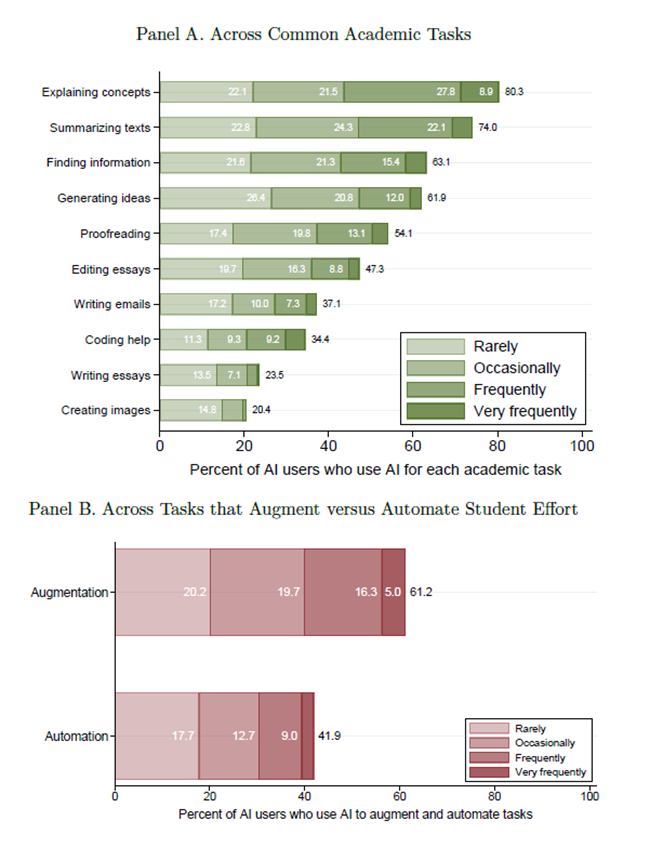
Contrary to fears about widespread academic dishonesty, students use generative AI more for augmentation (61.2%) than automation (41.9%), as shown in Figure 1.

Figure 1. Academic Uses of Generative AI

Augmentation includes using AI to explain concepts, find information, and receive feedback—activities that enhance learning while maintaining student engagement. Automation involves having AI directly produce outputs like essays or complete assignments.

Students frequently describe AI as an “on-demand tutor,” particularly valuable when traditional resources like office hours are unavailable. Non-native English speakers report using AI for proofreading to overcome language barriers, while STEM students use it to debug code and understand error messages. When students do automate tasks, it’s typically during periods of overwhelming workload, with time savings being the primary motivation.

Finding 2: Adoption varies dramatically across disciplines and demographics

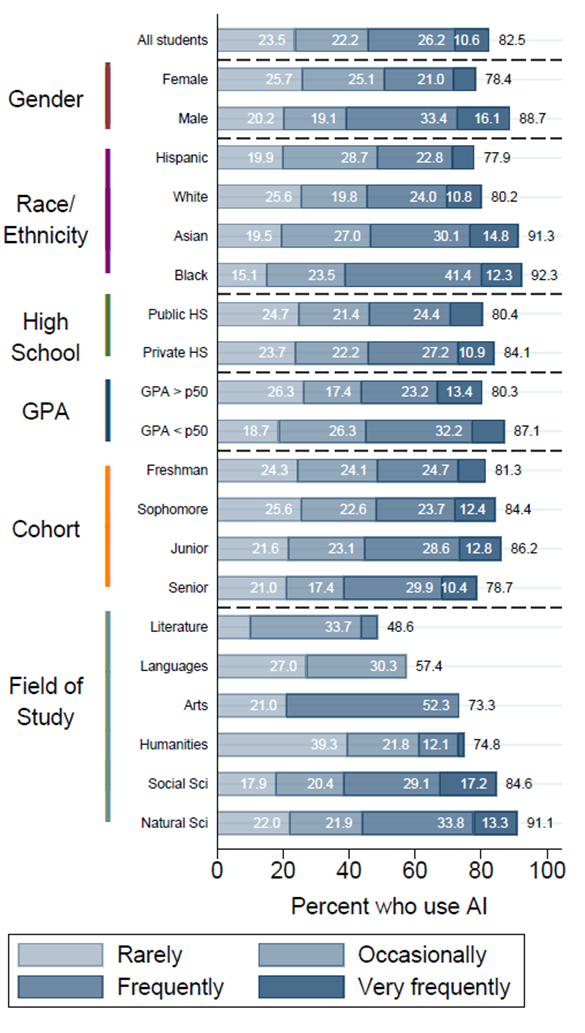
Figure 2. The Adoption of Generative AI among College Students

AI adoption is far from uniform. Natural Sciences majors (which includes computer science and math) lead with 91.1% usage, while Literature (48.6%) and Languages (57.4%) show substantially lower rates. This variation likely reflects how well AI capabilities align with field-specific academic tasks.

Notable demographic differences also emerge. Males adopt AI at higher rates than females (88.7% versus 78.4%), consistent with gender gaps documented across multiple contexts. Perhaps most surprisingly, lower-achieving students show higher adoption rates than their higher-achieving peers (87.1% versus 80.3%), suggesting AI could either help struggling students catch up or potentially widen achievement gaps if it undermines skill development.

Finding 3: Students believe AI improves learning but institutional policies matter

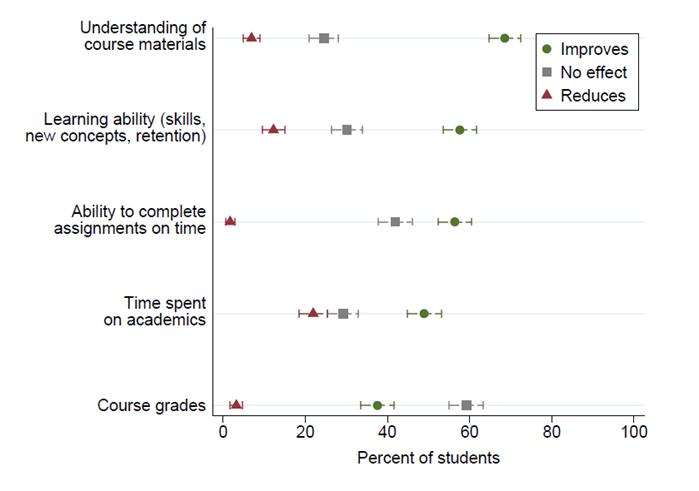
Figure 3. Student Beliefs about the Impact of AI on their Academic Performance

Most students believe AI improves their understanding of course materials (70.2%) and learning ability (60.1%), though fewer think it improves grades (41.1%), as shown in Figure 3.

These positive perceptions strongly predict adoption—a 10 percentage point increase in belief that AI improves learning corresponds to a 4.9 percentage point increase in usage.

Why this matters

These findings have important implications for educational policy. The rapid adoption and preference for augmentation over automation suggest that blanket AI bans may be both ineffective and counterproductive, potentially disadvantaging students who benefit most from AI’s learning enhancement capabilities.

The study also reveals significant information gaps—only 10.1% of students know about college-provided AI resources, and just 32.6% understand proper citation practices. These gaps suggest straightforward opportunities for improvement through better communication and training.

As generative AI becomes embedded in educational settings, understanding actual usage patterns becomes crucial. Rather than focusing on preventing cheating, institutions might better serve students by teaching responsible AI use that enhances rather than replaces learning. The technology has already transformed how students approach their education—the question now is how to harness it effectively.

Filed Under: Research Tagged With: ChatGPT, Generative AI, higher education, student learning, technology adoption

Understanding labor market adjustment in the age of automation

September 15, 2025 by Mark Fallak

The rapidly evolving landscape of the labor market, supercharged by advancements in AI, presents a complex challenge for policymakers striving to understand and mitigate its impact. A recent IZA discussion paper by Michael Johannes Böhm, Ben Etheridge, and Aitor Irastorza-Fadrique introduces an innovative equilibrium model designed to shed light on how workers and wages will adapt to these technological shifts. This model moves beyond simplistic categorizations of “automatable” jobs, instead offering a nuanced perspective by integrating expert data on automation’s reach, a sophisticated model of worker mobility, and historical evidence of past labor market adjustments.

One of the study’s core findings is the significant heterogeneity in workers’ ability to switch jobs. Occupations like those held by doctors and teachers are deemed “inelastic,” meaning substantial wage fluctuations do not translate into significant employment shifts. Conversely, roles in IT and administrative support demonstrate greater adaptability, with employment more responsive to wage changes.

Furthermore, the research reveals that occupational transitions are far from uniform in their ease. While some shifts, such as from lab technician to nursing, are common, others like moving from manufacturing to coding are infrequent and often entail considerable costs. This nuanced understanding of transition costs is crucial for effective policy design.

A particularly salient finding is the tendency for automation to impact similar jobs concurrently. This correlation in shocks limits workers’ fallback options, often preventing individuals in shrinking sectors from easily transitioning into growing, substitutable occupations.

Looking ahead, the model provides forward-looking projections for the labor market. It predicts an increase in employment for IT and construction-related occupations, alongside wage increases in the health and education sectors. Conversely, manufacturing jobs and even some high-skilled professions, including accountants and auditors, are expected to face declining wages. The analysis suggests that IT and tech roles will expand by attracting workers from a wide array of business and technical backgrounds, while manufacturing workers face limited attractive alternative occupations.

These findings carry profound implications for policy. Effective strategies must extend beyond merely identifying at-risk jobs to consider the realistic pathways for workers to transition elsewhere and the capacity of other occupations to absorb new labor. This necessitates targeted retraining initiatives for occupations with limited alternatives, along with comprehensive transition support such as job-matching and counseling along realistic career paths. Additionally, policymakers may need to explore wage subsidies or other support mechanisms for workers in low-mobility roles.

Ultimately, this research provides a powerful framework for policymakers to anticipate structural changes, predict the interplay between wages and employment, identify viable job transition routes, and craft more intelligent and targeted interventions to address potential inequalities in the labor market.

Filed Under: Research Tagged With: automation, job flows, labor demand

How workplaces shape the economic impact of caregiving shocks on mothers

June 4, 2025 by Mark Fallak

When a child falls seriously ill, the ripple effects go far beyond the hospital. For working parents—especially mothers—a sudden health crisis like a cancer diagnosis can upend careers, strain finances, and widen long-standing gender gaps in the labor market. A recent IZA discussion paper by Peyman Firouzi Naeim, David W. Johnston, and Maryam Naghsh Nejad explores this underexamined yet critically important issue: how do workplaces influence the extent to which caregiving shocks affect mothers’ jobs and incomes?

Using detailed administrative data from Australia, the researchers trace the employment and earnings outcomes of parents whose children are diagnosed with cancer. This rare but severe caregiving shock provides a unique lens through which to examine how workplace environments can either cushion or intensify the economic fallout. The findings offer powerful insights for policymakers, employers, and advocates interested in improving gender equity and caregiving support in the workforce.

Why this matters

While the effects of childbirth on women’s careers are well known, less attention has been paid to caregiving responsibilities that arise later in childhood. These episodes—often sudden and intense—can force parents to step back from paid work to care for their child, with long-term consequences for their earnings and career progression. Mothers are disproportionately affected, both because they tend to be the primary caregivers and because workplace structures often do little to accommodate these demands.

The researchers’ work sheds light on how much workplace characteristics matter in this context. By analyzing factors such as the prevalence of long working hours, the presence of women in leadership roles, and gender pay gaps across firms, occupations, and industries, they examine how workplace norms and structures influence the economic consequences of caregiving.

What the researchers did

The authors used population-wide data linking tax, welfare, and health records to follow the careers of nearly all parents in Australia whose children were diagnosed with cancer. This comprehensive dataset includes matched employer-employee records, allowing them to map out the workplace environments in which these parents were employed.

To identify the causal impact of caregiving, the researchers used a dynamic difference-in-differences approach. They compared parents of children recently diagnosed with cancer to those whose children will face a similar diagnosis in the future. This method allows them to control for family-specific characteristics and isolate the effect of the caregiving shock itself.

What they found

The effects on mothers are striking and persistent. In the year a child begins cancer treatment, maternal earnings drop by 15%. Even three years later, earnings remain nearly 10% lower than they would have been without the diagnosis. Notably, there is no similar impact on fathers’ earnings, reinforcing the gendered nature of caregiving responsibilities.

Workplace characteristics play a major role in shaping these outcomes. Mothers employed in firms or occupations with long average work hours experience larger earnings losses. In contrast, workplaces with more women in senior roles—especially at the firm level—are associated with smaller declines in maternal earnings. These results suggest that more flexible or supportive work environments can help mothers better balance caregiving with paid work.

Why workplace design matters

The findings suggest that workplace policies and cultures can significantly influence how families navigate serious caregiving demands. In particular, long-hour work cultures and limited representation of women in leadership appear to make it harder for mothers to stay engaged in the labor market during these shocks. Conversely, workplaces that offer flexibility and have more gender-equitable leadership structures may allow mothers to maintain employment and earnings more effectively. These environments likely reflect broader organizational support for caregiving, including formal policies (like leave or flexible schedules) and informal norms that shape how caregiving is viewed and accommodated.

Policy implications

The authors offer the following policy recommendations:

  • Supportive Work Environments Matter: Policymakers should encourage workplace flexibility and gender-inclusive leadership as part of broader efforts to improve labor market equity. Incentives or standards for caregiving-friendly practices could help reduce the economic penalties faced by working mothers.
  • Caregiving Leave Should Extend Beyond Early Parenthood: While many parental leave policies focus on the early years of a child’s life, these results highlight the need for support mechanisms that also address caregiving demands later in childhood—especially in cases of serious illness.
  • Targeted Income Support May Be Needed: Even in countries with robust health systems and social safety nets, families often bear long-term economic burdens when a child becomes seriously ill. Earnings losses that persist for years suggest a potential role for more generous or better-targeted income replacement during caregiving shocks.
  • Reducing Gender Gaps Requires Structural Change: The persistent earnings penalties for mothers underscore how gender inequality in the workplace is reinforced through caregiving demands. Addressing these disparities requires not only individual accommodations but systemic change in how work is structured and rewarded.

Looking ahead

As populations age and dual-earner households become the norm, the ability to balance caregiving with employment will only grow in importance. This study offers a data-driven look at one extreme but illustrative case: childhood cancer. The lessons apply more broadly to other caregiving scenarios—whether for children with chronic conditions, aging parents, or partners with disabilities.

Filed Under: Research

How administrative data fosters young economists’ careers

June 2, 2025 by Mark Fallak

The path to a successful academic career in economics is often shaped by more than just intellectual ability or hard work. Over the years, research has revealed that factors like institutional prestige, elite networks, and gender disparities play a major role in determining who gets hired, promoted, and recognized in the field. Scholars from top-ranked universities tend to benefit from better mentorship, greater visibility, and stronger professional connections. In contrast, women and researchers from less prestigious institutions often face tougher standards and fewer opportunities for recognition and collaboration.

A new dimension has emerged in this landscape: the increasing importance of administrative data. These large, detailed datasets, often maintained by government agencies, are now central to cutting-edge economic research, especially in applied fields like labor economics and public policy. But as this type of data becomes more essential for producing high-impact research, an important question arises: Does access to administrative data help level the playing field for early-career researchers, or does it further entrench existing academic hierarchies?

The case of VisitINPS

In a new IZA discussion paper, Anthony Lepinteur and Roberto Nistico address this question using a unique case: VisitINPS, a program run by the Italian Social Security Institute (INPS), which gives researchers access to rich administrative datasets on Italian workers, firms, and employment history. The authors follow nearly all early-career researchers who applied to VisitINPS over time, analyzing how data access affected their research output, visibility in the academic community, and job market outcomes.

The results show that access to administrative data can significantly shape academic careers. Researchers who gained access to the INPS data didn’t simply publish more papers. Instead, they were more likely to publish in prestigious field journals, especially in labor economics, where this data is particularly relevant. They also became more visible in the profession through working papers, conference presentations, and increased networking. These factors improved their standing in the academic job market, not necessarily through a sheer quantity of research, but by enhancing the quality and signals of their potential as scholars.

Interestingly, the impact of data access was not evenly distributed. Researchers from top-ranked PhD programs were particularly adept at converting data access into career benefits. On the other hand, even though women who accessed the data produced strong research, they didn’t experience a corresponding boost in career advancement. Additionally, data access also influenced where researchers ended up: while it reduced the probability of securing a position in a top world-ranked economics department, it increased their chances of getting hired at top departments within Italy, helping them build strong domestic careers.

Contributions and policy questions

This study offers several important contributions to ongoing debates in the economics profession. First, the paper adds to the growing literature on how resources and signals influence academic success. Just as graduating from a prestigious university or publishing in a top journal can open doors, access to administrative data is now another important career asset. This research highlights the growing importance of data access not only for individual academic careers, but also for the broader goals of scientific progress and evidence-based policymaking.

Second, the findings raise important policy questions. As programs like VisitINPS are publicly funded, understanding who benefits most from such programs is central to evaluating their distributional impact, not just on research outcomes but on the composition of the academic community itself. If those already well-positioned in academia are most likely to benefit from access to administrative data, such programs risk unintentionally reinforcing the very inequalities they seek to address.

Conclusion

In summary, the study offers a timely and thought-provoking look at how administrative data access affects academic careers in economics. As economics continues to evolve into a data-intensive discipline, who gets access to this data and who can make the most of it will play a defining role in shaping the next generation of scholars. While access to administrative data can be a powerful tool for research and professional advancement, its benefits are not automatically equitable.

Ensuring that all researchers can turn data into meaningful career opportunities will require more inclusive policy design. If programs like VisitINPS are to truly democratize research opportunities, they must ensure that access to data is paired with support mechanisms (such as training, mentoring, and infrastructure) that help researchers from diverse backgrounds succeed. Otherwise, the authors argue, the promise of data-driven research may remain out of reach for many talented scholars.

Filed Under: Research Tagged With: administrative data, career, economics

Raising the glass raises risks for the whole family

May 30, 2025 by Mark Fallak

A new IZA discussion paper by Petri Böckerman, Mika Haapanen, and Christopher Jepsen investigates the health impacts of Finland’s legal minimum drinking ages. The study, which uses nationwide register data and a regression discontinuity design, reveals far-reaching consequences of alcohol policy, extending beyond the individual to impact household members.

The researchers found that reaching age 18, when access to beer and wine becomes legal, significantly increases mortality and hospitalizations, particularly among men. These negative outcomes are primarily linked to alcohol-related causes and traffic accidents. The findings also show that at age 20, when access to spirits is granted, there’s a rise in alcohol-related deaths among men and an increased suicide risk among women.

Crucially, the study highlights substantial spillover effects within families. When an older sibling reaches the legal drinking age, younger siblings – especially brothers – face increased risks of alcohol-related deaths, accidents, and suicide attempts.

These results underscore that legal age thresholds for alcohol access affect not only the person gaining access but also their immediate household members. The study emphasizes the unintended broader consequences of alcohol policy and suggests that effective public health strategies must account for these family-level effects when designing and evaluating age-based alcohol regulations.

Filed Under: Research Tagged With: alcohol, drinking, health, mortality, siblings

Gender-based expectations influence external demands for parental involvement

May 28, 2025 by Mark Fallak

A new IZA discussion paper explores an everyday but important question: When systems, like schools, reach out to families, who do they contact first—mothers or fathers? The study by Kristy Buzard, Laura Katherine Gee, and Olga B. Stoddard uses a large-scale field experiment to show that mothers are 1.4 times more likely than fathers to be contacted.

The findings shine a light on significant ways that gender roles continue to shape family and workplace dynamics today. The study involved sending emails to over 80,000 school principals across the United States. These messages came from fictional families—each one portrayed as a married, heterosexual couple with a school-aged child. The goal of the email was straightforward: the family was moving to the area and looking for a school for their child.

The message asked the principal to call to discuss school options and provided phone numbers for both parents. The key to the experiment was in the wording of the email. Sometimes the message was neutral—giving both phone numbers but not suggesting who should be contacted. In other cases, the email stated that one parent was more available or less available for a conversation.

The researchers then tracked who got a phone call—mom or dad. In the first version of the email, there was no suggestion of which parent should be called. It simply said, “Can you call one of us to discuss?” and listed the phone numbers for both the mother and the father.

The default to mothers

So, in a situation where there’s no stated preference, do school principals reach out to both parents equally? Not quite. When a call was made in this group, it went to the mother about 60% of the time. This is well above the 50% mark that would be expected if the choice were completely random.

In a second version of the email, the message included a clear statement: the father had a lot of availability to talk. This time, the researchers were checking whether principals would adjust their outreach accordingly and prioritize the more available parent. And they did—to some extent. In this scenario, over 70% of the calls went to the dad. So yes, principals were more likely to contact the father when told he was more available.

But here’s the twist: 26% of the time, they still called the mother, even though the father said he was very available. This suggests that even when dads state that they are clearly available, there’s a strong tendency to contact moms.

A version of the email said that the mother had a lot of availability. Now the outcome was even more skewed. A full 90% of the calls went to the mother. That’s a much stronger shift than in the previous case. When mom was described as the very available parent, principals overwhelmingly chose to contact her. So while they responded to availability in both cases, the bias in favor of contacting mothers was stronger when it aligned with traditional expectations.

Broader implications for gender equality

These differences in call patterns point to deeper societal norms and expectations. The researchers argue that the results are likely just the visible part of a much larger issue. They suspect that similar biases play out in many day-to-day situations—like when schools need to call home because a child is sick or when teachers need help organizing an event. In those cases, moms are probably contacted even more often than dads, even when both parents are equally capable or available.

This pattern of defaulting to mothers as the primary contact point—even when they’re not available—feeds into broader issues of gender inequality. For example, if mothers are always the ones being contacted by schools, they may be the ones more likely to miss work, adjust their schedules, or take time off. Over time, that can have real consequences for their careers and income.

This research helps explain why progress toward gender equality in the workplace has been so slow, even as cultural attitudes have shifted. If society continues to place more caregiving and coordination responsibilities on mothers, women will continue to face extra hurdles when it comes to balancing work and family life.

Addressing unconscious biases

The study doesn’t suggest that principals are intentionally biased. In fact, many probably aren’t even aware of these patterns in their behavior. But that’s exactly the point: many gender-based expectations are so deeply embedded that they operate beneath the surface. They’re part of our habits, assumptions, and unconscious decision-making.

By bringing this issue to light, the researchers hope to start a conversation—not just in schools, but in all workplaces and households—about how gender roles continue to influence our actions in subtle ways. They argue that recognizing and addressing these patterns is a key step toward greater fairness and equality in both the home and the workplace.

Filed Under: Research

Pandemic slowed German firms’ tech progress

May 26, 2025 by Mark Fallak

A new IZA discussion paper by Melanie Arntz, Michael Johannes Böhm, Georg Graetz, Terry Gregory, Florian Lehmer, and Cäcilia Lipowski investigates how German firms adjusted their technology investments before and during the COVID-19 pandemic. The researchers aimed to answer two key questions: Did the crisis accelerate the adoption of advanced, “frontier” technologies (the latest, most integrated tech tools)? Or did it primarily shift investment focus towards solutions like remote work technologies, without boosting overall advanced technology use?

The study defines frontier technologies as state-of-the-art office tools (e.g., cloud computing, automated marketing, AI in business software) and advanced production equipment (e.g., smart robotics, integrated manufacturing systems).

Methodology: A deep dive into firm-level data

The study draws on a large, detailed survey of around 3,000 German firms, enriched by linking survey responses to administrative worker data and other official records. This allowed the researchers to capture:

  • When new technology investments were made (pre- or during-pandemic).
  • Whether these investments were explicitly motivated by the pandemic.
  • How firms’ technology use (office and production) changed over time.

By comparing current practices to data from a 2016 survey, the researchers tracked technology adoption changes over several years.

Key findings: Shifting sands of tech investment

Contrary to expectations, overall investments in frontier technologies actually dropped during the pandemic. For instance, before COVID-19, about 6% of firms annually invested in cutting-edge office technology; this rate nearly halved to roughly 3.6% during the pandemic. A similar, even steeper, decline occurred for production-related technology.

Only a small percentage of firms made their main technology investments specifically in response to the pandemic. Even when COVID-19 was cited as a reason, these pandemic-driven investments were smaller in scope. While additional secondary investments increased the percentage of pandemic-related investments somewhat, they still couldn’t match the scale of pre-crisis investments.

A clear change was firms shifting focus toward technologies supporting remote operations. Investments in communication, collaboration, and remote-work tools significantly increased, becoming crucial for maintaining connectivity and business continuity during lockdowns.

The study also examined the link between technology investments and workforce changes. Firms investing in remote work solutions saw a marked increase in employees working from home. They also relied less on government-supported short-time work schemes. This suggests that while overall tech spending declined, the investments made helped firms adjust and stabilize their workforce during the crisis.

Implications: Long-term growth and policy considerations

The pandemic appears to have slowed the overall pace of frontier technology adoption. Using models to compare outcomes with a no-crisis scenario, the researchers estimate firms lost approximately 1.4 years of technology investment activity relative to normal times. This slowdown indicates that despite the clear need for digital adjustments, large-scale technology investments decreased.

Investments in remote work tools provided an immediate remedy, helping firms adapt to COVID-19 restrictions. However, these changes were typically small-scale and more reversible, not signaling a broader, lasting shift towards a more technologically advanced operating model. The long-term plans of these firms didn’t show a strong, sustained commitment to additional frontier technology investments once the immediate crisis passed.

The findings raise important questions about how economic crises affect long-run growth. In Germany, the slowdown in adopting advanced technologies might contribute to lower productivity growth. The researchers suggest this pattern may call for counter-cyclical innovation policies—policies that boost technology investments during economic downturns to support long-term growth.

Conclusion: A complex picture of technological change

The study concludes that rather than dramatically accelerating advanced technology uptake, the COVID-19 crisis led to an overall reduction in such investments among German firms. While firms did reorient spending toward remote work tools—helping them manage operational challenges—these adjustments weren’t enough to offset the significant loss in broader technology adoption.

Consequently, while short-term adaptations stabilized employment, the long-term trajectory of technological progress may have slowed, with potential implications for future economic growth. This research underscores the complexity of technological change during crises and highlights the need for supportive policies to prevent temporary setbacks from having lasting effects on a nation’s economic dynamism.

Filed Under: Research

  • Page 1
  • Page 2
  • Page 3
  • …
  • Page 69
  • Next Page

Primary Sidebar

© 2013–2025 Deutsche Post STIFTUNGImprint | Privacy PolicyIZA