 Despite increasing female labor market participation, gender differences in labor market outcomes persist: men earn more, have better employment perspectives and better access to top positions. One explanation for the persisting gender gap is that women are more reluctant to engage in competition. A new IZA discussion paper by Maria De Paola, Francesca Gioia and Vincenzo Scoppa tests this hypothesis by running a field experiment. The experiment involves 720 undergraduate students enrolled at an Italian university and attending three economic courses in the academic year 2012-2013. The experimental design aims at disentangling gender differences in taste for competition from other differences in psychological attitudes, such as self-confidence and risk aversion. Students were invited to undertake a mid-term exam under a tournament scheme where they have the opportunity to win bonus points for the final exam. Students competed in pairs of equal ability but different gender composition. The authors find that females are as likely as males to take part in the competition. Moreover, men and women perform similarly both in the competitive and in the non-competitive environment. Lastly, the gender of one’s competitor does not affect student behavior.
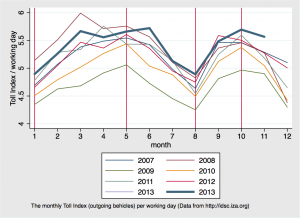
Toll Index – November 2013 – German Economy finishes strong
 The Toll Index for the month of November is just out (download the data from the IDSC of IZA) and shows a seasonally expected, slight drop, month on month partly accounted for by the working days difference (21 working days in November vs 22 in October 2013). Overall though the Toll Index shows an exceptionally high, heavy transport activity in the month of November (best November since at least 2007) reenforcing a late pattern and indicating that German manufacturing and the German economy as a whole may be closing the year on a fireworks note (we expect the BMWi to announce a strong Produktionsindex in about 3 weeks time). If we didn’t know better and if we wanted to poke the German political elite a bit we would say that the lack of government did not exactly harm the economy. It remains to be seen of course what the effect of the new government on the economy will be in the upcoming months which according to some estimates may not be as amusing (False Hopes in Germany’s Minimum Wage)…
After-school care allows parents to share work more equally
 While more and more women with children work in OECD countries, less than a half of them have a full-time position, which has negative consequences on future career opportunities. In the public debate, after-school child care facilities are seen as one key element to help women with children to increase their working hours. Yet, it is still unclear whether the availability of after-school care really stimulates the employment of mothers. Similarly, it is unknown how fathers’ employment reacts to an increase in the provision of supplementary school care. A new IZA discussion paper by Christina Felfe, Michael Lechner and Petra Thiemann analyzes whether after-school care provision promotes mothers’ employment and balances the allocation of paid work among parents of schoolchildren. The authors address this question by analyzing differences in cantonal (state) regulations of after-school care provision in Switzerland. In particular, they analyze confined regions along cantonal borders with different regulations on each side of the border. The authors show a positive impact of after-school care provision on mothers’ full-time employment, but a negative impact on fathers’ full-time employment. They conclude that the supply of after-school care fosters a convergence of parental working hours.
On the distributional effects of macro policies
Policy choices have distributional consequences. This proposition is seen as self-evident in the context of certain macroeconomic policies such as fiscal policy that often have an explicit redistributive element. However, far less attention has been paid to the distributional consequences of a range of other macroeconomic and structural policies, with much of the analysis in the academic literature typically focused on aggregate consequences, especially in terms of growth and volatility.
In a new IZA discussion paper, Eswar Prasad argues that a broad range of macroeconomic policies – especially those related to monetary policy and financial regulation – can also have significant distributional consequences. The reason is that financial markets are incomplete, imperfect (e.g., due to information asymmetries), and economic agents’ access to them is often limited. Consequently, households cannot effectively insure against the asymmetric effects of such policies.
In emerging markets and low-income economies, underdeveloped financial markets, coupled with insufficient access to formal financial institutions, limit households’ ability to insure against household-specific shocks and magnify the distributional effects of aggregate macroeconomic fluctuations that may initially have only small effects.
While distributional consequences of policies are of intrinsic interest, a related and equally important question is whether these consequences in turn determine the choice of policy responses to specific shocks. According to the author, such choices, which often reflect the relative political power of different groups, can sometimes have deleterious aggregate consequences.
Prasad argues that it is important to explicitly recognize distributional rather than just aggregate consequences when evaluating specific policy interventions as well as the mix of different policies. This does not mean, for instance, that central bankers should include measures of inequality in their operating rules. Rather, it is a call for a more careful evaluation of welfare consequences of policies that do not just focus on aggregate outcomes.
Broadband internet makes low-skilled workers more dispensable
 Does adoption of broadband internet in firms enhance labor productivity and increase wages? And is this technological change more beneficial for for high-skilled workers? A new IZA discussion paper by Anders Akerman, Ingvil Gaarder and Magne Mogstad answers these questions using rich Norwegian data with firm-level information on value added, factor inputs and broadband adoption. The authors exploit a public program that rolled out broadband access points to examine how it shifts the production technology and changes the productivity and labor outcomes of different types of workers. They find that broadband adoption favors skilled labor by increasing its relative productivity. The increase in productivity of skilled labor is especially large for college graduates in fields such as science, technology, engineering and business. By comparison, broadband internet is a substitute for workers without high school diploma, lowering their marginal productivity.
Consistent with the estimated changes in labor productivity, wage regressions show the expansion of broadband internet improves the labor market outcomes of skilled workers and worsens the prospects of the unskilled. The authors explore several possible explanations for the skill bias of broadband internet. They find suggestive evidence that broadband internet complements skilled workers in executing non-routine abstract tasks, and substitutes for unskilled workers in performing routine tasks. Taken together, the findings have important implications for the ongoing policy debate over government investment in broadband infrastructure: On the one hand, broadband internet can enhance firm productivity. On the other hand, it seems to have strong distributional implications favoring skilled workers, which could be a barrier to government investment in broadband infrastructure.
Higher bride prices reduce fertility – evidence from Senegal
 The bride price payment is a key element of the marriage contract in many sub-Saharan African countries, and particularly in Senegal. Contrary to a dowry payment, where the bride and her family give the marriage payment to the groom and his family, a bride price payment is defi
ned as the money or wealth transfer given by or on behalf of the groom to the bride and her family upon the marriage of the couple. Such a bride price system raises several concerns related to the economics of the marriage market, gender empowerment and intra-household bargaining power.
The bride price payment is a key element of the marriage contract in many sub-Saharan African countries, and particularly in Senegal. Contrary to a dowry payment, where the bride and her family give the marriage payment to the groom and his family, a bride price payment is defi
ned as the money or wealth transfer given by or on behalf of the groom to the bride and her family upon the marriage of the couple. Such a bride price system raises several concerns related to the economics of the marriage market, gender empowerment and intra-household bargaining power.
In a new IZA discussion paper, Linguère Mously Mbaye and Natascha Wagner analyze the effects of bride prices on fertility decisions. Using a unique panel dataset of married couples from rural Senegal, the authors find that women who receive a higher bride price have fewer children. The authors interpret their results in the following way: A marriage represents a social contract between a man and a woman with clearly defined roles. The husband takes the woman and gives her economic security. His appreciation of the bride and the value she represents for him is expressed by the bride price he pays. Whenever the groom is willing to give a higher bride price, he demonstrates his willingness to treat his wife well and avoid the risk of divorce, which would correspond with a financial failure of the investment. In turn, from the bride price payment received, the women can judge whether she needs to gain reputation within the groom’s family by giving birth to many children.
In line with this interpretation, the authors show that the bride price is an especially strong predictor of fertility in poor, low-educated and polygamous households. In contrast, it has no effect on fertility decisions in monogamous households and for love marriages.
Learning from nuns: Catholic schools are not better than the rest
 Several empirical studies have attempted to assess whether private schools provide better education than public schools. This question is crucial both for educational policy and parents’ school choice. Advocates of school competition often base their arguments on evidence suggesting positive effects of private schooling on educational outcomes. Indeed many studies have demonstrated a positive correlation between Catholic school attendance, which account for the largest share of private schools, and educational outcomes. Yet, a causal interpretation of this relationship is only valid if there are no other unobserved characteristics, such as student ability, that affect school choice and educational outcomes.
A new IZA discussion paper by Rania Gihleb and Osea Giuntella investigates whether the positive correlation between Catholic school attendance and educational outcomes is actually causal by using a novel approach that exploits an “religious earthquake” occurring in Rome in the early 1960s: With the universal call to holiness and the opening to lay leadership, the Second Vatican Council inadvertently produced a dramatic change in the cost and benefits of religious life and drained Catholic schools of critical human capital. Between 1966 and 1980, the number of Catholic sisters (nuns) was reduced by more than 30% and the share of religious teachers in Catholic schools fell by more than 50%. Because religious teachers were paid, on average, one-third the amount that lay teachers were paid, the sudden and rapid shift in personnel imposed severe financial constraints on Catholic schools and forced many schools to close.
Exploiting these supply shocks to Catholic schools, the authors merge diocesan data and data from the US Census to investigate whether Catholic schools indeed produce better students. Assuming that the demand for Catholic schools was unaffected by the “religious earthquake”, Gihleb and Giuntella show that there is no evidence of a positive effects of attending a Catholic school on student outcomes. If anything, they find evidence of negative effects. These results, in turn, suggest that the correlation between Catholic schooling and student outcomes are entirely driven by a positive selection of the students. In other words, students of Catholic schools are likely to be smarter already before attending the school.
Apprenticeships improve job opportunities
 In Italy, as in many other European countries, apprenticeships and on-the-job training have been gaining popularity. Although being only of temporary nature and exhibiting a relatively low level of employment protection, apprenticeships are widely believed to be a successful form of employment as they may eventually lead to permanent contracts. A new IZA discussion paper by Matteo Picchio and Stefano Staffolani puts this claim at a test by using administrative labor market data from Italy. The authors affirm that apprenticeships are sorts of “long entrance halls” towards open-ended contracts: apprentices often remain in the firm where they performed their apprenticeship.
People who play sports do better on the job
 Does playing sports or going to the gym help your career? In a new IZA discussion paper, Paul Downward and Michael Lechner investigate effect of sports participation on employment and earnings for England. The study is based on a unique dataset measuring participation in different types of sports, various labor market outcomes, and the availability of local sports facilities.
Downward and Lechner find a clear and positive association between labor market outcomes and sports participation, even when accounting for such factors as health or family composition, which could affect both sports participation and labor market success. The results suggest that sports has a positive effect on initial employment and on income opportunities at higher ages. Different types of sports have different effects: While participation in team sports is broadly associated with increased employability, fitness and outdoor activities have stronger associations with income.
Did your grandpa change his name? Find out why that was a smart thing to do.
Many immigrants arriving in America in the early 20th century started a new life, and often they started it with a new name. In fact, many Americans today have heard stories of migrant ancestors Americanizing their names. What exactly was the extent of this phenomenon? What consequences did it have on migrants’ economic success? A new IZA discussion paper answers these questions for the first time.
Costanza Biavaschi, Corrado Giulietti and Zahra Siddique have digitalized historical records that contain information on name Americanization. By digging through thousands of 1920s naturalization papers from New York City, the authors track a wide range of characteristics of migrants. Since migrants had to fill out two separate documents for the naturalization procedure, their characteristics can be observed both before and after they changed their names.
With almost a third of naturalizing immigrants abandoning their names and acquiring popular American names such as William, John or Charles, the authors find that not only was name Americanization a widespread practice, but it was also associated with substantial improvements to the migrant’s economic success. Migrants who Americanized their name earned at least 14% more than those who did not.
While acquiring a more popular American name could have influenced migrants’ success, it’s also quite possible that the choice of the new name reflected other aspects related to their experiences in the States during the 1920s, for example the acquisition of language skills. To find whether it was exclusively name Americanization that led to economic advancement, it is necessary to find factors influencing why migrants would Americanize their names that are unrelated with their earnings. The authors observe that individuals with names of certain linguistic complexity decided to Americanize their names irrespective of other reasons like socio-economic background. They measure such linguistic complexity using the amount of Scrabble points – yes, from the popular board game! – associated with each name. This allows them to isolate the pure effect of name Americanization on earnings from other spurious factors like language acquisition.
The findings of this research highlight the tradeoff that many migrant ancestors faced between maintaining one’s individual identity and being more successful in the labor market. Surely, nowadays, there are many alternative ways to make a better salary; perhaps giving up your name is something you did not think about. Until now.