• Skip to primary navigation
  • Skip to content
  • Skip to primary sidebar

IZA Newsroom

IZA – Institute of Labor Economics

  • Home
  • Archive
  • Press Lounge
  • DE
  • EN

Mark Fallak

Can more education save the planet?

March 16, 2023 by Mark Fallak

Climate change poses existential risks to the planet and generates trillions of dollars in annual costs to society. While changing pro-climate beliefs, behaviors, policy preferences, and voting is difficult, a promising approach is through more education.

A recent IZA discussion paper by Noam Angrist, Kevin Winseck, Harry A. Patrinos and Joshua Graff Zivin provides strong causal evidence that education can impact a range of pro-climate outcomes. The authors find that an additional year of education is linked with increases in pro-climate beliefs, behaviors, most policy preferences, and green voting, with voting gains equivalent to a large 35% increase – effects which are particularly consequential to promote pro-climate policies.

While education is often a footnote in climate change agendas, this paper reveals the promise of education as an additional tool to combat climate change. Europe in particular is a context where climate change is receiving substantial attention, including efforts such as the European Green New Deal, yet education remains an underutilized lever.

Moreover, while educational attainment has expanded dramatically in recent decades, the median school reform law in 2020 in Europe guaranteed only 10 years of schooling, a full two years below a complete primary and secondary education of 12 years.

These gaps are even more dramatic in the developing world; in sub-Saharan Africa educational reform laws only guarantee 8 years of schooling on average. Expanding access to education has traditionally been believed to play a transformative role in the economic and social well-being of societies – it now also appears to play a vital role in the battle against climate change.

Filed Under: Research Tagged With: climate change, compulsory schooling, education, human capital, voting

IZA promotes innovative economic research on climate change

March 6, 2023 by Mark Fallak

To foster research into the nature and implications of climate change, IZA gives an award for “Innovative Research in the Economics of Climate Change” (IRECC) for the two best topical IZA Discussion Papers of the previous year. Worth 10,000 euros, the IRECC Award recognizes important new insights into the broader, often underestimated consequences of climate change and the effects of environmental policies on society and the labor market.

From papers published between December 2021 and December 2022, these two have been selected for the 2023 IRECC Award:

 “Understanding Climate Damages: Consumption versus Investment” (IZA DP No. 14974) by Gregory Casey, Stephie Fried and Matthew Gibson shows that the welfare cost of climate change larger may be larger than currently estimated. The reason is that existing climate-economy models use aggregate damage functions to model the effects of climate change. This approach assumes climate change has equal impacts on the productivity of firms that produce consumption and investment goods or services. The authors show the split between damage to consumption and investment productivity matters for the dynamic consequences of climate change. Drawing on the structural transformation literature, they develop a framework that incorporates heterogeneous climate damages. When investment is more vulnerable to climate, short-run consumption losses will be smaller than leading models with aggregate damage functions suggest, but long-run consumption losses will be larger. The study quantifies these effects for the climate damage from heat stress and find that accounting for heterogeneous damages increases the welfare cost of climate change by approximately 4 to 24 percent, depending on the discount factor.

“Climate Change and Political Participation: Evidence from India” (IZA DP 15764) by Amrit Amirapu, Irma Clots-Figueras and Juan Pablo Rud provides new evidence about the ways in which political agents in developing countries (including both voters and candidates) may respond to climate change via political channels. The authors study the effects of extreme temperature shocks on political participation using data from Indian elections between 2009 and 2017. Taking advantage of localized, high-frequency data on land surface temperatures, they find that areas with greater cumulative exposure to extreme temperatures experience an increase in voter turnout and a change in the composition of the pool of candidates who stand for election. As a consequence, electoral outcomes are affected. The results are driven by the negative effect of climate change on agricultural productivity. First, the results are strongest in areas with a larger rural population. Second, there is a non-monotonic relationship between temperatures and turnout which closely mirrors the relationship between temperatures and agricultural productivity. Also, following temperature shocks, winning candidates are more likely to have an agricultural background. Finally, politicians with an agricultural background invest more in irrigation, which mitigates the effects of high temperatures, on both agricultural production and on turnout.

The IRECC winners “represent the best of modern applied-economics research,” according to the award committee made up of Susana Ferreira (University of Georgia) and Andrew Oswald (IZA and University of Warwick).

All climate-related IZA discussion papers submitted in 2023 will qualify for the second IRECC award, to be given in early 2024.

Filed Under: IZA News Tagged With: climate change, IRECC

How immigration affects housing costs

March 3, 2023 by Mark Fallak

Most advanced countries experienced a strong upward trend in housing costs since the mid 20th century. In Switzerland, prices of both single-family homes and owner-occupied apartments have roughly doubled in the period 1985-2016. Rental prices (for new lettings) also show a clear upward trend from 1999 onwards. One potential cause of rising housing costs is the massive immigration wave following the Agreement on the Free Movement of Persons (AFMP) between Switzerland and the EU. As of 2002, the immigration reform completely lifted immigration restrictions for EU workers, who are often better skilled and earn more than other immigrants.

The AFMP reform lends itself ideally to recover empirically causal (short-run) effects of immigration on housing prices. A recent IZA Discussion Paper by Fabienne Helfer, Volker Grossmann and Aderonke Osikominu employs two empirical strategies that exploit the reform and the historical distribution of immigrants across regions to generate exogenous variation in immigration flows to Swiss regions.

The first approach proposes an instrumental variables (IV) strategy that employs the widely used “shift-share” instrument for immigration. This instrument uses the historical distribution of immigrants (as of year 1980) across regions in Switzerland to predict current inflows into the respective regions. It exploits the tendency of newly arriving immigrants to move to areas where other immigrants of the same nationality already live.

The IV approach assumes that historical settlement patterns have no direct effect on the growth of current housing prices. Exploiting regional variation at the level of 106 local labor markets (MS regions) for the time period 1985-2016, the analysis suggests that immigration has substantially raised prices of owner-occupied housing after the AFMP reform came into place, whereas pre-reform immigration did not have an effect on housing costs. The differential impact of immigration before and after the AFMP reform confirms the exogeneity of historical immigrant settlement patterns.

The baseline estimates imply that an annual increase in the stock of foreigners equal to 1% of the initial population leads to an increase in single-family home prices by 4.3% and in owner-occupied apartment prices by 5.9% after the reform. Estimates based on cantonal data for the years 1998-2016 suggest that immigration raises rental prices even more than prices of owner-occupied housing. Immigration effects are lower when the immigration inflow is measured by the number of foreigners entering the country minus those leaving it (net migration), but still sizable.

The second empirical approach consists of an event study of the changes in house prices before and after the AFMP reform, where MS regions are grouped according to their historical share of immigrants from EU-15 countries (in 1980). Again, it is based on the hypothesis that immigration from the EU is particularly high in those regions where those migrants already live.

The event study analysis suggests that switching from a region with a historically low or medium level of immigration from EU-15 countries to one with a high past stock of EU immigrants raises the annual growth rate of house prices by about one percentage point after the AFMP reform. To the contrary, the historical level of the stock of foreigners from EU-15 countries did not matter for house prices before the reform. The event study approach thus verifies that housing price dynamics are indeed unrelated to the historical share of immigrants before the reform, which supports the validity of the shift-share instrument in the IV approach.

The results have potentially important policy implications. Despite the undisputed positive effects of (particularly) high-skilled immigration on labor market outcomes and economic development in an advanced economy such as Switzerland, the associated increases in housing prices particularly harm low-income individuals who do not own homes.

Ignoring these effects can generate resistance to liberal migration policies, as observed in Switzerland and elsewhere. Compensatory measures through the tax-transfer system and deregulation of zoning restrictions to promote housing construction could mitigate the distributional consequences of immigration in the medium run and could help avoid political backlash against the free movement of workers in Europe.

Filed Under: Research Tagged With: EU, freedom of movement, housing, immigration, Switzerland

G²LM|LIC Call for Proposals

February 16, 2023 by Mark Fallak

The IZA/FCDO Programme on Gender, Growth and Labour Markets in Low-Income Countries (G²LM|LIC) has opened the electronic application portal for Phase VI research proposals. Two types of research grants will be offered:

  1. Large-scale research grants for experienced researchers based in institutions and organizations from all over the world to fund larger research projects in LICs, with a minimum value of 100,000 Euros, up to a value of approximately 400,000 Euros.
  2. Small research grants to fund research projects in LICs, with a maximum value of 25,000 Euros, mainly targeting junior researchers (PhD students or researchers who have less than five years of work/research experience past their PhD) based in institutions and organizations from all over the world, as well as senior or junior researchers based in institutions and organizations in LICs. Small grants are designed to be contracted directly with individual researchers, not with the researcher’s institution.

The deadline for submission is April 10, 2023.

For details see: Call for Proposals 2023

Filed Under: IZA News Tagged With: G²LM|LIC, research grants

Do digital technologies complement or substitute employee training?

February 15, 2023 by Mark Fallak

There is much concern in policy circles about the labor market consequences of automation and digitalization. Several studies have stressed the importance of re-training and up-skilling workers whose jobs are being affected by technology. Adult learning is often seen as a useful antidote to navigate the troubled waters of modern labor markets. Since a substantial share of training is employer-provided, it is important to understand whether and how the increased use of automation and digitalization technologies affects employers’ incentives to invest in the training of their employees.

In a new IZA discussion paper, Giorgio Brunello and colleagues address this question by using rather unique firm-level data that cover the 27 EU countries, the UK and the US and include information both on the use of Advanced Digital Technologies (ADT) and on training investment. They show that employers adopting these technologies have reduced their investment in training per employee, especially in countries where employment protection legislation is less severe or where public training expenditure as share of GDP is lower. The authors argue that the observed reduction is unlikely to reflect only a decline in the cost of training but is also a reduction in the percentage of individuals undertaking job-related training.

Substitutes in production

A mechanism explaining this result is that ADT and training investment per employee are substitutes in production, which implies that a higher use of the former reduces the marginal product of the latter. This could happen because ADT not only replace unskilled labor with capital but also modify the remaining tasks filled by labor in such a way that the productivity of training declines. For example, the remaining tasks could be more focused on social interaction and communication, requiring different types of training and often informal learning, which is not captured by data on training investment.

Firms using ADT could also fill the skilled positions associated with these technologies by hiring rather than by training in-house, thereby reducing training needs. This explanation would also be in line with persistently high shortages for digital experts observed on labor markets in recent years. Although average training investment per employee has declined with automation, total firm-specific investment has increased because of the positive employment effects.

The study shows that the decline of training investment per employee with digital use and intensity is typical of countries with a relatively low public training expenditure (as a share of GDP). In countries that spend more on training policies – which include subsidies to employers – employers’ training investment per employee does not fall with digital use or intensity.

Risk of widening inequalities

On the one hand, these results are worrisome with respect to countries where there is little investment in active labor market policies and limited investment in training by employers. Here, the risk of widening inequalities linked to digitalization might be most pronounced. On the other hand, the findings point to the potential of positive complementarities between public and private sector.

Where spending on active labor market policies focusing on training is higher, firms also appear more likely to continue higher levels of training investment. This is particularly important in the current environment characterized by automation and digitalization to foster re-skilling and up-skilling, not only because they provide training opportunities for the displaced and unemployed, but also because they stimulate employers to invest more.

The combination could help to maintain high levels of employment against the background of accelerating digitalization as it facilitates adaptation to changing tasks and ways of work within firms and offering those having lost their jobs better opportunities for labor market reintegration. Finally, the combination would raise skill levels across the workforces, thereby helping to mitigate skill gaps.

Filed Under: Research Tagged With: automation, digitalization, productivity, training

“Higher wages or better working conditions can resolve labor shortages”

February 8, 2023 by Mark Fallak

In an interview with SPIEGEL Online, IZA’s new CEO Simon Jäger comments about the labor shortages that many German industries are complaining about, and suggests a simple solution. Below is an English translation of the German interview.

SPIEGEL: Mr. Jäger, companies are unable to fill around two million vacancies. Teachers, daycare staff, nurses and IT specialists are desperately needed. And you claim there is no labor shortage?

Simon Jäger: Yes, these labor shortages are essentially a myth.

Firms have been complaining about a shortage of skilled workers for the past 40 years.

SPIEGEL: What makes you think that?

Jäger: In the debate, we have to distinguish between two situations: now and in the future. Currently, there are more people in work in Germany than ever before – 45.9 million people who are better educated than all previous cohorts. Firms have been complaining about the shortage of skilled workers for the past 40 years. However, there is a simple market-based solution: higher wages. If a company offers higher wages or better working conditions, it becomes more attractive.

SPIEGEL: And if employers can’t afford that?

Jäger: Of course, in the case of hairdressers, for example, it depends on what price customers are willing to pay. But that doesn’t change the fact that there is no shortage of workers overall, they are just elsewhere. In this respect, the crucial question is: Who works where? We know from various studies that people move to jobs – or stay in jobs – that offer good wages and working conditions. So there is a simple market-based solution.

If firms want to find or retain workers, they will need to pay more or create better working conditions.

SPIEGEL: So the market takes care of everything?

Jäger: If firms are looking for workers or want to retain them, they will need to pay more or create better working conditions. But what we saw last year were massive real wage losses for employees, while at the same time employment was at a record high. That doesn’t fit with claims of labor shortages. In economic terms, we have an unusual situation: workers are in high demand, but real wages have fallen. Incidentally, this perceived shortage of skilled workers and the price signals sent by the market may also be socially desirable.

SPIEGEL: What do you mean?

Jäger: Over the last 30 years, we see that real incomes in the low-wage sector have stagnated on average, even though overall productivity has risen sharply. For a long time, lower incomes have hardly benefited from economic growth. But the low-wage sector is precisely where the pressure is now felt most.

SPIEGEL: Demographic change will reduce the number of workers available to the labor market in the future. Won’t skilled workers then be in short supply?

Jäger: We are an aging society. In the long term, the labor force potential will decline sharply. However, it is possible to take effective countermeasures.

SPIEGEL: The German government’s skilled labor strategy calls for higher female labor force participation, a modern immigration policy and targeted training measures. Are these the right steps?

An efficient allocation of the labor force is essential.

Jäger: Society must decide what answers to give. That’s a political decision. If we want to prevent the labor market in Germany from shrinking, a variety of measures could be effective. Highly mobile, international skilled workers can choose to go to the U.S., Sweden or Switzerland. For Germany to stand a chance in the fight for talent, we will need higher wages, better working conditions and long-term prospects for immigrants. And the system of joint income taxation of married couples still stands in the way of higher female labor force participation.

SPIEGEL: Measured against the demand for labor, there will still be a shortage in the future.

Jäger: If workers are in short supply, we must ensure that they are deployed where they create the greatest added value. An efficient allocation of the labor force is essential.

SPIEGEL: Can you give an example?

Jäger: Teachers are a good example. Working conditions in schools are not enticing, and teachers are frustrated. Qualified workers often don’t switch from the private sector to the teaching profession even if they would like to work at a school. Part of the problem is that we under-resource our schools.

The perceived shortage of skilled workers is just a symptom of the underlying problem.

SPIEGEL: Higher wages in daycare centers, nursing homes or in the public sector lead to higher daycare fees, health insurance contributions or tax payments.

Jäger: This discussion lacks openness. In fact, the labor shortage debate is essentially a societal debate about the areas in which we want to deploy our resources. Everything comes at a cost. That’s what it comes down to. The perceived shortage of skilled workers is just a symptom of the underlying problem: the distribution of scarce resources.

SPIEGEL: In 2022, 19 percent of employees worked in the low-wage sector, earning less than 12.50 euros per hour. Is there a way out for these people?

Jäger: In our research, we show that, especially in the low-wage sector, many employees in Germany underestimate how much money they could earn elsewhere. So they are actually paid less than they think. When they are informed about what comparable employees earn, they increasingly look for another job or renegotiate. So the low-wage trap at the bottom end of the wage distribution also has something to do with the transparency of wages.

SPIEGEL: In Austria, employers must indicate a wage floor in job ads. Does this transparency help employees earn higher wages?

Jäger: Studies from several countries suggest that such wage transparency leads to more competition, and companies tend to raise wages as a result.

SPIEGEL: Generation Z, born from the late 1990s onward, has a different perspective on gainful employment than previous generations: part-time is in demand, overtime less so. Time is precious, the future is uncertain, and the standard of living of one’s parents seems unattainable anyway. What can we do if people simply don’t want to work as much in the future?

Jäger: It helps to give people more flexibility in their working lives. A doctoral student of mine studied the impact of flexible working hours in Australia: Young mothers are more likely to work, and they work more. Also, the “motherhood penalty” has shrunk. That means the income gap between men and women after the birth of their first child has narrowed. The reform is a good example of how total hours worked could increase if people are given more working-time flexibility.

SPIEGEL: Until now, employment contracts have been rather rigid in Germany – it’s common to work either 20 or 40 hours.

Jäger: Many companies in Germany already have flexible working-time models, often in successful cooperation with the works council. In the future, it would be good to have additional options especially for older workers. Employees and employers could flexibly agree on the scope of work between zero and 100 percent. Some people would choose 80 percent, others 60 percent. Older workers could then, for example, care for their grandchildren more often and continue to work. Overall, more flexibility could lead to more hours worked in total.

SPIEGEL: Would that also be an alternative to raising the retirement age?

Jäger: Making working hours more flexible could at least calm down the debate about the retirement age a little. Employees could work longer – but with fewer hours per week. Many people feel the desire to meet colleagues at work, to engage in fulfilling activities or to pass on their knowledge to young colleagues. Those who decide independently and flexibly to work less will still remain in the labor market. To stabilize the pension system in the long run, however, the option of raising the retirement age must remain on the table.

Filed Under: Opinion Tagged With: Germany, labor shortage, skilled labor, wages, working conditions

Does immigration undermine social cohesion in the receiving country?

January 23, 2023 by Mark Fallak

Recently, there has been a surge in forced migration globally due to various events. In 2022, over five million people fled from Ukraine within a short period of time, and in 2021, the deteriorating situation in Afghanistan prompted approximately one million people to leave the country. The integration of such large numbers of forced migrants into receiving societies can be difficult, as there is a risk of tension between the newcomers and the native population. This tension may erode trust within society and lead to a decrease in social contributions from the native population. It is unclear, however, whether such claims are supported by the evidence or the result of isolated anecdotes or people’s gut feeling.

In a new study, Emanuele Albarosa and Benjamin Elsner examine the impact of the large influx of refugees in Germany in 2015/2016 on people’s attitudes and perceptions towards society. During this period, more than one million people sought asylum in Germany, mainly from Syria, Afghanistan, and the Western Balkans. Over the course of the influx, the public opinion about these newcomers in Germany changed dramatically. Initially, society was highly welcoming and a new German term, “Welcome Culture,” was even coined. However, after a series of violent attacks on New Year’s Eve 2015/2016, where some of the perpetrators were recently arrived migrants, attitudes towards the refugees deteriorated. This shift in public opinion makes Germany an interesting case for analyzing the effect of a mass influx of migrants on people’s attitudes and perceptions towards society.

The authors of the study analyze various indicators of people’s perceptions and attitudes towards society from the SOEP, a large, representative panel survey of the German population. These indicators include: trust in others, fairness, concerns about crime, concerns about immigrants, and charitable donations. They also used data on the occurrence of anti-immigrant violence, which represents a strong form of anti-immigrant sentiment. In their analysis, they compared individuals who had similar attitudes before the influx of refugees, but some of whom lived in areas where the number of refugees increased significantly more than others.

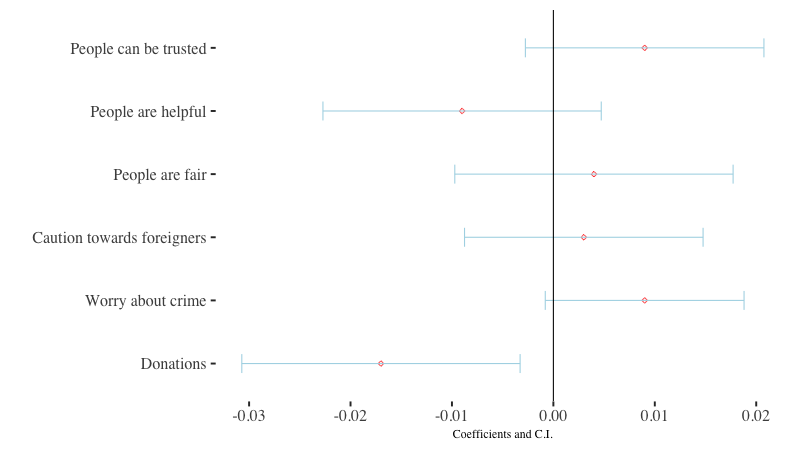
Overall, they find little evidence that the influx affected people’s attitudes and perceptions. The red dots in Figure 1 indicate the estimated effect of a doubling of the local number of refugees relative to 2014 on the likelihood that a respondent strongly agrees to a statement such as “People can be trusted” or “One should exert caution towards foreigners.” An effect of 0.01 means that the likelihood increases by one percentage point. The effects on general perceptions of society as well as concerns about crime and immigration are small and statistically insignificant. The only effect that is significant is on donations. An increase in the number of refugees reduced the likelihood that a person donates to charity.

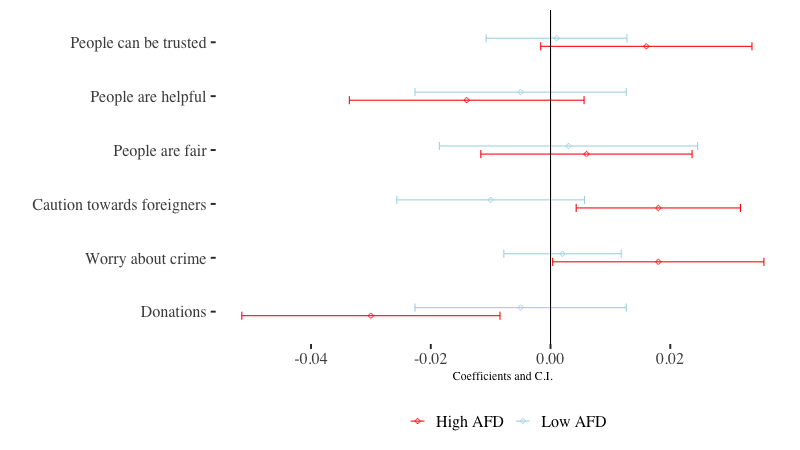
The authors also examine whether the effects of the influx of refugees differ across areas with different political leanings. Figure 2 presents separate estimates for areas with a high versus low share of votes for the populist party AfD in the federal election of 2013. In areas with a high AfD vote share, the influx led to an increase in concerns about crime and immigration. Additionally, the negative overall effect on charitable donations appears to be driven by areas with a high AfD vote share.

The analysis of anti-immigrant violence yields somewhat concerning results. The authors used data on the occurrence of anti-immigrant violence collected by the Amadeu Antonio Foundation, and compared counties with high versus low inflows of refugees before and after the influx. The main findings are shown in Figure 3. Prior to the influx, there was no difference in anti-immigrant violence between high- and low-inflow areas. However, after the influx, there was a noticeable increase in anti-immigrant violence in areas with large increases in the number of immigrants. This increase in incidents lasted for approximately two years.

Overall, the study’s findings suggest that a sudden and significant influx of refugees did not significantly alter Germans’ perceptions of their society, despite the change in public opinion during the influx. However, the impact on anti-immigrant violence indicates that this influx was not without tension.

Filed Under: Research Tagged With: anti-immigrant violence, forced migration, social attitudes

Immigration or automation?

December 19, 2022 by Mark Fallak

Many firms in advanced economies are currently facing difficulties in recruiting labor and filling their vacancies. There are several factors contributing to the tightness of the labor markets, including restrictive immigration laws, the retirement of large baby boomer cohorts and Covid-induced exits. It has been shown that firms manage to address labor shortages by investing in automation technologies, such as industrial robots. While it is reasonable to predict that labor shortages can induce firms to adopt automation technology, there is a lack of causal evidence to support this hypothesis.

In a recent IZA Discussion Paper, Katja Mann and Dario Pozzoli fill this gap by providing empirical evidence on the effect of an increase in the local supply of low-skill labor on firms’ adoption of robots with high-quality data for Denmark. Their main hypothesis is that the inflow of non-Western migrants into Denmark since the 1980s has increased the supply of low-skill labor, lowered labor costs and thereby reduced the need for firms to automatize their jobs. As a consequence, fewer robots have been adopted in municipalities with a large share of migrant workers. Vice versa, robot adoption would then be more widespread in labor markets with a shortage of low-skill workers.

The authors tease out causality in the relationship between immigration and automation by estimating firm-level regressions covering the time period 1995-2019, in which they exploit exogenous variations in the migrant share both across time and municipalities. Specifically, they instrument the share of migrant workers via a shift-share instrument which relies on the municipalities’ share of migrants by country of origin in 1993, well before robot use became widespread.

Robots and low-skill labor are substitutes

Consistent with their intuition, the authors find that a one percentage point increase in the share of non-Western migrants decreases the probability of robot adoption by 7%. Moreover, an increase in the share of non-Western immigrants is associated with a decline in the value of imported robots. If low-skilled workers and robots are substitutes, then a firm’s decision whether to adopt a robot instead of employing a human worker will depend on relative factor prices. Indeed, the analysis shows that the average value of imported robots within a municipality is positively correlated with immigrant workers’ average wages.

The findings carry important policy implications at a time when many countries have restrictive immigration policies in place and are experiencing labor shortages (especially in terms of low-skilled workers) due to the retiring of large baby boomer cohorts. The key finding that immigration and robot adoption are substitutes suggests that automation technology is expected to become more widespread over the next decades in response to labor shortages. According to the authors, it is therefore important to implement policies ensuring that young workers entering the labor force can collaborate, rather than compete with robots. Retraining measures should also be designed in order to help older workers’ transition into non-automatable tasks.

Filed Under: Research Tagged With: automation, Denmark, immigration, labor supply, robots

Skilled immigration spurs innovation

November 16, 2022 by Mark Fallak

Policy and academic discussions on immigration have focused on different types of immigration, depending on the host country being analyzed. While in the U.S. and countries with skill-points systems the literature on skilled migration is voluminous, in Europe the discussion has mostly centered around low-skilled migrants and political refugees, as they represent the largest proportion of arrivals.

Yet, Europe too receives skilled migrants and their number is increasing. For example, in France the share of tertiary educated immigrants at 23% is lower than in the U.S., Canada or the U.K., but it has strongly increased, by 11 percentage points, between 1995 and 2010.

Recent contributions point out that skilled immigration has greatly contributed to innovation and patenting activity. Yet, most papers focus on the U.S. and often use aggregate data or small samples of firm-level data. Europe has been largely overlooked by this literature, notwithstanding recent anecdotal evidence of the important role played by immigrants in innovation.

For example, BioNTech’s founder Dr. Sahin, who has developed the Pfizer Covid vaccine, is a Turkish-born scientist who lives and works in Germany. Similarly, a highly cited patent by the French company Alcatel that contributed to the improvement in the speed/cost of fiber-optic cable-based communication, was filed by a team of French and immigrant inventors.

Skilled migrants have larger effect than skilled natives

In a recent IZA Discussion Paper, Anna Maria Mayda, Gianluca Orefice and Gianluca Santoni provide evidence on the link between immigration and innovation in the European context. They use information on the universe of French firms spanning the period between 1995 and 2010 and investigate the impact of skilled migration on patenting activity and innovation.

The authors find that, between 1995 and 2010, the arrival of skilled migrants in a French district significantly raised the number of patents. Namely, a 10% increase in the district-level share of skilled immigrants led to an increase, on average, of 2.6 patents per 10,000 manufacturing workers. The study provides evidence that the effect of skilled migrants is significantly higher than the effect of skilled natives.

This implies that skilled immigrants do not just spur innovation by increasing the size of the skilled labor force. These results also hold when looking at the relation between the number of patents at the firm level and the district-level skilled immigrant share. Furthermore, the paper explores heterogeneity in the impact of skilled migration with respect to firm-level characteristics and shows that high-productivity, capital-intensive and large firms are those for which the effects are stronger.

Importantly, the wealth of data available for France allows the authors to carry out an investigation of a new channel through which skilled immigrants are likely to affect innovation and patenting. The existing literature has shown that immigrants tend to specialize in different tasks compared to similarly skilled natives. The authors combine insights from this literature with an analysis of the effect of immigration on innovation.

They point out that, given differing patterns of comparative advantages between immigrants and native workers, an inflow of skilled migrants will lead to a reallocation of workers across tasks, which in turn will increase the productivity of firms, specifically in terms of innovation activity.

Specialization leads to within-firm reorganization of tasks

The paper shows that the pro-innovation impact of skilled immigration is driven by a within-firm reorganization of tasks – by which skilled native workers specialize in communication-intensive, managerial tasks while skilled immigrant workers specialize in technical, research-intensive tasks. In other words, each group of workers moves towards the tasks in which they have a comparative advantage, which implies a higher efficiency of the innovation process driven by specialization.

The structure of task-specific comparative advantage is likely driven by the lower language abilities of skilled migrants (compared to skilled natives) or by other (institutional or de facto) constraints they face. Indeed, it may be extremely hard for foreign-born workers to access specific managerial occupations.

In the case of France, for example, the education system is set up in such a way that outsiders – both French workers who did not attend the extremely competitive Grandes Ecoles and foreign workers who studied abroad – are less likely to have access, in practice, to high-hierarchy positions within firms.

France does not have a large program explicitly targeted at attracting skilled migrants like the H-1B visas program in the U.S. Yet, French migration policy has drastically changed over time in the direction of favoring skilled migration. Recently, the Macron administration has been carrying out reforms of immigration policy aimed at discouraging asylum seekers while encouraging skilled foreign workers.

Similar situation in other European countries

Although the study is specific to the French context, the authors point at recent evidence that suggest the findings might extend to other destination countries in Europe. A recent report by the World Bank on skilled migration to Europe states that “the number of high-skilled migrants in the EU, defined as migrants with some tertiary education, more than tripled over the period 2004-18, increasing from about 4 million to 13 million”. It also shows that the occupation composition of skilled migrants in Europe is quite different from that of skilled natives.

Just like in the case of France, skilled migrants in other European countries are more likely to have jobs requiring technical and quantitative skills (for example, information and communication technology, software developers, engineers, and medical doctors) while skilled natives tend to be in communication-intensive occupations (such as sales, legal and finance professionals, teachers and administrative workers). This evidence suggests that France might not be an isolated case within Europe in terms of the innovation-migration nexus and of the task specialization channel.

The authors conclude that skilled migration represents an opportunity for policymakers in Europe to make progress in liberalizing labor markets while at the same time avoiding a political backlash – given that public opinion in many European countries is largely in favor of encouraging skilled immigration.

Filed Under: Research Tagged With: innovation, patents, skilled immigration

How firms adjust when they cannot hire foreigners for low-skill work

November 11, 2022 by Mark Fallak

Most economic research finds that the effect of the average immigrant worker on the average native worker is very small. There is much less agreement about the effect of the least-educated immigrant workers on the least-educated natives. Different studies reach conflicting conclusions, relying on a variety of strategies to separate mere correlation from true causes and effects.

This question is addressed with a nationwide policy experiment conducted by the United States government, in a new IZA Discussion Paper by Michael Clemens and Ethan Lewis.

Each year, firms in the United States apply to the federal government for permits to hire foreigners in temporary jobs that do not require a high school degree. About 100,000–130,000 such permits are given each year, across the country in industries including groundskeeping, hospitality, forestry, seafood processing, manufacturing, and construction.

Firms must enter a randomized lottery to pass a key step in the application process for these work visas. Using data on the lottery outcome and a new survey of firms, the study’s authors can observe what happens to groups of firms that can or cannot hire foreign labor for low-skill work, but otherwise start out identical.

One key finding of the study is that firms contract when they are barred at random from hiring immigrants for low-skill work. When this force majeure obliges otherwise identical firms to reduce foreign hiring by 50 percent, they slash production by 9 percent. The graph below shows the distribution of output by firms that ‘win’ the lottery and can thus hire their desired number of foreign workers, as a dashed green curve. The distribution for firms that ‘lose’ the lottery, and are thus obliged to hire far fewer foreign workers, is the solid red curve.

A second key finding is that firms barred at random from hiring foreigners for these jobs do not hire native workers as a replacement. The effect of losing the visa lottery on native hiring is not statistically distinguishable from zero, but if anything, losing the lottery results in fewer native hires. When otherwise identical firms are obliged to reduce foreign hiring for low-skill jobs by 50 percent, they reduce native hiring between zero and five percent.

In the graph below, the distribution of native hiring among ‘winning’ firms is the dashed green line. The distribution of native hiring among ‘losing’ firms is the solid red line. There is a high probability that any differences between these distributions arise only from chance.

These results have relevance to U.S. immigration policy because they study the impact of policy change: access to the country’s principal work visa for low-skill jobs. The results imply that for the policy-relevant occupations, native workers are extremely poor substitutes for native workers. The results cannot be interpreted as quantifying the overall effect of immigration for low-skill jobs on national GDP, however, because only effects at individual firms are directly measured.

Filed Under: Research Tagged With: labor migration, low-skilled workers, United States

  • Previous Page
  • Page 1
  • …
  • Page 11
  • Page 12
  • Page 13
  • Page 14
  • Page 15
  • …
  • Page 30
  • Next Page

Primary Sidebar

© 2013–2025 Deutsche Post STIFTUNGImprint | Privacy PolicyIZA