• Skip to primary navigation
  • Skip to content
  • Skip to primary sidebar

IZA Newsroom

IZA – Institute of Labor Economics

  • Home
  • Archive
  • Press Lounge
  • DE
  • EN

Mark Fallak

We need to talk: How audio surveys can enhance data collection

December 7, 2024 by Mark Fallak

Understanding beliefs, preferences, and motivations is central to social sciences, yet eliciting these dimensions can be challenging. A new IZA dicussion paper  by Vincenzo Galasso, Tommaso Nannicini, and Debora Nozza explores how the mode of response—spoken versus written—impacts the quality of open-ended survey answers. Through randomized controlled trials across three survey topics (AI, public policy, and international relations), the researchers highlight the distinct advantages of audio responses.

Oral answers are longer and more personal

Analyzing 7,766 open-ended responses, the study reveals that participants providing audio responses offered longer answers with more personal reflections compared to written responses. While oral responses tended to have simpler lexical structures, they conveyed more information overall. Using large language models (LLMs) to assess informativeness, the researchers found that spoken answers scored higher in providing nuanced reasoning and personal experiences.

Oral responses stood out for their spontaneity and emotional engagement, often reflecting the respondent’s immediate thoughts and feelings. This contrasts with written responses, which tend to be more filtered and less personal. The study demonstrates the value of integrating audio surveys into research, particularly for capturing subjective experiences and individual reasoning processes.

Implications for survey design and policymaking

These findings suggest that audio responses can provide researchers and policymakers with deeper insights into public attitudes, preferences, and motivations. However, challenges such as higher attrition rates among audio respondents and potential biases from unfamiliarity with voice recording need to be addressed. Future research could explore ways to optimize audio survey methods and incorporate tools like emotion recognition to further enhance data quality.

Filed Under: Research Tagged With: beliefs, large language models, survey design

Education increases family formation among women but has no effect on men

December 6, 2024 by Mark Fallak

As global fertility rates continue to decline, policymakers are keen to understand the factors influencing family formation. A recent IZA discussion paper by Hanna Virtanen, Mikko Silliman, Tiina Kuuppelomäki, and Kristiina Huttunen analyzes data from secondary and tertiary education admissions in Finland to explore the relationship between education and family formation.

The findings reveal a striking gender difference: while further education does not increase the likelihood of men forming families, it significantly boosts the chances for women. Women admitted to higher education are more likely to live with a partner and have children, challenging the traditional notion that education hinders women’s family formation due to career concerns while helping men find a partner.

No causal effect for men

Family formation rates among men, regardless of their education level, have declined over the past several decades. While highly educated men remain more likely to form families, the study suggests these differences are driven by selection effects rather than a causal impact of education. Men pursuing higher education may already have stronger preferences for family formation, while those with lower education levels face barriers that education alone cannot address.

Trend reversal for women

For women born in the 1940s, tertiary education was associated with a lower likelihood of family formation. However, the trend reversed for women born after 1975: women with tertiary degrees are now more likely to form families than their less-educated peers. Over the past half-century, societal changes have played a pivotal role. Policies like the expansion of public childcare have made balancing career and family easier, while shifting gender norms have created a more supportive environment for women pursuing both.

The researchers suggest that education enhances women’s appeal as partners. As returns to social skills grow and child development increasingly relies on parents—especially mothers—higher education equips women with the resources and abilities to meet these demands. Research shows that highly educated mothers tend to spend more time engaging in childcare-intensive activities, potentially making them more attractive as partners in a family-oriented society.

Filed Under: Research Tagged With: education, family, gender

Overconfidence undermines leadership effectiveness

December 5, 2024 by Mark Fallak

A recent IZA discussion paper by Ben Weidmann, Joseph Vecci, Farah Said, David Deming, and Sonia Bhalotra explored the factors that make an effective manager. Using a controlled lab experiment with 555 participants, the researchers assigned managers to three-person teams solving numerical, spatial, and analytical problems in four rounds each. Managers were tasked with delegating responsibilities, monitoring progress, and motivating team members. By randomizing manager assignments, the study isolated the managers’ causal impact on team performance.

Key findings revealed that managerial effectiveness significantly influences team outcomes, with skilled managers doubling the productivity impact compared to individual workers. Effective managers optimized task allocation to align with team members’ strengths, reduced wasted effort, and maintained high motivation levels, resulting in superior team performance.

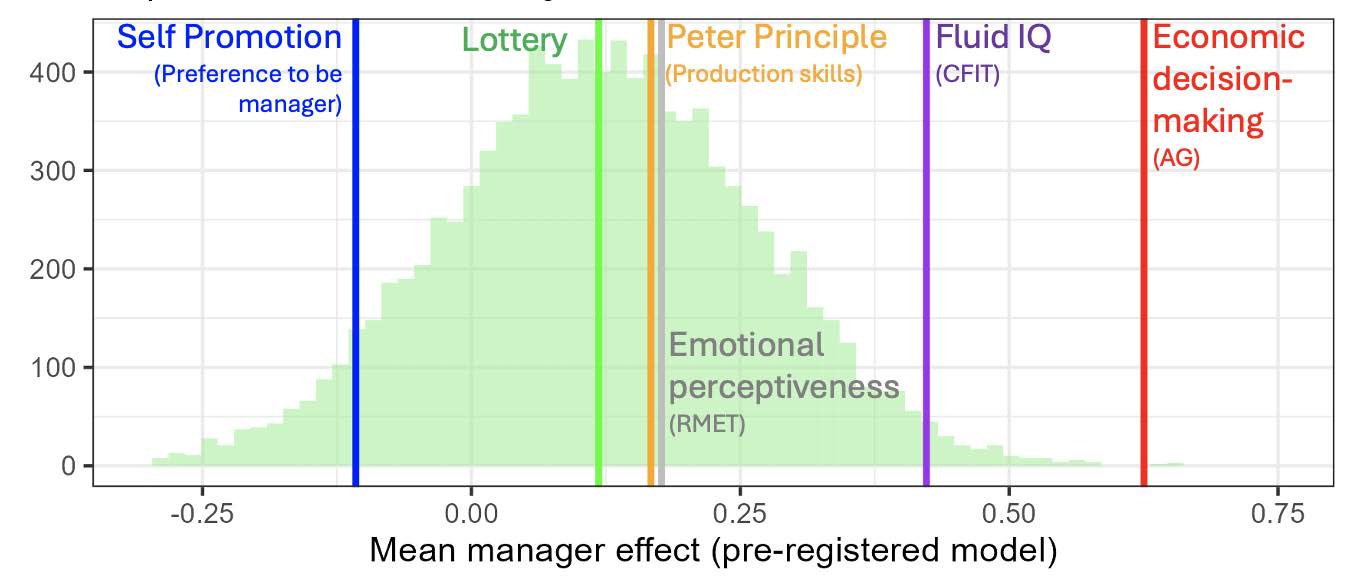
However, the study identified a critical flaw in self-selection: individuals eager to lead underperformed compared to those randomly appointed. Self-promoted managers tended to overestimate their abilities, particularly their social skills, which undermined their decision-making and team coordination. Conversely, managers with high cognitive and decision-making skills, such as fluid intelligence and economic decision-making proficiency, consistently drove better results.

Comparing methods of appointing managers

This figure illustrates the performance impact of different manager selection mechanisms, comparing self-promotion, random lottery, and skill-based approaches (e.g., fluid intelligence, economic decision-making, emotional perceptiveness, and individual production skills). Skill-based selection, particularly on decision-making and intelligence, yields significantly higher average manager quality, emphasizing the productivity gains of evidence-based selection methods (see page 30 of the paper for a more detailed description of the figure).

The implications for organizations are profound. The researchers recommend prioritizing skills over leadership ambition in managerial selection processes. Skill-based approaches, such as focusing on decision-making capabilities, could elevate team productivity by the equivalent of replacing average workers with top-tier performers. This underscores the importance of redefining leadership criteria to favor demonstrable abilities over confidence or self-promotion tendencies.

Filed Under: Research Tagged With: experiment, managers, measurement, skills, teamwork

Gender bias on social media: Women face unequal scrutiny

December 4, 2024 by Mark Fallak

Social media platforms like X (formerly Twitter) play a critical role in shaping public opinion, influencing elections, and affecting professional reputations. However, significant gender disparities persist in these spaces. Women often receive fewer likes, followers, and engagement than men, which limits their visibility and influence. A new IZA discussion paper by Nuzaina Khan, David Rand and Olga Shurchkov provides experimental evidence of gender bias in social media interactions.

The study found that male users were significantly more likely to flag women’s posts as concerning when they addressed traditionally male-stereotyped topics, such as finance or defense. Female users, in contrast, did not exhibit this bias. The results held true irrespective of the posts’ truthfulness, the user’s political ideology or their familiarity with Twitter, suggesting that these disparities stem from unconscious gender stereotypes rather than actual content veracity.

According to the authors, this bias reflects broader issues of stereotype-driven mistrust, which affect women’s credibility in professional and public domains. Such biases can have significant consequences, including limiting women’s influence in traditionally male-dominated fields and perpetuating gender disparities in law, politics, and STEM disciplines.

Filed Under: Research Tagged With: experiment, gender differences, misinformation, social media

When crisis strikes, voters hold female politicians to harsher standards

December 3, 2024 by Mark Fallak

A recent IZA discussion paper by Zohal Hessami and Temurbek Khasanboev examines how crises exacerbate gender biases in the reelection of incumbent politicians. Using data from local council elections in the German state of Hesse in March 2021, the researchers reveal the disproportionate electoral penalties faced by female politicians during the COVID-19 pandemic.

Female incumbents penalized twice as harshly at the ballot box

Despite having no direct role in pandemic management, local councilors experienced shifts in voter behavior tied to COVID-19 outcomes. The study found that reelection probabilities for incumbents decreased in municipalities with higher mortality rates. Critically, female incumbents were penalized almost twice as harshly as male incumbents. At the average mortality rate of one death per 1,000 inhabitants, an additional death reduced reelection probabilities by 4.3 percentage points for male incumbents and by 7.8 points for female incumbents.

The gender blame attribution gap

This disparity highlights a “gender blame attribution gap,” where voters disproportionately hold female politicians accountable during crises, irrespective of their actual involvement or performance. The study rigorously tested this hypothesis across various candidate, party, and municipal characteristics, confirming the robustness of these findings. Notably, this bias exacerbates gender underrepresentation in local councils, with simulations predicting a persistent 3–4 percentage point gap in female representation for at least a decade.

Long-term impacts on political representation

The study emphasizes the implications of this gendered electoral bias for policy outcomes. In smaller councils, even one fewer female member can influence decisions on public goods such as childcare provision. This underscores the broader societal costs of gender-biased electoral dynamics during crises.

This research not only contributes to understanding the barriers to gender equality in politics but also provides actionable insights for policymakers aiming to foster equitable political representation. The findings call for awareness and structural changes to mitigate crisis-induced biases in voter behavior.

Filed Under: Research Tagged With: crisis, gender, incumbency, local elections, political selection, voting

Flextime policies help maintain productivity

December 2, 2024 by Mark Fallak

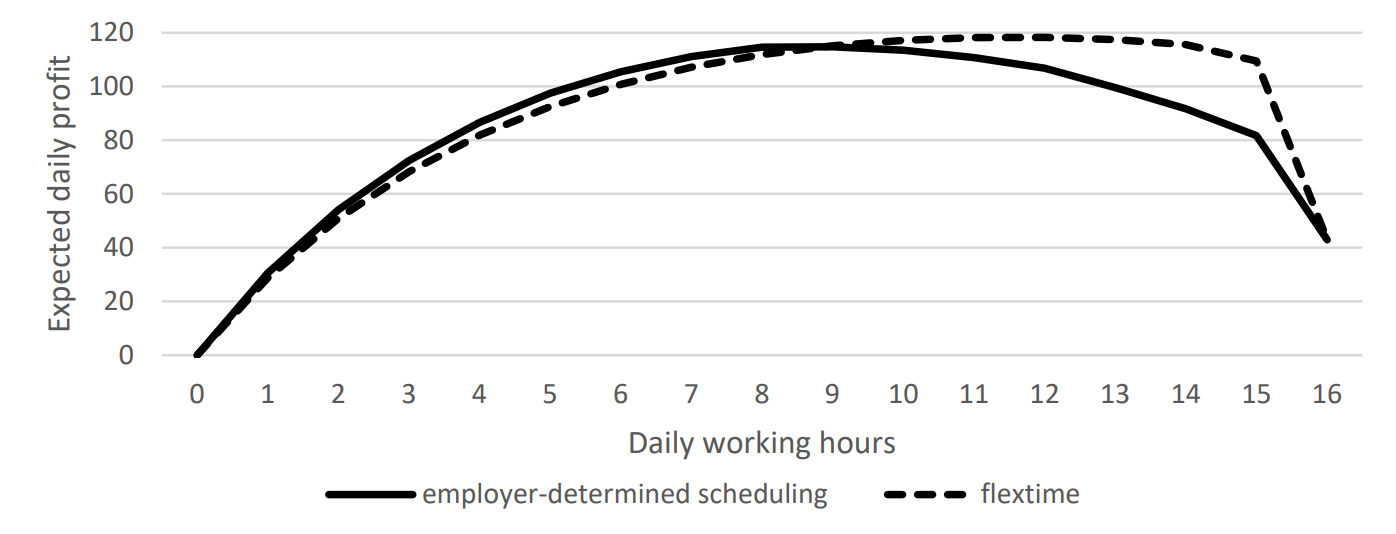
Workers eventually run out of steam, and their productivity drops, when they work long hours. However, this erosion happens faster when bosses dictate the specific hours employees must work. Flextime policies, on the other hand, allow workers to choose their own schedules, aligning work hours with personal preferences. This flexibility slows the onset of fatigue, enabling workers to sustain productivity for longer periods. As a result, employers who adopt flextime policies can push workers to longer hours without the typical decline in output.

A new theoretical model presented by Jed DeVaro in a recent IZA paper highlights these dynamics, demonstrating how flextime policies shift the peak of worker productivity further to the right on an inverted-U productivity curve:

The findings are backed by data from UK establishments tracked in the 2004 and 2011 Workplace Employee Relations Survey (WERS), showing that flextime mitigates productivity losses associated with extended working hours.

Interestingly, the model also shows that increases in the minimum wage make flextime policies less appealing to employers. When the costs associated with longer hours increase, employers may revert to dictating fixed work hours, prioritizing control over flexibility. This trade-off underscores the intricate balance between economic incentives and workplace policies that support worker autonomy and productivity.

Filed Under: Research Tagged With: flexible work practices, flextime, human resources management, labor productivity, work hours, work schedules, work-life balance, working from home, workplace flexibility

Peer mentoring enhances university choices and performance for high school students

December 1, 2024 by Mark Fallak

In a recent IZA discussion paper, Stefania Bortolotti and Annalisa Loviglio examine the effects of a peer-to-peer mentoring program on high school students’ university field selection and performance. The randomized controlled trial, conducted among Italian high school seniors, connected students with mentors enrolled in quantitative fields like STEM and Economics.

Through one-on-one meetings, mentors provided personalized guidance, covering topics such as curriculum details, enrollment procedures, study techniques, and career prospects. These tailored interactions encouraged mentees to ask questions, making the mentorship process responsive to each student’s needs.

The results indicate that students who engaged with mentors were 14-22 percentage points more likely to choose their mentor’s field, a shift that could raise prospective wages by 3.1-3.7%. The study reveals that the mentoring program not only nudges students toward higher-earning fields but does so without harming academic performance. Students in the treatment group were more inclined to select competitive programs, yet they maintained academic performance on par with their peers.

These findings underscore the value of personalized guidance during high school, highlighting how peer mentoring can shape future educational paths and, potentially, career outcomes.

Filed Under: Research

Political polarization undermines individuals’ rule-following behavior

November 28, 2024 by Mark Fallak

A new IZA Discussion Paper by Christoph Feldhaus, Lukas Reinhardt and Matthias Sutter investigates how political polarization affects individuals’ willingness to adhere to rules imposed by others. The researchers conducted an experiment involving 1,300 supporters and opponents of Donald Trump to explore the impact of group identity on compliance with restrictions.

Experiment with Trump supporters and opponents

Participants were asked to make decisions in three contexts: prosociality (e.g., altruism), risk preferences, and time preferences. Each participant was presented with a choice restriction imposed by an “interventionist” who either shared or opposed their political views on Trump. For example, in the altruism context, participants decided how to split a sum of money under restrictions such as being required to share at least a certain amount. In the risk context, participants chose between lotteries with differing probabilities and outcomes, some of which were restricted. In the time preference context, choices between immediate and delayed payouts were limited by the interventionist.

Participants could pay a small cost to lift the restrictions, allowing researchers to measure the extent to which compliance depended on the political alignment of the interventionist. Importantly, the restrictions themselves were identical across treatments, ensuring that only the perceived identity of the interventionist varied.

Outgroup members are perceived as more malevolent

The study found that participants were significantly more likely to pay to lift restrictions when they were imposed by someone from the opposing political group (outgroup) than when they came from someone with similar views (ingroup). This effect was consistent across all decision-making contexts but was strongest in prosocial and time preference tasks.

Further analysis revealed the mechanism behind this behavior: participants perceived restrictions imposed by outgroup members as more malevolent. They believed outgroup members were more likely motivated by a desire to harm or exert power rather than to protect or assist. When controlling for these perceptions, the difference in compliance between ingroup and outgroup interventions disappeared, emphasizing the role of perceived intent in driving resistance.

Factual arguments may have limited effectiveness

The research sheds light on the challenges of maintaining compliance and rule-following behavior in polarized societies. Resistance to identical rules based on the identity of the enforcer suggests that factual arguments or compromises on policy content may have limited effectiveness in bridging divides. Instead, fostering shared or overarching group identities could improve acceptance of rules and policies, regardless of political affiliation.

Filed Under: Research Tagged With: economic preferences, experiment, outgroup, political polarization, social identity

Flash IZA/Fable SWIPE Consumption Index above six percent in November 2024

November 21, 2024 by Mark Fallak

By Nikos Askitas and Ingo Isphording

The IZA/Fable SWIPE Consumption Index, a monthly measure of private consumption trends in Germany based on credit card transactions, shows a flash value of 6.34% year-on-year growth for November 2024, continuing a string of positive readings. This preliminary estimate offers an early insight into actual consumption behavior and is informed daily by fresh incoming data. It can be tracked via our embeddable, interactive graph shown below.

Clear insights needed 

Understanding household economic behavior—particularly spending and consumption patterns—is crucial for both policymakers and business leaders. Private consumption accounts for over 50% of German GDP, making it a key indicator for tracking economic resilience, overheating, or potential recessions. It also serves as a foundation for designing forward-looking economic and fiscal policies.

Traditionally, consumption trends have been assessed through survey-based sentiment indicators, such as the HDE-Konsumbarometer or the GfK-Konsumklimaindex, which measure consumer confidence. However, these sentiment indicators often fail to align with actual spending behaviors, as they capture perceptions and subjective expectations rather than concrete actions.

Moreover, methodological challenges—such as the sensitivity of survey-based economic sentiment to survey modalities—can further distort results. A recent example is the artificial pessimism introduced in the University of Michigan Survey of Consumer Sentiment by switching from telephone to online interviews.

Innovative approach

The IZA/Fable SWIPE Consumption Index provides objective metrics based on real spending data from credit card transactions. Complementing sentiment-based indicators, this index offers timely, reliable insights into consumption behavior. It correlates closely with Eurostat’s private expenditure data, making it a valuable tool for measuring consumption trends.

Despite Germany’s credit card penetration rate of 56.5%—ranking only 18th out of 121 countries—the index effectively captures aggregate spending patterns across a wide range of expenditure categories. This robustness is highlighted in a recent IZA discussion paper by Winfried Koeniger and his University of St.Gallen colleagues, Peter Kress and Jonas Lehmann.

Divergence between subjective and objective measures 

Subjective sentiment measures and objective spending data may not always follow similar time trends. Several factors can explain this discrepancy. For instance, financial constraints or the inelastic demand for essential goods may lead households to maintain steady spending levels, even when they express pessimistic sentiment.

Additionally, more subtle behavioral phenomena can contribute to this divergence. One example is the “lipstick effect,” where consumers opt for small, affordable luxuries during economic downturns. Another is the negativity bias produced by the dynamics of news supply and demand, which can skew reported sentiment away from actual spending behavior.

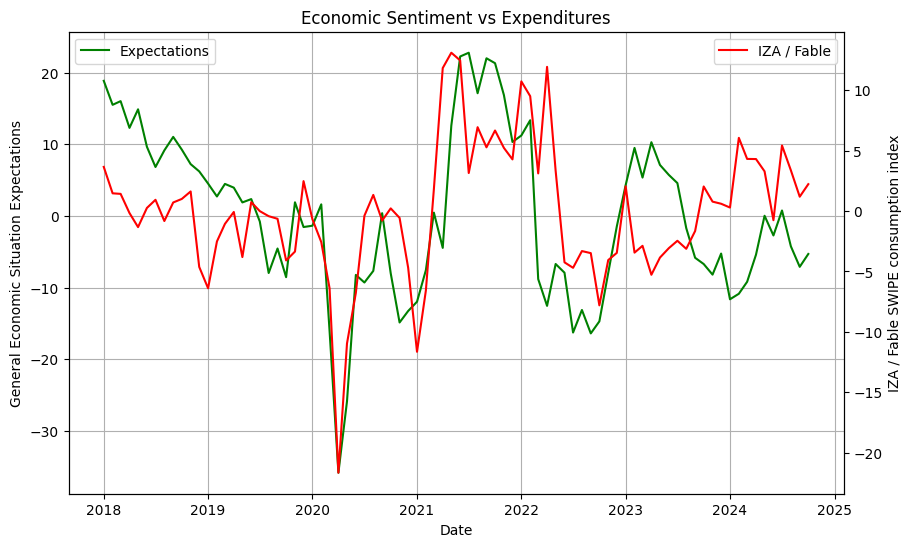
Figure 1 below illustrates the correlation dynamics of the IZA/Fable SWIPE consumption index and economic sentiment sourced from Eurostat, both adjusted for inflation. The figure highlights episodes of both decoupling and alignment between the two measures. During 2018–2019, economic sentiment steadily declined, reflecting growing pessimism, while actual spending, as captured by the SWIPE index, remained largely stable. This suggests that consumption patterns exhibited resilience despite deteriorating sentiment.

A similar divergence reemerged from early 2023 onward: while sentiment declines and stabilizes at a lower level in 2024, year-on-year consumption rates become increasingly positive in the same year. These contrasting trends, along with the broader disconnect between economic fundamentals and sentiment, may point to structural shifts in consumer behavior, the influence of financial constraints, or behavioral adaptations that sentiment indicators fail to capture.

In contrast, the period from 2020 to 2022—dominated by the pandemic, recovery efforts, and the onset of the Ukraine crisis—shows a more parallel movement of the two measures. This alignment likely reflects the heightened responsiveness of both sentiment and consumption to shared external shocks, such as fiscal interventions and global uncertainties.

Another related IZA discussion paper by Winfried Koeniger and Peter Kress provides a deeper analysis of the Fable data, illustrating how consumers responded to Germany’s temporary value-added tax (VAT) cut in 2020, implemented as a policy response to the pandemic.

Figure 1: Comparison of (both inflation adjusted) Sentiment vs. IZA / Fable SWIPE Consumption Index. While sentiment dropped in 2018-2019, consumption remained largely steady; in 2024, consumption grew year-on-year in almost all months despite a pessimistic outlook. (Source: Eurostat’s dataset EI_BSCO_M, variable M.BS-GES-NY.SA.BAL.DE).

Combining measures improves analysis

The patterns of divergence and convergence highlighted above underscore the importance of integrating subjective and objective measures to fully understand the interplay between consumer sentiment, actual behavior, and their impact on the business cycle. Tools like the SWIPE Index complement sentiment data, offering a more comprehensive framework for economic analysis.

Relying exclusively on sentiment-based forecasts risks underestimating the resilience of consumption. For example, Germany’s recently published third-quarter GDP growth, primarily driven by private and government consumption and described as “surprising” by the German media, closely aligned with SWIPE Index trends, which consistently indicated year-on-year growth in private spending for nearly every month of 2024. These insights from the SWIPE Index may even challenge the validity of the recently released official economic forecast for 2024.

Filed Under: Opinion Tagged With: consumption, index

Fewer exam retakes, better results?

November 13, 2024 by Mark Fallak

University exams are crucial in shaping students’ academic journeys, serving not only as a measure of knowledge but also as a source of feedback, an incentive for deeper study, and a means to develop critical skills needed for future challenges. However, the way exams are organized—particularly the number of retakes allowed—can significantly impact student performance.

In a recent IZA discussion paper, Massimiliano Bratti, Silvia Granato, and Enkelejda Havari provide new evidence on the effects of reducing the number of exam retakes at university. Their research examines a policy change introduced in 2010 at the Faculty of Economics of the University of Bologna, which reduced the number of allowed exam retakes per subject per year from six to three.

Challenges for higher education in Italy

In Italy, students enjoy considerable freedom in managing their university studies, with an average of five or more exam attempts per subject each year. They can also decline an exam grade and retake it. Despite these flexible arrangements, Italy faces challenges: it has lower continuation rates in higher education, high university dropout rates, and prolonged graduation times compared to most OECD countries. In fact, Italy ranks near the bottom of the OECD for the percentage of the population aged 24–35 with a university degree, at just 29.2%. This context makes it an ideal setting to explore whether reducing student flexibility in exam retakes, in line with international practices, can improve academic outcomes.

The Faculty of Economics at the University of Bologna aimed to address this issue by revising its exam policies. For example, in the United States, retakes are generally not allowed; in the United Kingdom, students typically have only two attempts; and in Sweden, students are usually limited to three attempts per academic year—similar to the new policy in Bologna. This policy change provided an opportunity to study how limiting exam retakes affects student performance.

The researchers compared the performance of students in degree programs that adopted the new rules (those in the Faculty of Economics) with those in programs that did not. They found that the reform led to significant improvements in first-year student outcomes. The probability of first-year dropout decreased by 4.2 percentage points (pp), while students earned an average of 11.2 additional credits and passed about one more exam.

No negative effect on grades

Looking at a longer time horizon, the study also documented a 5.7 pp (7%) increase in the probability of graduation and a 9.1 pp (22%) increase in on-time graduation. Remarkably, the faster degree completion did not negatively affect students’ final graduation marks, which was a major concern for many.

Further analysis based on family background, specifically whether students attended a vocational track in secondary education, revealed that those from lower socio-economic backgrounds—who were more likely to be working—benefited significantly from the reform.

Overall, the study suggests that revising how university exams are organized can be an effective policy tool to improve educational outcomes and address the long-standing issue of prolonged graduation times for Italian university students.

Filed Under: Research Tagged With: exams, Italy, retakes, student outcomes, university

  • Previous Page
  • Page 1
  • …
  • Page 3
  • Page 4
  • Page 5
  • Page 6
  • Page 7
  • …
  • Page 30
  • Next Page

Primary Sidebar

© 2013–2025 Deutsche Post STIFTUNGImprint | Privacy PolicyIZA