• Skip to primary navigation
  • Skip to content
  • Skip to primary sidebar

IZA Newsroom

IZA – Institute of Labor Economics

  • Home
  • Archive
  • Press Lounge
  • DE
  • EN

Can AI match human educators?

December 11, 2024 by Mark Fallak

As artificial intelligence rapidly transforms industries, its role in education is under increasing scrutiny, with tools like ChatGPT promising to ease workloads and personalize learning. A new IZA discussion paper by Arnaud Chevalier, Jakub Orzech and Petar Stankov investigates whether AI-powered tools, specifically ChatGPT 3.5 and 4, could match human instructors in providing feedback and grading student work.

Using a randomized controlled trial (RCT), undergraduate students were divided into three groups: those receiving feedback from human graders, ChatGPT 3.5, or ChatGPT 4. The quality of the feedback was evaluated based on the students’ performance on the subsequent assignment. The double-blind design ensured neither students nor instructors knew the source of feedback, isolating its effects on student outcomes.

Inconsistencies in grading reveal critical shortcomings

The results show that ChatGPT 4 can deliver feedback comparable to human instructors, with students receiving its guidance performing on par with those who received human feedback. In contrast, students who received feedback from ChatGPT 3.5 performed worse in subsequent assessments, suggesting that this earlier version of the AI struggled with providing actionable and effective insights.

When it came to grading, the study highlighted significant gaps. Both versions of ChatGPT tended to assign more generous grades than human graders, and their evaluations lacked consistency and contextual understanding. For example, ChatGPT 3.5 struggled with complex tasks like assessing draft work or interpreting tables and empirical data. Even ChatGPT 4, while more capable, showed limitations. Not only do the grade distributions differ, but the rank of students within the grade distribution varies considerably. Crucially, the variability in grades—where the same submission could receive drastically different scores—further highlights the current unsuitability of AI for grading.

AI shows potential to save educators time

While AI tools like ChatGPT show promise in reducing the time educators spend on feedback provision and marking, allowing them to focus more on teaching-oriented tasks, the study concludes that these tools are not yet ready to fully replace human expertise in grading. As generative AI technology continues to improve, this research provides critical insights for educators and policymakers navigating its integration into the classroom.

[Editor’s note: In keeping with the focus of the study, this summary is based on a ChatGPT-generated draft, edited by a human.]
Filed Under: Research Tagged With: AI, artificial intelligence, education, feedback, grading, teaching

Affordable housing improves individual labor market outcomes

December 10, 2024 by Mark Fallak

A recent IZA discussion paper by Wolfgang Dauth, Andreas Mense, and Matthias Wrede demonstrates that living in affordable housing has long-lasting positive effects on the employment outcomes of low-income individuals. The research integrates data on 465 subsidized rental housing projects in five major Bavarian cities with administrative social security data. This approach allows the researchers to identify individuals who have lived in these housing projects and to track their employment trajectories before and after moving into affordable housing. Given the similarity of the funding scheme to the American LIHTC program, the findings have relevance beyond Germany.

The study’s key finding is that labor income for affordable housing tenants begins to increase two years after admission, compared to what it would have been had they not moved into social housing. By 12 to 13 years after admission, their annual labor income is approximately EUR 4,000 higher—a 20% increase. A substantial part of this income growth is attributed to a significant reduction in unemployment. For this group, the unemployment rate drops from 25% to 15% following admission to affordable housing.

The paper explores four potential mechanisms behind these results:

  • First, subsidized housing units tend to be more centrally located and better connected to public transport than previous residences, enhancing access to local labor markets and improving employment opportunities.
  • Second, affordable housing allows residents to invest in human capital, with a higher likelihood of vocational training enrollment observed within one to five years after moving in.
  • Third, the high stability of affordable housing arrangements in Germany extends residents’ planning horizons by protecting them from being priced out of the local housing market. This stability increases the returns on firm-specific human capital investment, fostering more stable employer-employee relationships.
  • Fourth, object-based housing subsidies may reduce labor supply disincentives associated with tenant-based housing assistance.

These findings underscore that affordable housing can yield benefits beyond simply maintaining housing affordability for low-income households. However, these outcomes depend significantly on the design of housing policies, their interaction with other welfare programs, and the location of affordable housing projects.

Filed Under: Research Tagged With: affordable housing, housing policy, labor market access, labor supply, unemployment, urban

In-person collaboration boosts creativity in virtual teams

December 9, 2024 by Mark Fallak

As remote work becomes a permanent fixture in the modern workplace, questions about its impact on creativity and productivity have taken center stage. The COVID-19 pandemic accelerated the shift to virtual work, and while many employees have embraced the flexibility, employers are increasingly concerned about the long-term effects on collaboration and innovation.

As a result, a growing number of companies are calling their employees back to the office, at least part-time, to restore the in-person interactions that many believe are essential for creative work. This shift raises a critical question: Can virtual teams be as creative and effective as those working face-to-face, or is something lost in the translation to a digital workspace?

A recent IZA discussion paper by  Christian Grund, Christine Harbring and Lisa Klinkenberg offers some answers. Their research reveals that teams working in person are significantly more creative than those working entirely online. The findings suggest that hybrid work models, where teams alternate between in-person and virtual settings, may offer the best of both worlds for fostering creativity.

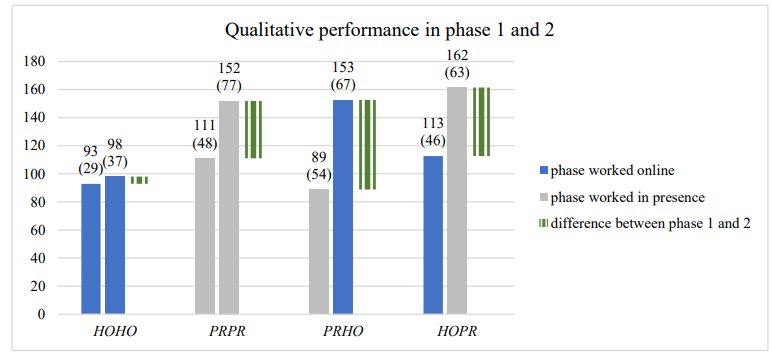
The study involved a two-phase experiment in which 122 teams, each consisting of two members, were asked to complete the “Unusual-Uses Task,” a well-known measure of creative thinking that resembles a typical non-routine task found in modern work. In this task, participants were required to come up with as many creative uses as possible for everyday objects, such as a tin can or a hanger.

The experiment simulated different workplace environments: some teams worked entirely in person, others entirely online, and some switched between the two settings over the course of the experiment.

As the figure illustrates, teams that collaborated in person consistently outperformed those who worked solely online. Even more interestingly, teams that experienced at least one phase of in-person collaboration demonstrated higher creative performance in subsequent online phases compared to those who worked entirely online. This finding underscores the importance of face-to-face interaction, even in an era where remote work is becoming increasingly common.

The researchers also explored whether allowing participants to choose their preferred workplace setting would impact creativity. Surprisingly, the study found no significant difference in creative output between teams that self-selected their work environment and those that were assigned one. This suggests that the physical setting itself may play a more crucial role in enhancing creativity than individual preferences.

The findings indicate that integrating in-person collaboration into remote work schedules could be key to unlocking higher levels of creativity and innovation in teams, especially for tasks that require divergent thinking and idea generation.

Filed Under: Research Tagged With: creativity, hybrid working models, remote work, self-selection, teams, work from home

Bonuses and overtime payments drive the gender wage gap

December 8, 2024 by Mark Fallak

The gender wage gap has narrowed significantly in industrialized nations since World War II. Yet, in recent decades, progress has slowed as women remain underrepresented in high-paying firms and tend to earn less than their male counterparts even when working in the same roles. A new IZA discussion paper by István Boza and Balázs Reizer highlights a specific driver of this persistent disparity: flexible wage components like bonuses and overtime payments.

Flexible wages widen the gap

Using extensive Hungarian administrative data linked with wage surveys spanning 2003 to 2017, the study reveals that the gender wage gap is significantly larger in firms where bonuses and overtime payments are prevalent. While firms without these flexible components show negligible gender wage differences, those that rely heavily on them exhibit a gender wage gap exceeding 11% in firm-specific wage premiums—the additional pay provided by firms beyond base wages.

A quarter of the gap stems from flexible wages

Performance and overtime payments contribute 60% to the gender gap in firm-specific wage premiums and 25% to the overall gender wage gap of 23.4% in Hungary’s private sector. This is partly due to sorting: women are less likely to work at high-paying firms offering these wage components. Even within the same firm, women receive a smaller share of firm premiums when flexible wages are involved, suggesting disparities in negotiation outcomes or allocation practices.

Implications for policy and equality

The findings underscore the disproportionate impact of flexible wage components on the gender wage gap. Addressing this inequality requires targeted interventions, such as revisiting the structure and regulation of performance and overtime payments. While these components may boost productivity, their uneven distribution exacerbates wage disparities, particularly for women. This research provides valuable insights for policymakers aiming to enhance fairness and equality in labor markets.

Filed Under: Research Tagged With: bargaining, overtime, performance pay, sorting, wage inequality

We need to talk: How audio surveys can enhance data collection

December 7, 2024 by Mark Fallak

Understanding beliefs, preferences, and motivations is central to social sciences, yet eliciting these dimensions can be challenging. A new IZA dicussion paper  by Vincenzo Galasso, Tommaso Nannicini, and Debora Nozza explores how the mode of response—spoken versus written—impacts the quality of open-ended survey answers. Through randomized controlled trials across three survey topics (AI, public policy, and international relations), the researchers highlight the distinct advantages of audio responses.

Oral answers are longer and more personal

Analyzing 7,766 open-ended responses, the study reveals that participants providing audio responses offered longer answers with more personal reflections compared to written responses. While oral responses tended to have simpler lexical structures, they conveyed more information overall. Using large language models (LLMs) to assess informativeness, the researchers found that spoken answers scored higher in providing nuanced reasoning and personal experiences.

Oral responses stood out for their spontaneity and emotional engagement, often reflecting the respondent’s immediate thoughts and feelings. This contrasts with written responses, which tend to be more filtered and less personal. The study demonstrates the value of integrating audio surveys into research, particularly for capturing subjective experiences and individual reasoning processes.

Implications for survey design and policymaking

These findings suggest that audio responses can provide researchers and policymakers with deeper insights into public attitudes, preferences, and motivations. However, challenges such as higher attrition rates among audio respondents and potential biases from unfamiliarity with voice recording need to be addressed. Future research could explore ways to optimize audio survey methods and incorporate tools like emotion recognition to further enhance data quality.

Filed Under: Research Tagged With: beliefs, large language models, survey design

Education increases family formation among women but has no effect on men

December 6, 2024 by Mark Fallak

As global fertility rates continue to decline, policymakers are keen to understand the factors influencing family formation. A recent IZA discussion paper by Hanna Virtanen, Mikko Silliman, Tiina Kuuppelomäki, and Kristiina Huttunen analyzes data from secondary and tertiary education admissions in Finland to explore the relationship between education and family formation.

The findings reveal a striking gender difference: while further education does not increase the likelihood of men forming families, it significantly boosts the chances for women. Women admitted to higher education are more likely to live with a partner and have children, challenging the traditional notion that education hinders women’s family formation due to career concerns while helping men find a partner.

No causal effect for men

Family formation rates among men, regardless of their education level, have declined over the past several decades. While highly educated men remain more likely to form families, the study suggests these differences are driven by selection effects rather than a causal impact of education. Men pursuing higher education may already have stronger preferences for family formation, while those with lower education levels face barriers that education alone cannot address.

Trend reversal for women

For women born in the 1940s, tertiary education was associated with a lower likelihood of family formation. However, the trend reversed for women born after 1975: women with tertiary degrees are now more likely to form families than their less-educated peers. Over the past half-century, societal changes have played a pivotal role. Policies like the expansion of public childcare have made balancing career and family easier, while shifting gender norms have created a more supportive environment for women pursuing both.

The researchers suggest that education enhances women’s appeal as partners. As returns to social skills grow and child development increasingly relies on parents—especially mothers—higher education equips women with the resources and abilities to meet these demands. Research shows that highly educated mothers tend to spend more time engaging in childcare-intensive activities, potentially making them more attractive as partners in a family-oriented society.

Filed Under: Research Tagged With: education, family, gender

Overconfidence undermines leadership effectiveness

December 5, 2024 by Mark Fallak

A recent IZA discussion paper by Ben Weidmann, Joseph Vecci, Farah Said, David Deming, and Sonia Bhalotra explored the factors that make an effective manager. Using a controlled lab experiment with 555 participants, the researchers assigned managers to three-person teams solving numerical, spatial, and analytical problems in four rounds each. Managers were tasked with delegating responsibilities, monitoring progress, and motivating team members. By randomizing manager assignments, the study isolated the managers’ causal impact on team performance.

Key findings revealed that managerial effectiveness significantly influences team outcomes, with skilled managers doubling the productivity impact compared to individual workers. Effective managers optimized task allocation to align with team members’ strengths, reduced wasted effort, and maintained high motivation levels, resulting in superior team performance.

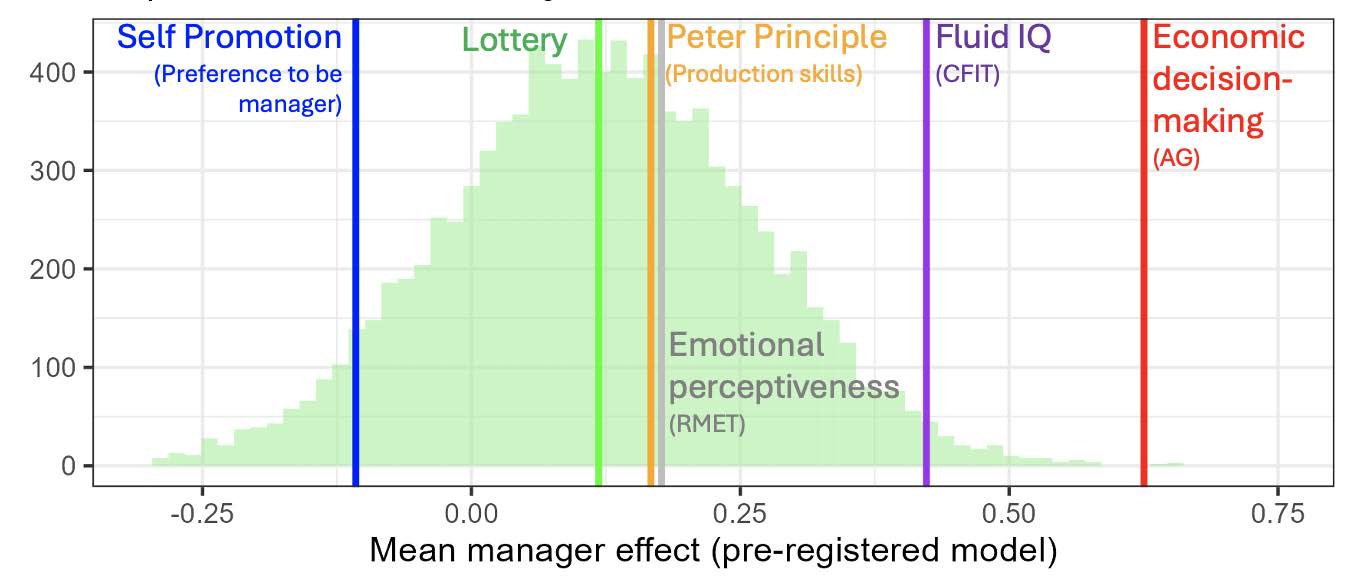
However, the study identified a critical flaw in self-selection: individuals eager to lead underperformed compared to those randomly appointed. Self-promoted managers tended to overestimate their abilities, particularly their social skills, which undermined their decision-making and team coordination. Conversely, managers with high cognitive and decision-making skills, such as fluid intelligence and economic decision-making proficiency, consistently drove better results.

Comparing methods of appointing managers

This figure illustrates the performance impact of different manager selection mechanisms, comparing self-promotion, random lottery, and skill-based approaches (e.g., fluid intelligence, economic decision-making, emotional perceptiveness, and individual production skills). Skill-based selection, particularly on decision-making and intelligence, yields significantly higher average manager quality, emphasizing the productivity gains of evidence-based selection methods (see page 30 of the paper for a more detailed description of the figure).

The implications for organizations are profound. The researchers recommend prioritizing skills over leadership ambition in managerial selection processes. Skill-based approaches, such as focusing on decision-making capabilities, could elevate team productivity by the equivalent of replacing average workers with top-tier performers. This underscores the importance of redefining leadership criteria to favor demonstrable abilities over confidence or self-promotion tendencies.

Filed Under: Research Tagged With: experiment, managers, measurement, skills, teamwork

Gender bias on social media: Women face unequal scrutiny

December 4, 2024 by Mark Fallak

Social media platforms like X (formerly Twitter) play a critical role in shaping public opinion, influencing elections, and affecting professional reputations. However, significant gender disparities persist in these spaces. Women often receive fewer likes, followers, and engagement than men, which limits their visibility and influence. A new IZA discussion paper by Nuzaina Khan, David Rand and Olga Shurchkov provides experimental evidence of gender bias in social media interactions.

The study found that male users were significantly more likely to flag women’s posts as concerning when they addressed traditionally male-stereotyped topics, such as finance or defense. Female users, in contrast, did not exhibit this bias. The results held true irrespective of the posts’ truthfulness, the user’s political ideology or their familiarity with Twitter, suggesting that these disparities stem from unconscious gender stereotypes rather than actual content veracity.

According to the authors, this bias reflects broader issues of stereotype-driven mistrust, which affect women’s credibility in professional and public domains. Such biases can have significant consequences, including limiting women’s influence in traditionally male-dominated fields and perpetuating gender disparities in law, politics, and STEM disciplines.

Filed Under: Research Tagged With: experiment, gender differences, misinformation, social media

When crisis strikes, voters hold female politicians to harsher standards

December 3, 2024 by Mark Fallak

A recent IZA discussion paper by Zohal Hessami and Temurbek Khasanboev examines how crises exacerbate gender biases in the reelection of incumbent politicians. Using data from local council elections in the German state of Hesse in March 2021, the researchers reveal the disproportionate electoral penalties faced by female politicians during the COVID-19 pandemic.

Female incumbents penalized twice as harshly at the ballot box

Despite having no direct role in pandemic management, local councilors experienced shifts in voter behavior tied to COVID-19 outcomes. The study found that reelection probabilities for incumbents decreased in municipalities with higher mortality rates. Critically, female incumbents were penalized almost twice as harshly as male incumbents. At the average mortality rate of one death per 1,000 inhabitants, an additional death reduced reelection probabilities by 4.3 percentage points for male incumbents and by 7.8 points for female incumbents.

The gender blame attribution gap

This disparity highlights a “gender blame attribution gap,” where voters disproportionately hold female politicians accountable during crises, irrespective of their actual involvement or performance. The study rigorously tested this hypothesis across various candidate, party, and municipal characteristics, confirming the robustness of these findings. Notably, this bias exacerbates gender underrepresentation in local councils, with simulations predicting a persistent 3–4 percentage point gap in female representation for at least a decade.

Long-term impacts on political representation

The study emphasizes the implications of this gendered electoral bias for policy outcomes. In smaller councils, even one fewer female member can influence decisions on public goods such as childcare provision. This underscores the broader societal costs of gender-biased electoral dynamics during crises.

This research not only contributes to understanding the barriers to gender equality in politics but also provides actionable insights for policymakers aiming to foster equitable political representation. The findings call for awareness and structural changes to mitigate crisis-induced biases in voter behavior.

Filed Under: Research Tagged With: crisis, gender, incumbency, local elections, political selection, voting

Flextime policies help maintain productivity

December 2, 2024 by Mark Fallak

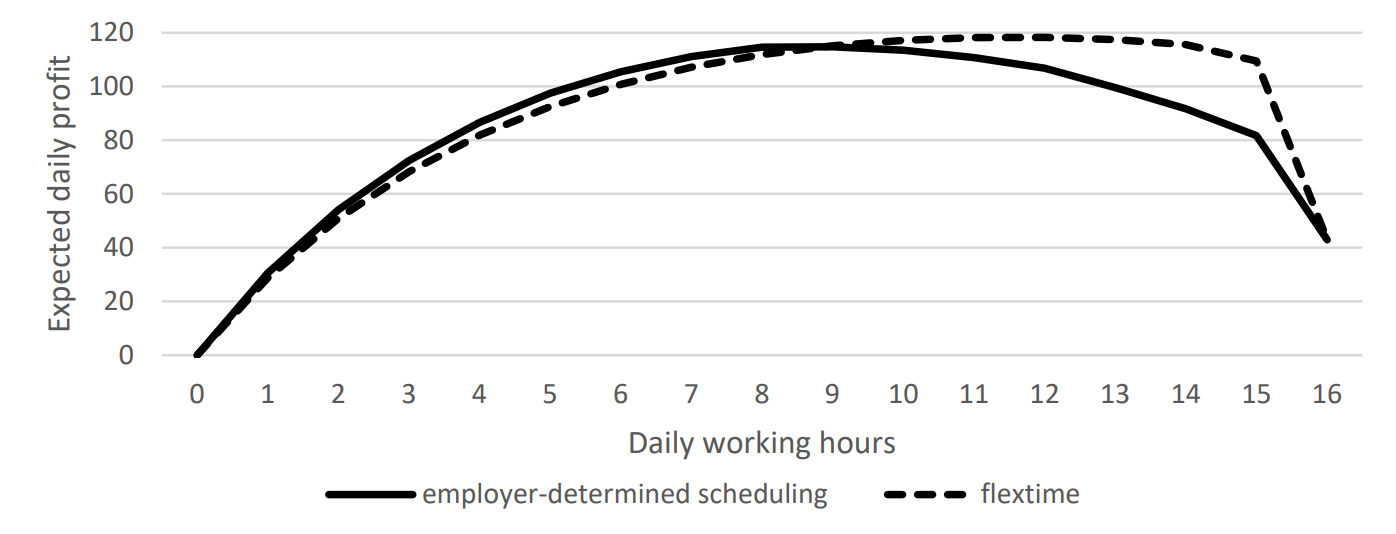
Workers eventually run out of steam, and their productivity drops, when they work long hours. However, this erosion happens faster when bosses dictate the specific hours employees must work. Flextime policies, on the other hand, allow workers to choose their own schedules, aligning work hours with personal preferences. This flexibility slows the onset of fatigue, enabling workers to sustain productivity for longer periods. As a result, employers who adopt flextime policies can push workers to longer hours without the typical decline in output.

A new theoretical model presented by Jed DeVaro in a recent IZA paper highlights these dynamics, demonstrating how flextime policies shift the peak of worker productivity further to the right on an inverted-U productivity curve:

The findings are backed by data from UK establishments tracked in the 2004 and 2011 Workplace Employee Relations Survey (WERS), showing that flextime mitigates productivity losses associated with extended working hours.

Interestingly, the model also shows that increases in the minimum wage make flextime policies less appealing to employers. When the costs associated with longer hours increase, employers may revert to dictating fixed work hours, prioritizing control over flexibility. This trade-off underscores the intricate balance between economic incentives and workplace policies that support worker autonomy and productivity.

Filed Under: Research Tagged With: flexible work practices, flextime, human resources management, labor productivity, work hours, work schedules, work-life balance, working from home, workplace flexibility

  • Previous Page
  • Page 1
  • Page 2
  • Page 3
  • Page 4
  • Page 5
  • Page 6
  • …
  • Page 69
  • Next Page

Primary Sidebar

© 2013–2026 Deutsche Post STIFTUNGImprint | Privacy PolicyIZA