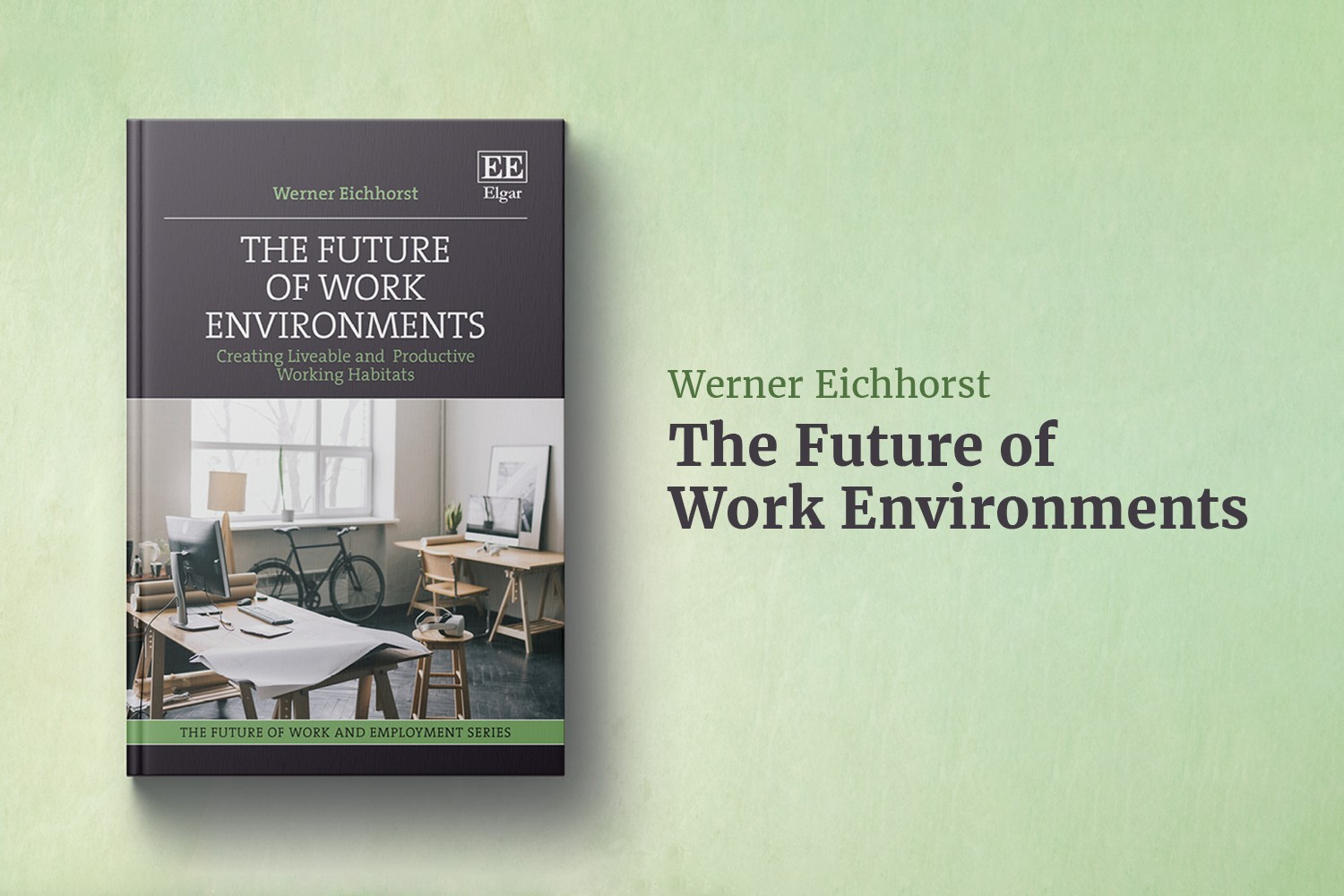
These days, the role of paid work is being questioned—not only from the perspective of economic and technological change but also from the viewpoint of individuals. There is a lot at stake for work in general and for all those who must cope with their jobs to make a living. This holds true for both the structure and quality of work, as well as its boundaries with non-work life.
The enduring importance of paid employment
The empirical account presented in my recent book, The Future of Work Environments: Creating Livable and Productive Working Habitats (Edward Elgar, 2025), makes it clear that, for the foreseeable future, paid work will remain essential for nearly everyone. Gainful employment under capitalism is here to stay. While we need not fear the end of work itself, we must pay close attention to the kind of work we do—and the conditions under which it is performed.
Human labor continues to grow where it is least similar to what machines can do—where it complements, uses, or opposes automation. This is even more pronounced in the era of rapidly advancing technologies, including artificial intelligence. The domain of human work now lies along a narrow frontier between automation and uniquely human capabilities. To expand this domain, human work must be increasingly distinct from what intelligent machines can replicate. People shape their work and, when conditions are right, become less and less replaceable.
Imagining different futures of capitalism
Although paid work continues under capitalism, it’s important to recognize there is not just one form of capitalism. We face various possible scenarios in this critical phase: optimistic, pessimistic, and ambiguous. One is a model of radical, unrestrained capitalism, marked by a rigid hierarchy and a complex periphery—combining old bureaucratic structures with a new, tightly managed regime focused on human capital. The other path imagines a more egalitarian, humane capitalism. This would involve a well-functioning labor market, better organizations, and empowered individuals flourishing in supportive environments.
Of course, reality may unfold somewhere in between—ambivalently, with gains for some and setbacks for others. Still, imagining these pathways helps us define what kind of future we want to strive for.
The triple embedding
To create good working habitats, I propose a triple embedding—bringing public policies, firm-level organization, and individual capabilities into coherence so they can reinforce one another. A more horizontal, egalitarian sphere of work—and a more humane capitalism—could form the foundation for livable and productive environments for all.
Reducing inequalities would mean weaker incentives for destructive competition. People could survive, and even thrive, at reasonable standards without an extreme concentration of advantage. Good institutions are key. Built and maintained through adaptation, they enable conditions where people can work and live well—with as much freedom as possible. They are essential for creating working habitats that are both productive and humane.
The role of public policy in shaping work
Public policies can help chart pathways toward more habitable forms of work—especially work that is non-routine and uniquely human. These policies define outer boundaries, shape power dynamics, and support access to employment. They help ensure income security, foster human capital, and enhance individual bargaining power. This benefits not just select groups, but society as a whole.
While policy cannot control every detail of how work evolves, it can provide essential infrastructure—dykes and dams that shape the flow without blocking it. Good policy is, in itself, a productive factor—supporting wages, social benefits, education, lifelong learning, and mechanisms for participation. All of this helps reduce hierarchy and foster more egalitarian labor relations.
Firms as collaborative workspaces
In the best-case scenario, companies become places of collaborative, joint productive work. This means fewer management layers, less rigid control, and more cooperation among equals. While such settings demand strong self-management and individual initiative, they also allow for diversity, creativity, and meaningful participation.
However, this model only works if the necessary skills and capital are widely distributed—not confined to a privileged few. The effort is still real, but work feels less superfluous or absurd. Instead of being extended unnecessarily, it becomes more purposeful.
Human capitalism and the boundary of work
In the era of “human capitalism,” everyone becomes a kind of human capitalist—whether they like the term or not. This system depends on expertise, self-organization, and the ability to cooperate and adapt. It also requires awareness of the boundary between work and its “hinterland”—the essential non-work sphere that sustains us.
Maintaining some distance from the constant demands of work helps preserve mental well-being. People have a remarkable capacity to not just endure difficult conditions, but to shape them, to craft their jobs, and to manage boundaries—especially when supported by a conducive overall environment.
A future worth building
I argue that we can look to the future with relative confidence—especially if the settings we create help individuals shape their own working habitats. When positive complementarities between policy, firms, and individuals reinforce one another, truly livable and productive work environments can emerge.
Still, the future will never unfold exactly as we imagine it—and that’s a good thing. Complete predictability would be stifling. Today’s uncertainty is a sign of the future’s openness. The more is at risk, the more is uncertain—and the more important the idea of a working habitat becomes.
An attractive working habitat—good for both work and non-work—can offer a sense of rescue and refuge. As good as it can get.