
Generative AI is transforming higher education at unprecedented speed, with over 80% of students at an elite U.S. college now using these tools for academic purposes—up from less than 10% before Spring 2023. This represents one of the fastest technology adoption episodes ever documented, according to a new IZA discussion paper by Zara Contractor and Germán Reyes.
The researchers surveyed students at Middlebury College, a highly selective liberal arts institution, between December 2024 and February 2025. Their findings challenge common narratives about AI in education and reveal important patterns in how students actually use these powerful new tools.
Finding 1: Students primarily use AI to enhance learning, not replace it
Contrary to fears about widespread academic dishonesty, students use generative AI more for augmentation (61.2%) than automation (41.9%), as shown in Figure 1.
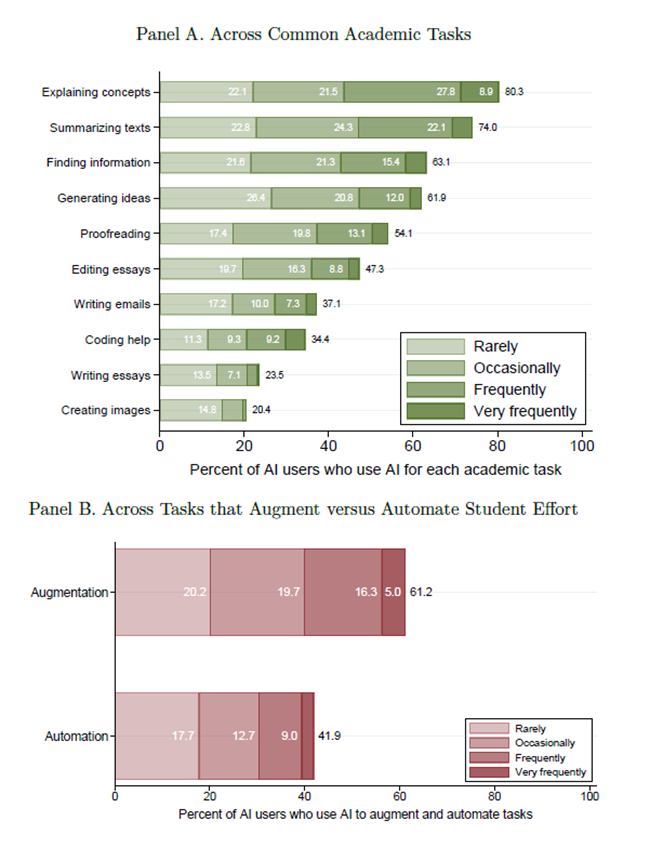
Augmentation includes using AI to explain concepts, find information, and receive feedback—activities that enhance learning while maintaining student engagement. Automation involves having AI directly produce outputs like essays or complete assignments.
Students frequently describe AI as an “on-demand tutor,” particularly valuable when traditional resources like office hours are unavailable. Non-native English speakers report using AI for proofreading to overcome language barriers, while STEM students use it to debug code and understand error messages. When students do automate tasks, it’s typically during periods of overwhelming workload, with time savings being the primary motivation.
Finding 2: Adoption varies dramatically across disciplines and demographics
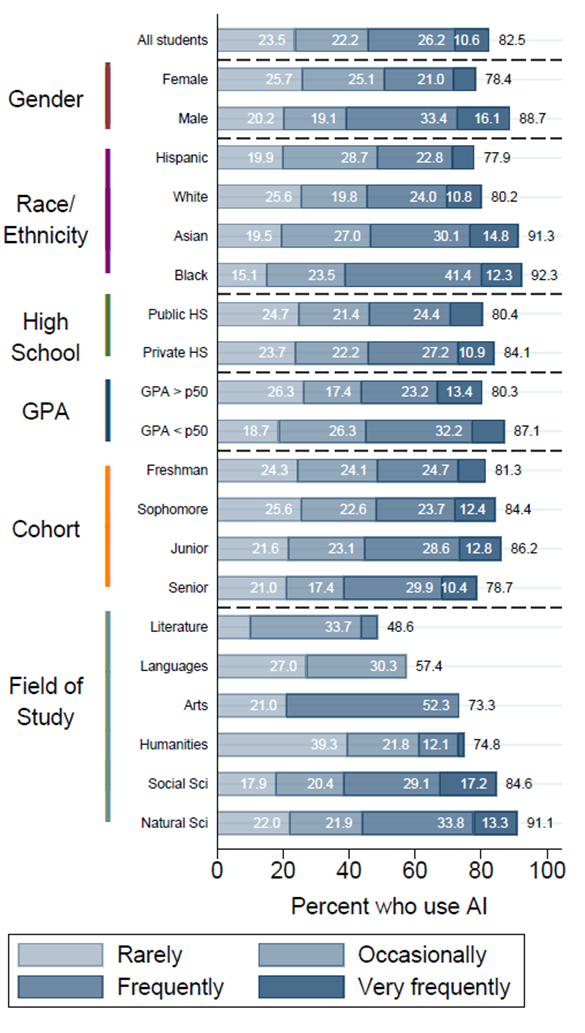
AI adoption is far from uniform. Natural Sciences majors (which includes computer science and math) lead with 91.1% usage, while Literature (48.6%) and Languages (57.4%) show substantially lower rates. This variation likely reflects how well AI capabilities align with field-specific academic tasks.
Notable demographic differences also emerge. Males adopt AI at higher rates than females (88.7% versus 78.4%), consistent with gender gaps documented across multiple contexts. Perhaps most surprisingly, lower-achieving students show higher adoption rates than their higher-achieving peers (87.1% versus 80.3%), suggesting AI could either help struggling students catch up or potentially widen achievement gaps if it undermines skill development.
Finding 3: Students believe AI improves learning but institutional policies matter
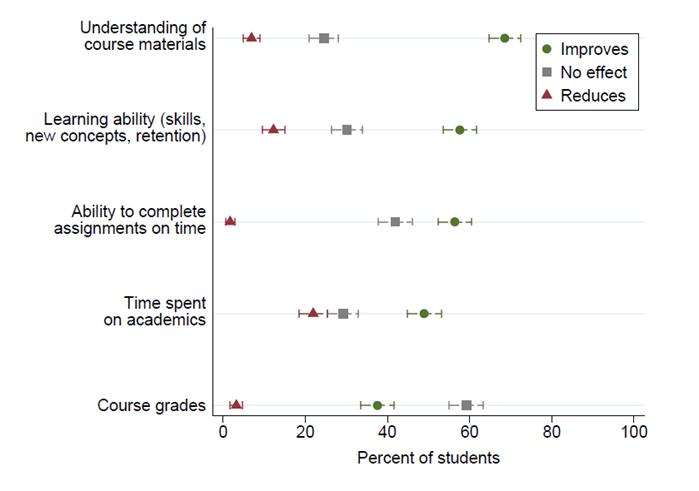
Most students believe AI improves their understanding of course materials (70.2%) and learning ability (60.1%), though fewer think it improves grades (41.1%), as shown in Figure 3.
These positive perceptions strongly predict adoption—a 10 percentage point increase in belief that AI improves learning corresponds to a 4.9 percentage point increase in usage.
Why this matters
These findings have important implications for educational policy. The rapid adoption and preference for augmentation over automation suggest that blanket AI bans may be both ineffective and counterproductive, potentially disadvantaging students who benefit most from AI’s learning enhancement capabilities.
The study also reveals significant information gaps—only 10.1% of students know about college-provided AI resources, and just 32.6% understand proper citation practices. These gaps suggest straightforward opportunities for improvement through better communication and training.
As generative AI becomes embedded in educational settings, understanding actual usage patterns becomes crucial. Rather than focusing on preventing cheating, institutions might better serve students by teaching responsible AI use that enhances rather than replaces learning. The technology has already transformed how students approach their education—the question now is how to harness it effectively.