
• Skip to primary navigation
  • Skip to content
  • Skip to primary sidebar

IZA Newsroom

IZA – Institute of Labor Economics

  • Home
  • Archive
  • Press Lounge
  • DE
  • EN

admin

Vanishing effect of religion on the labor market participation of European women

August 10, 2015 by admin

Religion and the traditional role model it conveys affects female labor market participation: Studies show that the likelihood of employment is lower for Catholic, Christian-Orthodox, and Muslim women compared to their Protestant peers. However, the influence of religious-conservative values may well change as society and economy transform. A changing society might imply changes in attitudes, or changes in child upbringing technology and household duties – either might pose internal and external restrictions on labor market access for married women.

A new IZA paper by Justina A. V. Fischer and Francesco Pastore analyzes whether the impact of religious denomination on employment of married women in Europe differs a) by time period, b) over the female life cycle, and c) by cultural regions within Europe. Using the World Values Survey 1981-2013, the authors exploit information on 44,000 married women aged 25 to 60 years in about 40 countries. They distinguish between OECD and non-OECD countries to account for modernization and democratization processes in OECD countries.

[Read more…] about Vanishing effect of religion on the labor market participation of European women

Filed Under: Research Tagged With: behavioral differences, catholic, Christian-orthodox, democratization, female employment, labor market participation, modernization, Muslim, protestant, religion, religious denomination

Home births lead to higher infant mortality: Dutch mothers in poorer areas at risk

July 27, 2015 by admin

The safety of home births for low-risk women is a hotly debated topic in the Western world. In this context, the Netherlands stands out as one of the few developed countries with a health care system geared toward home births, with one-third of all low-risk deliveries taking place at home. This makes it one of the best settings to study the safety of home births. A new study finds that encouraging home births may come at the cost of higher infant mortality, at least for mothers living in poorer areas.

In their paper, N. Meltem Daysal (University of Southern Denmark and IZA), Mircea Trandafir (University of Southern Denmark and IZA) and Reyn van Ewijk (VU University Amsterdam and University of Mainz) examine 356,412 low-risk Dutch women who delivered between 2000 and 2008 and who were allowed to choose between a home and a hospital birth.

[Read more…] about Home births lead to higher infant mortality: Dutch mothers in poorer areas at risk

Filed Under: Research Tagged With: babies, home birth, hospital, infant mortality, medical treatments, mother, Netherlands, risks

“When the going gets tough, the tough major in STEM fields”

July 27, 2015 by admin

The consequences of economic fluctuations are large and long-lasting, and can have an especially strong influence on investment choices. A new study by Erica Blom, Brian C. Cadena, and Benjamin J. Keys provides new insights into how personal exposure to the business cycle affects the choice of college major, a key investment in human capital.

The authors use data from more than 50 cohorts of U.S. college graduates in the American Community Survey (ACS) to estimate how responsive college students are in their choice of major. The results show that, when unemployment is high, students choose majors that are higher-paid, more math-heavy and challenging, suggesting that students consider college as an “investment” more than as “consumption” when times are bad.

[Read more…] about “When the going gets tough, the tough major in STEM fields”

Filed Under: Research Tagged With: business cycle, college major, consumption, economic environment, economic fluctuations, graduating, investment, investment choices, labor market prospects, recessions, STEM, students

Inter-ethnic interaction shapes attitudes towards minorities

July 23, 2015 by admin

Hostile attitudes of majority members towards ethnic, racial or social minorities are of major concern for policymakers and researchers alike. In his talk in the IZA Research Seminar, Scott E. Carrell (University of California, Davis) presented compelling evidence for the malleability of such attitudes: Attitudes are not fixed, but can be affected through social inter-group interaction.

We took the opportunity to talk to him about the attitudes towards minorities and options for public policy.

[Read more…] about Inter-ethnic interaction shapes attitudes towards minorities

Filed Under: Research Tagged With: active labor market policy, discrimination, economic efficiency, Hostile attitudes, minorities, positive interactions, racial attitudes

A big fish in a small pond: How rank affects students’ educational decisions

July 16, 2015 by admin

The characteristics of potential classmates are among the decisive factors for parents when choosing a school for their child. It is commonly believed that children learn and achieve more when surrounded by high-ability classmates. In their new discussion paper, IZA researchers Benjamin Elsner and Ingo Isphording explore a channel that runs counter to the positive impact of high-ability peers: a student’s ordinal rank in her peer group. Smart students who have a low relative ability compared to their peer group – small fish in a big pond – may erroneously conclude that they have a low absolute ability and, thus, under-invest in their human capital.

[Read more…] about A big fish in a small pond: How rank affects students’ educational decisions

Filed Under: Research Tagged With: ability, cognitive skills, college, educational attainment, educational outcomes, high school, social comparisons, students

Socio-economic background shapes children’s personality

July 13, 2015 by admin

In many countries, people find it hard to climb up the economic ladder. According to a recent IZA paper, one of the reasons for social immobility is that parents’ education and income are important predictors of children’s personality traits. Wealthy and educated families have more resources to invest in forming personality traits that improve academic achievement and are valued in the labor market. These traits include time and risk preferences, as well as altruism and IQ.

[Read more…] about Socio-economic background shapes children’s personality

Filed Under: Research Tagged With: academic achievement, altruism, children, disadvantaged, education, income, IQ, personality traits, risk preferences, socio-economic status, time preferences

Student work experience doesn’t help to get a job interview

July 9, 2015 by admin

Students in high school and university are often encouraged to work during the summer or after class to gain practical experience, make money, expand their networks, and thereby increase their chances of finding a “real” job later. While this seems to be common sense, a new IZA Discussion Paper finds that work experience in a student’s CV does not help at all – it may even reduce the chances to get a job interview!

We wanted to know more about this counterintuitive finding and spoke with Stijn Baert, who co-authored the paper with Olivier Rotsaert, Dieter Verhaest and Eddy Omey.

[Read more…] about Student work experience doesn’t help to get a job interview

Filed Under: Research Tagged With: call-back, human capital, job application, signaling, students, summer job, work experience

Early-life medical interventions benefit siblings of treated children

July 7, 2015 by admin

When newborns with a too low birth weight are treated, even their non-affected siblings benefit. This is the conclusion of a recent IZA Discussion Paper authored by N. Meltem Daysal, Sanni Breining, Marianne Simonsen, and Mircea Trandafir, using data from Danish children born between 1982 and 1993.
During the past few decades, medical spending for the very young increased substantially faster than spending for the average individual. These early-life medical interventions substantially improve the short-term health and long-term academic achievement of treated children. But it doesn’t stop here: The authors investigate whether the beneficial effects of early-life medical treatments also spill over to the siblings of treated children.

[Read more…] about Early-life medical interventions benefit siblings of treated children

Filed Under: Research Tagged With: academic achievement, birth weight, children, Denmark, family, health, intellectual disability, medical interventions, medical treatments, parental health education, siblings

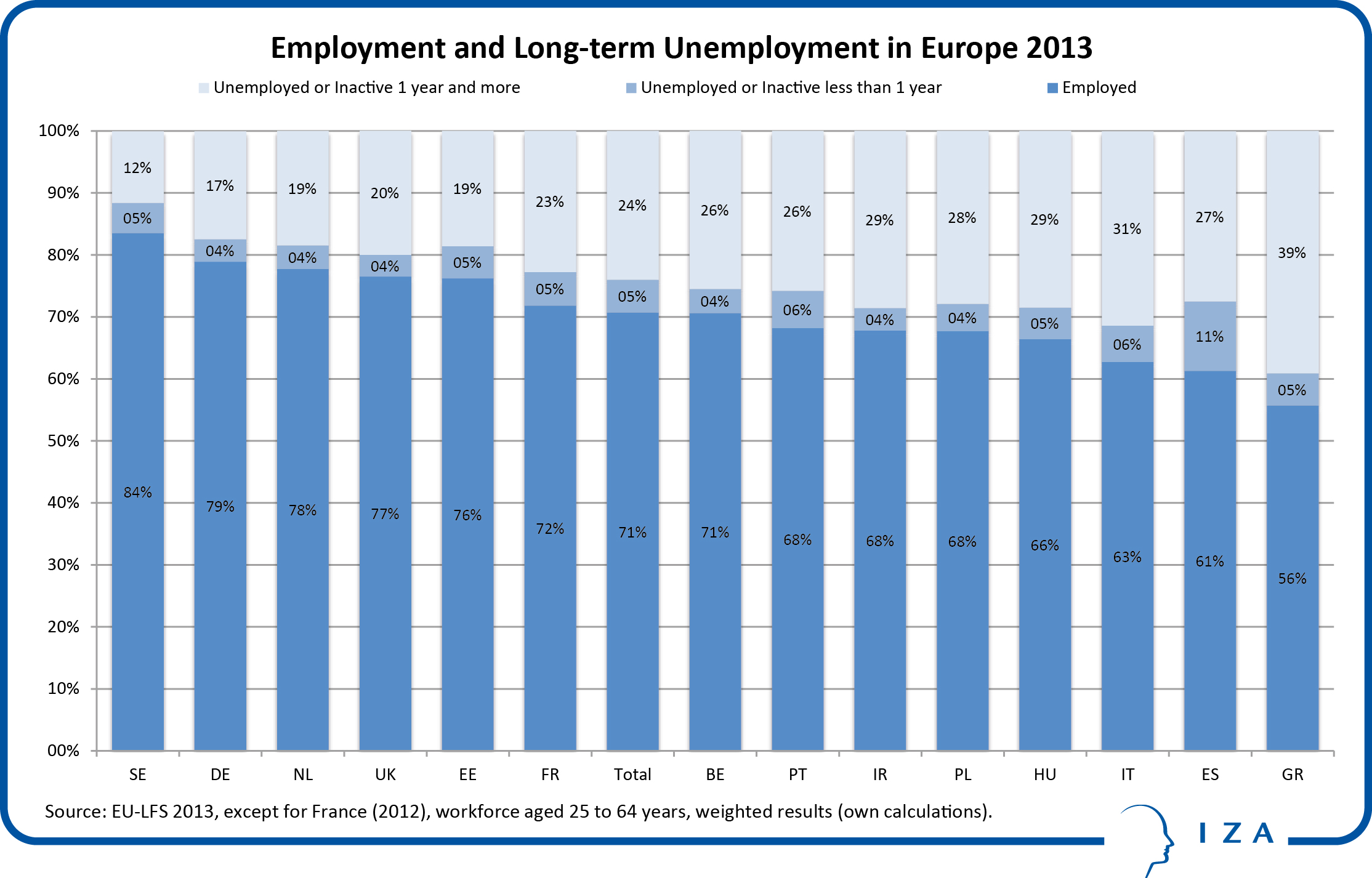
A European perspective on long-term unemployment

June 26, 2015 by admin

By Werner Eichhorst

In the aftermath of the 2008/09 recession, long-term unemployment has increased in many EU member states. Even in some countries with a favorable economic environment that contributed to declines in overall unemployment, the share of long-term unemployed in total unemployment remains at high levels.

In addition, some countries with low long-term unemployment rates have persistently high numbers of working-age long-term benefit recipients (e.g. disability, sickness or early retirement) so that the overall numbers of people dependent on benefits are more similar across countries than a comparison of long-term unemployment figures suggests.

[Read more…] about A European perspective on long-term unemployment

Filed Under: Opinion, Research Tagged With: active labor market policies, activiation, benefit receipt, Europe, long-term unemployment

Don’t be afraid of the future of work! Werner Eichhorst explains current labor market trends

June 22, 2015 by admin

A new book edited by Werner Eichhorst and Paul Marx looks at Non-Standard Employment in Post-Industrial Labour Markets. Examining the occupational variation within non-standard employment, the book combines case studies and comparative writing to illustrate how and why alternative occupational employment patterns are formed.

[Read more…] about Don’t be afraid of the future of work! Werner Eichhorst explains current labor market trends

Filed Under: Videos Tagged With: developed economies, future of labor, future of work, non-standard employment, occupational employment, occupational factors, policy makers

  • Previous Page
  • Page 1
  • …
  • Page 18
  • Page 19
  • Page 20
  • Page 21
  • Page 22
  • …
  • Page 45
  • Next Page

Primary Sidebar

© 2013–2025 Deutsche Post STIFTUNGImprint | Privacy PolicyIZA