• Skip to primary navigation
  • Skip to content
  • Skip to primary sidebar

IZA Newsroom

IZA – Institute of Labor Economics

  • Home
  • Archive
  • Press Lounge
  • DE
  • EN

Mark Fallak

Short-term consequences of COVID-19 on labor market outcomes in the United States

April 29, 2020 by Mark Fallak

The COVID-19 pandemic has had vast tragic human consequences. The human suffering brought about by the pandemic and its economic consequences are depressing in the short run. A new IZA discussion paper by Louis-Philippe Béland, Abel Brodeur, and Taylor Wright studies the economic impacts of COVID-19 on workers in the United States.

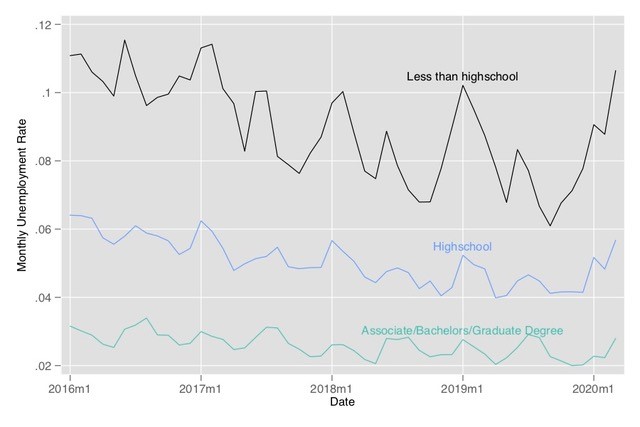
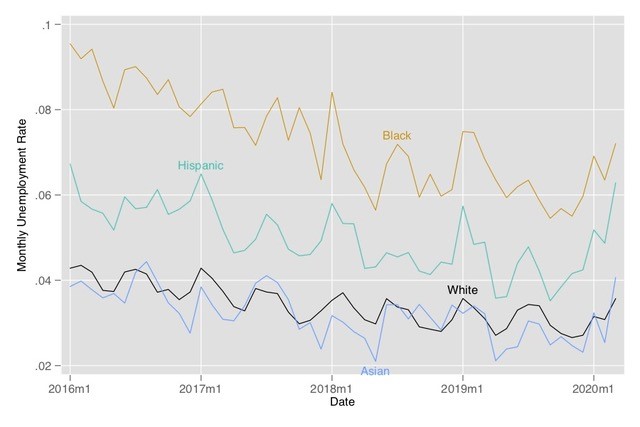
Using monthly U.S. employment data from the Current Population Survey (CPS), a nationally representative survey, the authors find COVID-19 had negative impacts on short-term labor market outcomes (unemployment, wages, hours worked, and labor force participation) in the US especially for men, younger workers, immigrants, Hispanics and less-educated workers (see Figures below for a look at unemployment).
In order to gain further insight into which workers are more or less likely to be impacted, the researchers look at workers in occupations that are more exposed to disease and infection; working more closely in proximity to others; and are more likely to work remotely. Occupations are classified based on whether they are above or below the median index value for each of these indexes.

The Figure below illustrates the three indexes. Each circle in the figure represents an occupation. The size of each circle represents the number of CPS respondents employed in that occupation: the larger the circle, the greater the number of people employed in that occupation. The x-axis plots each occupation’s physical proximity to coworkers, measured by O*NET‘s index. The further to the right, the closer in proximity employees in that occupation work with their coworkers. The y-axis plots each occupation’s exposure to infection and disease, also measured by O*NET’s index. The further up, the more frequently employees in that occupation are exposes to infection and disease. The color of the circles corresponds to the quartile of each occupation in the remote work index constructed by the authors. Occupations in the first quartile are not commonly done from home while those in the fourth quartile are more commonly done from home.

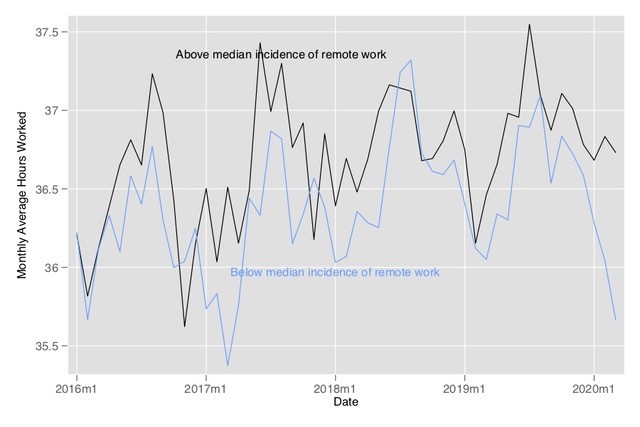
The results show that individuals in occupations working in proximity to others are more affected in terms of negative labor market outcomes while occupations able to work remotely are less affected (see Figure below for a look at hours worked). The authors also find that occupations classified as more exposed to disease are less affected, possibly due to the large number of essential workers in these occupations.
These results are important given the current tradeoff faced by state governors between employment and disease prevention. As policy makers look to help displaced and affected workers, these findings highlight some of those most in need of assistance. Looking forward, these insights can aid policy makers in prioritizing which occupations and workers should be allowed to resume usual activities.
Filed Under: Research Tagged With: COVID-19, employment, remote work, wages

Katharine Abraham and Shelly Lundberg newly elected AEA Distinguished Fellows

April 29, 2020 by Mark Fallak

The American Economic Association has chosen two IZA Research Fellows to be among this year’s four new Distinguished Fellows. Katharine Abraham, Co-Director of IZA’s Program on Labor Statistics, and Shelly Lundberg, long-time IZA Fellow, have been recognized for their lifetime research contributions with this highest accolade conferred by the Association.

“The Award is extremely well-deserved. IZA is proud to have had both Katharine and Shelly as Research Fellows, and collectively we congratulate them on this honor,” says IZA Network Director Daniel Hamermesh.

Read more on the AEA website.

Filed Under: IZA News

Helping job seekers online

April 23, 2020 by Mark Fallak

The COVID-19 pandemic has lifted the veil on the limitations and flaws of the employment assistance services around the world. Last week, hundreds of people in Florida had to line up to get paper applications for unemployment benefits as the state was struggling to cope with online filing issues. The state of New Jersey had to launch a call for volunteers who knew how to code COBOL, a 1950s computer programming language still used to manage unemployment claims applications after an unprecedented demand.

Other government agencies around the world, such as Italy and Australia, also saw their online systems crushed due to a surge in online benefits applications. In a few weeks, these IT issues will be remembered by policymakers as no more than temporary annoyances compared to the magnitude of the challenge that lies ahead.

In the week ending March 28, 2020, the U.S. Department of Labor recorded more than 5.8 million actual initial claims for unemployment insurance. That is millions of claims that need to be checked for validity and honest reporting, and millions of people being defaulted in re-employment policies or programs. However, many of these job seekers will not be able to return to work any time soon, and many will see their jobs disappearing for good as some industries will be severely hurt by the virus.

Conventional programs don’t work well in the crisis

Policymakers must begin thinking now how to put those unemployed workers back into a job while public health restrictions will remain in place for the foreseeable future. Traditional policy levers for the re-employment of job seekers include assistance with job search and re-skilling training services. These conventional programs have two drawbacks during a pandemic: They are expensive, and they are predominantly delivered face-to-face.

At a time when the unemployment rate is skyrocketing, and as long as physical distancing measures are in place, these policies are of little use. This disruption comes at a time when labor economists are converging to new evidence that some elements of these policies might in fact improve beneficiaries’ job outcomes. The silver lining in this crisis is that policymakers might be pushed to explore innovative ways to deliver the same assistance to the unemployed, such as helping them online.

Field experiment shows benefits of online job search assistance

In a new IZA Discussion Paper, Guglielmo Briscese, Giulio Zanella, and Nicky Quinn report the results of a field experiment where they tested the effect of complementing offline assistance with a website that provided an editable resume and cover letter templates, as well as tips on how to look and apply for a job. The researchers randomized exposure to the website among about 2,700 job seekers.

They find that the intervention increased the rate of job seekers who found their own employment (i.e. not through a vacancy that was secured by an employment agency), particularly among those aged 35-50 (up to 8 percentage points), with larger effects for women within this age group (up to 10 percentage points).

The job retention rates were higher compared to the control group, suggesting that the quality of job matches improved, too. But the study also shows that not everyone is ready for a sudden transition to the online world. Older and less tech-savvy job seekers might face a double barrier in shifting to an online labor market and could thus be at greater risk of displacement.

COVID-19  is imposing a fast adjustment. As a vaccine, most likely, won’t be available until late next year, many industries will be disrupted and millions of workers displaced. It would be a shame, the authors argue, to let such serious crisis go to waste and miss the opportunity to radically improve employment assistance programs.

Filed Under: Research Tagged With: Australia, COVID-19, field experiment, job search, labor market policy, online services, unemployment

Low-income earners suffer most from the COVID-19 crisis

April 17, 2020 by Mark Fallak

Home office at full pay is not an option for all employees hit by the coronavirus crisis. To analyze changes in work arrangements during the pandemic, a team of economists from the University of Bonn, IZA and the University of Tilburg surveyed around 5,500 individuals in the Netherlands from March 20-31. The results show that high-skilled workers spend more time in the home office, while less-skilled workers are more likely to work reduced hours or lose their jobs.

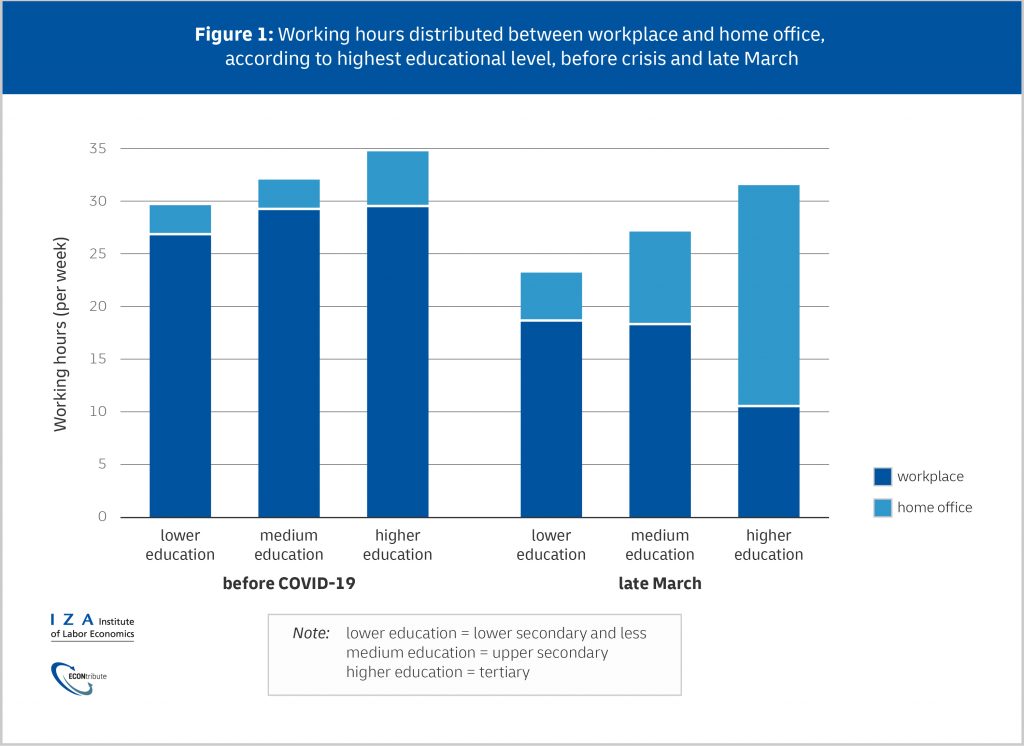
Education plays a key role in terms of being able to work from home, according to new data from the COVID Impact Lab, a joint research project by the University of Bonn’s ECONtribute Cluster of Excellence and IZA. The researchers compared work arrangements at the onset of the crisis and shortly after social-distancing policies were implemented. Their data are the first to show detailed changes in the proportion of telework among different groups of employees.

High-paid workers benefit from the home office option

The total share of employees who work from home at least two hours a day has doubled from 27 to 54 percent. This is mainly driven by high-skilled workers (76 percent) while only 31 percent of low-skilled workers report at least two home office hours per week since the beginning of the crisis. For university graduates, switching to telecommuting seems relatively easy: While their share of home office hours increased from 11 to 68 percent, the share among the low-educated is only one-fifth. The latter group, instead, experienced a much larger drop in total hours (see Figure 1).

Double impact of the crisis on low-income earners

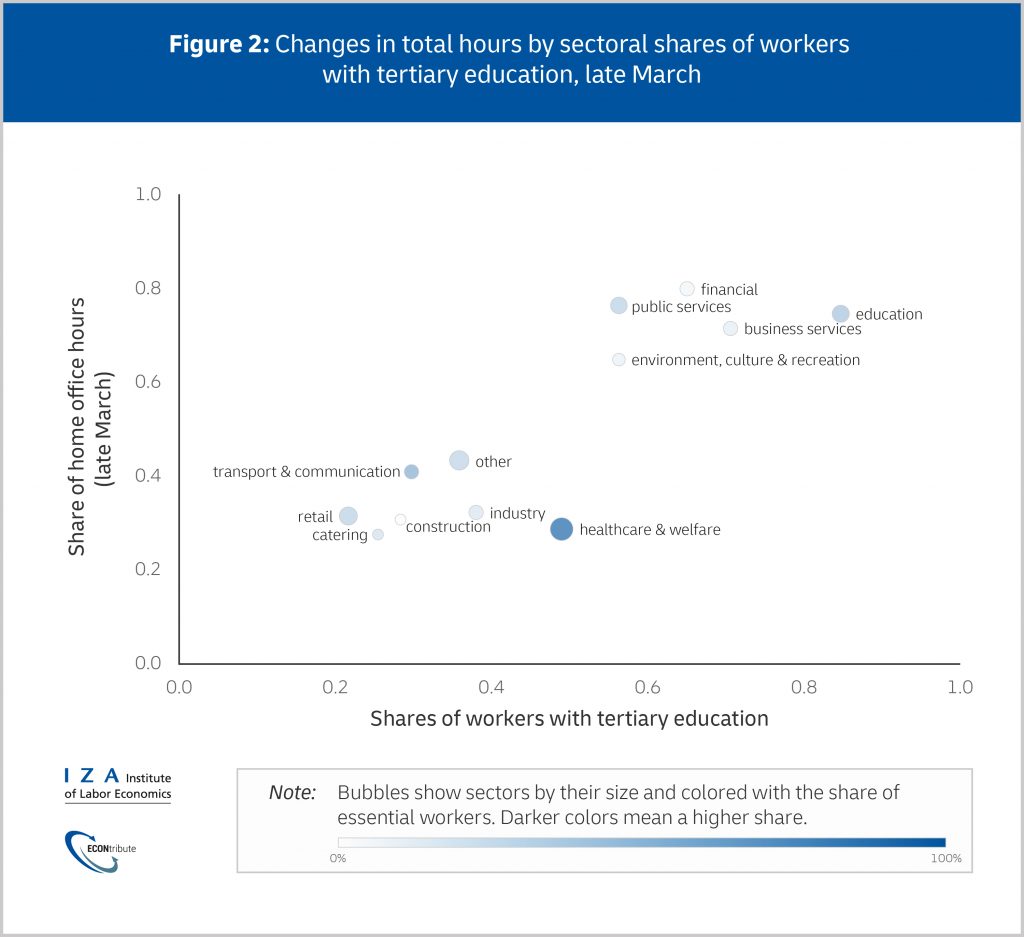
The main reason may be that less qualified workers are more often found in occupations where remote work is impossible, such as transportation, retail, or catering. This makes them more prone to job loss or substantial working hour reductions. At the same time, they are less likely to have savings or assets to compensate for income loss, which makes them particularly vulnerable to the crisis and more in need of government support.

Lower educated workers are also found in essential occupations, such as nursing care or grocery retailing. While their jobs are currently safe, they are at higher risk of infection. Home office workers, on the other hand, are protected against both infection and income loss. This aggravates the labor market segmentation into office jobs, characterized by higher education levels and home office rates, and lower-skilled jobs with no home office option (see Figure 2).

Transferability of the findings to Germany

“The data currently available for Germany are less detailed, but preliminary findings suggest that the situation is very similar. Although the increase in the share of home office hours seems somewhat less pronounced than in the Netherlands, it is clear that workers without higher education are less likely to be able to work from home. Both countries have also implemented similar restrictions on social contacts, which creates a comparable setting,” says IZA research team leader and ECONtribute professor Hans-Martin von Gaudecker.

About the dataset

Data were collected through the Dutch LISS panel (Longitudinal Internet Studies for the Social Sciences) which has been surveying 4,500 households regularly on a variety of topics for over ten years. The households are representative of the Dutch population and answer the questionnaires online. For the current wave of the LISS panel, the research team designed a new module to ask panel members about behaviors, beliefs and expectations during the Corona epidemic. The first wave of this module was fielded between March 20 and March 31 among LISS participants aged 16 and over. The response rate was over 80 percent, which translates into a sample of 5,544 individuals. Comprehensive data are not yet available for Germany, but initial trends can be seen. The German data is also being collected via an online survey through GESIS, the Leibniz Institute for the Social Sciences.

Filed Under: Research Tagged With: COVID-19, home office, telecommuting, telework

Do immigrants integrate differently in new and traditional host countries?

April 16, 2020 by Mark Fallak

In many countries, the formal and informal institutions shaping immigrants’ labor market integration have evolved over decades or even centuries. Immigrants arriving into these traditional destinations can often rely on established ethnic networks and interact with natives who are accustomed to immigrants. However, a large number of people also move to countries that have short, if any, immigration history. Do these “pioneers” adopt different strategies to cope in the labor market than those arriving to the more established destinations?

A new IZA paper by Laura Ansala, Olof Aslund and Matti Sarvimäki examines this question by presenting a careful documentation of how immigrants enter the Finnish and Swedish labor markets. The two countries provide an informative case study because they are similar in many dimensions, but differ starkly in their immigration histories. In 1990, when the analysis period begins, Sweden was already an established host country with almost 10% of the population born abroad. By contrast, Finland had strongly restricted immigration and less than 1% of the population was immigrants.

As a consequence, immigrants arriving to the two countries faced very different circumstances. For example, only 0.3% of jobs in Finland were in establishments that had an immigrant manager while the corresponding figure in Sweden was 7.3%. Furthermore, natives in Finland were much less used to working with foreigners and more likely to hold negative attitudes towards immigrants than natives in Sweden.

Most immigrants start in low-paying jobs

Using detailed data covering the entire of population of the two host countries in 1990–2010, the authors find that despite the differences in immigration histories, immigrants start their careers in a remarkably similar manner in Finland and Sweden. In both countries, they tend to enter the labor market through low-paying establishments, where other workers and managers are disproportionately often immigrants – particularly from the same region of origin as the entrant herself. For example, 8% and 9% of immigrants to Finland and Sweden, respectively, enter the labor market through an establishment where the manager is from the same region of origin as the immigrant herself.

The similarities between Finland and Sweden extend to many details of labor market entry and subsequent careers. However, this does not mean that all immigrants would enter the labor market in the same way. The authors document large heterogeneity in time to first employment and entry job characteristics by region of origin, arrival cohort, gender, age and family structure.

Ethnic segregation and segmentation of the labor market emerge quickly

Importantly, however, the associations between background characteristics and labor market entry are very similar in Finland and Sweden. A case in point is refugees arriving from the former Yugoslavia and Somalia in the early 1990s. In Sweden, there was already a significant community of immigrants from the former Yugoslavia due to labor migration that had started in the 1950s. No such community was present in Finland. Furthermore, there were virtually no earlier immigrants from Somalia in either of the two host countries. Yet, the paper shows that those arriving from Yugoslavia enter the Finnish and Swedish labor markets in a similar way – as do those coming from Somalia.

These results are consistent with the hypothesis that ethnic segregation and segmentation are such fundamental features of the labor market that they emerge quickly even in a country with very limited immigration history. Thus the host country’s immigration history would play only a limited role in shaping the integration process. Of course, a descriptive study of two countries is not sufficient for establishing generality for this conjecture. Given the high social and policy importance of understanding the determinants of immigrant labor market outcomes, documenting these patterns also for other countries would thus be highly valuable.

Filed Under: Research Tagged With: Finland, immigration, Sweden

Making sure that SURE works

April 5, 2020 by Mark Fallak

By Werner Eichhorst and Paul Marx

To mitigate the labor market impact of the Corona recession, the European Commission has proposed to the Council a temporary European financial instrument (SURE, Support to mitigate Unemployment Risks in an Emergency). Its goal is to support short-time work and related emergency schemes in EU member states most affected by the crisis.

This instrument, based on art. 122 TFEU, is to be funded through bonds issued by the EU up to 100 billion euros. The supporting funds will be handed over as loans under favorable conditions to those member states suffering heavily from the crisis and using short-time work (or similar measures, particularly for the self-employed) to secure employment and income.

The distribution of the funds depends upon decisions by the Council, upon proposal by the Commission. To this end, the Commission will have to assess requests from the member states and evaluate their situation, in particular the increase of spending on short-time work and similar measures.

While it is conceived as a temporary assistance to member states, there is no fixed end date due to the unpredictable development of the current emergency. However, the scheme will be limited by the available funds. It will be complementary to existing or planned national measures and to other European funds.

SURE can be seen as an ad-hoc European reinsurance of national short-time work schemes. To understand the proposal, two levels have to be distinguished: 1) the general role of short-time work and 2) the genuine European contribution.

Sharing the financial burden of unemployment

Short-time work is a partial unemployment scheme, compensating for hours not worked and not paid due to an inevitable and temporary loss of demand (read more in the IZA World of Labor). The current shutdown of some sectors is a textbook example for its use. It allows for a burden sharing between employers, employees and unemployment funds or government (the exact distribution depends, of course, heavily on the details of the schemes).

It relieves employers from part of the labor cost during the slump, thereby trying to avoid dismissals, maintain employment and stabilize the labor force so that firms can catch up quickly during a phase of economic recovery. Short-time work only makes sense if one can expect a return to ‘normal’ economic activity and increased labour demand in the near future. This is a plausible assumption in the unexpected and (hopefully) temporary Covid-19 recession.

Ideally short-time work schemes provide assistance to firms and workers for as long as the emergency situation lasts. SURE is arguably inspired by the remarkable success of the German short-time work scheme (Kurzarbeit) during the 2008/09 crisis, where it helped avoid job losses in the heavily exposed export sector. It is important to note, however, that the success of Kurzarbeit benefited from a tradition of social partnership in large industrial firms that provided additional working-time and wage flexibility.

Covid-19 crisis differs from previous crises

Now, the situation in Germany and elsewhere is different. The Covid-19 crisis not only affects manufacturing but many small and medium-sized firms in the service sector as well as the self-employed. In these cases, short-time work (and assistance to self-employed outside unemployment insurance) can only work if it is administered in a way that facilitates access by target groups that have no experience with this scheme.

This creates strong demands on the responsible administrative bodies. Hence, while we know that some countries have created or expanded short-time work in response to the 2008/09 crisis and are going even further in the current situation, it will be crucial to what extent the newly affected firms and freelancers can effectively be supported. This might create a dilemma in some countries, because public employment services have to decide between effective monitoring (which will compromise the stabilizing function of the scheme) and a lenient approach (which will make it hard to prevent deadweight losses).

It is noteworthy that for the case of German industry, the application for Kurzarbeit typically requires consent from works councils. This is an additional control mechanism that is absent in countries and sectors with different patterns of industrial relations.

One should also take into account the difficult situation of workers with fixed-term contracts and temporary agency workers. It is the raison d’etre of these jobs to provide flexibility in times of crisis. The experience of 2008/09 tells us that these workers, unsurprisingly, suffer disproportionately from economic shocks.

Short-time work complements dismissal protection

In this context, it is important to appreciate that short-time work is ideal to complement dismissal protection. It allows employers to retain workers at low cost instead of having to shoulder separation costs in the form of severance pay, long notice periods, or law suits.

Temporary workers do not create separation costs and tend to be excluded from this beneficial complementarity. Few employers will extend temporary contracts or assignment of agency workers only to use short-time work. Short-time work therefore risks leaving behind workers that are already vulnerable. An explicit approach to protecting these groups would make the initiative more socially balanced. This is important in particular for the segmented labor markets that exist in some of the heavily exposed countries.

SURE is a timely and necessary expression of European solidarity.

SURE is a timely and necessary expression of European solidarity with the member states, firms and workers that are affected by the crisis in an unprecedented way. There is a short- and medium-term dimension to this. In the short run, the European contribution relieves immediate pressure on national budgets and unemployment funds. Of course, is too early to tell if the funds are sufficient to make a difference and if the national administration can deliver short-time work quickly enough to those in need.

The European initiative does not directly interfere with the diversity of national schemes. Nor is there are an agreement on the precise goals of the intervention. While this is justified by the time pressure involved, it would be important to ensure that European funds do not simply crowd out national spending, but lead to a genuine expansion. This applies in particular to the question of how generous and inclusive national systems are towards low-wage earners, workers on non-standard contracts or vulnerable, economically dependent self-employed.

Hence, the increase in expenditure for short-time work and similar programs that is required to be supported by European loans should also be linked with a sufficient generosity and scope of these programs.

Model for a European unemploymen (re)insurance

Second, in a mid- to long-term perspective, the proposed scheme could not only help stabilize member states’ labor markets now, but also provide a pilot for the introduction of a permanent European unemployment (re)insurance system. The current crisis illustrates how valuable an effective system of automatic stabilizers without the need for cumbersome ad-hoc decision making would be.

Based on our experience with previous crises, the European initiative to expand short-time work is a sensible policy that can help alleviate the Covid-19 shock. Beyond the current crisis, it could be an opportunity to address the pressing questions of how we could organize European solidarity – and how we want to include workers at the margins of Europe’s current employment models.

Filed Under: Opinion Tagged With: corona crisis, COVID-19, employment protection, Europe, short-time work, SURE, unemployment

How expectations affect compliance with COVID-19 social-distancing measures in Italy

March 30, 2020 by Mark Fallak

The coronavirus COVID-19 outbreak has rapidly and drastically affected the livelihoods of millions of people around the world. Several countries began implementing strict self-isolation measures (e.g. school closure, stay-at-home) to slow down contagion. The effectiveness of these measures depends entirely on citizens’ compliance, which may be affected by many factors, such as risk awareness, rules clarity, penalties for transgressions, trust towards public authorities, and the severity of the isolation costs.

In a new IZA discussion paper, Guglielmo Briscese, Nicola Lacetera, Mario Macis, and Mirco Tonin offer evidence of another key factor that influences compliance: people’s expectations on when the isolation measures will end. While countries like China introduced lockdown measures without announcing an end date of the measures, other countries like Italy announced that most measures would be lifted after a specified date.

Representative survey on Italians’ compliance intentions

In a survey on a representative sample of the Italian population, the authors elicit compliance intentions if the stay-at-home measures were extended (i) by a few weeks, (ii) a few months, or (iii) indefinitely (“until deemed necessary”), and control for the respondents’ level of awareness, expectations, and current compliance.

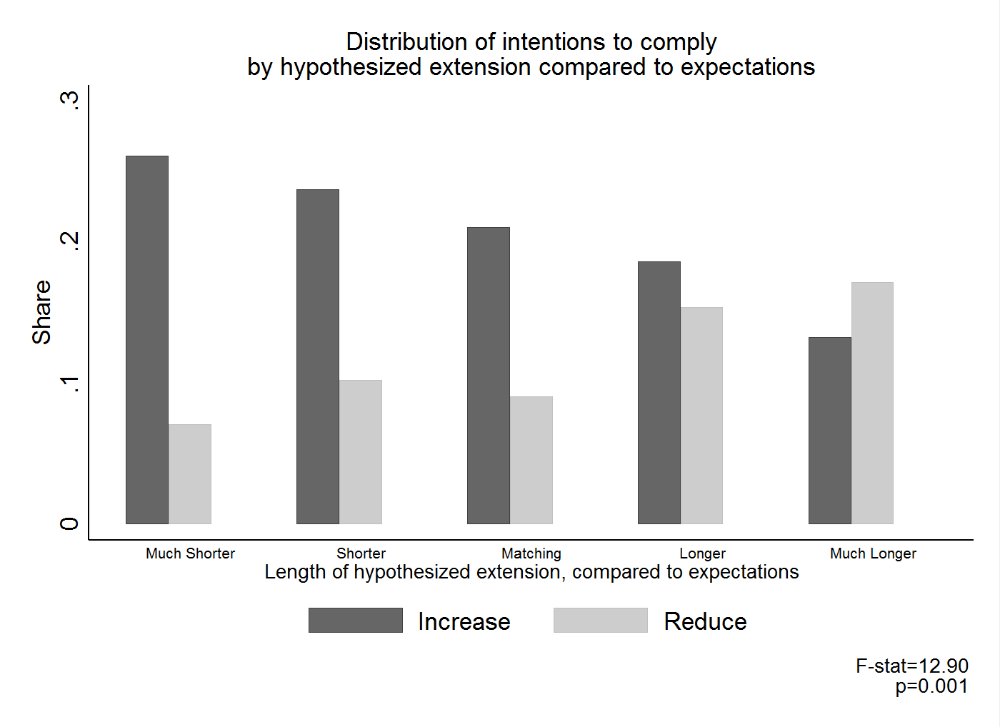
The results show that people’s willingness to comply is related to their expected end date of self-isolation measures. Those who would be positively surprised (i.e. extensions shorter than expected) intend to increase their isolation efforts; those who would be negatively surprised (i.e. extensions are longer than expected) are less willing to maintain or increase their self-isolation efforts (see Figure).

The study also finds that:

  • About 50% of respondents have not yet adopted some of the recommended social distancing measures.
  • Most people are aware of the official end date of social isolation measures (April 3rd), but there is some confusion among the elderly (60+ years old) who report a wrong date about 1/3 of the time.
  • Almost everyone expects that the stay-at-home measures will continue beyond April 3rd. However, expected extensions vary widely: 40% expect the measures to be extended by a few weeks, 20% by a few months, and 40% indefinitely (until necessary). The elderly population is more likely to expect measures to end sooner.
  • In case of an extension, most respondents intend to continue with self-isolation regardless of the duration. More people are willing to increase, rather than decrease, their self-isolation efforts.
  • Respondents who stated to have already adopted most recommended self-isolation measures are more likely to state they would reduce compliance with the restrictions in case of an extension longer than they expect. This might suggest “isolation fatigue” and that the efforts of compliant individuals should not be taken for granted.
  • Respondents who have adopted only some of the recommended isolation measures state they would be more likely to increase their self-isolation if the extension is shorter than they expect and are less likely to increase compliance if the extension is longer than they expect.

Managing the public’s expectations

The authors suggest that to maximize compliance with self-isolation, public authorities must also focus on managing the public’s expectations on the duration of such measures. An unexpectedly long extension might reduce people’s willingness to comply. Therefore, public authorities will need to consider this behavioral response and balance it with potential downside of not announcing an end, which might in turn cause some anxiety to some people.

Considering recent developments, self-isolation measures will likely be extended across most countries, possibly for an indefinite period. The results of the survey show that people’s intentions to comply with time-limited self-isolation norms depend on how authorities communicate their duration, and on the (mis)match between such announcements and individuals’ expectations. As the escalation of policy responses in Italy resembles the one being followed by other countries, the results  have implications for the timing of upcoming policy announcements by other governments around the world.

+++

Note: The survey was implemented in partnership with SWG, a major Italian market research firm, on March 18-20, on a sample of n=894, at a time when the Government of Italy had already introduced stay-at-home measures (on March 9, until April 3) and the closure of most retail stores throughout the country (on March 11, until March 25) and just before the suspension of all non-essential economic activities (on March 22, until April 3). The timing of the survey implementation ensures that responses were in a period when an extension of stay-at-home measures was likely, and indeed discussed in the media, but not yet implemented.

Filed Under: Research Tagged With: compliance, coronavirus, COVID-19, expectations, lockdown, self-isolation

Do women shy away from public speaking?

March 16, 2020 by Mark Fallak

Psychological traits – such as risk aversion, willingness to compete, or aversion to feedback – contribute to explaining gender differences in occupations, wages and careers. Public speaking is generally thought to be relevant for career prospects and leadership positions. The ability to present information publicly, clearly and eloquently creates an important competitive advantage in a variety of job settings.

At the same time, speaking to a public is also a possible source of anxiety and embarrassment. If men and women differ in their willingness to deal with the stress deriving from this type of exposure to judgment, this could in turn cause gender differences in career prospects and access to top positions.

A new IZA paper by Maria De Paola, Rosetta Lombardo, Valeria Pupo and Vincenzo Scoppa examines this question in an incentivized setting at an Italian university. Their field experiment involved more than 500 undergraduate students who were given the chance to gain two extra points for their final exam grade by presenting orally the solutions of a problem set. Students were randomly assigned to present only to the instructor or in front of a large audience (a class of 100 or more).

Social norms play an important role

The researchers find that while women are more willing to present face-to-face to the instructor (participating on average 43%), they are considerably less likely to give a public presentation (25%). In contrast, men tend to participate less in face-to-face presentations (about 39%), but there is no difference in their propensity to participate if they are assigned to the public presentation. This tendency does not depend on gender differences in abilities, risk aversion, self-confidence and self-esteem.

Consistent with previous findings on the relationship between women’s labor market participation and their children’s gender attitudes, the study finds that female aversion to public speaking is much lower for daughters of working women.

From data obtained through an online survey, the authors also show that giving higher incentives for public presentation does not close the gender gap in public speaking aversion. Even when the gains deriving from public speaking are quite high, women are much less likely than men to engage in this type of activity. Moreover, women do not seem to benefit from getting more time to prepare for the task.

These findings suggest that women’s tendency to shy away from public speaking situations is difficult to change, as it is probably the result of deeply embedded social norms. The authors argue that designing work and educational environments in a way to help women overcome their aversion to public speaking may reduce gender differences in access to high-level positions and career prospects.

Filed Under: Research Tagged With: anxiety, career, gender gap, public speaking, university

In memory of Don J. DeVoretz – a great inspiration in migration economics

March 15, 2020 by Mark Fallak

IZA Fellow Don J. DeVoretz passed away on March 14, 2020. He was among the most active members of our network and a prominent figure in the field of the economics of international migration.

Recently he submitted his last IZA Policy Paper, on issues of Canadian immigration policy. Don contributed numerous insightful papers that illustrated the policy relevance of migration economics. His core interest was the economics of integration and citizenship. He was an untiring ambassador for liberal citizenship legislation and policy incentives to achieve language acquisition.

IZA’s network program area on migration and labor mobility benefited from his thoughtful, novel ideas; and many IZA researchers will remember him for his warm-hearted advice and cooperation during his many stays in Bonn. Given recent international trends toward populism, intolerance and walling-off of immigrants, his quiet but powerful voice will be greatly missed.

Filed Under: IZA News

Male students are more likely to receive favorable grade changes in college

March 12, 2020 by Mark Fallak

Women and men differ across a variety of behaviors, including their tendency to negotiate. The difference in propensity to negotiate has been argued to contribute to the gender gap in the labor market.

In a new IZA discussion paper, Cher Li and Basit Zafar study whether and why there are gender differences in grade changes in college. Since grades serve as productivity signals and many employers require transcripts for entry-level jobs, gender differences in grade changes in college may put equally qualified women at a disadvantage when they compete for the same position.

Men are more likely to ask

Using a unique administrative dataset from a large four-year public university, the authors find that men are 18.6% more likely than women to have their grade changed to a better grade. This gender gap can hardly be explained by the characteristics of the students, instructors, and classes. Although grade changes are infrequent after instructors submitted the final grades, 40% of students reported that they asked their instructor for a better grade at some point during their college life.

Administrative data is limited in what it can tell us about the origins of the gender differences in regrades. For example, they may be a result of at least three distinct scenarios: 1) male students are more likely than female students to ask instructors for grade changes although instructors treat all requests equally; 2) male and female students ask for grade changes at the same rate, but the outcomes are more favorable for males than for females when they ask; and 3) if female students make regrade requests during the semester, it may lower their demand for regrade requests at the end of the semester.

Ask and you shall receive?

To understand the mechanism, the researchers conducted surveys among instructors and students. The surveys support the first scenario and show that men are indeed more likely than women to ask for regrades. Therefore, even if instructors treat all regrade requests equally, we are still more likely to see more men than women getting their grade changed to a better grade. The study did not find evidence supporting the other two scenarios. Conditional on asking, men and women are similarly likely to see their grade changed to a better grade. Furthermore, men are more likely than women to ask not only at the end of the semester, but also during the semester.

To corroborate the results from the surveys, the authors conducted a laboratory experiment to test the gender differences in asking for regrades. In the experiment, participants completed a quiz, and the payoff was tied to the grade they received—the higher their score, the higher their payment. The experimenters picked 3 out of 20 questions to randomly grade them. Therefore, the initial grade could be the participant’s true grade, but it could also be higher or lower than their true grade.

Participants were fully informed of the uncertainty in the grades, and they were giving ten different cost scenarios to decide whether they are willing to pay the cost to get it regraded. If they paid the cost, the true grade was revealed and their payment was adjusted. If they chose not to pay the cost, the initial grade became final and they were paid accordingly. The researchers find that given a positive cost, nearly half of male participants versus slightly over one-third of female participants were willing to pay the cost to get a regrade.

Women are more uncertain about their performance

Why don’t women ask? Women tend to be less confident about their answers and more uncertain about their performance in the quiz. Nearly half of the gender difference in the willingness to pay for a regrade can be explained by the gender differences in the confidence level, uncertainty about the potential outcomes, and personality traits. However, the remaining half of the gender gap remained unexplained. In the survey, female students also reported a relatively high stress level when they have to ask.

The study thus shows that men and women do differ in their tendency to ask, even when they are still in school. The researchers suggest that making an explicit and transparent grading (and regrading) policy for students to follow would take part of the uncertainty out of the equation. They also believe that making clear grading standards could send a strong signal of student’s performance in the class to reduce the gender gap in grade changes. Being aware of the gender difference in asking and addressing the uncertainty in grading policy is likely to reduce the female disadvantage in grade changes and subsequent labor market outcomes, the authors argue.

Filed Under: Research Tagged With: college, education, gender differences, gender gap, grades, negotiation

  • Previous Page
  • Page 1
  • …
  • Page 22
  • Page 23
  • Page 24
  • Page 25
  • Page 26
  • …
  • Page 30
  • Next Page

Primary Sidebar

© 2013–2026 Deutsche Post STIFTUNGImprint | Privacy PolicyIZA