• Skip to primary navigation
  • Skip to content
  • Skip to primary sidebar

IZA Newsroom

IZA – Institute of Labor Economics

  • Home
  • Archive
  • Press Lounge
  • DE
  • EN

Mark Fallak

Internships are more likely to be paid when local unemployment is low

February 28, 2020 by Mark Fallak

Based on ads from an internship-specific website, a recent IZA paper by David Jaeger, John Nunley, Alan Seals, and Eric Wilbrandt shows that internships are less likely to be paid when the local unemployment rate is higher and when minimum wages are higher, indicating a clear link between the regular labor market and the market for interns. Internships more closely associated with a specific occupation are more likely to be paid.

The authors use a résumé audit study with more than 11,500 applications submitted to examine the determinants of success in the internship market. They find that previous internship experience is key to landing another internship, particularly for unpaid internships. Applicants with black-sounding names are less likely to receive a positive response from firms, as are applicants that are located further away from firms.

The results of the audit study suggest that firms consider whether applicants will accept or can afford to take an unpaid internship. If internships play an important role in subsequent labor market success, less advantaged students may suffer by not being able to take internships during college. The authors argue that providing financial support to allow students to take unpaid internships may level the playing field.
Filed Under: Research Tagged With: discrimination, internship, unemployment, work experience

Does it pay to start your career with a job at a larger firm?

February 26, 2020 by Mark Fallak

Young people entering the labor market face difficult decisions under uncertainty when choosing their first job. Workplace experiences can be worlds apart as similar young workers may end up in firms that differ vastly along dimensions such as pay, worker training, technology adoption, and productivity. But will it matter in the long run where a young person lands their first job?

On the one hand, given that young people change jobs relatively often, characteristics of the first employer might not be key from a long-term perspective. On the other hand, first employers could strongly affect career paths because search for ensuing jobs could vary based on first-employer quality, and opportunities to learn useful skills might also differ across firms.

Comparing the employment histories of Spanish workers

In a new IZA discussion paper, Jaime Arellano-Bover uses Spanish social security data to study the long-term effects of landing one’s first job at a large firm versus a small one. The size of a firm could be a very relevant employer attribute for inexperienced workers: large firms offer better training opportunities, pay higher wages and in general offer more productive work environments.

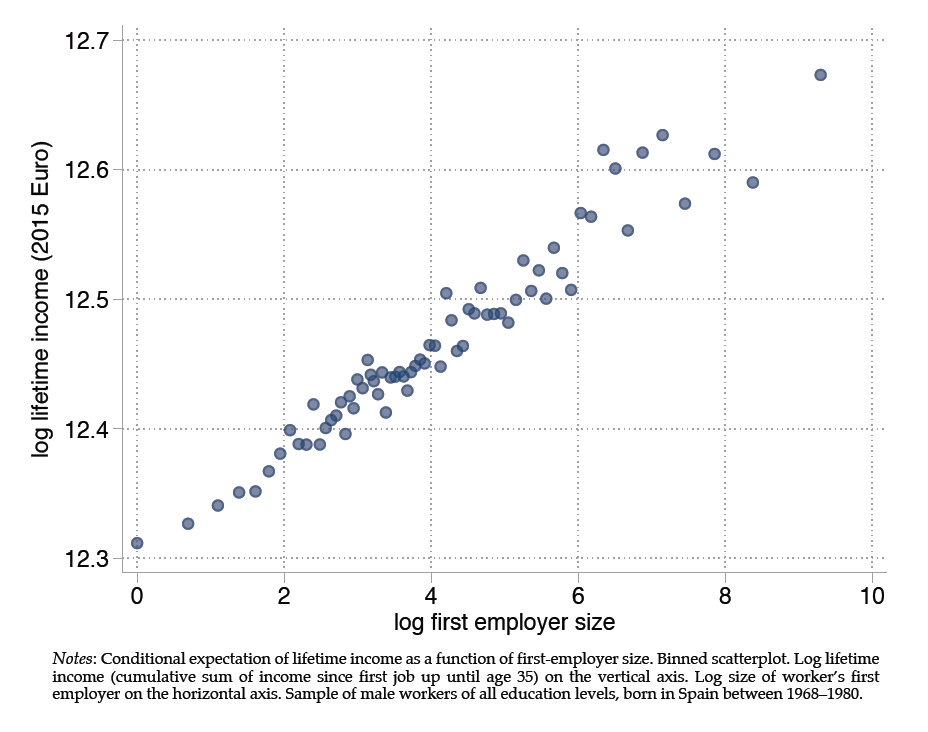
Figure 1 compares the working histories of Spanish workers who started at larger firms with those who started at smaller firms. Those workers who started at larger firms experience a significant bonus in lifetime incomes.

Figure 1: Positive correlation between lifetime income and size of first employer

But do those who start at larger firms fare better because they started at a large firm? Or are they more productive and motivated to begin with? To address this question and uncover a causal relationship between entry job firm size and long-term outcomes, the author bases his estimations on which firms happen to be hiring: graduating students hardly choose but passively encounter a different mix of employers (large vs. small) looking to hire inexperienced workers.

Importantly, this mix varies depending on when and where different young people graduate. The context of the study (1985-2003 Spain) is a particularly good setting for this approach, as after accession to the EU in 1986 strong economic transformations took place.

The results based on this empirical strategy indeed confirm the pattern of Figure 1 as a causal relationship. Initially matching with a larger firm leads to substantial long-run benefits in terms of higher lifetime income, arising from greater daily wages and employment. These effects seem particularly strong for low-educated workers and workers from less urban provinces.

Workers acquire more valuable skills at larger firms

The author shows that these benefits persist even after workers move on to subsequent jobs. Why would the benefits of a first job at a larger firm persist even after switching employers? The study argues that young workers acquire more valuable skills when employed at larger firms, and that these skills pay returns later on. These effects on skills could potentially arise from training schemes, learning from better peers and managers, or working in a generally more productive environment.

Overall, the paper illustrates how early career jobs act as important stepping stones that persistently impact young workers’ trajectories. Young people seem well advised to choose carefully their early career steps, while better informing young people in the school-to-work transition about the long-term consequences of first job choice helps in critical early career decisions.

Filed Under: Research Tagged With: career, entry job, firm size, job search, lifetime income, skills

How cash windfalls affect wages

February 21, 2020 by Mark Fallak

Do firms use an unexpected cash flow to spend the extra money on dividends (i.e. transfer it to owners or shareholders), wages, or investment in physical or human capital (i.e. new hires)? This question is not easy to answer because rents are usually associated with productivity growth. To observe the wage effects of pure rent-sharing, one would ideally need an experiment that randomly assigns cash to firms.

To approximate such an obviously quite unrealistic experiment, a new IZA paper by Sabrina T. Howell and J. David Brown evaluates the effects of a government R&D grant program on employee earnings by comparing grant awardees with unsuccessful applicants. The grant can be considered a cash flow shock because there are no restrictions on how it is spent.

The authors use data from applications to Small Business Innovation Research (SBIR) grants awarded by the U.S. Department of Energy between 1995 and 2013. They concentrate on small, likely financially constrained firms in the high-tech sector, which are crucial to economic growth and have especially dynamic employment and wage structures.

Backloaded wage contracts

The analysis shows that incumbent employees, hired before the application year, receive a 16 percent increase, which is consistent across the wage distribution. The wage effect increases with worker tenure, by 1.2 percent for each additional year on the firm’s payroll. New employees, hired in or after the year of the award, do not benefit at all. This leads to higher wage inequality between incumbents and new hires.

The grant also increases employment and revenue. Productivity growth, however, cannot not fully explain the wage effects. Instead, the data and a grantee survey suggest a frequent use of “backloaded” wage contracts, in which employees of financially constrained firms initially accept relatively low wages and are paid more when cash is available.

The authors point out that large, unconstrained firms are likely to react quite differently to a cash windfall than the smaller firms in their data, which tend to have less hierarchical structures, more employee autonomy, and more opportunity for monitoring and coordination.

Filed Under: Research Tagged With: cash flow, earnings, employees, grant, innovation, rent-sharing, wages

Expert commission delivers annual report on research and innovation in Germany

February 19, 2020 by Mark Fallak

Today the Commission of Experts for Research and Innovation (EFI) presented its 13th annual report to Chancellor Angela Merkel. Established by the German government, the commission analyzes the performance of the German research and innovation system and makes policy recommendations for improvement.

In addition to covering recent trends and future challenges related to the implementation of Germany’s “High-Tech Strategy 2025”, this year’s report focuses on three key areas that require policymakers’ attention:

Innovation in East Germany – 30 years after reunification: The eastern regions have largely caught up to the west in terms of overall innovativeness. Deficits still exist with regard to launching new activities and bringing innovations to market.

Cybersecurity: The threat of cyber attacks harms innovation. Germany lags behind other major industrial nations in terms of cybersecurity knowledge, experts, and innovative technology.

Knowledge and technology exchange between Germany and China: Germany needs to ensure fair competition in foreign direct investment, scrutinize acquisitions in technologically sensitive sectors, and strengthen China expertise. “Research institutions and firms, especially small and medium enterprises, need more people who are familiar not only with the Chinese language and culture, but also with the country’s markets, institutions, and political structures,“ says IZA research director Holger Bonin, who is a member of the EFI commission.

Read more in German.

Filed Under: IZA News Tagged With: China, cybersecurity, Germany, innovation, research, reunification, technology

Economic crises have long-term adverse health effects

February 17, 2020 by Mark Fallak

The misfortune of being born – or graduating – in a recession can have long-term consequences for people’s life outcomes that extend beyond economic disadvantage. Two recent IZA discussion papers highlight the adverse health effects ranging from lower birthweight to higher mortality.

Graduating in a recession

Entering the labor market in a recession worsens lifetime outcomes of young workers through no fault of their own. Research has long established that poor job prospects at the time of graduation may result in permanent income losses (see the IZA World of Labor for an overview).

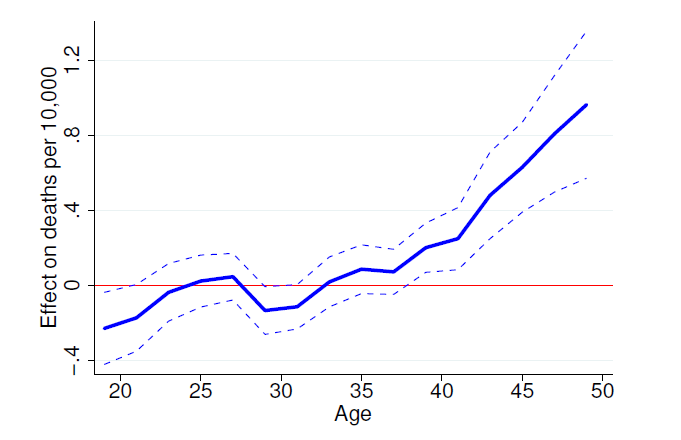
A new paper by Hannes Schwandt and Till von Wachter shows that this also affects mortality in midlife. Using several large cross-sectional data sources, the authors find that cohorts coming of age during the deep recession of the early 1980s suffer increases in mortality that appear in their late 30s and further strengthen through age 50 (see figure below).

These mortality impacts are largely driven by disease-related causes such as heart disease, lung cancer, and liver disease, as well as drug overdoses. At the same time, unlucky middle-aged labor market entrants earn less and work more while receiving less welfare support. They are also less likely to be married, more likely to be divorced, and experience higher rates of childlessness.

The findings of the study thus demonstrate that temporary disadvantages in the labor market during young adulthood can have substantial impacts on lifetime outcomes, can affect life and death in middle age, and go beyond the transitory initial career effects typically studied.

Children of crisis

But the role of luck comes into play already much earlier in life – even before birth. Using Turkish survey data, a new study by Mevlude Akbulut-Yuksel, Seyit Mumin Cilasun and Belgi Turan shows how newborns suffer from expectant mothers’ exposure to a severe economic crisis.

The authors explore the deep crisis of the Turkish economy between 2001 and 2008 and use regional variation in the crisis impact to analyze the effects on newborns, compared to their siblings. The findings reveal that regional GDP contributes significantly to better birth outcomes among crisis-time children, in terms of lower probability of low birthweight, less premature births and a longer pregnancy duration.

Adverse health effects are mainly observed among children born to mothers with low socio-economic status, which suggests that credit constraints play a major role.

Since previous IZA research has shown that low birthweight has long-term adverse effects on education, income, and mortality, the “children of crisis” are likely to face disadvantages later in life that warrant policymakers’ attention.

Filed Under: Research Tagged With: birth, crisis, labor market entry, mortality, recession

How biased news affect our willingness to pay taxes

February 12, 2020 by Mark Fallak

People’s willingness to pay taxes does not only depend on the fear of a tax audit or the amount of penalties for cheaters. Satisfaction with the actions and trustworthiness of the government is another crucial driver of tax compliance.

Theoretical work in economics suggests that if citizens believe that the government does not spend their taxes well, they may want to reciprocate by refusing to pay their full tax liability. If instead the belief prevails that institutions use taxes to fund public goods and services adequately, taxpayers will be more willing to comply.

These perspectives imply a vital role for information about the efficiency and fairness of government action and, more generally, of the political process. Media coverage of economic and policy issues, however, is far from balanced. Mass media tend to overreport negative news as they generate stronger reactions in the audience and better fit the public’s preference for negative content.

This negative bias creates what has been called the ‘spiral of cynicism’, as the public’s demand for sensational news strengthens the incentive for journalists and newsmakers to provide negative content. The recent spreading of anti-establishment narratives related to the rise of populist movements has further exacerbated the negativity bias in reporting about the efficiency and fairness of public institutions.

Laboratory experiment

A new IZA discussion paper by Miloš Fišar, Tommaso Reggiani, Fabio Sabatini, and Jiří Špalek explores in a controlled laboratory environment how this negativity bias in the coverage of economic policy issues affects tax compliance.

In their novel experiment, the authors compared the tax compliance of three groups of subjects under three different conditions. The first group was exposed to negatively biased news about government actions. This treatment was intended to reflect the media negativity bias that is the status quo in the supply of news about public finance and policy issues. The experimenters exposed the second group of participants to positively biased news and the third (control) group to a placebo treatment.

Pieces of good news raise tax compliance

Compared to the placebo treatment, exposure to negative news does not affect tax compliance, confirming that participants perceive the media negativity bias as the norm rather than the exception. As the selection and tonality of news deviate from the status quo resulting in positive content, participants become significantly more compliant than the control group. The effect is economically sizable: subjects treated with good news reported a compliance rate of 23 percentage points higher than those exposed to negative or neutral news.

These results reveal that how the media present public finance and policy issues is a crucial determinant of tax compliance, suggesting that biased news act as a constant source of psychological priming. Individuals tend to reciprocate the behavior they observe in the government, and more generally in public institutions, as if they were bound to them by a ‘psychological contract’. The systematic tendency of the media to focus on negative news entails hidden social costs related to the government’s inability to fully exploit its tax revenue potential and meet its fiscal goals, with detrimental effects on the efficient provision of public goods and services.

The most striking finding of the study, however, is the positive effect on tax compliance of even brief exposure to good news about the public sector’s activity. Contrary to intuition, according to which a piece of adverse news is more salient than a good one, merely exposing participants with a few (authentic) pieces of information about the appropriate use of tax revenues acts as a powerful determinant of higher levels of tax compliance.

Promoting the impartial reporting of good news

This result suggests that stronger attention of newsmakers in impartially reporting (also) good news may ultimately strengthen the psychological contract between taxpayers and the state by allowing the public sector to fully exploit its tax revenue potential, which could, in turn, be conducive to improvements in the provision of public goods and services.

The authors’ take-home message for policymakers:

Public policy can create the preconditions to promote tax compliance in previously unsuspected ways. The design of strategies and incentives nudging the provision of more balanced information that impartially reports also positive news could help the government to meet its tax revenue objectives, possibly feeding a virtuous cycle through the more efficient provision of public goods and services. In doing so, the preservation of freedom of expression and critique would play a crucial role not only in supporting democracy but also in strengthening the belief that the political process is fair and the policy outcomes legitimate, which could, in turn, further underpin tax morale.

Filed Under: Research Tagged With: fiscal policy, media bias, tax compliance

Students overestimate their academic achievement

February 7, 2020 by Mark Fallak

People tend to hold rather favorable views of their own abilities, both in absolute and relative terms. Such upwardly biased self-views may have important economic consequences, not just for firms with overconfident managers. When individuals invest in human capital early in life, biased beliefs about academic skills may be related to mistakes and mismatches in schooling choices that are hard to reverse, with potentially long-lasting consequences for labor market outcomes.

In a new IZA discussion paper, Matteo Bobba and Veronica Frisancho analyze how students update their beliefs in response to performance feedback. The authors ran a field experiment in Mexico City, providing randomly chosen ninth-graders with individualized feedback on a mock exam preceding a high-stakes admission test which regulates access to public high schools.

To understand the effect of this feedback, the researchers elicited beliefs about own ability – both before and after the mock exam. The data show that prior beliefs were relatively inaccurate, especially for low-performing students. Only eight percent of the students scored better in the mock test that they had previously assumed.

High-performing students are more effective at updating their beliefs

Individual feedback led to a more realistic self-assessment, but not to the same extent for everyone. Students from a favorable socioeconomic background, especially those who attended better schools, processed the new information more effectively. Also, boys were better at updating their beliefs than girls.

These findings may have important implications for the design and targeting of policy interventions aimed at disseminating information among youth on the verge of important schooling decisions. While enabling students to better assess their own ability, feedback may also increase inequality by gender or socioeconomic status if it helps some groups of students more than others.

Filed Under: Research Tagged With: achievement, bias, feedback, overconfidence, self-perception, students

Student feedback has little effect on teacher behavior

February 5, 2020 by Mark Fallak

Regular provision of feedback to employees is common practice in many organizations. Feedback often serves as a means to provide recognition to good performers as well as to help employees learn about how to improve one’s performance.

Providing employees with feedback has also become increasingly prevalent in education. Many schools use students’ evaluations of teachers to enable and motivate teachers to improve teaching. Moreover, students’ evaluations sometimes play a role in tenure, bonus, and promotion decisions.

Field experiment at a Dutch school

A new IZA discussion paper by Margaretha Buurman, Josse Delfgaauw, Robert Dur, and Robin Zoutenbier addresses the question under what conditions teachers are responsive to student feedback.

The authors ran a field experiment at a large Dutch school for intermediate vocational education to examine whether the response of teachers to student feedback depends on the content of the feedback.

Students evaluated all teachers, but only a randomly selected group of teachers received feedback. Additionally, all teachers were asked before and a year after the experiment to assess their own performance on the same items.

Only female teachers respond to feedback

The analysis shows that receiving student feedback had, on average, no effect on student evaluation scores a year later. However, teachers whose self-assessment before the experiment is much more positive than their students’ evaluations do improve significantly in response to receiving feedback.

The authors also find that provision of feedback reduces the gap between teachers’ self-assessment and students’ assessment, but only to a limited extent. All of these results are driven by the female teachers in the sample, whereas male teachers appear to be unresponsive to student feedback.

Filed Under: Research Tagged With: evaluation, feedback, performance, students, teachers

Extensive social media use hurts teenagers’ mental health

January 30, 2020 by Mark Fallak

Social media use can affect adolescents’ well-being and mental health in different ways. On the one hand, social media can promote interaction with peers with similar interests, facilitate communication and information on sensitive topics, and can be a vehicle of collaboration and involvement with the community. On the other hand, it can also facilitate the sourcing and transmission of harmful content, such as the spreading of cyber bullying and peer pressure, which can affect sleep patterns, perception of body image, and ultimately can result in increased stress and anxiety.

The evidence on the possible causal relationship between social media exposure and adolescents’ well-being is scarce, and most of the existing literature uses cross-sectional data, without considering the importance of unobserved individual characteristics. In other words, there could be other factors at play, such as personality traits, attitudes, or family values, which affect both social media use and mental health. Also, cross-sectional descriptive studies do not consider the risk of reverse causality (i.e., young people may be going online because they have low levels of well-being, not vice versa).

To tackle these methodological issues, a recent IZA discussion paper by Paul McNamee, Silvia Mendolia, and Oleg Yerokhin uses data from Understanding Society, the UK Household Longitudinal Study. The authors compare children aged 10 to 15 who spend long hours on social media with children who have very similar observable characteristics (including child’s age, ethnic group, and gender; mother’s mental health, education, labor market activity and marital status; family income, region of residence and urbanization), but do not spend long hours on social media. Through various econometric techniques they minimize the risk that potential confounders may affect their modeling.

Not social media per se, but high intensity of use is harmful

The results show that prolonged use of social media (more than four hours per day) is significantly associated with poorer emotional health and more behavioral difficulties, and in particular decreased perception of self-value and increased incidence of hyperactivity, inattention and conduct problems. These effects are found especially for girls and regardless of family’s socio-economic status. However, limited use of social media (less than three hours per day) has some positive effect on peer relationships.

In the light of these findings, the authors suggest that parent and teachers should not stigmatize social media use as a completely negative phenomenon, but rather highlight the possible risks of prolonged social media use at the expense of other socializing activities.

Filed Under: Research Tagged With: mental health, peer pressure, social media, teenagers, well-being

How broadband internet affects labor market matching

January 27, 2020 by Mark Fallak

The internet may affect labor market matching by reducing information asymmetries and labor market frictions, potentially leading to higher pay, more stable employment and lower unemployment rates. However, these effects are not well understood due to a lack of data on job vacancies and quasi-experimental variation in internet use.

A new IZA discussion paper by Manudeep Bhuller, Andreas R. Kostøl and Trond C. Vigtel helps fill this gap using plausibly exogenous roll-out of broadband infrastructure in Norway, and comprehensive data on recruiters, vacancies and job seekers.

The main results of the paper can be summarized in three broad conclusions.

  1. Broadband internet has improved the recruitment process: The authors find that broadband expansions increased online vacancy-postings, shortened the average duration of a vacancy by 9%, and lowered the share of establishments with unfilled vacancies by 13%.
  2. Job seekers with broadband internet access were more likely to find a new job, and starting wages after a spell of unemployment increased by 3-4% as an effect of better broadband internet availability.
  3. The analysis also shows more stable employment relationships, which is in line with better match quality.

The authors’ calculations suggest that the steady-state unemployment rate fell by as much as one-fifth due to improvements in matching efficiency and falling cost of gathering information about job vacancies.

Filed Under: Research Tagged With: broadband, Internet, matching, Norway, recruitment, unemployment, vacancy

  • Previous Page
  • Page 1
  • …
  • Page 23
  • Page 24
  • Page 25
  • Page 26
  • Page 27
  • …
  • Page 30
  • Next Page

Primary Sidebar

© 2013–2026 Deutsche Post STIFTUNGImprint | Privacy PolicyIZA