• Skip to primary navigation
  • Skip to content
  • Skip to primary sidebar

IZA Newsroom

IZA – Institute of Labor Economics

  • Home
  • Archive
  • Press Lounge
  • DE
  • EN

Graduating in a pandemic may lead to long-term income losses

August 31, 2020 by Mark Fallak

In 2019, times were rosy for job seekers. Employment reached a record high in Germany since 1990, and the U.S. job market was the strongest in 50 years. Then the coronavirus hit the world and caused the most severe economic crisis in modern times. Jobs disappeared at an unprecedented rate, with U.S. unemployment rising to 14.2 percent in April and only slowly recovering to about 10 percent at the end of July. Even in Germany, which has so far weathered the crisis fairly well, almost 635,000 jobs have been lost year-on-year in July 2020.

For young people unfortunate enough to graduate during the pandemic, this is a bleak outlook. Fewer job opportunities will make school-to-work transitions difficult, possibly imposing large and long-lasting losses. IZA research has repeatedly shown that graduates who leave school in a recession earn substantially less in their first jobs. Although earnings tend to recover after a few years when labor market opportunities improve again, a large gap in lifetime income remains. For example, an earlier IZA paper based on Canadian data from the 1980s and 1990s suggests that a 3-4 percentage points higher unemployment rate at the time of graduation results in average losses of 5 percent in lifetime earnings.

What are the expected effects of the current pandemic on recent graduates? The latest wave of the IZA Expert Panel asked labor economists from about 50 countries how they believe the COVID-19 crisis will affect labor market entrants in their countries.
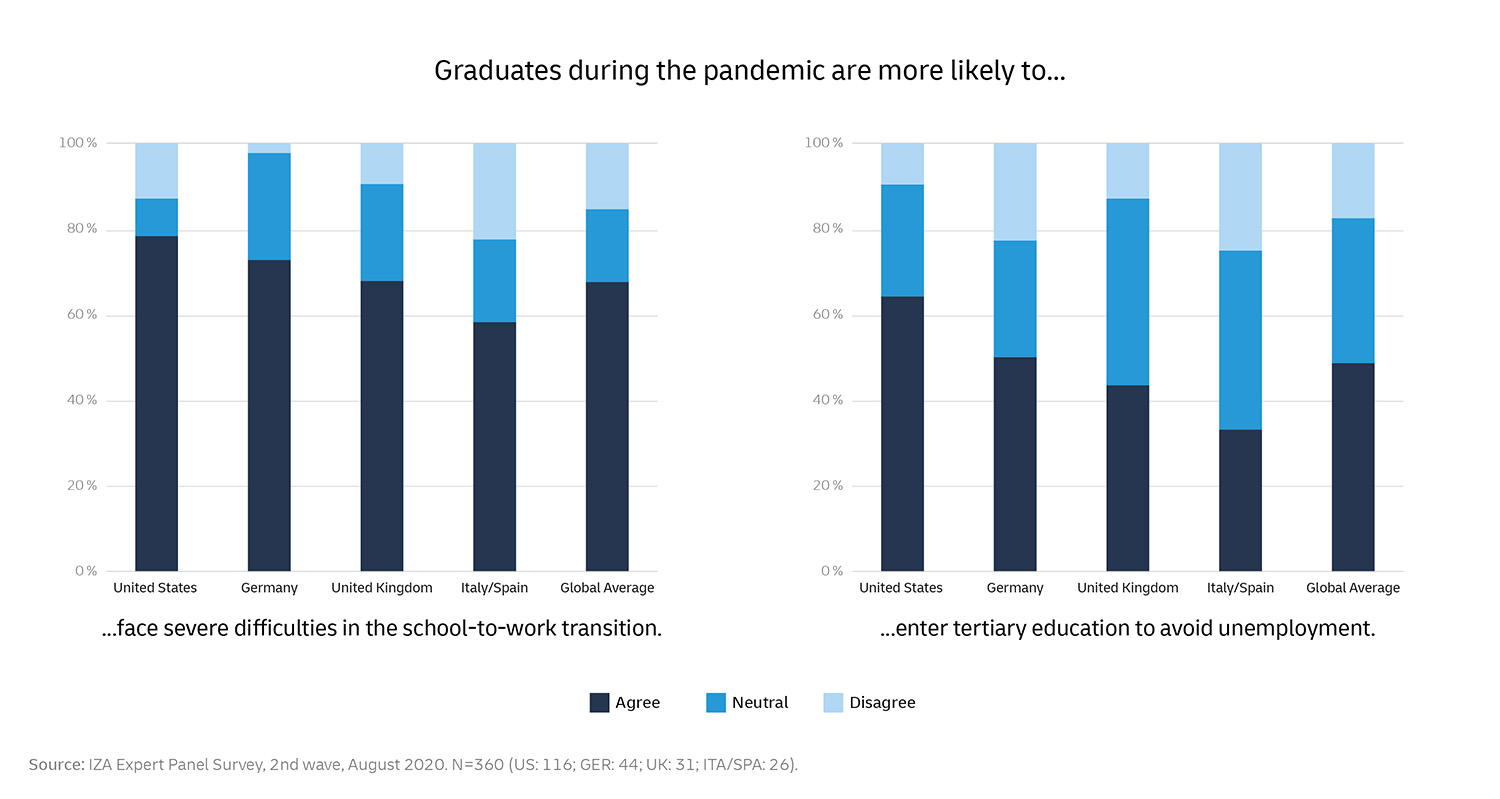
The analysis shows that more than two-thirds of the experts expect 2020 graduates to have greater difficulties in the important school-to-work transition than previous cohorts. Remarkably, both U.S. and German experts are more pessimistic than the average, whereas labor market researchers in Italy and Spain provide a slightly more optimistic outlook. While the survey does not shed light on the reasons for these country differences, a possible explanation may be that the latter countries had already faced high youth unemployment rates before the crisis. In contrast, U.S. and German job markets for graduates were exceptionally strong in previous years, which could make a larger drop appear more likely.

Moving on to tertiary education is an option for young people to avoid unemployment in a tight job market while at the same time investing in their human capital to improve future earnings prospects. This option seems to be particularly relevant in the UK, where more than 60 percent of the surveyed experts believe that secondary school graduates will be more likely to enter tertiary education.
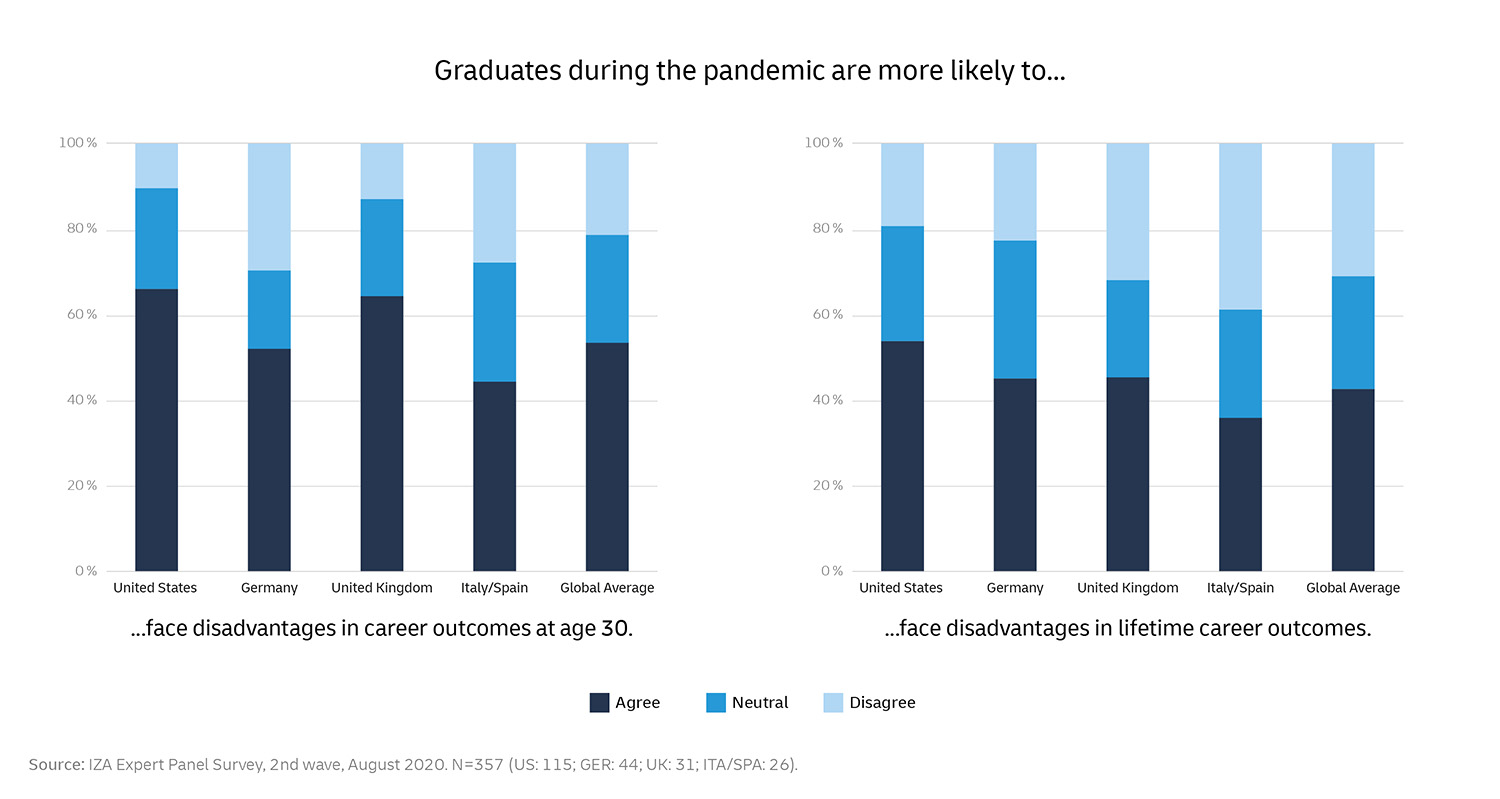
Regarding the longer-term impact on career outcomes, the experts (particularly those from the US and UK) expect significant disadvantages at age 30 for those who graduate during the recession. These negative effects are expected to fade over time, as reflected in the somewhat more favorable outlook on lifetime career disadvantages. Once again, respondents from Italy and Spain are less likely to expect large negative effects. As suggested above, this may to some extent be due to country differences in pre-crisis labor market conditions.

What can graduates in a pandemic do to make the most out of their situation? IZA Research Fellow Philip Oreopoulos from the University of Toronto provides some advice in a recent IZA World of Labor opinion piece. In addition to staying in education, he suggests volunteering as a way to apply one’s skills and gain experience that may prove useful in future job interviews. Nonetheless, recent graduates will likely need to be more mobile and flexible in their job preferences than previous cohorts.

+++

Read more about previous findings from the IZA Expert Survey:
  • High-skilled workers expected to suffer less from the COVID-19 crisis
  • U.S. experts favor income support to mitigate the COVID-19 labor market crisis

Filed Under: IZA News, Research Tagged With: career, COVID-19, education, graduate, school-to-work, youth unemployment

High-skilled workers expected to suffer less from the COVID-19 crisis

June 25, 2020 by Mark Fallak

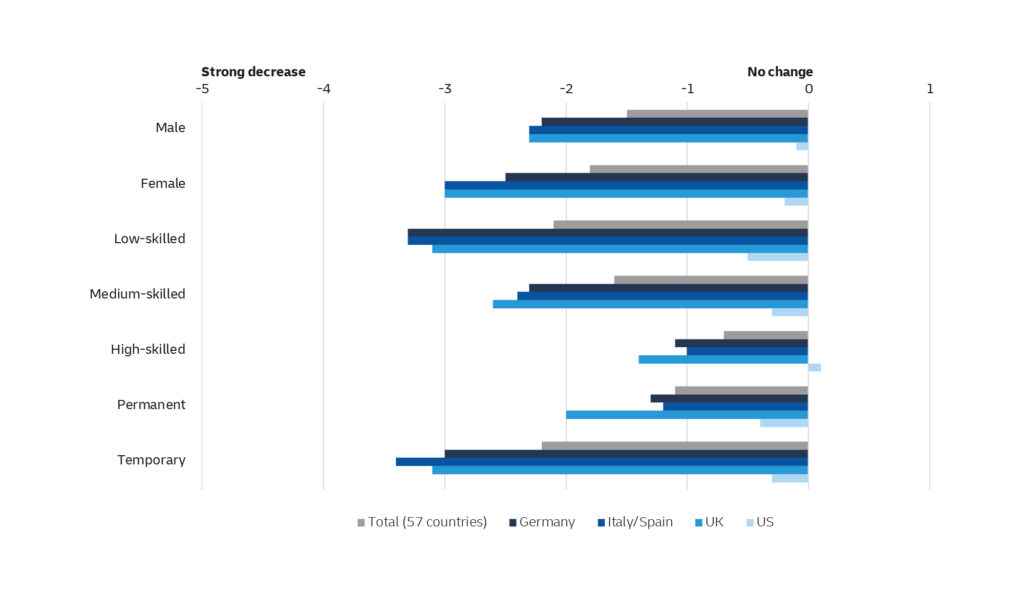
International labor economists are more optimistic about the short-term employment changes for high-skilled and permanent employees than for other groups of workers, according to the “IZA Expert Panel” survey conducted in mid-May. Respondents were asked to rate the expected employment changes in their country over the next four months on a scale from -5 (strong decrease) to +5 (strong increase).

Although declining employment is expected for virtually all groups of workers, the negative impact is more pronounced for low-skilled workers and employees on fixed-term contracts. On average across all countries, this is reflected in a 1.4-point difference in favor of high-skilled workers. A similar pattern holds for the difference between permanent employees and those on a fixed-term contract. In continental Europe these differences are even more pronounced, while they seem to be much smaller for the United States.

Figure 1: Expected employment change until mid-September by groups of workers

Source: IZA Expert Panel 2020. Notes: The number of observations ranges between 47 (UK, permanent/temporary workers) and 494 (total, high-skilled workers). Respondents were asked, “Compared to today, how do you expect total employment in your country to change over the next 4 months, for the following groups of workers? (If the concept of temporary and permanent contracts does not exist as such in  your country, just skip these items.) Please indicate the strength of the expected change in employment on a scale from -5 (“strong decrease”) to 5 (“strong increase”).“

Education and gender

As in previous economic crises, these findings underscore the protective effect of good educational qualifications. In the current crisis, low-skilled workers are more severely affected by job and income losses, also because their job tasks are less easily transferrable to working from home. Moreover, temporary employees are naturally more at risk of job loss because their employers do not incur any firing costs when the fixed-term contract expires.

Although there is currently an intense debate on gender inequality in the COVID-19 crisis, the experts expect rather small differences between employment trends for men (-1.5 points) and women (-1.8 points). For Spain and Italy, the differences are somewhat larger than average, which could be due to a different gender distribution across occupations and tasks in these countries.

Transatlantic differences

It may seem surprising that the differences across all dimensions are significantly smaller in the U.S. than in Europe. However, since U.S. firms reacted fast to the demand shock by laying off workers early in the crisis, unemployment had already risen to record levels at the time of the survey in mid-May. Unfortunately, the survey data thus does not shed light on the role that qualification and gender may have played in these early layoffs.

In Europe, in contrast, many firms have been able to take advantage of government support programs to safeguard employment such as short-time work. The expectations for Europe are thus likely to take into account delayed employment effects of the pandemic, whereas expectations in the U.S. are already somewhat geared towards a labor market recovery.

About the IZA Expert Panel

The panel measures the opinions, beliefs and attitudes of IZA network members about the impact of the COVID-19 pandemic on labor market outcomes in their respective countries. More than 500 labor market economists from over 50 countries participated in the first survey wave, conducted in mid-May 2020.

Filed Under: IZA News, Research Tagged With: COVID-19, IZA Expert Panel

U.S. experts regard income support for the unemployed as the most useful policy to mitigate the COVID-19 labor market crisis

June 4, 2020 by Mark Fallak

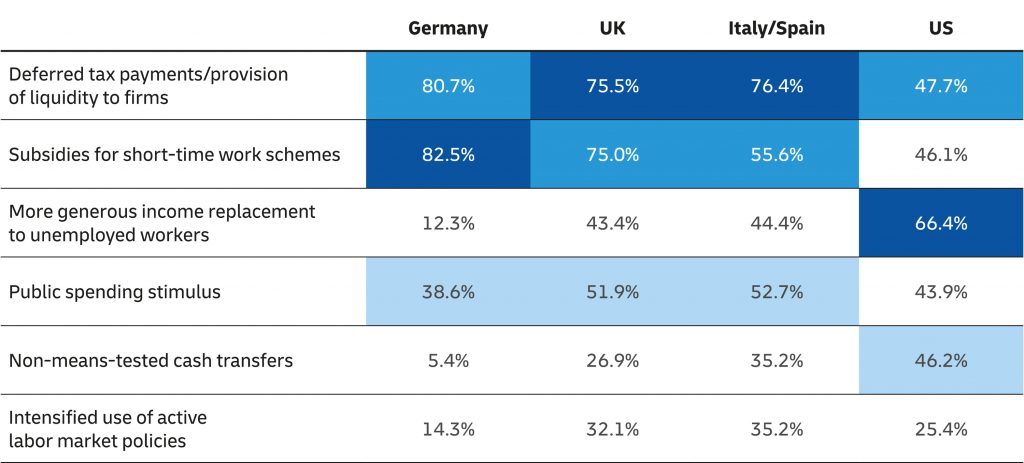
Two-thirds (66.4%) of U.S. labor economists surveyed as part of the “IZA Expert Panel” regard more generous income replacement to unemployed workers as “very useful” or “extremely useful” to mitigate the negative labor market consequences in the current phase of the COVID-19 pandemic. Almost half (46.2%) of respondents consider non-means-tested cash transfers, such as “helicopter money,” very useful.

This is in stark contrast to respondents from European countries, who on average attribute the greatest usefulness to policy measures aimed at preventing unemployment, e.g. by providing liquidity to firms and subsidizing short-time work. Less than half of U.S. respondents find these measures particularly useful in their country. This striking difference can be attributed to the fact that firing costs are much lower and the social safety net is much weaker in the U.S. than in most European countries. As a consequence, U.S. unemployment had already skyrocketed at the time of the survey.

As Table 1 shows, the largest differences can be seen between the U.S. and Germany. The top two measures in the U.S. receive the least support among German experts – with more generous unemployment assistance and non-means-tested cash transfers considered very useful by only 12.3% and 5.4% of respondents, respectively. In Germany, where short-time work has been particularly successful at safeguarding employment in previous crises, this policy receives the strongest support, also among European countries.

Table 1: Country differences in expert opinions on COVID-19 policy responses

Source: IZA Expert Panel 2020. Notes: Number of observations: 57 (Germany), 53 (UK), 55 (Italy/Spain), 132 (US). Percentages are the share of respondents who consider the respective policy response as “very useful” or “extremely useful”. Colored fields show the top-3 policies considered most useful in the respective country context.

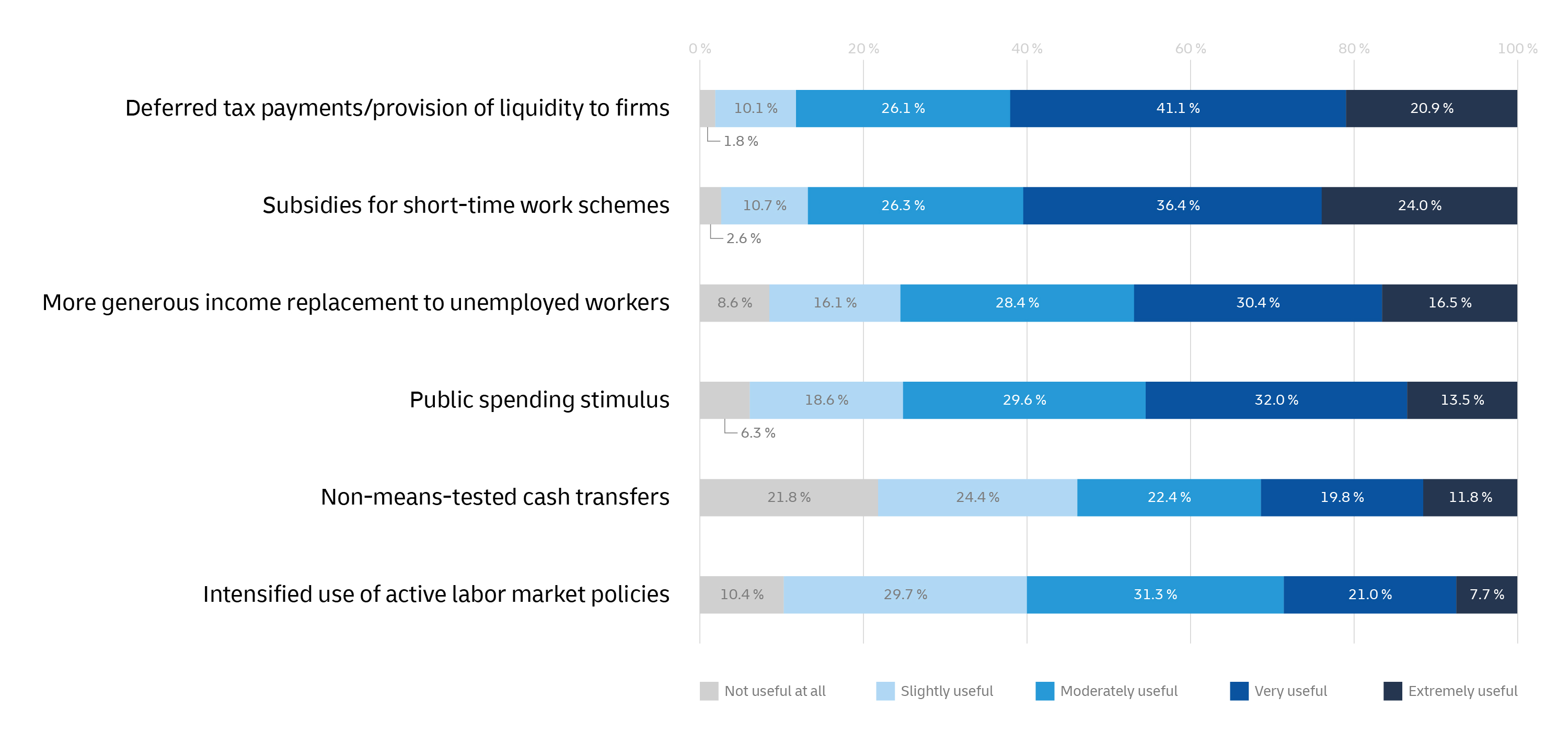
Across all respondents worldwide, deferred tax payments and other forms of liquidity support to firms were most often seen as “extremely useful” or “very useful” (62.0%), followed by short-time work (60.4%). The experts’ focus is clearly on acute crisis relief measures at this point, while an intensified use of active labor market policies (28.7%) may become more important in the recovery period. Among all measures, non-means-tested cash transfers were most often found “not useful at all” (see Figure 1).

Figure 1: Global expert opinions on COVID-19 labor market policy responses

Source: IZA Expert Panel 2020. Notes: The number of observations ranges between 492 (Intensified use of active labor market policies) and 513 (Deferred tax payments/provision of liquidity to firms). Exact wording of the question: “In view of the expected negative impact of the COVID-19 pandemic on the economy, many governments have implemented a range of aid measures to support firms and workers. What do you think, how useful are the following policies, if applied in your country, with regard to mitigating negative labor market consequences of the pandemic?” The respondents were asked to answer this question regardless of whether their country had adopted such a policy.


About the IZA Expert Panel

The panel measures the opinions, beliefs and attitudes of IZA network members about the impact of the COVID-19 pandemic on labor market outcomes in their respective countries. More than 500 labor market economists from 50 countries participated in the first survey wave, conducted in mid-May 2020. Further results will be published shortly.

Filed Under: IZA News, Research Tagged With: COVID-19, IZA Expert Panel

Katharine Abraham and Shelly Lundberg newly elected AEA Distinguished Fellows

April 29, 2020 by Mark Fallak

The American Economic Association has chosen two IZA Research Fellows to be among this year’s four new Distinguished Fellows. Katharine Abraham, Co-Director of IZA’s Program on Labor Statistics, and Shelly Lundberg, long-time IZA Fellow, have been recognized for their lifetime research contributions with this highest accolade conferred by the Association.

“The Award is extremely well-deserved. IZA is proud to have had both Katharine and Shelly as Research Fellows, and collectively we congratulate them on this honor,” says IZA Network Director Daniel Hamermesh.

Read more on the AEA website.

Filed Under: IZA News

In memory of Don J. DeVoretz – a great inspiration in migration economics

March 15, 2020 by Mark Fallak

IZA Fellow Don J. DeVoretz passed away on March 14, 2020. He was among the most active members of our network and a prominent figure in the field of the economics of international migration.

Recently he submitted his last IZA Policy Paper, on issues of Canadian immigration policy. Don contributed numerous insightful papers that illustrated the policy relevance of migration economics. His core interest was the economics of integration and citizenship. He was an untiring ambassador for liberal citizenship legislation and policy incentives to achieve language acquisition.

IZA’s network program area on migration and labor mobility benefited from his thoughtful, novel ideas; and many IZA researchers will remember him for his warm-hearted advice and cooperation during his many stays in Bonn. Given recent international trends toward populism, intolerance and walling-off of immigrants, his quiet but powerful voice will be greatly missed.

Filed Under: IZA News

Expert commission delivers annual report on research and innovation in Germany

February 19, 2020 by Mark Fallak

Today the Commission of Experts for Research and Innovation (EFI) presented its 13th annual report to Chancellor Angela Merkel. Established by the German government, the commission analyzes the performance of the German research and innovation system and makes policy recommendations for improvement.

In addition to covering recent trends and future challenges related to the implementation of Germany’s “High-Tech Strategy 2025”, this year’s report focuses on three key areas that require policymakers’ attention:

Innovation in East Germany – 30 years after reunification: The eastern regions have largely caught up to the west in terms of overall innovativeness. Deficits still exist with regard to launching new activities and bringing innovations to market.

Cybersecurity: The threat of cyber attacks harms innovation. Germany lags behind other major industrial nations in terms of cybersecurity knowledge, experts, and innovative technology.

Knowledge and technology exchange between Germany and China: Germany needs to ensure fair competition in foreign direct investment, scrutinize acquisitions in technologically sensitive sectors, and strengthen China expertise. “Research institutions and firms, especially small and medium enterprises, need more people who are familiar not only with the Chinese language and culture, but also with the country’s markets, institutions, and political structures,“ says IZA research director Holger Bonin, who is a member of the EFI commission.

Read more in German.

Filed Under: IZA News Tagged With: China, cybersecurity, Germany, innovation, research, reunification, technology

The 2020 IZA Prize in Labor Economics goes to Lawrence Katz

January 16, 2020 by Mark Fallak

Lawrence F. Katz (Harvard University) will receive the 2020 IZA Prize in Labor Economics for his 35 years of research documenting changes in earnings inequality and showing the role of the expansion of educational opportunity in increasing living standards. Worth 50,000 euros, the IZA Prize is regarded as the most prestigious science award in the field. It will be formally conferred during the EALE/SOLE/AASLE World Conference in Berlin on June 27, 2020.

According to the award statement, “Lawrence Katz is universally recognized in the world of economics as a remarkably imaginative and productive scholar, who combines profound economic research with an interest in current basic and specific issues of public policy. Most important, the same recognition is given to his decency in dealing with other economists, especially junior researchers.”

[download the full statement – PDF]

The IZA Prize Committee consists of seven distinguished economists, five of whom are previous Awardees. “I am absolutely delighted that we are conferring this Prize on Larry Katz. Like others worldwide, my understanding of changes in inequality in rich countries and what has been causing them has been greatly enhanced by his vast oeuvre of research on these subjects,” said IZA Network Director Daniel Hamermesh, who chairs the committee.

[read more about the IZA Prize and previous winners]

Filed Under: IZA News Tagged With: IZA Prize

IZA Young Labor Economist Award presented in San Diego

January 4, 2020 by Mark Fallak

At an IZA Reception during the ASSA 2020 Annual Meeting in San Diego, the 2019 IZA Young Labor Economist Award was conferred  to Leah Platt Boustan (Princeton University) for her historical research on immigration, and to Philipp Kircher (University of Edinburgh and European University Institute) for his work on search, sorting and matching in labor markets [read more about the winners].

Pictured from left to right: Claudia Goldin (member of the IZA Prize Committee), Hilmar Schneider (CEO of IZA), Leah Boustan (co-winner of the Award), Daniel S. Hamermesh (Chair of the IZA Prize Committee).

Filed Under: IZA News Tagged With: IZA Young Labor Economist Award

Changing work arrangements and their implications for workers

December 11, 2019 by Mark Fallak

Although firms have always outsourced work, there is evidence in many advanced economies of recent growth in the use of various types of contract work as an alternative to direct hiring onto firms’ own payrolls. Contract work includes the use of independent contractors and freelancers, among them “gig workers” whose activity is mediated through mobile apps and online platforms; workers supplied by staffing firms; and contract companies whose employees perform tasks previously performed by in-house employees.

Available measures of the scope and nature of changes in the use of these arrangements have important limitations and there is much to learn about what growing reliance on contract work may imply for workers and businesses. The 3rd IZA Workshop on Labor Statistics, organized by Katharine Abraham and Susan Houseman and co-sponsored by the W.E. Upjohn Institute for Employment Research, provided a forum for senior and junior scholars studying these developments to share their research.

Using tax data to study changes in work arrangements

Among the 16 workshop presentations was a paper presented by Andrew Garin, which uses tax data to study the growth in self-employment generally and “gig employment” specifically. Their paper focuses on so-called 1099 workers, named after the tax form that U.S. employers use to report payment of nonemployee compensation to the tax authorities. The authors show that 1099 workers as a share of the U.S. tax workforce grew by nearly 2 percentage points from 2000 to 2016 and highlight the growth since 2013 in the share of workers receiving payments from platform companies. Most of those with platform income, however, are supplementing wage and salary earnings rather than relying on platform income as their primary source of income.

Where and how contract work arrangements are used

Another presentation by Kyung Min Lee reported on an examination of new data from the 2015 Annual Survey of Entrepreneurs (ASE), an employer survey fielded by the U.S. Census Bureau. The ASE data allow an unprecedentedly in-depth examination of firms’ use of contract workers. The authors find that 30% of U.S. firms make at least some use of contract workers, with those workers accounting for 14% of full-time-equivalent work effort.  Relative to full-time employees, contract workers are most likely to be involved in operations, product development and technology development activities, and least likely to be involved in management and human resources activities. New businesses are more likely than established businesses to use contract workers. Interestingly, although they are more likely to hire part-time employees, franchise firms are less likely to make use of contract workers.

Implications of contract work for workers and firms

David Weil, who gave the workshop’s keynote address, spoke about the implications of growing reliance on contract workers and what he has termed the “fissuring”of the labor market. Existing labor market laws and regulations were designed to provide workplace protections for those in traditional employment arrangements, but that protective umbrella generally does not extend to self-employed individuals. Just as important, existing rules may not function well in the increasingly common situation in which a firm subcontracts work to other firms who in turn may rely on their own network of subcontractors.

Weil used the retail industry, and specifically the case of Amazon, to illustrate the growth of such subcontracting arrangements.  He asked the audience to consider as an example what happens if someone working for a subcontractor or as an independent contractor suffers a workplace injury. In such cases the firm at the top of the structure is not formally the person’s employer and, as a result, may be able to avoid any resulting liability. Weil discussed effective strategies for dealing with wage theft and other labor violations associated with the fissured workplace, drawing upon his experience as Wage and Hour Administrator at the U.S. Department of Labor.

See the workshop program for the full set of presentations.

Filed Under: IZA News Tagged With: contract work, labor statistics

Skills, preferences and labor market outcomes

November 1, 2019 by Mark Fallak

One of the important insights of research into human capital over the past two decades has been that good cognitive skills, such as math or language proficiency, are not enough to succeed in the labor market. Non-cognitive skills and individual preferences matter just as well. While this topic has been extensively researched for developed countries, there is a small but growing literature for post-transition and emerging economies. The 3rd IZA/HSE Workshop, organized by Hartmut Lehmann, Vladimir Gimpelson, Rostislav Kapeliushnikov and Alexander Muravyev in St. Petersburg, provided a forum for junior and senior researchers in this field.

Institutional influence on personality traits

Among the 14 presentations was a paper by Anna Kochanova and Maryam Nagsh Nejad , who studied the effect of socio-political and economic institutions on the development of non-cognitive skills of individuals. Interpreting the breakdown of the Soviet Union as a natural experiment, the authors use data from three post-Soviet countries – Armenia, Georgia and Ukraine – to compare personality traits of individuals born at least a decade before the collapse of the Soviet Union with those born shortly before or later, relative to individuals from several other developing countries that had not experienced profound institutional changes similar to those in the transition countries. The results indicate significantly higher scores of extraversion, openness and agreeableness for younger generations of people that never lived under the communist regime. Overall, the findings imply that institutions can shape the non-cognitive skills of individuals, and thus suggest a channel through which institutions may impact economic development.

IZA/HSE workshop participants

Son preferences and girl penalties

The phenomenon of son preference is common in many developing countries. The implications for girls and women may be severe. Many studies document differential treatment of boys and girls already early in life with girls being breastfed for less time, receiving worse childcare, and suffering excess mortality through infanticide and neglect. Using data from India to study the effect of son preference on cognitive skills in early childhood, Cara Ebert and Sebastian Vollmer propose an innovative child-specific measure of son preference, which allows to explicitly address the effects of birth order and sex composition. This approach helps to establish that son preference is more common among later born children and in families with fewer sons. The study shows that son preferences have adverse effects on cognitive and language skills of two-year-old girls at higher birth orders. A similar pattern is found for girls with sisters and for girls of mothers with a high number of desired sons.

Opportunities and challenges of digitalization

In an invited lecture on “Digitalization and the Future of Work,” Hilmar Schneider provided answers to the politically explosive question to what extent digitalization differs from previous technology shocks, such as the mechanization of manufacturing or the introduction of computers in various sectors of the economy. These past shocks did not cause a dramatic rise in unemployment. On the contrary, technological change has always created more jobs than it destroyed. According to Schneider, there is no reason to believe that the effects of digitalization will be fundamentally different in this respect. He emphasized that most existing simulations of job destruction through digitalization neglect or completely ignore the job creation potential.

Overall, Schneider presented a rather optimistic outlook: Digitalization gives creative human workers more freedom to work anytime from anywhere while leaving tedious and repetitive tasks to computers and robots. Nonetheless, he also pointed at the potential downsides: On the individual level, the blurring boundaries between work and leisure create new responsibilities for employers and workers themselves to prevent excessive stress. On the macro level, huge data flows not only constitute an economic asset that generates large profits but also make economies more vulnerable to hacker attacks.

See the workshop program for more presentations.

Filed Under: IZA News Tagged With: emerging economies, preferences, skills, transition

  • Previous Page
  • Page 1
  • …
  • Page 3
  • Page 4
  • Page 5
  • Page 6
  • Page 7
  • …
  • Page 9
  • Next Page

Primary Sidebar

© 2013–2026 Deutsche Post STIFTUNGImprint | Privacy PolicyIZA