• Skip to primary navigation
  • Skip to content
  • Skip to primary sidebar

IZA Newsroom

IZA – Institute of Labor Economics

  • Home
  • Archive
  • Press Lounge
  • DE
  • EN

Covid-19 scrambled European country ranking of labor market performance

May 18, 2021 by Mark Fallak

How did the labor market get through Covid-19 year 2020 in Europe? Broadly speaking, without much damage, according to a recent IZA Policy Paper by Stijn Baert (Ghent University). The percentage of unemployed among the 25 to 64-year-olds in the EU-27 rose 0.2 percentage points (pp) from 4.8% to 5.0%. By comparison, between 2009 and 2010, when the labor market digested the Financial Crisis of 2007–2008, this number increased by 1.3 pp at the EU-27 level.

This average obviously hides differences between EU countries. Most strikingly, in the Baltic states, the increase in percentage of unemployed is more than 1.5 percentage points and therefore substantial: Estonia (1.7 pp), Latvia (1.8 pp) and Lithuania (1.7 pp).

Among the other countries, only Romania (1.0 pp) and Sweden (1.2 pp) exhibit growth in their unemployment-to-population ratios in excess of 1 pp. Thereby, Sweden, often seen as a ‘model country’ even drops to 23rd place by unemployment (out of 27 countries).

Inactivity rose more sharply in Southern Europe

But what happened to the percentage of inactive people in 2020? While unemployed search for a job, this is not the case for inactive people. Did some of the unemployed become discouraged, partially masking the shift from employment to unemployment with a parallel shift from unemployment to inactivity?

Overall, the increase in inactive persons at the EU-27 level also remained rather limited. In 2019, 20.0% of the population was inactive; in 2020, that percentage rose to 20.3%—an increase of 0.3 pp. This rather small number still implies an increase by about 720,000 persons.
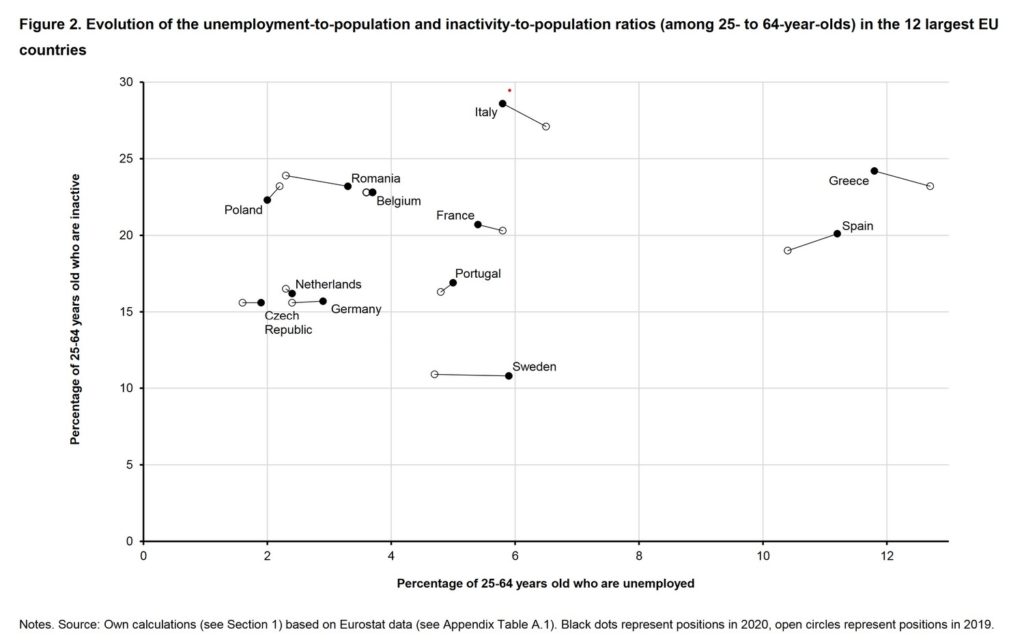
Again, we see important differences between countries. Inactivity rose more sharply in Southern Europe: Spain (1.1 pp), Italy (1.5 pp), Portugal (0.6 pp) and Greece (1.0 pp). Bulgaria (0.8 pp) and Ireland (0.8 pp) are also close to 1.0 pp increases in inactive persons.

Overall, the labor market of Poland experienced the most favorable evolution: despite the crisis, both the percentage of unemployed and inactive fell.

Germany’s position remains rather stable

Germany, the largest EU country by number of citizens, is not mentioned in the above discussion. This is because Germany remained fairly stable in terms of its position in the ranking of European countries.

Between 2019 and 2020, the percentage of unemployed among 25-64 year olds increased by 0.5 pp (i.e. from 2.4% to 2.9%). Admittedly a bit more than the European average, but because Hungary and Romania experienced a stronger increase, Germany rose from 7th to 5th place of best-performing countries in terms of unemployment.

The percentage of inactive persons rose even less, i.e. from 15.6% to 15.7%. This does mean, however, that Germany drops from 5th to 6th place as Latvia saw its inactivity percentage decrease despite Covid-19.

Overall, Germany is stable within the best quarter of European countries for both parameters.

What about 2021 and 2022?

Does the small overall effect of Covid-19 year 2020 mean that the ominous reports at the start of the crisis should be classified as misconceptions?

Stijn Baert:

“Not necessarily. The labor market almost always follows the pattern in economic growth at some distance. During the Financial Crisis, unemployment peaked about a year after the deepest decline in economic growth. If the current downturn in economic activity continues, it might not be possible to sustain the current level of labor hoarding, especially if support measures are removed. Much also depends on how the European countries deal with their accumulated debt: hard savings can be expected to deal an extra blow to the labor market, while well-considered investments could, through their multiplier effect, provide stimuli.”

Filed Under: Research Tagged With: COVID-19, crisis, European Union, inactivity, unemployment

Higher minimum wage lowers enrollment in academic programs at universities

May 11, 2021 by Mark Fallak

While much research has been done on the employment effects of minimum wages, little is known about their effect on human capital accumulation. A new IZA discussion paper by Diana Alessandrini and Joniada Milla finds a strong impact of higher minimum wages not only on individuals’ schooling decisions, but also on the type of human capital acquired by students.

Using Canadian longitudinal data, the authors explore 136 minimum wage amendments across provincial jurisdictions. Canada provides a unique test case because community colleges play a large role in post-secondary education in Canada and because they often provide occupation-specific training rather than general academic training. This allows for potential important interactions between minimum wages and the type of education that individuals pursue, in addition to effects on overall education levels.

Shift towards occupation-speci fic training

The study finds that high minimum wages stimulate the accumulation of occupation-specific human capital at community colleges but discourage enrollment in academic programs offered by universities. Quantitatively, a 10% increase in the minimum wage increases community-college enrollment by 6% and reduces university enrollment by 5%.

At the same time, high minimum wages strengthen the link between parental background and children educational attainment, worsening the university participation gap between individuals with high and low parental education. The increase in the opportunity cost of education caused by the minimum wage appears to discourage enrollment among students with lower-educated parents.

Lower drop-out rates

Finally, minimum wages also affect whether students drop out of post-secondary education or return to school later in life as mature students. The data show that the positive effect on community-college enrollment is driven by older students. As minimum wage hikes may increase competition in the labor market, students already enrolled in community college are less likely to drop out, and workers who separate from their job are more likely to return to community college to advance their studies.

These novel results an inform policymakers regarding the spillover effects of minimum wage regulations on human capital accumulation and the unintended consequences on educational attainment. Given substantial government spending on post-secondary education, it is important to know whether a minimum wage policy works against or in favor of concurrent education policies.

Filed Under: Research Tagged With: college, education, minimum wage, university

Relative comparisons affect performance and choices in college

May 5, 2021 by Mark Fallak

When making choices about one’s educational career, students face considerable uncertainty about their own ability. Am I sufficiently prepared to pass the exam? Am I good enough to pursue a college education? A young person might have difficulties in answering these questions right away and will have to form beliefs about their own ability.

More often than not, this will be done by comparing oneself with friends or fellow classmates. A student who is a big fish in a little pond, outperforming their classmates, tends to be more confident and might believe that they are more capable than an otherwise identical student who happens to be in a group with higher ability peers.

Such social comparisons may be of particular importance in the first year of university, which for many students is a daunting experience. Coming from the familiar environment of high school, where they shared classrooms with the same classmates for many years, they suddenly interact with students from all over the world. This drastic change in one’s peer group may also change students’ beliefs about their own ability.

In a new IZA discussion paper, which is now accepted for publication in the Economic Journal, Benjamin Elsner, Ingo Isphording and Ulf Zölitz show how social comparisons affect the choices and performance of first-year students who are randomly assigned to first-year tutorials at a Dutch business school.

Rank matters!

The authors measure a student’s relative ability through their ordinal rank within their teaching section. The ordinal rank measures whether a student is ranked first, second, third and so on, based on the grades they had received before being assigned to their new section. Different mechanisms explain why a higher ordinal rank may affect choices and performance: a more highly ranked student may perceive herself as more competent in general (the big-fish-in-a-little-pond effect), and it might affect how teachers or fellow students interact with them.

In line with this idea, the authors find a strong effect of a student’s rank on contemporaneous performance. Students with a higher rank have a lower risk of dropping out of a course and receive higher grades in standardized exams that are anonymously graded. The effects of rank on expectations about future grades and satisfaction with fellow students suggest that a higher rank leads students to believe that they are more capable than their peers. Thus, being a big fish in a little pond in your first-year tutorial boosts performance by shaping a student’s beliefs about own ability.

Students react to good news only

A student’s rank appears to be especially important at the very beginning of the first year, a period characterized by particular uncertainty in a completely new environment. But how students react to their rank depends on the information the rank conveys: Students respond asymmetrically to changes in their rank. An increase in the rank relative to the previous period significantly improves performance, whereas a decrease in the rank has no effect.

The authors interpret this as evidence for the good-news-bad-news effect, which means that people respond to positive but tend to ignore negative signals. Only if a rank in a tutorial indicates that a student became better over time will it affect their performance.

Persistent effects of rank

The authors also show that the effects of one’s rank in a first-year tutorial are persistent. Students with a high rank in a particular first-year course are more likely to choose a related follow-up course in higher years: A student who was highly ranked in a statistics course is more likely to specialize in statistics later on. A student who was highly ranked in marketing rather specializes in marketing. The ordinal rank in first-year courses appears to shape students’ perceived comparative advantages in one subject over the other and have a lasting effect on students’ choices.

The results provide important insights into the decision-making of college students. Whether or not someone is a big fish in a little pond is to a large degree a matter of luck. Yet, when making important career decisions, students appear to put considerable weight on relative comparisons to other students – a factor to be kept in mind when helping students to make better-informed career choices.

Filed Under: Research Tagged With: higher education, peer effects, rank, social comparisons

“I will have to discuss this with my family”

April 29, 2021 by Mark Fallak

People work only slightly more when they can earn high wages than they do at other times. Does this mean that people respond only weakly to wage incentives? This would have important consequences for economic policy. For example, tax cuts would only to a very limited extent induce people to work more. Similarly, government stimulus packages could be expected to have little effect if firms, when demand for their products is high, are unable to achieve a significant increase in hours worked through paying higher wages.

However, there are several arguments against such a view. Progressive tax systems or the pursuit of promotions can weaken the measured relationship between hours worked and pay, even if workers are in principle willing to work more for more money. A recent IZA discussion paper by Christian Bredemeier, Jan Gravert and Falko Juessen points to another reason: Changes in one family member’s income alter the balance of power in the family’s decision-making processes, and this can affect how much each family member works.

The study builds on a large body of scientific literature that has demonstrated that families respond differently to a given amount of income depending on which family member earned that income. A change in a family member’s income appears to alter that member’s influence in the family’s decision-making processes. A career setback, for example, tends to lead to having less say in the family. One can then try to restore one’s old position in the metaphorical “family council”, for example, by working (paid) overtime, even if, as a single person, one would rather wait to do so until one’s work is paid better again.

Consumption patterns reveal family members’ influence

The authors develop a statistical method that deducts the changes in intra-family bargaining positions caused by wage changes when measuring the willingness of employees to work more if they are paid more. The method uses information on families’ consumption patterns, i.e., what goods and services are purchased, to infer which family member currently has a large influence on family decisions.

The results of the study indicate that workers are willing to work about 7% more if their earnings per hour are 10% higher. For a full-time worker, this amounts to just under three hours of (paid) overtime per week. This figure is discernibly larger than the results of most previous studies, which do not factor out the effect of wage changes on intra-family bargaining positions.

Factoring out this effect is instructive for assessing the consequences of policies that similarly affect the earnings of different family members and therefore have no substantial effects on intra-family bargaining positions. According to the authors, temporary tax cuts or increases in the general wage level could indeed induce employees to increase their working hours by clearly relevant, albeit moderate amounts.

Filed Under: Research Tagged With: consumption, intra-family bargaining, labor-supply elasticity, wages, working hours

Happy power couples?

April 22, 2021 by Mark Fallak

A happy relationship is what most people strive for in private life. At the same time, we try hard to succeed in our jobs. If we are lucky, we find happiness in both departments, at least for some time. What is well known is that for this to happen, working life and private life need to strike a balance, so that none of them comes at a constant cost for the other. Much less attention has been paid to interference between working life and private life that might in fact be advantageous, that is if partners are also work-linked.

In fact, many of us are work-linked in some form, as our partners work in the same industry, have the same occupation or even the same employer. Some prominent examples may come to mind, such as Özlem Türeci and Ugur Sahin, the copreneurial couple who invented the first Covid-19 vaccine, or lawyers Ruth and Marty Ginsburg whose careers mutually benefited from sharing the same occupation.

But are these links actually beneficial and, if yes, in what area of life do they pay off? Is a work link too much of an interference between private life and work life when no line can be drawn between the two areas? Juliane Hennecke and Clemens Hetschko answer these questions in a new IZA discussion paper.

The two researchers from Auckland University of Technology and University of Leeds analyze the well-being of work-linked couples in Germany. Based on nationally representative data, the analysis focuses on industry-linked and occupation-linked couples, as compared to couples where both partners work in different fields. To identify advantages and disadvantages in different areas, the authors examine people’s satisfaction with their incomes, jobs, family lives and leisure, besides general life satisfaction.

Higher satisfaction, but not for the self-employed

The study confirms what the authors call the ‘power couple hypothesis’. Various data analyses identify a positive effect of being work-linked on overall life satisfaction, which seems to be especially driven by much higher income satisfaction in work-linked couples. Job satisfaction also benefits from the link, unlike satisfaction with leisure and family life.

The positive effects of being work-linked are most pronounced in high-skilled workers. These results imply that work-linked partners may help each other climb the career ladder, presumably by providing mutual support, sharing networks and information. Strikingly, being work-linked to the partner does not benefit self-employed workers. This might be an example of a work link being too close.

According to the authors, their findings may also hold implications for recruitment policies. When hiring specialized talents who need to relocate, firms often provide job search support for partners. Given the well-being effects of being work-linked, there may be a case for seeking job opportunities in the same industry, as happier workers are also more productive workers.

Filed Under: Research Tagged With: assortative matching, career, copreneurs, gender, relationship, well-being, work-life balance, work-linked couples

Men try to avoid being beaten by a woman

March 30, 2021 by Mark Fallak

Gender differences in paid performance under competition have been found in many laboratory-based experiments, and it has been suggested that these may arise because men and women respond differently to psychological pressure in competitive environments. A recent IZA discussion paper by Alison Booth and Patrick Nolen explores these gender differences further in a laboratory experiment with 444 subjects.

The experiment comprised four distinct competitive situations: (i) the standard tournament game where the subject competes with three other individuals and the winner takes all; (ii) an anonymized competition in which an individual competes against an imposed production target and is paid only if s/he exceeds it; (iii) a ‘personified’ competition where an individual competes against a target based on the previous performance of one anonymized person of unknown gender; and (iv) a ‘gendered’ competition where an individual competes against a target based on the previous performance of one anonymized person whose gender is known.

Women do not respond to changing competitive pressure

The analysis shows that only men respond to pressure differently in each situation, whereas women responded the same to pressure no matter the situation. Moreover, the personified target caused men to increase performance more than under an anonymized target and, when the gender of the person associated with the target was revealed, men worked even harder to outperform a woman but strove only to equal the target set by a male.

In other words, while women shy away from competition, once in a competitive environment their performance is not worsened, while men will respond positively. Therefore, the authors conclude that policies to raise the share of females in competitive environments could increase overall output and productivity.

Filed Under: Research Tagged With: competitive behavior, experiment, gender, psychological pressure, tournament

Even those who are fair can discriminate

March 18, 2021 by Mark Fallak

Recruitment tests and assessment centers are commonplace in both the private and public sectors to find the most qualified applicants for a specific job. But while anonymously graded tests are generally deemed to be procedurally fair, they still carry the risk of disadvantaging certain applicant groups if test instruments are used that have no relevance for actual job performance.

A recent IZA discussion paper by Dominique Meurs and Patrick A. Puhani finds such “systemic discrimination” in the recruitment process for the French civil service. The study compares the entry exams for senior regional administrators with evaluations and tests administered after a one-year trainee program. The trainee program is much more practical than the recruitment exams and also includes an internship component.

Women outperform men on the job

It turns out that women do better in the trainee program than men, even when comparing women and men with the same results in the entry exam. This suggests the recruitment exams tend to overlook job-relevant positive qualities of female applicants, thus favoring men – even though the exams are graded anonymously and women may even be slightly favored in the non-anonymous job interview.

Further analysis shows that an essay exam on common culture, a minimally job-related exercise, leads to the disadvantage for women. While the discrimination is not very pronounced, it is still statistically significant. Although it has been suspected that elites try distinguish and protect themselves via a “hidden curriculum” of hard-to-acquire codes not taught in the general school system, the authors suggest the discrimination they found was probably unintended.

Nonetheless, they argue that their results should raise awareness for “systemic discrimination,” which can and should be avoided by choosing recruitment criteria that clearly signal productivity on the job. They also point out that some situations that look like gender or ethnic discrimination may at least in part be cases of cultural discrimination.

Filed Under: Research Tagged With: discrimination, hiring

Does technological progress promote gender equality?

March 8, 2021 by Mark Fallak

As societies transition to more advanced stages of technological and economic development, an important question arises about how these processes affect gender equality in these societies. A new IZA paper by Alina Sorgner provides a comprehensive literature review on the relationship between gender equality and industrialization in the context of developing countries.

The study highlights historical developments, such as pre-industrial preconditions of contemporary levels of gender equality. It also provides empirical evidence for the current situation and discusses new trends, such as Industry 4.0 and premature deindustrialization, which may affect gender equality in developing countries.

Gender inequalities are region-specific and persist over time

Gender inequalities, for instance, in labour market participation or participation in politics, seem to have their roots in local pre-industrial conditions. The transitioning of pre-industrial societies to a more advanced stage of technological development, such as the Neolithic Revolution and the use of more advanced technologies in agriculture, for example the plough, have likely contributed to the emergence and strengthening of gender-specific roles. One of the most striking results is that these roles tended to persist over time, even when societies transitioned to a more advanced stage of development.

This finding has important policy implications. First, the determinants of gender equality are at least partly defined at a rather narrow level of regions defined within countries rather than at a broad level of nations. The existing initiatives to promote gender equality often disregard regional variations in the determinants of gender equality. However, regional differences in gender equality within a country are likely to be substantial, which is due to sectoral structure of regional economies, region-specific social norms and values regarding appropriate gender roles in a society, and local historical contingencies, among others. This implies that initiatives to promote gender equality should entail a location-based approach. The “glocalization” of efforts to promote gender equality seems to be a promising way to achieve this goal: While the promotion of gender equality is a global objective, it can best be achieved by considering local factors that might affect gender equality.

Second, given the strong persistence of regional gender-specific roles over time, policymakers need to make a long-term commitment to fighting gender inequality. It is fairly unlikely that short-term measures, particularly if they do not account for local conditions, will be successful in promoting gender equality.

The pace of industrialization matters for gender equality

Results presented in this paper suggest that developing countries that industrialize at a high pace are generally less gender equal compared to developing countries with a lower speed of industrialization. Importantly, this result varies significantly across regions and across countries within regions. This variation could be explained, for instance, by differences in the sectoral structure of developing countries’ economies, which determine the availability of opportunities for female labor.

Women in some developing countries, for example, had high labor market participation rates in certain manufacturing industries, such as textile and apparel, whereas a high share of mining and quarrying industries in the economy was associated with low female labor force participation rates. This pronounced variation of female labor force participation across sectors might also explain the strong variation in the levels of gender equality across regions within countries. Therefore, the issue of gender equality needs to be addressed with a special attention in developing countries that industrialize at a high pace.

News trends of Industry 4.0 and premature deindustrialization

A recent trend of the de-feminization of the manufacturing sector in selected developing countries seems to be driven at least partially by the technological upgrading within labor-intensive sectors. This trend is particularly important in the context of the Industry 4.0. One example is the textile industry, which experienced a strong decline in the share of female workers, even though this share is still high. This industry is characterized by strong transformations due to the introduction of so called Fourth Industrial Revolution (4IR) technologies.

At the same time, new 4IR technologies are likely to have labor-displacing effects on workers with specific types of skills. It appears that women in developing countries are less likely than men to possess skills that shield them from the labor-displacing effects of new digital technologies, such as analytical, non-routine manual, interpersonal, advanced ICT and socio-emotional skills.

This result is robust across sectors, but gender differences are more pronounced in manufacturing than in services. Moreover, developments in Industry 4.0 will result in a higher demand for workers with advanced ICT skills. However, gender differences in the level of ICT skills and access to digital technologies are particularly large in developing countries. Thus, education programs specifically designed for women are needed to reduce this digital gender divide. Moreover, further action should be taken to improve opportunities for women to take over managerial posts and other decision-making positions.

Last but not least, premature deindustrialization is a relatively new trend in developing countries that signifies a decreasing share of manufacturing employment among late industrializers at a lower level of economic development compared to early industrializers. This trend is likely to amplify the defeminization of manufacturing labor. The transition to post-industrial societies may also result in new types of social inequalities, for instance, related to the hollowing-out of the middle class. The author stresses that these developments must be closely monitored in developing countries to identify the emergence of potentially new gender inequalities in a timely manner.

Filed Under: Research Tagged With: Development, gender equality, industrialization, Industry 4.0

Working from home continues to increase

March 2, 2021 by Mark Fallak

To reduce the risk of infection at work, Germany’s Federal Labor Ministry issued a new regulation in late January 2021, mandating employers to offer work from home to all employees whose tasks are suitable for remote work. A representative survey conducted by IZA in mid-February assesses the incidence of, and experience with, working from home, as well as changes in working conditions due to the new regulation, employees’ perceived risk of infection at the workplace, and general stress perceptions.

Almost half of employees work at least partly from home

According to the survey, 49% of employees worked from home at least some of the time, while 34% worked mainly or exclusively from home in February. Compared to January, 22% of employees worked more hours from home.

One-fourth of respondents stated that the new workplace health and safety regulation had an impact on workplace arrangements at their firm, with more coworkers switching to remote work or increasing their hours working from home. Those who did not notice any changes attributed this mainly to already existing remote work options before the regulation came into effect, or to the fact that their jobs cannot be done from home.

Only one in five employees cites a lack of suitable technical equipment as a reason for not working (more) from home. While some plan to ask their employer to increase their share of work done from home, the overwhelming majority of employees are satisfied with the options currently offered by their firm.

High satisfaction with measures taken by employers

In addition to the increase in work from home, the new regulation also seems to have led to improved infection control measures in the workplace. One-third of employees noted that their firm tightened social distancing at work when compared to December 2020. One-fourth indicated their firm had started providing medical protective masks, while 12% (22% in small firms) did not receive them from their employer.

Most employees are satisfied with the way their employer handles infection control. Only 17% are very concerned they could become infected at work. With regard to the provision of technical equipment, 85% stated they received computers, laptop or tablets, and 44% were given smartphones. Notably, female employees were less likely to receive technical equipment for remote work than their male coworkers.

Many employees feel a heavy workload

Gender differences also appear with respect to the perception of workload, exhaustion, and stress. 42% of employees currently feel a high or very high level of stress, which is more prevalent among women (48%) than among men (36%).

The rising stress level also seems to have a negative impact on life satisfaction. On a scale from 0 (completely dissatisfied) to 10 (completely satisfied), the surveyed employees reported an average value of 6.7. At the outset of the pandemic in April 2020, a representative survey of the entire German population had recorded an average of 7.4 points.

+++

The IZA study was conducted on behalf of the Federal Labor Ministry and is available in German language only.

Filed Under: IZA News, Research

Targeted COVID-19 relief programs improve compliance with confinement measures

February 1, 2021 by Mark Fallak

Until a vaccine becomes available for the entire population, social distancing is doomed to remain a matter of life or death. Compliance with social distancing measures requires civic-mindedness, law enforcement, and the capacity to satisfy basic needs from home. In particular, stay-at-home orders can be unbearably unfair to people who can neither work from home nor afford food delivery.

Enlightenment thinkers like Locke and Rousseau taught that inadequate or unfair policies weaken the social contract between citizens and the state, encouraging agents to withdraw their cooperation. In a pandemic crisis, the belief that the policy response is unsustainable or unfair may discourage compliance with emergency rules, resulting in the worsening of the epidemiological situation.

In a new IZA Discussion Paper, Claudio Deiana, Andrea Geraci, Gianluca Mazzarella and Fabio Sabatini study how to improve social distancing in the wake of the pandemic recession. The authors assess the impact of a food relief program on compliance with social distancing mandates in Italy, the early European epicenter of the pandemic.

Food stamps for the economically disadvantaged

At the end of March 2020, the Italian government launched emergency measures aimed at providing food stamps to economically disadvantaged groups. The authors combine information on the allocation of the program’s resources across Italian municipalities with data tracking citizens’ movements through mobile devices and vehicles’ navigation systems, anonymized and aggregated at the municipality level. As social distancing requires staying at home and renouncing unnecessary activities, the empirical analysis employs human mobility as a proxy for compliance.

To assess the causal impact of the aid program, Deiana and colleagues exploit nonlinearity in the allocation of funds. A quota of resources was distributed to municipalities depending on the deviation of their per capita income from the national level in 2017, more than two years before the pandemic. This design generated a random treatment assignment in a neighborhood of a threshold point. A -1000€ per capita deviation from the cut-off determines an increase in municipality transfers of 0.58€ per capita (i.e., 0.58€ multiplied by the population size), to be distributed to the limited group of beneficiaries. The remaining resources were allocated proportionally to municipalities’ population.

Mobility decreased with the amount of transfers received

The authors find robust evidence that, after the introduction of the program, mobility decreased with the transfers received by each municipality. The effect is statistically significant and economically sizable. In the week of the policy announcement, the transfers cause a drop in mobility of 3 percentage points from the baseline level observed before the pandemic crisis (between January 13 and February 16, 2020). Two weeks later, the impact is still negative, statistically significant, and sizable. Given an average drop of 60 percentage points in the neighborhood of the threshold point in the same week, the increase in transfers determined by a -1000€ per capita deviation from the threshold point causes a decrease in mobility by 5%. The decline in mobility persisted for approximately two more weeks.

The size of the effect suggests that more than one mechanism may have been at work in channeling the impact of the emergency measures. The program probably reduced mobility needs and the marginal utility of contravening stay-at-home orders for the targeted group. However, behavioral spillovers may also have occurred, affecting a larger population than the limited pool of the program’s beneficiaries. Improving the fairness of the COVID-19 policy response may have strengthened lower-income agents’ motives for staying at home by reinforcing the social contract between citizens and the institutions.

Targeted relief measures vs. general fiscal stimuli

The authors’ results put forward actionable insights for policymakers. Relief programs must be designed also in light of their potential impact on social distancing. For example, a recent study finds that support to the hospitality sector led to a multiplication of new infection clusters in the UK, probably due to lesser social distancing. Instead, alleviating the essential needs of economically disadvantaged groups can significantly encourage compliance with social distancing measures.

Compensation measures targeting economically disadvantaged groups can be more effective than indiscriminate fiscal stimuli to mitigate pandemic economic disruption and encourage compliance simultaneously.

Filed Under: Research Tagged With: compliance, COVID-19, fairness, food relief, Italy, social distancing

  • Previous Page
  • Page 1
  • …
  • Page 14
  • Page 15
  • Page 16
  • Page 17
  • Page 18
  • …
  • Page 69
  • Next Page

Primary Sidebar

© 2013–2025 Deutsche Post STIFTUNGImprint | Privacy PolicyIZA