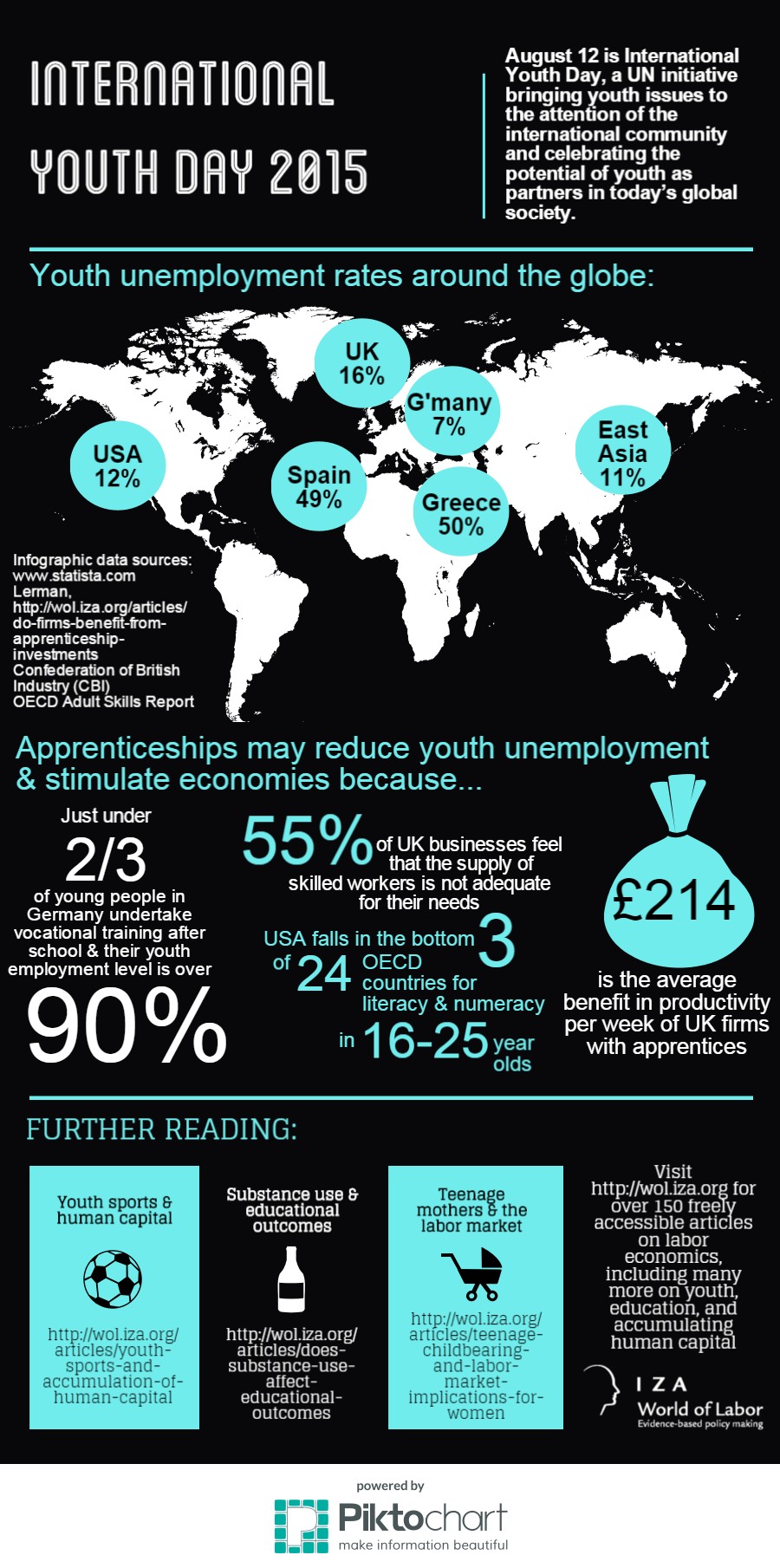
 The theme of this year’s International Youth Day, celebrated on August 12th, is “Youth Civic Engagement.” According to the UN, the engagement and participation of youth is essential to achieve sustainable human development. To create better opportunities for youth to engage politically, economically and socially, and to prevent a “lost generation”, improving the labor market prospects of the world’s youth must become a top policy priority.
To help in formulating good policies and best practices, IZA World of Labor provides decision-makers with relevant and succinct information based on sound empirical evidence.
Read these selected IZA World of Labor articles on youth topics:
- Youth bulges and youth unemployment (David Lam)
- Youth labor market interventions (Jochen Kluve)
- Does vocational training help young people find a (good) job? (Werner Eichhorst)
- Do youth mentoring programs change the perspectives and improve the life opportunities of at-risk youth? (Núria Rodríguez-Planas)
- Youth sports and the accumulation of human capital (Michael A. Leeds)
- The effect of early retirement schemes on youth employment (René Böheim)
- Does minimum age of employment regulation reduce child labor? (Eric V. Edmonds)
Read also IZA Director Klaus F. Zimmermann’s new post on LinkedIn:
 Religion and the traditional role model it conveys affects female labor market participation: Studies show that the likelihood of employment is lower for Catholic, Christian-Orthodox, and Muslim women compared to their Protestant peers. However, the influence of religious-conservative values may well change as society and economy transform. A changing society might imply changes in attitudes, or changes in child upbringing technology and household duties – either might pose internal and external restrictions on labor market access for married women.
 The safety of home births for low-risk women is a hotly debated topic in the Western world. In this context, the Netherlands stands out as one of the few developed countries with a health care system geared toward home births, with one-third of all low-risk deliveries taking place at home. This makes it one of the best settings to study the safety of home births. A new study finds that encouraging home births may come at the cost of higher infant mortality, at least for mothers living in poorer areas.
 The consequences of economic fluctuations are large and long-lasting, and can have an especially strong influence on investment choices. A new study by
  Hostile attitudes of majority members towards ethnic, racial or social minorities are of major concern for policymakers and researchers alike. In his talk in the IZA Research Seminar,
  The characteristics of potential classmates are among the decisive factors for parents when choosing a school for their child. It is commonly believed that children learn and achieve more when surrounded by high-ability classmates. In their new discussion paper, IZA researchers
  In many countries, people find it hard to climb up the economic ladder. According to a
  When newborns with a too low birth weight are treated, even their non-affected siblings benefit. This is the conclusion of a recent IZA Discussion Paper authored by