• Skip to primary navigation
  • Skip to content
  • Skip to primary sidebar

IZA Newsroom

IZA – Institute of Labor Economics

  • Home
  • Archive
  • Press Lounge
  • DE
  • EN

admin

Individuals with criminal records may stay in their jobs longer

October 29, 2018 by admin

In sales and customer service positions, employees with criminal records may stay in their jobs longer and be less likely to leave, according to a study published in the IZA Journal of Labor Policy.

Researchers at Northwestern University investigated the possible relationship between having a criminal record and job performance by evaluating data from employees in sales or customer service jobs in call centers in the US. They found employees with a criminal record stayed in their roles on average 19 days longer than those who did not have a criminal record.

Deborah Weiss, the corresponding author of the study, said: “In sales and customer service positions, turnover is a major labor cost. Our study found that employees with criminal records had a longer tenure and were less likely to quit their jobs voluntarily than other workers. This finding suggests that individuals with a criminal record represent an untapped productivity pool.”

Fewer job prospects

The authors suggest that employees with a criminal record may stay in their jobs longer because they have fewer job prospects outside of their current role.

Deborah Weiss said: “Job applicants with criminal records are much less likely than others to receive an offer of employment. Six months after release from prison, 50 to 80 percent of the formerly incarcerated remain unemployed. Some of those who are offered employment may stay longer because they have no other options and others may feel a sense of loyalty or gratitude to an employer who has given them a second chance.”

Differences by job type

The researchers also found a 34% increased chance of misconduct in sales jobs for employees with a criminal record but not in customer service jobs, which may suggest that performance and tenure for employees with a criminal record may be better in customer service roles than sales roles. The authors suggest that despite this higher misconduct rate, sales employees with a criminal record may be a good investment for employers. The authors estimated that hiring a worker with a criminal record for a sales job increased expected theft-related costs by about $43, while saving the same employer about $746 in turnover costs on that worker.

Deborah Weiss said: “Finding gainful employment for individuals with a criminal background is an important public priority: without such employment, reoffending is almost inevitable. While our study may not entirely dispel employers’ fears that hiring applicants with a criminal record may carry risks, our findings suggest that there are unexploited opportunities to hiring applicants with a record in a way that makes sense both on efficiency and on moral grounds.”

The researchers used data on 58,977 applicants hired for sales or customer service jobs in call centres in the US, collected by a hiring consultancy from May 2008 to January 2014. The authors evaluated possible associations between having a criminal record or not having a criminal record and job performance, misconduct and time spent in the job.

The authors caution that the study only evaluated data from those working in the sales and customer service jobs, which may limit the generalizability of the results outside of these positions. The observational nature of this study does not allow for conclusions about cause and effect.
Filed Under: Research Tagged With: call center, criminal record, job prospects, job tenure, productivity, sales jobs, service jobs, turnover

Does faster reintegration of the unemployed reduce job quality?

October 5, 2018 by admin

Active labor market policies aim at a fast reintegration of the unemployed into the labor market. Since finding a new job requires both search effort and application skills, job centers may try to improve both by increasing the search requirements for unemployment benefit recipients and providing them with job search assistance, respectively. Two recent IZA discussion papers investigate how these approaches affect employment outcomes in Switzerland.

Stricter search requirements reduce unemployment duration

The paper by Patrick Arni and Amelie Schiprowski analyzes how the level of the search requirement affects the provision of effort, the duration of unemployment and re-employment outcomes. Since job seekers are randomly assigned to caseworkers, who vary with respect to how many applications they require per month, the researchers were able to isolate the effect of stricter search requirements.

Their study shows that the duration of unemployment decreases by 3% when the requirement increases by one monthly job application. Changes in the requirement mostly affect lower-skilled job seekers. For skilled job seekers, targeting the quantity of job applications appears to be less effective. Moreover, the effects are larger among individuals who exhibited lower levels of voluntary effort prior to the first caseworker meeting.

These results show that the setting of individual effort targets to steer job search can be a successful strategy for labor market policy. However, when considering the longer run, the authors find modest reactions of re-employment job quality to requirements. An additionally required job application causes re-employment spells to shorten by 0.3%, while the effects on wages are zero. Strengthening the requirement regime thus seems to only marginally reduce job quality.

Job search assistance raises employment only in the short run

The paper by Lionel Cottier, Yves Flückiger, Pierre Kempeneers and Rafael Lalive looks at the long-term effects of a  job search assistance program designed by a job placement firm in Geneva to help the long-term unemployed. The program offered guidance on writing job applications and help in finding job vacancies.

In the short run, the program significantly improved job-seekers’ re-entry into the labor force, with a difference of around four percentage points compared to the control group. In the medium run, though, these positive effects vanish and both groups have a similar performance until approximately two years after the experiment. Then, the patterns revert: Treated job seekers are less likely to be employed than their control group counterparts. The difference is significant up to three years after the experiment and finally disappears when looking at a longer horizon.

The authors find that the program probably reduced employment stability by lowering job quality. Many participants leave their new job exactly once they qualify again for unemployment benefits. The results show that job search programs can place job seekers fast but at the expense of employment stability. Evaluations of such programs should thus assess whether job quality is affected and adopt a long time horizon to assess employment stability.

Filed Under: Research Tagged With: active labor market policies, behavior, employment, Switzerland, unemployment

Why does education reduce crime?

September 24, 2018 by admin

Reduced criminality is a beneficial consequence of education policies that raise the school leaving age. There are two possible explanations: First, extra time spent in the education system increases labor market prospects and makes crime relatively less profitable (the longer-term effect). Second, children in the classroom are kept off the streets and have less free time to commit crimes (the temporary “incapacitation” effect).

A new IZA discussion paper by Brian Bell, Rui Costa and Stephen Machin analyzes both mechanisms within the same empirical setting. The paper studies how crime reductions occurred in a sequence of state-level dropout age reforms enacted between 1980 and 2010 in the United States. The authors find that these reforms changed the shape of crime-age profiles, reflecting both a temporary incapacitation effect and a more sustained crime-reducing effect in the longer run.

In contrast to previous research looking at earlier education reforms, crime reduction does not arise solely as a result of education improvements. The reforms studied in the new paper at best had very modest effects on average educational attainment and wages. The authors instead interpret the observed longer run effect as “dynamic incapacitation” – which essentially means that avoiding trouble during the school-age years keeps people on the right track later in life.

Filed Under: Research Tagged With: crime, education, education policy, high school dropouts, school leaving age

Parental leave benefits do not widen the socio-economic gap in child development

September 21, 2018 by admin

When Germany introduced generous parental leave benefits in 2007, higher-income households benefited relatively more from the reform than low-income households. Critics feared this would widen the socio-economic gap in child development as better educated mothers could delay their return to work and spend more time with their children.

However, a new IZA dicussion paper by Mathias Hübener, Daniel Kühnle and C. Katharina Spieß reveals no effects of the changes in parental leave benefits on child development across various socio-economic groups, and consequently no effects on socio-economic development gaps. The study is based on administrative data from mandatory school entrance examinations containing detailed child development assessments at age six.

This finding is good news, according to the authors, as other positive effects of parental leave would at least not be diminished by increasing social inequality in child development.

Fewer single mothers

An earlier IZA discussion paper by Kamila Cygan-Rehm, Daniel Kühnle and Regina T. Riphahn points to one of these positive effects: Since parental leave benefits are only paid to parents who live in the same household, the reform increased the likelihood that children grow up with both parents.

Comparing children who were born shortly before/after the parental allowance was introduced on January 1, 2007, the researchers found that the reform increased the probability that a newborn lives with non-married cohabiting parents. This goes along with a reduced incidence of single motherhood among the potential winners of the reform – an effect that persists over time.

Filed Under: Research Tagged With: child development, Germany, parental leave, single motherhood, socio-economic inequality

How xenophobic violence impairs the integration of immigrants

September 19, 2018 by admin

Integration of immigrants is a two-way process involving immigrants and the host country society. An underexplored question is how events of xenophobic violence in the host country affect the integration of immigrants.

For this purpose, a new IZA discussion paper by Max Steinhardt exploits a unique series of anti-immigrant attacks in the early 1990s in West Germany. Using a difference-in-differences matching strategy, he finds that macro exposure to xenophobic violence has an impact on several dimensions of socio-economic integration of immigrants.

In particular, it reduces subjective well-being and increases return intentions, while it reduces investment in German language skills among those staying in Germany. From a policy perspective, this paper shows that anti-immigrant violence can have indirect costs by impairing the integration of those immigrants who belong to the target group of xenophobic attacks.

Read a more detailed summary in German.

Filed Under: Research

Gay marriage policies improve attitudes towards sexual minorities

September 18, 2018 by admin

Do laws shape attitudes? Or do they simply reflect them? A new IZA discussion paper by Cevat Giray Aksoy (EBRD, IZA, London School of Economics), Christopher Carpenter (Vanderbilt University, IZA, NBER), Ralph De Haas (EBRD and Tilburg University) and Kevin Tran (DIW Berlin) answers these questions by using a large cross-national dataset from Europe. Specifically, they examine whether the gradual rollout of same-sex relationship recognition policies improved attitudes toward sexual minorities.

The researchers find that the introduction of a relationship recognition law for same-sex couples is associated with a statistically significant 3.6 percentage point increase in the likelihood that a respondent agreed that “gay men and lesbians should be free to live their own life as they wish”. In other words, the adoption of expanded relationship recognition policies for same-sex couples can explain more than one-third of the overall improvement in attitudes toward sexual minorities between 2002 and 2016. They also document that the effects identified emerge only after policy adoption, suggesting that the policies cause changes in attitudes (and not vice versa).

The study also shows that the effects of same-sex relationship policies are unique to LGBT attitudes: there is no systematic relation between these policies and people’s views on other social and economic issues (including attitudes toward other minority groups such as immigrants). The improvements in attitudes can also be observed across many demographic groups.

Studying these policy changes is timely because advancements in civil rights for lesbian, gay, bisexual, and transgender (LGBT) individuals throughout Europe and the Americas have been some of the most striking social changes in recent decades. The results of the study suggest that as marriage equality and other relationship recognition policies continue to expand throughout the world, one might expect to observe continued improvements in attitudes towards sexual minorities.  This could translate into less discrimination (or more inclusion) in labor and housing markets, improved mental health for sexual minorities, and a range of other potential benefits associated with less anti-LGBT sentiment.

Bullying in school and at work

One such benefit could be fewer instances of bullying experienced by sexual orientation minorities, which is a phenomenon that tends to persist over time, according to another recent IZA discussion paper by Nick Drydakis (Anglia Ruskin University, IZA). His estimations suggests that school-age bullying of LGB people is associated with victims’ lower educational level and occupational sorting into non-white-collar jobs, especially for gay/bisexual men. School-age bullying also appears to be positively associated with workplace bullying and negatively associated with job satisfaction.

In an IZA World of Labor article, Drykadis summarizes more international research findings on how sexual orientation affects job access and satisfaction, earnings prospects, and interaction with colleagues.

Filed Under: Research

School reforms and socioeconomic inequality in Germany

September 17, 2018 by admin

In Germany, the poor performance in PISA 2000 stimulated a heated public debate and a strong policy response. Reacting to the low average and remarkable disparities registered by the test, the government implemented several educational reforms which improved the country’s educational performance and reduced the gap between children from advantaged and disadvantaged educational backgrounds. Between‐group achievement inequalities, however, still persist within the country. A new IZA Policy Paper by Goethe University Frankfurt researchers  Maddalena Davoli und Horst Entorf takes a closer look at the policy reforms and the current situation.

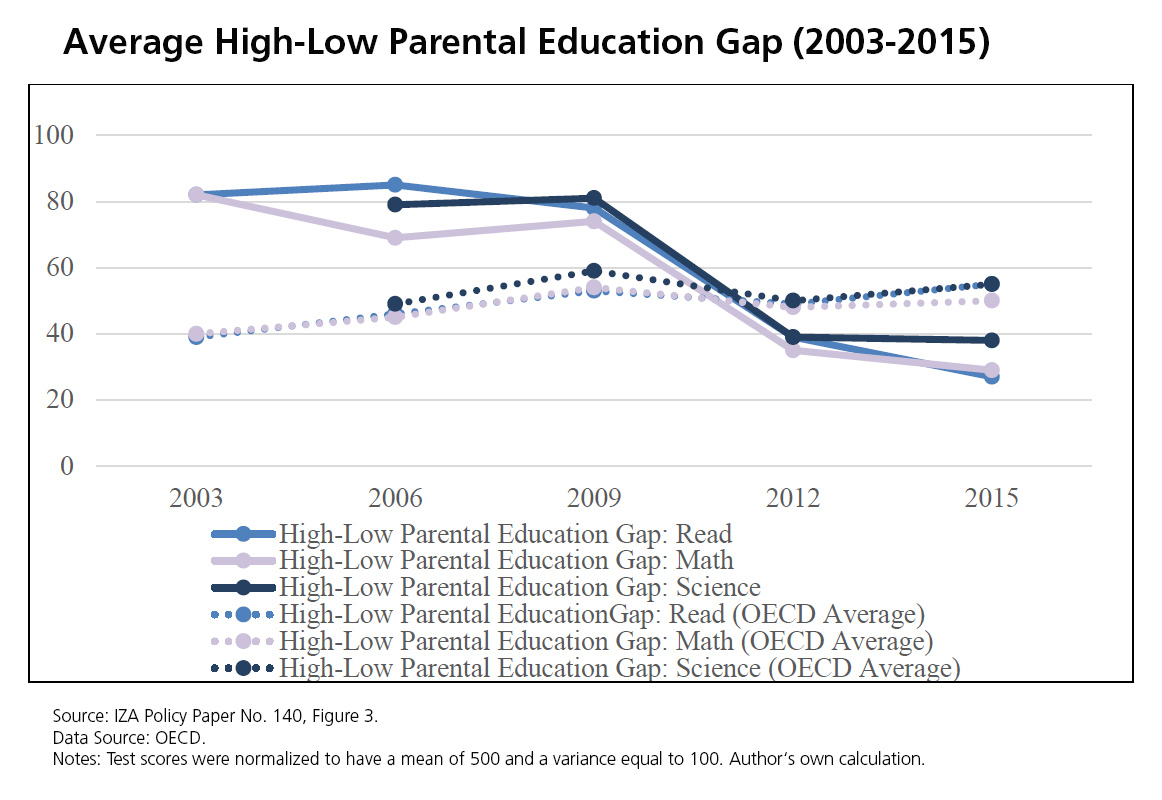
The reforms eventually led to a schooling system which has become more standardized and centralized, more closely monitored, and perhaps most importantly, less segregated than at the time before PISA 2000. The result of this change can be seen when looking at the performance difference of PISA scores between children from high vs. low educated parents: Whereas the disadvantage was significantly above the OECD average still in 2009, it fell well below the OECD average after the year 2012.

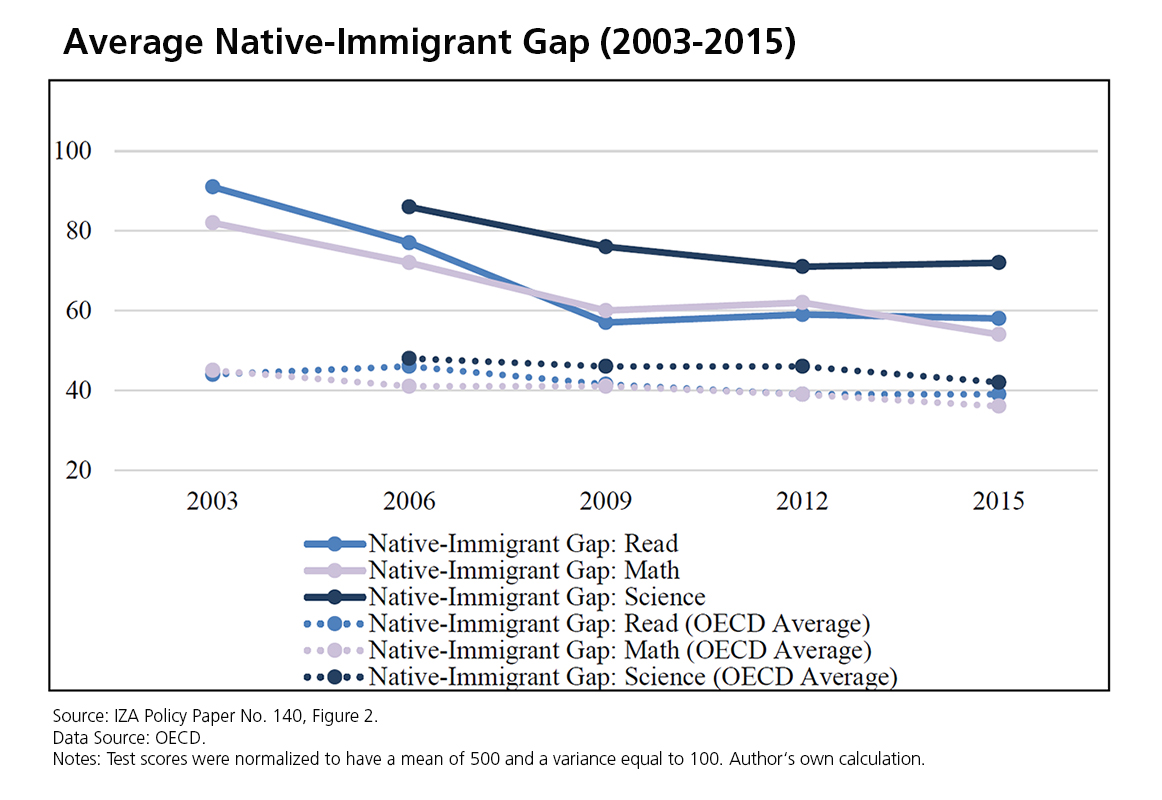
Still, children with a migratory history lag behind. Despite some improvements, the gap between native and immigrant children has remained above the OECD level.

The analysis identifies language problems as the major obstacle. In this respect, the common practice of early tracking restricts integration, as many of those with a poor command of the German language end up in the lower-track secondary schools (Hauptschulen), where they keep the peers speaking their mother tongue.

Controversy about the role of schools

Finally, although OECD’s PISA tests seems to be very successful, particularly in Germany, the authors also note that the OECD has been criticized for a potentially misleading impact of PISA tests as they may be biased in favor of the economic role of public schools. Critics claim that preparing children for gainful employment should not necessarily be the main goal of public education. Instead, students should be prepared for participation in democratic self‐government, moral action and well-being.

According to the authors, this critique is certainly an opinion which is not shared by the majority of German citizens and researchers working on education, but it represents the voice of a significant number of practitioners and educational scientists.

Filed Under: Research Tagged With: achievement, education, education policy, Germany, inequality, migration background, PISA, reforms, school

Immigration of poor voters increases redistribution

August 30, 2018 by admin

How does immigration of poor people affect the lives of natives? This old policy question has recently gained extra attention in countries with large immigrant and refugee inflows. One recurring concern in the public debate is that generous welfare states attract low-skilled immigrants who supposedly benefit from public spending while contributing little in taxes. Consequently, immigration may reduce the level of taxation and spending if it lowers native voters’ support for redistributive policies – possibly also at the expense of poor natives.

However, this relationship may change if immigrants are allowed to vote as well. A recent IZA discussion paper by Arnaud Chevalier, Benjamin Elsner, Andreas Lichter and Nico Pestel analyzes how immigration causally affects redistribution in a setting where immigrants are granted immediate voting rights. Exploiting a historical episode of mass migration to post-war West Germany as a natural experiment, the paper provides evidence that the inflow of poor immigrant voters led to a more generous welfare state and had a lasting impact on preferences for redistribution.

Voting rights and welfare eligibility

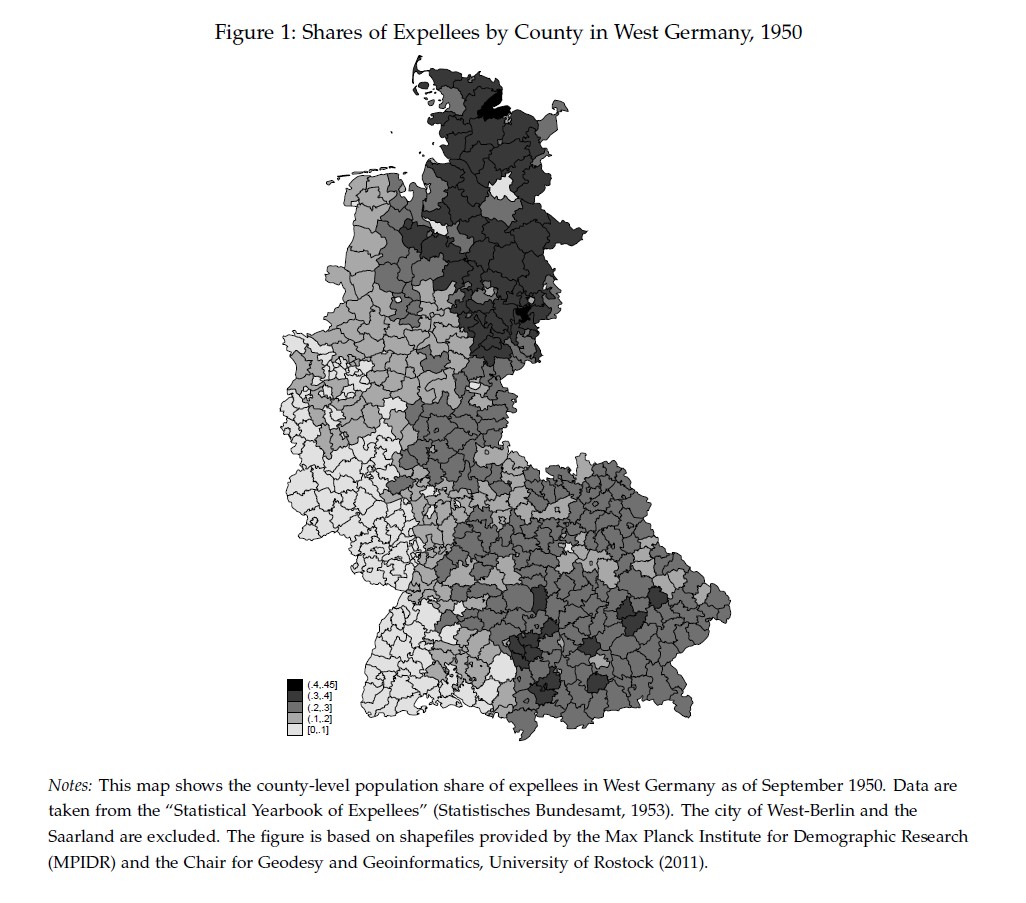
After the end of World War II, twelve million Germans were forcibly displaced from the territories ceded to Poland and the Soviet Union. Around two-thirds of them settled in West Germany, which increased the West German population by almost 20% within a very short period of time, with the migrant population share varying by county from below 2% to more than 40%. These migrants were considerably poorer than the average native. However, as German citizens, they had voting rights and were eligible for social welfare from their time of arrival.

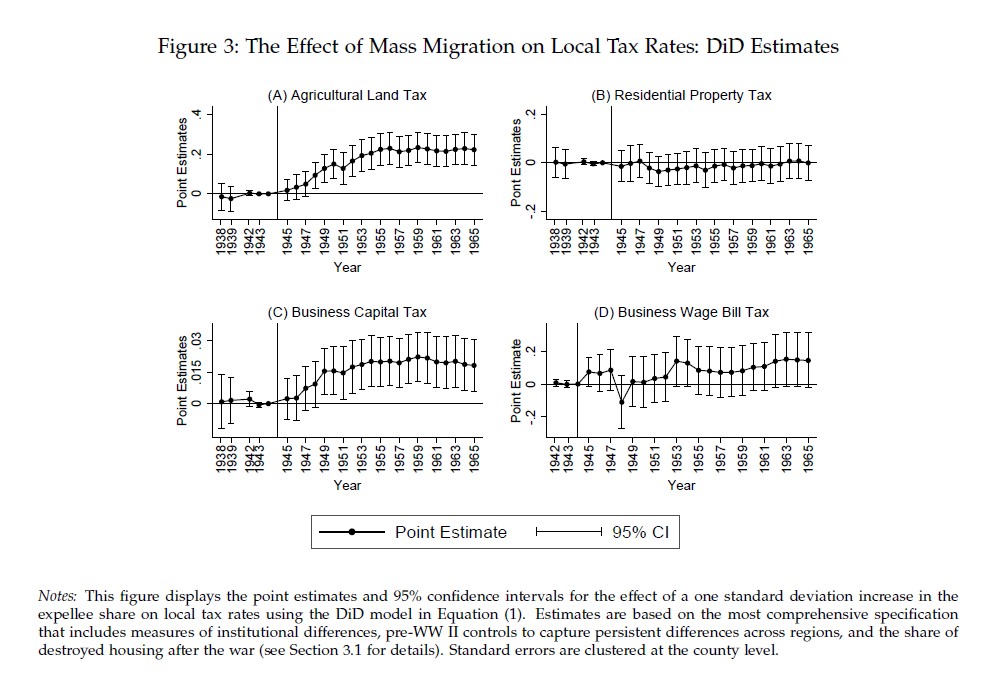
Using panel data for West German cities, the study finds that local governments responded to the migration shock with selective and persistent raises in local taxes as well as shifts in municipal spending. Farm and business owners were taxed more while residential property and wage bill taxes remained largely unchanged (see figure below). High-inflow cities significantly raised welfare spending while reducing spending on infrastructure and housing.

Long-lasting effects

Election data suggest that these policy changes were partly driven by the political influence of the immigrants. In high-inflow regions, the major parties were more likely to nominate immigrants as candidates, and a pro-immigrant party received high vote shares. The impact of the expellees can be felt until today: More than 50 years later, people living in areas with larger inflows in the 1940s still have a substantially higher demand for redistribution.

The findings have implications for today’s debates about migrants’ voting rights. For example, intra-EU migrants are currently allowed to vote in local elections in their country of residence. But the largest global migration flows still occur within countries, especially from rural to urban areas. The study suggests that larger cities with a growing population of poor migrants may see a shift of the political landscape if the migrants have the same voting rights as the incumbent population.

Filed Under: Research Tagged With: expellees, immigration, natives, redistribution, refugees, taxation, voting, welfare

Brothers foster women’s gender conformity

August 27, 2018 by admin

Having a brother rather than a sister increases the gender-stereotypical degree of women’s choice of occupation and partner, according to a recent IZA discussion paper by Anne Ardila Brenøe (University of Zurich and IZA). The effect can be attributed mainly to gender-specialized parenting in families with mixed-sex children, which leads to a stronger transmission of traditional gender norms, persisting into the next generation of girls.

In most OECD countries, women today attain more education than men and participate almost equally in the labor force. However, gender identity still plays an important role for gender differences in behavior and economic outcomes. Although the barriers to women’s participation in education and the labor force have been largely removed in an attempt to achieve gender equality, women keep choosing fields of study that lead to substantially lower-paid occupations.

Family environment matters

Brenøe wanted to find out to what extent this gender conformity is influenced by the gender of peers. Given that the family constitutes an essential facet of a child’s socialization process, sibling gender composition might have a crucial impact on how siblings interact with each other, as well as how parents interact with their children. For instance, parents might invest differently in their children depending on the children’s gender composition, which in turn could alter the intergenerational transmission of gender norms.

Using high-quality administrative data for the entire Danish population, the study evaluates women’s choice of occupation and partner from age 31 to 40 by looking at the gender share in the respective occupations. To isolate the influence of sibling gender, Brenøe compares first-born women who have a second-born brother to those with a second-born sister.

Women with brothers choose lower-paid occupations

The findings show that women with a younger brother are indeed more likely to work in female-dominated occupations and choose more traditional partners. They are 7.4 percent less likely to work in science and technology (STEM) occupations, which are still male-dominated and typically better-paid. Not surprisingly, therefore, the study also shows that women with a brother earn less than those with a sister. These effects seem to persist in the long run: Daughters’ comparative advantage in language over math in school is larger for those with a more gender-conforming mother.

In theory, the “brother effect” could go through either child-parent and/or child-sibling interactions. The study provides compelling evidence in favor of the former channel by showing that parents of mixed-sex children invest their time more gender-specifically: Mothers spend more (and fathers less) time with their first-born daughters if the second-born child is a boy. As a result, girls with a younger brother receive less qualified help with homework in traditionally male-dominated subjects, which might prevent them from growing interests in these fields.

The study thus concludes that the formation of gender identity among girls in the childhood family environment, particularly in more traditional families, fosters gender-conforming behavior that stands in the way of eliminating gender inequality in the labor market. “If society wants to give boys and girls the same opportunities at the time when they enter the labor market in adulthood, policy-makers need to focus on how to counteract gender-stereotypical human capital investments,” writes Brenøe.

Filed Under: Research Tagged With: gender, human capital, parents, STEM

When the market drives you crazy

August 22, 2018 by admin

The stock market influences some of the most fundamental economic decisions of investors, such as consumption, saving, and labor supply, through the financial wealth channel. A new IZA discussion paper by Corrado Giulietti, Mirco Tonin and Michael Vlassopoulos provides evidence that daily fluctuations in the stock market have sizeable spillover effects in an unrelated domain, namely driving. Using the universe of fatal road car accidents in the United States from 1990 to 2015, the authors find that a 1% reduction in daily stock market returns is associated with a 0.5% increase in the number of fatal accidents.

Correlation vs. causation

But is this a causal relationship or a simple correlation? Several tests point to a causal interpretation, with stock market negative performance triggering an increase in fatalities on the road. First of all, the relationship between stock market and accidents is present only when the stock market is actually open. Moreover, the relationship is present only for drivers that are most likely to participate in the stock market, based on the average income in their zip code, on their age, or on the type of car they drive.

The study finds that the effect is particularly strong between mid-1997 and early-2001, a period when stock market participation sharply increased. Data from the Survey of Consumer Finances show that, after a period of stability, households’ stock market participation increased from 28.8% in 1995 to its highest ever historical level of 34.1% in 2001.

Moreover, the authors do not find an association between stock market performance and causes of accidents like speeding or intoxication, while they do find an effect on reckless driving. In sum, their results are consistent with immediate emotions stirred by a negative stock market performance triggering irrational behavior, which in the context of driving leads to an increase in the number of fatal accidents. This poses a particular hazard to inexperienced investors, who are less likely to be used to the ups and downs of the stock market and may therefore overreact to short-term movements.

Filed Under: Research Tagged With: accidents, behavior, decision making, emotions, financial wealth, reckless driving, stock market

  • Page 1
  • Page 2
  • Page 3
  • …
  • Page 45
  • Next Page

Primary Sidebar

© 2013–2025 Deutsche Post STIFTUNGImprint | Privacy PolicyIZA