• Skip to primary navigation
  • Skip to content
  • Skip to primary sidebar

IZA Newsroom

IZA – Institute of Labor Economics

  • Home
  • Archive
  • Press Lounge
  • DE
  • EN

admin

How internet search analysis can help prevent traffic jams

December 2, 2015 by admin

Traffic congestion keeps rising. In 2014, the German Automobile Club (ADAC) recorded 475,000 traffic jams on German highways, totaling 960,000 kilometers of jammed traffic. Side effects include increased carbon emissions, energy waste, higher transportation and production costs, waste of labor, and delays in product deliveries. A consortium of German car manufacturers estimates the daily economic damage at about 250 million euros.

As the emergence of traffic jams is a complex matter with many potential causes, forecasting traffic jams is a methodologically demanding task. In a new IZA Discussion paper, Nikos Askitas proposes an elegant and parsimonious way to capture expected road congestion before it appears. He utilizes the fact that car drivers tend to inform themselves via internet search about pre-existing traffic conditions, thereby revealing their planned itineraries in advance.

His results show that publicly available Google search intensity data allows to accurately predict 80% of the variation in ADAC traffic jam reports two hours in advance: a 1% increase in searches for the term “stau” (traffic jam) implies a .4% increase in traffic jam reports two hours later.

In a nutshell, the Google searches at 7:00hrs and 16:00hrs predict how bad things will be at the peak of badness at 9:00hrs and 18:00hrs, respectively, netting out fluctuations by time of day and day of week. Geographic information incorporated into Google searches, such as specific highway numbers and regions, provides further information for a higher quality of forecasting.

The author argues that traffic planners would be well advised to take Google searches for traffic congestion into account when developing models for traffic congestion forecasting and prevention. He further highlights the need for more detailed target data, e.g. through GPS information of search engine users.

Image source: pixabay

Filed Under: Research Tagged With: congestion, forecasting, google, internet search, traffic jams, traffic planning

The effect of linguistic proximity on immigrants’ labor market performance

November 30, 2015 by admin

With the current increase of global mobility, immigration policy has jumped to the forefront of the political agenda. Immigration can play a central role in boosting economic growth and demographic sustainability of a destination country, but it is often feared as a potential burden to the welfare system and as a strain on social cohesion.

The key to this debate requires an understanding of what makes immigrants successful. Decades of research on immigrant assimilation have isolated a few basic traits that define immigration policies around the world. Linguistic fluency stands up as a major player in immigrants’ social and economic integration.

The analysis of its impact on immigrant outcomes should be of particular interest for countries that have based their immigration policies on attracting high skilled immigrants, and for those contemplating such policies in the near future (see OECD. “Who should be admitted as a labour migrant?”, Migration Policy Debates 4, 2014)

Linguistic proximity is associated with better wages

Combining information from the Canadian Census (1991-2006) with measures of linguistic proximity and the skills required in a broad range of occupations, a new IZA Discussion Paper by Alicia Adserà and Ana Ferrer assesses whether the wages and skills required for jobs that immigrants hold are influenced by the linguistic proximity between the languages of the source and host countries.

Of particular interest is whether linguistic proximity matters more for obtaining and/or moving to jobs that require specific social or communication job-skills, rather than for jobs requiring specific analytical or strength skills. These are the key results:

  1. Linguistic proximity is generally associated with better wages. The wages of immigrants from countries whose most used language shares no linguistic connection (in the dictionary of languages) with the most used language in Canada, are 20% lower than those of similar natives. The penalty for lack of linguistic proximity to English is larger for the university-educated. Wages for this group are 25% lower than those of university educated native born, whereas the difference is only 18% among the non-university educated.
  2. Linguistic proximity significantly affects the returns associated with skills required for the jobs immigrants hold. Wage penalties are mostly linked with lower returns to social skills rather than to other skills: returns are up to 28% lower for immigrants in a job using similar levels of social skills than a native born, but only 16% (12%) lower in a job requiring similar levels of strength (analytical) skills than a native born. These differences exist even for immigrants from English-speaking countries: 6% lower wages than natives in jobs requiring similar levels of social skills, but no difference in those requiring similar levels of strength or strength skills.
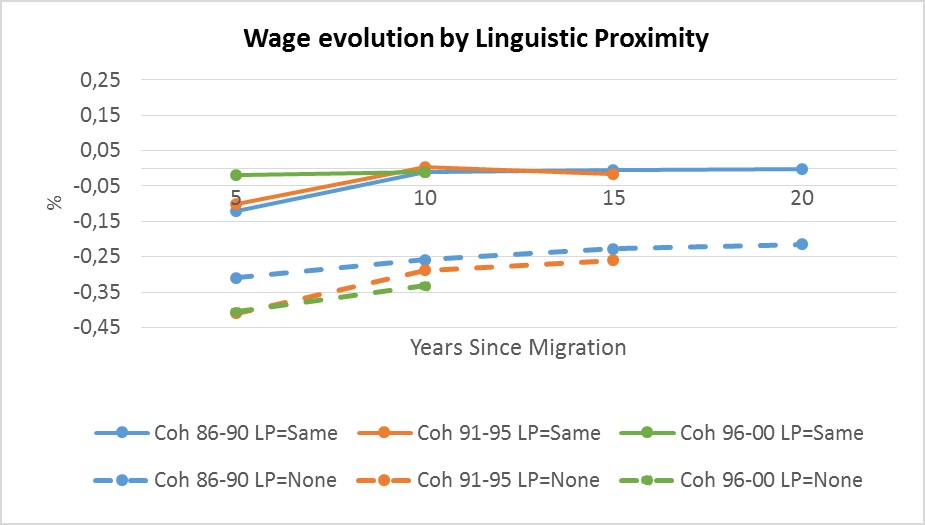
  3. There is not strong evidence that linguistic proximity influences the rate at which migrants converge toward wage parity with native-born workers in the medium to long term, although it affects the initial level of wage differences. (Figure 1).
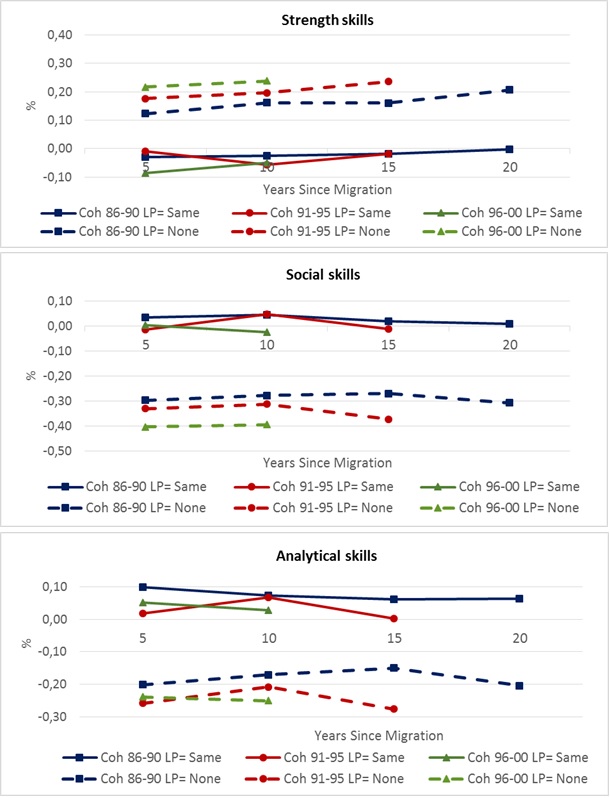
  4. Similarly, linguistic proximity is associated with the types of skills required in the jobs immigrants hold, but not with the rate at which immigrants switch to higher-status jobs over time, which remain largely flat (Figure 2).
Figure 1: Immigrants’ wage assimilation by Linguistic Proximity and arrival cohort

Notes: (1) LP = Most used language in country of origin is the same as the most used language in country of destination. LP=None: The languages share no branch of the linguistic tree (i.e. English and Chinese).

(2) Coh indicates an arrival cohort. E.g. Coh 86-90 indicates the group of immigrants arriving in Canada between 1986 and 1990, which were observed through the Census years 1991, 1996, 2001, and 2006.

Source: IZA DP No. 9499

These findings generally agree with the predictions of human capital theory that linguistic proximity will be correlated with high wages and will be complementary to education. However, they show that linguistic proximity is unlikely to accelerate the rate at which assimilation (in wages or job status) happens.

Early language intervention facilitates economic integration

According to the human capital model, this could be due to lack of improvement in language skills over time – for instance, if ethnic enclaves limit economic opportunities and learning. Early intervention in language integration policies could be most beneficial for economic integration.

However, it is also possible that there are systematic barriers that limit integration, which can be (or not) related to language proficiency. This could be the case if, as noted in related research, immigrants arriving as adults may never reach the level of proficiency required to access certain types of high level jobs or there is discrimination.

Figure 2: Evolution of job-required skills by Linguistic Proximity and arrival cohort

Notes: see Figure 1

Source: IZA DP No. 9499

Image Source: pixabay & IZA DP No. 9499

Filed Under: Research Tagged With: assimilation, Canada, global mobility, immigration, immigration policy, integration, labor market, labor market performance, language, linguistic proximity

Rank, sex, drugs and crime: How relative ability affects adolescents’ risky behaviors

November 27, 2015 by admin

Parents, teachers and policymakers alike are concerned with adolescents engaging in risky practices, such as drug abuse, unprotected sex, or all kinds of delinquent behaviors (stealing, fighting, etc.). Adolescents are often motivated by short-term benefits while potentially not foreseeing associated detrimental effects on educational achievement, health and career outcomes. Peer pressure has long been discussed in the social sciences literature as one of the main drivers behind teenage risky behaviors, though knowledge behind specific mechanisms relating peer characteristics to individual behavior remains incomplete.

In their new discussion paper, IZA researchers Benjamin Elsner and Ingo E. Isphording explore a specific channel through which peers affects risky behaviors: a student’s ordinal rank in a school cohort.

Consider two similar students with the same ability and similar socioeconomic background. By chance, both end up in two different grades, where the first is surrounded by very well performing peers, so that he ranks among the less able students in his grade. The second student is surrounded by less able peers, so that this student is ranked among the best students in his grade. Elsner and Isphording pose the question: to what extent does this difference in the ordinal rank affect the behavior of these otherwise similar students?

There are at least two theoretical reasons why the ordinal rank may influence risky behaviors. First, a student surrounded by high-achieving peers (i.e. who has a low relative ability) might erroneously infer lower likelihoods of a successful career which would lower the expected costs of a bad health status, earlier pregnancies or incarcerations. Second, low-ranked students might think of risky behaviors as a way to gain reputation among their peers, instead of gaining status through academic achievement.

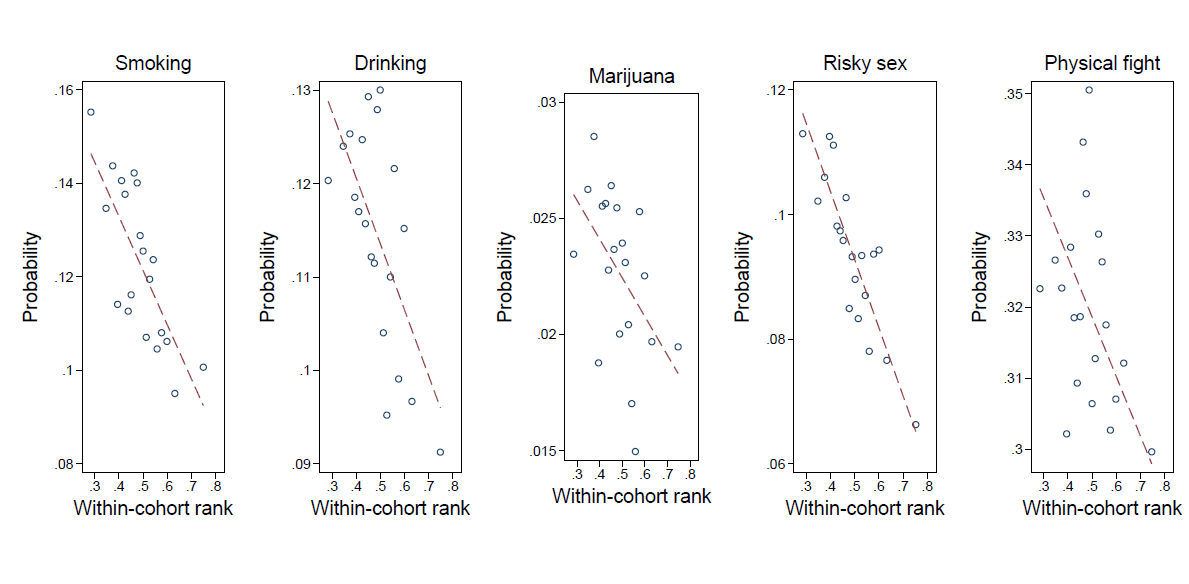
Using data from the National Longitudinal Study of Adolescent Health (AddHealth), a representative panel survey of US middle and high school students, the authors compare students who end up in different ranks because they started school in different school years. Using this within schools/across grades research design, the authors can exclude many potential confounding factors like strategic school choice and quality differences across schools. A first graphical summary of their results hints at a strong negative association between the ordinal rank and different kinds of risky behavior.

Relationship between ordinal rank and risky behaviors

A thorough statistical analysis that takes into account differences in background characteristics as well as potential effects of drug abuse on cognitive ability reveals strong negative effects of the ordinal rank on smoking, alcohol abuse, and the probabilities of engaging in unprotected sex and physical fights, arguably behaviors that are associated with severe long-term costs.

These results should be of concern for parents and policymakers: Choosing the best possible school is not always optimal, because a child with a low rank in the best school may be more inclined to engage in risky behavior than she would be in the second-best school. Moreover, given that risky behaviors impose a significant cost for society, it is important to know their determinants in order to design interventions that prevent adolescents from engaging in them, e.g. through specifically targeting low-ranked students and informing them about the long-run consequences of risky behaviors.

Image source: pixabay and IZA DP No. 9478

Filed Under: Research Tagged With: adolescents, crime, drinking, drug use, education, high school dropouts, peer effects, rank, relative ability, risky behavior, sex, teenagers

Courage, trust and autonomy: Werner Eichhorst outlines challenges of the new world of work

November 20, 2015 by admin

In a recent podcast by the WorkLife HUB, an online platform focusing on work-life balance topics, Werner Eichhorst speaks about the challenges and opportunities of future work. He describes what to expect from the rising importance of robots in the workplace and explains how education systems will have to adapt to the requirements of life-long learning. Eichhorst also provides a set of recommendations for CEOs who worry about their company keeping up with competition and the future of work.

Will robots take our jobs? With all the hype generated around this question it is getting harder to separate facts from the noise. Werner Eichhorst reassures us that the future is not as gloomy as it may seem. In the podcast interview, he unpicks the different elements as to what it means to be working side by side with smart machines and robots.

Key skill of the future: Adapting to change

On the one hand, there will be a lot more interaction between humans and robots, during which the smart machines will take on more and more complex tasks. But the technological advances will also lead to an increased human-to-human interaction in most jobs. And both of these will require not only new skills but also a dedication to a continuous updating of skills. Perhaps one of the most important skills for the future will be the capacity to adapt to change, including the willingness to change occupations.

This alone raises a number of issues, such as figuring out where the responsibility lies for continuously updating the skills and competences of the workforce throughout their working lives. This calls for different responses for low-skilled and high-skilled labor, with the latter requiring much more individual initiative to ensure that skills are relevant.

Government and employers must to their part to ensure employability

Eichhorst also underlines that we must differentiate between cultures. In Europe there is major responsibility for general education by the government, so there needs to be a universal public policy to not only ensure a minimum set of skills for everyone across the workforce for employability, but also to take on some of the responsibility for updating these skills throughout the working lives of employees in collaboration with employers and individuals. Examples include leave or part-time arrangements for educational purposes.

One of the biggest challenges for employers will be to ensure job security and a high level of job quality for their workforce while at the same time organizing workers in a flexible way to get the most out of their innovation capacity. This calls for a new balance of different aspects of flexibility inside the firm, but also using flexible types of employment and project-based work to a reasonable extent.

Eichhorst also recommends the creation of an “enabling working environment” that provides space for formal and informal exchanges between employees that foster innovation. In short: employers who want to be well-prepared and gain a competitive edge in the future world of work should hire the right people, break down rigid hierarchical structures, give them autonomy, and trust in them to help co-create the work organization. Some of this, of course, will take great courage to implement.

Filed Under: Opinion Tagged With: autonomy, education, employability, future of work, lifelong learning, robots, skills, smart machines, work environment

Sexual orientation related to preferences for competition

November 18, 2015 by admin

The gender wage gap is one of the most researched empirical facts in labor economics. But it is not only the biological sex that is related to wages. A small but growing empirical evidence documents how individual sexual orientation is related to significant differences in labor market success. Gay men earn less than straight men; lesbian women earn more than straight women. Still, the reasons remain largely unknown.
Thomas Buser, Lydia Geijtenbeek and Erik Plug from the University of Amsterdam try to uncover a so far under-researched mechanism behind differences in labor market success by sexual orientation: do gays and lesbians differ from straight workers in their preference for competition? Are gays less competitive than straight men and lesbians more competitive than straight women? And can this explain the gay penalty and lesbian premium?

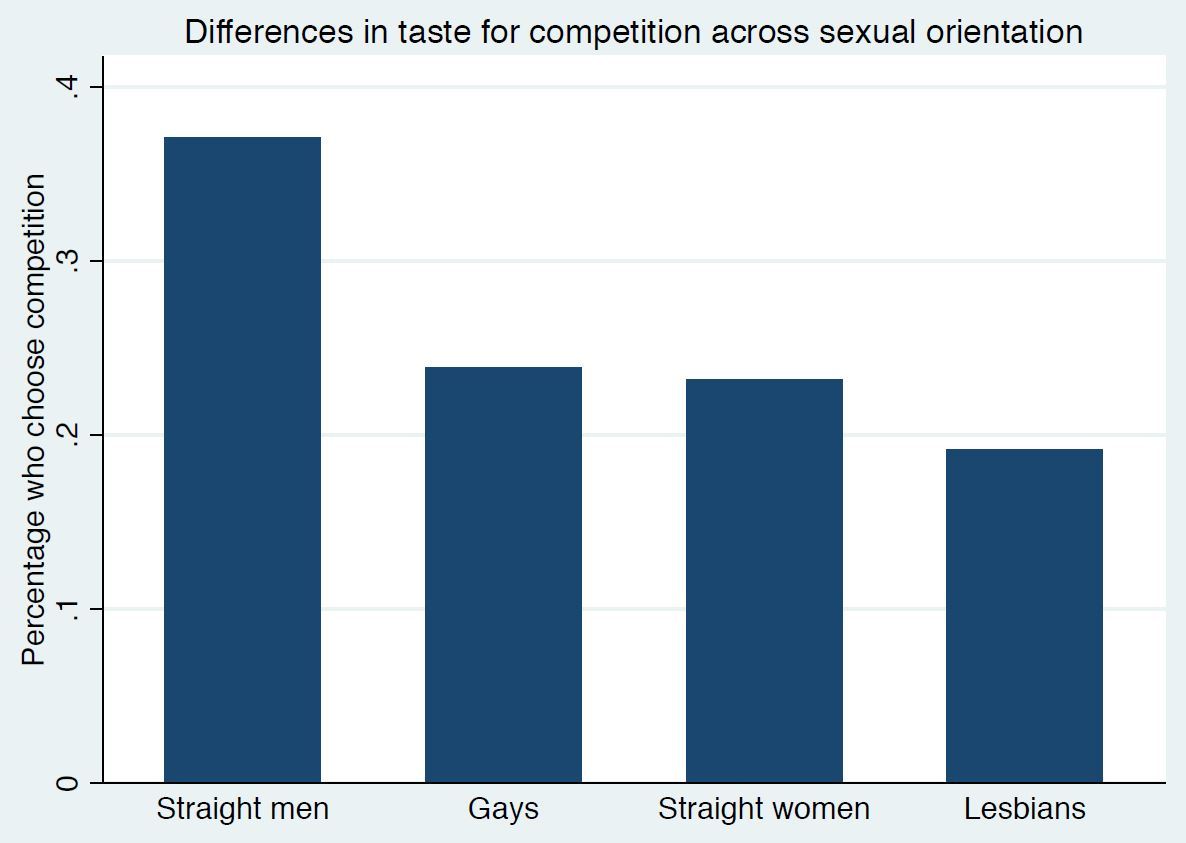
In an experiment with members of an online survey panel, the researchers set gay, lesbian and straight panel members to work on a simple mathematical task: finding the two numbers in a grid of eight numbers that add up exactly to ten. Participants were paid according to their performance. To measure their competitiveness, the participants could choose whether they preferred to get paid a fixed amount for each grid they solved or whether to compete against another participant in a tournament, earning more if they performed better than their opponent and earning nothing if they performed worse.

Percentage of players choosing competitive mode, by sexual orientation (Source: IZA DP No. 9382)

The results show that the competitive hypothesis by sexual orientation holds for men, but not for women. When given the choice of whether to compete, lesbians proved to be as competitive as straight women. By contrast, gays were much less likely to opt for the tournament than straight men, regardless of their grid solving abilities. When the experimental choices are matched to survey data on salaries, the researchers find that these differences in competitiveness can account for almost 40 percent of the gay penalty in earnings.

Image source: Pixabay

Filed Under: Research Tagged With: behavior, competition, experiment, gay, gender wage gap, lesbian, preferences, sexual orientation

Demanding occupations and the retirement age

November 17, 2015 by admin

With populations aging in across most developed countries, governments are under pressure to reform pension schemes to guarantee their fiscal sustainability. Raising the statutory retirement age – the age at which individuals are entitled to ‘full’ retirement benefits – is one of the most common policy responses already applied in many settings.

However, concerns arise about consequences for workers in demanding occupations. While in many jobs people are able to work much longer, more demanding occupations require workers to retire before reaching any statutory retirement age, thereby entering less favorable early retirement, unemployment, or disability schemes.

In the Dutch policy debate, it was argued that low-skilled construction workers cannot work longer since their job requires a level of physical health they are unable to longer maintain at an older age due to the strains of many years of heavy physical work. Soon several other occupational groups argued for exceptions, too.

Despite these concerns, and out of practical implementation problems, the Dutch government decided to raise the statutory retirement age without any exceptions. While the Dutch discussion is far from over, similar debates are ongoing in Belgium, the UK and potentially any other country that raises the statutory retirement age.

Which occupation is considered more demanding than others?

At the core of these debates lies the question of what qualifies as a demanding occupation. When policy makers have to decide where to draw the line, public opinion is a crucial factor. A recent IZA paper by Niels Vermeer, Mauro Mastrogiacomo and Arthur van Soest analyzes the opinion of the Dutch population on early retirement arrangements of demanding occupations.

The study uses survey data on a sample of over 1,800 Dutch adults (the CentERpanel), which was collected in 2012, in the midst of the policy debate on demanding occupations. The authors seek to analyze which characteristics cause an occupation to be perceived as demanding in the public eye. Secondly, they want to examine how the perceived burden of an occupation affects the reasonable retirement age and the willingness to contribute to an occupation-specific early retirement scheme.

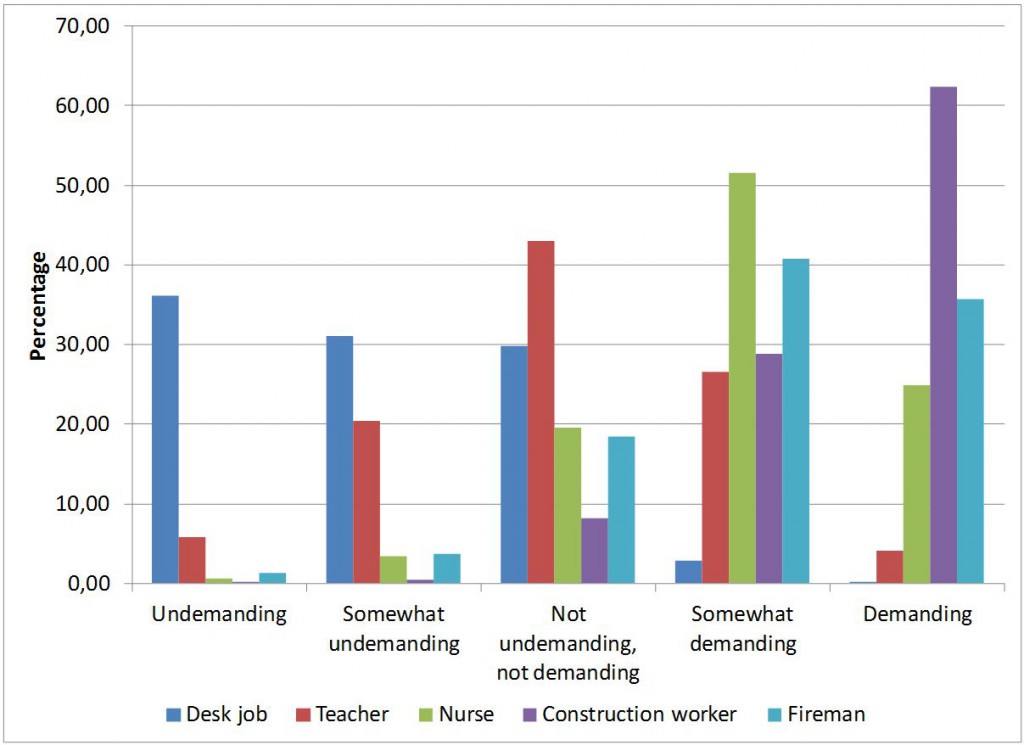
Figure 1 Answer to the question: “Do you think that the occupation of … is demanding?”

The results paint a clear picture of what is perceived as a demanding occupation: Respondents attach much weight to physical effort while mental effort or job stress is not regarded as demanding. As illustrated in figure 1, they see “construction worker” as a burdensome occupation, but not “teacher” or “desk job”, while “nurse” and “firefighter” range in between.

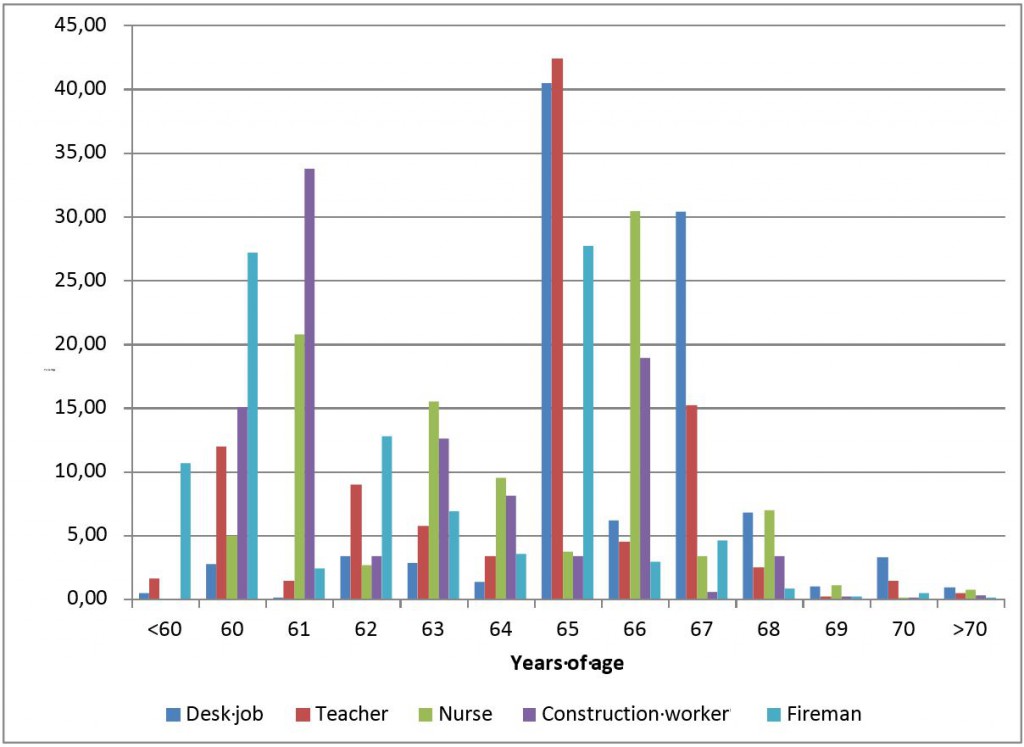
Figure 2: Answers to the question: “What do you think is a reasonable retirement age for … ?“

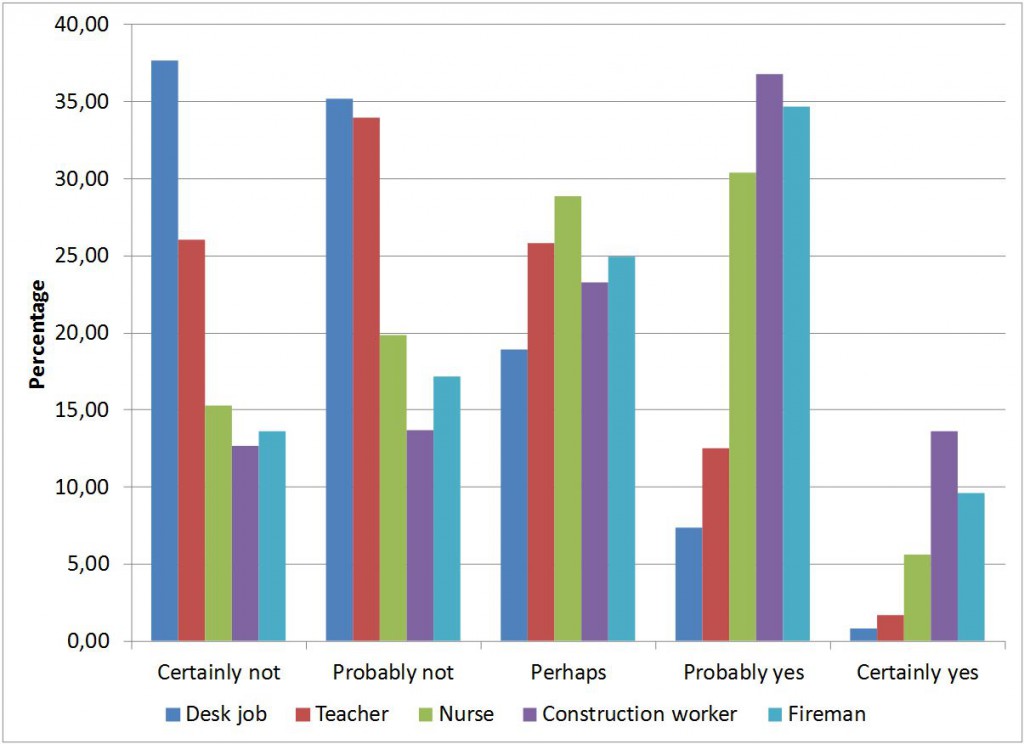
As figure 2 shows, respondents think that construction workers should be able to retire earlier than people with other occupations, while workers with a desk job should work the longest. For the willingness to contribute to an early retirement scheme, the results are similar (figure 3): People show a much larger willingness to contribute to an early pension for construction workers than for firefighters or nurses. Respondents were even less inclined to pay for an early retirement scheme for teachers and employees with a desk job.

Figure 3: Answers to: “Are you willing to contribute as a tax payer to an early retirement scheme for … ?”

These figures are confirmed by a more thorough statistical analysis. Respondents who perceive an occupation as more demanding think that individuals with this occupation should be able to retire earlier. Respondents agree that a worker in a demanding occupation should be allowed to retire about two years earlier. Moreover, respondents indicate a willingness to pay higher taxes for a more generous early retirement scheme, irrespective of whether they work in a demanding occupation themselves.

Exceptions provide disincentives for employers and employees

What do these findings imply for public policy? The Dutch government concluded that differentiating the age of state pension eligibility was unfeasible in practice, reducing incentives for employers to invest in new technology and preventing workers in demanding occupations to change to a less demanding job at a later age.

Vermeer, Mastrogiacomo and van Soest discuss a policy proposal basing the eligibility age on the number of years worked over the lifetime, with adjustments for unemployment, disability, or parental leave. Such a system was recently introduced in Germany, where the statutory retirement age is (gradually) raised to 67, but workers with 45 years of pension insurance contributions can retire at age 63 with full pension benefits.

According to the authors, this policy is easier to implement and discourages strategic behavior. At the same time, individuals with physically demanding occupations would benefit since they often have low education levels and start working at an early age.

Image sources: pixabay and IZA DP No. 9462

Filed Under: Research Tagged With: early retirement, Netherlands, pension, pension schemes, physically demanding jobs, population aging, retirement, statutory retirement age

Youth employment programs around the world – do they work?

November 11, 2015 by admin

Improving the employment prospects of the young generation has become a top priority in labor market policymaking around the globe. Accordingly, youth employment interventions play an important role in international development cooperation. However, since the implementation of a program alone does not guarantee that the desired outcome is achieved, it is not always clear whether the money is well spent.

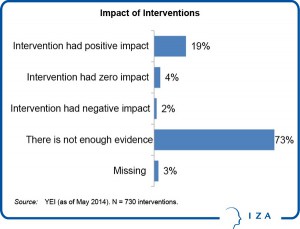
A new IZA Research Report by Werner Eichhorst and Ulf Rinne therefore aims to provide empirical evidence for informed policy decisions. The good news: Overall, youth employment initiatives seem to be on the right track. Very few of the interventions for which conclusive evidence is available have zero or negative effects. However, the vast majority of measures lack a rigorous evaluation.

On behalf of GIZ and BMZ, the IZA experts have analyzed 730 projects in 110 countries covered in the Youth Employment Inventory (YEI) as of May 2014. This internet-based databank is a worldwide stock-taking exercise of employment-related projects for youth which documents program design, implementation and results. Originally initiated by the World Bank, the YEI is now a joint effort of international institutions including BMZ, ILO and others.

These are some of the findings of the descriptive analysis:
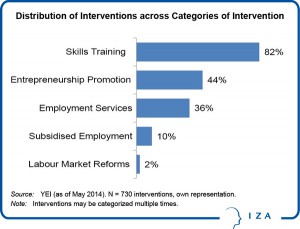
  • 82% of the interventions in the YEI involve skills training.
  • 66% of the interventions were implemented in the Middle East and North Africa (MENA countries) and in Sub-Saharan Africa.
  • For each intervention some kind of evaluation is available.
  • For 48% of the interventions just a basic descriptive evaluation has been performed.
  • For 73% of the interventions there is not enough evidence to make an assessment.

The meta-analysis of evaluations with conclusive results reveals the following:

  • Youth employment measures are more effective in developing countries than in developed countries.
  • Employment services (focusing on job placement) outperform other measures.
  • Combined measures do not outperform programs that include only one type of intervention.

The analysis thus confirms many previous findings in the literature but finds some more heterogeneity across categories of intervention, and points out that integration per se does not guarantee success.

The IZA study concludes that the YEI’s potential for evidence-based policy making could be significantly improved if more interventions were subject to rigorous scientific evaluation. The authors suggest that evaluation requirements should be taken into account in the design of interventions, as well as in budgeting, implementation and reporting.

Filed Under: Research Tagged With: Development, evaluation, meta-analysis, policy intervention, skills, youth employment

Interview with Michael Clemens on smart policy toward high-skill emigration

November 10, 2015 by admin

IZA World of Labor, the unique online resource for evidence-based policymaking, has now published over 200 articles! The author of the most recent article, Michael A. Clemens (Center for Global Development and IZA), is one of the leading scholars in the economics of migration. During his visit to IZA last week, we took the opportunity to talk to him about what constitutes smart policy toward high-skill emigrants.

IZA: With the refugee crisis dominating European headlines, public opinion is starting to turn against legal immigration driven by economic motives. More and more people support politicians who advocate more restrictive immigration policies. What is your opinion, based on the evidence?

Michael Clemens at the IZA Research Seminar

Clemens: The effects of refugees and economic migrants are created primarily by policy. It is possible to turn either refugees or economic migrants into a burden. It is also possible to turn them into a resource. This is a choice. There is recent and groundbreaking research on this, in two very different settings. Low-skill refugees in Denmark have raised the wages of native Danish workers. This is shown in a study with data on every single worker in Denmark across two decades, by Mette Foged of the University of Copenhagen and Giovanni Peri of the University of California Davis. When refugees were dispersed across the country, they generally complemented the labor of native workers. And where they did displace limited numbers of native workers, those natives ended up earning more, because they were displaced into jobs requiring more complex tasks.

The result is similar in a radically different setting: the effects of the two million Syrian refugees now in Turkey. You might think that such a large and unmanaged flow, unlike in Denmark, would have to break the Turkish labor market. But that refugee inflow, too, has actually raised wages for Turkish workers. This is shown in a remarkable new study by Ximena del Carpio of the World Bank and Mathis Wagner of Boston College. Those refugees have displaced many Turkish workers, but they have displaced many of them into higher-paid formal work, while Syrians take the informal jobs that Turks used to fill.

It didn’t have to work out this way. In either of these situations, policy could have converted these people from an economic resource into an economic burden. Denmark, instead of spreading refugees around the country and helping integrate them into the labor force, could have tried to ‘protect’ native workers from them (as some Eastern European countries are doing now). This, Foged and Peri show, would have actually harmed native workers. Turkey, rather than issuing Syrians identification cards designed to facilitate job offers, could have confined them in the camps and actively prevented them from working (as Lebanon has done). That would have lowered Turkish wages and increased their dependence on government handouts. In economic terms, there is nothing necessarily beneficial or harmful about people arriving in desperate conditions; policy makes the difference.

IZA: Many have advocated limits on high-skill migration in the name of economic development overseas, to keep skilled people from leaving countries where they are needed. In your IZA WoL article, you argue that many such policies are misguided. How is that?

Clemens: This is a common idea. Even respected development experts have recommended blocking migration of skilled people from poor countries on these grounds. The basic problems with such policies related to effectiveness and ethics.

On effectiveness: They have never been shown to work. Think about a poor neighborhood you are familiar with, and consider whether forcibly preventing smart young people from leaving that neighborhood would result in improved well-being there. For one thing, you might find the brightest kids being a lot less interested in school if they knew that they could never work outside a ghetto, where their efforts would be rewarded. There would be many other pernicious effects as well. With countries, too, there are indirect effects of this kind. This is why no one has ever demonstrated a positive effect on development, economic or otherwise, from trapping skilled people inside a poor country. In fact, if you think of places where skilled people really have been trapped against their will in the past—East Germany, North Korea—you are not thinking of places with vibrant development.

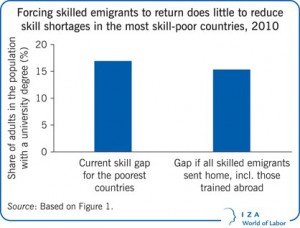
Beyond this, for the truly poor countries the problem is that they have extremely few skilled workers, period, not that those skilled workers are leaving. Think of the countries on earth with the lowest numbers of university-educated workers as a fraction of the labor force, like Malawi. Even if some draconian policy somehow forced all the skilled people from those countries who are abroad to return home—including the ones who got their training abroad—this would barely change the skill shortages at home.

And on ethics: Think for a moment about the policy I just mentioned, of forcing all skilled people from poor countries to go back there. That prospect should be shocking and abhorrent. Imagine someone arriving at your own door, and informing you that your plans for your life are not important, and that someone else has determined that your skills are needed in a place you have decided you don’t want to live—so you’ll be sent there against your will. It would shatter your universe; it is not something we should discuss casually. The United Nations Universal Declaration of Human Rights, Article 13, guarantees the unconditional right of all people to leave any country they wish to leave, for any reason. Interfering with such a basic human right is something we should only ponder gravely, in the face of extremely compelling evidence that it would do good. As I mentioned above, we don’t have such evidence.

IZA: But why should politicians in developed countries care? And what can they do?

Clemens: Politicians who care about development should promote well-regulated skilled migration. High-skill emigration brings many indirect benefits to developing countries. Economists have shown that high-skill emigration increases trade for the countries that those migrants leave, by building their networks abroad. And it increases not just the amount of trade, but the diversity of products produced and exported. High-skill migration similarly causes investment in the countries migrants come from, and transfers new technologies (measured by patents) to the countries of origin. The effects of skilled workers are global, and many of them do more for their countries abroad than they can do at home.

These effects are documented in rigorous statistical studies. But they are easy to see as well. A well-known example of this is Mohamed Ibrahim, an engineer who once worked as a functionary in Sudan’s telecommunications agency. He emigrated to the United Kingdom and founded a telecom company, later bringing new technologies and billions in investment to Africa. A shortsighted policymaker may have tried to block him from leaving Sudan in the first place, since his ‘skills were needed’ there. Farsighted policymakers understand that the world and the economy are much more complex than that.

But this does not mean that regulation on skilled migration, in the name of development, is useless. An important concern for the countries that skilled migrants leave is a fiscal concern: many poor countries heavily subsidize higher education, and this can turn skilled emigration into a fiscal drain. The best policy solution to this isn’t to block skilled migration, which is ethically problematic and would cut off the many benefits. Rather, a policy priority is to develop systems of higher education finance that are built around the reality of migration, encouraging skill formation and mobility while limiting fiscal drain. I proposed one such system in IZA’s Journal of Labor Policy, but we need a lot more innovation here.

Filed Under: Research Tagged With: brain drain, Development, emigration, high-skilled migration, immigration, refugees, skill gap

Broadband boosts firm performance but not jobs in rural areas

November 4, 2015 by admin

To fully realize the potential of today’s internet requires fast access. But in some of Europe’s rural areas, broadband connections are still a scarce resource. Especially rural businesses complain about the lack of internet infrastructure in their regions. In the EU 2020 strategy, the European Union has identified the “digital divide” between rural and urban areas as a major impediment to growth.
But does the speed of internet access really have such a large effect on the performance of firms? Despite growing policy attention to broadband diffusion in rural areas, not much is known about its economic impact. A new IZA discussion paper by Giulia Canzian (FBK-IRVAPP), Samuele Poy (Università Cattolica del Sacro Cuore) and Simone Schüller (FBK-IRVAPP and IZA) provides empirical evidence on the impact of broadband availability and firm performance in rural Italy.

Broadband increases firms’ annual turnover and value added

The authors look at the Province of Trento, where between 2011 and 2014 the government rolled out a public broadband delivery program explicitly targeted at providing ‘underserved’ rural and sparsely populated areas with broadband internet access. Their research represents the first impact evaluation of a policy delivering access to advanced ADSL2+ technology with upload speeds of up to 20 Mbps. Previous studies only examined the very first ADSL technology providing speeds exceeding 256 Kbps.

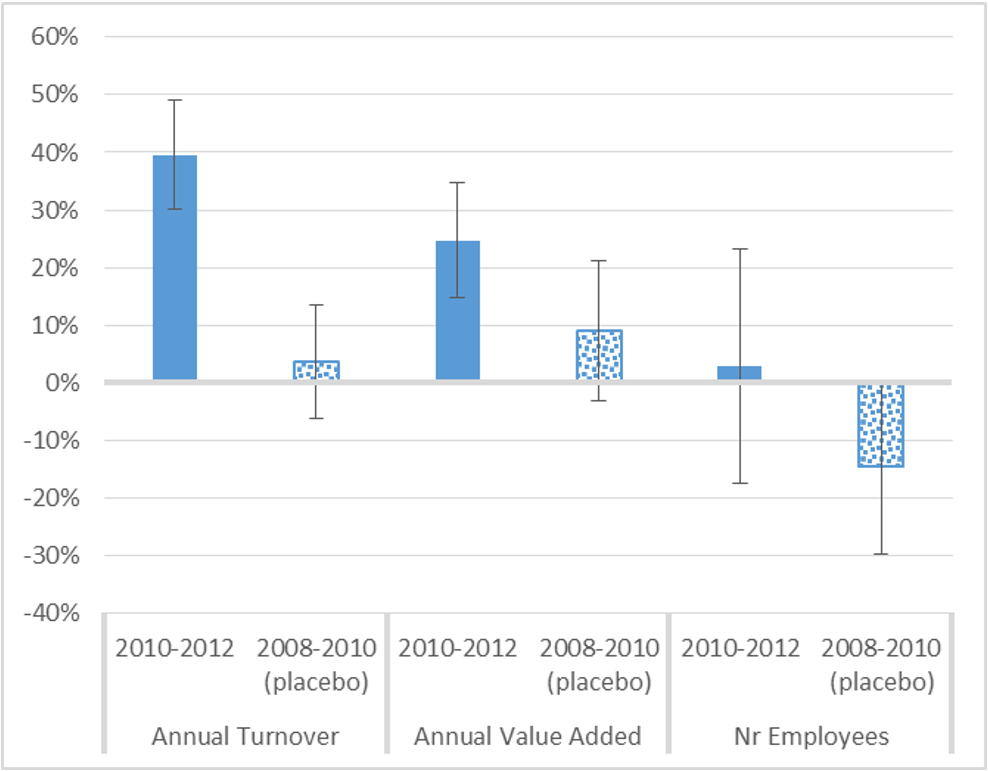
Using balance sheet data on corporate enterprises, the authors show that firms in rural and remote areas benefit considerably from the enhanced broadband delivery program. Over a two-year period, ADSL2+ availability increased firms’ annual turnover by about 40 percent and value added by about 25 percent. However, the positive impact on output could not be observed with regard to employment. The authors did not find evidence that the firms that had gained a fast ADSL2+ connection would hire extra workers.

In order to verify the results, the researchers also ran placebo regressions in the two-year period before the actual program started. The fact that these test regressions showed no effects (see figure above) supports the causal interpretation that the provision of broadband internet was indeed the driving factor behind the boost in firm performance.

These findings have important implications for the ongoing policy debate on public investment in broadband infrastructure. It should encourage policy makers, especially in relatively under-developed remote and rural areas, to focus on broadband delivery in order to encourage local economic growth.

Image source: pixabay

Filed Under: Research Tagged With: ADSL2+, broadband internet, firm performance, infrastructure, Italy, rural-urban internal migration, Trento

Social ties increase the chance of getting published in economics journals

October 28, 2015 by admin

Social connections influence individual behavior and ultimately affect a variety of economic outcomes, such as welfare program participation, criminal activity, and labor supply. For professional careers, social networks undoubtedly play a crucial role, but they can cut both ways: Personally knowing a job candidate might improve the outcome of a selection process but also bears the risk of favoritism.

A vast literature in labor economics has investigated the use and beneficial effects of network membership on labor market outcomes (see e.g. IZA DP 5240). A new IZA Discussion Paper by Tommaso Colussi focuses on the efficiency of connections and whether they harm or improve the outcomes of selection processes.

His study analyzes the role of social connections in the publication process in economics, looking at the ties between editors and authors. His results show that an editor’s former PhD students and faculty colleagues experience an increase in their publication outcomes when the editor is in charge of a journal. At the same time, these connections improve the quality of published papers, as the analysis of citation suggests.

The ecosystem of economists

It is no secret that knowing the right people can help your career. But assessing the real impact of social ties and favoritism is more difficult than it seems, given that reliable data on social connections among (future) colleagues is often not available. The academic sector provides a rewarding exception, as scholars openly publish their academic histories and reveal much about their social connections. Colussi exploits this situation to empirically investigate the extent to which connections between authors and editors influence the selection (and quality) of articles in economics journals.

The world of economists who publish in high-impact journals is small and composed of interconnected scholars. Descriptive statistics show that about 43% of papers published in the journals considered are authored by at least one scholar that is connected to at least one editor at the time of the publication. Moreover, 72% of authors become connected to at least one editor at some point in time.

In order to explain the role which social ties play in this situation, Colussi built a unique dataset on articles, authors and editors of the top general interest journals in economics (American Economic Review, Journal of Political Economy, Econometrica and Quarterly Journal of Economics) over the period 2000-2006. These data allow to identify whether social ties between each author and each editor exist along various dimensions. An author was considered to be connected to an editor if he/she is a faculty colleague, a former PhD student, from the same PhD program, or a co-author.

Knowing the editor helps getting published, but doesn’t hurt quality

The results of Colussi’s study reveal that social ties with editors positively increase the chance for an author to get published. When a scholar is in charge of a journal, the number of papers published by his connections increases by about two papers in three years. Furthermore, editors tend to publish papers of scholars’ faculty colleagues and former graduate students. Connected scholars are also more likely to publish lead and longer articles.

To verify his findings, Colussi examined if his results could also be explained by other factors. For example, a journal’s preference towards papers in a particular research field could simultaneously affect the appointment of an editor, who is a prominent scholar in that field, and the publication outcomes of his connections. But the robustness checks showed that neither this “field effect”, nor other unobserved characteristics of connected scholars generated the correlation. Colussi illustrates that due to tastes and technological complementarities between connected scholars, editors always prefer to publish papers authored by researchers they are connected to.

In the second part of his study, Colussi looked at how this apparent academic favoritism affected the quality of the papers. He analyzed the effect of social ties on the number of citations that papers receive. The results showed that papers authored by an editor’s former PhD students increase the number of citations by more than 27% when this editor is in charge. However, this positive effect on quality does not apply to papers authored by past and current faculty colleagues.

In sum, Colussi found a twofold effect of social connections in academia: While editors clearly tend to favor connected authors, the connections are also likely to improve selection decisions and, in the case of former PhD students, lead to better results.

Image source: pixabay

Filed Under: Research Tagged With: academia, citations, connections, economics, editors, favoritism, journal, publishing, social networking, social ties

  • Previous Page
  • Page 1
  • …
  • Page 15
  • Page 16
  • Page 17
  • Page 18
  • Page 19
  • …
  • Page 45
  • Next Page

Primary Sidebar

© 2013–2025 Deutsche Post STIFTUNGImprint | Privacy PolicyIZA