 Economics is the science on scarce resources. And what is more scarce than time in modern societies? A recent literature acknowledges this scarcity of disposable time of individuals and households and analyzes the interplay between time allocation and economic decisions and outcomes.
In a new IZA Discussion Paper, José Alberto Molina and J. Ignacio Gimenez-Nadal look at a new aspect of time use: They provide international evidence on how individual satisfaction with one’s health status affects the allocation of time to different daily activities. The researchers analyze daily diaries from six countries in which individuals report how they use their time.
Without claiming a causal interpretation, the authors find that a better health perception is associated with more time spent on paid work and less time devoted to sleep, body care and leisure. But unlike healthier Americans, who also spend more time on home production, Europeans do less housework when they feel healthier. In addition, the study reveals differences in how Europeans tend to allocate their time. For example, Germans invest less time in sleeping or leisure activities compared to other Europeans, but spend more on personal care.
 How to handle the inflow of refugees to the European Union is one of the current hot topics in the media. Under the current regime, the share of inflows borne by EU member states is heavily skewed to a small number of receiving countries. As the recent public discussion shows, this unequal distribution gives rise to general resentment of immigration and negative attitudes towards asylum seekers in particular.

 The fact that it has been difficult to document a consistent positive effect of the often huge public spending on activation of the unemployed does not imply that it is without consequences how unemployed individuals are spending their time and what they are being offered in terms of programs.
 Parents have strong preferences for sending their children to the best schools available. There seems to be a general perception that graduating from a elite school equals winning a lottery in life chances. Empirical evidence though tells a different story, suggesting at best marginal effects on test scores and college outcomes. However, the impact on outcomes later in life is largely unexplored.
 According to a report by
 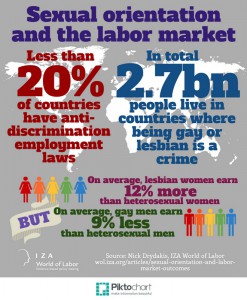 Workplace harassment can have serious mental health consequences for the individuals who are bullied or harassed and detrimental effects on the firm’s smooth operation. Gay and lesbian employees who can be open about their sexual orientation in a safe and diverse workplace are more productive, creative, and loyal because they feel more comfortable and safe.
 Many European countries are contemplating (or have already introduced) mandatory quotas for the share of women on the executive level of firms. The idea is to help women break the glass ceiling and create more equality of opportunity also in the lower ranks. Quota advocates also argue that more gender diversity at the top increases firms’ productivity and performance.
 The hot debate about President Obama’s immigration reform shows that many Americans still view immigrants as taking jobs away from natives – while in fact quite the opposite can be true: In a recent IZA Discussion Paper,
  Nutritional disruptions experienced during the stage of fetal development impair an individual’s labor market productivity later in life. This is shown in a new IZA paper by