• Skip to primary navigation
  • Skip to content
  • Skip to primary sidebar

IZA Newsroom

IZA – Institute of Labor Economics

  • Home
  • Archive
  • Press Lounge
  • DE
  • EN

admin

Welfare benefits are no magnet for migrants

October 21, 2013 by admin

EU commissioner Laszlo Andor has been under fire since he claimed last week that welfare tourism is “neither widespread nor systematic.” However, the newly published International Handbook on the Economics of Migration, co-edited by Amelie F. Constant and Klaus F. Zimmermann from IZA, confirms Andor’s position.

Anti-immigration sentiment is on the rise in Europe. The UK has recently joined Germany and several other EU member states in projecting a rather reserved position when it comes to access of immigrants to their labor markets and welfare systems.

Reviewing the state of the art in economic research, the handbook chapter on welfare migration concludes that “fears about immigrant abuse of welfare systems are unfounded or at least exaggerated.” Robust evidence shows that even if some relationship between immigration and welfare generosity is found, it is rather exiguous.

“In fact, recent research suggests that immigration may lead to increased welfare generosity,” explains Corrado Giulietti, one of the contributing authors. According to a research paper by an IZA team that came out in International Journal of Manpower earlier this year, the economic situation or presence of relatives or other contacts in receiving countries are some of the much more important pull factors. The main goal of migrants from new member states coming to the old EU states is employment, according to the Handbook.

Immigrants have been scapegoated, and not only by rising anti-immigrant parties in countries such as France or the Netherlands, also for their alleged abuse of social benefits. An earlier study by IZA and the Economic and Social Research Institute (ESRI, Dublin) shows that in most EU member states immigrants are in fact less likely to use the welfare system than natives.

“Analysis of hard data reveals that even for unemployment benefits immigrants are equally and in several countries less likely recipients than comparable natives,” asserts Martin Kahanec, co-author of the study. “We need a paradigm shift, from the debate about abuse to a debate about lack of access to social benefits and services,” he adds.

Aging and crisis-stricken Europe needs to tap on all available resources. Mobile workers can provide the much-needed flexibility and skills where they are needed. “The role of migration is ever more, and not less, important in times of economic crisis. Mobility can not only absorb some of the negative shocks, but also contribute to recovery through increased efficiency,” concludes IZA Director Klaus F. Zimmermann.

For more information on the International Handbook of the Economics of Migration, see the Handbook’s homepage and a video of the Handbook’s Presentation with statements of the editors.

Filed Under: Opinion, Research Tagged With: anti-immigration movement, demographic change, employment, Europe, European Union, Germany, immigration, migration, UK, welfare migration, worker mobility

America’s children are the silent victims of the Great Recession

October 16, 2013 by admin

By Miles Corak

Miles Corak
University of Ottawa and IZA

The Great Recession has disrupted the lives of families and their children in an unprecedented way.

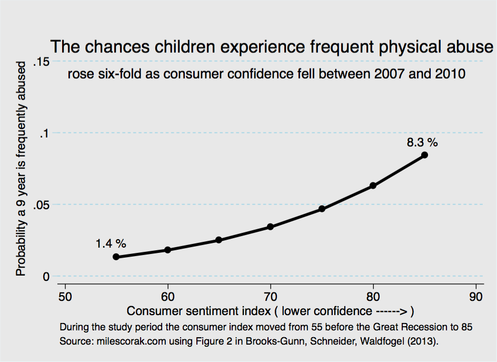
It has changed everyday life in some ways that can be measured by money, but in others that cannot, and at the extreme it has even led to a six-fold increase in the risk children will be physically abused.

Lost jobs, falling incomes, and foreclosures will likely compromise the capacity of children to become all that they can be, with the effects of the recession echoing not just across years, but also across generations.

Recessions do not normally figure into the way economists think about the factors determining the adult prospects of children. Unemployment spells are usually short, temporary events. In gauging the capacities of families to invest in and promote the capabilities of their children, it is important to look past the changes in incomes that result, and focus on the long-term, more permanent, resources available to parents.

Family income measured in any single year is, for example, not a good predictor of the adult incomes of children, but an average over, say, 10 years offers a better picture of family wealth, and is much more strongly associated with adult outcomes.

Economic theory teaches us, that people base their spending decisions, along a whole host of dimensions, on their expected long-run earnings prospects.

Certainly buying a home is made on this basis, young couples entering into debt because they expect their earnings to grow over the decades with more and more job experience. Investing in your children is no different: which schools and colleges they attend, what vacations to go on, what other extra-curricular expenditures and care arrangements to make, are all decisions that need not be rethought if income decreases, or for that matter increases, temporarily for a short period of time. Borrowing, drawing down savings, or government support can make up the difference, and maintain a customary life style.

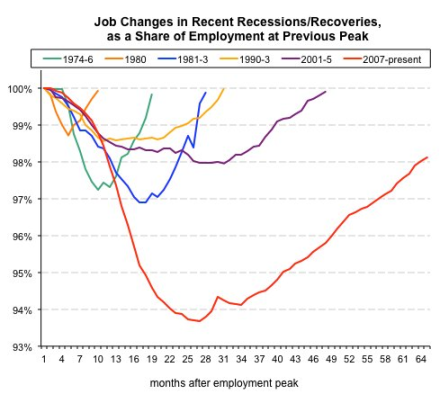
But the Great Recession, unleashed with full force in the autumn of 2008 and from which the American economy has yet to fully recover, has shattered both reality and expectation.

Source: Catherine Rampall (2013), Economix Blog, The New York Times, May 3rd.
http://economix.blogs.nytimes.com/2013/05/03/comparing-jobs-in-recessions-and-recoveries-2/

Its severity and duration calls us to rethink this rather sanguine point of view.

Research has shown that losing a job with no prospects of getting recalled lowers the incomes of long-tenured workers by as much as 25%: the new jobs these workers eventually find rarely pay as much as the old jobs they lost.

Just as importantly, this has a long-term impact on children.

The loss in income matters, but so do the other accompanying changes that will also influence the way they lead their lives. The Great Recession has certainly caused major, long-term income losses for many families, but this matters all the more because it was associated with the bursting of a housing bubble that unleashed an unprecedented number of foreclosures.

This means some children are not only living in poorer families, but that they also face the disruptions associated with changing schools, neighbourhoods, and even cities. Frequent moves and a repeated loss of friends and networks lowers high school graduation rates, and the adult incomes kids will ultimately earn.

The Great Recession didn’t just deplete bank accounts and disseminate home equity; it also ushered in a major crisis of confidence. Family life, even among those who did not experience job loss, is much more stressful, making parenting a bigger challenge.

Children benefit most from a so-called “authoritative” parenting style, a loving and warm relationship that also offers clear expectations of behaviour and accomplishment. But financial strain, whether subjective or not, taxes the energies of parents, and raises the likelihood of “authoritarian” behaviour, which involves strict adherence to rules, and unfair punishment to enforce them.

A telling, if extreme, example is a recent finding that during the Great Recession children have been more likely to fall victim to physical abuse.

A soon to be published research paper by Jeanne Brooks-Gunn, William Schneider, and Jane Waldfogel, researchers at Columbia University and the London School of Economics, shows that the drop in consumer confidence beginning in 2007 is associated with a six-fold increase in the chances that mothers will hit their children frequently (on about at least a monthly basis).

Before the recession, less than two per cent of the nine year-olds they studied in America’s major cities were at risk of being abused in this way, but when the drop in consumer confidence reached is nadir, close to 8% were.

A recession is usually a short, temporary event, something that can even be planned for, or at least weathered by a combination of personal savings, insurance, and income support. But the Great Recession was deeper, has lasted longer, and has unleashed a whole host of long-term changes. These will most likely scar some children by compromising the quality of their home life, making them the silent victims of these turbulent times.

This is a reblog of the original article published at milescorak.com.

Filed Under: Opinion Tagged With: children, crisis, Great Recession, income shocks, unemplyoment

Peer effects at work are smaller than often suggested

October 14, 2013 by admin

What happens to a worker’s own productivity if one of her less productive colleagues is replaced by a highly productive new co-worker? Would this have any impact on that worker’s own productivity? And if so, then what is the possible channel?
There are at least two reasons why this new productive colleague makes her co-workers in the same peer group more productive. First, workers may learn from each other, and the new colleague may transmit knowledge to her co-workers which increases their productivities (knowledge spillover). Alternatively, co-workers might feel guilty or ashamed if their productivity falls short of that of their new colleague, and they may therefore work harder when a new and very productive new co-worker enters their peer group (social pressure).

Whether such spillovers in productivity exist, and what are the channels, is not only important for our understanding of the wage setting process and the hiring policy of the firm, but has also implications for wider issues such as wage inequality. Despite the potentially important implications of spillovers in the workplace, empirical evidence on this question is still scarce. The existing empirical literature on productivity spillovers in the workplace is so far restricted to only to a handful of studies referring to very specific settings, such as supermarket cashiers, soft fruit pickers, teachers or scientists.

In a new IZA discussion paper, Thomas Cornelissen, Christian Dustmann and Uta Schönberg go beyond the existing literature and investigate peer effects in the workplace for a representative set of workers, firms, and sectors of a large local labor market over two decades. Further, the authors focus on peer effects in wages rather than productivity. The researchers find only small peer effects in the labor market in general, as well as in highly skilled occupations. Hence, the larger peer effects established in specific settings in existing studies do not carry over to the labor market in general. This is an important finding, and suggests that – overall and for high skilled occupations – peer effects contribute little to wage inequality. In low-skilled occupations, in contrast, peer effects are sizable, indicating that a 10% increase in co-worker quality increases a worker’s own wage by 0.6-0.9%. The authors present several pieces of additional evidence suggesting that social pressure is the primary source of these peer effects.

Filed Under: Research Tagged With: co-workers, colleagues, peer effects, productivity, wage inequality

“The Price of Rights”: How to regulate international labor migration

October 11, 2013 by admin

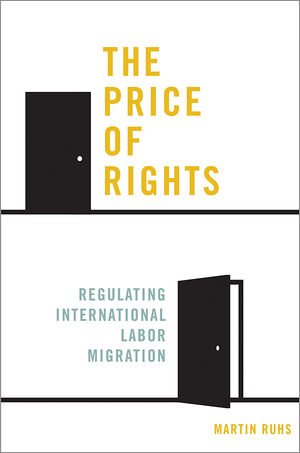
Many low-income countries and development organizations are calling for greater liberalization of labor immigration policies in high-income countries. At the same time, human rights organizations and migrant rights advocates demand more equal rights for migrant workers. “The Price of Rights“, a new book by Oxford Economist and IZA Research Fellow Martin Ruhs, shows why you cannot always have both.

The author analyzes the trade-offs between admitting migrants and granting them rights. The book examines labor immigration policies in over 45 high-income countries, as well as policy drivers in major migrant-receiving and migrant-sending states. It finds that greater equality of rights for new migrant workers tends to be associated with more restrictive admission policies, especially for admitting lower-skilled workers from poorer countries. The tension between “access and rights” applies to a few specific rights that are perceived to create net-costs for the receiving countries including especially the right of lower-skilled migrants to access certain welfare services and benefits.

Most low-income countries around the world are acutely aware of the trade-off between access to labor markets in high-income countries and some migrant rights. Few migrant-sending countries are willing to insist on full and equal rights for fear of reduced access to the labor markets of higher-income countries. As discussed in The Price of Rights, some migrant-sending countries have explicitly rejected equality of rights for their nationals working abroad on the grounds that it constitutes a restrictive labor immigration policy measure.

How to respond to the trade-off between openness and rights is an inherently normative question with no one right answer. Martin Ruhs argues that there is a strong case for advocating the liberalization of international labor migration, especially of lower-skilled workers, through temporary migration programs that protect a universal set of core rights and account for the interests of nation-states by restricting a few specific rights that create net costs for receiving countries, and are therefore obstacles to more open admission policies.

The book suggests that we should start discussing the creation of a list of universal ‘core rights’ for migrant workers that would include fewer rights than the 1990 UN Convention of the Rights on Migrant workers with a higher chance of acceptance by a greater number of countries – thus increasing overall protection for migrant workers including in countries that admit large numbers of migrants.

Filed Under: Research Tagged With: admission policy, high-income countries, high-skilled, immigration, labor migration, liberalization, migration, population aging, welfare migration

Firms do not benefit from active labor market policies

October 11, 2013 by admin

Do firms benefit from active labor market policies? In order to answer this question, Michael Lechner, Conny Wunsch and Patrycja Scioch investigate the link between variation in the supply of workers who participate in specific types of active labor market policies (ALMPs) and firm performance using a new and rich German employer-employee data base. The paper exploits that local employment agencies in Germany have a high degree of autonomy in determining their own mix of ALMPs. In addition, firms’ hiring regions overlap only imperfectly with the areas of responsibility of the employment agencies. This mismatch allows the authors to identify the effect of ALMPs on firm performance. The results indicate that in general firms do not benefit from ALMPs and in some cases may even be harmed by certain programs. In particular, subsidized employment and longer training programs seem to be detrimental to firm performance. These findings complement the negative assessment of the cost-effectiveness of ALMPs from the empirical literature on the effects for participants.

Filed Under: Research Tagged With: active labor market policies, firm performance, Germany, local employment agencies, subsidized employment, training programs

Longer maternity leave: Good for children of highly educated mothers

October 7, 2013 by admin

Do children do better in school if mothers stay longer at home after birth? A new IZA Discussion Paper by Natalia Danzer and Victor Lavy investigates this question by estimating if and how long-term human capital outcomes are affected by the duration of maternity leave, that is, by the time mothers spend at home with their newborn before returning to work. The authors exploit an unanticipated policy reform in Austria: the maximum duration of parental leave for children born on July 1, 1990 or later was extended from 12 to 24 months. Thus, as of July 1, 1990, newborns had a higher probability that their mothers stayed home longer after birth. Using scores from the Austrian PISA test to measure school performance and proxy human capital, the study shows that there is no significant overall impact of the extended parental leave on test scores at age 15. Yet, the authors also look at the effect for different subgroups, finding opposing effects. On the one hand, children of highly educated mothers do better in school if mothers stay home longer. In contrast, schooling outcomes of children from lower educated mothers seem to have been harmed: boys have lower test scores and girls have a higher likelihood of being in a lower grade. The authors conclude that in a country with no formal child care system for very young children, early maternal employment of highly educated women might have detrimental effects for their offspring. Yet, it remains an open question to what extent such potential negative effects can be mitigated or reversed through a high-quality formal day care system.

Filed Under: Research Tagged With: Austria, eduaction, female labor supply, human capital, parental leave

Firms with female CEOs exhibit a more stable performance

October 4, 2013 by admin

Do female-led firms perform differently than male-led ones? A new IZA Discussion Paper by Pierpaolo Parrotta and Nina Smith investigates this relationship. The authors measure female leadership by CEO gender and composition of the board of directors, thus by the presence of a female chairman and share of women in the boardroom. They then relate female firm leadership to measures of firm performance such as investments, profits, return to equity, and sales. Relying on Danish worker-company data, the authors show that there is no association between a female CEO and the levels of firm performance measures. Yet, there is a significant effect in terms of volatility: female-led firms exhibit a more stable performance over time – a finding which is in line with previous findings in the literature showing that women are more risk-averse decision makers who focus more on monitoring activities and on the implementation of a stricter firm governance.

Filed Under: Research Tagged With: CEO, discrimination, female leadership, firm performance, gender inequality, leadership, volatility

September 30, 2013 by admin

Have the benefits from marriage changed over the past decades? A new IZA Discussion Paper by Shelly Lundberg and Robert A. Pollak investigates this question by putting it into an economic perspective. In particular, the authors take the changing labor market role of women into account: the educational attainment of women has overtaken and surpassed that of men, and the ratio of male to female wage rates has fallen.

The authors argue that this development has weakened traditional patterns of gender specialization in work as the primary economic benefits from marrying in the 1950s lay in the specialization between work (typically the husband’s task) and the production of household services and commodities (typically the wife’s). Instead, in modern times, the main benefit from marriage is the investment in children. Lundberg and Pollak argue that for some couples, this change means that marrying is no longer worth the costs since people give up independence and face the risk of choosing the wrong partner. Because of that, cohabitation has become an acceptable living arrangement, but cohabitation serves different functions among different groups.

The authors stress the fact that the poor and less educated are much more likely to rear children in cohabitating relationships, while the college educated typically cohabit before marriage, and marry before conceiving children. In addition, marriages of well-educated couples are relatively stable. According to the paper, different patterns of childrearing are the key to understanding class differences in marriage and parenthood: marriage is the commitment mechanism that supports high levels of investment in children and is hence more valuable for parents adopting a high-investment strategy for their children.

https://newsroom.iza.org/en/archive/research/2049/

Filed Under: Research Tagged With: children, divorce, education, family, female employment, female labor supply, fertility, marriage, mating

Unmet expectations: Why we are unhappy during midlife

September 27, 2013 by admin

Human beings are happy when they are in the mid-20s and when they are hitting the 60s, but they experience quite low levels of wellbeing and life satisfaction during midlife. Some theories have assumed that this U-shaped pattern over the life cycle is caused by unmet expectations that are felt painfully during that time of the life. A new IZA discussion paper by Hannes Schwandt puts this theory at a test by comparing 132,609 expectations of future life satisfaction with the actual life satisfaction outcome. He finds people to err systematically in predicting their life satisfaction over the life cycle: Young adults have high aspirations that are subsequently unmet. And their life satisfaction decreases with age as long as expectations remain high and unmet. In the late 50s, most people abandon their aspirations and expectations align with current wellbeing. At that age wellbeing starts to rise again. The author argues that given the disappointed expectations accumulated until that age, it is possible that wellbeing increases if the elderly learn to feel less regret. In other words: people might not anticipate the wellbeing enhancing effects of abandoning high aspirations and experiencing less regret.

Filed Under: Research Tagged With: ageing, expectations, export, happiness, life satisfaction, wellbeing

Ulf Rinne on the merits of anonymous job applications

September 25, 2013 by admin

In the latest IZA interview, Ulf Rinne, Deputy Director of Research at IZA, talks about the merits and problems of anonymous job applications.


For more information on anonymous job applications, see a related paper by Annabelle Krause, Ulf Rinne and Klaus F. Zimmermann entitled “Anonymous Job Applications in Europe”, which has been published in the IZA Journal of European Labor Studies, Vol. 1, Article 5, 1-20.

Filed Under: Videos Tagged With: affirmative action, anonymous job applications, discrimination, employers, firms, hiring, minority, policy tool

  • Previous Page
  • Page 1
  • …
  • Page 36
  • Page 37
  • Page 38
  • Page 39
  • Page 40
  • …
  • Page 45
  • Next Page

Primary Sidebar

© 2013–2025 Deutsche Post STIFTUNGImprint | Privacy PolicyIZA