• Skip to primary navigation
  • Skip to content
  • Skip to primary sidebar

IZA Newsroom

IZA – Institute of Labor Economics

  • Home
  • Archive
  • Press Lounge
  • DE
  • EN

Dajan Baischew

Lower sickness rates on “bridging days”

May 27, 2019 by Dajan Baischew

In many countries, the day of the week of certain public holidays varies over the calendar years because they always fall on a fixed date. This variation creates “bridging days,” which are Mondays or Fridays that are between a weekend and a public holiday. Bridging days allow for a longer absence from work and could increase utility from leisure.

In a related context, research from Sweden found that the sickness rate increases during major sports events, and around employees’ birthdays. From an economic perspective, it thus seems plausible that more workers will shirk by calling in sick on bridging days than on other Mondays or Fridays.

To find out whether this is indeed the case, a recent IZA Discussion Paper by René Böheim and Thomas Leoni analyzes Austrian Social Security data and sickness absences recorded by the statutory health insurance.

The authors construct a panel of firms’ daily sickness absences from January 2006 until December 2016. Their unit of observation is the individual firm, and they restrict the data to Mondays and Fridays except public holidays. In this period, there were 45 bridging days, creating a sample of 36.9 million firm-day observations on 67,634 firms.

Contrary to what one might expect, and to what is sometimes suggested by anecdotal evidence, the study finds no evidence for inflated sickness absence rates. Quite conversely, sickness rates are consistently lower on bridging days.

As illustrated in Figure 1, sickness rates on bridging days decrease relative to regular Monday or Fridays regardless of firm size and employee’s gender or age.
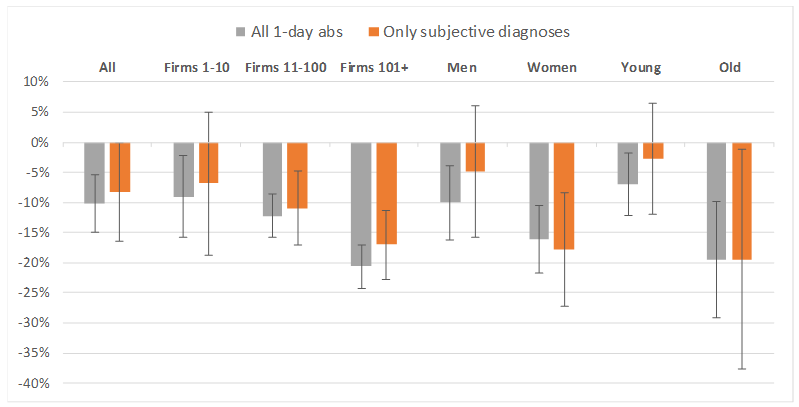
Figure 1: Estimated differences in sickness rates on bridging days relative to regular Mondays or Fridays (% change)

One possible explanation would be strategic behavior on the part of workers. The obvious advantage of bridging days for planning leisure activities could cause employees to be particularly cautious when calling in sick on such days.

However, since the researchers do not observe differences in absence rate patterns across different types of illnesses, they find it more plausible that lower absences rates are driven by workers using vacation days and employers giving their employees an extra day off on bridging days.
Filed Under: Research Tagged With: absenteeism, employee, employer, sick leave, vacation, workers

How environmental policies affect the labor market

May 27, 2019 by Dajan Baischew

Do environmental regulations actually destroy jobs? Will a cleaner environment improve people’s health, education and performance on the job? These were the key questions discussed at the 7th annual workshop of IZA’s “Environment, Health and Labor Markets” program held in Bonn. The program area focuses on the interaction between the environment and environmental policies with labor markets, health and human capital. Given that many politicians and people around Europe and the rest of the world have remained opposed or skeptical about environmental policies, addressing these highly policy-relevant issues with rigorous empirical research has become ever more important.

Air pollution and human capital formation

In his keynote presentation, Michael Greenstone (University of Chicago) showed that childhood exposure to air pollution has substantial negative consequences not only for people’s health and human capital accumulation in the long run. His research exploits China’s “Huai River Policy”, a natural experiment where the government provided free coal for heating during the winter months, but only north of a geographic line. This policy implies that people born north of the line are exposed to substantially higher levels of air pollution during childhood than those in the south. By comparing adults who were born just north of the line to adults born just south, the results show that the Huai River Policy causes people to get 0.8-1.0 fewer years of education and reduces incomes by 12-21%.

Adverse effects from childhood exposure to pollution on human capital accumulation are not unique to settings like China with extreme levels of air pollution. In her presentation, Claudia Persico (American University) uses data from Florida to compare students attending schools within one mile of a local industrial pollution site that opens or closes to students attending schools between one and two miles away. She finds that being exposed to air pollution is associated with lower test scores, increased likelihood of suspension from school, and increased likelihood that a school’s overall high stakes accountability ranking will drop.

Consequences for cognitive performance

Particulate pollution also affects people’s cognition. Juan Palacios (Maastricht University) presented his work using data on the performance of chess players combined with information on indoor conditions. By using a chess computer to evaluate the quality of moves in tournament games he finds that elevated levels of indoor air pollution substantially increases the probability of making an erroneous move and also increases the magnitude of errors. The impact becomes larger during phases of the game when players are under time pressure.

Against the background of global warming, the effects of rising average temperatures have received a lot of attention in recent research. Joshua Graff-Zivin (UC San Diego) showed that temperature plays an important role in high-stakes cognitive performance. His research uses data from the National College Entrance Examination in China, one of the most important higher education institutions in China. He finds that an increase in temperature decreases the total test score as well as the probability of getting into first-tier universities, which has potentially far-reaching impacts for the careers and lifetime earnings of students.

See the workshop program for a full list of presentations.

Filed Under: IZA News, Research Tagged With: climate change, climate costs, environmental policy, human capital, pollution

Do employee share owners face too much financial risk?

May 16, 2019 by Dajan Baischew

Employee ownership has attracted substantial attention in many countries, and a variety of public policies encourage it.  While employee ownership may help raise company performance along with worker incomes and influence at work, one of the major objections is that workers may face too much risk, by having both their jobs and some of their wealth tied to one company.  This risk is shown especially in the high-profile failure of Enron and the sacrifices made by employees at United Airlines.

Employer stock tends to come on top of other wealth

Assessing risk comprehensively issue requires data not just on individual employee holdings of employer stock, but on how these holdings fit into their family wealth portfolios.  A recent IZA Discussion Paper by Rutgers University economists Douglas L. Kruse, Joseph Blasi, Dan Weltmann, Saehee Kang, Jung Ook Kim and William Castellano provides the first estimates of how employer stock relates to family wealth using data from the 2004-2016 U.S. Survey of Consumer Finances.  They find that 15.3% of families with private-sector employees had employer stock in their portfolio, with a median value of $6,000 and a median percent of family net worth of 3.1%.

Recent theory by Harry Markowitz, who won the Nobel Prize for portfolio theory, concludes that 10-15% of a worker’s wealth portfolio can be prudently invested in employer stock provided the rest of the portfolio is properly diversified.  This study finds that about one in five (19.2%) of the families with employer stock exceed the 15% threshold.  The risk may be overstated, however, given that Markowitz says the 15% threshold pertains to purchased stock and not to stock granted with no sacrifice by the employee, and the data show that employee ownership appears to generally add to, rather than substitute for, other wealth.

Employee owners report higher financial knowledge and risk tolerance

Are employee owners simply more naïve about the risks they face?  The data show that respondents from families with employer stock express greater risk tolerance, have higher self-rated knowledge of personal finances, and are more likely to understand the general value of diversification. The finding that employee owners are more likely to understand the value of diversification, but still invest in employer stock, suggests the relevance of Keynes’ view that investing in a company one knows well may be smarter than investing in diverse companies that one does not know well.

While financial risk does not appear to represent a substantial problem in practice for most employee share owners, a small minority may face excessive risk. The study concludes with approaches to address excessive financial risk in company stock when it appears, including steps that can be taken both by companies and by policy-makers.

Approaches to reduce excessive risk

For example, companies and HR professionals could help employees manage by providing access to financial counseling, so employees can become aware of the risks of overconcentration and will consider their employee ownership in the context of the rest of their family wealth.  A second way for companies to minimize risk is to ensure that employees have access to diversified retirement plans to supplement employee share ownership plans.

Another approach would be to provide financial products, such as a form of pooled equity insurance by companies with employee share ownership, which would compensate employees in failing companies for at least some of their lost employer stock value. This idea is embodied more generally in stock protection funds. These policies could be expanded particularly where employees are purchasing the entire value of the stock with wages or savings.

Filed Under: Research Tagged With: employee ownership, investment, portfolio, risk, stock market

Discrimination in hiring based on presence of children or perceived “risk” of pregnancy

May 12, 2019 by Dajan Baischew

Maternity, and the possibility of maternity, may disadvantage women in the labor market on two fronts: In their fertile age, employers’ may perceive them at “risk” of pregnancy. When children are present, employers may be concerned that due to conventional gender norms, women are more likely to be in charge of childcare than men. This may lead to more frequent absences – for example when children are sick. Both factors potentially affect hiring practices of firms.

To test this, Sascha O. Becker, Ana Fernandes and Doris Weichselbaumer conducted a large-scale correspondence study in Germany, Switzerland, and Austria, sending out nearly 9,000 job applications to full- and part-time vacancies. The researchers indicated the probability of childbearing as well as childcare chores by varying information on marriage, presence of children and age of children, while holding applicant age (30 years) and past work experience constant.

Employers may fear child-related absences

Childless, but married women may be less likely to receive a callback than single women if employers considers them at particular “risk” of becoming pregnant. At the same time, mothers of two young children are more likely to suffer from child-related absences, e.g., due to child sickness, than mothers of two older children. Mothers of older children might therefore receive more callbacks than mothers of young children.

Concerning the difference between candidates applying to full- and part-time jobs the authors hypothesize the following: Applicants to part-time jobs convey a desire to reconcile family duties with work. In contrast, applicants to full-time jobs signal that, independent of their family situation, they “must have” childcare arrangements in place, because otherwise they could not reconcile a full-time job with the logistics of picking up children from kindergarten or school. As a result, one would expect differences in callbacks between mothers of old children vis-à-vis mothers of young children to be more pronounced for part-time work.

Substantial hiring discrimination for part-time jobs

The study finds that for applicants to full-time jobs, fertility-related information actually does not result in different callback rates. Apparently, employers rely on full-time applicants having their family-related issues dealt with. However, in line with the authors’ hypotheses, they find stronger differences looking at applicants to part-time jobs, where there is substantial variation in callback rates. Married, but childless women applying to part-time jobs have the lowest callback rates, and women with two older children the highest.

The gap in callback rates between these two groups is 14 percentage points, which is substantial given average callback rates of 19 percent for part-time jobs. The authors interpret these findings as presence of substantial hiring discrimination based on realized and expected fertility for part-time jobs – a possibly surprising result, given that these jobs are typically meant to be particularly family-friendly.

Filed Under: Research Tagged With: childcare, discrimination, female labor force participation, fertility, gender, hiring, job application

Being bullied in school leads to poorer outcomes later in life

May 10, 2019 by Dajan Baischew

Widespread bullying in schools is an important policy issue as being bullied may lead to long-lasting problems: low self-esteem, mental health conditions and poorer job prospects. Many studies document a negative correlation between bullying and later outcomes. However, there is little evidence available on whether being bullied causes poorer outcomes, and to what extent. Similarly, there is little evidence about the effects of different types and frequencies of bullying.

The causal effects of being bullied are useful to quantify because bullying is amenable to policy intervention. Evidence has shown that anti-bullying programs are effective at reducing the extent of bullying in schools. Therefore, it is important to know the benefits from reducing bullying in schools, to compare with the cost of anti-bullying programs.

A recent IZA paper by Emma Gorman, Colm P. Harmon, Silvia Mendolia, Anita Staneva, and Ian Walker fills this gap by providing new evidence on the consequences of being bullied in schools in England.

Frequency and type of bullying

The researchers used confidential data on over 7,000 school pupils from the Longitudinal Study of Young People in England, aged between 14 and 16 years. About 50% of pupils reported experiencing any type of bullying at this age. The data contained information on how frequently the children were bullied, and what type of bullying they experienced.

Examples include being called names, being excluded from social groups, being threatened with violence, experiencing violence, having their possessions taken off them. This information was reported by both the child and parent, so the researchers could gain a detailed picture of the patterns of bullying.

To isolate the effects of being bullied on later outcomes, rather than other factors, the researchers compared the outcomes from young people who had the same background characteristics, including previous school performance at ages 7 to 11 (Key Stage 2), social background, demographics, and parental attributes.

Higher unemployment, lower income, poorer mental health

The analysis shows that experiencing bullying of any kind has negative consequences for academic achievement in schools. Specifically, being bullied reduced the probability of gaining 5 or more good GCSE passes (at A*-C grades), as well as the probability of staying on to take A-levels, by about 10%.

These negative effects are persistent: Being bullied in school increased the probability of being unemployed at age 25 years by about 30%; reduced income by about 2%; and had a large negative impact on mental health (increasing mental ill-health by about one-third of a standard deviation).

The researchers also found suggestive evidence showing that, while all types of bullying have negative consequences, persistent bullying and violent bullying had greater negative impacts than less frequent or non-violent bullying. Overall, the findings suggest that a targeted approach to reduce more extreme forms of bullying may be warranted.

Filed Under: Research Tagged With: adolescents, bullying, education, outcomes, school, school achievement, unemployment

Children benefit from school construction and conditional cash transfers

May 4, 2019 by Dajan Baischew

The 3rd Annual IZA Workshop on Gender and Family Economics was held jointly with the Adolfo Ibáñez University, Chile, on April 12 – 13, 2019. It was an excellent opportunity for researchers in Central and South America to become familiar with IZA and for the excellent research taking place in Central and South American to be exposed to a wider audience.

Among the many excellent papers, two in particular stood out. Richard Akresh evaluated the long-term impact of one of the largest school construction programs ever that took place in Indonesia in 1973. Exploiting variation across birth cohorts and districts in the number of schools built, the paper shows that education benefits for men and women persisted 43 years after the program. Exposed men are more likely to be formal (and non-agriculture) workers and to migrate. Women are more likely to migrate and have fewer children. The paper also shows evidence for transmission of the education benefits to children, particularly from mothers to daughters.

Florencia Lopez Boo evaluated the impact of a randomly assigned conditional cash transfer in Honduras. The paper shows significant and sizable (0.34 SD) impact of the cash transfer program on cognitive development in children aged 0-60 months. Families that received the “health” transfer, which targeted 0-5-year-old children only, benefited significantly from the program, whereas families receiving the “education” transfer, which targeted 6-18 year-olds, received no benefit. The “health” transfer families were more likely to attend health checkups, which may have induced behavior changes that improved children’s health and cognitive development, including purchasing more nutritious food.

See the workshop program for a full list of presentations.

Filed Under: IZA News, Research Tagged With: cash transfer, child development, cognitive development, familiy economics, gender, school

How day-to-day violence affects children’s educational attainment

April 24, 2019 by Dajan Baischew

After a decade of declining rates of crime and homicides, more recently Brazil has observed a steep increase in violent crime, with more than 60,000 victims of homicides in 2018 alone. Studies have estimated that the economic cost of violence in Brazil corresponds to 5% of the country’s GDP. Yet little is known exposure to day-to-day crime may affect educational outcomes of children. Being exposed to violent crime may cause trauma to children, and the uncertainty associated with observing violent crimes may undermine incentives to invest in human capital.

Estimating the causal effect of exposure to day-to-day violence on educational outcomes, such as test scores, school attendance or dropout is complicated by the fact that the incidence of crime varies with a multitude of socioeconomic characteristics of a neighborhood. Because these characteristics are also reflected in the socioeconomic composition of students in schools in these neighborhoods, it is difficult to determine whether it is the violence level and exposure to crime or some related neighborhood characteristic that is affecting  schooling outcomes. For example, neighborhoods with lower socioeconomic status often register higher crime rates while socioeconomic difficulties may in turn negatively affect schooling performance, which makes it difficult to isolate the effect of violence from other sources of disadvantages.

Crime and violence around schools

In a recent IZA discussion paper, Martin F. Koppensteiner and Lívia Menezes address this difficult empirical exercise by utilizing unusually detailed data on the exact location and timing of crimes in relation to schools and individual ways to school of more than 600,000 primary and secondary school students in the city of São Paulo, Brazil. They estimate the effect of exposure to these homicides on test scores, student and parental reported aspirations, and attitudes towards education.

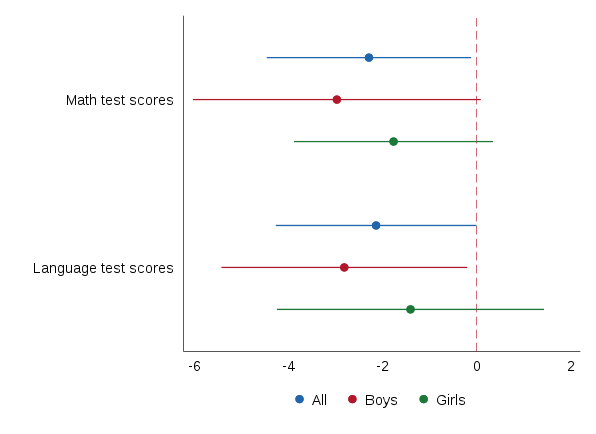
Exposure to violence around the schools leads to a substantial deterioration in the educational performance of school children. The authors estimate that one additional homicide in a 25 meters radius around schools reduces test scores in math and language by about 5% of a standard deviation in test scores. These effects are not short-lived but hold for exposure even more than six months before the test date. They also reduce attendance and increase drop-out. Figure 1 shows that the estimated effects are more pronounced for boys and this pattern is replicated across other outcomes, such as attendance.

Fig. 1: Effect of exposure to homicides around schools on test scores

Lower aspiration towards school after exposure to violence

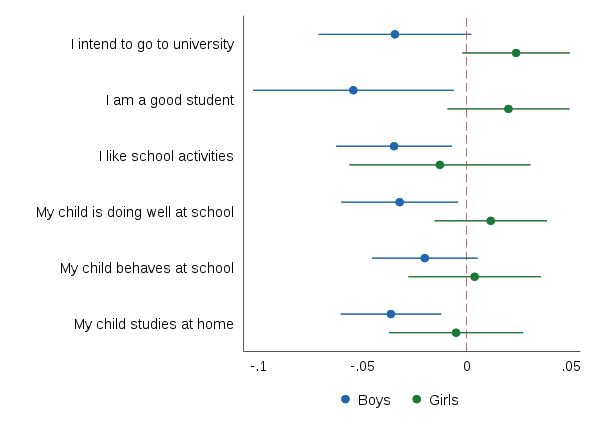
The study also shows that aspirations and attitudes towards education reported by students and their parents are affected by exposure to violence. Again, the effects vary by sex. For example, after exposure to violence, boys are less likely to say that they intend to go to university or that they are good students, and they are overall less interested in school activities. The effects on self-reported attitudes are confirmed by the effect on parental assessment of their children’s attitude towards education.

Fig. 2: Effect of homicides on parent-reported aspirations and attitudes towards education

These results contribute to better estimates of the socioeconomic cost of crime. Exposure to violence negatively affects the educational outcomes of children and hinders their investment in human capital. Given the abundance of violent crime in Brazil, this may reduce later-life opportunities for a large number of children, especially boys.

Filed Under: Research Tagged With: Brazil, crime, educational attainment, human capital, school, violence

Tax incentives for filming do not bolster local economies

April 16, 2019 by Dajan Baischew

Tax incentives for filming and motion picture production have become incredibly popular in the United States, Canada, Europe, and in many other countries. Policymakers have pushed these subsidies to achieve many different goals, such as growing or forming a regional film industry, stimulating the economy through spillover benefits of filming activity, or promoting the region by having it featured on the big screen. A recent IZA Discussion Paper by Patrick Button estimates the impact of State Film Incentives (SFI) in the U.S. and finds that they are ineffective at reaching their primary goals.

Film incentives exploded in the 2000s

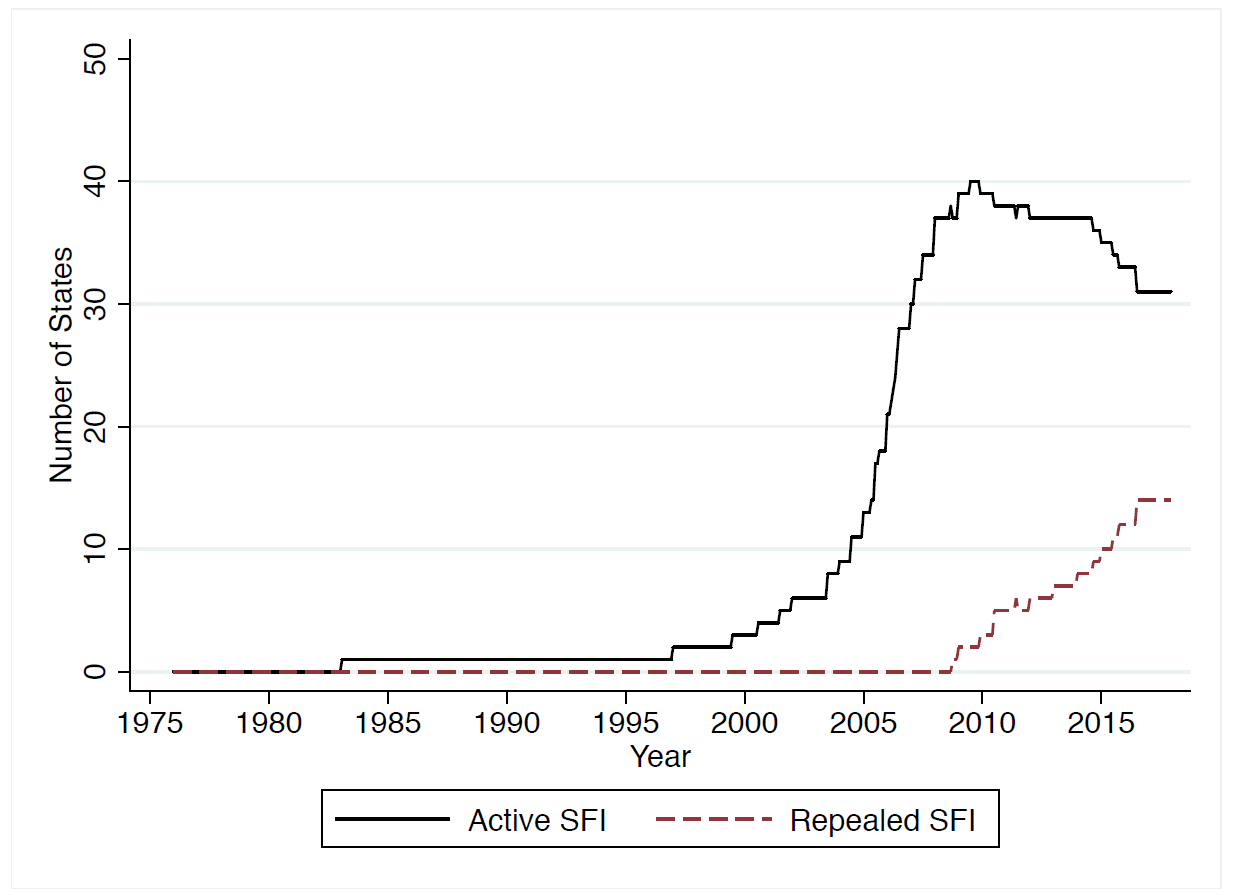
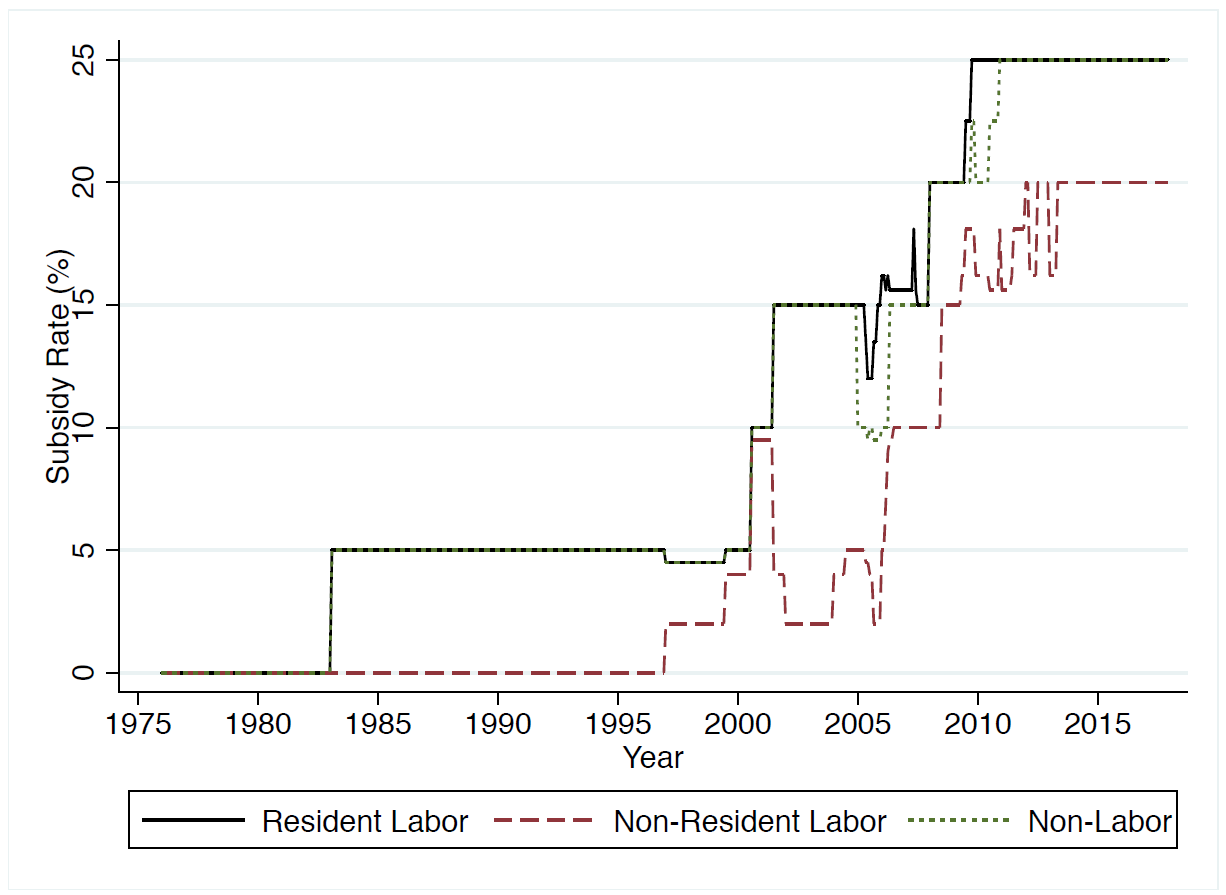
At the U.S. state level, film incentives went from being almost non-existent before the 1990s to peaking at 40 states having an SFI in the late 2000s (Figure 1). Over the same period, states made their SFIs more aggressive, with the average production getting a 20-30% subsidy to their expenditure on filming (Figure 2). These incentives are often more aggressive and widespread than subsidies for other industries, such as for manufacturing or research and development.

Figure 1: Number of U.S. States with an Active or Repealed State Film Incentive (SFI)
Figure 2: Median Subsidy Rates of SFIs over Time, by Categories of Qualified Expenditures

To estimate the effects of SFIs on filming and economic development, Button compares states before and after they adopt SFIs to similar states over the same time period that did not adopt SFIs. The author did legal research to determine what incentives were available in each state over time and combined this with filming location data for TV series and feature films from IMDb and Studio System. To determine the effect on the film industry and related industries (e.g., independent artists, catering, rentals), he uses Quarterly Census of Employment and Wages data for the motion picture production and related industries.

No effect on related industries

The analysis finds that SFIs actually relocate TV series filming: the average SFI-adopting state got between 0.5 and 1.5 TV series per year, which is up to a 56% increase in TV series filming. This effect is concentrated in states with a larger existing industry. However, SFIs had no effect on feature films. This difference is likely because there are large fixed costs to relocating filming and it is easier to absorb these costs for a longer-term and more expensive project like a TV series.

Despite some effects on filming, the study finds no meaningful effect on employment, business establishments, or wages in motion picture production or related industries. SFIs do not create or bolster local film industries beyond getting some TV series filming.

Tax incentives provide little economic stimulus

Button’s research shows that tax incentives are often ineffective at influencing business location and economic development, even in cases such as film tax incentives where the relocation of business activity is easier, and the incentives are aggressive. This suggests that tax incentives may not be a worthwhile tool to try to develop local economies. For film tax incentives specifically, they do not seem to create local industries or lead to much economic stimulus. According to the author, this should prompt policymakers to reconsider costly film tax incentives as they are ineffective at reaching their primary goals.

Filed Under: Research Tagged With: economic development, film industry, local buiness, relocation, subsidies, tax incentives

briq/IZA Workshop on Behavioral Economics of Education

April 15, 2019 by Dajan Baischew

Can behavioral insights be used to shape educational decision-making and student achievement? How should we design education policy, teacher incentives or interventions to address the shortcomings in decision-making by parents, students and teachers? To answer these questions, the briq/IZA Workshop on Behavioral Economics of Education brought together 26 researchers in Bonn to present their work.

Feedback on teacher performance

The first presentation of the workshop ,“Repeated Praise – Evidence from a Field Experiment”, studies how providing teachers with relative performance feedback affects changes in teaching effectiveness. Maria Cotofan shows that teachers who receive repeated recognition of their work become better at preparing students for centralized exams. The study suggests that such feedback could be an effective policy tool to raise student performance.

Mentoring programs for children

The paper “(In)Equality of Opportunity, Mentoring, and Critical Educational Decisions”, presented by Armin Falk, shows that parental education is a key determinant of educational success and that intergenerational educational mobility is particularly low in Germany. According to the study, a one-year child mentoring intervention effectively increases equality of opportunity. Children from disadvantaged family backgrounds especially benefit from the mentoring intervention and become more likely to attend the academic high school track (Gymnasium) in Germany. The paper highlights that educational careers are malleable and that the social environment can have lasting effects on student lives.

Female math teachers as role models

Alex Eble presented his paper “Stereotypes, role models, and the formation of beliefs”, which establishes that girls in Chinese middle schools perform better when having a female math teacher. He shows that this effect can be explained by changes in beliefs and aspirations as well as parental investments. Given that women remain underrepresented in math-intensive subjects, this research suggests that gender equality could be increased by providing girls with same-gender role models.

Filed Under: IZA News, Research Tagged With: behavioral economics, education, inequality, students, teacher

How four-day school weeks affect student achievement

April 11, 2019 by Dajan Baischew

The aftermath of the Great Recession has seen large reductions in school funding, leading to increased financial pressures on many school districts. Due to these financial pressures, school districts have had to find unique ways to reduce costs or increase expenditures.

Traditionally, school districts have dealt with budgetary problems by cutting academic programs, increasing class sizes, reducing staff, and charging student activity fees (e.g., pay-to-play athletics).  As an alternative to these types of cost-cutting measures, some, primarily rural, school districts, have championed four-day school weeks as a way to reduce costs and ease financial pressures.

Like many other cost-cutting policies, the academic implications are of great importance when assessing the overall effectiveness of these types of policies. A new IZA discussion paper by Paul Thompson considers the academic implications of these four-day school weeks and suggests that detrimental effects for student achievement may arise, especially if overall instructional time is not maintained as a result of the switch from five-day to four-day weeks.

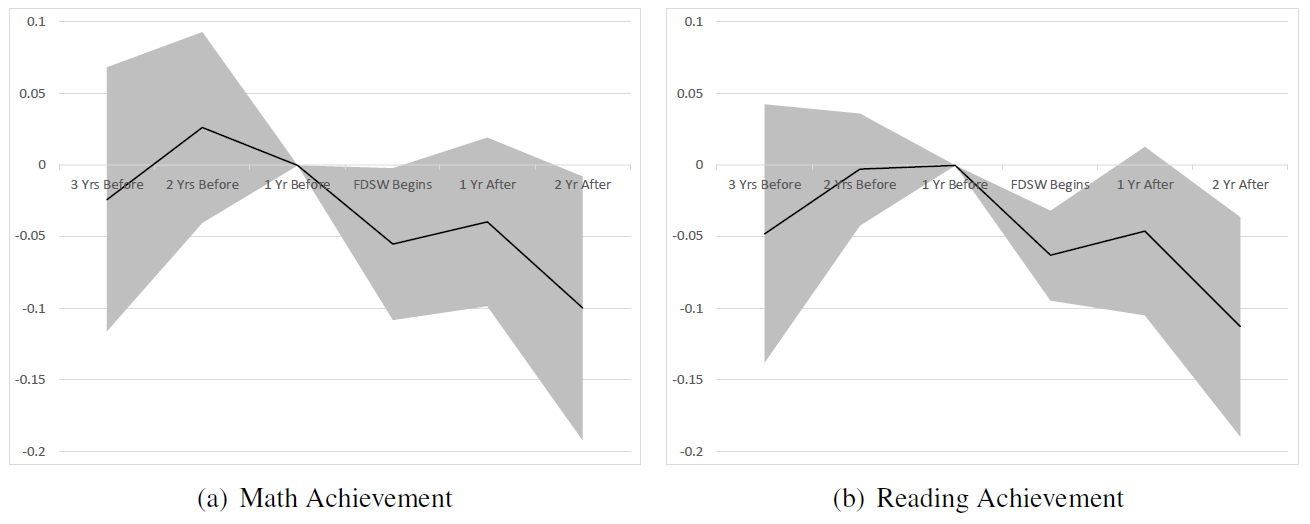
This study analyzes the effects of these school schedules on student achievement and the mechanisms driving these effects using student test score data from 2007-2015 in Oregon.  The analysis finds negative math and reading achievement effects of four-day school weeks, on average, with larger detrimental achievement effects for boys (in math and reading) and low-income students (reading only).

Achievement differences between four-day school weeks (FDSW) and five-day schedules

The study also finds that a substantial portion of these achievement effects can be attributed to early start times and reductions in overall weekly time in school, which falls by about three and a half hours following the switch to the four-day school week.

Filed Under: Research Tagged With: academic achievement, education policy, educational outcomes, math, public spending, reading, school

  • Previous Page
  • Page 1
  • Page 2
  • Page 3
  • Next Page

Primary Sidebar

© 2013–2025 Deutsche Post STIFTUNGImprint | Privacy PolicyIZA