• Skip to primary navigation
  • Skip to content
  • Skip to primary sidebar

IZA Newsroom

IZA – Institute of Labor Economics

  • Home
  • Archive
  • Press Lounge
  • DE
  • EN

Mark Fallak

Minimum wage increases lead to substantial declines in vacancy postings

June 24, 2022 by Mark Fallak

Since the last federal minimum wage increase in the US in 2009, many states have enacted state-level changes to their minimum wage laws. Most recently, on January 1st 2022, twenty states increased their minimum wage, while the US Congress debates a similar federal-level increase. A broad-based minimum wage increase might appear as an attractive labor market policy tool to boost wages and lower poverty among low-wage earners. However, economic theory predicts that, in a competitive labor market, a minimum wage hike might lead to a decline in employment. This issue has motivated a long-lasting, at times contentious, debate in the literature on the effect of minimum wage increase on employment.

In a recent IZA discussion paper, Marianna Kudlyak, Murat Tasci and Didem Tuzemen study the effect of minimum wage increases on vacancies. They combine occupation-specific county-level vacancy data from the Conference Board’s Help Wanted Online at a quarterly frequency with the data on minimum wage changes at the state level. The authors separately estimate the effect of minimum wage increases on existing vacancies (stock) and new vacancies, i.e., less than 30-day old (flow).

Occupations that typically employ lower-educated workers affected most

The study finds a statistically significant and economically sizeable negative effect of the minimum wage increase on vacancies. Specifically, a 10 percent increase in the level of the effective minimum wage reduces the stock of vacancies in at-risk occupations by 2.4 percent and reduces the flow of vacancies in at-risk occupations by about 2.2 percent. At-risk occupations are such occupations with large shares of employed workers at or near the state-level effective minimum wage. Accordingly, vacancies in occupations that typically employ workers with lower educational attainment (high school or less) are affected more negatively than vacancies in other occupations.

So far, most studies have found relatively small or non-existent effects of minimum wage hikes on employment. How can this be reconciled with the findings of the new paper? Vacancies reflect the quantity of labor demanded by firms and serve as one of the adjustment margins that firms can use to reach their optimal level of employment. In contrast, employment is an equilibrium object, determined jointly by labor supply and labor demand; therefore, changes in employment reflect a combination of various margins of adjustment to a policy change.

Minimum wage hike might lead to a decline in turnover

The effect of the minimum wage on hiring is ambiguous because while vacancies decline, job seekers’ input increases—either due to the increase in the number of job seekers or search efficiency. Even though on impact one might expect a higher rate of separations due to the dissolution of some marginal matches, a higher minimum wage forces all new matches to satisfy a higher threshold for productivity. This, in turn, makes these new matches more durable relative to an environment with a lower minimum wage. One implication of this is that a minimum wage hike might lead to a decline in turnover as employees stay longer with one employer but possibly no change in the stock variables such as unemployment and employment.

By analyzing vacancy postings, the authors provide more insight into firms’ behavior as they adjust to minimum wage changes. Understanding these different margins of adjustment may provide more context for policymakers and researchers on the contentious debate of the employment effects of minimum wage increases.

Filed Under: Research Tagged With: hiring, minimum wage, search and matching, vacancies

Minimum wage contributed to rise in solo self-employment

May 23, 2022 by Mark Fallak

The share of “solo self-employed” individuals – those who operate on their own account without any employees – is on the rise in most developed countries. This coincides with a more general trend towards alternative work arrangements, such as agency workers, on-call workers, contract company workers or independent contractors.

Understanding the consequences of this development is important because many of these jobs are characterized by less favorable working conditions. For instance, solo self-employment typically does not offer the same employment protection, social insurance or pension entitlements as dependent employment. Accordingly, solo self-employed individuals share important characteristics with underemployed workers, such as lower earnings and working hours, a higher incidence of part-time and a higher risk of income loss. These atypical jobs may therefore not be entirely voluntary. Yet, little is known about the drivers of such alternative work arrangements, especially the role of policies and regulations.

In a new IZA paper, Angelika Ganserer, Terry Gregory and Ulrich Zierahn investigate the impact of minimum wage policies on solo self-employment. They exploit a quasi-experimental setting: Germany introduced its first minimum wages on an industry level, starting with main construction, roofing, electrical trade, and painting. No other industry was subject to a minimum wage regulation at that time, providing the opportunity to compare a set of treated industries with all other comparable but uncovered industries, using on a long time series of data.

To identify self-employed individuals, defined as firm owners without employees, the authors exploit a micro-level firm data set (Mannheim Enterprise Panel) that comprises the universe of active firms in Germany and contains detailed industry codes for the level on which the first minimum wage regulations were introduced. They match this data with industry-level workforce data prepared from a two percent random sample of all workers in Germany that are subject to social security contributions (i.e., excluding self-employed and public servants).

Strong increase in solo self-employment in German minimum wage industries

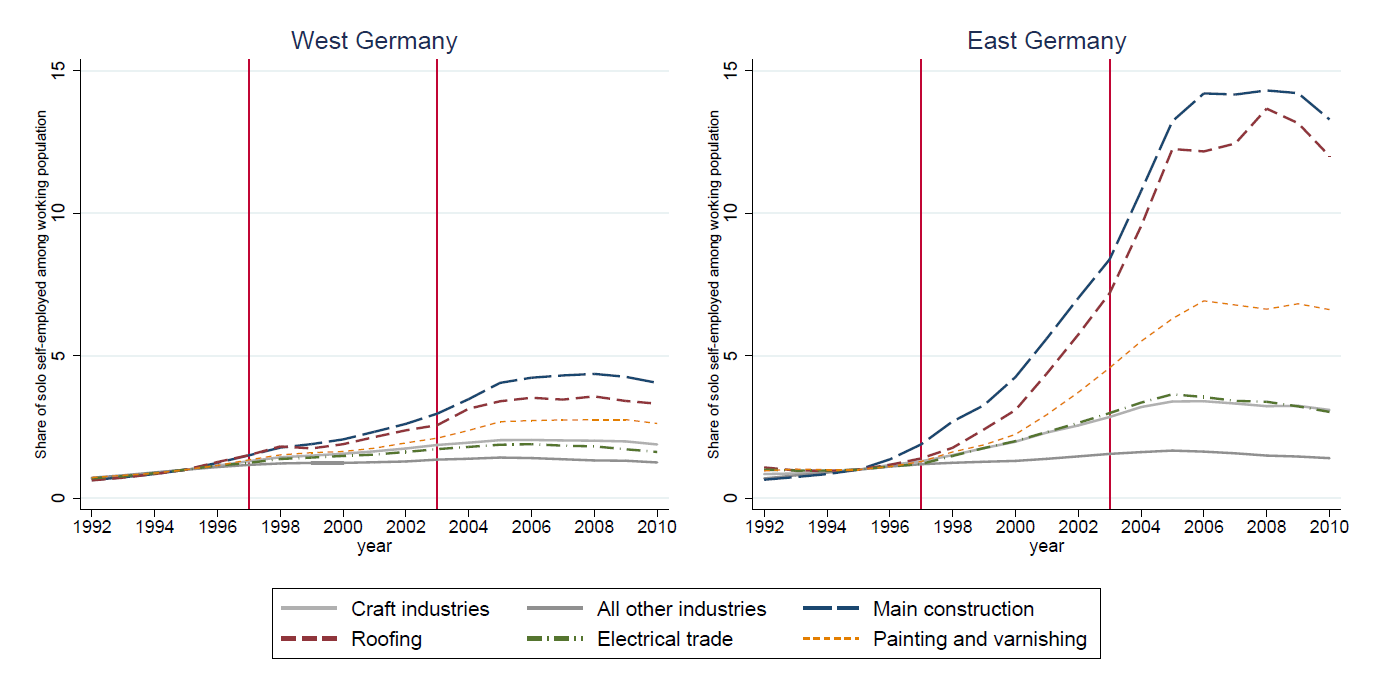
For Germany, the authors find that the share of solo self-employed individuals among the workforce increased from 2.3% to 4.9% during the observed time period 1992-2010. The figure below demonstrates that the increase occurred very heterogeneously across industries and between the eastern and western parts of the country. Most strikingly, the increase was significantly stronger in the minimum wage industries, compared to all other industries.

Trends in Solo Self-Employment

To investigate the causal impact of the policy reform, the authors apply a synthetic control group approach, which allows them to compare a set of treated industries with all other comparable but uncovered industries. The results suggest that the minimum wage induced a substantial increase in solo self-employment: Depending on the industry and region, the first-time adoption of a minimum wage increased the share of solo self-employed individuals between 1.1 and 8.5 percentage points. For some industries, this meant a sixfold increase in solo self-employed individuals compared to pre-treatment years.

High-skilled workers involuntarily search for alternative income sources    

The increase in solo self-employment can be explained by a decline in earnings perspectives of potential solo self-employed (due to the German Meisterzwang, which requires a master craftsman certificate to start an own firm in the industries under study, these comprise only high-skilled workers). In line with a substitution-scale model, the authors show that while the minimum wage induced a substitution of low- by high-skilled workers (positive substitution effect), at the same time all skill groups suffered equally from an overall decrease in labor demand in response to the minimum wage-induced labor cost shock (negative scale effect). As a result, net high-skilled labor demand substantially decreased, pushing them into solo self-employment.

The study indicates that the decision of high-skilled workers to become solo self-employed was not entirely voluntary. The theoretical model suggests that a high minimum wage pushes high-skilled workers with less favorable characteristics into self-employment whenever they face worsening perspectives in dependent employment. In line with this hypothesis, the authors find declining revenues (i.e., incomes) of solo self-employed individuals, especially among those who started their business in reaction to the policy reform. As argued by other studies, this could reflect that firms outsource work by re-grading their employees as independent self-employed contractors or using other alternative work agreements to buffer the cost shock induced by the minimum wage.

How transferable are the results?

Whereas the authors’ study focuses on selective industries in Germany, these effects generally occur whenever the scale effect (overall decline in industry employment) exceeds the substitution effect (substitution towards high-skilled workers in reaction to the change in relative input prices).

Then, high-skilled workers face lower labor demand and become solo self-employed. This can happen, for instance, in situations where the bite of the minimum wage is large or whenever the economy faces a downturn, forcing increases in wages and prices and triggering declines in demand and output.

For instance, the authors show that the magnitude of the effects significantly increases with the size of the Kaitz index (the ratio of the minimum wage to the median wage). At the same time, all industries investigated experienced a long-lasting economic downturn. Another situation that makes such effects likely is when tasks performed by low-skilled workers differ substantially from the tasks performed by high-skilled workers. In such cases, substitution towards high-skilled workers, which generally benefits those workers, becomes less likely.

Finally, it is worth mentioning that in the specific case of Germany, only high-skilled workers can become solo self-employed, due to industry regulations (Meisterzwang). However, even in cases where also low-skilled workers can become solo self-employed, one would expect an increase in solo self-employment, which might even be stronger due to the large decline in demand for those workers.

Filed Under: Research Tagged With: Germany, minimum wages, solo self-employment, synthetic control method

Employer market power in Silicon Valley

May 17, 2022 by Mark Fallak

“We rarely hear… of the combinations of masters, though frequently of those of workmen,” writes Adam Smith, “But whoever imagines… that masters rarely combine [to lower wages], is as ignorant of the world as of the subject.” Today such behavior is difficult to study because it is typically illegal, giving firms powerful incentives to hide it from both government officials and researchers. In a recent IZA working paper, Matthew Gibson studies the 2005–2009 “no-poach” agreements among Silicon Valley technology firms, which provide a rare opportunity to examine the clandestine exercise of employer market power.

Illegal agreements

The following firms were party to at least one no-poach agreement: Adobe, Apple, eBay, Google, Intel, Intuit, Lucasfilm and Pixar. Concluded at the highest levels of management, including boards and CEOs, the agreements prohibited participating firms from recruiting or hiring each other’s employees. Prompted by a whistleblower, a US Department of Justice (DOJ) investigation began to unravel the no-poach agreements in early 2009. National media revealed the antitrust investigation on June 3, 2009 and the DOJ filed its civil complaint in US v. Adobe Systems on Sept. 24, 2010. This was followed by a civil class action in 2011, with settlements in 2015 and 2018.

Primary findings

By comparing employees at colluding firms to others in the tech sector, before and after the no-poach agreements dissolved, the paper estimates effects on salaries, stock bonuses, and ratings of job satisfaction. This research design relies on the plausibly random timing of the DOJ investigation, which forced defendant firms to end the agreements. The study’s findings are important because the information technology sector is a large and growing part of the US economy. From 1997 to 2019, value added in this sector rose from $232 billion to $1.7 trillion. These findings may assume more general significance because recent evidence suggests growing scope for employer market power in the US. Workers in a majority of US occupations face labor markets that are “highly concentrated” under DOJ guidelines.

The paper’s primary data come from Glassdoor, an online aggregator of wage and salary reports from workers. Reports cover employer, work location, job, salary, and years of experience. Some users report non-salary compensation variables, including stock and cash bonuses. The paper finds that the no-poach agreements reduced salaries at colluding firms by approximately 4.8 percent on average. Salaries rose following the abandonment of the agreements in 2009, converging to non-colluding comparison firms like Amazon and Microsoft by 2012. Glassdoor data on non-salary compensation are much less complete, but the study estimates that stock bonuses were approximately 48 percent lower during the no-poach agreements.

Significance and worker losses

The author argues that the magnitude of these no-poach effects is striking because affected workers are well educated and highly paid. Thirty-one percent have a graduate degree and the average salary is $93,158 (2009 US$). One might expect these characteristics to make them less vulnerable than other workers to employer market power.

The study approximates worker losses based on salary alone. According to the plaintiffs’ expert report from the class action, affected earnings were $52 billion. Earnings in the absence of the agreements would then have been $54.56bn and worker losses were $2.56bn. The author contends this estimate should be viewed as a floor. It excludes not only non-salary compensation, but also additional job search costs incurred by affected workers. Even ignoring such omissions, this damage estimate is substantially greater than the $435 million the defendants paid to settle the case. This gap raises the question of whether civil penalties will meaningfully deter future exercise of employer market power in the US.

Filed Under: Research Tagged With: collusion, employer market power, labor earnings, monopsony, no-poach agreements, oligopsony, Silicon Valley

MIT economist Simon Jäger to become CEO of IZA in September

May 11, 2022 by Mark Fallak

Simon Jäger, labor economist at the Massachusetts Institute of Technology, has been appointed to become the CEO of IZA as of September 2022. He will take over this position from Hilmar Schneider, who has successfully managed and expanded IZA’s activities in labor economics research and evidence-based policy advice for past six years, and will leave the institute at the end of May.

After studying economics at the University of Bonn and the University of California, Berkeley, Simon Jäger graduated with a PhD in economics from Harvard University. His dissertation was awarded the W.E. Upjohn Institute Dissertation Award’s First Prize and Harvard University’s David A. Wells Prize for the best dissertation in economics, and he was recently awarded a Sloan Research Fellowship. He is currently an Assistant Professor of Economics (Associate Professor as of July 2022) at MIT and an NBER Faculty Research Fellow.

He works on such topics as competition in the labor market, unions and other forms of worker representation, unemployment, and the role of psychological factors in the labor market. One line of his work has studied the causal effects of giving workers the right to participate in their firm’s decision-making and electing employee board representatives on outcomes such as productivity and wages.

Some of his recent work sheds light on how workers’ misperceptions about wages they could earn elsewhere give rise to firms’ market power to set lower wages and sustain a low-wage sector in the labor market. Methodologically, his research combines experimental and quasi-experimental methods with large administrative data sets, for example from Germany, Finland or Argentina.

Since 2009, Simon Jäger has been a member of the IZA network with now over 1,800 scholars worldwide. With the MIT economist’s appointment as CEO, IZA aims to further strengthen its international reputation as a leading center for research in labor economics. Professor Jäger will be on leave from MIT. His affiliation with the University of Bonn is planned.

Filed Under: IZA News Tagged With: CEO, IZA, MIT

How attractive is telework?

March 31, 2022 by Mark Fallak

COVID-19 has made telework an integral part of many people’s daily lives. Many employers are currently wondering to what extent they should keep offering the option to work from home in the post-pandemic future – and how to compensate workers if they cannot offer this option.

Unfortunately, when it comes to the attractiveness of telework, employers cannot rely on existing global scientific findings as they are not specific or causally interpretable. A new IZA discussion paper by Eline Moens, Stijn Baert, Elsy Verhofstadt and Luc Van Ootegem therefore aims to provide answers to the questions: How much pay are people prepared to give up for more telework? What type of employees are attracted to telework? And why?

The Ghent University researchers had a representative sample of 500 Flemish employees participate in an experiment in which they had to evaluate job offers, with respect to general attractiveness and other job perceptions. These offers differed in several respects, including pay and the degree of teleworking offered.

Is a job offer with more telework more attractive?

The study shows that a job with more telework opportunities is perceived as more attractive. If the number of possible teleworking hours increases by 10 percentage points, for example from 20% (one day in a full-time week) to 30% (one and a half days), people are satisfied with 2.3 percentage points less pay increase.

A full-time employee appreciates one extra day of teleworking almost as much as a 5 percentage points higher pay raise in the new job. In other words, if in a new job the salary would normally increase by 10%, an increase of only 5% would be just as acceptable if the difference is offset by an extra day of teleworking.

The study is the first to demonstrate that the link between telework opportunities and job attraction is more or less linear: each (half) day of more telework opportunity leads to more attraction to the job. So there is no ceiling above which more teleworking opportunities are no longer seen as extra attractive.

Why is teleworking so attractive?

The attractiveness of teleworking is explained in particular by expectations of a better work-life balance, more autonomy in terms of work planning and more autonomy in terms of work methods in jobs with more teleworking opportunities.

The authors thus suggest that in jobs where telework is less feasible, it is particularly important that employers communicate their efforts to facilitate work-life balance, work-planning autonomy, work-method autonomy and decision-making autonomy.

However, the researchers also put forward a negative expectation in connection with increased teleworking opportunities, namely in terms of the quality of the relationship with colleagues.

Who appreciates telework more?

The research also shows that employees who are more conscientious are generally less attracted to better telework opportunities. A possible explanation for this finding is that in some jobs it is not possible to perform tasks from home as efficiently as from the central work location, so more dutiful employees may find teleworking less attractive.

According to the authors, employers should thus keep a close eye on the self-selection of less conscientious employees into jobs with more telework to avoid lower productivity.

Filed Under: Research Tagged With: Belgium, job attractiveness, pay, telework

How COVID-19 affects educational choices in high school

March 29, 2022 by Mark Fallak

The economic disruptions caused by the COVID-19 pandemic had a particularly negative impact on sectors that typically employ many young people. Earlier research suggests that young people adjust their educational choices in response to worsening labor market prospects: During downturns, more students enroll in university studies and choose fields of study with more secure labor market prospects.  In contrast, there is little evidence on how economic disruptions affect field-of-study choices at the high school level despite the fact that high-school major choices can have important consequences for future labor market outcomes.

In a recent IZA discussion paper, Aino-Maija Aalto, Dagmar Müller and J. Lucas Tilley analyze whether high school applicants responded to the COVID-19 crisis by adjusting their field-of-study choices. The authors focus on Sweden, where high school applicants choose between different academic (Humanities, Natural Science, etc.) and vocational (Child & Recreation, Hotel & Restaurant, etc.) programs, but similar field-of-study choices are made by the majority of high school students in Europe.

In Sweden, the admission process consists of a preliminary round in which applicants initially rank programs in order of preference and a final round in which they can alter their preliminary rankings. In 2020, the timing of the two rounds happened to provide unique pre- and post-crisis snapshots of the field-of-study choices of high school applicants.

In order to conduct their study, the authors contacted local admission centers and obtained school-level information on the number of top-ranked applications to each specific program for both admission rounds. The self-collected data includes information on field-of-study choices for the years 2016-2020 and covers more than 90% of applicants. By comparing the difference in top-ranked applications between the preliminary and final application rounds with the same difference in previous years, the results are less likely to be caused by other factors besides the pandemic that could affect program choices.

The authors find that the COVID-19 pandemic did not affect demand for academic programs but led to a decline in top-ranked applications to several vocational programs. The declines in demand are most pronounced for several service-oriented programs, in particular those related to the hotel and restaurant sector, which was the most adversely affected industry during the crisis. Demand for these programs decreased by 8% during the first year of the pandemic. This finding suggests that labor market considerations influence the study choices made by relatively young students.

Filed Under: Research Tagged With: career, COVID-19, education, field of study, high school

Cooperation of BIBB and IZA facilitates research data access

March 9, 2022 by Mark Fallak

Researchers who deal with issues relating to the acquisition and utilization of professional knowledge and skills can now analyze research data from the Federal Institute for Vocational Education and Training (BIBB) using controlled remote computing, i.e. without having to visit the BIBB premises. This is made possible by JoSuA (Job Submission Application), a software developed at IZA’s research data center (IDSC).

Empirical economic and social research relies to a large extent on datasets that are subject to strict data protection and data security requirements. Working with such data is often only possible using secure guest workstations at the location of the data provider. This time-consuming process has been made even more difficult by travel and contact restrictions due to the pandemic.

At the same time, the COVID-19 crisis has accelerated structural changes in the labor market, which call for more research in the field of vocational education and training. The implementation of JoSuA now enables the BIBB, whose data is particularly relevant for research in this field, to accommodate this growing demand.

JoSuA is a flexible instrument for data analysis that can be adapted to the data security regulations of the respective data provider and is easily scalable. Making this service now also available at the BIBB (free of charge for scientific research purposes) will further strengthen the evaluation of research data for labor market and vocational research, particularly on education and training.

More information:

  • IZA/BIBB press release (in German), March 9, 2022
  • Details on the BIBB research data and terms of use
  • JoSuA (Job Submission Application) in the BIBB-FDZ
  • JoSuA homepage

Filed Under: IZA News Tagged With: BIBB, IDSC, JoSuA, research data

New book on labor markets in low-income countries

February 9, 2022 by Mark Fallak

To improve knowledge on labor market issues in the world’s poorest regions, IZA has been collaborating closely for many years with the UK Foreign, Commonwealth & Development Office (FCDO) on the “Growth, Gender, and Labour Markets in Low-Income Countries” (G²LM|LIC) research initiative. The goal is to provide a solid basis for capacity building and development of future labor market policies.

Based on numerous studies and policy recommendations that have emerged from this initiative, the program’s founding director David Lam and IZA’s deputy program director Ahmed Elsayed have now published a book on Labour Markets in Low-Income Countries: Challenges and Opportunities.

Covering such topics as poverty, informality and rural labor, skills training and behavior, gender inequality, youth and child labor, and migration, the book presents key takeaways from the latest research in the field.

Which development policies will work, which strategies are likely to fail? Drawing on the results of new evaluation studies, the authors provide an in-depth discussion of current development programs and derive important policy lessons. The volume is available free of charge as an open-access publication for non-commercial use.

On February 23, core findings of the book will be discussed by invited experts during an online book presentation [register as a guest here].

Filed Under: IZA News, Research Tagged With: Development, growth, labor markets, low-income countries

IZA promotes innovative research in the economics of climate change

February 3, 2022 by Mark Fallak

To foster research into the nature and implications of climate change, IZA has established an award for “Innovative Research in the Economics of Climate Change” (IRECC) given for the two best topical IZA Discussion Papers of the previous year. Worth 10,000 euros, the IRECC Award recognizes important new insights into the broader, often underestimated consequences of climate change and the effects of environmental policies on society and the labor market.

These two papers have been selected for the 2022 IRECC Award:

  • “Temperature, Workplace Safety, and Labor Market Inequality” (IZA DP No. 14560) by Jisung Park, Nora Pankratz and Patrick Behrer illustrates that rising temperatures increase the risk of work injuries at both outdoor and indoor workplaces. Since low-wage earners are disproportionately affected, this may also exacerbate income inequality. This is a prime example of unexpected secondary effects of climate change that deserve further investigation. Assessing the welfare cost of climate change is only at the beginning and needs a lot of further development. [more about this paper]
  • “Fighting Climate Change: The Role of Norms, Preferences, and Moral Values” (IZA DP 14518) by Peter Andre, Teodora Boneva, Felix Chopra, Armin Falk addresses the role of social norms, individual preferences, and moral views in fighting climate change. The remarkable key finding of this experimental study: Many people contribute little to climate protection because they underestimate the willingness of others to fight global warming. Providing information on prevalent climate norms raises support for climate-friendly policies, particularly among climate-change skeptics. Without a doubt, these are highly relevant findings for policy making. [more about this paper]

The inaugural IRECC winners “represent the best of modern applied-economics research,” according to the award committee made up of Susana Ferreira (University of Georgia), Andrew Oswald (committee chair; IZA and University of Warwick) and Hilmar Schneider (CEO of IZA).

All climate-related IZA discussion papers submitted in 2022 will qualify for the second IRECC award, to be given in early 2023.

Filed Under: IZA News Tagged With: climate change, IRECC

How people’s feelings evolved during the pandemic

January 24, 2022 by Mark Fallak

The COVID-19 pandemic and the fight to contain it have had widespread large effects on individual well-being, but the channels are less clear. Was the incidence and fear of infection more impactful, or the consequences of containment policies? Perhaps the pandemic, in which everyone is at risk, engendered a positive sense of solidarity. How resilient were we – were the impacts lasting? To answer these questions, a recent IZA discussion paper by Francesco Sarracino, Talita Greyling, Kelsey O’Connor, Chiara Peroni and Stephanie Rossouw describes the changes in well-being that occurred throughout 2020 in ten mostly European countries.

The authors first computed a real-time measure of well-being referred to as Gross National Happiness (GNH) using tweets as they are posted. Compared to the snapshots provided by surveys, data from Twitter reveal a much more varied picture. Tweets provide a wealth of information that can be transformed into usable data using sentiment analysis – an automated process that uses natural language processing to determine the feelings and attitudes of a written text’s author.

Sentiment analysis has been used by many researchers, for instance, to predict future events, such as the result of elections or stock markets, to track the influenza rate, and to measure people’s well-being. Using this process to derive the sentiment of each tweet, the authors calculate GNH as the average sentiment expressed in a country during a particular day. They focus on seven European countries: Belgium, France, Germany, Italy, Luxembourg, Spain and the United Kingdom.

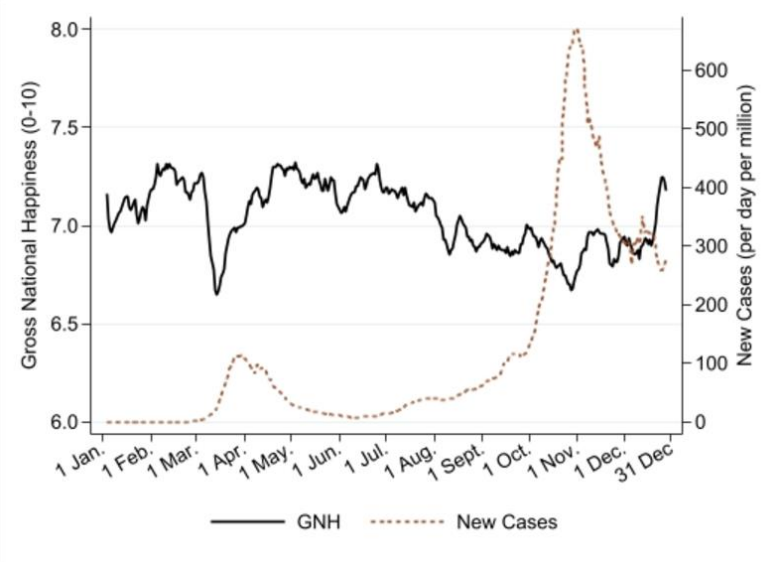
The paper finds that well-being declined dramatically at the onset of the pandemic in March 2020. The initial decline in GNH is partially explained by the exponential rise in confirmed COVID-19 cases (left figure) and severe containment policies (right figure) that were implemented in mid-March. After the initial shock, shortly before the peak of the first wave, well-being began to recover, reaching pre-pandemic levels by the end of April. In mid-year, as cases started to slowly climb again, well-being slowly declined, reaching another minimum at the end October, which corresponds with another peak in cases.

Beyond these observations, regression analysis suggests well-being declined as a result of COVID-19 cases and containment policies, and between the two, cases had a more robust negative impact throughout 2020. The regression results also show that economic fear, trust in national institutions, and loneliness were not significantly associated with GNH. This puzzling finding could indicate that health and lockdown concerns dominated individuals’ mood during the pandemic.

While GNH, like any indicator, has its limitations and may not fully capture country-specific aspects differences or long-run impacts, various tests conducted by the authors suggest that it does serve as a valid and reliable measure of well-being. A key finding from this analysis is how quickly people recovered during the first wave. Real harm was caused to mental and physical health, but people also revealed significant resilience.

Filed Under: Research Tagged With: COVID-19, Europe, sentiment, twitter, well-being

  • Previous Page
  • Page 1
  • …
  • Page 13
  • Page 14
  • Page 15
  • Page 16
  • Page 17
  • …
  • Page 30
  • Next Page

Primary Sidebar

© 2013–2025 Deutsche Post STIFTUNGImprint | Privacy PolicyIZA