• Skip to primary navigation
  • Skip to content
  • Skip to primary sidebar

IZA Newsroom

IZA – Institute of Labor Economics

  • Home
  • Archive
  • Press Lounge
  • DE
  • EN

Challenging the use of the twin instrument in the social sciences

October 11, 2018 by Mark Fallak

By Sonia Bhalotra and Damian Clarke

Twins have intrigued humankind for more than a century. Twins are not as rare as we may think: 1 in 80 live births and hence 1 in 40 newborns is a twin, and the trend is upward. In behavioral genetics, demography and psychology, monozygotic twins are studied to assess the importance of nurture relative to nature. In the social sciences, twin births are also used to denote an unexpected increase in family size which assists causal identification of the impact of fertility on investments in children and on women’s labor supply. A premise of studies that use twin differences or the twin instrument is that twin births are quasi-random and have no direct impact (except through fertility) on the outcome under study.

Our recent IZA discussion paper (forthcoming in the Review of Economics and Statistics) presents new population-level evidence that challenges this premise. Using almost 17 million births in 72 countries, we show that the likelihood of a twin birth varies systematically with maternal condition. In particular, our estimates establish that mothers of twins are selectively healthy. We document that this association is meaningfully large, and widespread- that it is evident in richer and poorer countries, and that it holds for sixteen different markers of maternal condition including health stocks and health conditions prior to pregnancy (height, obesity, diabetes, hypertension, asthma, kidney disease, smoking), exposure to unexpected stress in pregnancy, and measures of the availability of medical professionals and prenatal care.

We also show that a positive association of the chances of having twins with health-related behaviors in pregnancy (healthy diet, smoking, alcohol, drug consumption), although we do not rely upon this because behaviors in pregnancy may reflect a response to the mother’s knowledge that she is carrying twins.

Differences between mothers of twins and singletons

Previous research has documented that twins have different endowments from singletons, for example, twins are more likely to have low birth weight and congenital anomalies. We focus not on differences between twins and singletons but rather on differences between mothers of twins and singletons, which indicate whether occurrence of twin births is quasi-random. It is known that twin births are not strictly random, occurring more frequently among older mothers, at higher parity and in certain races and ethnicities, but as these variables are typically observable, they can be adjusted for. Similarly, it is well-documented that women using artificial reproductive technologies (ART) are more likely to give birth to twins but ART-use is recorded in many birth registries, and so it can be controlled for and a conditional randomness assumption upheld.

The reason that our finding is potentially a major challenge is that maternal condition is multi-dimensional and almost impossible to fully measure and adjust for. To take a few examples, fetal health is potentially a function of whether pregnant women skip breakfast, whether they suffer bereavement in pregnancy,  or exposure to air pollution.

Our underlying hypothesis is that twins are more demanding of maternal resources than singletons and, as a result, conditions that challenge maternal health are more likely to result in miscarriage of twins than of singletons. We discuss the role of alternative mechanisms including non-random conception and maternal survival selection. We provide evidence in favor of the selective miscarriage mechanism using US Vital Statistics data for 14 to 16 million births.

Selective miscarriage is similarly the mechanism behind the stylized fact that weaker maternal condition is associated with a lower probability of male birth. We confirm this in our data, showing that twin births are more likely to be female.

Controlling for maternal health conditions

Our findings add a novel twist to a recent literature documenting that a mother’s health and her environmental exposure to nutritional or other stresses during pregnancy influence birth outcomes, with many studies documenting lower birth weight. If birth weight is the intensive margin, we may think of miscarriage as an extensive margin response, or the limiting case of low birth weight.

Our findings have implications for research that has exploited the assumed randomness of twin births. No previous study has attempted to control for maternal health conditions or behaviors. Studies using twins to isolate exogenous variation in fertility will tend to under-estimate the impact of fertility on parental investments in children, and on women’s labor supply if selectively healthy mothers invest more in children post-birth, and are more likely to participate in the labor market.

This is pertinent as it could resolve the ambiguity of the available evidence on the impacts of fertility. In particular, recent studies using the twin instrument challenge a long-standing theoretical prior in rejecting the presence of a quantity-quality (QQ) fertility trade-off in developed countries, but our estimates suggest that this rejection could in principle arise from ignoring the positive selection of women into twin birth. Similarly, research using the twin instrument tends to find that additional children have relatively little influence on women’s labor force participation. But, again, these estimates are likely to be downward biased.

The results of studies in Economics, Psychology, Education and Biology that instead exploit the genetic similarity of twins will not be biased but will tend to have more restricted external validity than previously assumed.
Filed Under: Opinion, Research Tagged With: fertilty, maternal health, natural experiment, randomness, social sciences, twin instrument, twins, validity

Britain’s got talent

August 7, 2018 by admin

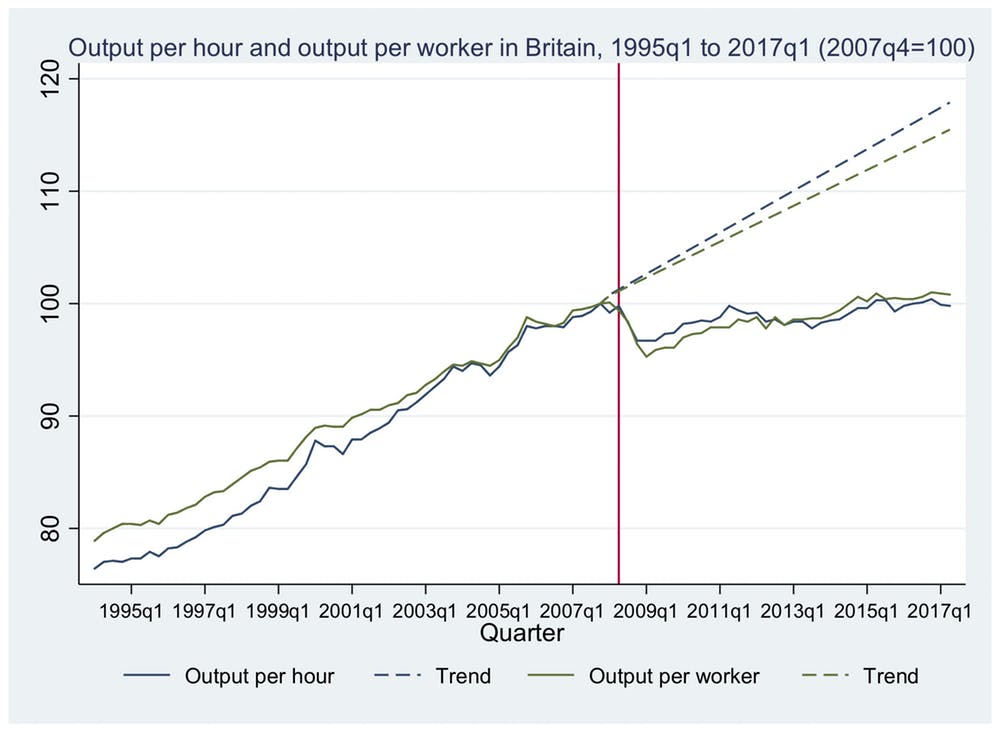
Productivity growth in the UK has conspicuously lagged behind that of other G7 nations since the global financial crisis. The latest quarterly figures perpetuate what has come to be known as Britain’s “productivity puzzle”.

This flatlining of productivity has been unprecedented in the post-war era. Productivity (which measures output per hour and/or output per worker) would have been 16% higher by 2015 if the pre-recession level of productivity had been maintained. That this productivity slump has endured well beyond the financial crisis has become a major policy concern given that the pace of productivity growth determines a nation’s material well-being.

Meanwhile, efforts to jolt the patient back to life have taken on an especially urgent air in the face of Brexit. The fear of a “talent exodus” in the wake of Britain’s withdrawal from the EU, coupled with a possible restriction on migrant flows and the impact this might have on business, has set alarm bells ringing.

So, too, have the reality of accelerated technological change and the consequent potential mismatch between the skills that employees possess today and the skills that they are likely to need in the future. Small wonder that every major political party has called for better training and an improvement in the skills of the UK’s existing workforce. It is well established that an improvement in skills helps boost productivity.

Britain’s flatlining productivity. Getinet Haile | Data: ONS

But how is this upskilling best achieved? Government-backed efforts currently revolve around the Investors in People standard, which is a benchmark for good training and staff development in organisations. Companies that sign up to the initiative and meet its guidelines are rewarded with an accreditation.

With Brexit on the horizon and the productivity puzzle persisting, we seem to be rapidly nearing the point at which the effectiveness of this voluntary scheme is called into question or requires further investment.

Embracing the upskilling effort

The Investors in People initiative has assisted thousands of businesses since its launch in 1991 – more than 10,000 over the last 27 years. And my recent IZA discussion paper looking at its effectiveness shows that it brings businesses genuine benefits in terms of workforce upskilling – and so also benefits the wider economy.

I examined data from the Workplace Employment Relations Survey, a national survey of all UK businesses with five or more employees, which gives a comprehensive picture of organisations’ attitudes to workforce training. The data include responses to questions related to different aspects of on-the-job training, such as computing, teamwork, leadership, problem solving and customer service. Analysing these and focusing on almost 900 panel organisations in the 2004 and 2011 surveys, there was a clear and positive link between the Investors in People accreditation and upskilling in the private sector.

This is solid evidence that the initiative is effective. In particular, it was linked with helping organisations train staff in soft skills such as teamwork and communication and more practical ways of boosting productivity such as computer training and operating new equipment.

On-the-job training, at least in the short term, is therefore one of the most plausible policy tools available for overcoming the UK’s poor productivity growth, preparing for a challenging Brexit and the growing skills shortage that this could exacerbate.

Upscaling upskilling

Despite the clear success of the Investors in People initiative and the number of businesses it has helped, logic alone dictates that many thousands more have had nothing to do with it. The number of UK small and medium-sized enterprises (SMEs) alone is thought to be more than five million.

The idea of making the Investors in People and similar initiatives compulsory sounds impractical – accommodating five million accreditation-seeking businesses seems fanciful. But with pressure to improve the skills of the UK’s existing workforce never so intense, there’s a need to ensure upskilling takes place on a truly significant scale.

Upskilling initiatives will not entirely solve the productivity puzzle. But it is a good start and best applied to the private sector. The public sector, which includes the NHS, consumes a significant amount of public resources and yet struggles to meet the demand for its services. It is in desperate need of a productivity boost, particularly given its reliance on EU workers. Yet, my research found that the Investors in People accreditation was not as effective in improving skills in the public sector. It may therefore need its own specially-designed upskilling programme.

Needless to say, solving the UK’s productivity puzzle is a daunting prospect. But the evidence around upskilling shows that at least some of the country’s problems can be fixed through rolling out more training programmes. The talent is there. It needs to be better developed.

Note: This article was originally published on The Conversation. Read the original article.The Conversation

Filed Under: Opinion, Research Tagged With: human resources, job skills, productivity, skills, skills gap, UK, workforce

Can foreign aid reduce emigration?

July 2, 2018 by admin

Politicians in Europe and the United States alike have issued an urgent mandate to their respective national development agencies – focus on deterring migration from poor countries.

The EU has pledged €3 billion to combat the so-called “root causes” of destabilization, forced displacement and irregular migration from Africa. The U.S. government has similarly poured hundreds of millions of dollars into addressing the key drivers of unaccompanied, undocumented child migration from Central America.

For such efforts to succeed, two outcomes are required: First, foreign aid must substantially change the economic and social conditions in migrant origin countries, and second, such change must cause fewer people to move.

It is not enough for these aid funds to target development outcomes which could shape migration in principle. Aid must also affect the desired in-country outcomes to a sufficient extent to deter future emigration.

The scientific evidence on whether foreign aid has deterred emigration from poor countries in the past is sobering.

The first key question is as follows: How long might it take for a now-poor country to develop to the point where emigration begins to fall?

The result may be shocking: almost 200 years, at the average historical growth rate. Emigration is unlikely to systematically decrease until countries reach a per capita GDP of about 8,000 to 10,000 U.S. dollars at purchasing power parity.

And even if one were to assume very optimistically that development aid could raise growth rates by two percentage points – a tripling of the current rate – reaching this point would still take half a century.

But it is far from clear whether such growth is feasible. Many rigorous studies fail to detect any growth effect of aid. And even if aid could plausibly achieve desired growth outcomes, it would require aid agencies to spend drastically more money on such projects.

It is similarly unclear whether foreign aid can positively impact youth employment, conflict prevention, and human rights. While some programs have had small positive effects, it remains ambiguous whether such interventions can be sustainably scaled for broader impact.

This is not to say that aid cannot affect conditions in major migrant origin countries in future. But, based on our research, there is one clear implication: Aid would need to be implemented in previously unprecedented ways, at much higher levels of funding and over generations, in order to sufficiently affect major drivers of migration.

The second key question is: how does migration behavior respond to these outcomes? Does development – better incomes, health, and education – lead to decreased emigration?

The evidence here shows that emigration from middle-income countries is typically much higher than from poor countries. Specifically, 67 of the 71 countries that grew to middle-income status over the past 50 years also saw increased emigration rates.

This suggests that a higher level of development actually does more to encourage migration in the poorest contexts than to stem it.

The main political implication of these findings is equally clear: Western politicians currently issuing public appeals to address the root causes of migration must resist the temptation to oversell the – at least implicit – promise they are making to their electorates. More and/or better focused aid is not likely to deter migration from poor countries.

Under the best of circumstances, assuming elevated funding and a singular commitment by all parties to make development aid effective this time around, it will take generations for this effect to set in.

These findings suggest one key lesson for policymakers: Aid efforts aimed at shaping migration must look beyond deterrence. Demographic realities imply that large-scale migration will continue in some form for the foreseeable future.

While traditional aid programming and interdiction are unlikely to deter the majority of these flows, aid agencies seeking to shape future migration flows should instead focus on cooperation with migrant-origin countries to shape how migration occurs, maximizing its potential benefits for everyone involved.

Filed Under: Opinion Tagged With: Africa, aid, Development, GDP, growth, migration, refugees, root causes, youth unemployment

‘Dreamers’ could give US economy – and even American workers – a boost

January 24, 2018 by admin

By Amy Hsin (City University of New York)

Earlier this month, hopes were high that a bipartisan deal could be reached to resolve the fate of the “Dreamers,” the millions of undocumented youth who were brought to the U.S. as children.

Those hopes all but vanished on Jan. 11 as President Donald Trump aligned himself with hard-line anti-immigration advocates within the GOP and struck down bipartisan attempts to reach a resolution.

Demonstrators chant slogans during an immigration rally in support of DACA. AP Photo/Jose Luis Magana

In the final hours before the recent government shutdown, many Democrats were insisting that any short-term funding agreement must include a resolution for Dreamers.

One of the arguments advanced by those who oppose giving them citizenship is that doing so would hurt native-born workers and be a drain on the U.S. economy. My own research shows the exact opposite is true.

Lives in limbo

All in all, about 3.6 million immigrants living in the U.S. entered the country as children. Without options for legal residency, their lives hang in the balance.

To address this problem, the Obama administration created the Deferred Action for Childhood Arrivals program in 2012. DACA gave almost 800,000 of them temporary legal work permits and reprieve from deportation. Although his successor terminated the program in September, this month a federal court halted that process, allowing current recipients the ability to renew their status.

Any cause for celebration, however, was short-lived as the Department of Justice immediately responded by asking the Supreme Court to overturn the ruling. The Supreme Court has not yet announced a decision. In the meantime, the future of DACA recipients remains uncertain.

Today, the best hope for a permanent fix for the Dreamers rests on bipartisan efforts to enact the 2017 DREAM Act – for Development, Relief and Education for Alien Minors – which would extend pathways to citizenship to undocumented youth who entered the United States as children, graduated from high school and have no criminal record. A version of the act was first introduced in 2001.

The debate surrounding the DREAM Act is often framed around two seemingly irreconcilable views.

On one side, immigration activists advocate for legalization based on pleas to our common humanity. These Dreamers, after all, were raised and educated in the United States. They are American in every sense but legally.

On the other, critics contend that legalization will come at a cost to U.S.-born workers, and their well-being should be prioritized.

Many immigrant advocates consider the DREAM Act the best hope for a permanent fix. AP Photo/Lynne Sladky

Impact of Dreamer citizenship on wages

My research with economists Ryan Edwards and Francesc Ortega estimated the economic impact of the 2017 DREAM Act if it were to become law. About 2.1 million of the undocumented youths would likely be eligible to become citizens based on its age and educational requirements.

Our research showed that immigrants given permanent legal work permits under the DREAM Act would not compete with low-skilled U.S.-born workers because only those with at least a high school degree are eligible for legalization. The act also encourages college attendance by making it one of the conditions for attaining legal residency.

We also found that the act would have no significant effect on the wages of U.S.-born workers regardless of education level because Dreamers make up such a small fraction of the labor force. U.S.-born college graduates and high school dropouts would experience no change in wages. Those with some college may experience small declines of at most 0.2 percent a year, while high school graduates would actually experience wage increases of a similar magnitude.

For the legalized immigrants, however, the benefits would be substantial. For example, legalized immigrants with some college education would see wages increase by about 15 percent, driven by expansions in employment opportunities due to legalization and by the educational gains that the DREAM Act encourages.

President Trump’s termination of DACA has put the lives of Dreamers like Faride Cuevas, second from right, in limbo.

Broader economic benefits

The DREAM Act also promotes overall economic growth by increasing the productivity of legalized workers and expanding the tax base.

Lacking legal work options, Dreamers tend to be overqualified for the jobs they hold. My ongoing work with sociologist Holly Reed shows that the undocumented youth who make it to college are more motivated and academically prepared compared with their U.S.-born peers. This is at least in part because they had to overcome greater odds to attend college.

We find that they are also more likely than their native-born peers to graduate college with a degree. Yet despite being highly motivated and accomplished, undocumented college graduates are employed in jobs that are not commensurate with their education level, according to sociologist Esther Cho. With legal work options, they will be able to find jobs that match their skills and qualifications, making them more productive.

Legalization also improves the mental health of immigrants by removing the social stigma of being labeled a criminal and the looming threat of arrest and deportation.

From an economic standpoint, healthier and happier workers also make for a more productive workforce.

Overall, we estimate that the increases in productivity under the DREAM Act would raise the United States GDP by US$15.2 billion and significantly increase tax revenue.

Democratic Sen. Dick Durbin and Republican Sen. Lindsey Graham have been leading recent efforts to pass bipartisan immigration reform. AP Photo/Manuel Balce Ceneta

Everyone can win

The U.S. continues to grapple with how to incorporate the general population of nearly 11 million undocumented immigrants living in the country.

The inability of the Trump administration and lawmakers from both parties to find common ground is emblematic of just how deeply divided Americans are between those who want to send most of them home and others who favor a path toward citizenship for many if not most of them.

While there appears to be no resolution in sight for the general population of 11 million undocumented immigrants living in the United States, common bipartisan ground can be found on the issue of Dreamers. A recent survey found that 86 percent of Americans support granting them amnesty.

The DREAM Act offers an opportunity to enact a permanent resolution for a group widely supported by the public. What is more, our research shows a policy that affirms our common humanity also increases economic growth without hurting U.S.-born workers.

The ConversationThis is a win-win for everyone, whether you care about social justice or worry about U.S. workers.

+++

Editor’s note: Amy Hsin (Queens College, City University of New York) co-authored The Economic Effects of Providing Legal Status to DREAMers (IZA Discussion Paper No. 11281) with Francesc Ortega (Queens College CUNY and IZA) and Ryan Edwards (UC Berkeley). This article was originally published on The Conversation. The reference to the government shutdown has been updated as the original article appeared before the shutdown.

For more research on the topic, see also the IZA World of Labor article:
Legalizing undocumented immigrants

Filed Under: Opinion Tagged With: amnesty, citizenship, DACA, Dreamers, immigration, legalization, U.S. economy

The impact of repealing “Obamacare” on children’s academic performance

August 22, 2017 by admin

By Michael A. Leeds (Temple University and IZA)

There are many reasons to feel relieved by the recent failure to overturn the Patient Protection and Affordable Care Act, better known as the ACA or “Obamacare.” While attention was rightly focused on the impact that repealing the ACA would have had on the poor, the sick, and the elderly, the repeal could have had severe consequences for another group that was not directly targeted by opponents of the ACA. The cognitive and non-cognitive development of America’s youth, even of boys and girls whose health coverage was not threatened by repeal of the ACA, could have been deeply harmed.

This risk was largely overlooked because it was an unintended consequence of the repeal-and-replace movement. Lost in the debate over Medicaid cuts was the impact such cuts would have had on public schools. Public schools are legally required to provide special education programs for the physically and mentally disabled, for which they rely heavily on Medicaid funding. If Medicaid appropriation levels fell significantly, schools would be forced either to increase their revenues through taxation—never a popular idea—or to cut spending elsewhere. School superintendents have stated that such cuts would likely have forced them to reduce such extracurricular activities as art, music, and athletics.

Participation in athletics increases cognitive and non-cognitive skills

If extracurricular activities lead to greater educational attainment and better labor market outcomes later in life, such cuts might be short-sighted. Some claim, for example, that participation in sports (as well as other extracurriculars) generates greater cognitive skills—the ability to process information and reason, frequently measured by standardized tests. Others claim that athletic participation fosters greater non-cognitive skills. These are the “softer” abilities, such as self-confidence or self-discipline.

Michael A. Leeds

Research on whether athletic participation causes greater skill development is complicated by a number of factors, such as the precise skill being measured and the subset of the population (e.g. men or women) being studied. The most serious difficulty is what econometricians call “the endogeneity problem.” This states that, while it is clear that athletic participation and skills are correlated, it is not obvious which factor causes which.

The most successful approach to dealing with the endogeneity problem in this case has been to use panel data. Panel data follows a group of individuals over time, so that one can view their behavior before and after they undergo a treatment of some kind. In this case, it allows us to see how participation in sports—the “treatment” here—changes youths’ academic performance and behavior.

These studies provide clear evidence that participation in athletics increases cognitive and non-cognitive skills. Moreover, the impact of sports on skill development appears to be greatest among the very young. Elementary school-age children who participate in sports earn higher grades later on, suggesting that they have developed stronger cognitive skills. They also encounter fewer emotional problems, enjoy better physical health, and have a stronger sense of personal well-being, all of which indicate that sports inculcate stronger non-cognitive skills.

The attempts to replace the ACA could thus have consequences that go well beyond insurance markets and health care. If schools were forced to limit extracurricular activities to fulfill their mandates to provide services to children with special needs, they probably would have to cut back on activities that benefit children’s development. The defeat of the attempt to “repeal and replace” thus prevented even more harm than the ACA’s defenders had imagined.

Read Michael A. Leeds‘ IZA World of Labor article:

  • Youth sports and the accumulation of human capital

See also a related article by Michael Lechner:

  • Sports, exercise, and labor market outcomes
Image source: pixabay

Filed Under: Opinion Tagged With: Affordable Care Act, child development, cognitive development, extracurricular activities, health care, Medicaid, Obamacare, Patient Protection Act, USA

The gender pay gap: Discrimination or structural differences?

March 17, 2017 by admin

Women earn less than men. In the US the gap is approximately 22%. Among OECD countries the gap averages 15%. One might argue this indicates rampant discrimination. But the story is far more complicated.

Many women earn more than men, and for those that earn less, the gap is not uniform. For 55–64 year olds in the US the gap is close to 25%, yet for 16–24 year olds the gap is just 5%. For single-never-marrieds the gender gap is about 5%, but for married men and women the pay gap is almost 23%. Children exacerbate the gap between 2% and 10% per child, and the gap is even bigger when children are spaced widely apart. In contrast, the median salary for full-time young single women in a number of metropolitan areas exceeds men’s by over 8%.

These same patterns persist across most countries. The gender wage gap for marrieds is between 3 and 30 times greater compared to singles. Similarly children widen the gap.

If discrimination were the reason, then one would need a theory about why employers discriminate less against young childless women employees, but so much more against older and married women.

Perhaps the explanation isn’t gender discrimination, but lifetime work commitment. Work patterns also differ by gender, marital, and child status. In 1970 US married men’s labor force participation rate was 86%; married women’s was 40%. In 2010 it was 76% for married men and 61% for married women. For singles these gender differences are much smaller. In 1970 the labor force participation rate was 66% for single men and 57% for single women, and in 2010 they were 67% for single men versus 63% for single women. Even today, many women still drop out to raise children. Studies indicate many are hesitant to work long hours. In short, single men and women accumulate experience at roughly similar rates, but married women accumulate far less labor market experience than married men.

One cannot overemphasize the importance of work continuity. Dropping out is costly. Earnings power depreciates up to 5% for each non-work year. Those who expect to drop out tend to enroll in less job-related schooling and to take jobs with less training and lower earnings growth. The same is true for those who seek shorter work hours and smaller commutes.

Over the last century female lifetime work increased dramatically, while male lifetime work has declined moderately. Concomitant with this gender work convergence is a decline in the gender earnings gap from approximately 70% in the early 1800s to the current 22% in the US. Similar patterns hold in other countries.

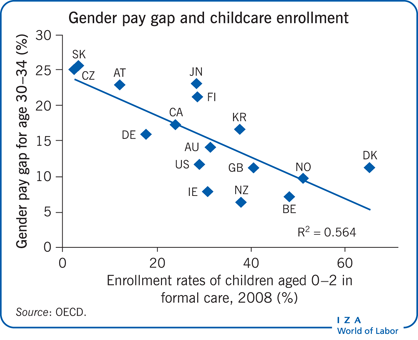
Policies consistent with promoting greater female lifetime work effort have reduced the gender wage gap. One such policy is making day care more available. An analysis by the OECD finds smaller gender wage gaps in countries with greater day care enrollment. Lower marginal tax rates that encourage greater participation of women in the labor force would work in the same direction.

Related IZA World of Labor article:
Equal pay legislation and the gender wage gap, by Solomon W. Polachek

***

Women’s lower wage sensitivity

Another IZA World of Labor article by Boris Hirsch (Leuphana University of Lüneburg and IZA) points to recent studies finding that imperfect competition in the labor market can account for a large part of the unexplained wage gap. The gap thus reflects “monopsonistic” wage discrimination—that is, employers exploiting their wage-setting power over women—rather than any sort of prejudice.

Hirsch argues that many women, due to domestic responsibilities, tend to care more about commuting times or working hours than salary offered. While equal pay legislation may help prevent employers from exploiting their wage-setting power, Hirsch recommends addressing the sources of women’s limited wage sensitivity by investing in additional and better childcare or enforcing more flexible working time arrangements.

Gender gap in leadership positions

Gender wage gaps are most pronounced in leadership positions. As Mario Macis (Johns Hopkins University and IZA) explains in his article, this is due to a combination of economic forces, cultural and social norms, discrimination, and unequal legal rights. Apart from social justice concerns, these gender disparities are economically inefficient because they imply a sub-optimal allocation of female talent.

Gender differences in competitiveness

A common explanation of the gender pay gap is that attitudes towards competition differ between genders. Mario Lackner‘s (Johannes Kepler University Linz) article references laboratory and field experiments finding that women are more reluctant and less aggressive when it comes to initiating negotiations or applying for jobs with negotiable salaries.

According to the article, such differences in competitiveness are formed at young ages and are relatively persistent, exerting a profound influence on an individual’s future career. Consequently, policy measures should be targeted at early childhood education and education systems in general. The driving forces of this ‘competitiveness gap’ are, however, still under debate. Moreover, closing the gender gap in competitiveness might not be desirable under all circumstances, as men are often found to be overconfident and over-competitive.

Read more on the IZA World of Labor “key topic” page:

  • What is the gender divide?

Filed Under: Opinion, Research Tagged With: competitiveness, equal pay, female leadership, gender, gender differences, gender gap, gender inequality, gender pay gap, gender wage gap, labor market, labor market policy, leadership, wages, women

Will robots take over? How automation changes the world of work

November 8, 2016 by admin

Technological change has advanced digitalization and automation in a number of industries, raising fears that human workers will eventually become redundant. Recent studies predict that almost half of existing jobs are at risk of becoming extinct due to this process. But how grim are the prospects really for human workers? Hilmar Schneider discussed this topic in the recent edition of “Made In Germany,” a business program of Deutsche Welle TV.

Schneider pointed out that this pessimistic outlook is based on gross figures. It’s easy to see what gets destroyed by new technologies, but it’s hard to see the jobs that emerge, he said. “Imagine in 1995, when the Internet was starting up, someone having to predict what type of jobs would emerge within the next five years. No one would have been able to do that.” What we have learned from technological change in the past is that “people became wealthier, jobs became easier, and work did not disappear – it just changed.”

While low-skilled workers who perform primarily mechanical tasks can be replaced by robots, and computers can be used for anything that can be “coded,” humans remain superior to machines in all areas related to creativity and social interaction. “This is something that machines up to now – and probably also in the next couple of decades – will not be able to do,” predicted Schneider.

Watch the video:

Filed Under: Opinion, Research, Videos Tagged With: automation, digitalization, future work, machines, robots, technology

On the costs and benefits of international labor mobility: Interview with George Borjas

July 25, 2016 by admin

The drastic and unexpected increase in the number of people seeking asylum in Germany in 2015 has overshadowed the long ongoing discussion about amending the German immigration law. The current refugee situation has caused some to argue that such a reform is now obsolete. But, on the other hand, with refugee numbers beginning to decline, it could provide the opportunity to take up the discussion again and not yield the floor to right-wing populists.

Despite being one of the most popular destination countries of worldwide immigration since the early 1960s, Germany only introduced a half-hearted attempt at reform in 2004. The current law still falls short of well-defined qualitative and quantitative selection criteria.

George Borjas at IZA

We took the opportunity to ask George Borjas (Harvard University), one of the world’s leading migration economists and program director of IZA’s “Labor Mobility” research area, to comment on his perceptions and views in the debate.

IZA: Mirroring the polarized public debate, migration economists also have diverging views on the expected costs and benefits of increased international labor mobility. What is your take on this discussion in general?

George Borjas: This is a very interesting question that’s actually hard to answer. Whenever I think about international labor mobility, I tend to think of it in terms of economic models. So that means I have a particular methodological approach that sets up the question in my mind and that guides me to an answer. I do a lot of empirical analysis as well, but I usually look at the data through the lens of an economic framework.

Other social scientists, and even some economists, often look at immigration as a policy issue—which it obviously is—but that lens also determines how one frames questions and how one looks at data. The problem with this policy-based lens is that it is very easy for your own policy preferences to filter into the work and contaminate the conclusions.

Germany is in the midst of a public debate about how to reform its migration law. How can migration policy make a difference in extracting potential benefits from migration?

If the economic literature on immigration has taught us anything, it has taught us that from the receiving country’s point of view, high-skill migration is economically more beneficial than low-skill migration. High-skill immigrants tend to complement the resources that industrialized economies have far more than low-skill immigrants.

High-skill immigrants could potentially introduce knowledge and information that would spill over into other sectors of the economy, making everyone more productive. And high-skill immigrants would contribute more in taxes and require many fewer social services.

The question, therefore, is not whether high-skill immigration is economically preferable to low-skill immigration. The question instead is whether the receiving country’s immigration policy should be guided by economic gains alone.

You have an upcoming release of a new book this October titled, “We Wanted Workers: Unraveling the Immigration Narrative.” How would you describe the key message for German readers?

The title of the book comes from a quote by Swiss writer Max Frisch. Looking at the guest worker migration into Germany and other Western European countries in the 1950s and 1960s, he quipped that: “We wanted workers, but we got people instead.”

I think a key lesson from this insight, which I develop in my new book, is that the “economistic perspective” on international migration—one that views immigrants as an army of worker-robots—is very misguided. Immigrants are people who have many other consequences on the receiving country, and the economic impact of those consequences could be far greater than the benefits that accrue from immigrant participation in the labor market.

Filed Under: Opinion Tagged With: Germany, immigration policy, labor market, migration, refugee crisis

The overeducated Italian doctors

July 22, 2016 by admin

By Giuseppe Lucio Gaeta, Giuseppe Lubrano Lavadera, and Francesco Pastore

Gaining a Ph.D. possibly determines positive outcomes from both an individual and a societal perspective. For candidates, doctoral education is an investment aimed at acquiring skills and competences to be used in future career. For the society as a whole those who achieve a Ph.D. are likely promoters of innovation. In order to achieve these outcomes, Ph.D. holders must be able to get job positions that allow them to fully exploit their educational background. How frequently does this occur?

A crucial question in Europe and in Italy

This question is particularly important in Europe nowadays. Starting from the Bologna Process, doctoral studies are interpreted as the third cycle of education and therefore public as well as private entities, alongside the academia, are considered as possible destinations for Ph.D. holders. This makes it very important to investigate whether the job-education matching is frequent among Ph.D. holders.

Italy is an appropriate context to investigate this issue for two main reasons. First, a remarkable growth of doctoral education has been reported in this country over recent years. Data reveals that at the beginning of the 2000s the annual number of new Ph.D. holders was approximately 3,000 while few years later, in 2006 it was higher than 10,000. Nevertheless, in 2011, the Italian graduation rate at a doctoral level was still lower than the OECD average.

Second, in Italy the size of personnel devoted to research and development (R&D) is lower than the EU28 average. Personnel working in Italian universities has been declining from 2008 (-17%, data provided by the Italian Ministry of Education, Universities and Research), while over recent years (2007-2013) an opposite increasing trend (+33%) is reported for the R&D personnel working in private firms.

Unemployment and overeducation

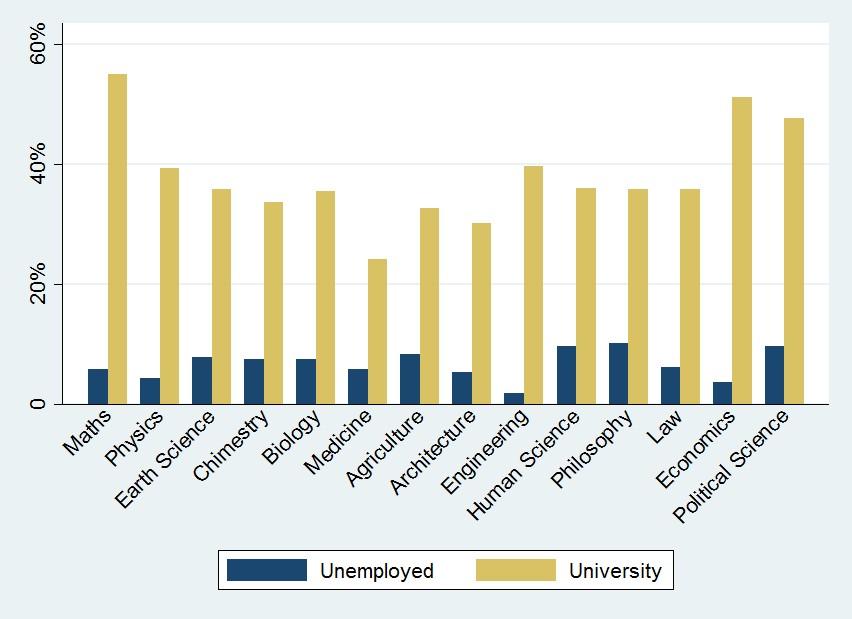
In 2009, ISTAT carried out a survey of Ph.D. holders who completed their studies three and five years earlier, in 2006 and in 2004, respectively. The data reveals that unemployment among Ph.D. holders is lower than what is reported for university graduates. A share as high as 92.5% of doctors who completed their studies in 2006 was working at the time of the survey and the figure is even higher in the case of those who graduated in 2004 (93.7%).

Figure 1 confirms this, while also showing that there is high heterogeneity of unemployment rates across fields of study, since Human Sciences and some of the Social Sciences perform worse than other fields. The share of Ph.D. holders working in the academia after the completion of their studies is approximately 36% with a remarkable variability among fields of study; it is higher in Mathematics and Physics and lower in Law and Life Sciences (see figure below).

Figure 1: Unemployment and university employment of Ph.D. holders.
Source: IZA DP No. 10051 based on ISTAT data.

What about the job to education matching among those who work outside of the academia? Approximately 31.28% of them report that their Ph.D. title was not useful to get the job they were carrying out when interviewed. Nevertheless this figure does not tell us anything about skills utilization.

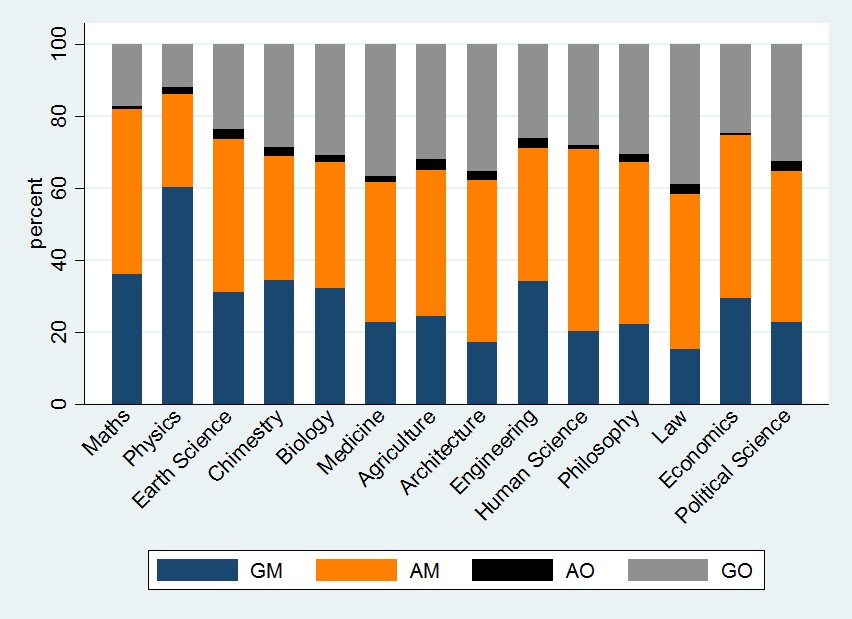
In order to provide a more in depth analysis, we used the ISTAT self-reported data to observe for each of the respondents which of the following alternative situation applies: 1) genuine overeducation (GO) defined as holding a job for which the Ph.D. title and the skills acquired during doctoral studies are useless; 2) apparent overeducation (AO) that arises when the Ph.D. title was not useful to get the current job while doctoral competences are valuable in carrying it out; 3) apparent matching (AM), that arises when doctoral education was useful to get the current job but Ph.D. skills are not; 4) genuine matching (GM) defined as holding a job for which both the Ph.D. title and skills acquired during doctoral studies are useful.

Figure 2 shows the incidence of these conditions among the surveyed doctorate holders who work in the extra-academic by field of doctoral studies. Data suggests that GO is particularly frequent among those who studied Philosophy, Law, Political Sciences and Human Sciences. Particularly worrying is that the sum of GO and AM results to be higher than 50% in most of the fields of study, which suggests that the application of skills acquired during Ph.D. studies is critical.

Figure 2: Genuine overeducation (GO), apparent matching (AM) , apparent overeducation (AO) and genuine matching (GM) among Ph.D. holders working outside the academia.
Source: IZA DP No. 10051 based on ISTAT data.

The detrimental effect of overeducation on wages

This mismatch presumably affects in a negative way the Ph.D. holders’ capacity to generate positive outcomes for the society but also individual private returns to education might be harmed by it.

To check whether the latter claim is true, our recent IZA Discussion Paper relies on the cross-sectional data presented so far. We account for the possible endogeneity of GO by proposing an instrumental variable analysis in which the instrument is represented by the incidence of GO among those who share the same profile of respondents in terms of field of study, area of residence and year of graduation.

According to the empirical investigation, GO leads to a wage penalty of approximately -9%. This effect is remarkably higher (approximately -25%) when the GO status of respondents is defined in a slightly different way, i.e. when we consider as genuinely overeducated those who hold a job for which the Ph.D. title is useless and who are totally dissatisfied with the current use of the skills acquired during their doctoral studies.

Conclusion

While most of research focuses on the career outcomes of university graduates, our essay suggests that there is also need of investigating those of doctors. Since Ph.D. holders are considered to be crucial actors in knowledge economies, incentives should be designed in order to ease the application of doctoral knowledge in non-academic jobs and support the dialogue between the academic and non-academic world in defining some specific topics for Ph.D. training.

Keeping in mind these aims, it is very important to carry out a careful assessment of projects such as the recently released Italian Ph.D.ITalents, which is specifically aimed at easing matching between supply and demand of doctors.

Image Source: Pixabay

+++

On a related note, see also Hilmar Schneider’s recent op-ed (in German) published in Wirtschaftswoche:

  • Ein ökonomisches Plädoyer gegen den Akademisierungswahn

Filed Under: Opinion Tagged With: doctors, Italy, overeducation, PhD, wages

What politicos get wrong in Germany’s retirement debate

July 7, 2016 by admin

Werner Eichhorst

A crucial reality check for all Germany’s politicians eager to hand out even more retirement benefits: They need to ensure that the – already staggering – financial burden carried by the younger members of the workforce will not rise even more.

Keeping young people motivated and willing to carry their load is of paramount importance and will be difficult enough. Any further increase may be the straw that breaks the proverbial “camel’s” back.

That’s the gist of an op-ed by Werner Eichhorst, IZA Director of Labor Policy Europe, published in Fortune [read entire article].

Filed Under: Opinion Tagged With: demography, generations, Germany, inequality, pay-as-you-go, pensions, retirement, social security

  • Previous Page
  • Page 1
  • Page 2
  • Page 3
  • Page 4
  • Page 5
  • Next Page

Primary Sidebar

© 2013–2025 Deutsche Post STIFTUNGImprint | Privacy PolicyIZA