• Skip to primary navigation
  • Skip to content
  • Skip to primary sidebar

IZA Newsroom

IZA – Institute of Labor Economics

  • Home
  • Archive
  • Press Lounge
  • DE
  • EN

New book on labor markets in low-income countries

February 9, 2022 by Mark Fallak

To improve knowledge on labor market issues in the world’s poorest regions, IZA has been collaborating closely for many years with the UK Foreign, Commonwealth & Development Office (FCDO) on the “Growth, Gender, and Labour Markets in Low-Income Countries” (G²LM|LIC) research initiative. The goal is to provide a solid basis for capacity building and development of future labor market policies.

Based on numerous studies and policy recommendations that have emerged from this initiative, the program’s founding director David Lam and IZA’s deputy program director Ahmed Elsayed have now published a book on Labour Markets in Low-Income Countries: Challenges and Opportunities.

Covering such topics as poverty, informality and rural labor, skills training and behavior, gender inequality, youth and child labor, and migration, the book presents key takeaways from the latest research in the field.

Which development policies will work, which strategies are likely to fail? Drawing on the results of new evaluation studies, the authors provide an in-depth discussion of current development programs and derive important policy lessons. The volume is available free of charge as an open-access publication for non-commercial use.

On February 23, core findings of the book will be discussed by invited experts during an online book presentation [register as a guest here].
Filed Under: IZA News, Research Tagged With: Development, growth, labor markets, low-income countries

How people’s feelings evolved during the pandemic

January 24, 2022 by Mark Fallak

The COVID-19 pandemic and the fight to contain it have had widespread large effects on individual well-being, but the channels are less clear. Was the incidence and fear of infection more impactful, or the consequences of containment policies? Perhaps the pandemic, in which everyone is at risk, engendered a positive sense of solidarity. How resilient were we – were the impacts lasting? To answer these questions, a recent IZA discussion paper by Francesco Sarracino, Talita Greyling, Kelsey O’Connor, Chiara Peroni and Stephanie Rossouw describes the changes in well-being that occurred throughout 2020 in ten mostly European countries.

The authors first computed a real-time measure of well-being referred to as Gross National Happiness (GNH) using tweets as they are posted. Compared to the snapshots provided by surveys, data from Twitter reveal a much more varied picture. Tweets provide a wealth of information that can be transformed into usable data using sentiment analysis – an automated process that uses natural language processing to determine the feelings and attitudes of a written text’s author.

Sentiment analysis has been used by many researchers, for instance, to predict future events, such as the result of elections or stock markets, to track the influenza rate, and to measure people’s well-being. Using this process to derive the sentiment of each tweet, the authors calculate GNH as the average sentiment expressed in a country during a particular day. They focus on seven European countries: Belgium, France, Germany, Italy, Luxembourg, Spain and the United Kingdom.

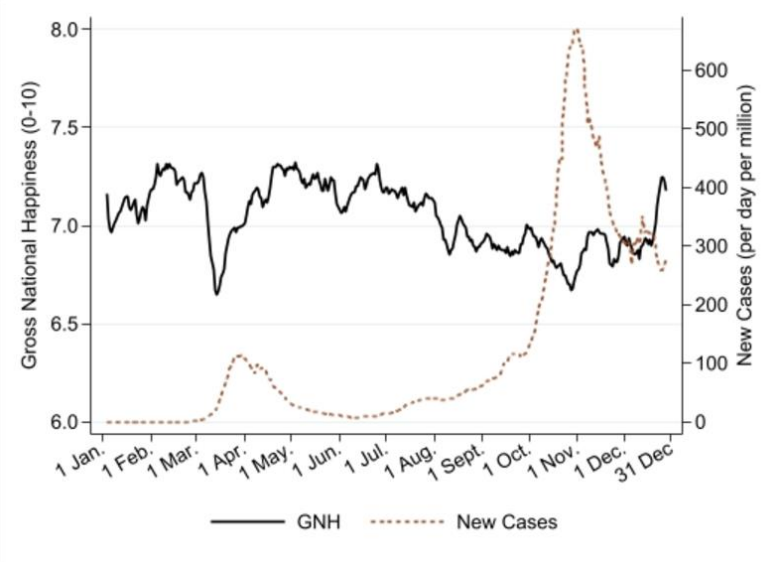
The paper finds that well-being declined dramatically at the onset of the pandemic in March 2020. The initial decline in GNH is partially explained by the exponential rise in confirmed COVID-19 cases (left figure) and severe containment policies (right figure) that were implemented in mid-March. After the initial shock, shortly before the peak of the first wave, well-being began to recover, reaching pre-pandemic levels by the end of April. In mid-year, as cases started to slowly climb again, well-being slowly declined, reaching another minimum at the end October, which corresponds with another peak in cases.

Beyond these observations, regression analysis suggests well-being declined as a result of COVID-19 cases and containment policies, and between the two, cases had a more robust negative impact throughout 2020. The regression results also show that economic fear, trust in national institutions, and loneliness were not significantly associated with GNH. This puzzling finding could indicate that health and lockdown concerns dominated individuals’ mood during the pandemic.

While GNH, like any indicator, has its limitations and may not fully capture country-specific aspects differences or long-run impacts, various tests conducted by the authors suggest that it does serve as a valid and reliable measure of well-being. A key finding from this analysis is how quickly people recovered during the first wave. Real harm was caused to mental and physical health, but people also revealed significant resilience.

Filed Under: Research Tagged With: COVID-19, Europe, sentiment, twitter, well-being

Women face higher earnings losses than men after job displacement

January 17, 2022 by Mark Fallak

Existing research has shown that job displacement leads to large and persistent earnings losses for men, but evidence for women is scarce. In fact, there is more research on how women react to their husband’s job loss than to their own. Using a sample of more than 80,000 displaced workers extracted from German administrative data, a recent IZA paper by Hannah Illing, Johannes F. Schmieder and Simon Trenkle  aims to close this gap in the economic literature.

To achieve a high comparability, the study compares women and men working in very similar jobs. The results show that over the five years after a mass layoff, women’s earnings decline on average by around 35 percent relative to their earnings two years before job loss, compared to men who only lose around 26 percent. As women recover more slowly, the gender gap in earnings losses increases further with time since displacement.

Even full-time wage losses are much higher for women

The study examines a variety of reasons for the higher wage and earnings losses of women. One explanation for the difference in earnings losses is a higher propensity of women to take up part-time or marginal employment following job loss, but even full-time wage losses are almost 50 percent (or 5 percentage points) higher for women than for men.

One reason for the wage losses is sorting into establishments with lower wage premia. In the long run (five years after displacement), women are employed at establishments paying slightly lower wage premia, which in turn explains about a fourth of the gender gap in full-time wage losses. The presence of young children in a household magnifies the gender gap in earnings losses. Women with young children at time of displacement face the largest losses in earnings, wages, and employment, while men with young children have the smallest losses.

The study also examines whether the higher earnings losses for women reflect differences in labor supply or demand. Based on job-preference characteristics elicited by caseworkers at the local UI agency, the authors show that differences in labor supply are important: women are about 11-13 percentage points less likely to exclusively search for a full-time job although most of them had been working full-time before displacement. Nonetheless, the study cannot rule out that demand-side factors, such as employer discrimination against displaced women and mothers, play a role as well.

Filed Under: Research Tagged With: gender pay gap, Germany, household structure, job loss, labor supply

Minimum wage reduced the gender wage gap in Germany

January 7, 2022 by Mark Fallak

In many countries, women are over-represented among low-wage employees and might thus benefit particularly from wage floors. To find out whether this is indeed the case, a new IZA paper by Marco Caliendo and Linda Wittbrodt analyzes the impact of the German minimum wage introduction in 2015 on the gender wage gap. Germany poses an interesting case study in this context because it has a rather high gender wage gap and set the minimum wage at a relatively high level, affecting more than four million employees.

Based on individual data from the Structure of Earnings Survey, containing information for over one million employees working in 60,000 firms, the authors use a difference-in-difference framework that exploits regional differences in the bite of the minimum wage. They find a significant negative effect of the minimum wage on the regional gender wage gap.

Between 2014 and 2018, the gap at the 10th percentile of the wage distribution was reduced by 4.6 percentage points (or 32%) in regions that were strongly affected by the minimum wage compared to less affected regions. For the gap at the 25th percentile, the effect still amounted to -18%, while for the mean it was smaller (-11%) and not particularly robust.

The results suggest that the minimum wage can indeed reduce gender wage disparities. While the effect is highest for the low-paid, it also reaches up into higher parts of the wage distribution.

Filed Under: Research Tagged With: gender wage gap, Germany, minimum wage, regional bite

Coal phase-out in 2030 – what costs will employees face?

December 15, 2021 by Mark Fallak

The new German government is aiming for an earlier coal phase-out, “ideally” by 2030. The associated job loss was perhaps the most important concern here. Often, only the number of jobs lost is considered – in 2020, for example, there were 9,960 jobs in coal mining, according to the German Federal Employment Agency. But the consequences of such a job loss for individual workers vary widely: a job loss may be followed by a long period of unemployment, a direct job change or early retirement. The new job may be better or worse paid and come with more or less security.

A recent IZA discussion paper by Luke Haywood, Markus Janser, and Nicolas Koch shows which of these factors – unemployment, lower wages, and job security – are most important for workers’ welfare loss. This allows the authors to answer several questions: Who is most affected by job loss? What additional costs will workers face if we bring forward the coal phase-out from 2038 to 2030? What labor market policies can alleviate the welfare costs?

Prime-aged workers face highest losses

For the study, the entire labor market biographies of all employees in the coal industry were analyzed, with a special focus on employees in coal mining. This made it possible to compare salaries in the coal industry with salaries in other industries, in addition to length of employment. The main driver of welfare costs, the study finds, is not income losses due to periods of unemployment after leaving the coal industry, but rather income losses incurred by switching from higher-paying, relatively secure jobs in the coal industry to lower-paying and less secure jobs in other industries. This also explains why neither the younger nor the older workers face the highest losses, but prime-aged workers. These workers have progressed to higher wages, and would continue to receive them for many years without the coal phase-out.

The authors calculate one-third higher welfare costs for an earlier coal phase-out without accompanying measures in 2030 – a total welfare loss of about €2.19 billion. The driver of these additional costs is the age composition of the workforce. An exceptionally large number of employees will retire from the workforce over the coming years. The paper projects that 1,500 employees will retire between 2030 and 2038 – this group now faces welfare costs of job loss with an earlier coal phase-out.

Wage subsidy could reduce welfare costs by over 90 percent

Importantly, the study shows that labor market policy can provide significant relief. However, the currently favored measure – a subsidized early retirement program (“Anpassungsgeld”) – has several disadvantages. First, it is expensive for the state, as it largely replaces existing occupational pensions. Second, it is available only to workers aged 58 and above, although it is middle-aged workers who bear the greatest costs. Third, it contains little incentive for employees to remain active in the labor market. This is problematic as a shortage of skilled workers is currently seen as a great challenge in Lusatia, the region most affected by job losses.

The authors contrast the problematic early retirement policy with a wage insurance scheme (“Entgeltsicherung“). They propose a wage subsidy that would enable employees to maintain their wage level even if they move from the well-paid coal-mining industry to another sector. The government would compensate workers for their wage losses of moving to lower-paid jobs outside the coal industry for a limited period of time – for example, five years.

The German Federal Employment Agency already implemented a similar model for older unemployed workers, thus it appears administratively feasible. Although the measure comes at a cost – about €615 million – it could reduce the welfare costs of the coal phase-out in 2030 by more than 90% while retaining important skilled workers in the affected regions.

Filed Under: Research Tagged With: coal exit, environment, job loss, structural change

What if working from home will stick?

December 1, 2021 by Mark Fallak

The COVID-19 pandemic created the largest experiment in working from home. In a recent IZA discussion paper, Marion Bachelet, Matthias Kalkuhl and Nicolas Koch study how persistent telework may change energy and transport consumption and costs in Germany to assess the distributional and environmental implications when working from home will stick.

Based on data from the German Microcensus and available classifications of working-from-home feasibility for different occupations, the authors calculate the change in energy consumption and travel to work when 15% of employees work full time from home. Their findings suggest that telework translates into an annual increase in heating energy expenditure of 110 euros per worker and a decrease in transport expenditure of 840 euros per worker.

All income groups would gain from telework but high-income workers gain twice as much as low-income workers. The value of time saving is between 1.3 and 6 times greater than the savings from reduced travel costs and almost 9 times higher for high-income workers than low-income workers. The direct effects on CO2 emissions due to reduced car commuting amount to 4.5 millions tons of CO2, representing around 3 percent of carbon emissions in the transport sector.

Filed Under: Research Tagged With: climate, energy, inequality, telework

Labor market programs substantially improve refugee integration in Germany

November 22, 2021 by Mark Fallak

The massive inflows of refugees in 2015/2016 have posed great challenges to Germany’s labor market and society. To assess the success of various integration measures, the Federal Labor Ministry commissioned a research consortium led by IZA to conduct a large-scale evaluation study comprising a causal analysis of administrative data, complemented by survey data and a comprehensive implementation analysis.

The final report (available in German language only) presents findings on the implementation, utilization, effects and economic efficiency of the labor market integration measures for refugees in the time period between September 2017 and December 2020. These measures, specified in the German Social Code (SGB II and SGB III), include seven different program types ranging from vocational training to subsidized employment.

Almost all programs were found to be effective in terms of increasing the length of employment spells and reducing the duration of welfare benefit receipt for program participants compared to non-participants. These effects were most pronounced for measures involving employers, such as temporary wage subsidies and introductory company trainings. A cost-benefit analysis already shows a positive fiscal balance for these programs after 40 months, while the fiscal gains of other measures aimed more at long-term integration through education and training are expected to offset their costs within about five years.

Apart from labor market integration, the evaluation found substantially improved social participation, due also to the language acquisition aspect of the integration programs. Women benefit as much as men but are markedly underrepresented among program participants.

[read more in German]

Filed Under: Research Tagged With: Germany, integration, refugee

Schools may contribute to stemming the pandemic

November 16, 2021 by Mark Fallak

In most German schools, face masks are mandatory at least to some extent. Moreover, all schoolchildren and the few unvaccinated teachers are tested for COVID-19 up to three times a week. A new IZA discussion paper by Ingo E. Isphording, Marc Diederichs, Reyn van Ewijk and Nico Pestel investigates how school re-openings after the summer break have affected the spread of the pandemic.

Since summer holidays are staggered across German states, the researchers were able to compare states where schools opened again after the summer break with states where schools were still closed. To isolate the effect of school re-openings, they controlled for changes in mobility as people increasingly commuted to work again.

The analysis shows that open schools did not accelerate COVID-19 infection rates. While cases among 5 to 14-year-olds did increase temporarily due to positive tests of children who had not been tested during the holidays, there was no longer-run effect on COVID-19 cases in this age group, nor among people aged 60 and over. Most remarkably, infections among 15 to 59-year-olds remained even lower than they would have been if the schools had remained closed.

These findings indicate that mandatory testing in schools promotes the early detection and quarantining of infected children, which contributes to curbing the pandemic also outside of schools. Since COVID-19 cases among children are often asymptomatic yet infectious, keeping schools open with mandatory testing helps identify infected children and prevent them from spreading the disease.

The authors conclude that schools – at least in the German school system where testing, mask-wearing and a set of additional hygiene measures are in place – do not pose a considerable infection risk to children, while at the same time they can help stem the pandemic.

Filed Under: Research Tagged With: COVID-19, pandemic, schools, testing

Profit taxation reduces innovation by firms

November 12, 2021 by Mark Fallak

In retrospect, it is often the genius inventors like Thomas Edison who get praise for humanity’s progress. Most scientists, however, would argue that it is rather the firm which serves as the cradle of groundbreaking new technologies and products. But for firms, research and development (R&D) is not a goal per se – it serves as an instrument to expand, to increase productivity and to assimilate new knowledge.

Beyond the firm itself, positive knowledge spillovers provide benefits to society as a whole. From this perspective, investments in innovation are often too small, as firms struggle to fully monetize the benefits of new ideas, and banks are not always willing to finance risky projects. Active policy is necessary to bring innovation to optimal levels.

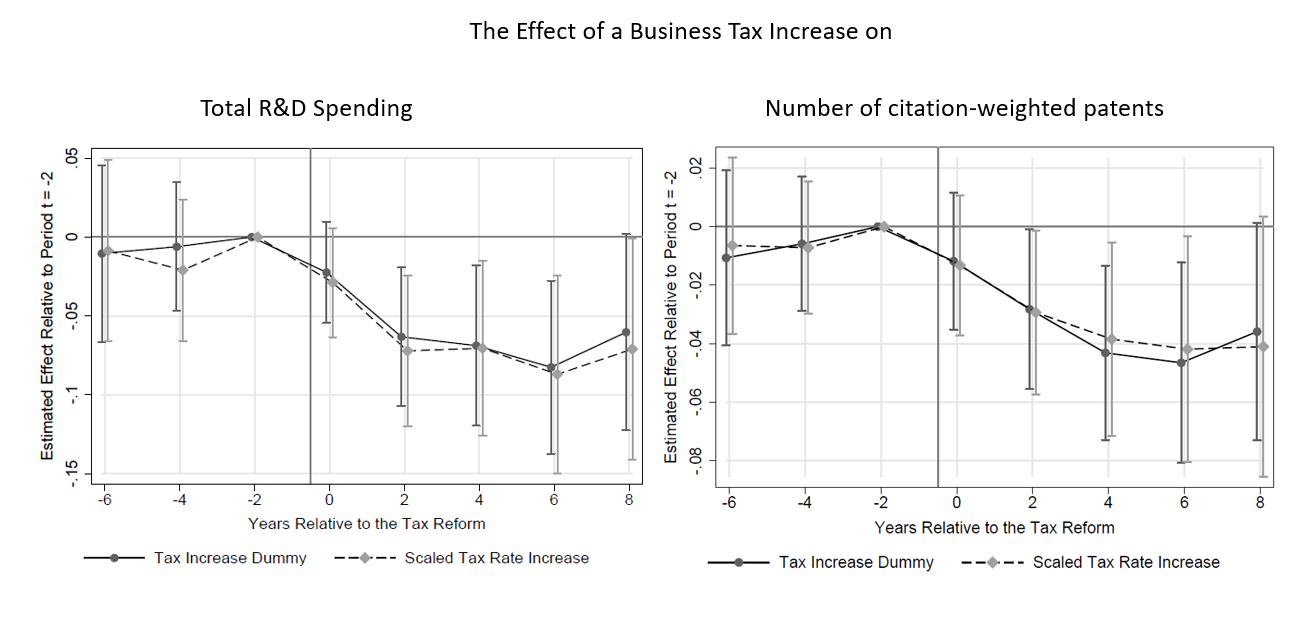
In a new IZA discussion paper, Andreas Lichter, Max Löffler, Ingo E. Isphording, Thu-Van Nguyen, Felix Pöge and Sebastian Siegloch estimate the impact of profit taxation of German firms on the level of R&D spending and filed patents (as a proxy of innovation output). The size of this effect is immensely important for the design of tax policy, as profit taxation is an important source of revenue for many countries.

Based on a sample of nearly all R&D active firms in Germany, the authors exploit close to 7,300 local tax changes between 1987 and 2013. Each tax change is interpreted as a single natural experiment, comparing the accompanying change in R&D investment to the level of investment of plants in municipalities where taxes remained unchanged at the same time.

Higher taxes lead to lower R&D spending and fewer patents

The empirical results indicate that an increase in the local business tax rate has a negative and statistically significant effect on plants’ total R&D expenditures. These reductions in R&D spending are particularly strong among young and credit-constrained firms. A similar negative effect appears about two years later in resulting patents.Despite these notable effects, the authors emphasize that reductions in business taxes are likely not the best policy response to their study’s findings. Instead, “targeted tax incentives for R&D expenditures appear to be the more efficient policy instrument altogether,” as untargeted tax changes affect both innovating and non-innovating firms.

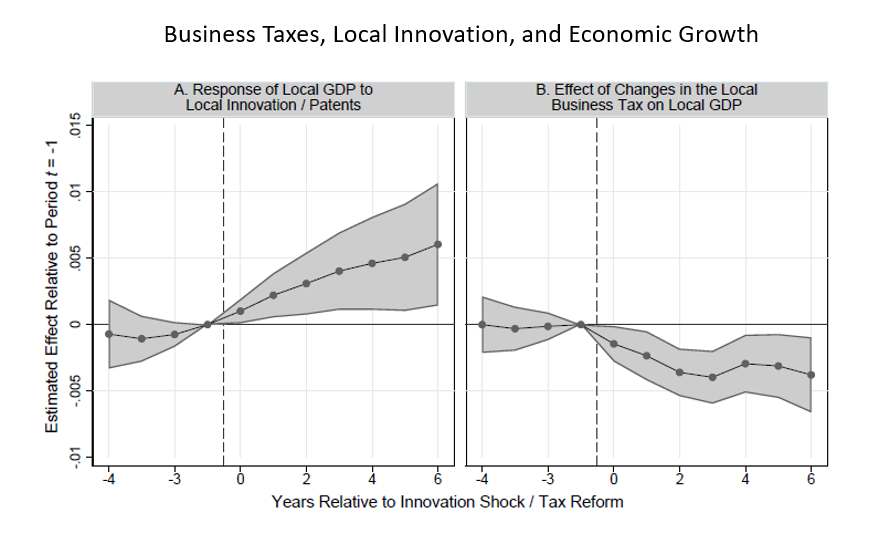
The authors also provide suggestive evidence that local innovation has a positive and lasting effect on municipal economic growth. In contrast, an increase in the local business tax considerably reduces local GDP. Combining these two pieces of evidence with the effect of taxes on innovation, they conclude that around eight percent of the total negative effect of profit taxation on local growth are due to tax-induced reductions in innovation, which highlights the important role of innovation for economic growth.

Filed Under: Research Tagged With: economic growth, firms, innovation, profit taxation, R&D

It hurts to be economically insecure

September 24, 2021 by Mark Fallak

According to a study published in 2021, about one-fifth of citizens in rich nations suffer from chronic pain. Although the economic costs of chronic pain among workers are substantial, this phenomenon has been relatively little studied in large cross-national samples. To fill this gap, a new IZA discussion paper by Andrew Oswald and Lucía Macchia explores the link between economy-wide fluctuations and the amount of pain in a society. The authors analyze data on approximately 1.3 million adults in a large sample of countries.

Standard economic reasoning would predict that people work longer hours in good times, so pain levels would be expected to increase when the economy booms. However, the paper finds the opposite: The level of physical pain felt by a country’s population is lower in a boom and greater in an economic downturn with high unemployment. The estimated effect sizes are most pronounced in richer countries.

The analysis suggests that an extra three percentage points of unemployment is associated with just under a one percentage point rise in the numbers of citizens in pain. For the United Kingdom with a population of about 65 million, a three-percentage point rise in unemployment (from the UK mean) would be associated with an extra half a million people reporting a lot of physical pain.

The findings hold after adjusting for those individuals who themselves join the ranks of the unemployed in a recession. In other words, the extra half million adults are not the jobless. Instead, the measured rise in national pain can be considered a kind of multiplied external consequence of recession – a spread of pain that extends beyond those made literally jobless and is detectable in the pain levels felt by other adults who were not. This could be explained with the link between mental stress and physical pain. People who are anxious and under psychological strain may be intrinsically tense, and susceptible to illness, and thus might report (and feel) greater physical pain.

Notably, the increase in physical pain is found predominantly among women. There are several potential explanations, including increased domestic abuse and violence, greater exploitation of vulnerable kinds of employees, physical injuries resulting from criminal activity, and physiological effects from the consumption of cheaper and less healthy kinds of food. Also, other studies found that women during recessions are more likely to experience high work demands, have little decision authority at work, lack control over their work situation, and tend to be more pessimistic about the future.

Filed Under: Research Tagged With: boom, health, pain, recession, unemployment, well-being

  • Previous Page
  • Page 1
  • …
  • Page 11
  • Page 12
  • Page 13
  • Page 14
  • Page 15
  • …
  • Page 69
  • Next Page

Primary Sidebar

© 2013–2025 Deutsche Post STIFTUNGImprint | Privacy PolicyIZA