• Skip to primary navigation
  • Skip to content
  • Skip to primary sidebar

IZA Newsroom

IZA – Institute of Labor Economics

  • Home
  • Archive
  • Press Lounge
  • DE
  • EN

Educational choices can help explain income inequality in Germany

August 16, 2017 by admin

Rising levels of income inequality in many developed countries have led to much political and scientific controversy. One of the empirical challenges is to identify the causes and drivers of inequality. A new study by German economists Albrecht Glitz (Universitat Pompeu Fabra and IZA) and Daniel Wissmann (LMU Munich) investigates how shifts in skill premiums – the wage difference between skilled and unskilled workers – can help explain income inequality between different skill and age groups.

Different trends in wage differentials since 1980s

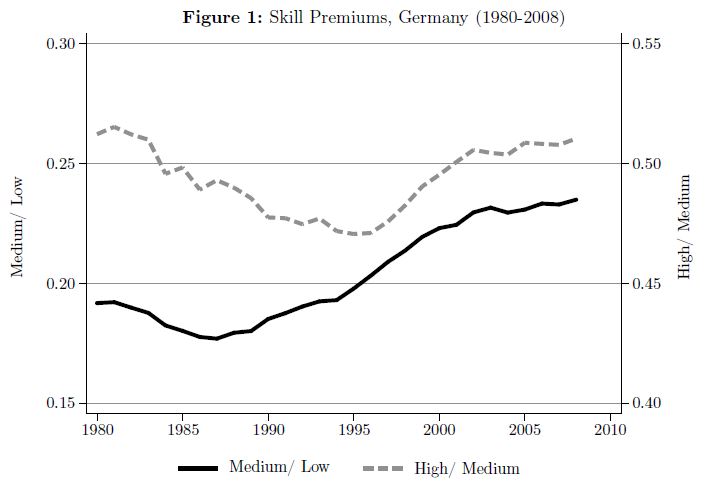
The authors show for Germany that the wage differential between medium (those with vocational training and/or Abitur) and low-skilled workers (those without a post-secondary degree) decreased slightly over the 1980s and then increased by a third from 18% to 24% since the late 1980s (solid line in graph), while the high skill premium, i.e. the wage differential between those holding a college or university degree and those with vocational training, followed a U-shape pattern over the same period (Figure 1).

But not all medium-skilled workers benefited from this rise in the skill premium, which is apparently attributable to a pronounced increase in the medium skill premium of young workers (aged 30 and below).
According to Glitz and Wissmann, these differences in the development of wage premia may simply be due to the relative abundance of workers with a specific skill level. Analyzing long-term education trends in Germany for those born between 1950 and 1981, the authors find a pronounced trend break in the educational attainment of the West-German population: relative to previous trends, the shares of both high- and low-skilled individuals increased while the share of medium-skilled individuals declined markedly.

Fewer medium-skilled workers

For cohorts born after 1965, the share of individuals with completed vocational training decreased strongly and was as large for the 1980s cohorts as it was for the 1940s cohorts, while the share of individuals with tertiary education increased to unprecedented levels and the long-term decline in the share of low-skilled individuals came to a hold.

The authors conclude that a considerable part of recent changes in earnings inequality between different skill groups in Germany are the result of longer term educational choices of the population and hence, ultimately, driven by labor supply. With this explanation, the authors complement recent attempts focusing on demand-side explanations of rising inequality, such as technological change and the role of globalization in the vanishing of manual, routine-intensive occupations.

Image source: Goodluz via Shutterstock

Filed Under: Research Tagged With: education, Germany, high-skilled, income distribution, income inequality, labor market, labor supply, skill premiums, skills, vocational training, wages

Unpaid graduate internships: Career boost or bust?

August 11, 2017 by admin

The rising prevalence of unpaid internships as a gateway to highly competitive careers in law, politics, creative industries, media and publishing, and the sciences, has raised concerns about diminishing social mobility, and raised questions about whether and how interns benefit from the experience.

A recent IZA Discussion Paper by Angus Holford (University of Essex & IZA) uses the Destination of Leavers from Higher Education (DLHE) survey on graduates from English and Welsh universities between 2005 and 2011 to study the returns to taking an unpaid internship six months after graduating from a first degree, on labor market outcomes a further three years later. He compares interns with individuals who went straight into paid work, into further study, or something else, by pairing them each one with a ‘matched’ individual, according to their demographic characteristics and their reported motivations for taking the job or internship they are in.

The results show that, on average, former interns face a salary penalty of approximately £3500 per year compared with those who went straight into paid work, and £1500 compared with those who went into further study. Only compared with those doing ‘something else’ (including traveling or remaining unemployed) do interns gain any significant benefit on average, being 6.4 percentage points more likely to be ‘very satisfied’ with their career.

Outcomes vary by demographic group

Holford also analyzes access to and returns from unpaid internships by demographic characteristics. His findings suggest that there are both advantaged and disadvantaged groups (in terms of expected labor market outcomes after university) who are more likely to be taking an internship. Among the former group are those with parents in professional or managerial jobs, those who went to private schools or ‘elite’ universities, and those graduating with a first or upper second class degree. Among the latter group are Black and ethnic minority graduates, those with disabilities, and from areas with a higher unemployment rate.

The study also finds the negative returns to taking an internship to be significantly smaller for graduates who were privately schooled or with parents in professional occupations. This suggests a segregated market in which the social and financial capital that graduates from higher socio-economic backgrounds can access gives them an advantage in accessing the ‘good’ internships, with a relatively high labor market return.

Holford argues for improving access to and reducing the opportunity cost for students with low socio-economic status of taking relevant experience for ambitious careers during undergraduate degrees, and improving provision of information to students and early graduates about the likelihood of different outcomes from internships in key fields.

Image source: pixabay

Filed Under: Research Tagged With: career, experience, graduate, income, internship, job, salary penalty

GLM|LIC Call for Proposals: Growth and labor markets in low-income countries

August 1, 2017 by admin

The IZA/DFID Programme on Growth and Labour Markets in Low-Income Countries (GLM|LIC) has opened the electronic application portal for Phase IV research proposals. Research projects can be proposed for the following research areas:

  1. Growth and Labour Market Outcomes
  2. Active Labour Market Policies, Labour Market Institutions and Labour Market Frictions
  3. Human Capital and Labour Productivity
  4. Migration and Labour Markets
  5. Labour Market Dimensions of Population Dynamics, Urbanisation, and the Environment

Proposals will be due on October 16, 2017.

https://glm-lic.iza.org/call-phase-iv

Filed Under: Research

IZA continues GLM|LIC program with DFID – new website now online

July 17, 2017 by admin

Since 2011, IZA has been coordinating the “Growth and Labour Markets in Low Income Countries” program on behalf of the British Department for International Development (DFID). The objective is to fund research projects that deliver a significant new body of evidence to help shape future policies in low-income countries.

So far, 31 projects within five topic areas have been supported, generating more than 150 publications. Many of these publications have been featured in in top academic journals and major international conferences. A number of important policy recommendations have come out of the projects, described in the Policy Brief series.

To facilitate access to these findings, the relaunched GLM|LIC website has a number of new features. In addition to information about the supported projects, including working papers, policy briefs, and published articles from the projects, an Evidence Finder makes it easy to locate GLM-LIC research results by topic and country.

Meanwhile, the cooperation between DFID and IZA has been renewed until 2020. The “Call for Proposals” for innovative new research to be funded in the next phase will be posted on August 1.

Filed Under: IZA News, Research

Long-term unemployed through the eyes of recruiters: Less motivated, less talented and less trainable

July 11, 2017 by admin

Recent research has shown that employers are reluctant to hire long-term unemployed: the longer job candidates’ unemployment spell, the lower is their chance of a positive reaction. In a new IZA Discussion Paper, scholars from Ghent University, KU Leuven, Vrije Universiteit Brussel, and University of Oxford have investigated why this is the case.

Unemployment as a signal of factors not shown in a CV

The research results confirm what was found in recent experiments with fictitious job applications: job candidates with long unemployment spells get fewer positive call-backs on their applications. Doctoral researcher Eva Van Belle: “Recruiters judging job candidates are confronted with very limited information. They use this information to predict other factors that drive productivity. In this respect, a main finding of our research is that recruiters perceive long-term unemployment as a signal of lower motivation. This turns out to be the most important explanation for the fact that long-term unemployed job candidates are immediately rejected.”

In addition, long-term unemployed are perceived as having lower intellectual and social skills, being less up-to-date with technological changes, and being less trainable. The research shows that these perceptions also drive the lower hiring chances of the long-term unemployed, albeit to a lesser extent than the association between unemployment and motivation.

Recruiters rely on the negative judgment of their colleagues

A final phenomenon at play is what economists call “rational herding”. IZA research fellow Stijn Baert, labor economics professor at Ghent University: “The recruiters in our research concluded that long-term unemployed candidates had often been rejected by other employers. In other words, other employers had found the candidate’s productivity to be low. As a consequence, inviting these candidates for a job interview seemed inefficient.”

Policy perspective

The study shows that long-term unemployed might benefit from including as many relevant details as possible regarding their motivation in their job applications. It seems that the focus here should be on work motivation and not on general (social) motivation as an additional analysis showed that the association between unemployment duration and hiring chances could not be compensated by revealing engagement as a volunteer.

Method

The results are based on a state-of-the-art vignette experiment in which 219 recruiters evaluated five fictitious job candidates each. These candidates differed by gender, education level, work experience, social activities, and unemployment duration (from 1 to 36 months). Each recruiter had to evaluate different candidates. The recruiters judged and ranked these candidates in terms of likelihood of job interview invitation (and being hired). In addition, they rated the candidates on eight characteristics (including perceived motivation and intellectual and social skills). By means of an econometric model, the association between unemployment duration and chance of a job interview could be explained by these eight characteristics.

Image source: pixabay

Filed Under: Research Tagged With: cognitive skills, hiring, job applications, long-term unemployment, motivation, productivity, recruiting, social skills

Public health in utero: How external factors influence birth outcomes

July 7, 2017 by admin

By Jeanna Canapari (Yale University)

In the study of birth outcomes, going to extremes is not always necessary. While intense events such as heat waves, deep cold or famine can impact fetal development and play a major role in the health of newborns, scientists who study birth outcomes can learn a great deal in more moderate scenarios.


To illuminate this, IZA research fellow Xi Chen, a health economist and assistant professor in the Department of Health Policy & Management at Yale University, looked to the Muslim observance of Ramadan, which requires a month of fasting from sunrise until sunset, to understand how nutritional disruptions to an expecting mother can impact fetal development. The study was published as IZA Discussion Paper No. 8494.

Studies of external factors such as fasting also can have greater influence on policy making than the study of extreme factors such as famine, Chen said. Moderate factors affect far more people: the Ramadan fast potentially impacts the health of more than one billion Muslims worldwide.

Fasting mothers, obese children

Chen’s study revealed that babies who were deprived of prenatal nutrition during Ramadan were more likely to be obese later in life. More generally, having been constrained during early life, Chen said, babies make more efficient use of the limited nutrients they receive during a time of fast, and develop stronger digestive systems. As this generation ages with access to abundant food supply (high fat, sugar diets, etc.), Chen said, the effect of this adaptation to the early environment of under-nutrition begins to show.

Xi Chen

“When they are older, and richer, and they take the same dose of nutritious food as the cohort not exposed to under-nutrition in an early stage of life, biologically their stronger digestive systems tend to produce more surplus energy as regulated in part by peptide hormones in the brain and gut, they are more likely to be susceptible to the risk of developing obesity and other chronic diseases.”

Birth outcomes can hold several clues to the adult that newborn will someday become. By examining factors such as a newborn’s birth weight, gestational size and birth defects, Chen looks to predict not only future health, but also the potential for future economic success. In another study, for instance, he looked to poor, rural China and the effect that the practice of gift giving has on birth outcomes.

“If you do not send a gift,” during community festivals and observances such as births, marriages and funerals, “you become socially isolated,” said Chen. In years with an abundance of such events, expectant parents are often forced to choose gifts over prenatal nutrition, to protect their social standing. The result, Chen said, is a negative impact on the height of children from birth to age 6 who were born during years of frequent festivals. The study was published as IZA Discussion Paper No. 10662.

Predicting future health and career

Prenatal care, said Chen, is an investment that parents make in their children. “Social scientists, like myself, often treat birth outcomes as the starting point for human capital,” he said. The conditions that expectant parents live in, and the economic decisions they make, reflect their commitment to investing in the future health of their children. This prenatal care can help determine a child’s success as he or she grows up, and ultimately enter the workforce and contribute to the economy themselves.

As telling as birth outcomes can be, Chen is part of a growing group of researchers going even further back to conception and the whole pregnancy to predict future health. Through data collected from prenatal ultrasounds, Chen is examining three measures: head circumference, femur length and abdominal circumference, all of which, he said, are indicators of long-term health, and predictors of adult chronic disease. Ultrasound data enables Chen to track each ultrasound throughout a fetus’s development, enabling his team to study trajectories of growth before birth.

“I know of only other one economist, Dr. Gabriella Conti of the University College London, who has been exploring early human health using an ultrasound data set.” Chen said. While Heckman’s data set counts information from 1,000 infants in the United Kingdom, Chen, together with Yawei Zhang from Yale’s Environmental Health Sciences Division, are working with a data set of 20,000 babies, collected from hospitals in two Chinese provinces.

Next, Chen and his team plan to use ultrasound data to explore prenatal exposure to air pollution and climate change, and how it interacts with an infant’s genes to affect their long-term development. Additionally, Chen hopes to not only continue going back in time, to fetal development, but forward as well.

“Ideally, we want to follow up on these infants all the way until they grow up and go into the labor market,” he said. “Everyone wants to know the longer-term impact. Our eventual goal is to link the two ends of life course to better understand the role of early childhood circumstances in shaping health inequality in old age.”

Image source: JDOHaD

Filed Under: Research Tagged With: birth outcomes, China, environment, fetal development, health, nutrition, prenatal care, Ramadan

Getting it right: Policies to fight youth unemployment in the EU

June 27, 2017 by admin

Despite the fact that the global financial crisis has largely come to end, youth unemployment remains high, with rates of jobless young people higher than those of adults across the entire EU. This problem has not gone unnoticed, however. Many Member States, especially those facing the highest rates of unemployment (sometimes exceeding 40%), have enacted labor reforms to provide a potential boost to employment. Nevertheless, because economic growth has remained sluggish, the reforms have had little effect, and these same countries—located mostly in Southern and Eastern Europe—still struggle to find solutions to solve the problem.
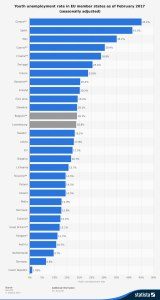


Youth unemployment rates in EU member countries (Feb. 2017)
EU youth unemployment (click to enlarge)

While Central and Northern European as well as Anglo Saxon countries also face similar challenges, these countries have weathered the storm much more strongly, and in some cases, such as in Germany, see almost nonexistent differences in unemployment between youth and adults.

In a newly released IZA Policy Paper, Francesco Pastore (Università della Campania Luigi Vanvitelli and IZA) seeks to evaluate what has led to this lack of convergence within the EU and proposes potential policy solutions to overcome it. The author primarily points to contradictory demands placed on Member States coming from the Maastricht Treaty and Lisbon Treaty as one of the key issues. And, while the recently implemented labor reforms were indeed necessary, he suggests that a shift to educational reforms is needed to fully address the problem of youth employment.

Overcoming and reforming the Maastricht Treaty’s limitations

On a basic level, one of the key drivers of unemployment is the lack of economic growth. This is specifically being seen in the Southern and Eastern European countries, which, for example, have had difficulties reaching the Europe 2020 goals. At the root of this, Pastore suggests, is the fact that the Maastricht Treaty and Lisbon Treaty, both seen as cornerstones of the EU, propose largely antagonistic recipes for growth.

While the Maastricht Treaty follows the so-called Washington consensus, a monetarist policy suggesting that financial stability is the key to growth, the Lisbon Treaty recognizes the need for infrastructure and human capital investments. As an example of the limitations of monetary policy, the author highlights the modest outcomes of the policies of quantitative easing seen in the US and the EU (too aggressive in the former, too little in the latter).

The author therefore proposes re-discussing and rewriting the Maastricht Treaty with a bottom-up approach which allows for greater financial flexibility but recognizes the insufficiency of complete financial decentralization. At the same time, public spending should constantly be evaluated and be promoted for activities that foster growth. Finally, a reinvigoration of policy that acknowledges regional differences in terms of the need for more or less EU spending would help draw in the widening gap between core and peripheral countries.

Educational curriculum should better match work requirements

While these macroeconomic adjustments are important to stimulate growth, Pastore stresses that microeconomic reforms need to be made in preparation for when growth expands again. He explains that after having focused on labor reforms for the past two decades, policy makers should now turn their attention to educational reforms. In particular, the author emphasizes the necessity of creating better links between the skills learned during education and the skills needed in the world of work.

He explains that, for the most part, the mission of education has been focused only on fostering a general education. Instead, Pastore proposes reforming the system into a more flexible dual system that provides both general education and practical work-related training. Several existing systems that better link the education system and the labor market, such as Germany’s dual system with strong apprenticeships, Japan’s Jisseki Kankei that links graduates to employers, and the job-placement services found in the Anglo Saxon countries, could all be used as potential models and adapted to fit the needs of different EU countries.

Pastore concludes that a reworking of the Maastricht Treaty, which focuses on the principles of the Lisbon Treaty—improving the level of human capital and increasing spending on research and development­­—along with increased financial and fiscal flexibility, will ultimately enhance economic growth. To do so will require more energetic decision-making at the EU level in terms of both fiscal and educational policy. Thus, solving the high youth unemployment problem in the EU will require promoting policies that better foster growth through public investments in infrastructure and human capital alongside the establishment of better links between education and the labor market.

Image: Pixabay. Chart: Statista.

Filed Under: Research Tagged With: education, EU, European Union, human capital investment, Lisbon Treaty, Maastricht Treaty, monetary policy, school-to-work, training, youth unemployment

The economic value of Breaking Bad: How misbehavior in school pays off for some kids

June 21, 2017 by admin

By Nicholas W. Papageorge (Johns Hopkins University and IZA)

Nicholas W. Papageorge

There is growing interest in how schools can shape children’s non-cognitive skills (sometimes known as behavioral traits, soft skills, or personality). One reason for this interest is that non-cognitive skills predict a wide range of economic outcomes, such as employment and lifetime earnings, but are also relatively malleable—at least until adulthood. This opens up a role for policy interventions aimed at school children. For example, schools could focus resources on cultivating positive non-cognitive skills (or eliminating negative ones) similar to the way that they develop math and reading skills. My research shows that policies aimed at reducing so-called “negative” non-cognitive or behavioral traits, however, could harm children in the long run.

Together with two co-authors, I have studied how classroom misbehavior relates to both educational attainment and labor market performance. Surprisingly, we find evidence that some non-cognitive skills that manifest as childhood misbehavior in the classroom (and are predictive of lower schooling attainment) are also predictive of higher earnings later in life. This finding challenges prevailing research, which has generally argued that misbehavior in the classroom reflects underlying skills that are bad for schooling and bad overall.

Our analysis uses data from a study following individuals born in 1958 in Great Britain. When these individuals were 11-year-olds, the study asked their teachers to fill out a series of inventories describing each child’s behavior in the classroom. The study followed these children into adulthood, collecting information on their educational attainment and employment. The length of the survey enables us to relate each individual’s economic success to his or her childhood misbehavior in the classroom.

Distinguishing different types of misbehavior is the key

It has been long established in the psychology literature that the survey information collected from teachers on classroom behavior is statistically well summarized by two underlying factors, each reflecting a different non-cognitive skill. One of the factors captures anxious, aggressive, or restless outwardly expressed (thus: externalizing) behaviors. The second embodies withdrawn, inhibited (thus: internalizing) behaviors. Recognizing the distinction between these two underlying traits is the key. If we simply summarize all misbehavior, as some previous research has done, we find that misbehavior lowers schooling attainment and also lowers earnings. This is the basis for the widespread view that childhood misbehavior has a detrimental impact on all economically relevant outcomes.

However, when we recognize that misbehavior in the classroom can be reflective of two very different non-cognitive skills—externalizing and internalizing behaviors—a much more nuanced story emerges. Both of these characteristics are associated with lower schooling attainment. However, whereas internalizing behaviors, like being unforthcoming, depressive or withdrawn, predict lower earnings, externalizing behaviors, such as aggression, predict higher earnings. In other words, the externalizing factor lowers schooling attainment, but appears to have value in the labor market. This finding calls into question the role of schooling in identifying and cultivating skills that are productive.

Externalizing behaviors can be quite lucrative

We find that externalizing behaviors raise earnings even after we account for its negative impact on schooling. We show similar patterns for men and women, however we find large differences in how externalizing affects individuals depending on their socioeconomic status as children. Children from low-income families who exhibit externalizing behaviors see no benefit in the job market. This finding confirms previous results in the literature showing that policies that reduce externalizing behaviors among children from disadvantaged families can boost their lifetime earning potential. However, our work also shows that for children who do not grow up in poverty, externalizing behaviors can be quite lucrative.

Our ongoing research asks whether patterns similar to what we found in Great Britain hold in the U.S. Preliminary evidence shows that for the same levels of externalizing behaviors, African American children face higher earnings penalties than white children. We suspect that part of this is due to higher rates of interaction with the criminal justice system for high-externalizing African Americans.

This research suggests several avenues for future caution in how we design policies targeting non-cognitive skills. This stands in contrast with health or cognition, which are generally perceived as “goods” that improve people’s lives. What we show is that non-cognitive skills, personality or behavioral traits can have very mixed effects. In our case, we show that a factor that predicts lower educational attainment also predicts higher earnings. Finally, our results on externalizing suggest that schools do not always foster the sorts of skills that are valuable in the labor market.

+++

Editor’s note: This is a slightly edited version of the article that originally appeared on the Brookings Institution’s Brown Center Chalkboard. Reposted with kind permission.

Filed Under: Research Tagged With: behavioral traits, classroom, earnings, education, non-cognitive skills, personality, school, schooling, skills

Who feels the pain of science research budget cuts?

June 12, 2017 by admin

By Bruce A. Weinberg (Ohio State University and IZA)

Science funding is intended to support the production of new knowledge and ideas that develop new technologies, improve medical treatments and strengthen the economy. The idea goes back to influential engineer Vannevar Bush, who headed the U.S. Office of Scientific Research and Development during World War II. And the evidence is that science funding does have these effects.

But, at a practical level, science funding from all sources supports research projects, the people who work on them and the businesses that provide the equipment, materials and services used to carry them out. Given current proposed cuts to federal science funding – the Trump administration has, for instance, proposed a 20 percent reduction for the National Institutes of Health – it’s important to know what types of people and businesses are touched by sponsored research projects. This information provides a window into the likely effects of funding cuts.

Most existing research into the effects of science funding tries to quantify research artifacts, such as publications and patents, rather than tracking people. I’ve helped to start an emerging project called the UMETRICS initiative which takes a novel approach to thinking about innovation and science. At its core, UMETRICS views people as key to understanding science and innovation – people conduct research, people are the vectors by which ideas move around and, ultimately, people are one of the primary “products” of the research enterprise.

UMETRICS identifies people employed on scientific projects at universities and the purchases made to carry out those projects. It then tracks people to the businesses and universities that hire them, and purchases to the vendors from which they come. Since UMETRICS relies entirely on administrative data provided by member universities (now around 50), the U.S. Census Bureau and other naturally occurring data, there are no reporting errors, sample coverage concerns or burden for people. It covers essentially all federal research funding as well as some funding from private foundations.

Who does research funding support?

Our administrative data allow us to identify everyone employed on research projects, not just those who appear as authors on research articles. This is valuable because we’re able to identify students and staff, who may be less likely to author papers than faculty and postdocs but who turn out to be an important part of the workforce on funded research projects. It’s like taking into account everyone who works in a particular store, not just the manager and owner.

We compared the distribution of people supported on research projects at some of the largest National Science Foundation (NSF) Divisions and National Institutes of Health (NIH) Institutes and Centers. Together, the NSF and NIH support close to 70 percent of federally funded academic R&D.

The striking thing is that the majority of people employed on research projects are somewhere in the training pipeline, whether undergraduates; graduate students, who are particularly prevalent at NSF; or postdocs, who are more prevalent at NIH. Staff frequently constitute 40 percent of the NIH-supported workforce, but faculty are a relatively small portion of the workforce at all NIH Institutes and NSF Divisions.

Based on these results, it seems likely that changes in federal research funding will have substantial effects on trainees, which would naturally have implications for the future STEM workforce.

What happens to STEM doctoral recipients?

Given the importance of trainees in the research workforce, we have focused much of our research on graduate students.

We mapped the universities in our sample and the share of the graduate students in each state one year after graduation. Our data show that many grad students contribute to local economies – 12.7 percent are within 50 miles of the universities where they trained. For six of our eight universities, more people stayed in state than went to any other single state. At the same time, graduate students fan out nationally, with both coasts, Illinois and Texas all being common destinations.

The doctoral recipients in our sample are also more likely to take jobs at establishments that are engines of the knowledge economy. They are heavily overrepresented in industries such as electronics, semiconductors, computers and pharmaceuticals, and underrepresented in industries such as restaurants, grocery stores and hotels. Doctoral degree recipients are almost four times as likely as the average U.S. worker to be employed by an R&D-performing firm (44 percent versus 12.6 percent). And, the establishments where the doctoral degree recipients work have a median payroll of over US$90,000 per worker compared to $33,000 for all U.S. establishments and $61,000 for establishments owned by R&D performing firms.

We also studied initial earnings by field and find that earnings of doctoral degree recipients are highest in engineering; math and computer science; and physics. Among the STEM fields, the lowest earnings are in biology and health, but our data also suggest that many of the people in these fields take postdoc positions that have low earnings, which may improve long-run earnings prospects. Interestingly, we find that women have substantially lower earnings than men, but these differences are entirely accounted for by field of study, marital status and presence of children.

Taken as a whole, our research indicates that the workers trained on research projects play a critical role in the industries and at companies critical for our new, knowledge economy.

What purchases do research projects drive?

Another way in which sponsored research projects affect the economy in the short run is through purchases of equipment, supplies and services. Economist Paula Stephan writes eloquently of these transactions, which range from purchasing computers and software, to reagents, medical imaging equipment or telescopes, even to lab mice and rats.

Still unpublished work studying the vendors who sell to sponsored research projects at universities shows that many of the firms selling to sponsored research projects are frequently high-tech and often local. Moreover, firms that are vendors to university research projects are more likely to open new establishments near their campus customers. Thus, there is some evidence that research projects directly stimulate local economies.

So while the goal of sponsored research projects is to develop new knowledge, they also support the training of highly skilled STEM workers and support activity at businesses. The UMETRICS initiative allows us to see just which people and businesses are touched by sponsored research projects, providing a window into the short-run effects of research funding as well as hinting at its long-run value.

theconversation

This article was originally published on The Conversation.
Read the original article.The Conversation

Filed Under: Research Tagged With: budget cuts, funding, R&D, research, Science, STEM, technology, unviersities

Rise in earnings inequality is the biggest difficulty in today’s US labor market

May 24, 2017 by admin

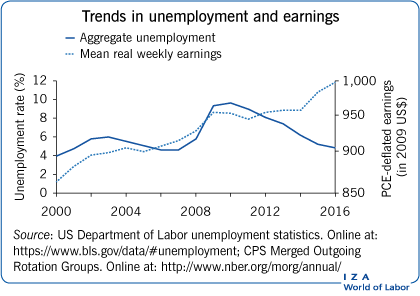
A new IZA World of Labor report looking at the US labor market (2000-2016) finds a remarkable drop in the labor force participation rate; the nearly full recovery of unemployment from the depths of the Great Recession; and the continuing growth in post-inflation average earnings while earnings inequality continues to rise.

The report by IZA Network Coordinator Dan Hamermesh (Royal Holloway, University of London) looks at the development of the American labor market since before the 2001 recession. In the aggregate the US labor market is doing quite well today. Unemployment is currently below 5%, and real weekly earnings of full-time workers increased from the 2000 cyclical peak to the current period of near full employment.

The difficulties lie behind the aggregates. Teen unemployment at 15% is far higher than desirable, especially since it is coupled with the higher long-term unemployment among teenagers. It suggests that there is an increasingly large group who are beginning their work lives with long-term disappointment and with dim career prospects.

Even though labor force participation rates of people aged 55 and over have continued to rise, those of adult men aged 20−54 have dropped, continuing a trend. Since 2000 the overall participation rate has fallen by over four percentage points. Surprisingly so too has that of women aged 20−54, sharply reversing the previous trend. This decline means that employment is about six million people lower than it would have been had the participation rate not fallen. Hamermesh argues that seeing a decline in labor market participation may suggest that Americans are developing a more reasonable work−life balance.

Though post-inflation average earnings continue to rise, so does earnings inequality, with the growth in earnings most prevalent among workers in the upper half of the earnings distribution. The earnings of African-American and Hispanic workers relative to whites have not changed greatly and remain far below those of white workers.

Hamermesh sees the continuing rise in earnings inequality as one of the biggest challenges in today’s US labor market. He suggests that the solution to this problem is simple and would put the US economy more in line with those of other wealthy nations. Since the labor market continues to generate increasing earnings inequality, its effects could be offset by tax policy affecting income inequality: The government should raise tax rates on households in the upper third of the distribution of household incomes while at the same time lowering rates on households in the bottom two-thirds.

— — —

This is the first of a series of 27 articles written by labor and macro economists from different countries who summarize the current state of the central issues in their country’s labor market: Unemployment and labor force participation, overall and by demographic group; changes in real wages and wage inequality; and other country-specific labor-market topics. Find out more on IZA World of Labor!

Filed Under: Research Tagged With: earnings, Great Recession, income inequality, labor force participation, macro conditions, unemployment, United States, US labor market

  • Previous Page
  • Page 1
  • …
  • Page 32
  • Page 33
  • Page 34
  • Page 35
  • Page 36
  • …
  • Page 69
  • Next Page

Primary Sidebar

© 2013–2026 Deutsche Post STIFTUNGImprint | Privacy PolicyIZA