• Skip to primary navigation
  • Skip to content
  • Skip to primary sidebar

IZA Newsroom

IZA – Institute of Labor Economics

  • Home
  • Archive
  • Press Lounge
  • DE
  • EN

How to increase the attractiveness of STEM for female students

June 17, 2015 by admin

Women have been traditionally under-represented in college major fields of Science, Technology, Engineering and Math (STEM). Analyzing the reasons is one of the hottest topics in the economics of education. Low graduation rates in STEM fields among women are believed to be a major driving factor behind the persistent gender wage gap.

Peter Arcidiacono (Duke University) is one of the leading scholars in the analysis of tertiary education. He recently gave an IZA seminar presentation on the effect of differences in grading standards and grade inflation on incentives for women to go into STEM. In an IZA Newsroom interview, he explained his key findings.

[Read more…] about How to increase the attractiveness of STEM for female students

Filed Under: Research Tagged With: career, college major, gender differences, grading, scholarships, STEM, university, workload

Reducing early marriage to boost female labor market participation in Senegal

June 15, 2015 by admin

Senegal is a country with large gender disparities in education and career opportunities. Early marriage and low age at first birth greatly impede women’s career prospects. A study by Francesca Marchetta and David E. Sahn, conducted under the GLM-LIC program supported by DFID and IZA, provides some important insights into opportunities for improving the well-being of Senegalese women. [Read more…] about Reducing early marriage to boost female labor market participation in Senegal

Filed Under: Research Tagged With: birth, early childbearing, education, gender disparities, GLM-LIC, labor market entry, marriage, senegal, sexual behaviors

Why labor market policies should be guided by happiness

June 11, 2015 by admin

Happiness should be a guiding factor in the governance of labor markets, argues Jo Ritzen in his most recent IZA World of Labor article. When designing employment policies, policy makers should weigh the unhappiness of the unemployed against the extra happiness which the employed derive from employment protection.
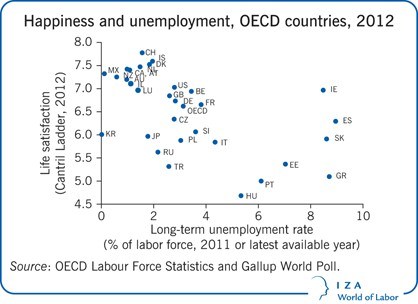
Increasing citizens’ happiness is rarely declared an official policy goal, even though many political decisions have a direct impact on people’s joy. While personal factors, such as health and character traits are the key determinants of happiness, external factors play an important role, too. Scientific studies show that employment is the most important external factor affecting people’s happiness. Unsurprisingly, studies reveal that unemployed people are in general less happy than employed people. Additionally, having a job with high employment protection provides a sense of more security and contributes to happiness.

[Read more…] about Why labor market policies should be guided by happiness

Filed Under: Research Tagged With: employment, employment protection, happiness, labor market policy, permanent contracts, temporary contracts, unemployment, well-being

The online temptation: How employees react to restrictions of internet use in the workplace

June 10, 2015 by admin

Employers tend to regard Twitter, Facebook, and other online services including e-mail as “temptations” that distract employees from the work they are supposed to do. Many firms have therefore implemented policies prohibiting private e-mail and internet use in the workplace. While such a policy removes a temptation, it also signals distrust and could hurt worker morale.

In a lab experiment, Aarhus University economists Alexander Koch and Julia Nafziger investigate how workers react to such restrictive policies. Specifically, they analyze (i) whether workers tempted to surf the internet still reciprocate generous wages by putting in substantial effort, and (ii) how an active policy of restricting internet use affects workers’ output.

[Read more…] about The online temptation: How employees react to restrictions of internet use in the workplace

Filed Under: Research Tagged With: control, distraction, facebook, fairness, private internet use, social media, twitter, wage

Addressing demographic challenges: RIETI and IZA World of Labor Policy Symposium in Tokyo

June 3, 2015 by admin

The Tokyo-based Research Institute of Economy, Trade and Industry (RIETI) and IZA World of Labor joined forces to discuss international evidence and the policy implications for Japan’s demographic challenges in the Policy Symposium “Reforming Labor Market Institutions to Promote Elderly Employment”, held in Tokyo on May 26, 2015.

In his opening remarks RIETI President Masahisa Fujita stressed the value of evidence-based policy, a common thread in the activities of RIETI and IZA. IZA’s Director for Strategy and Research Management Alessio J.G. Brown highlighted the need for evidence-based scientific policy advice and presented IZA World of Labor as an example how to support evidence-based policymaking in labor economics.

Various leading international and Japanese researchers presented experiences and evidence. In the first keynote David Neumark (UC Irvine) showed that age discrimination laws in the US have complemented social security reforms to boost the labor supply of older workers. Nonetheless, while successful in normal times, these laws failed during the Great Recession since they reduced hiring of older workers in the severe downturn. The evidence suggests that age discrimination in hiring in the US persists and needs to be addressed.

The European experience of highly regulated European labor markets and the Great Recession was presented by Juan F. Jimeno (Bank of Spain), whose keynote discussed various policy responses based on the European experience to promote elderly employment. He proposed that the degree of employment protection should not depend on seniority. Rather than severance payments, unemployment benefits with some US-type experience rating should be used to compensate for job losses. Jimeno also rejected the “lump of labor fallacy”, which implies that restricting the supply of older workers increases the employment of younger workers, as not supported by empirical evidence.

Ayako Kondo (Yokohama National University) provided facts about elderly employment in Japan and evidence on the effects of legislative reforms. Japan obliged employers to offer workers continued employment until the eligibility age for full pension benefits. This implies the need to adjust wages of older workers, and Kondo highlighted that they have actually started decreasing. She also stressed the importance of promoting female labor supply in the light of the shrinking population and relatively low female labor force participation. Promoting female employment is as important as promoting elderly employment, said Kondo.

At the beginning of the panel on lessons to be learned for Japan’s policies based on international evidence, Kotaro Tsuru (Keio University, RIETI Program Director) reiterated the need for wages to adjust and called for a shift from the existing employment type of regular employees with an unlimited scope of duties to clearly defined and specified job duties, thus, job-based regular employment.

The European experience has shown that those countries which addressed challenges on various policy margins fared much better. A significant margin to address the challenges created by population aging is increasing female labor market participation. In addition to legislative reforms, Tsuru suggested reducing labor market segmentation. Further options discussed were unemployment benefits with experience-rating for older workers and the abolition of a mandatory retirement age.

The panelists broadly agreed that the current Japanese social and employment model is no longer viable in light of population aging, and that various complementary instruments should be implemented to induce a change of the Japanese model and its perception.

See also:

  • Summary of the RIETI-IZA Symposium
  • Videos of the RIETI-IZA Symposium

Read relevant IZA World of Labor articles on this topic:

  • Late-life work and well-being
  • Is training effective for older workers?
  • Impact of aging on scale of migration
  • Effect of early retirement schemes an youth employment
  • Incentive effects of minimum pensions
  • Redesigning pension systems

Filed Under: Research Tagged With: aging, demography, evidence-based policy making, experience rating, female labor supply, Japan, older workers, pension

Causes and remedies of youth unemployment

June 2, 2015 by admin

In the aftermath of the Great Recession, one in five young people in Europe are currently unemployed, with peak rates of 50 percent or above. Against this background, the IZA Workshop “Which Institutions Promote Youth Employment?” organized by Pierre Cahuc and Konstantinos Tatsiramos brought together international researchers to discuss the role of institutions in shaping employment opportunities for youth.

At today’s workshop, we talked with Bart Cockx, a leading expert on youth unemployment, about determinants, consequences and remedies of youth unemployment.

Youth unemployment reached all-time highs during the recent recession. Who is to blame for this unprecedented development?

Bart Cockx

Bart Cockx: First, youth unemployment is high, but its level is not unprecedented. For instance, around 1984 and 1994 and 2004 youth unemployment attained similar levels in many European countries. Youth always suffer more from recessions than prime-aged workers. In economic downturns employers must absorb the decline in the demand for goods and services by laying off their less experienced – usually younger – workers and by reducing the hiring rate, which obviously hurts those at the start of their professional career more intensively. Low-skilled youth are much more affected than high-skilled, since the high-skilled can still temporarily accept jobs below their qualifications, while this strategy is not feasible for the low-skilled. So, essentially economic recessions are to blame for the high unemployment rate. The reason why youth unemployment now peaks is that the last recession was particularly “Great”.

Are young people entering the labor market during the recession truly a lost generation?

Cockx: Most existing research confirms that a recession indeed generally imposes a long-lasting penalty on the labor market career of youth who enter the labor market at that moment, but the persistence depends on the skill level and on the rigidity of the labor market. For instance, entering the relatively flexible North American labor market imposes a modest, but long-lasting earnings penalty on highly skilled youth gradually fading away in about ten years. In face of a recession, high-skilled youth is essentially forced to accept lower quality jobs with reduced career prospects. These unlucky generations can catch up with the more lucky ones by participating more intensively in training and in on-the-job search, but due to labor market imperfections this catching-up process may last as long as ten years.

For low-skilled youth the adverse effects of a recession are more severe, but short-lived. This is because in the North American labor market for the low-skilled operates more like a spot market in which wages, rather than employment reacts rapidly to changing economic conditions. Moreover, even if the low-skilled may experience unemployment in the short-run, this does have not so much impact on their long-run career, because the low skilled jobs require much less investment in human capital and involve much less long-term career contracts, reducing the negative impact of the lost labor market experience induced by unemployment.

What are the findings of your work that you presented at the workshop?

Cockx: My research studies this persistence in Belgium. The Belgian case is particularly interesting because it is regarded as one of the most rigid labor markets in the OECD: the flows in and out of unemployment are much lower than in other countries. Such a rigid labor market generally reinforces the persistence mechanisms. In contrast to North America, we find that earnings penalties persist more than ten years, both for low- and high-skilled workers. For low-skilled workers the earnings penalty is not induced by lower hourly wages, but by more unemployment, which in turn seems to impose a long-run scar on earnings.

We argue that the extremely high minimum wage is the main explanation of this finding. For high-skilled workers this minimum wage is not binding, however. For them the persistence runs mainly through lower hourly wages and, hence, like in North-America, more through the acceptance of lower quality jobs. But catching-up with the lucky generation is much more difficult in Belgium, than in North America, because Employment Protection Legislation (EPL) is much stricter for these high-skilled jobs. Hence, since this EPL reduces turnover and job opportunities for experienced workers, the Belgian high-skilled youth is much more locked into the lower quality jobs than the North-American.

What can policy makers do to help young people to cope with their challenges?

Cockx: Essentially, the best strategy for policy makers is to implement policies that reduce the likelihood, magnitude and duration of economic recessions. Notice that this does not involve policies specifically targeted on youth. Ex-post, in case a recession could not be prevented, one could enact curative policies that minimize the consequence of such a recession, for instance, by financially supporting youth to continue education, or employers to offer apprenticeships and on-the-job training during recessions.

In order to avoid persistent penalties on the labor market career, policy makers should increase labor market flexibility. In this respect, the challenge is, however, to implement labor market reforms that enhance flexibility without affecting job security. “Flexicurity” and the single contract are promising in this respect, but the problem is that there is no consensus on the exact forms these institutional innovations should take on. Moreover, such structural reforms typically require in-depth changes of institutions, and are therefore very difficult to implement politically.

***

Read more about youth unemployment in these selected IZA World of Labor articles:

  • Youth bulges and youth unemployment
  • Youth labor market interventions
  • Does vocational training help young people find a (good) job?
  • Do youth mentoring programs change the perspectives and improve the life opportunities of at-risk youth?

Filed Under: Research Tagged With: flexicurity, high-skilled, job search, low-skilled, recession, rigid labor market, training, youth unemployment

Technological unemployment is not inevitable

May 28, 2015 by admin

The relationship between technology and employment has long been a subject of debate. Technological change has contributed to the decline in manufacturing and to persistent unemployment in many advanced economies. This development is not inevitable, claims Marco Vivarelli from the Università Cattolica del Sacro Cuore in Milano. In his new article for the IZA World of Labor, he surveys the existing empirical evidence, showing that technological change can also induce job growth through innovation.

What are the roles of technology and innovation in explaining the long-term declining trend of manufacturing? Vivarelli distinguishes between job-destroying process innovation on the one hand and product innovation on the other, which can imply the emergence of new firms, new sectors, and thus new jobs. Policy makers should focus on maximizing the job-creation effect of product innovation, while minimizing the direct labor-saving impact of process innovation.

Filed Under: Research Tagged With: emerging markets, process innovation, product innovation, technological change, technology

Consumption loans: Breaking the cycle of hunger in Zambia

May 26, 2015 by admin

Small-scale farming remains the primary source of income for the vast majority of the rural population in Zambia, with typically low levels of productivity and farming income. During the hungry season (January to March), farmers who can’t get access to credit typically increase their off-farm labor supply as casual day laborers. This drives down wages and may even hurt future harvests as laborers are forced to neglect their own fields.

A research project supported by DFID under the GLM-LIC program, coordinated by IZA, looks at a potential way out of this dilemma: Providing consumption loans can help farmers invest in their own fields and possibly boost their productivity. In their study, Günther Fink, Kelsey Jack and Felix Masiye examined whether farmers would opt for a loan with reasonable interest as an alternative way to access food. In randomly selected villages in the eastern part of Zambia, farmers were offered up to three bags of maize flour during the hungry season (enough to cover the consumption needs of an average household over a three-month period). They were asked to repay in maize after the harvest.

The outcome was extremely positive. First, farmers wanted the loans: 95 percent of those offered the loan took it up. Second, farmers were able and willing to repay: among those who took out a loan, over 95 percent repaid in full. But most important, there were positive effects on consumption, the labor supply, and wages. Specifically, when compared to a randomly assigned control group, the farmers with loans missed almost 50 percent fewer meals and were forced to look for casual day labor 25 percent less often. Most remarkably, local wages increased substantially.

See also the Jobs and Development Blog:
Juggling Labor, Credit, and Crops in Zambia

image source: pixabay

Filed Under: Research Tagged With: casual day labor, consumption loans, Development, DFID, farmers, GLM-LIC, hunger, labor supply, wages, Zambia

Should colleges share the burden of student loan debt?

May 20, 2015 by admin

Tertiary education is a costly thing. How to design its financing is a major topic in public policy. Around the world, very different policies have been implemented – from tuition-free education in Germany, and interest-free loans reimbursed after graduation in Australia, to a more or less free-market solution in the U.S.

All-time high tuition fees in the U.S. and the accompanying peak in the national student loan debt of more than $1.3 trillion, with more than 80% backed by the federal government, have sparked a new discussion on how to design tertiary education financing. Default risk of students is high, exceeding that of credit cards, mortgages or auto loans. Current drastic examples like the collapse of for-profit tertiary education provider Corinthian Colleges show that the blame is partially attached to the institutions themselves. An emerging discussion addresses whether colleges should share their part of the burden of risk of students defaulting.

IZA Fellow Douglas A. Webber (Temple University) is an expert on tertiary education financing and testified in front of a U.S. Senate committee on May 20. We took the opportunity to talk to him about his opinion in the debate.

Should tertiary education institutions share their part of the default risk of student loan debt?

Webber: I am strongly in favor of this type of intervention. Student loan debt is a problem both on a macroeconomic ($1.3 trillion and growing, and has been compared to the housing bubble of the last decade) and individual level (growing debt negatively affects numerous important measures of well-being in addition to financial security). It is also important to recognize that there does not need to be fraudulent intent or poor teaching (although these are certainly issues at some institutions) for colleges to bear some fraction of the responsibility for their students’ labor market outcomes.

Risk-sharing means setting incentives to increase student completion rates. What can colleges do to keep student drop-out at low levels?

Webber: There are actually many mechanisms that schools would be incentivized to use, student completion rates are just one of the most obvious channels. Time to degree completion is important because it impacts both the level of debt and the likelihood of graduation. Getting students through their tertiary education in a more efficient way would substantially reduce the number of eventual student defaults. Furthermore, many students aren’t aware of the enormous implications that their choice of major has on their future job-finding prospects. Schools and specific degree programs need to be more transparent with the labor market outcomes of their past students. I am certainly not saying that students should choose a school or major solely based on economic factors, but if graduates from an institution/major are unable to consistently find gainful employment, prospective students and parents need to be aware of this before taking on substantial debt.

How would students be affected by such a policy change?

Webber: This was the focus of a recent IZA Discussion Paper of mine. I wanted to examine the extent to which institutions might respond to risk-sharing by passing the costs on to students in the form of higher tuition. Without getting into the technical details, I found that for the vast majority of institutions, the expected tuition increases would likely be modest (1-2%, even under fairly stringent risk-sharing penalties). The only institutions which are projected to see considerably higher tuition increases (2.5-4.5%) are those with high tuition, high rates of borrowing, and high default rates – in other words, the institutions who are most contributing to the national student debt problem.

***

Read more about the economics of higher education in these recent IZA World of Labor articles:

  • Is the return to education the same for everybody? (by Douglas Webber)
  • Do higher levels of education and skills in an area benefit wider society? (by John V. Winters)
  • Overeducation, skill mismatches, and labor market outcomes for college graduates (by Peter J. Sloane)
  • University study abroad and graduates’ employability (by Giorgio Di Pietro)
  • How to attract foreign students (by Arnaud Chevalier)
image source: pixabay

Filed Under: Research Tagged With: college, debt, financing, higher education, student loans, tuition, university

Innovative approach to reduce violence and crime in Liberia: New research supported by DFID and IZA

May 19, 2015 by admin

Cities are home to more than half the population of developing countries. Many cities struggle to deal with large-scale urban violence, crime, and drugs, especially among poor young men. In post-conflict and fragile states, poor young men are also targets for mobilization into election intimidation, rioting, and rebellion.

In Liberia, which saw two civil wars between 1989 and 2003, development experts and policymakers are seeking evidence on the most effective ways to reduce crime and violence among high-risk young men. Two of the most common policy prescriptions—job creation and policing—aim to reduce crime and violence by either changing the incentives facing young men or punishing them.

An alternative approach seeks to rehabilitate high-risk men, using therapy and counseling to foster “character skills” such as self-control and a noncriminal self-image. It has been unclear, however, whether character and self-image are malleable in adults, especially “hard core” criminals or drug users.

Researchers from Columbia University, Harvard Medical School, and the U.S. Consumer Financial Protection Bureau partnered with Innovations for Poverty Action (IPA) to test and evaluate innovative approaches for reducing crime and violence in Liberia’s capital, Monrovia. They recruited the highest risk men—those engaged in regular crime, drugs, and violence.

The study was conducted within the GLM|LIC program funded by the UK Department for International Development (DFID) and coordinated by IZA.

The main program, the Sustainable Transformation of Youth in Liberia (STYL), was an 8-week program of cognitive behavior therapy developed by a local community organization. The therapy, led by reformed street youth and ex-combatants, aimed to foster self-control and a new self-image as a member of the community. The study also tested unconditional cash transfers to the high-risk men, with and without therapy.

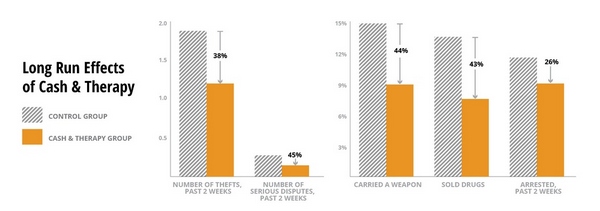
The evaluation found that even these highest-risk young men largely invested and saved the unconditional cash transfer. Almost none was spent on drugs, alcohol, or other temptations. Yet the money only produced short-run improvements in investment and income.

The therapy program, however, while not affecting income, led to persistent falls in crime, drug use, and violence—especially in the group receiving cash in addition to therapy. Researchers concluded that self-control and self-image are malleable, and that cognitive behavior therapy can help reduce less organized, impulsive, and expressive forms of violence and crime.

image source: pixabay

Filed Under: Research Tagged With: cash, cognitive behavior, crime, Development, drugs, GLM-LIC, Liberia, poverty, risk, self-image, therapy, violence, youth

  • Previous Page
  • Page 1
  • …
  • Page 45
  • Page 46
  • Page 47
  • Page 48
  • Page 49
  • …
  • Page 69
  • Next Page

Primary Sidebar

© 2013–2025 Deutsche Post STIFTUNGImprint | Privacy PolicyIZA