 It is widely believed that certain types of workers suffer from globalization since firms’ international engagement might lead to lower job security and lower bargaining power in wage negotiations. In particular, low-skilled workers are seen as the losers of globalization in this respect. In a new IZA discussion paper, Andreas Lichter, Andreas Peichl and Sebastian Siegloch test this belief empirically by looking at the effects of firms’ exporting behavior on the workers’ potential to claim higher wages in Germany. In line with common belief, the authors show that the higher the exports of a firm, the higher the competition in the product market and the lower the scope for wage increases of the workforce. Yet, they do not find evidence that low-skilled workers are particularly negatively affected. The findings of the paper could also explain the stylized fact that workers employed in exporting firms generally receive higher wages than employees in non-exporting firms: Besides reflecting differences in firm productivity, the wage premium could also serve as a compensation for higher job insecurity of the workforce and lower upward mobility of wages.
“Sex in Marriage is a Divine Gift” – but for whom?
 High fertility rates are often seen as a major cause of persistent poverty, especially in developing countries. The reason: a rise in family size is expected to reduce the money and time that parents can invest per child. A new IZA discussion paper by Christelle Dumas and Arnaud Lefranc explores this hypothesis by estimating the effect of family size on child education in urban Philippines. In the late 1990s, the mayor of Manila enacted a municipal ban on modern contraceptives in the capital. At the same time other comparable cities in the Manila metropolitan area were not affected by the ban. This policy change allows the authors to implement a research design similar to a laboratory experiment using a treatment (Manila) and a control group (the other cities). First, the authors find that the contraceptive ban led to a significant increase in family size. Second and in line with the hypothesis, the results show that increased family size leads to a substantive decrease in the children’s school performance.
Men vote for Mars, women vote for Venus
 A new IZA discussion paper by Vincenzo Galasso and Tommaso Nannicini investigates whether the degree of aggressiveness of political campaigns has a different impact on female and male voters. During the 2011 municipal elections in Milan, a sample of voters was randomly divided into three groups. While all voters were exposed to the same incumbent’s campaign, they faced different campaigns of the opponent: voters in group 1 were exposed to a positive campaign; the campaign for group 2 made use of negative advertising. Voter group 3 served as a control group and received no electoral information on the opponent. The field experiment revealed stark gender differences: negative advertising increases men’s turnout, but has no effect on women. Females, however, vote more for the opponent and less for the incumbent when they are exposed to the opponent’s positive campaign. Exactly the opposite is true for males. Thus, the authors conclude that effective strategies of political advertising should take gender into account.
Low fast-food prices make teenagers fat
 How do food prices affect body fatness of teenagers aged 12 to 18? This is the research question raised by Michael Grossman, Erdal Tekin and Roy Wada in a new IZA discussion paper. The authors use regional differences in prices for certain types of food in the United States to examine whether there is an effect on clinical measures of obesity, such as the body mass index or the percentage body fat. The findings are as follows: higher prices of fast-food restaurants decrease body fatness among youths. Moreover, teenagers lose weight if the price per calorie for food consumed at home goes up. In contrast, an increase in the price of fruits and vegetables increases obesity. The results have important implications for policy makers willing to prevent or reduce childhood obesity: a tax on meals purchased in fast-food restaurants or a subsidy to the consumption of fruits and vegetables would lead to better obesity outcomes among teenagers.
Munich discriminates against lesbians, Berlin does not
 Are lesbians subject to labor market discrimination? And can they avoid discrimination by adopting a more conventional lifestyle such as marriage? A new IZA discussion paper by Doris Weichselbaumer examines these questions for Germany. In an experiment she sent out more than 1,200 job applications in Munich and Berlin. The applications were identical except for family status (married vs. single) and sexual orientation (heterosexual vs. lesbian), as indicated through volunteer engagement in a gay and lesbian organization. The results show that discrimination based on sexual orientation is evident in Munich, but not in Berlin. Family status does not seem to matter: Lesbians who are in a “registered partnership” (same-sex marriage) are not treated more favorably than single lesbians.
How superstition affects house prices
 People looking to buy and sell homes in areas with large concentrations of Asian immigrants may benefit from a crash course in Chinese numerology. In many Chinese dialects, the word for “four” is a homonym for death, and “eight” sounds like wealth and prosperity, these differences may seem like interesting quirks or cultural cues. But if you’re holding real estate in a neighborhood that has experienced a Chinese influx in recent decades, they are no laughing matter: the last digit of your address could literally cost you or earn you extra thousands of dollars. A new IZA Discussion Paper by Nicole Fortin, Andrew Hill and Jeff Huang looks at five years’ worth of single-family dwelling sales—nearly 117,000 transactions—in the Greater Vancouver area of British Columbia, and isolates the interaction between the fateful addresses and local ethnic Chinese concentration using data from the Canadian Censuses. The authors find that homes addresses ending with lucky eights sold at a 2.5 per cent premium, while unlucky fours sold at a 2.2 per cent discount in neighborhoods with a higher than the 18 percent average Chinese concentration. Consistent with speculative behavior, the paper shows similar effects in repeated sales outside of Chinese neighborhoods. Wanting to exploit these quirks further, you are not alone; so many homeowners with ill-fated addresses have had their addresses changed so that unlucky fours have almost disappeared in some Chinese areas and city-councils are reviewing their address change policies.
Why start-up subsidies even help in labor market slumps
 Subsidizing unemployed workers to start their own business has been proven an effective policy tool to improve long-term employment and income prospects of unemployed. One open question is whether these labor market programs also work in regions with bad labor market conditions: on the one hand, subsidies might be highly effective given few vacancies; on the other hand, adverse labor market conditions might jeopardize the long-term economic success of the start-up. A new IZA discussion paper by Marco Caliendo and Steffen Künn investigates this trade-off using data on participants in German start-up subsidy programs. The authors show that even in regions with bad labor market conditions unemployed individuals in start-up programs do – mostly – better than people in privileged labor markets. This effect is mainly driven by the bad labor market prospects of the non-participants, rather than by differences in firm performance of the newly founded enterprise under different circumstances. The authors conclude that policy makers should continue to provide start-up subsidies to unemployed individuals in the future — especially in regions with unfavorable labor market conditions.
Getting stuck in the blues – on the persistence of depression and anxiety
 With 10% of the population in the Western world affected, depression and anxiety are two major health disorders. While the social and economic costs of mental health problems, e.g. less successful labor market careers and high health care costs, are widely recognized, much less is known about their persistence. A new IZA discussion paper by John Roy and Stefanie Schurer examines why symptoms of depression and anxiety are so chronic in nature. The authors hypothesize that a first-time experience of an episode of depression or anxiety will alter an individual’s way of thinking and behavior which causes the individual to get trapped in a vicious cycle of continuously experiencing such symptoms in the future. Using Australian data, the study indeed finds that experiencing an episode of depression or anxiety doubles the probability of experiencing such an episode again in the next year. Low household income is a major risk factor in this “state dependence”, as it increases this probability by almost 500%. It immediately follows that treating first episodes of depression and anxiety is crucial in averting the excessive long-term economic and social costs associated with chronic mental health problems. Hence, the authors suggest that public policy makers in Australia should increase the hours of free counseling services provided to individuals suffering from depression or anxiety (currently 10 per year), and should target in particular low-income individuals.
How being a victim of school bullying affects your labor market career
 Do victims of bullying at school still suffer later in their working lives? A new IZA Discussion Paper by Nick Drydakis answers this question by examining the long-term correlations between bullying in school and adult employment outcomes. Bullying experiences might decrease a victim’s productivity through lower academic achievement and mental health problems later in life. The empirical findings confirm this hypothesis: Labor force participation, employment probability, and hourly wages are negatively affected for bullying victims. Men are more likely to suffer from long-term consequences of bullying than women. Most vulnerable to the effects are homosexuals, immigrants, unmarried people, and those with low human capital and poor mental health.
Explaining the impact of the crisis on young and old workers in the EU
A new research project coordinated by IZA experts Werner Eichhorst and Michael Kendzia and commissioned by the EP Committee on Employment and Social Affairs analyzes the impact of the economic crisis on European labor markets, with special attention to the situation of young and old workers. The study shows that while young people in many EU countries have faced severe difficulties in finding jobs, employment rates of prime-aged and older workers have remained remarkably stable (see Figure 1).
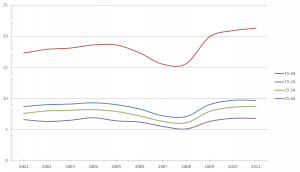
On average, youth unemployment rates have increased twice as strongly as the rates of older workers between 2008 and 2011. The study further shows that youth unemployment sky-rocketed in countries (1) where unemployment for older workers also increased strongly, (2) with large construction sectors, (3) that have implemented two-tier reforms of employment protection. In contrast, pension reforms in many EU countries since the 1990s do not seem to have lowered the employment prospects of young people.
In general, there is little evidence of a close substitutability between young and elderly workers. The reason is that young and old workers cannot readily substitute each other in most sectors of the economy, given their different experience levels and skill profiles. Additional empirical evidence from regional labor markets suggests that early exit of elderly workers from the labor market tends to aggravate the labor market outcomes of young individuals. The study concludes that the employment rates for older and younger workers are positively related, tending to converge rather than diverge (see Figure 2). Accordingly, the retention of older workers neither impedes the employment of young workers nor does it increase their unemployment, indicating that there is no competition on the labor market between young and older workers.

The study also suggests ways to solve the European unemployment problem. In order to enhance the functioning of EU labor markets, vocational education and training policies, active labor market policies, and a smooth labor market regulation are of key importance. EU members states should therefore design and implement structural employment-friendly policies that help to stimulate job creation and economic growth. Moreover, a debate on the reforming European benefit systems turning them into re-employment payments should be initiated. In addition to this, EU countries should reform their employment protection legislation. Unbalanced employment protection legislation creates barriers to mobility and discourages the job-to-job or occupational mobility of prime-aged or older workers. Lastly, the experts stress that acquiring and adjusting job-related skills is essential in a dynamically changing economy. This is particularly the case for young people, where initial training and early work experience help to establish a solid employment record. The authors of the report therefore point out that it is necessary to disseminate information about initial vocational education among EU Member States, stressing the need for continuous skill updating and retraining.