• Skip to primary navigation
  • Skip to content
  • Skip to primary sidebar

IZA Newsroom

IZA – Institute of Labor Economics

  • Home
  • Archive
  • Press Lounge
  • DE
  • EN

admin

Expensive development program did not improve living conditions in Northern Ireland

December 1, 2014 by admin

The signing of the Belfast Agreement on Good Friday 1998 is widely seen as the final act in the long process to bring peace to Northern Ireland. Although an era of violence ended on that day, Northern Ireland’s economy afterwards still lagged behind that of mainland Great Britain and inter-community tensions remained easily visible. Protestant and Catholic children, for example, were educated separately and a snake of “peace walls” physically divided the two communities in Belfast and other urban centers.

To overcome these problems the European Union brought the PEACE II project into being. Starting in 2000, approximately one billion euros were spent over six years on community-instigated projects with the aim of bringing communities together and reconciling past differences. Despite the huge outlay, however, official monitoring of the program’s success is, at best, lacking in transparency.

In a recent IZA Discussion Paper, Tilman Brück and Neil T. N. Ferguson fill this gap by exploring data on perceptions of latent neighborhood quality from the British Household Panel Survey. They focus on two questions: The first asks individuals whether or not they like the neighborhood in which they live. The second asks whether or not they would like to move house. This data is matched to a database of all 12,000 applications for PEACE II funding. It includes information on whether or not the application was successful, how much funding was given to each project and the location in which the project was expected to have impacts.

The results show that individuals in areas that received more funds exhibit higher perceptions of neighborhood quality than others, but that this relationship is not causal. Thus, spending appears to have reached only those communities that exhibited already elevated perceptions of quality but it does not otherwise play a role in determining individuals’ feelings about the neighborhood in which they live. This suggests that PEACE II did not necessarily reach the neighborhoods most in need of support, and that it is not associated with any longer-term improvements in the areas in which projects were funded.

A cursory glance at recent developments in Northern Ireland may suggest that such a finding is not entirely unexpected. Almost fifteen years after the program began, inter-community tensions remain prevalent and, whilst improving, economic performance still lags behind mainland Britain. Schooling remains segregated along religious lines and the number of peace walls has actually increased since PEACE II began.

While the targeted spending of peace-building interventions is unlikely to be an inherently bad thing, the outcomes of PEACE II suggest that how spending is targeted must be more carefully considered. The success of targeted spending requires policymakers to accurately determine the areas that will benefit most from intervention, as well as evaluating the quality of the interventions.

Filed Under: Research Tagged With: Belfast Agreement, catholic, education, funds, house, intervention, neighborhood, PEACE II project, peace wall, protestant, religious lines

Learning from the older brother? Sibling spillover effects in school achievement

November 28, 2014 by admin

How much a younger sibling’s school achievement is affected by his/her older sibling’s achievement at school is an important question to answer as it helps us understand whether investments in children may have multiplier effects through their impact on younger children. Cheti Nicoletti and Birgitta Rabe are the first to investigate this “sibling spillover effect” in a new IZA paper.

The older sibling’s achievement may have a direct effect on the younger sibling’s school grades if 1) the older sibling teaches the younger sibling or helps with homework; 2) the younger sibling imitates the older sibling, for example in their work style, or conversely tries to be different, for example to avoid competition; 3) the older sibling passes on important information about educational choices or school and teachers to the younger sibling.

When trying to assess the extent of any sibling spillover effects, it is important to distinguish the direct influence of the older to the younger sibling from any similarities in their exam grades that are caused by the fact that they come from the same family and are likely to go to the same school. Nicoletti and Rabe do this by combining several techniques known to economists.

The study shows that there is a small direct effect from the older sibling’s test scores to the younger sibling’s exam marks. More precisely, for each GCSE exam grade improvement of the older sibling – for example from a B to an A – the younger sibling’s exam marks would go up by just 4% of a grade. This effect is about equivalent to the impact of increasing yearly spending per pupil in the younger sibling’s school by £670.

The spillover effect is larger for siblings in families eligible for free school meals, living in deprived neighbourhoods and speaking a language other than English at home. This means that children from more deprived backgrounds benefit more from a high attaining older sibling than children from more affluent backgrounds.

It may be that the effect arises through information sharing about educational choices and schools/teachers. Information on this is likely harder to come by in poorer families, and the benefit to younger children therefore high. The findings of the study indicate that siblings can play an important role in conveying education-related information in families where parents have less access to such information. This suggests that investments into children from deprived families can have considerable multiplier effects on younger siblings.

Read abstract or download complete paper [PDF].

Filed Under: Research Tagged With: children, education, exams, learning, school achievement, siblings

European unemployment insurance faces dilemma

November 26, 2014 by admin

More substantial fiscal integration in Europe by way of a common unemployment insurance scheme for eurozone member states? This question is currently a subject of intense discussion. Would an automatic stabilizer like this necessarily turn Europe into a transfer union? A recent IZA Discussion Paper by Mathias Dolls, Clemens Fuest, Dirk Neumann, Andreas Peichl shows that a European Unemployment Insurance would have cushioned the impact of the recent crisis in the most embattled euro area member states. Germany would have been a net contributor in the period between 2000 and 2013 despite the rather weak economic situation at the turn of the millennium. In future crises, however, burden-sharing might take a different turn.

Does the euro area need an unemployment insurance that completely or partially replaces national systems? Opinions on that matter are divided in the areas of politics and academia. Proponents stress that a joint unemployment insurance would stabilize total demand in the participating countries in times of crisis. Objectors argue that a European insurance system would transform the eurozone into a transfer union. The new study examines how different models of a European unemployment insurance would have affected households in the 18 countries of the euro area between 2000 and 2013. This is the first micro-data simulation to address this research question.

The authors found evidence that an unemployment insurance scheme for the euro area that pays a rate of 50 percent of the recipient’s last income level for a duration of 12 months could have been implemented with a relatively small annual budget. Over the period from 2000 to 2013, the benefits paid “by Europe” would have amounted to about 49 billion euros per year. In the simulation, the budget of the scheme was financed by the eurozone members with a standard contribution rate of 1.57 per cent of income per employee.

Five out of 18 euro area countries considered in the study would have been net contributors or net recipients in each year of the simulation period. The largest net contributors would be Austria, Germany and the Netherlands with average annual net contributions of 0.2–0.42 per cent of gross domestic product (GDP). Spain and Latvia would be the largest net recipients with average annual net benefits of 0.53 and 0.33 per cent of GDP. Cross-country redistribution effects are limited, however, if benefits are strictly directed towards member states where the labor market situation is worsening. In such a scenario, not a single eurozone member state would have been a permanent net contributor. All in all, household incomes would have been stabilized, in particular at the beginning of the financial and economic crisis.

photo credit: xtock via Shutterstock

Filed Under: Research Tagged With: benefits, Europe, Eurozone, fiscal integration, Germany, joint unemployment insurance, net contributors, transfer union

Stealing to survive: Crime rates rise in response to poor harvest

November 24, 2014 by admin

Between 1863 and 1890, phylloxera (an insect which attacks grapevine roots) destroyed about 40% of the French vineyards. The crisis could only be stopped when vineyards were replanted with hybrid American vines which were resistant to the insect.

This poor harvest induced a large productivity shock in the 19th century French economy that was still largely dependent on agricultural production (accounting for 30 percent of GDP at the time). Local credit markets, which could have alleviated the crisis, collapsed and the modern welfare state was not yet established. For a large share of the population, this meant a huge negative income shock.

The fact that phylloxera affected the different départements in different years offer a natural experiment to explore the effects of this negative income shock on property and violent crime rates, as done by Vincent Bignon, Eve Caroli and Roberto Galbiati in their new IZA Discussion Paper.

The results: Full contagion by phylloxera in a département on average increased property crime rates by 18 percent whereas violent crime rates dropped by about 12 percent. The authors show that the latter decrease really is driven by the drop in wine supply. The crisis lowered the consumption levels of alcohol, making the people less receptive for violence.

Filed Under: Research Tagged With: agriculture, alcohol, crime, France, income shocks, phylloxera, productivity, shock, violence, wine

The coach matters: Evidence from the Bundesliga

November 21, 2014 by admin

What difference does the quality of the single person at the top make for the overall performance of the organization? How dependent are large companies on their CEOs? Are they really the ones leading the firm or just mascots with very limited powers?

These questions are very hard to answer since CEOs work only for a very small number of different firms in their lifetime. This limits the scope to measure their contribution to organizational success, because observing the same manager in different organizations thus using different sets of resources and working with different people is crucial to measure a manager’s contribution to overall success.

In a new IZA Discussion Paper, Sandra Hentschel, Gerd Mühlheußer and Dirk Sliwka study the impact of managers on the success of professional soccer teams using data from the German “Bundesliga”. The authors exploit the high turnover of managers between teams to disentangle the managers’ contributions. Furthermore, team performance is publicly observable on a weekly basis.

The researchers find that teams employing a manager at the 75% ability percentile gain on average 0.25 points per game more than those employing a manager at the 25% ability percentile, which corresponds to a sizeable difference of 18% of the average number of points awarded per game.

As an example: In comparison to a moderately able manager, a team coached by Jürgen Klopp (the current coach of Borussia Dortmund) would have achieved 0.46 points more per game, leading to 15.64 more points per season. On the other hand, a team coached by Benno Möhlmann (the current manager of FSV Frankfurt) would have acquired 0.33 points less per game or 11.22 points per season.

Filed Under: Research Tagged With: Bundesliga, CEO, coach, company, firm performance, football, manager, organization, team

Is formal care as good as the support of loving grandparents?

November 19, 2014 by admin

Since early childcare plays an important role in the development of cognitive skills, it partially determines success later in life. What improves cognitive ability and behavioral development at a young age is therefore of crucial policy importance.

While early psychological theories have stressed the need for maternal care, more recent studies in psychology as well as in sociology and economics show that other childcare arrangements do not necessarily produce negative outcomes. Two of the most common alternatives to parental care are support by the grandparents and formal care centers.

In a new IZA Discussion Paper, Daniela Del Boca, Daniela Piazzalunga and Chiara Pronzato analyze the influence of these arrangements on the development of the child. Using data on 10,000 babies born in the UK in 2000 and 2001, the researchers find that children cared for by grandparents are better at naming objects, but perform worse in tests concerning basic concepts development, problem-solving, mathematical concepts and constructing ability than children in formal care.

Concerning school readiness at age three, the authors observe a positive effect of formal care centers, while more hours spent with grandparents have a negative influence. Also the positive effect on grandparents’ support on vocabulary at age three vanishes when the children become five years old.

Nevertheless, these results hide strong heterogeneities: The positive association between grandparents’ care and child outcomes is stronger for children growing up in more advantaged households (higher income and education) while the negative association is significant only for children in more disadvantaged households (lower income and education).

Filed Under: Research Tagged With: ability, baby, childcare, cognitive skills, education, formal care, grandparents, parents, UK

Is formal care as good as the support of loving grandparents?

November 18, 2014 by admin

Since early childcare plays an important role in the development of cognitive skills, it partially determines success later in life. What improves cognitive ability and behavioral development at a young age is therefore of crucial policy importance.



While early psychological theories have stressed the need for maternal care, more recent studies in psychology as well as in sociology and economics show that other childcare arrangements do not necessarily produce negative outcomes. Two of the most common alternatives to parental care are support by the grandparents and formal care centers.

In a new IZA Discussion Paper, Daniela Del Boca, Daniela Piazzalunga and Chiara Pronzato analyze the influence of these arrangements on the development of the child. Using data on 10,000 babies born in the UK in 2000 and 2001, the researchers find that children cared for by grandparents are better at naming objects, but perform worse in tests concerning basic concepts development, problem-solving, mathematical concepts and constructing ability than children in formal care.

Concerning school readiness at age three, the authors observe a positive effect of formal care centers, while more hours spent with grandparents have a negative influence. Also the positive effect on grandparents’ support on vocabulary at age three vanishes when the children become five years old.

Nevertheless, these results hide strong heterogeneities: The positive association between grandparents’ care and child outcomes is stronger for children growing up in more advantaged households (higher income and education) while the negative association is significant only for children in more disadvantaged households (lower income and education).

Filed Under: Research Tagged With: ability, baby, childcare, cognitive skills, education, formal care, grandparents, parents, UK

Mobilizing employment potentials of the service sector in manufacturing-heavy economies

November 17, 2014 by admin

Modernizing developed economies in order to remain competitive in global markets is a pressing issue when manufacturing jobs can be automated or off-shored, with the threat of many of these jobs disappearing in the nearer future. This potentially affects all developed economies, but in particular manufacturing-heavy countries such as Germany or Korea.

Werner Eichhorst

The Korean Development Institute (KDI) recently organized an international expert forum in Seoul to discuss how to promote future employment potentials in different types of services. A major challenge is to take advantage of technical innovations such as digitalization to create new and more sophisticated manufacturing goods that can be complemented by services. In the future we will likely see more service-oriented types of employment around innovative manufacturing core activities. Here, skill formation, but also regional and sectoral clustering is important. And the better this works, the smaller is the risk of off-shoring and automation, as IZA Director of Labor Policy Europe Werner Eichhorst explained at this event, using the German experiences as a case in point.

Related to the issue of rapid structural change and observable job polarization between knowledge-intensive and personal service tasks in many developed economies is the important issue of creating employment opportunities for the most disadvantaged, in particular the low-skilled and the long-term unemployed. Here, different options are available: training investment, publicly supported employment and direct job creation or a more flexible labor market relying on non-standard types of employment and low pay.

An international workshop organized by the Korean Employment Information Service (KEIS) collected the international evidence and stimulated the exchange of national experiences with these policy approaches. Apart from questions around the design and evaluation of active labor market policies for the most vulnerable groups, Werner Eichhorst addressed the issue of low pay and increased labor market flexibility as an alternative option in order to foster job creation for low-skilled or long-term unemployed people.

Werner Eichhorst also appeared on Korea’s Arirang television (Dec. 4, 2014):

Filed Under: Research Tagged With: employment growth, Germany, job polarization, Korea, labor market flexibility, low pay, manufacturing, sectoral clustering, service sector, skill formation

Online quizzes can motivate students to learn more

November 11, 2014 by admin

A large fraction of students fail at university. One potential reason is that students do not exercise enough effort on a regular basis. If intrinsic motivation does not suffice to induce satisfactory student performance, then what interventions might help to increase student effort and performance?

In a recent IZA Discussion Paper, Arnaud Chevalier, Peter Dolton and Melanie Lührmann vary incentives for students to provide effort on a weekly basis. They focus only on one type of effort, participation to a weekly online quiz which provides students with feedback of their understanding of the lecture.

On a given week, students face either no incentive, get additional educational material if they participate, the best performer wins a book voucher, or the quiz is declared to be compulsory. In a second cohort, two additional incentives are included, the quiz grade counts for 2.5% or 5% towards the final grade for the course.

The study finds that the provision of additional educational material has little impact on weekly effort, whereas the book voucher rewarding only the top performer even reduces participation. But if effort is rewarded in terms of grades, then participation becomes close to what it is under compulsion. Assessment weighting increases quiz effort and continuous learning relatively more among lower ability students.

For the cohort subjects to the assessment weighting of quiz grades final grades improve at an average of 4%. These performance increases are in the order of magnitude of the results for large financial incentives. Since all incentives in the setup relate directly to course outcomes and are easy to scale up at a low cost, the authors conclude that it is quite easy to increase students effort and grades.

Filed Under: Research Tagged With: achievement, effort, exams, grades, incentive, motivation, participation, quiz, student, university

Which kids are born in a crisis? Evidence from the fall of the Berlin Wall

November 6, 2014 by admin

By Arnaud Chevalier and Olivier Marie

Do individuals born at different points of the economic cycle have different outcomes, and what could be the reasons? To answer this question, we explore the educational attainment and criminal activity of children born in East Germany, in the few years after the collapse of the Berlin Wall when uncertainty about the future was extremely high. We first discuss how such economic circumstances could affect parenting decisions of individuals differently depending on their characteristics and thus lead to cohort selection. We then provide empirical evidence on selection looking both at the child’s outcome and at the mechanisms which may have led to them.

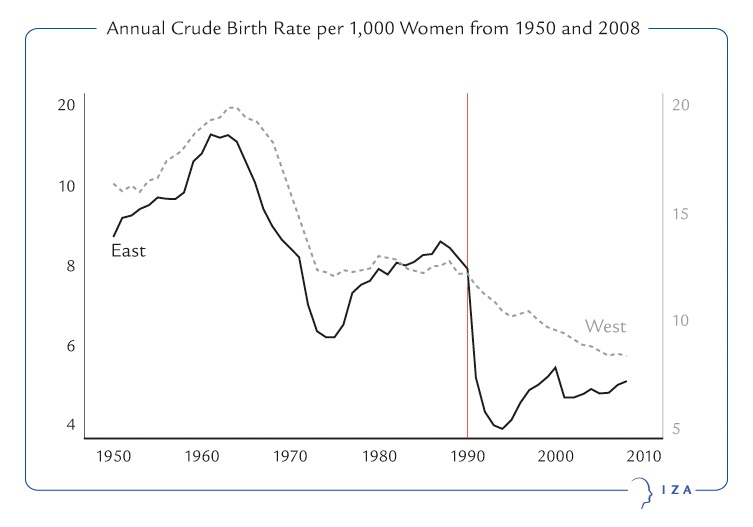
This November, Germany and the rest of Europe celebrate the twenty fifth anniversary of the fall of the Berlin Wall which was perhaps the most symbolic moment of the collapse of the communist regimes in Eastern Europe. This event had colossal repercussions in the economic development of the region but also, and maybe less obviously, on its demography. Following the collapse of the Communist regimes, fertility in Eastern Europe went into a sharp decline. This was especially marked in East Germany which over a very short period experienced a 50% drop in fertility (see figure below) which has been described by demographers as the “most substantial fall in birth rates that ever occurred in peacetime”.

Based on administrative population data from the Federal Institute for Population Research.

Economic uncertainty was one of the main reasons for the fertility drop. Which kind of parents decide to still have children in these distressing economic times, and does this parental selection matter in terms of the cohort outcomes? Theoretically, an economic downturn has two opposite effects on the demand for children, it reduces household income (income effect) but it also reduces the opportunity costs of having children (substitution effect). Which effect dominates is a priori ambiguous, but since fertility is pro-cyclical, the income effect appears to dominate overall. In fact, it is likely that the relative size of the substitution and income effect depends on family characteristics, leading to differences in parental composition throughout the economic cycle. Indeed, a 2004 study shows that in the U.S. white mothers giving birth when unemployment is higher are less educated resulting in worse health outcomes at birth.

The fall of the Berlin Wall provides a unique “natural experiment” to study this question. In our 2013 paper we define the cohort of children born in East Germany between August 1990 (conceived just after the collapse of the wall) and December 1993 as the “Children of the Wall”. We provide evidence on parental selection based on i) the average criminal activity of the Children of the Wall as they grew up, ii) their educational attainment and iii) detailed individual level data, on both mother and child, regarding parental skills.

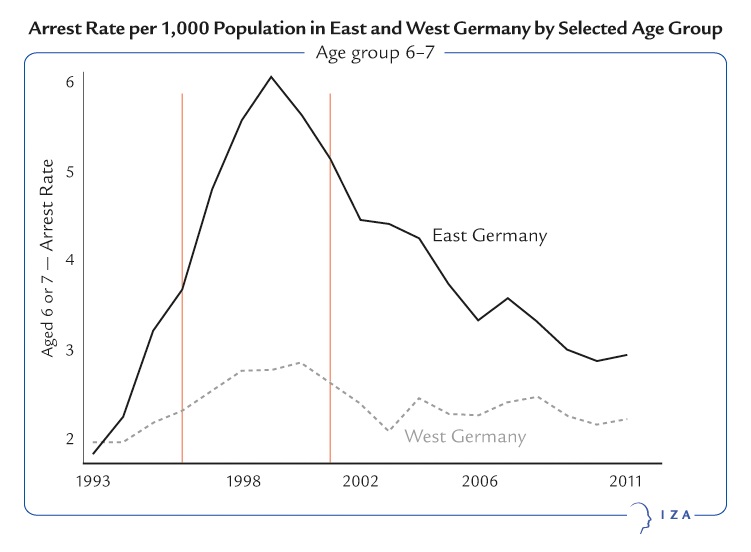
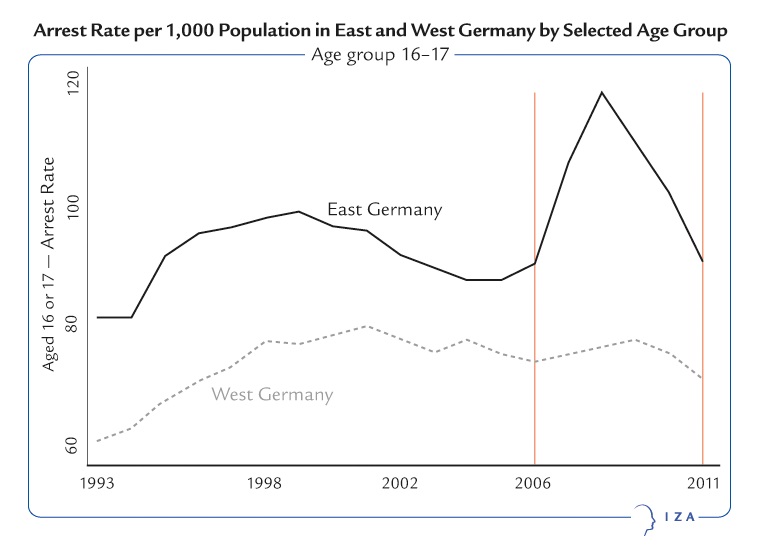
Using state level statistics on contact with the police by age group over the period 1993-2011, we find that the Children of the Wall exhibit arrest rates at least 40 percent higher when compared to older cohorts and to their West German peers. This is true for all crime types and for both boys and girls. Importantly, these differences in the frequency of contact with the police start appearing as early as age 6 (see figure below). This is despite being part of a numerically smaller cohort, which is usually associated with positive outcomes and is indicative of a strong negative parental selection.

Based on administrative arrest data provided by the Federal Criminal Police Office.

Vertical red lines indicate the Children of the Wall cohort.

Similarly, the children of the Wall have worse educational outcomes. Compared to their class peers who were conceived just before the wall fell, they have lower test scores in PIRLS (age 11-12) and PISA (age 15-16) and are over-represented amongst low achievers. As such, they are 33% more likely to have repeated a grade by age 12 and 9% more likely to have been put into a lower educational track.

To explore if these negative outcomes are driven by negative parental characteristics, we make use of very detailed survey data from the German Socio Economic Panel (SOEP) and the Deutsches JugendInstitut survey (DJI). Women who gave birth in East Germany just after the end of the communist regime were on average younger, less educated, less likely to be in a relationship and less economically active. Importantly, they also provided less educational input to their children even if they are not poorer. The Children of the Wall also rate their relationship with their mothers and the quality of parental support they have received by age 17 much less favorably than their peers. Both these children and their mothers are also far more risk-taking than comparable individuals who did not give birth (were not born) in East Germany between August 1990 and December 1993.

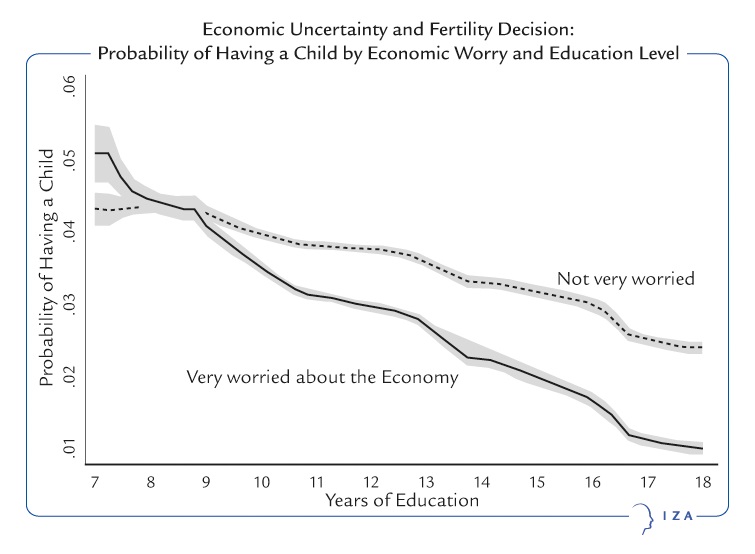
While these results are in line with negative parental selection, they could also be driven by timing of birth effects: Due to the economic turmoil prevalent at the time, these children may have experienced higher levels of maternal stress in utero and during early childhood, which may have shaped their future behavior. To assess this hypothesis, we examine the same set of outcomes for the older siblings of the Children of the Wall who were born in the non-uncertain times of East German Communism. They also similarly report having a poor relationship with their mothers, lower educational attainment, and are more risk taking individuals. We thus reject the possibility that the Children of the Wall have worse outcomes due to being born in ‘bad times’ and instead conclude that the negative outcomes observed for this cohort are explained by the lower average parenting skills of those who decided to have children during a period of high economic uncertainty. A possible reason for this negative parental selection is that the fertility decision of these women does not react as strongly to changes in the economic environment. Indeed, further analysis of the SOEP reveals that, less educated mothers are far less l

Note: The graph plots the estimated probability of having a child in the period 1991/93 separately for individuals reported to be very worried about the economy (‘very’ = 1 and ‘somewhat’/‘never = 0) or not, by years of education for all women aged 17 to 47 surveyed in SOEP during this period. The probit model which generates these coefficients also includes education, age and year dummies. The grey area represents the 95 percent confidence intervals.

ikely than more educated one to reduce their fertility when they perceive a bad economic environment (see figure):

Our findings confirm that parental selection may be one of the best predictors of the future outcome of a cohort, and that this most likely works through quality of parenting. These conclusions have potentially important policy implications. First, provision of public services should not only be based only on the size of an incoming cohort, and more attention should be paid on its composition. Second, interventions need to start from a very young age, and targeting could probably be improved by more commonly including non-cognitive characteristics such as risk attitude of expecting mothers or children.

Filed Under: Research Tagged With: arrest rates, Berlin Wall, children, criminal activity, East Germany, economic uncertainty, educational attainment, fertility, kids, mothers, parental selection, parenting, risk-taking

  • Previous Page
  • Page 1
  • …
  • Page 24
  • Page 25
  • Page 26
  • Page 27
  • Page 28
  • …
  • Page 45
  • Next Page

Primary Sidebar

© 2013–2025 Deutsche Post STIFTUNGImprint | Privacy PolicyIZA