• Skip to primary navigation
  • Skip to content
  • Skip to primary sidebar

IZA Newsroom

IZA – Institute of Labor Economics

  • Home
  • Archive
  • Press Lounge
  • DE
  • EN

Dajan Baischew

What was the effect of Hartz IV on German unemployment?

April 9, 2019 by Dajan Baischew

By Brigitte Hochmuth, Britta Kohlbrecher, Christian Merkl and Hermann Gartner

About 15 years ago, Germany implemented the Hartz labor market reforms. Since then German unemployment has dropped substantially (see Figure 1). The most controversial reform step was the so-called “Hartz IV” reform that reduced unemployment benefits for long-term unemployed. While macroeconomists agree that Hartz IV has reduced unemployment, there is no agreement by how much.
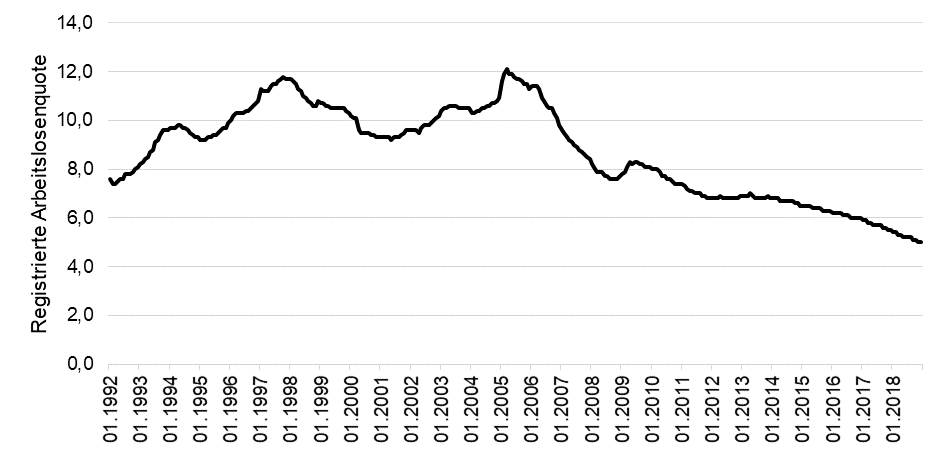
Figure 1: Registered Unemployment Rate for Germany, 1992-2018.

In order to quantify the macroeconomic effects of Hartz IV, it is necessary to use model-based simulations. Launov and Wälde (2013), Krebs and Scheffel (2013) and Krause and Uhlig (2012) analyze the effects of the reform on unemployment to employment transitions. However, they come up with very different quantitative results. While according to Launov and Wälde unemployment dropped by 0.1 percentage points due to Hartz IV, Krause and Uhlig find a 2.8 percentage point decline. A key reason for these differences is that each of these studies uses a different decline of the replacement rate for long-term unemployed as model input. The actual decline is difficult to measure due to complex institutional structures.

We avoid this problem by using a novel approach to evaluate the reform. We propose a macroeconomic model in which we distinguish between partial effect and equilibrium effect. We define the partial effect as the direct impact of the reform observed at the individual worker-firm level. Due to the reform, workers are ready to make concessions, e.g. accept lower wages. Thereby, firms are more likely to hire a given job applicant. In our terminology, firms’ selection rate increases.

We measure the selection rate with data from the IAB Job Vacancy Survey. This measure corresponds to the share of suitable applicants hired by plants. Thus, we construct an empirical time series for hiring standards and show that this margin moves procyclically (as predicted by our model). Furthermore, we estimate the partial effect of the Hartz IV reform based on the response of the selection rate and target this effect in our quantitative model. This approach has three advantages: First, in contrast to the job-finding rate (matches over unemployment), the selection rate does not have a structural break in 2005. Second, the selection rate is not contaminated by direct effect of the Hartz III reform. Third, we measure the partial effect directly instead of assuming a certain decline of the replacement rate.

Figure 2 shows that the selection rate increases in booms and decreases in recessions. Market tightness (vacancies divided by unemployment) indicates the state of the business cycle on the labor market. Furthermore, the selection rate increased substantially at the time of the Hartz IV reform. We estimate changes of the selection rate at different aggregation levels and control for business cycle effects. Overall, according to our approach, the partial effect (i.e. increase of the selection rate) led to a decline of unemployment by about one percentage point.

Figure 2: Dynamics of German labor market. For better comparability, each of the time series is normalized to an average of one.

However, the partial effects tells only part of the story. On top of it, there is an equilibrium effect. When unemployed workers are willing to accept a lower wage, firms start posting additional vacancies. More vacancies increase the probability of workers to get in contact with a firm. At the same time, the selection rate increases (partial effect) and thereby the probability that a contact becomes a match. Based on the observed dynamics of the job-finding rate and the selection rate, we determine the relative importance of partial effect and equilibrium effect. It turns out that both effects are similarly important. According to our model simulation, unemployment declined by more than 2 percentage points due to Hartz IV, which corresponds to around one million additional jobs.

Our results regarding the partial effect are in line Price (2018) who uses a causal microeconometric estimation at the worker level. Furthermore, our model simulation can replicate the shift of the Beveridge Curve (joint movement of unemployment and vacancies) in the aftermath of the Hartz IV reform. It has to be noted that our approach delivers a lower bound for the macroeconomic effects of Hartz IV because the reform may also have reduced separations, which we keep constant in our simulation (see Klinger and Weber (2016) and Hartung, Jung and Kuhn (2018)).

Overall, we find substantial effects of the Hartz IV reform on aggregate unemployment. According to our analysis, the reform has created at least one million additional jobs. Our paper only analyzes the positive dimension, which is an important prerequisite for a better understanding of normative aspects.

Filed Under: Opinion, Research Tagged With: Germany, Hartz reforms, labor market, unemployment, unemployment insurance

The ‘Race against the Robots’ and the ‘Fallacy of the Giant Cheesecake’

April 3, 2019 by Dajan Baischew

Technology is the wildcard in humanity’s survival, development and future prospects. In the past, various waves of technological innovations and scientific advances facilitated the emergence of homo sapiens as the dominant species on the planet. Recently a new technology has arrived that has been described as a new general-purpose technology akin to electricity: Artificial Intelligence (AI).

There are concerns that AI will disrupt society. The immediate concern is whether labor can win a ‘race against the robots’ and the longer-term concern is whether an artificial general intelligence (super-intelligence) can be controlled. A new IZA discussion paper by Wim Naudé describes the nature and context of these concerns, reviews the current state of the empirical and theoretical literature in economics on the impact of AI on jobs and inequality, and discusses the challenge of AI arms races. Naudé concludes that despite the media hype neither massive jobs losses nor a ‘Singularity’ are imminent.

His conclusion is based on these main findings:

  • The methods to calculate potential job losses are sensitive to assumptions used.
  • Automation may affect tasks more significantly, rather than the jobs within which they are performed.
  • Net job creation can be positive because automation stimulates the creation of new jobs or jobs elsewhere.
  • Diffusion of AI may be much slower than is thought or assumed.
  • The tempo of innovation in AI is slowing down, and complementary investments and innovations are needed for this.

Even though AI thus seems unlikely to have either utopian or apocalyptic impacts, Naudé points at a number of implications that will challenge economists in coming years. These include regulation of data and algorithms; the (mis-)measurement of value added; market failures, anti-competitive behavior and abuse of market power; surveillance, censorship, cybercrime; labor market discrimination, declining job quality; and AI in emerging economies.

Filed Under: Research Tagged With: artificial intelligence, automation, digitalization, future of labor, robots

Peer diversity and college performance

March 28, 2019 by Dajan Baischew

The tertiary education system has experienced fast-paced internationalization during recent decades. Between 2000 and 2013, UNESCO statistics indicate that the number of international students rose from 2.0 million to 4.1 million worldwide. The UK has become one of the largest recipient countries of foreign students. In 2016, Britain hosted more than 400,000 international students, which amounts to 18% of the student population in the country.

With this trend, a scientific and politic debate emerged on the benefits but also the costs of a diverse student body: Advocates of internationalization argue that both native and foreign students benefit from diversity, although critics raise concerns about potential negative spill-overs due to a deterioration of the learning environment, which may even result in native college flight. Empirical evidence pointing to small ambiguous effects of increasing numbers of foreign students is scarce and mostly restricted to primary and secondary education.

Randomly assigned seminar groups to estimate causal effect

A new IZA discussion paper by Arnaud Chevalier, Ingo Isphording and Elena Lisauskaite adds to the understanding of how the ethnic composition of small-scale learning groups can affect student performance and choices. Based on the administrative records of economics students at a university in the London metropolitan area, the researchers make use of a “natural experiment”: Students in the economics program are allocated as-good-as-randomly to small teaching groups. Hence, whether a student meets a large and linguistically diverse group of non-English-speaking students or a homogeneous group is purely due to chance. This feature enables the researchers to estimate the causal effect of being assigned to a linguistically diverse learning environment.

No negative spill-overs from foreign students

Contrary to commonly held beliefs about negative spill-overs from foreign students, the results show that the performance of English-speaking students is unaffected by the share of non-English-speaking students and the linguistic diversity of a classroom. More importantly, for a given share of non-native speakers in the classroom, increased linguistic diversity improves the academic performance of non-English-speaking students, especially for low-achieving students. This result appears to be driven by changed patterns of classroom interactions across ethnicities. Asked about their experiences, non-English-speaking students revealed they were much more likely to interact with English-speaking students when they were assigned to a more diverse classroom.

These immediate effects of classroom compositions have longer-run consequences for academic choices of students. When exposed to higher shares of non-English-speaking students in their early study seminars, non-English-speaking students choose more numerical classes and courses that are generally more popular among non-English-speaking students. But this effect is mediated when the non-English-speaking group is more diverse. Even after graduation, the effects seem to influence migration decisions of students.

Less segregation enhances performance of foreign students

The results of the study have implications for education practitioners. Even in an environment where non-English-speakers represent more than half of the students, the authors do not find any negative effects on the performance and educational choices of English-speaking students. Moreover, avoiding linguistic segregation in early university years appears to be a useful tool to enhance the performance and integration of foreign students. “Our results support current policies of pursuing greater internationalization in higher education,” says Ingo Isphording. “Calls for stricter admission policies based on origin seem to be unfounded.”

Filed Under: Research Tagged With: academic performance, college, diversity, globalization, higher education, language, university

How minimum wages affect employment and labor market participation

February 21, 2019 by Dajan Baischew

By Ernest Boffy-Ramirez

Minimum wages have been studied so extensively that it is rare to find a fresh angle that piques labor economists’ interest. Despite a mountain of literature, advances in empirical methods, and the availability of new data, definitive studies are scarcer than policymakers would hope to find. The empirical challenges researchers of the minimum wage face boil down to specifying an appropriate counterfactual control group that could be used to understand what would have happened to unemployment and labor force participation in the absence of a minimum wage change.

The difficulty of addressing this challenge is evident in the variety of empirical approaches seen in the literature. In my new IZA Discussion Paper, I address this issue by looking at thousands of individuals immediately before and after a minimum wage increase. Using short 4-month individual panels that straddle state minimum wage changes in the U.S., this paper estimates the impacts of minimum wage changes on individual unemployment, part-time employment status, and labor force participation.

Different family structures, preferences for work, reservation wages, and demographic characteristics all mean that individuals are unique in their interaction with the labor market. The empirical strategy in this paper compares individuals to themselves, assuaging the need to defend a counterfactual control that may look like the individual who experienced a minimum wage increase from the outside, but is fundamentally different in other respects. Any biases generated by unchanging individual-specific characteristics, like an individual’s propensity to move in response to a minimum wage increase or their tastes for full-time vs. part-time work, are controlled for and the narrow temporal window aids in the identification of minimum wage effects by reducing the possibility that slower-moving economic shocks are confounding the results. The Current Population Survey’s month-to-month survey design ensures the impacts are contemporaneous.

The sample period from 1990–2017 covers hundreds of effective state minimum wage changes experienced by hundreds of thousands of unique individuals in the U.S. The size of the CPS samples, the substantial variability in the magnitude of minimum wage changes, and the number of changes in minimum wages over this period reinforce the generalizability of the results. These features of the data mean I have the necessary power to be able to estimate minimum wage impacts on smaller demographic subsamples likely to be impacted by the minimum wage.

I choose to analyze populations determined relevant by previous literature—teens, young adults, and the less educated. This paper’s primary results can be summed up in three conclusions. First, there is almost no evidence of a rise in unemployment immediately following a minimum wage increase. Second, it does not appear that employers are substituting full-time workers for part-time workers. Third, there is robust evidence that immediately following a minimum wage increase, there are fewer individuals in the labor force. For individuals ages 20 to 24, a 10% increase in the minimum wage is associated with .14% decrease in labor force participation. I also find decreases in labor force participation for foreign-born individuals of between .10 and .16% depending on whether they have less than a high school degree or have exactly a high school degree.

The results suggest that the lack of an increase in unemployment among individuals in the labor force may be explained by individuals exiting the labor market. In the short run, the relevant labor market margin to study is labor force participation.

+++

Editor’s note: For more insights on the employment effects of minimum wages see the recently updated IZA World of Labor article by David Neumark.

Filed Under: Research Tagged With: employment, full-time, labor market participation, minimum wage, part-time, unemployment

Gender quota on corporate boards in Italy had no spillover effects

February 4, 2019 by Dajan Baischew

The low representation of women in top earnings positions is a major obstacle for closing the remaining gender pay gaps and achieving full gender equality. Even though women make up almost half of the labor force, they are becoming increasingly scarce the higher one moves in the earnings distribution, and they are also severely underrepresented in leadership positions.

Mandated gender quotas have been suggested as a policy measure to promote female career progression towards the top. In 2003, Norway was the first country to pass a law requiring a minimum representation of 40% for each gender on the boards of listed companies. Since then, Austria, Belgium, Denmark, France, Ireland, Iceland, Italy, Germany, the Netherlands and Spain have followed suit, adopting similar regulations. In the Europe 2020 Strategy, the European Commission proposes a law that requires a minimum of 40% female board members in listed companies across the European Union.

These laws are intended to break the “glass ceiling” which prevents women from advancing into top corporate positions. In a new IZA discussion paper, Agata Maida and Andrea Weber evaluate the Italian law of 2011, which installed a stepwise increase in gender quotas that remain effective for three consecutive board renewals of listed limited liability firms.

No effect on female executives and top earners

The researchers link firm-level information on board membership and board election dates with detailed employment and earnings records recently issued by the Italian Social Security Institute (INPS) through the VisitINPS scholar program. Exploiting the staggered introduction of the gender quota regulation and variation in board renewals across firms, they evaluate the effect of the board gender composition on measures of gender diversity in top positions over a period of four years.

While the Italian reform led to a fourfold increase in female board members (from 193 in 2011 to 758 in 2017), the study finds no evidence of spillover effects on the representation of women in top executive or top earnings positions. “There is some indication that listed companies promoted one of their female managers as a CEO. But these promotions did not lead to a higher representation of women among top earners in the company”, the authors write.

Results compare to Norway

These results confirm the findings of an earlier IZA discussion paper (now published in the Review of Economic Studies) on the introduction of a gender quota for board members in Norway. Even though Italy is a much less gender-egalitarian country than Norway with lower female labor force participation, higher gender wage gaps, and lower representation of women in the top of the earnings distribution, the strict enforcement of gender ratios on boards of directors does not have a trickle-down effect that leads to changes in the overall labor market situation of women.

Potential explanations

Why did the Italian board quota fail to generate the intended effects? The study points at several potential explanations:

  • First, the number of high-profile positions created by the reform is relatively limited, which suggests that the coverage of the law should be extended to a much wider range of companies.
  • Second, if the law affects perceptions and social norms about women in top positions, economic outcomes might respond with some delay, and the analysis of short-term effects might not capture the full extent of its impact.
  • Third, newly appointed female board members might not be in powerful positions that allow them to influence changes at the firm level. Recent findings from Germany and France show that newly appointed women on supervisory boards are less likely to hold key positions than their male counterparts, which weakens any potential positive effects of a gender quota.

The authors conclude that “while a higher female representation on corporate boards is certainly desirable on the ground of equity concerns, our findings do not support the idea that the gender quota alone represents an effective tool to reduce gender disparities within firms, especially in a country like Italy characterized by a traditional gender culture.”

Alternative solutions

In an article for the IZA World of Labor, Nina Smith provides a broader picture of the pros and cons of gender quotas on boards of directors from an economic perspective. She concludes that policymakers “may have to change their focus from requiring quotas for the top of an organization to the much broader task of getting a more balanced gender division of careers within the family, for instance by encouraging more fathers to take advantage of parental leave schemes.”

Filed Under: Research Tagged With: female leadership, gender pay gap, quota

Revisiting the importance of replication studies in economics

February 1, 2019 by Dajan Baischew

Analyzing public health interventions undertaken a hundred (or more) years ago in Western countries can be important for understanding whether similar interventions in developing countries, if pursued today, would be effective. Given that restricting access to public health interventions from randomly chosen residents of a developing country would obviously be unethical, the analysis of historical data provides policy makers with credible estimates that would otherwise be difficult to obtain.

A 2005 paper by David M. Cutler and Grant Miller is an example of a highly influential study that used historical data to shed light on the effectiveness of public health interventions that are still used today. Specifically, these authors estimated the impact of clean water technologies – filtration and chlorination – on mortality in US cities at the turn of the 20th century. Two recent IZA discussion papers follow up on the Cutler and Miller study, providing new results and highlighting the importance of revisiting old questions with better data.

The original study sought to analyze whether clean water technologies explained the dramatic decline in mortality from 1900 to 1936. It was published in Demography, a leading journal for public health experts. Cutler and Miller found that water filtration and chlorination were responsible for 41 percent of the observed reduction in overall mortality during this period, and 59 percent of the observed reduction in child mortality.

Huge social rate of return?

The striking magnitudes of these estimates suggest, even under conservative assumptions, that there was a huge social rate of return to adopting clean water technologies. Cutler and Miller estimated that every dollar invested in water filtration would lead to 23 dollars of benefits in the form of improved health. The Cutler and Miller article has been, according to Google Scholar, cited more than 840 times, not only in academic journals but also in policy briefs and opinion pieces.

Accurately assessing the social rates of return to public policy interventions is of obvious importance. Practitioners and policymakers, especially in developing countries, face tight budget constraints and are under tremendous pressure to get the biggest bang for their buck. Different rates of social returns imply different mixes of optimal policy portfolios.

In a recent IZA discussion paper, IZA Fellows D. Mark Anderson (Montana State, NBER), Daniel I. Rees (UC Denver) and their co-author Kerwin Kofi Charles (U Chicago, NBER) examined the effects of several public health interventions that often accompanied the introduction of water filtration but have received much less attention in the literature. These interventions included the treatment of sewage before its discharge into lakes and rivers, requirements that milk meet strict bacteriological standards, and requirements that milk come from tuberculin-tested cows.

Unclear effects on infant mortality

Anderson notes that, because exclusive breastfeeding was not the norm in first decades of the 20th century, public health experts viewed cleaning up the milk supply as critically important. “Yet,” according to Anderson, “we know next to nothing about its effectiveness. Did cleaning up the milk supply reduce infant mortality? We were really curious.”

Their results were surprising. Consistent with Cutler and Miller, they found that filtering the municipal water supply sharply reduced mortality from typhoid. More broadly, however, they found little evidence in support of the argument that public health interventions drove the extraordinary reductions in infant and total mortality after 1900.

But why were Anderson, Charles and Rees’s results so different from Cutler and Miller’s? It turns out that there was a series of transcription errors in the data on infant mortality used by Cutler and Miller (twenty percent of their infant mortality counts were incorrectly transcribed). Correcting these errors reduced the estimated effect of water filtration on infant mortality by two-thirds. In addition, Anderson, Charles and Rees raised doubts about the method used to construct total death rates in cases where municipal population data was missing. Results on total mortality turned out to be very sensitive to the choice of method.

Productive exchange between the authors

Approaching the original authors with these new results sparked a vital and productive exchange. A first comment by Cutler and Miller on the new results can be found here. A rejoinder to this comment is now available as an IZA discussion paper. According to Anderson, “Cutler and Miller have been extraordinarily gracious and professional. Without their help and original data, we would not have been able to identify why our results were so different from theirs.”

This exchange between researchers highlights the importance of replicating existing, influential studies both from a policy perspective and as a cautionary note for future researchers. It also shows the importance of cooperation between the original and replicating authors. Without a willingness to share code and data, progress on these important questions would be much slower if not stalled.

Replications play an important role in building a robust base of empirical evidence. A previous IZA Newsroom post compared the dearth of replication studies to the “tragedy of the commons”: there is wide agreement that replications are useful, but most people count on others to conduct them. New incentives – through better publication possibilities (see e.g. IREE, the new International Journal for Re-Views in Empirical Economics) or specific funding supporting this type of research – have to be provided to raise the intrinsic value of replications, especially for early career researchers.

More on replication in social sciences in the IZA Newsroom:

  • A new definition for ‘replications’ in social science
  • Promoting replications in social science to overcome the tragedy of the (research) commons
  • Reality (TV) Check: The Value of Replication Studies

Filed Under: Research Tagged With: public health, public policy, publication, replication, social science

Telework increases employees’ stress levels

January 17, 2019 by Dajan Baischew

With the expansion of residential high-speed internet and new telecommunication tools, teleworking is no longer just for self-employed workers. According to the American Time Use Survey, the number of salary workers in the U.S. who regularly work from home more than doubled between 2005 and 2015. The reduced wage penalty for teleworkers, increased work-life balance conflicts, and rising female labor force participation add to this trend.

Homeworking comes with pro and cons. While some describe as an ideal that combines family life and work, others depict it as chaotic and stressful – just imagine your cat sitting on the laptop, your baby crying on the ground, and your dog biting the shoes. According to a recent IZA discussion paper by Younghwan Song and Jia Gao, the extra stress associated with working from home should not be underestimated.

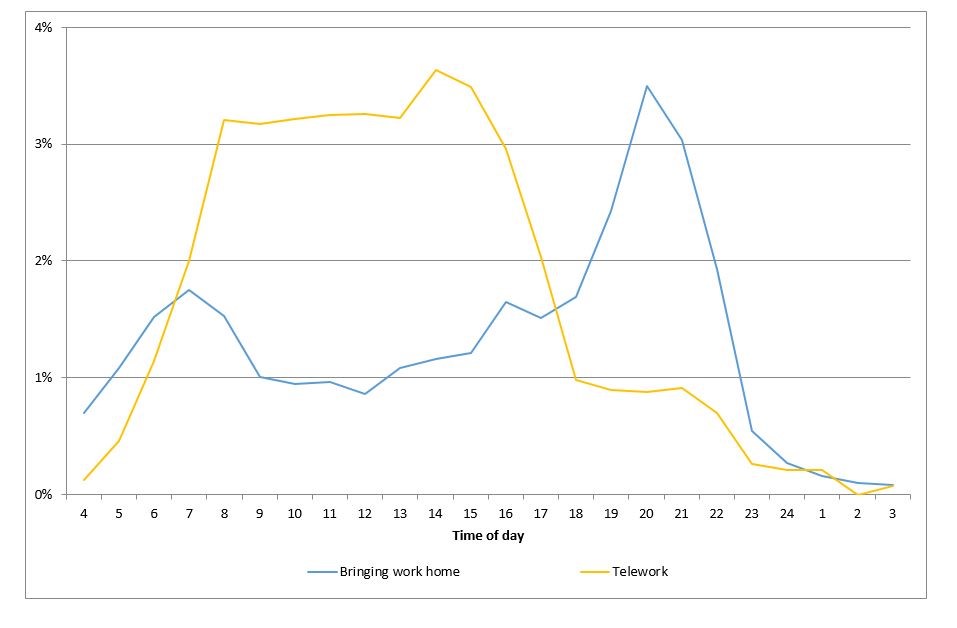
The authors emphasize the importance of distinguishing between telework (working at home without commuting to the office) and bringing unfinished work home from the office. As the figure below shows, telework mainly takes place during regular office hours on weekdays while office workers’ extra work at home peaks in the early mornings and late evenings.

Percentage of teleworkers and those bringing work home among all salary/wage workers who worked on the day on weekdays by time of day, 2016 ATUS

To evaluate the impact of these modes of teleworking on salary employees’ instantaneous subjective well-being, the authors analyzed the emotions felt by a sample of nearly 4,000 salary employees when they work from home. Since the negative effect of telecommuting may be overestimated if people who are more likely to work at home are also those who are more prone to feel tiredness and stress because of taking care of children or elderly, the study compares changes in work arrangements and well-being within the same person.

Decrease in subjective well-being

In general, the authors find that working at home is associated with a lower level of “net affect” (positive minus negative emotions) and a higher probability of having unpleasant feelings compared to office work. Although teleworkers feel less tired, probably because of the time and energy saved on commuting, they experience more stress, which may be due to increased conflicting demands of work and home, and the blending of personal and professional life.

Bringing work home on weekdays also results in a lower subjective well-being as it is associated with more stress and less happiness. The authors rule out longer working hours per se as an explanation but instead point at conflicts in the family about time arrangement between working hours, household chores, and leisure.

More support for homeworkers

Although the new study cannot resolve the whole debate on home-based work, it highlights the importance to differentiate formal telework from informal overtime work at home in evaluating homeworking. The results also underscore the need for employers to reconsider the potential well-being impacts of homeworking and rethink the benefits of telework for their employees.

To enhance life quality, the authors conclude that policymakers and employers should provide more support to homeworkers such as childcare, care for aging parents, suitable workspaces, and a social network that can sustain homeworking practices. All this would help homeworkers cope with the loneliness, stress, and work-family conflicts, and help them develop boundaries in time and space between the worlds of home and work while maintaining high levels of self-motivation.

Filed Under: Research Tagged With: happiness, home office, stress, subjective well-being, telework, work-life balance

What hides behind the German labor market miracle?

December 19, 2018 by Dajan Baischew

A key question in labor market research is how the unemployment insurance system affects unemployment rates and labor market dynamics. A new IZA Discussion Paper by Benjamin Hartung, Philip Jung and Moritz Kuhn revisits this old question studying the German Hartz reforms. The study traces the German labor market miracle back to the reform of the German unemployment insurance system that took place in the mid-2000s and abolished long-term, wage-dependent unemployment benefits.

The analysis highlights changes in separation rates after the unemployment benefit reform as the quantitatively important channel through which the unemployment insurance system affects unemployment rates and labor market dynamics.

The results show that a decrease in separation rates after the reform explains 76% of declining unemployment. Existing studies on the German labor market miracle leave this empirical fact unexplained by focusing on changes in job finding rates. The reduction in separation rates is heterogeneous, with long-term employed, high-wage workers being most affected.

Unemployment would be 50% higher without Hartz IV

The authors use economic theory to causally link the empirical findings to the abolition of long-term, wage-dependent unemployment benefits that was implemented by the Hartz reforms. Using a quantitative labor market model, they find that absent the reform, unemployment rates would be 50% higher today. In this case, German unemployment would have developed similar to labor market trends in Austria.

With respect to the welfare consequences of the labor market reforms, the study shows that long-term employed high-wage workers suffered substantial welfare losses in the absence of compensating transfers. This worker group accounts for almost two-thirds of the German workforce. The separation rates of these workers are the lowest in the labor market, and it might therefore appear as if these workers are very detached from any changes in the unemployment insurance system. However, the paper shows that this is not the case and that, in hindsight, their welfare losses might explain the discontent of a large part of the German electorate with these reforms.

Read a more detailed summary with charts in German.

Filed Under: Opinion, Research Tagged With: Germany, Hartz reforms, labor market reforms, unemployment, unemployment insurance

Are professors good teachers?

December 14, 2018 by Dajan Baischew

Among instructors in academia, professors are at the top of the pecking order. They often earn more than other, lower-ranked, instructors. When it comes to teaching, many students believe that professors are more knowledgeable than other academic staff. But do professors also teach better than their lower-ranked colleagues? Are they actually better at preparing students for the challenges of today’s labor market?

A new IZA discussion paper by Jan Feld, Nicolás Salamanca and Ulf Zölitz studies these questions and reveals that professors are no whit better than other instructors when it comes to tutorial teaching. The authors use data from a Dutch business school where students were randomly assigned to instructors. They find that students taught by professors instead of graduate students, for example, neither achieve better grades nor do they perform better in related consecutive courses. Also, after graduation, these students do not earn higher wages and are not more satisfied with their jobs.

Given the current debate about lowering the cost of post-secondary education, we wanted to know more and spoke with Ulf Zölitz, assistant professor at the University of Zurich and co-author of the study:

Why does it matter whether professors are good tutorial instructors?

Ulf Zölitz: In many universities, tutorials – also called exercise, lab or TA sessions – are taught by students and professors. This seems crazy – professors and students doing the same job? We looked at tutorials taught by students and professors and did not notice a huge difference. But it would be surprising if the vast difference in qualification and experience didn’t matter at all. We therefore wanted to find out about the costs and benefits of different instructor types.

What’s new about your study? Hasn’t this topic been researched before?

Surprisingly, no. Tutorial teaching has been mostly ignored by other researchers, who focus more on effectiveness in giving lectures. This is especially surprising since, by our calculations, over 60 percent of universities in OECD countries use tutorials at the undergraduate or graduate level, and over half of those universities use a mixture of low- and high-ranked instructors. Another contribution of our paper is that we study a broad range of student outcomes in university and the labor market. We do not only look at course performance, but also study students’ subsequent grades in related courses, student course evaluations, earnings and job satisfaction. We only find that professors get slightly better course evaluations. But other than the tiny impact on course evaluations, we find there’s no good reason to staff tutorials with professors.

This seems to suggest that professors are not ‘worth’ the higher salaries they receive for tutorial teaching. Is your paper bad news for your colleagues in the profession?

Not at all. We actually believe our finding is good news! Our results suggest that universities around the world have a huge potential to free up professors’ time by assigning more students to teach tutorials. Professors could then focus on what they do best and, for example, spend more time on research.

Lower teaching load, more time for research – a conclusion many of your colleagues will certainly endorse… Thanks for the interview!

Filed Under: Research Tagged With: education, professors, teaching, university

Ten years after the financial crisis

November 5, 2018 by Dajan Baischew

The impact of the financial crisis and the Great Recession on post-transition and emerging economies has varied tremendously. Some economies experienced very large recessionary shocks with long-lasting effects for the labor market, human capital formation and growth, while others benefited from policy efforts and an economic structure that alleviated negative labor market effects.

An IZA workshop jointly organized with the Higher School of Economics in Moscow took stock of labor market performance and adjustment in post-transition and emerging economies nearly ten years after the Great Recession.

Earnings inequality

In their study  “Winners and Losers After 25 Years of Transition: The Case of Slovenia”, Peter F. Orazem and co-authors review the gains to education, work experience and gender over 25 years of transition from plan to market using data on the universe of all workers in Slovenia over the period 1991–2015. They find that rates of return to education and work experience rose and remained high on average. However, the rapid expansion of tertiary education resulted in declining returns to schooling among the youngest cohorts of college graduates. The resulting decrease in earnings inequality across schooling groups among the young has been sufficient to lower overall wage inequality in Slovenia, unlike the typical rising wage inequality commonly observed in market economies since the 1990s.

Trade liberalization

The paper co-authored by Feicheng Wang on “Labor Market Reform, Firm-level Employment Adjustment and Trade Liberalization” empirically investigates whether the nature of firm-level employment adjustment is affected by the flexibility of the labor market and by an exposure to trade liberalization. It takes advantage of differences in local labor market conditions created by the non-uniform implementation of hukou reform in China to identify the employment effects of the reform. The results show that firms exposed to the hukou reform have higher employment adjustment rates on average than similar firms without reform, indicating that the labor market reform allowed more employment adjustment. Moreover, firms respond to trade shocks by adjusting employment relatively more in the presence of hukou reform. These findings offer important policy implications to the current labor market reform in China and to other developing countries with inflexible labor markets.

Minimum wages

In her paper “Do Minimum Wages Matter for Earnings Inequality? Evidence from Large Increases of Minimum Wage in Russia (2005-2017)”, Anna Lukyanova notes that little empirical work has been done on the effects of minimum wages in transition economies, where labor market institutions experienced rapid changes over the last decades. This paper presents empirical evidence on minimum wage effects for Russia, the largest transition economy. It uses regional variation in the relative level of the federal minimum wage to identify the impact of a large increase in the real value of the minimum wage on the distribution of wages in Russia between 2005 and 2015. The analysis suggests that the minimum wage can account for the bulk of the decline in the lower tail inequality, particularly for females.

The other presentations covered issues from labor supply and wage inequality to political economy aspects of the labor market (papers listed below, presenters named first).

Filed Under: IZA News, Research Tagged With: emerging markets, financial crisis, Great Recession, human capital, labor market, post-transition economies

  • Previous Page
  • Page 1
  • Page 2
  • Page 3

Primary Sidebar

© 2013–2025 Deutsche Post STIFTUNGImprint | Privacy PolicyIZA