• Skip to primary navigation
  • Skip to content
  • Skip to primary sidebar

IZA Newsroom

IZA – Institute of Labor Economics

  • Home
  • Archive
  • Press Lounge
  • DE
  • EN

Mark Fallak

Losing a parent strongly affects teenagers’ mental health

June 2, 2021 by Mark Fallak

Children face many challenges on their path to adulthood. Probably the most difficult situation a child can face is the death of a parent. Children in these circumstances are forced to overcome a likely reduction in family income, a loss of parental guidance and social support, and many other shortfalls that other children do not have to face.

A recent IZA paper by Petri Böckerman, Mika Haapanen and Christopher Jepsen uses administrative data for Finnish citizens born between 1971 and 1986 to estimate the relationship between a parental death between ages 10 and 20 and the likelihood of hospitalization for mental health reasons. While the authors find no clear evidence of increased hospitalization following the death of a parent of a different gender, there are significant effects for boys losing their fathers and girls losing their mothers.

The results show that young men have higher hospitalization for mental health reasons for several years following the death of their father. Depression is the most common cause of hospitalization in the first three years after paternal death, whereas anxiety and, to a lesser extent, self-harm are the most common causes five to ten years after the paternal death.

Similarly, young women have a large increase in hospitalization when their mother dies. This increase is similar in magnitude to the effect for men when their father dies. But for women, the duration of the effect is much shorter.

Apart from the direct health effects, the consequences for educational and career outcomes should not be underestimated. The study finds further evidence of an increase in the use of mental health-related medications and sickness absence as well as substantial reductions in years of schooling, employment, and earnings for children following the death of a parent.

Filed Under: Research Tagged With: mental health, parental death

Zooming to class?

May 28, 2021 by Mark Fallak

During the COVID-19 pandemic, many schools and universities had to pivot to online learning.  However, there is little research on the causal effects of online learning compared to in-person instruction because most colleges and school districts choose to go either all in-person or online, or a hybrid for each student.

A recent IZA discussion paper by Michael S. Kofoed, Lucas Gebhart, Dallas Gilmore, Ryan Moschitto exploits a unique experimental setting at the United States Military Academy at West Point to examine the effects of online learning on student performance. West Point randomizes students into class sections, class hours, and instructors. As a response to the pandemic, the authors were allowed to use this variation to randomly assign students into either an online or in-person class section in a Principles of Economics class.

Large learning gaps for academically at-risk students

Courses at West Point have uniform graded events and lesson plans across instructors, and each instructor agreed to teach half of their teaching load in both modalities. The authors randomized 550 students across twelve instructors in 36 different classrooms. The analysis shows that students assigned to an online classroom received a final grade that was 0.20 standard deviations less than those assigned to an in-person class. This corresponds to a reduction by a half +/- grade.

Demographic data reveal that students who previously had below-average academic ability have the largest learning gaps, including those who were formerly enlisted in the United States Army or attended the preparatory school (similar to a community college). The result is also consistent across NCAA athletes and non-athletes.

Finally, the authors use a post-course survey to explore mechanisms. The responses indicate that online learning greatly reduced concentration, but also whether a student felt connected to their instructor and whether their instructor cared about them. Students also felt less connected to their peers. In sum, the study shows that online coursework reduced academic achievement, increased inequality, and deteriorated the classroom experience during the pandemic.

Read more about the paper in a Twitter thread by @mikekofoed.

Filed Under: Research Tagged With: academic achievement, COVID-19, online learning, students

Working from home may hurt productivity

May 27, 2021 by Mark Fallak

Across the globe, many businesses were forced to abruptly shift to having their employees Work From Home [WFH] during the Covid-19 pandemic. With a year of experience at WFH, there is now significant debate among businesses and policymakers about the extent to which WFH will continue once the pandemic is over. While some businesses (e.g., Facebook) have stated that they plan to continue offering full WFH for select employees, others have reported mixed results and plan to bring employees back to the office.

To date most studies of WFH have relied on survey data. However, such data might be problematic, due to inaccuracies in respondent answers. Moreover, especially during a crisis such as Covid, employees might overstate their productivity out of a concern about their career prospects. A new IZA discussion paper by Michael Gibbs, Friederike Mengel and Christoph Siemroth instead uses rich workplace analytics data to study the effects of the switch to WFH on employee productivity and work times. The data cover 10,000 information technology professionals in a large Asian IT services company. This setting is of particular interest because the industry and occupation have been predicted to be among the most amenable to WFH.

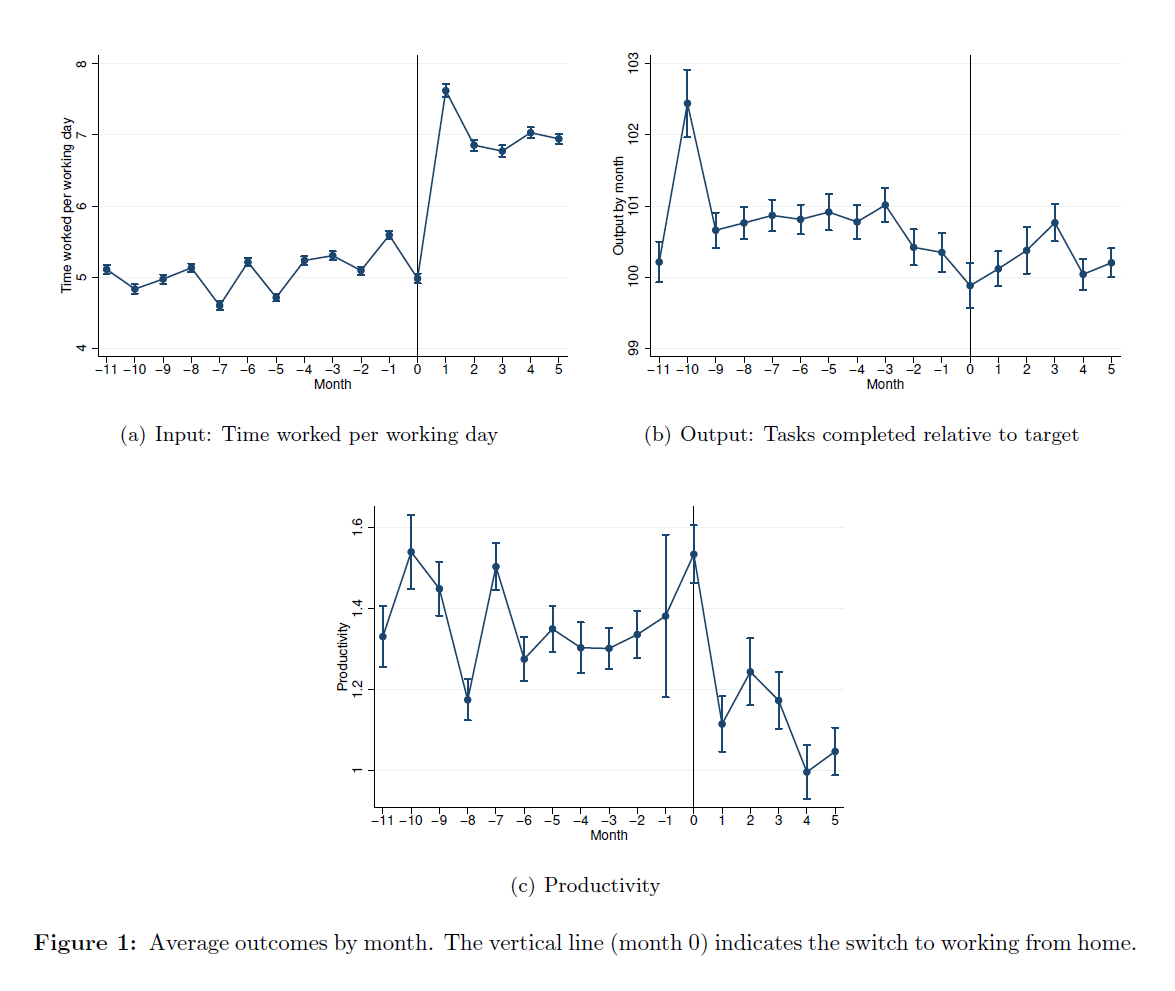
The authors used data from April 2019 through August 2020. This allowed them to compare productivity of the same employees before and during WFH, which began in March 2020.  They were also able to study employee performance, hours worked, networking activity, and other collaboration patterns.

Longer working hours

During WFH, the study finds that employees maintained output and achieved goals at approximately the same levels as they did prior to the pandemic. However, in order to maintain this output, on average total work hours increased by about 30%, including an increase of 18% outside of normal business hours. Productivity – measured as output per work hour – declined by about 20%.

The increase in total work hours was not due to time saved by not having to commute. Based on an estimate of commute time for employees, the authors found no statistical association of commute times with changes in work hours and productivity during WFH. Hence, employees with longer commutes prior to WFH did not increase work hours more during WFH.

The researchers were also able to examine how WFH affected workers differently, depending on their characteristics. Employees with children at home experienced a larger drop in productivity, and increased total work hours by more than those without children to compensate. Women fared less well than men in WFH, based on working hours and productivity. However, this was not driven by the presence of children at home. The study also finds that employees with greater company experience performed better. This may indicate that they were able to be more effective during WFH, by drawing on their knowledge of company procedures, and their deeper network of colleagues.

More distractions at home

What explains the drop in productivity? The authors’ explanation is that there were more distractions at home  – especially with children – and that the costs of communication and collaboration were significantly higher during WFH. Employees spent a great deal more time in formal meetings, including teleconferences. They also sent more emails than before. Meetings and other coordination activities  appear to have  been disruptive, as employees had significantly less “focus time” in which they were able to work without interruption. Additional evidence for this view is that employees networked less – they had fewer contacts with colleagues and business units both inside and outside the firm. Moreover, they had fewer meetings with their supervisor, or coaching sessions.

These findings are only for the first phase of WFH. Nevertheless, they provide a cautionary note that WFH is not a perfect substitute for personal interactions in the workplace. Companies will likely have to evolve practices which involve a mix of working from the office and home.

Filed Under: Research Tagged With: collaboration, COVID-19, future of work, output, productivity, remote work, work from home, work hours

Short-time work reduces unemployment and stabilizes aggregate demand

May 20, 2021 by Mark Fallak

Short-time work (STW), a policy that subsidizes working time reductions and thereby aims to prevent firings, is used in almost all OECD countries in the Covid-19 crisis as a labor market stabilizer. In Germany, almost every fifth employee (6 million workers) was affected by STW in spring 2020. When comparing this to the peak during the Great Recession, which was at about 1.5 million, it becomes clear that the use of STW has reached an unprecedented level, and so have public expenditures on these subsidies.

This is not only true for Germany. Equally high numbers were observed in Italy, Spain, France, Belgium, Austria and the UK. For example, the UK introduced the furlough scheme that covered up to almost 9 million workers in May 2020. At the European level, the EU has implemented the “Temporary Support to mitigate Unemployment Risks in an Emergency” (SURE) scheme, which provides financial support of up to 100 billion Euro in the form of loans to member states, specifically to finance the implementation or extension of schemes to preserve employment.

Short-time work reduces income risk and stabilizes demand

In a new IZA discussion paper, Thomas Dengler and Britta Gehrke investigate different mechanism of how this policy stabilizes the aggregate labor market. In particular, they focus on aggregate demand effects next to the direct reduction of labor costs for firms. In a recession when firings increase, employed workers aim to self-insure against rising unemployment risk and reduce their consumption. This fall in demand triggers a further reduction of production and even more firings – a contractionary spiral. Short-time work may break this spiral as it reduces the unemployment and income risk of workers.

Using a dynamic macroeconomic model with incomplete asset markets and labor market search frictions that is calibrated to the German economy, the authors find that a recession that would generate an increase of the unemployment rate by 3 percentage points with STW would increase unemployment by 4 percentage points without STW. Out of the total stabilization of 1 percentage point, 0.2 percentage points is due to the reduction of aggregate demand channel. The effects may be even larger in an economy with on average higher labor market flows such as the US. With higher flows labor market risk is generally larger and the demand channel plays a more prominent role.

Increasing the subsidy to short-time workers is very effective

An increase of the subsidy to short-time workers can provide additional stabilization of consumption demand and hence the aggregate economy. The effects are particularly strong if monetary policy is constrained by the zero lower bound, as it is the case in the current situation. An increase of the subsidy to short-time workers can even be more effective compared to a similar increase of the unemployment benefit replacement rate. Intuitively, the latter generates direct upward pressure on wages via the reservation wage, whereas this effect plays less of a role for short-time compensation.

In sum, these results support that short-time work can be a powerful policy in temporary crisis times to stabilize the labor market. But short-time work should never be a permanent phenomenon. Then, it may trigger biases and inefficiencies. For example, short-time work may hinder the reallocation of labor to growing and productive firms or it may lead to excessive hours reductions.

Moreover, access to short-time work should be strictly limited to firms facing large negative shocks. As another recent IZA study from France shows, take-up by less severely-hit firms during the 2008/2009 recession led to large windfall effects, which significantly increased the cost of the policy per job saved.

Filed Under: Research Tagged With: aggregate demand, consumption, COVID-19, savings, short-time work, unemployment

Measuring labor market conditions

May 19, 2021 by Mark Fallak

Economists and policymakers rely on labor market indicators produced by statistical agencies to gauge the health of economies during recessions and recoveries, to identify labor market trends, and to develop policy responses to problems identified in the data. Yet, the data on which these analyses depend often provide an incomplete, noisy, or even biased picture of labor market conditions. In addition, the rapidity with which the global recession developed during the Covid-19 pandemic has underscored the need for more timely economic data than national statistical agencies typically provide, spurring the use of real-time data from proprietary sources.

The 4th IZA workshop on labor statistics, organized by Katharine Abraham and Susan Houseman, featured twelve papers that critiqued existing measures of labor market conditions, provided corrected or new measures, and made use of novel data to address substantive labor market questions.

Improving measures of labor market slack

Several workshop papers addressed problems with statistics designed to measure the degree of unemployment and underemployment (or “slack”) in labor markets. The data for calculating the unemployment and the labor force participation rates in the United States come from a monthly household survey in which households are surveyed a total of eight times. This allows one to observe how workers move between being employed, unemployed, and out of the labor force.

Hie Joo Ahn and James Hamilton, however, point to large inconsistencies in the monthly estimates of the unemployment rate and labor force participation rate, on the one hand, and the movements between these labor force states over time.  Part of the problem arises from the fact that the more times survey respondents are interviewed, the less likely they are to report being unemployed or part-time, or to answer survey questions at all, owing to stigma associated with being unemployed or underemployed.  Correcting for these and other problems in the data, Ahn and Hamilton find that the unemployment rate and the labor force participation rate both are underestimated by about 2 percentage points.

Instead of correcting official measures, Jason Faberman, Andreas Mueller, Ayşegül Şahin, and Giorgio Topa propose a new measure, the “Aggregate Hours Gap,” to capture the degree of slack in labor markets. Their measure is derived from questions on desired hours worked in a household survey conducted by the Federal Reserve Bank of New York. They find that their measure performs as well as or better than the unemployment rate in accounting for changes in wages. Their measure also suggests that the recovery following the Great Recession was slower than suggested by the unemployment rate or other measures of labor market slack.

Using proprietary data to measure the economic impacts of Covid-19

Lags in the collection and publication of government data have hampered efforts to provide timely analysis of the impacts the pandemic recession is having on businesses and workers. To assess the widely held belief that small businesses and their workforces have been especially harmed by the recession in the United States, André Kurmann, Etienne Lalé, and Lien Ta use data from Homebase—a company that provides scheduling software primarily to small service-sector businesses—supplemented with business opening and closing information gleaned from Google, Facebook, and other online sources. Contrary to expectations, they find that, while small business employment was especially hard hit in the early stages of the recession, small businesses have rebounded and, on net, have not fared worse than larger businesses during the recession.

Links to these and other papers may be found on the workshop program.

Filed Under: IZA News, Research Tagged With: labor statistics

Covid-19 scrambled European country ranking of labor market performance

May 18, 2021 by Mark Fallak

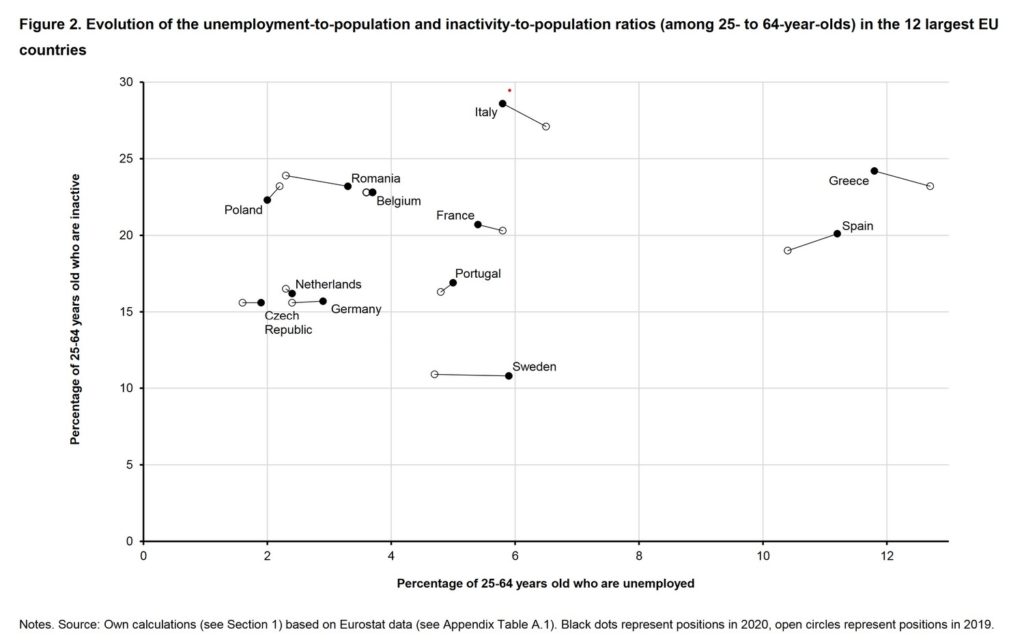
How did the labor market get through Covid-19 year 2020 in Europe? Broadly speaking, without much damage, according to a recent IZA Policy Paper by Stijn Baert (Ghent University). The percentage of unemployed among the 25 to 64-year-olds in the EU-27 rose 0.2 percentage points (pp) from 4.8% to 5.0%. By comparison, between 2009 and 2010, when the labor market digested the Financial Crisis of 2007–2008, this number increased by 1.3 pp at the EU-27 level.

This average obviously hides differences between EU countries. Most strikingly, in the Baltic states, the increase in percentage of unemployed is more than 1.5 percentage points and therefore substantial: Estonia (1.7 pp), Latvia (1.8 pp) and Lithuania (1.7 pp).

Among the other countries, only Romania (1.0 pp) and Sweden (1.2 pp) exhibit growth in their unemployment-to-population ratios in excess of 1 pp. Thereby, Sweden, often seen as a ‘model country’ even drops to 23rd place by unemployment (out of 27 countries).

Inactivity rose more sharply in Southern Europe

But what happened to the percentage of inactive people in 2020? While unemployed search for a job, this is not the case for inactive people. Did some of the unemployed become discouraged, partially masking the shift from employment to unemployment with a parallel shift from unemployment to inactivity?

Overall, the increase in inactive persons at the EU-27 level also remained rather limited. In 2019, 20.0% of the population was inactive; in 2020, that percentage rose to 20.3%—an increase of 0.3 pp. This rather small number still implies an increase by about 720,000 persons.

Again, we see important differences between countries. Inactivity rose more sharply in Southern Europe: Spain (1.1 pp), Italy (1.5 pp), Portugal (0.6 pp) and Greece (1.0 pp). Bulgaria (0.8 pp) and Ireland (0.8 pp) are also close to 1.0 pp increases in inactive persons.

Overall, the labor market of Poland experienced the most favorable evolution: despite the crisis, both the percentage of unemployed and inactive fell.

Germany’s position remains rather stable

Germany, the largest EU country by number of citizens, is not mentioned in the above discussion. This is because Germany remained fairly stable in terms of its position in the ranking of European countries.

Between 2019 and 2020, the percentage of unemployed among 25-64 year olds increased by 0.5 pp (i.e. from 2.4% to 2.9%). Admittedly a bit more than the European average, but because Hungary and Romania experienced a stronger increase, Germany rose from 7th to 5th place of best-performing countries in terms of unemployment.

The percentage of inactive persons rose even less, i.e. from 15.6% to 15.7%. This does mean, however, that Germany drops from 5th to 6th place as Latvia saw its inactivity percentage decrease despite Covid-19.

Overall, Germany is stable within the best quarter of European countries for both parameters.

What about 2021 and 2022?

Does the small overall effect of Covid-19 year 2020 mean that the ominous reports at the start of the crisis should be classified as misconceptions?

Stijn Baert:

“Not necessarily. The labor market almost always follows the pattern in economic growth at some distance. During the Financial Crisis, unemployment peaked about a year after the deepest decline in economic growth. If the current downturn in economic activity continues, it might not be possible to sustain the current level of labor hoarding, especially if support measures are removed. Much also depends on how the European countries deal with their accumulated debt: hard savings can be expected to deal an extra blow to the labor market, while well-considered investments could, through their multiplier effect, provide stimuli.”

Filed Under: Research Tagged With: COVID-19, crisis, European Union, inactivity, unemployment

Higher minimum wage lowers enrollment in academic programs at universities

May 11, 2021 by Mark Fallak

While much research has been done on the employment effects of minimum wages, little is known about their effect on human capital accumulation. A new IZA discussion paper by Diana Alessandrini and Joniada Milla finds a strong impact of higher minimum wages not only on individuals’ schooling decisions, but also on the type of human capital acquired by students.

Using Canadian longitudinal data, the authors explore 136 minimum wage amendments across provincial jurisdictions. Canada provides a unique test case because community colleges play a large role in post-secondary education in Canada and because they often provide occupation-specific training rather than general academic training. This allows for potential important interactions between minimum wages and the type of education that individuals pursue, in addition to effects on overall education levels.

Shift towards occupation-speci fic training

The study finds that high minimum wages stimulate the accumulation of occupation-specific human capital at community colleges but discourage enrollment in academic programs offered by universities. Quantitatively, a 10% increase in the minimum wage increases community-college enrollment by 6% and reduces university enrollment by 5%.

At the same time, high minimum wages strengthen the link between parental background and children educational attainment, worsening the university participation gap between individuals with high and low parental education. The increase in the opportunity cost of education caused by the minimum wage appears to discourage enrollment among students with lower-educated parents.

Lower drop-out rates

Finally, minimum wages also affect whether students drop out of post-secondary education or return to school later in life as mature students. The data show that the positive effect on community-college enrollment is driven by older students. As minimum wage hikes may increase competition in the labor market, students already enrolled in community college are less likely to drop out, and workers who separate from their job are more likely to return to community college to advance their studies.

These novel results an inform policymakers regarding the spillover effects of minimum wage regulations on human capital accumulation and the unintended consequences on educational attainment. Given substantial government spending on post-secondary education, it is important to know whether a minimum wage policy works against or in favor of concurrent education policies.

Filed Under: Research Tagged With: college, education, minimum wage, university

IZA Young Labor Economist Award goes to Patrick Kline

May 6, 2021 by Mark Fallak

Patrick Kline (University of California, Berkeley) has been selected as the winner of the 2021 IZA Young Labor Economist Award for his research on empirical methodology in labor economics and on the determination of wages. This biennial prize is awarded to outstanding labor economists whose Ph.D. was received fewer than 15 years ago.

“The Award typifies the interaction of economic ideas with the development of proper tools to frame their measurement,” said Daniel Hamermesh, who chairs the IZA Prize Committee.  This year’s committee selecting the awardee consisted of Joseph Altonji (Yale), Oriana Bandiera (LSE), Richard Blundell (UCL), George Borjas (Harvard), Pierre Cahuc (Sciences Po), and Claudia Goldin (Harvard).

The Award contains a small monetary prize, which will be conferred during the IZA Reception at the ASSA Meetings on January 7-9, 2022, in Boston, Massachusetts.

Filed Under: IZA News Tagged With: IZA Young Labor Economist Award

Relative comparisons affect performance and choices in college

May 5, 2021 by Mark Fallak

When making choices about one’s educational career, students face considerable uncertainty about their own ability. Am I sufficiently prepared to pass the exam? Am I good enough to pursue a college education? A young person might have difficulties in answering these questions right away and will have to form beliefs about their own ability.

More often than not, this will be done by comparing oneself with friends or fellow classmates. A student who is a big fish in a little pond, outperforming their classmates, tends to be more confident and might believe that they are more capable than an otherwise identical student who happens to be in a group with higher ability peers.

Such social comparisons may be of particular importance in the first year of university, which for many students is a daunting experience. Coming from the familiar environment of high school, where they shared classrooms with the same classmates for many years, they suddenly interact with students from all over the world. This drastic change in one’s peer group may also change students’ beliefs about their own ability.

In a new IZA discussion paper, which is now accepted for publication in the Economic Journal, Benjamin Elsner, Ingo Isphording and Ulf Zölitz show how social comparisons affect the choices and performance of first-year students who are randomly assigned to first-year tutorials at a Dutch business school.

Rank matters!

The authors measure a student’s relative ability through their ordinal rank within their teaching section. The ordinal rank measures whether a student is ranked first, second, third and so on, based on the grades they had received before being assigned to their new section. Different mechanisms explain why a higher ordinal rank may affect choices and performance: a more highly ranked student may perceive herself as more competent in general (the big-fish-in-a-little-pond effect), and it might affect how teachers or fellow students interact with them.

In line with this idea, the authors find a strong effect of a student’s rank on contemporaneous performance. Students with a higher rank have a lower risk of dropping out of a course and receive higher grades in standardized exams that are anonymously graded. The effects of rank on expectations about future grades and satisfaction with fellow students suggest that a higher rank leads students to believe that they are more capable than their peers. Thus, being a big fish in a little pond in your first-year tutorial boosts performance by shaping a student’s beliefs about own ability.

Students react to good news only

A student’s rank appears to be especially important at the very beginning of the first year, a period characterized by particular uncertainty in a completely new environment. But how students react to their rank depends on the information the rank conveys: Students respond asymmetrically to changes in their rank. An increase in the rank relative to the previous period significantly improves performance, whereas a decrease in the rank has no effect.

The authors interpret this as evidence for the good-news-bad-news effect, which means that people respond to positive but tend to ignore negative signals. Only if a rank in a tutorial indicates that a student became better over time will it affect their performance.

Persistent effects of rank

The authors also show that the effects of one’s rank in a first-year tutorial are persistent. Students with a high rank in a particular first-year course are more likely to choose a related follow-up course in higher years: A student who was highly ranked in a statistics course is more likely to specialize in statistics later on. A student who was highly ranked in marketing rather specializes in marketing. The ordinal rank in first-year courses appears to shape students’ perceived comparative advantages in one subject over the other and have a lasting effect on students’ choices.

The results provide important insights into the decision-making of college students. Whether or not someone is a big fish in a little pond is to a large degree a matter of luck. Yet, when making important career decisions, students appear to put considerable weight on relative comparisons to other students – a factor to be kept in mind when helping students to make better-informed career choices.

Filed Under: Research Tagged With: higher education, peer effects, rank, social comparisons

“I will have to discuss this with my family”

April 29, 2021 by Mark Fallak

People work only slightly more when they can earn high wages than they do at other times. Does this mean that people respond only weakly to wage incentives? This would have important consequences for economic policy. For example, tax cuts would only to a very limited extent induce people to work more. Similarly, government stimulus packages could be expected to have little effect if firms, when demand for their products is high, are unable to achieve a significant increase in hours worked through paying higher wages.

However, there are several arguments against such a view. Progressive tax systems or the pursuit of promotions can weaken the measured relationship between hours worked and pay, even if workers are in principle willing to work more for more money. A recent IZA discussion paper by Christian Bredemeier, Jan Gravert and Falko Juessen points to another reason: Changes in one family member’s income alter the balance of power in the family’s decision-making processes, and this can affect how much each family member works.

The study builds on a large body of scientific literature that has demonstrated that families respond differently to a given amount of income depending on which family member earned that income. A change in a family member’s income appears to alter that member’s influence in the family’s decision-making processes. A career setback, for example, tends to lead to having less say in the family. One can then try to restore one’s old position in the metaphorical “family council”, for example, by working (paid) overtime, even if, as a single person, one would rather wait to do so until one’s work is paid better again.

Consumption patterns reveal family members’ influence

The authors develop a statistical method that deducts the changes in intra-family bargaining positions caused by wage changes when measuring the willingness of employees to work more if they are paid more. The method uses information on families’ consumption patterns, i.e., what goods and services are purchased, to infer which family member currently has a large influence on family decisions.

The results of the study indicate that workers are willing to work about 7% more if their earnings per hour are 10% higher. For a full-time worker, this amounts to just under three hours of (paid) overtime per week. This figure is discernibly larger than the results of most previous studies, which do not factor out the effect of wage changes on intra-family bargaining positions.

Factoring out this effect is instructive for assessing the consequences of policies that similarly affect the earnings of different family members and therefore have no substantial effects on intra-family bargaining positions. According to the authors, temporary tax cuts or increases in the general wage level could indeed induce employees to increase their working hours by clearly relevant, albeit moderate amounts.

Filed Under: Research Tagged With: consumption, intra-family bargaining, labor-supply elasticity, wages, working hours

  • Previous Page
  • Page 1
  • …
  • Page 17
  • Page 18
  • Page 19

Primary Sidebar

© 2013–2026 Deutsche Post STIFTUNGImprint | Privacy PolicyIZA