• Skip to primary navigation
  • Skip to content
  • Skip to primary sidebar

IZA Newsroom

IZA – Institute of Labor Economics

  • Home
  • Archive
  • Press Lounge
  • DE
  • EN

Mark Fallak

Who goes on disability when times are tough?

February 15, 2019 by Mark Fallak

By Delia Furtado, Kerry L. Papps and Nikolaos Theodoropoulos

Social Security Disability Insurance (SSDI) is a federal program that was established in 1956 to insure U.S. workers against the risk of being unable to work as a result of a physical or mental disability. It is well established that SSDI applications tend to rise during recessions. One possible explanation for this is that applicants with marginal disabilities only find it worthwhile to apply when their opportunities in the labor market are sufficiently poor. Under this view, those applicants with the lowest costs of applying should be the most likely to apply at all times, but may also be the most sensitive to economic conditions.

In a new IZA discussion paper, we study the take up of SSDI among immigrants for two reasons. The first is that focusing on immigrants allows us to exogenously assign people to ethnic networks based on country of birth. The second is that, even if the out-of-pocket costs of applying are the same, the “social” costs of applying are likely to vary across immigrant communities. For example, immigrants whose compatriots have high levels of SSDI take-up may find it easier to gather information about the application process from others in their networks. In addition, immigrants from countries with strong taboos against leaving the workforce may be marginalized if they apply for SSDI despite having only a relatively minor disability.

Using data from the 2001 to 2016 samples of the American Community Surveys, we show that immigrants from high SSDI take-up countries of origin are more sensitive to economic conditions than immigrants from low take-up countries. We interpret this result as evidence that applicant decisions, as opposed to employer or Social Security Administration decisions, drive the counter-cyclicality of SSDI take-up rates. Additional results suggest that our baseline findings are driven by differential costs of participation by origin group as opposed to differences in eligibility rates or experienced severity of recessions. We supplement our analysis using complementary data from the 2001-2017 Current Population Surveys and show that a similar pattern exists among second generation immigrants, hinting that our results might be generalizable to natives as well.

Work norms and social pressure

We also examine why immigrants in high SSDI take-up groups are more likely to apply for SSDI when jobs become scarce. To provide evidence of the role of social norms, we collect longitudinal data from the 1981-2014 World Values Survey and the European Values Survey on home country attitudes regarding the importance of work, such as whether a person believes work is a duty towards society. We show that during bad economic times, immigrants belonging to ethnic groups with weaker importance of work norms are more likely to take up SSDI. This suggests that social pressure may be an important consideration for people when deciding whether to apply for government assistance during periods of economic hardship.

Our results suggest that the SSDI program is not being used only to provide insurance against the possibility of becoming permanently disabled. It also works as an insurance mechanism against job loss. This is problematic because while recession-induced job losses are mostly temporary, people tend to stay on SSDI once they go on it.
Filed Under: Opinion, Research Tagged With: disability, immigrants, job loss, recession, social security, take-up

The platform economy in Germany

December 18, 2018 by Mark Fallak

The emergence of the gig or platform economy is one of the hottest topics in the context of digitalization and the future of work. While it is often regarded as an opportunity for people to enter the labor force, or to work more independently from daily routines, “crowdwork” and other forms of platform labor are also associated with the strategic circumvention of existing labor laws and the misuse of social security systems.

A new IZA Research Report provides an overview on recent trends in the platform economy in Germany, with a special focus on its challenges for social dialogue institutions. The report concludes a two-year research project “IRSDACE – Industrial Relations and Social Dialogue in the Age of Collaborative Economy” covering seven EU member states. Funded by the European Commission – DG Employment the research was carried out by:

  • CEPS – Center for European Policy Studies, Brussels, Belgium (project lead)
  • CELSI – Central European Labour Studies Institute, Bratislava, Slovakia
  • FA – Fundacion Alternativas, Madrid, Spain
  • FAOS – University Copenhagen, Copenhagen, Denmark
  • IZA – Institute of Labor Economics, Bonn, Germany

The rapidly mutating platform economy in Germany (and elsewhere) was initially driven by firms created by young, highly skilled entrepreneurs with a strong affinity for technology but often little intimate knowledge of the markets they entered. This might explain a large part of the initial frictions with social partners. Along with German trade unions beginning to address the new target group of crowdworkers, some platform owners started to organize employer federations and committed themselves to minimum labor standards (code of conduct) while others still neglect regulation as they view their firms merely as a technological service “platform” to match demand and supply.

From a policy perspective, there are strong calls for stricter regulation to avoid precarious employment and give crowdworkers access to regular social security. Reliable data is scarce, however, which makes it difficult to assess the actual scope of platform work and creates some uncertainty about its future development.

Invited by IZA, representatives from academic science, trade unions, and platform owners discussed their insights during a workshop in Bonn. In line with the conclusion of the IZA Research Report, it was argued that the relatively small size and importance of the platform economy in Germany may be due to robust labor market conditions and a tight regulatory environment. However, the experts also agreed that it is still too early to predict the future of the platform economy.

Filed Under: IZA News, Research Tagged With: crowdwork, digitalization, gig, platform economy, social dialogue

Steering more students into STEM?

December 10, 2018 by Mark Fallak

As the price of college continues to rise alongside falling state support for public institutions of higher education, students and families bear a growing share of the costs of college. Concerns about the affordability of higher education have led to calls for creative thinking about ways to temper rising costs. However, at the same time, demand for increased training in STEM fields and policies that push students toward such fields abound.

Instruction represents a key category of expenditure at most institutions. Thus, efforts to contain costs must thoughtfully attend to instruction. However, detailed information on instructional costs has been historically difficult to obtain, especially across disciplines. Discipline-specific costs have implications for policies such as differential tuition, budget allocation models, and initiatives that encourage students toward certain fields.

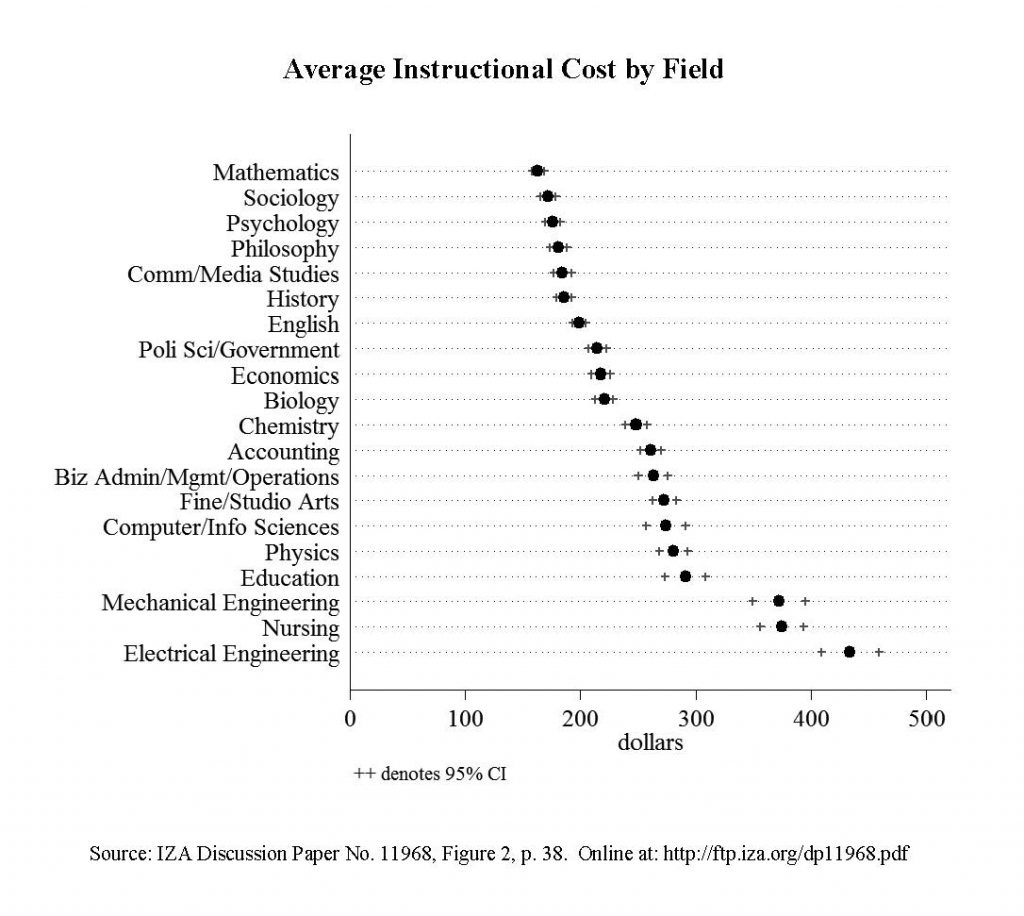
A new IZA discussion paper by Steven Hemelt, Kevin Stange, Fernando Furquim, Andew Simon, and John Sawyer provides the most comprehensive overview of the costs associated with teaching across 20 fields based on a large and diverse sample of four-year colleges and universities from the Delaware Cost Study. The results show that the cost of a unit of instruction differs markedly by discipline.

A student credit hour of electrical engineering, for example, costs twice as much as a credit hour of English. At the other extreme, math is about 22 percent cheaper per credit hour than English. In general, pre-professional fields like business and accounting, along with fields that typically command higher earnings like engineering and nursing, are more costly to teach than the social sciences and humanities.

What explains this variation in costs across fields?

The authors partition differences in instructional costs into four drivers: faculty salaries, faculty workload, class sizes, and non-salary expenses (e.g., lab and equipment costs). Differences in class sizes and faculty salaries tend to explain the bulk of differences in costs across fields. For example, though average salaries are higher for economics faculty than English faculty, class sizes in economics are substantially larger than in English, resulting in costs of instruction per credit hour that are slightly lower in economics than English. Business and accounting faculty also earn more relative to English, but the larger class sizes in these fields only partially offset those differences in pay. Faculty workload and non-personnel expenses generally play minor roles in explaining cost differences across fields.

The paper also shows that marginal costs vary widely across fields and are meaningfully shaped by whether a department offers graduate programs. For example, electrical engineering has the highest marginal cost, in addition to the highest average cost. Documenting differences in relative marginal costs helps to assess possible benefits of initiatives like differential pricing and the cost implications of increasing demand for STEM education.

What can we learn about trends in instructional costs over time?

In contrast to the narrative of soaring prices, inflation-adjusted instructional costs have remained relatively flat over the past decade and a half. However, this average trend obscures variation by field. Costs for many STEM fields like mechanical engineering, chemistry, biology, and nursing declined over the period, as class sizes and faculty teaching loads increased, and as contingent faculty, who are paid less, became more prevalent. Costs increased for many fields in the social sciences and for pre-professional programs, reflecting reductions in class size and higher salaries (most pronounced for accounting, economics, and business faculty).

The adoption of online education has commanded sustained interest from policymakers and institutional leaders as a cost-saving innovation. However, the authors find that the take-up of online education remains relatively low; only about half of programs offer any online instruction. Nursing is the field with the highest rate of online instruction, but even among nursing programs online education accounts for 15% of instruction in undergraduate programs, and 35% at the graduate level. The authors find little evidence that online education lowers average costs of instruction, though results suggest that programs that are substantially online may experience lower costs.

Filed Under: Research Tagged With: disciplines, education, engineering, faculty, math, STEM, students, tuition, university

Blind hiring is curbing biased decisions — using algorithms and AI

December 7, 2018 by Mark Fallak

“If you’ve got the grades, the skills and the determination, this government will ensure that you can succeed.” These were the words of then Prime Minister David Cameron in October 2015 in light of recent findings on biased recruitment decisions. In many instances, job applicants are — consciously or unconsciously — judged on the basis of prejudices and stereotypes rather than solely in terms of their qualifications, talent and experience.

For example, a different name alone can dramatically decrease the chances of being invited to a job interview. In the United States, a pioneering study found that the callback rate for a job interview was nearly 50% higher for applicants with “white” names (Emily Walsh and Greg Baker) than for otherwise similar persons with African-American names (Lakisha Washington and Jamal Jones).

Callback rates nearly 50% higher for applicants with “white” names

Similarly, evidence from Sweden finds 50% more callbacks using a Swedish name than a Middle Eastern name when sending out otherwise equal applications to real job offers.

Application photos can aggravate the problem. When résumés of the same fictitious female character, differing solely in her name and application photo, were sent out in Germany, callback rates were strikingly different. In this study, the character’s first version with a German name (Sandra Bauer) had a callback rate of 18.8%, its second version with a Turkish name (Meryem Öztürk) a callback rate of 13.5%, and its third version with the same Turkish name, but additionally wearing a headscarf on the photo, a very low callback rate of just 4.2%.

Hiring discrimination on the basis of race, gender, age, sexual orientation or religion is thus well documented. This is not only unfair and costly for the victims, but it also has substantial economic costs for society. So what if the key information categorising individuals into minority groups was removed from the application?

Leading graduate employers in the UK committed to name-blind hiring

As a response to Cameron’s speech in 2015, leading graduate employers responsible for 1.8 million jobs in the UK committed to name blind hiring. Most recently, the Bank of England implemented anonymous applications to minimise the bias in recruitment and to boost diversity. But blind hiring has also begun to go global. To isolate the effects of anonymous job applications, field studies have been conducted in Europe, Canada and Australia.

While, intuitively, blind hiring processes should lead to more objective decisions, they are not a universal remedy against all forms of discrimination in the labour market. For example, biased decisions can still be taken when applicants and recruiters physically meet, that is, in the interview stage. In that case, discrimination would simply be postponed. Often, it is also the case that the scope for removing identifying information is limited. For instance, episodes of maternity leave indicate the applicant’s gender, while bilingual applicants can be easily assumed to have some form of immigration history.

A suboptimal method of de-identifying application documents can also result in high costs — not only monetary, but also resulting in time-consuming, labour-intensive and error-prone procedures.

However, pilot projects show that when using an efficient method of de-identifying application documents, blind hiring can be successful in terms of effectively reducing discrimination. As expected, in most studies callback rates between minority and majority groups converge when anonymous job applications are introduced. The resulting effect, however, depends on the extent of discrimination prior to the introduction of anonymous applications. Affirmative action also becomes harder to implement.

Innovative recruitment processes

Nowadays, more and more employers try to overcome prejudices and biases by relying on innovative recruitment processes. And new possibilities are becoming available. For example, GapJumpers, a Silicon Valley start-up, offers employers anonymous screening of job applicants. The idea is to reverse conventional hiring. Before submitting any documents or personal information, applicants take custom-tailored anonymous tests that take the specific job requirements into account. And just with the resulting test scores at hand, hiring firms decide whom to invite for interview.

This is just one example how to take advantage of technological progress to combat hiring discrimination. In the future, digital recruitment methods may even become standard. For example, LinkedIn has just announced to use artificial intelligence features in the hiring process. And unless human programmers insert prejudices and stereotypes in the underlying algorithms, there is hope for objective recruitment decisions.

—
Editor’s note: This op-ed by Ulf Rinne previously appeared on Apolitical, an online platform that connects public servants to the ideas, people and partners they need to solve society’s hardest challenges.

Filed Under: Research Tagged With: anonymous job applications, artificial intelligence, bias, blind hiring, discrimination

How Germany is tackling the future of work

November 30, 2018 by Mark Fallak

Digital technologies could have a disruptive effect on future jobs, as well as on the tasks performed by workers and the skills required of them. There may be an even stronger demand for highly skilled workers, but the outlook for those in medium-skilled manufacturing who hold vocational training degrees is more unsure. This is seen as a major challenge for the German economic model, which has emphasized skilled manufacturing and innovation that is more incremental.

Meanwhile, the usual channels German workers use to affect change – collective bargaining and representation at the firm level – are in decline. The rise of platform work and self-employment through the gig economy poses challenges for the social insurance funding model. These are issues that are being raised throughout the industrialized world, including Canada.

To address the implications of digitalization and automation, in 2015 the German government initiated a consultation with a wide range of partners from academia, unions, and the nonprofit and private sectors. The objective was to encourage policy-making that would help prepare German workers, the welfare state and firms for the future economy, with an emphasis on protecting participation in the labor market. A central theme was flexibility – how could workers be supported effectively in this rapidly changing environment?

Work 4.0 policy process

The two-year consultation, which included commissioned research, debates, workshops and public consultations, culminated in a March 2017 in a white paper, Work 4.0. Four main themes emerged during the process: lifelong learning, flexible working environments, health and safety, and protection for the self-employed.

  • First, lifelong learning was seen as essential in order to keep up with rapidly evolving technological developments. Additional (digital) qualifications were expected to be compulsory in almost all sectors and occupations. Hence, a legal right to continuing vocational education and training was discussed as a possible solution. The paper also raised the potential for the development of a “personal activity account,” which would be accorded to citizens at the beginning of their working life. The funds in the account could be used for improving skills, starting a business or taking personal leave during their careers.
  • Second, the white paper acknowledges more flexible working arrangements and employee autonomy in the new world of work. It calls for predictable working schedules, even in highly flexible settings, but also suggests existing legislation be modified to allow workers to choose their own work times. Negotiating agreements on work schedules was raised. For example, demands on worker availability in more flexible working environments could be increasingly important. The white paper also warns of a breakdown of the boundaries between work and private life.
  • Third, health and safety departments must consider the risks of digital work, especially with more Germans working later in life. The report noted the psychological strains of work and the need for healthy work environments that allow for productive employment.
  • Fourth, the lines between employment and self-employed work are blurring. The paper recommended including self-employed individuals in in social insurance, in particular old-age pensions, as a way of stabilizing welfare state funding and establishing a level playing field in the different types of work. In the case of an increase in platform work and new forms of self-employment, protection strategies would be needed that are tailored for employee-like self-employed workers.

The general nature of the white paper reflects the differing interests of the stakeholders involved in the consultation. The German trade unions said it would be important to redefine employment status, enhance social protection coverage and wage formation, and ensure worker participation in emerging new employment models. The employers insisted that existing regulations are generally sufficient and should even be relaxed in some cases, for example, in the allowances made for flexible working time. The government pointed to the need to invest in boosting skills and improving individual prospects for advancement at an early stage, in order to maintain individual employability and minimize the risk of unemployment.

Some of these issues related to Work 4.0 reappear in the current government’s agenda. First, a national strategy on lifelong learning is being developed. Second, steps to increase the social insurance coverage of self-employed workers are being discussed. Third, steps have been taken toward producing legislation on a right to return from part-time to full-time work (under certain conditions). The government has launched a new dialogue on the future of the welfare state that deals with many issues highlighted in the White Paper.

Evidence-based, innovative policy solutions

It’s important to underline that the main issues debated in the context of Work 4.0 have long been part of the discourse on labor market and social policy in Germany. But recently there has been a new sense of urgency in the discussions about technological change and automation. Policy-makers as well as trade unions have strongly advocated linking technological innovation and social innovation. One might think that a co-operative approach among the various actors in the labor market is feasible, as they share an interest in productivity, innovation and jobs, but the prospects of this are limited. Still, there does seem to be a general openness to collect and assess evidence on current developments, allow for experiments, and design innovative policy solutions.

In their discussions of the future of work, Canadian policy-makers and stakeholders should find ways to include the newly emerging and less organized sectors, instead of allowing old interests that are focused on collective bargaining and lobbying to dominate the process. It is also important to identify areas of converging interests early, so that the dialogue on policies is not overly dominated by distributional struggles and is more productive. Nevertheless, when it comes to more concrete steps, viable compromises have to be found.

Editor’s note: This article was published on the PolicyOptions website of the Institute for Research on Public Policy (IRPP), Canada, as part of the Preparing citizens for the future of work special feature.

Filed Under: Opinion Tagged With: automation, digitalization, flexible work environments, health and safety, lifelong learning, platform work, Work 4.0

New education models for the workforce of the future

November 23, 2018 by Mark Fallak

Industry 4.0 is still ongoing, but we can already see some of the most important effects, such as the almost complete robotization of almost all manufacturing production and digitalization of an increasing part of consumption. After the disappearance of the working class, now also white-collar jobs are put under threat together with the middle class of shopkeepers, which was the backbone of retail trade.

A number of more or less worrisome predictions have been made regarding the number of jobs that will disappear, starting from the seminal paper of Frey and Osborne. Their prediction was that 47% of the current jobs will be lost, which is not such a big share if we look retrospectively at the labor market impact of past industrial revolutions. Other scholars have predicted a lower share of job loss. It is clear that most tasks, especially the routine-based ones, within a large number of jobs will disappear. What remains still unclear is whether this will also make the jobs disappear altogether, or whether jobs will dramatically change from the way they are done today.

Rising importance of work-related skills

At the same time, new products, new consumption patterns and therefore new jobs are going to be created. At the moment, it is impossible to predict the exact number and even the field in which they will be created. Looking at the skills that are most under threat today, our educated guess is that the jobs which will survive and even develop further will be those that require a big deal of creativity. Such jobs will need to embody an ever higher level of human capital. And human capital in this case does not only mean general education (especially in the STEM fields) but especially work-related skills and competences.

General work-related competences (adapting to the hierarchical and functional division of labor, teamwork, dealing with customers) can more easily be learned through any kind of work experience, even of relatively short length. In contrast, job-specific competences can be learned only through long periods of on-the-job training. These refer to specific tasks that are done only in a given type of job, such as designing a building or doing the accounting for a company.

Extending the principle of dual education

How should educational systems and school-to-work transition (SWT) regimes be modeled to better serve the needs of Industry 4.0? Although a high level of general education will be important for its training content to develop adaptability, it is not the only component to develop. What will be increasingly important are the work-related skills.

This will require important educational reforms to favor an ever-better integration of educational institutions and the world of work, especially in the countries whose SWT regime is sequential (training after education) rather than dual (education together with training). Educational systems should learn to work with the world of business and thus collaborate with it. School and university rooms need no longer be the only places where human capital is generated. Firms should also become learning and training places again, as they used to be before the first industrial revolution.

The duality principle is the basis for a strong diversification of the supply of education. It should cross through the entire educational system, from high secondary school (work-related learning, vocational education and training, and apprenticeship) to bachelor degrees (professional universities for those who received vocational training, and high-level training or apprenticeships for university students) and post-graduate programs (master programs with on-the-job training, business incubators and training for self-employed and entrepreneurs, and industrial doctorates). In addition, life-long learning should be offered to help those who lose their job or wish to start a new occupation.

Filed Under: Opinion, Research Tagged With: automation, competences, digitalization, dual education, Industry 4.0, skill, training

Race-blind school admissions policy increases racial segregation

November 19, 2018 by Mark Fallak

In the United States, federal mandates over the past two decades preclude the explicit use of race in school admissions decisions. Do race-blind admissions impact school racial segregation? How do students and teachers respond to any resulting changes in the racial composition of the student body?

To answer these questions in a new IZA discussion paper, Jason Cook studies a unique policy change where a large, urban school district was forced to adopt a race-blind lottery system to fill seats in its oversubscribed magnet schools. Because black students were more likely to apply to magnet schools than other students, the district had previously integrated its magnets by conducting separate admissions lotteries for black and non-black students.

As a result, the requirement to use race-blind lotteries dramatically segregated subsequent magnet school cohorts. The size of the increase in segregation that each school experienced is predictable based on how intensely the school protected its seats for non-black students before the policy change. By leveraging this idea, the researcher can isolate the effect of the increase in racial segregation on teacher and student behavior.

Segregation causes “white flight”

The study finds that white students who attend more racially segregated magnet schools (i.e., schools with higher black enrollment shares) are more likely to later transfer to a different school district outside of the city. As a result, the segregation caused by race-blind admissions is self-perpetuating. Because magnet schools began as a way to integrate schools and prevent “white flight,” finding that race-neutral admissions undermine this original purpose is striking.

Segregation causes good teachers to leave

The author also finds that magnet schools that become segregated struggle to retain their better teachers. Measures of teacher quality steadily decline over time after schools racially segregate.

Segregation harms student outcomes

The analysis shows that the racial segregation stemming from race-blind admissions harms standardized test scores for both black and non-black students. The negative effects are persistent. Black students who attend more segregated magnet schools are less likely to go on to attend college. Taken together, Jason Cook interprets these results as evidence that, in this district, by increasing racial segregation the race-blind admissions policy harmed student outcomes.

Filed Under: Research Tagged With: affirmative action, discrimination, education, magnet schools, racial segregation, schooling, student outcomes, United States

Shrinking gender pay gap has made boys more ambitious

November 6, 2018 by Mark Fallak

Girls born in 2000 are aspiring to do jobs that are paid 31 percent lower than males, according to a new IZA discussion paper by LSE researchers Warn N. Lekfuangfu and Grace Lordan. Boys born in 2000, on the other hand, have higher aspirations than previous male generations in terms of income, to the point where the gender pay gap could actually become larger than it is at present if these aspirations are fulfilled.

The study concludes that a persistent lack of women in highly paid jobs in areas such as science, technology, engineering, finance and politics is due to girls internalizing social norms, rather than a result of their innate preferences. This conclusion emerges from the researchers finding that time, rather than childhood factors, is what has altered the tendency for males and females to choose different types of jobs. Social movements or campaigns are essential to encourage girls to aim higher, it suggests.

The researchers’ analysis of occupational sorting for children born in 1958, 1970 and 2000 found that over time increasing numbers of women pursue traditional male jobs, such as law, accountancy and pharmacy, but that in jobs with the highest share of males (over 80 percent), there has been no change in the 60 years (see figure). These jobs are often the “golden pathway” to powerful “C suite positions”, the paper says.

The asymmetric gender revolution

Boys’ current aspirations, from those born in 2000, are increasingly geared towards jobs with “significantly higher levels of competitiveness and larger incomes” compared to previous generations and their current female peers, resulting in the possibility that the gender pay gap could actually become larger than it is at present. The paper acknowledges, however, that not all boys will achieve their ambitions. This raises a big question of why males are failing to opt in increasing numbers for traditionally female occupations such as social work, nursing and primary school teaching.

IZA Fellow Grace Lordan of LSE’s Psychological and Behavioural Science Department said: “More and more we actively encourage our girls to pursue occupations that are currently dominated by males. However, boys are rarely encouraged to pursue occupations where females have had higher shares. The asymmetry of the gender revolution needs to be considered. This becomes more important given that we expect jobs that are traditionally female to expand over the next decades – for example, the nursing and caring professions.”

Read more comments from the authors on the LSE news page.

Filed Under: Research Tagged With: gender gap, income, inequality, nature vs. nurture, occupational sorting, STEM

  • Previous Page
  • Page 1
  • …
  • Page 28
  • Page 29
  • Page 30

Primary Sidebar

© 2013–2026 Deutsche Post STIFTUNGImprint | Privacy PolicyIZA