• Skip to primary navigation
  • Skip to content
  • Skip to primary sidebar

IZA Newsroom

IZA – Institute of Labor Economics

  • Home
  • Archive
  • Press Lounge
  • DE
  • EN

MIT economist Simon Jäger to become CEO of IZA in September

May 11, 2022 by Mark Fallak

Simon Jäger, labor economist at the Massachusetts Institute of Technology, has been appointed to become the CEO of IZA as of September 2022. He will take over this position from Hilmar Schneider, who has successfully managed and expanded IZA’s activities in labor economics research and evidence-based policy advice for past six years, and will leave the institute at the end of May.

After studying economics at the University of Bonn and the University of California, Berkeley, Simon Jäger graduated with a PhD in economics from Harvard University. His dissertation was awarded the W.E. Upjohn Institute Dissertation Award’s First Prize and Harvard University’s David A. Wells Prize for the best dissertation in economics, and he was recently awarded a Sloan Research Fellowship. He is currently an Assistant Professor of Economics (Associate Professor as of July 2022) at MIT and an NBER Faculty Research Fellow.

He works on such topics as competition in the labor market, unions and other forms of worker representation, unemployment, and the role of psychological factors in the labor market. One line of his work has studied the causal effects of giving workers the right to participate in their firm’s decision-making and electing employee board representatives on outcomes such as productivity and wages.

Some of his recent work sheds light on how workers’ misperceptions about wages they could earn elsewhere give rise to firms’ market power to set lower wages and sustain a low-wage sector in the labor market. Methodologically, his research combines experimental and quasi-experimental methods with large administrative data sets, for example from Germany, Finland or Argentina.

Since 2009, Simon Jäger has been a member of the IZA network with now over 1,800 scholars worldwide. With the MIT economist’s appointment as CEO, IZA aims to further strengthen its international reputation as a leading center for research in labor economics. Professor Jäger will be on leave from MIT. His affiliation with the University of Bonn is planned.

Filed Under: IZA News Tagged With: CEO, IZA, MIT

Cooperation of BIBB and IZA facilitates research data access

March 9, 2022 by Mark Fallak

Researchers who deal with issues relating to the acquisition and utilization of professional knowledge and skills can now analyze research data from the Federal Institute for Vocational Education and Training (BIBB) using controlled remote computing, i.e. without having to visit the BIBB premises. This is made possible by JoSuA (Job Submission Application), a software developed at IZA’s research data center (IDSC).

Empirical economic and social research relies to a large extent on datasets that are subject to strict data protection and data security requirements. Working with such data is often only possible using secure guest workstations at the location of the data provider. This time-consuming process has been made even more difficult by travel and contact restrictions due to the pandemic.

At the same time, the COVID-19 crisis has accelerated structural changes in the labor market, which call for more research in the field of vocational education and training. The implementation of JoSuA now enables the BIBB, whose data is particularly relevant for research in this field, to accommodate this growing demand.

JoSuA is a flexible instrument for data analysis that can be adapted to the data security regulations of the respective data provider and is easily scalable. Making this service now also available at the BIBB (free of charge for scientific research purposes) will further strengthen the evaluation of research data for labor market and vocational research, particularly on education and training.

More information:

  • IZA/BIBB press release (in German), March 9, 2022
  • Details on the BIBB research data and terms of use
  • JoSuA (Job Submission Application) in the BIBB-FDZ
  • JoSuA homepage

Filed Under: IZA News Tagged With: BIBB, IDSC, JoSuA, research data

New book on labor markets in low-income countries

February 9, 2022 by Mark Fallak

To improve knowledge on labor market issues in the world’s poorest regions, IZA has been collaborating closely for many years with the UK Foreign, Commonwealth & Development Office (FCDO) on the “Growth, Gender, and Labour Markets in Low-Income Countries” (G²LM|LIC) research initiative. The goal is to provide a solid basis for capacity building and development of future labor market policies.

Based on numerous studies and policy recommendations that have emerged from this initiative, the program’s founding director David Lam and IZA’s deputy program director Ahmed Elsayed have now published a book on Labour Markets in Low-Income Countries: Challenges and Opportunities.

Covering such topics as poverty, informality and rural labor, skills training and behavior, gender inequality, youth and child labor, and migration, the book presents key takeaways from the latest research in the field.

Which development policies will work, which strategies are likely to fail? Drawing on the results of new evaluation studies, the authors provide an in-depth discussion of current development programs and derive important policy lessons. The volume is available free of charge as an open-access publication for non-commercial use.

On February 23, core findings of the book will be discussed by invited experts during an online book presentation [register as a guest here].

Filed Under: IZA News, Research Tagged With: Development, growth, labor markets, low-income countries

IZA promotes innovative research in the economics of climate change

February 3, 2022 by Mark Fallak

To foster research into the nature and implications of climate change, IZA has established an award for “Innovative Research in the Economics of Climate Change” (IRECC) given for the two best topical IZA Discussion Papers of the previous year. Worth 10,000 euros, the IRECC Award recognizes important new insights into the broader, often underestimated consequences of climate change and the effects of environmental policies on society and the labor market.

These two papers have been selected for the 2022 IRECC Award:

  • “Temperature, Workplace Safety, and Labor Market Inequality” (IZA DP No. 14560) by Jisung Park, Nora Pankratz and Patrick Behrer illustrates that rising temperatures increase the risk of work injuries at both outdoor and indoor workplaces. Since low-wage earners are disproportionately affected, this may also exacerbate income inequality. This is a prime example of unexpected secondary effects of climate change that deserve further investigation. Assessing the welfare cost of climate change is only at the beginning and needs a lot of further development. [more about this paper]
  • “Fighting Climate Change: The Role of Norms, Preferences, and Moral Values” (IZA DP 14518) by Peter Andre, Teodora Boneva, Felix Chopra, Armin Falk addresses the role of social norms, individual preferences, and moral views in fighting climate change. The remarkable key finding of this experimental study: Many people contribute little to climate protection because they underestimate the willingness of others to fight global warming. Providing information on prevalent climate norms raises support for climate-friendly policies, particularly among climate-change skeptics. Without a doubt, these are highly relevant findings for policy making. [more about this paper]

The inaugural IRECC winners “represent the best of modern applied-economics research,” according to the award committee made up of Susana Ferreira (University of Georgia), Andrew Oswald (committee chair; IZA and University of Warwick) and Hilmar Schneider (CEO of IZA).

All climate-related IZA discussion papers submitted in 2022 will qualify for the second IRECC award, to be given in early 2023.

Filed Under: IZA News Tagged With: climate change, IRECC

Honoring IZA Young Labor Economist Award Winner Patrick Kline

January 12, 2022 by Mark Fallak

Traditionally, the IZA Young Labor Economist Award (YLEA) is conferred during the Annual Meeting of the Allied Social Science Association (ASSA). Since the event was held online due to the pandemic, IZA organized a virtual cocktail party in honor of Patrick Kline (University of California, Berkeley), who won the award for his research on empirical methodology in labor economics and on the determination of wages.

As chair of the selection committee, IZA Network Director Daniel Hamermesh acknowledged the laureate’s impressive publication record and stressed that “more important than the numbers, one learns something from each of his papers.”

Harvard economist and former YLEA winner Raj Chetty praised Kline’s focus on rigor and his excellent knowledge of statistics in search for answers to real-world problems. The most recent IZA discussion paper co-authored by Pat Kline on systemic discrimination among large U.S employers was mentioned by several of his colleagues as an example of methodologically convincing and highly policy-relevant work.

According to David Autor (MIT), Kline stands out for “making complicated ideas transparent and understandable.” Kerwin Charles, dean of the Yale School of Management, reflected on his long-standing professional relationship with the award-winner, having early on suggested to Kline that he pursue a career in economics, and admitted “there is no other colleague whose judgment I’d trust more.”

Apart from Kline’s qualities as a researcher, many speakers also emphasized his positive influence on faculty members and students. “His energy, curiosity and expertise have a tremendous impact on the people around him,” said Yale economist Joseph Altonji, winner of the 2018 IZA Prize in Labor Economics. There was wide agreement that Kline’s personality and academic work will greatly influence future generations of labor economists.

Filed Under: IZA News Tagged With: IZA Young Labor Economist Award

Fifth Annual IZA Junior/Senior Symposium

November 8, 2021 by Mark Fallak

Reflecting IZA’s mission to provide mentoring and guidance to young labor economists, the annual IZA Junior/Senior Symposium gave selected young scholars the opportunity to present and discuss their current work. Organizers Maia Güell and Daniel Hamermesh had to choose from among over 80 submissions. Three of the papers are summarized below.

How male and female students differ in college major choices

The first presentation focused on the choice of university program in contexts where standardized exams are common. Catalina Franco used data from the nationwide competition in Colombia for coveted spots in the national university that works through scores on a national standardized exam. Similar systems exist in many countries. Prospective students specify their preferences for university specialty and are admitted based on their exam scores. The study demonstrates that women are more likely to choose to enter specialties that admit them quickly, even if that specialty was not their first choice. This gender difference in behavior explains part of women’s relative absence in STEM fields.

How international trade can create new types of jobs

The study presented by Gueyon Kim discussed the role of international trade in stimulating restructuring of the workplace, in the form of jobs/occupations that previously had not existed. She showed that new jobs appear more often in those industries in which employers are most exposed to pressures from international competition. Implicitly, this suggests that international trade produces technical innovation in the structure of the demand for labor, not merely through the destruction of jobs in exposed firms. While others have shown how international trade stimulates technical innovation in terms of patent applications, this is the first paper to show how trade is linked directly to new occupations.

How geographic features affect migration patterns

Riley Wilson demonstrated in his paper how apparently insignificant geographic features sharply affect migration patterns. In the U.S. people are much more likely to move to a county in the state where they reside than to an equally close county in an adjacent state. This implicit barrier cannot be explained by such things as interstate differences in religious affiliation, tax rates, or many other characteristics. Its existence means that a negative shock to a labor market at the edge of a state will not be dissipated by out-migration to a nearby state, and will be slower to re-adjust after a shock. While the analysis is for the U.S., the same border-effect likely applies in regions within European countries, e.g., Scotland vs. England, Bavaria vs. Baden-Wurttemberg, and many others.

Download all the presented papers from the symposium’s online program.

Filed Under: IZA News Tagged With: junior, senior, young scholars

Women in leadership

November 4, 2021 by Mark Fallak

Inspired by this year’s International Women’s Day, the 4th IZA Workshop on Gender and Family Economics focused on “Women in Leadership.” Despite various attempts across countries to increase the share of women in leadership positions in the private and public sector, women still remain strongly underrepresented at this level. Organized by Deborah A. Cobb-Clark and Christian Zimpelmann, the workshop brought together 16 international researchers to present state-of-the art research on the determinants and consequences of this phenomenon.

Impact of gender quotas

The first set of papers was centered around gender quotas for boards. In her keynote speech, Andrea Weber pointed out that such a reform in Italy raised the share of women in corporate boards as expected, but had no spillover effects on the representation of women in top executive or top earnings positions (read more in an earlier IZA Newsroom post).

Joanne Tan presented evidence on a similar French reform. She concluded that while women on lower levels of the firm hierarchy were unaffected by the reform, the wages at upper levels of the firm increased, suggesting a trickle-down effect.

Effects of networking

Francesca Truffa looked at the role of network effects for female careers. Based on administrative data, the study demonstrated that variation in the gender composition in business schools affects the gender gap in senior corporate leadership positions. Specifically, more female peers in one’s MBA section increase the likelihood of entering senior management for women but not for men.

Women in politics

The last section of the the workshop discussed the question how policies of female politicians differ from those of male politicians. Damian Clarke made use of gender quotas to investigate the effect of more female politicians on various health outcomes. The study shows how quotas led to a reduction in maternal mortality of 8 to 10 percent, indicating that on average women seem to set different priorities than men in these positions.

Carmela Accettura studied the role of politicians’ gender in political budget cycles, i.e., the observation that governments tend to increase spending before an election. By comparing mixed-gender mayor races, the paper illustrated that male mayors who are elected by a small margin are more likely to engage in strategic spending at pre-electoral and electoral years, as compared to female mayors.

Taken together, the narrow focus of the workshop led to lively discussions and exchange among the mix of junior and senior researchers and pointed to several policy-relevant conclusions.

For a full list of presentations see the detailed program on our website.

Filed Under: IZA News Tagged With: gender, leadership, women

Matching workers and jobs online

November 2, 2021 by Mark Fallak

Many types of markets, the labor market among them, take place online over the internet. For that reason, leveraging the internet as a data source of social science, and labor economics in particular, is at the core of the research mission of IDSC, IZA’s research data center.

When markets take place online, the underlying information and communications technology is used to optimize the matching of supply and demand, which is the core problem of any market. Generating transaction data in such markets can be done easily and efficiently, due to the nature of digital technology, which can then be used to rewind and replay the markets so that studying and understanding such markets depends heavily on access to such data.

Organized by Nikos Askitas and Peter J. Kuhn, the fourth IDSC workshop brought together economists from across the globe to showcase research with online data in three sessions (Search and Matching / Evidence from Vacancy Postings / Search Behavior), featuring three keynote lectures (“Salary History and Employer Demand” / “Online Jobs Vacancies in the Covid Crisis” / “Algorithmic Hiring”). A key feature of this year’s workshop was the large number of high quality, deep, multidisciplinary job market papers, some of which are summarized below.

Solving congestion in labor market recommender systems

Designing labor market recommender systems is a fundamentally different problem than designing product recommender systems. This is because most workers can only work for a single firm, while firms can often serve millions of customers at the same time. Thus, while it makes sense for algorithms to suggest the same movie to a large number of customers, suggesting the same worker to all firms would be disastrous. Using data from the French Public Employment Service (PES), Bruno Crépon and co-authors propose and evaluate improvements to existing algorithms that solve this ‘congestion’ problem. Using the mathematics of optimal transport, the study generates substantial improvements on product-type labor market recommendation algorithms.

Predicting wage premia from the language of job postings

Following the rich tradition in the economics literature of estimating wage premia for various job characteristics by applying hedonic regression, Sarah H. Bana applied natural language processing (NLP) techniques on data with salary information from Greenwich.HR linked with job postings data from Burning Glass Technologies to build a model that predicts salaries from job postings text. The model explains 73% of the variation, which is 10 percentage points above a fixed effects model using occupation and location. The result of the paper is a crucial input in the matching process as firms and workers make strategic decisions in the two-sided market.

Alma mater matters: A global look at university quality

While several countries have popular ranking systems for their universities, to date it has been hard to compare the value of degrees from universities in different countries.  Using Glassdoor data on the earnings of a college’s graduates, and exploiting the fact that graduates from top universities are increasingly internationally mobile, Jason Sockin and co-authors are able to solve this comparability problem. While their ranking of colleges is correlated with existing rankings (such as U.S. News), it ranks liberal arts colleges and top science and engineering schools in developing countries much higher. Their paper shows that graduates of the latter schools make an outsized contribution to world entrepreneurship and innovation, regardless of the country they work in.

For a full list of presentations see the workshop program.

Filed Under: IZA News Tagged With: internet data, labor demand, labor supply, matching, online job boards

New contributions of economic research to the study of time, sleep and stress

October 28, 2021 by Mark Fallak

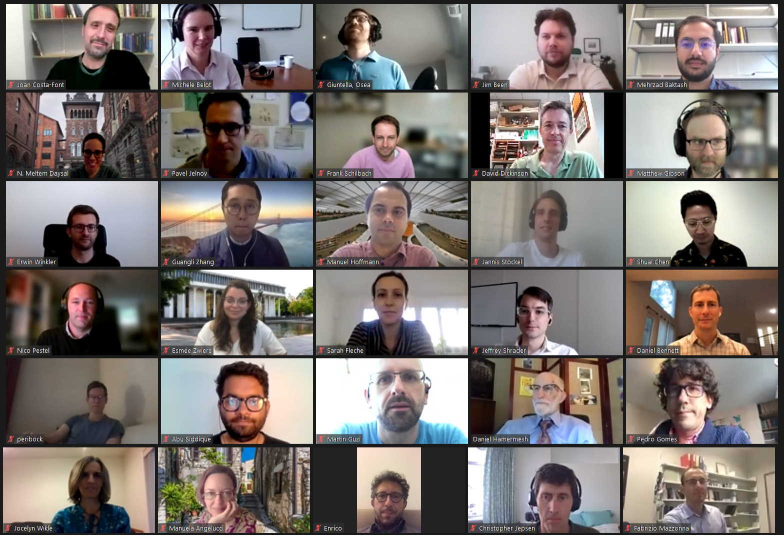
Economists have recently started to dive deeper into the relationship between time, sleep and stress. To present and discuss new research on these issues, the IZA Workshop on the Economics of Time Use and Mental Health: Stress, Sleep, Fatigue and Employment, organized by Michèle Belot, Joan Costa-Font, Osea Giuntella and Nico Pestel, brought together economists analyzing the relation between time use and mental health.

In his keynote address, Dan Hamermesh explained that the unique contribution of economists to the study of time, sleep and mental health is the consideration of the role of time, prices and constraints (income effects). He discussed the importance of time constraints asking about the Keynes conjecture (1980) about how people allocated their time when they don’t need to work anymore and the effect of time gifts. He also focused on the importance of sleep variability (and volatility), which affects well-being and is highly driven by income and education.

Leisure, sleep and mental health

The first presentation of the workshop addressed the question whether watching TV has a positive or negative effect on individual well-being. Manuel Hoffmann explored the roll-out of commercial TV in West Germany in the late 1980s where receipt of commercial TV via terrestrial frequencies was initially restricted to certain geographic areas. According to the study, TV consumption increased in areas with access to commercial TV but did not affect health outcomes while the effects on life satisfaction are positive.

The paper presented by Sarah Fléche explored the impact of DST (Daylight Saving Time) on individuals’ welfare. Using survey data from Germany, she finds that the Spring DST causes a significant decline in life satisfaction. The negative impacts on physical and emotional health seem to follow from deteriorated sleep and increases in time stress induced by the DST policy.

Life shocks and mental health

Next, Petri Böckerman presented evidence on the causal effects of parental death on children’s mental health. Building on unique register-based data from Finland on children born between 1971 and 1986, the authors conduct an event study and find that losing a father has large effects on boys, and losing a mother has large effects on girls, while there is no clear evidence of increased hospitalization following a death of a parent of a different gender. Depression is the most common cause of hospitalization in the first three years following paternal death, whereas anxiety and, to a lesser extent, self-harm are the most common causes five to ten years after paternal death.

Jim Been introduced a study about the effects of job loss on health. Using micro-level panel data from the Netherlands on health, employment, and job loss expectations, the paper finds no evidence of an impact on physical and mental health, but instead positive effects in terms of reductions in headaches and fatigue. The results suggest that the immediate effects of reduced work stress are bigger than the immediate increase in financial stress from job loss.

Medication and gender

Meltem Daysal presented evidence on the impact of adolescent antidepressant use on academic achievement. Using an identification strategy based on heterogeneity in specialists’ propensity to prescribe, the paper finds that antidepressant use leads to an increase in test scores in math.

By using a similar identification strategy based on heterogeneity in average prescription behavior by family doctors, Janet Currie and Esmee Zwiers demonstrated the effects of postpartum depression medication in the Netherlands. They find that postpartum depression medication affects the propensity to use anti-depressants later on in life but does not affect labor market outcomes.

Abu Siddique ended the session with a study of the impact of tele-counseling for women in rural India during the Covid-19 pandemic. The intervention reduced the propensity of women to be stressed and depressed and to be food insecure both immediately after the intervention ended and in a follow-up ten months later.

Economic impact of mental health

Daniel Bennett examined the effect of psychiatric care interventions reducing depression in India. The paper documents positive effects on human capital accumulation, which is explained by reduced barriers to action, though no effects were observed on productivity.

Finally, Barbara Biasi discussed the career effects of individuals with mental disorder by using Danish data documenting labor market penalties in the range of 35-70 percent. To investigate the causal effects of mental health on a person’s career, the paper exploits the approval of lithium as a maintenance treatment, which closed the labor market gap by about one-third.

Filed Under: IZA News Tagged With: fatigue, mental health, sleep, stress, time use

Three IZA Research Fellows receive Economics Nobel Prize

October 11, 2021 by Mark Fallak

The Sveriges Riksbank Prize in Economic Sciences in Memory of Alfred Nobel 2021 will be awarded to David Card (UC Berkeley) “for his empirical contributions to labor economics” as well as Joshua D. Angrist (MIT) and Guido W. Imbens (Stanford University) “for their methodological contributions to the analysis of causal relationships.”

“A very well deserved Prize,” said IZA Network Director Daniel Hamermesh. “Their work has affected and enhanced the thinking and research of all labor economists — and it has added to public interest in and understanding of labor issues.”

All three laureates have been IZA Research Fellows for many years. Card and Angrist joined IZA over 20 years ago and have been among the most active IZA Research Fellows ever since, submitting dozens of IZA Discussion Papers and participating in a number of IZA events. In November 2006, David Card was awarded the IZA Prize in Labor Economics jointly with Alan Krueger.

For more information see the nobelprize.org press release.

Filed Under: IZA News Tagged With: Nobel Prize

  • Previous Page
  • Page 1
  • Page 2
  • Page 3
  • Page 4
  • Page 5
  • …
  • Page 9
  • Next Page

Primary Sidebar

© 2013–2025 Deutsche Post STIFTUNGImprint | Privacy PolicyIZA