• Skip to primary navigation
  • Skip to content
  • Skip to primary sidebar

IZA Newsroom

IZA – Institute of Labor Economics

  • Home
  • Archive
  • Press Lounge
  • DE
  • EN

Students overestimate their academic achievement

February 7, 2020 by Mark Fallak

People tend to hold rather favorable views of their own abilities, both in absolute and relative terms. Such upwardly biased self-views may have important economic consequences, not just for firms with overconfident managers. When individuals invest in human capital early in life, biased beliefs about academic skills may be related to mistakes and mismatches in schooling choices that are hard to reverse, with potentially long-lasting consequences for labor market outcomes.

In a new IZA discussion paper, Matteo Bobba and Veronica Frisancho analyze how students update their beliefs in response to performance feedback. The authors ran a field experiment in Mexico City, providing randomly chosen ninth-graders with individualized feedback on a mock exam preceding a high-stakes admission test which regulates access to public high schools.

To understand the effect of this feedback, the researchers elicited beliefs about own ability – both before and after the mock exam. The data show that prior beliefs were relatively inaccurate, especially for low-performing students. Only eight percent of the students scored better in the mock test that they had previously assumed.

High-performing students are more effective at updating their beliefs

Individual feedback led to a more realistic self-assessment, but not to the same extent for everyone. Students from a favorable socioeconomic background, especially those who attended better schools, processed the new information more effectively. Also, boys were better at updating their beliefs than girls.

These findings may have important implications for the design and targeting of policy interventions aimed at disseminating information among youth on the verge of important schooling decisions. While enabling students to better assess their own ability, feedback may also increase inequality by gender or socioeconomic status if it helps some groups of students more than others.

Filed Under: Research Tagged With: achievement, bias, feedback, overconfidence, self-perception, students

Student feedback has little effect on teacher behavior

February 5, 2020 by Mark Fallak

Regular provision of feedback to employees is common practice in many organizations. Feedback often serves as a means to provide recognition to good performers as well as to help employees learn about how to improve one’s performance.

Providing employees with feedback has also become increasingly prevalent in education. Many schools use students’ evaluations of teachers to enable and motivate teachers to improve teaching. Moreover, students’ evaluations sometimes play a role in tenure, bonus, and promotion decisions.

Field experiment at a Dutch school

A new IZA discussion paper by Margaretha Buurman, Josse Delfgaauw, Robert Dur, and Robin Zoutenbier addresses the question under what conditions teachers are responsive to student feedback.

The authors ran a field experiment at a large Dutch school for intermediate vocational education to examine whether the response of teachers to student feedback depends on the content of the feedback.

Students evaluated all teachers, but only a randomly selected group of teachers received feedback. Additionally, all teachers were asked before and a year after the experiment to assess their own performance on the same items.

Only female teachers respond to feedback

The analysis shows that receiving student feedback had, on average, no effect on student evaluation scores a year later. However, teachers whose self-assessment before the experiment is much more positive than their students’ evaluations do improve significantly in response to receiving feedback.

The authors also find that provision of feedback reduces the gap between teachers’ self-assessment and students’ assessment, but only to a limited extent. All of these results are driven by the female teachers in the sample, whereas male teachers appear to be unresponsive to student feedback.

Filed Under: Research Tagged With: evaluation, feedback, performance, students, teachers

Extensive social media use hurts teenagers’ mental health

January 30, 2020 by Mark Fallak

Social media use can affect adolescents’ well-being and mental health in different ways. On the one hand, social media can promote interaction with peers with similar interests, facilitate communication and information on sensitive topics, and can be a vehicle of collaboration and involvement with the community. On the other hand, it can also facilitate the sourcing and transmission of harmful content, such as the spreading of cyber bullying and peer pressure, which can affect sleep patterns, perception of body image, and ultimately can result in increased stress and anxiety.

The evidence on the possible causal relationship between social media exposure and adolescents’ well-being is scarce, and most of the existing literature uses cross-sectional data, without considering the importance of unobserved individual characteristics. In other words, there could be other factors at play, such as personality traits, attitudes, or family values, which affect both social media use and mental health. Also, cross-sectional descriptive studies do not consider the risk of reverse causality (i.e., young people may be going online because they have low levels of well-being, not vice versa).

To tackle these methodological issues, a recent IZA discussion paper by Paul McNamee, Silvia Mendolia, and Oleg Yerokhin uses data from Understanding Society, the UK Household Longitudinal Study. The authors compare children aged 10 to 15 who spend long hours on social media with children who have very similar observable characteristics (including child’s age, ethnic group, and gender; mother’s mental health, education, labor market activity and marital status; family income, region of residence and urbanization), but do not spend long hours on social media. Through various econometric techniques they minimize the risk that potential confounders may affect their modeling.

Not social media per se, but high intensity of use is harmful

The results show that prolonged use of social media (more than four hours per day) is significantly associated with poorer emotional health and more behavioral difficulties, and in particular decreased perception of self-value and increased incidence of hyperactivity, inattention and conduct problems. These effects are found especially for girls and regardless of family’s socio-economic status. However, limited use of social media (less than three hours per day) has some positive effect on peer relationships.

In the light of these findings, the authors suggest that parent and teachers should not stigmatize social media use as a completely negative phenomenon, but rather highlight the possible risks of prolonged social media use at the expense of other socializing activities.

Filed Under: Research Tagged With: mental health, peer pressure, social media, teenagers, well-being

How broadband internet affects labor market matching

January 27, 2020 by Mark Fallak

The internet may affect labor market matching by reducing information asymmetries and labor market frictions, potentially leading to higher pay, more stable employment and lower unemployment rates. However, these effects are not well understood due to a lack of data on job vacancies and quasi-experimental variation in internet use.

A new IZA discussion paper by Manudeep Bhuller, Andreas R. Kostøl and Trond C. Vigtel helps fill this gap using plausibly exogenous roll-out of broadband infrastructure in Norway, and comprehensive data on recruiters, vacancies and job seekers.

The main results of the paper can be summarized in three broad conclusions.

  1. Broadband internet has improved the recruitment process: The authors find that broadband expansions increased online vacancy-postings, shortened the average duration of a vacancy by 9%, and lowered the share of establishments with unfilled vacancies by 13%.
  2. Job seekers with broadband internet access were more likely to find a new job, and starting wages after a spell of unemployment increased by 3-4% as an effect of better broadband internet availability.
  3. The analysis also shows more stable employment relationships, which is in line with better match quality.

The authors’ calculations suggest that the steady-state unemployment rate fell by as much as one-fifth due to improvements in matching efficiency and falling cost of gathering information about job vacancies.

Filed Under: Research Tagged With: broadband, Internet, matching, Norway, recruitment, unemployment, vacancy

Are women more willing to accept jobs with lower pay?

December 19, 2019 by Mark Fallak

Few topics in labor economics have received more attention in academic, public and policy debates than the gender pay gap. The IZA Newsroom frequently summarizes new research findings on various drivers of the gap, including the role of discrimination vs. structural differences, or gender differences in wage expectations. Three recent IZA papers have looked into gender differences in quit behavior, job satisfaction, and job preferences – or, more broadly speaking, why women tend to be less pay sensitive than men.

Why men quit and women stay when pay is low

It has long been documented that men are more likely than women to quit their jobs for better pay at another firm. This contributes to the gender wage gap because firms need to pay their male employees relatively more to keep them on board. A new IZA discussion paper by Christian Bredemeier, based on data from a large U.S. household survey, shows that almost all of the gender difference in job quitting behavior can be attributed to gender differences in household earner roles rather than risk aversion or other psychological factors.

“When offered a job that pays, say, 5% more than the current job but is less likeable in terms of other characteristics such as location or working hours, the importance of this 5% pay difference depends on how strongly the household relies on the earnings of the considered individual,” says Bredemeier. As long as men are still the primary earners in most households, the non-pay dimensions of their jobs will receive relatively little weight.

The results thus suggest that firms discriminate by earner status rather than against women per se when they pay men more to keep them from quitting. Since this practice reinforces and perpetuates pay differences between men and women, policies promoting gender equality in the household could play an important role in closing the gender pay gap.

Why women are more satisfied with their jobs

There has been much debate about why a gender gap also exists in job satisfaction, even when a wide range of personal and job characteristics are controlled for. One often cited argument is that women may have lower expectations than men, and therefore report higher satisfaction, even in jobs that may be objectively worse.

However, using unique data for Europe which captures detailed preferences relating to an employee’s job choice (see table below), an IZA discussion paper by Paul Redmond and Seamus McGuinness shows that job preferences explain much of the gender gap in satisfaction.

Two preferences stand out as particularly important: intrinsically liking the work and having a good work-life balance. These preferences are strongly associated with greater job satisfaction and women place a greater emphasis on both of these factors than men. Controlling for these preferences causes the gender gap in job satisfaction to disappear.

Why women are overrepresented in the public sector

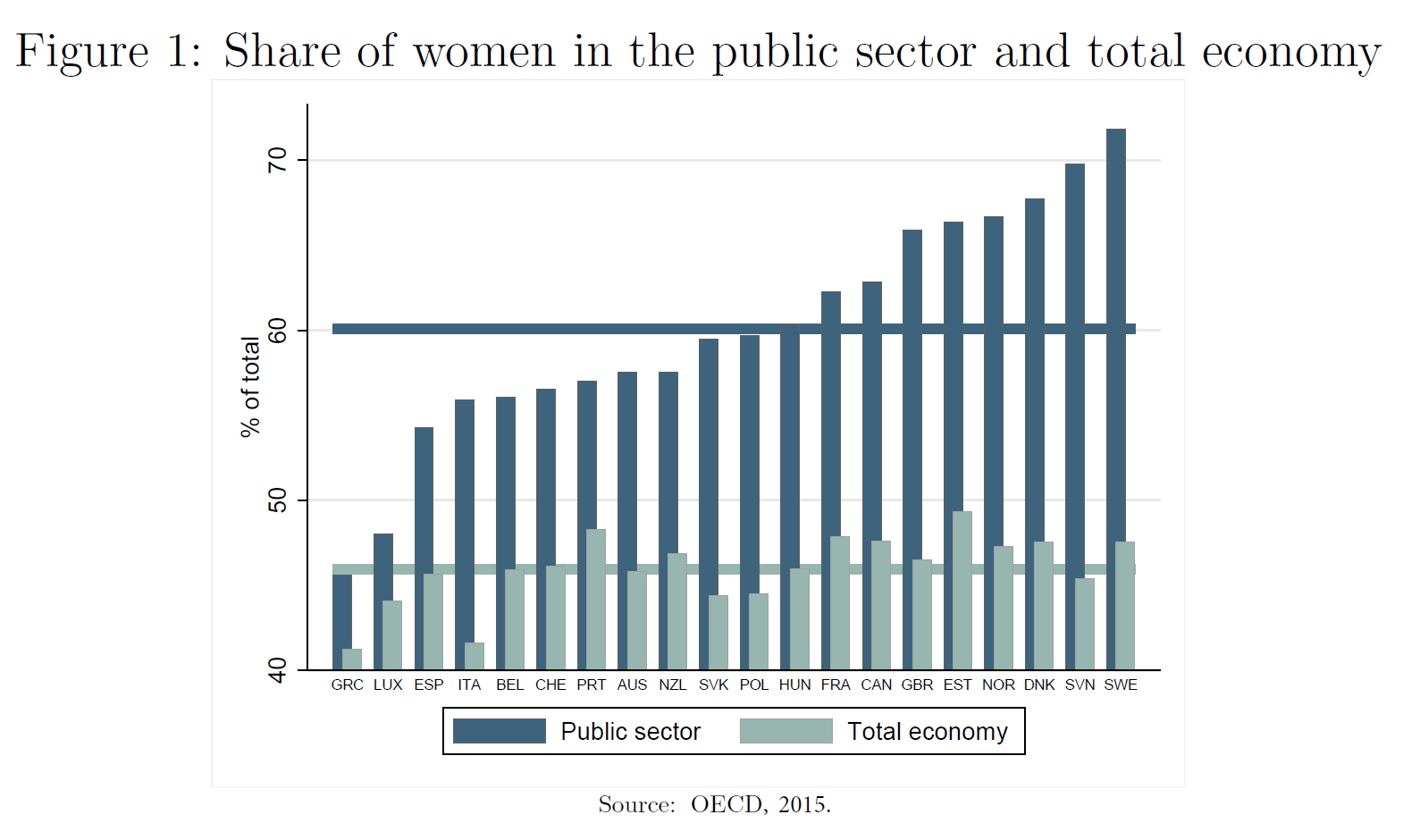
Gender differences in job preferences may also explain why in most countries women are overrepresented in the public sector (see figure). A recent IZA discussion paper by Pedro Maia Gomes and Zoë Kuehn quantifies for four countries how much of the selection of women into the public sector is driven by lower gender wage gaps, better work-life balance, greater job security, or intrinsic preferences for public sector activities.

The authors find that women’s preferences explain 20 percent of the gender bias in France, 45 percent in Spain, 80 percent in the US, and 95 percent in the UK. The remaining bias is explained by differences in public and private sector characteristics, in particular relatively higher wages for female public sector workers that explain around 30 percent in the US and Spain and 50 percent in France. Work-life balance is found to be an important driver only in France and Spain, explaining 20 to 30 percent of the gender bias.

Calculating how much of their wages private sector workers would be willing to sacrifice to face the same job separation rates or working hours as workers in the public sector, the authors find that the work-life balance premium is very high in Spain (25 to 36 percent), high in France and the UK (7 to 15 percent) and lower in the US (7 to 9 percent).

In all countries, the job security premium is much lower, ranging from 1-2 percent in the US and the UK to 3-4 percent in France and Spain, countries with higher unemployment rates. Regarding gender differences, the study finds that women are willing to pay more for work-life balance, while men are willing to pay more for job security. Higher job security in the public sector thus actually reduces the gender bias. This is due to the fact that women in general have a higher “opportunity cost” of working, as well as lower wages, which makes job losses more painful for men.

+++

For related research see also the IZA World of Labor key topic page: “What is the gender divide?”

Filed Under: Research Tagged With: gender, job satisfaction, pay, preferences, public sector, quits, work-life balance

How the rise of industrial robots affects family behavior

December 17, 2019 by Götz Siedler

Million of workers across the world feel the growing pressure and fear of machines replacing their jobs. Artificial intelligence (AI), machine learning, robots, and the Internet have already transformed the nature of jobs and will continue to rapidly change our labor markets.

The debate on the effects that the development of robotics and automation will have on the future of jobs has been lively. However, despite the growing interest on the labor market effects of automation, we know very little about how these structural economic changes are reshaping life-course choices.

Over the last three decades, the stock of these operational industrial robots in the US increased by more than five times. In 2016, robot sales increased by 16% reaching a new peak for the fourth year in a row. This surge is driven by the increase in electrical/electronics industry. Yet, the automotive industry still accounts for the highest share of industrial robots. Between 2011 and 2016, the average robot sales increase was at 12% per year. This continued growth was pushed by the trend to automate production as a way to strengthen American industries and keep manufacturing in the US. Just since 2005, and despite the slow-down caused by the great recession, the number of robots per thousand worker grew from 1.3 to 2.4.

Isolating the effects of automation

A new IZA discussion paper by Massimo Anelli, Osea Giuntella, and Luca Stella examines how the exposure to robots and its consequences on job stability and economic uncertainty have affected individual demographic behavior.  The researchers focus on the US labor market and base their analysis on the American Community Survey (ACS) data covering years from 2005 to 2016 and use data from the International Federation of Robotics (IFR). These data track the change by economic sector in the operational stock of “industrial robots,” fully autonomous, multipurpose machines that are automatically controlled, do not need a human operator and can be re-programmed to perform several tasks. These robots can easily replace human operators in most industrial production activities that require “reaching and handling” actions.

The authors construct a measure of robots penetration in US labor markets by exploiting the variation in the distribution of industrial employment across commuting zones (i.e. geographical units corresponding to regional labor markets characterized by intense daily commuting of workers) combined with changes in the adoption of robots across industries over time.  To mitigate the concern that the adoption of robots could be correlated with other demographic trends within an industry or a commuting zone, the authors use the industry-level spread of robots in advanced economies other than the US as an instrument for the adoption of robots in the US. In this way, they only exploit the variation resulting from industries that exhibited an increase in the use of robots in other advanced economies. This variation should capture the exogenous trends in automatability of certain sectors driven by advancements of the technological frontier, which are plausibly independent of US demographic trends.

Marriage market and fertility

Using this empirical strategy, the researchers first show that robot exposure had differential effects on the labor market opportunities of men and women.  They find that a one standard deviation increase in robot exposure reduced the gender wage gap by 4% and the gender gap in labor force participation by 2%. They then turn to investigate the effects of this labor market shocks on the marriage market and fertility.

The study shows that commuting zones that were more exposed to robot penetration experienced a reduction in marriage rate and an increase in divorce and cohabitation. A one standard deviation increase in robot exposure was associated with a 4% reduction in the marriages, a 5% increase in divorces, and a 13% increase in cohabitations.

While the authors find a null effect of robots on overall fertility, this result masks substantial heterogeneous effects on fertility. Indeed, commuting zones that were more exposed to robots penetration exhibit a 15% reduction in marital fertility and a 20% increase in the rate of children born out-of-wedlock.

Greater labor market uncertainty

Overall, the findings suggest that a decrease in the relative marriage-market value of men and the greater labor market uncertainty may be a relevant transmission mechanisms of the impact of robot penetration on marriage and marital fertility rates.

The authors argue that robots have overall increased the growing uncertainty associated with the labor market conditions for most workers and has substantially lowered the economic value of men on the marriage market. This in turn has contributed to reduce willingness to long-term commitments, such as marrying. At the same time, the lower value of men has increased the value of out-of-wedlock fertility options for women and the probability that children grow up in cohabitating households.

Given the concerns that cohabitation may reduce children’s well-being, developing more encompassing family policies that cover more homogenously married and cohabitating couples could be a natural response to the effects of robotics on life-course choices, according to the authors.

Filed Under: Research Tagged With: automation, divorce, early childhood, family, marriage, robots

Worker representation in the boardroom increases capital formation

December 13, 2019 by Mark Fallak

A fundamental question societies face is whether and how to involve stakeholders, in particular workers, in corporate decision-making. Many countries, particularly in continental Europe, grant workers formal authority in firms’ decision-making. Such shared governance or codetermination institutions include worker-elected directors on company boards. By contrast, in many liberal market economies such as the United States, firms are legally controlled solely by their owners.

This consensus, along with the idea that corporations ought to primarily benefit their shareholders, has recently been called into question. For example, the Business Roundtable issued a statement in August 2019 on “the purpose of a corporation,” arguing that companies should advance the interests of stakeholders, including employees, rather than following a model of shareholder primacy.

In addition, policy proposals that would mandate worker-elected directors, as in many European countries, have been proposed in the US. For example, two federal bills introduced in 2018, the Accountable Capitalism Act and the Reward Work Act, would mandate that 40% or 1/3, respectively, of the directors of large companies be worker representatives.

What are the consequences of forcing firms to have worker-elected directors in the boardroom?

On the one hand, worker participation may help overcome coordination issues and improve information flows, foster long-term employment relationships, or facilitate the enforcement of implicit contracts. On the other hand, according to the influential “hold-up” hypothesis, granting workers control rights will raise worker bargaining power and thereby discourage capital formation, as capitalists anticipate that labor will grab a larger share of the fruits from investments.

Compelling evidence to adjudicate between these views is scant due to the absence of experiments randomizing shared governance across firms.

Policy reform provides a natural experiment

A recent IZA discussion paper by Simon Jäger, Benjamin Schoefer and Jörg Heining exploits a natural experiment in Germany to provide empirical evidence on the effects of shared governance. The authors study a 1994 reform in Germany, which sharply abolished worker-elected directors in certain new firms and permanently preserved the mandate in others.

Before the law change, all stock corporations had to apportion at least one-third of their supervisory board seats to representatives elected by their workforce. In dual board settings such as Germany’s, the supervisory board appoints, monitors, dismisses, and sets the compensation for the executive board. It is also involved in important decisions, such as large investments.

The 1994 reform abruptly abolished worker-elected directors in newly incorporated stock corporations, so that these firms were formally completely controlled by their shareholders unless reaching a threshold of 500 employees. Importantly, the cohort-based reform permanently locked in shared governance in the incumbent firm cohorts incorporated before the reform for the rest of their lifecycle.

The researchers leverage the natural experiment created by the 1994 reform and compare stock corporations incorporated just before and after the date of the reform. They also compare changes in a placebo group of other corporation types not affected by the reform.

Effects on capital formation, wages, and borrowing costs

A central focus of the study is the effect of shared governance on the production process, with a particular focus on capital formation. Most importantly, the analysis shows that along a variety of measures, shared governance shifts firms toward a more capital-intensive mode of production.

The authors also find less outsourcing in these firms, while output per worker in affected firms increases. Hence, their evidence is inconsistent with the disinvestment prediction of the canonical hold-up mechanism: capital increases rather than decreases when workers get seats on the board.

Regarding the effect on wages, the study finds at best small and statistically insignificant wage increases in shared governance firms, further making the standard hold-up mechanism unlikely to hold. On the financial side, shared governance does not appear to reduce firms’ external-finance capacity. There is no clear effect on profitability or measures of financial constraints.

Leverage is unchanged, although interest payments over debt are slightly reduced, perhaps consistent with the market considering firms with worker involvement in governance to be less risky.

Even though the authors do not find negative profitability effects, they cannot definitively measure the effects of the additional capital formation on shareholders, or whether it reflects yet another agency conflict inside the firm. For example, worker participation may lock in resources into fixed capital at the expense of dividend payouts to the owners.

Workers may also aggravate agency conflicts of an imperfectly incentivized management engaging in empire building and hence overinvestment. Such an interpretation may also help explain why at least individual capitalists may not voluntarily adopt codetermination.

Improved information flows and cooperation

The authors discuss a variety of potential channels that can in principle lead shared governance to raise capital investment, such as improved information sharing or facilitating long-term interactions.

They also show that the disinvestment prediction of the canonical hold-up model is fragile and in fact can be overturned in a simple and perhaps realistic extension, consistent with their main findings. In the model extension, codetermination may increase worker bargaining power over a variety of corporate decisions that also include investment, not necessarily just wages.

In this model, a complete absence of workers in firms’ decision-making leads to underinvestment. Introducing codetermination will raise investment and can bring the economy closer to social efficiency but, beyond a certain level, increases in worker bargaining power may also lead to inefficient overinvestment.

Therefore, the findings leave open the important question whether the additional capital stock brings the overall economy closer to social efficiency, for example if investment is inefficiently low due to market failures.

Validity for other countries may be limited

In terms of external validity to other corporate-governance systems such as the US, the authors note that their experiment occurred against the backdrop of existing establishment-level worker participation through works councils, an institution with a long history in Germany and the second lever of codetermination besides board-level representation.

On the one hand, an interaction between these two codetermination institutions may amplify effects of shared corporate governance through information sharing or by providing the worker-elected directors with leverage beyond their voice and vote on the board. On the other hand, the incremental effect of supervisory board seats could also duplicate some channels by which works councils already affect firm outcomes.

Relatedly, this new research raises the question whether the overall cooperative labor relations in the German context may affect the findings – or whether the shared governance institution under study may have even contributed to this cooperative equilibrium: since the capital side retains the majority of seats, it could always outvote radical labor representatives voicing excessive demands.

Therefore, in systems with minority representation of labor in the board, labor representatives may have an incentive to be moderates in order to wield influence through coalition-building with shareholders.

+++

See also media coverage of this paper by Reuters, Bloomberg, and NPR.

Filed Under: Research Tagged With: capital, codetermination, corporate boards, investment, labor, unions

Taxing billionaires

December 2, 2019 by Mark Fallak

The United States exhibit vast geographical differences in the degree to which personal income, corporate income and wealth are taxed. There has been much debate in recent years on the costs and benefits of state and local governments imposing high taxes on their richest residents, especially in light of the potential for tax flight.

To add new empirical findings to the debate, a recent IZA discussion paper by Enrico Moretti and Daniel J. Wilson studies the effects of state-level estate taxes on the geographical location of the Forbes 400 richest Americans between 1981 and 2017 and the implications for tax policy.

Billionaires move away from estate tax states

The authors exploit the sudden change created by a 2001 federal tax reform. Before 2001, some states had an estate tax and others didn’t. However, there was also a federal credit against state estate taxes. For the ultra-wealthy, the credit amounted to a full offset. In practice, this meant that the estate tax liability for the ultra-wealthy was independent of their state of residence. As part of the Bush tax cuts of 2001, the credit was eliminated. The estate tax liability for the ultra-wealthy suddenly became highly dependent on state of residence.

The analysis shows that the number of Forbes 400 individuals in estate tax states fell by 35% (or 2.35 billionaires on average) after 2001 compared to non-estate tax states. The authors estimate that $80.7 billion of 2001 Forbes 400 wealth escaped estate taxation in the subsequent years due to billionaires moving away from estate tax states. Especially older billionaires’ geographical location appears to be highly sensitive to state estate taxes.

Estate tax revenues exceed foregone income tax revenue

States therefore face a trade-off in terms of tax revenues: On the one hand, an estate tax on billionaires implies a one-time estate tax revenue gain upon the death of a billionaire in the state. According to the estimates, estate tax revenues sharply increase – by $165 million on average – in the three years after a Forbes billionaire death. On the other hand, this comes at the cost of foregone income tax revenues if estate taxes induce some billionaires to move away.

Surprisingly, the authors find that for most states the benefit of additional revenues from adopting an estate tax significantly exceeds the cost of foregone income tax revenue due to tax-induced mobility. Overall, it is estimated that 28 of 29 states that currently do not have an estate tax and have at least one billionaire would experience revenue gains if they adopted an estate tax on billionaires. The only exception is California, where the personal income top tax rate is very high.

The authors caution, however, that their cost-benefit analysis does not include potential indirect effects on states if billionaire relocation causes relocation of firms and investments as well as a reduction of donations to local charities.

Filed Under: Research Tagged With: billionaires, cost-benefit analysis, estate tax, income tax, mobility, revenue, taxation, wealth

How earthquakes affect social preferences

November 27, 2019 by Mark Fallak

Imagine you have to explain inequalities to your kids. Would you say that differences in income and wealth are a matter of luck? For example, the luck of being born in the right place into the right family. Or would you rather tell your kids that success entirely depends on talent and effort, so they will have to work hard to achieve their goals?

The economics literature believes that what we learn in our young age about what causes success in life will likely inform our preferences on redistributive policies. At the macro level, these beliefs have a remarkable economic and societal impact.

If a society believes that socioeconomic success only depends on merit, and that everyone should fully enjoy the fruits of her work, it will demand low redistribution. If, instead, the belief prevails that wealth is mostly determined by “luck”, such as the fortune of being born in the right place into the right family, society will support higher redistribution thus levying heavier taxes.

But what happens when a person believing in the role of merit suddenly and unpredictably experiences bad luck? Standard economic reasoning suggests she may adjust the expectations on what determines success thereby raising her support for redistribution.

Natural experiment

A recent IZA discussion paper by Giovanni Gualtieri (Italian National Research Council), Marcella Nicolini (University of Pavia), and Fabio Sabatini (Sapienza University of Rome and IZA) answers this question by exploiting evidence from an unfortunate natural experiment, the earthquake that struck central Italy in 2009. The earthquake consisted of a first strong shake that occurred on April 6 and dozens of aftershocks lasting until April 13, seven of which were as destructive as the first one.

To study how the exposure to the shakes affected inhabitants’ preferences about redistribution, the authors match information on the peak ground acceleration (PGA) of each shock recorded by the Italian National Strong Motion Network throughout the L’Aquila earthquake with nationally representative survey data about individual opinions and beliefs that were collected almost two years after the shock. This allows reconstructing the acceleration experienced by each survey respondent during each shake.

PGA is the largest peak acceleration recorded at a given geographic point during a seismic event. Unlike the Richter and moment magnitude scales, it is not a measure of the total energy of the earthquake, but rather of how hard the earth shakes on the surface. It thus provides an objective indicator of the intensity with which residents perceive the shakes.

Multiple shocks

The empirical analysis shows that the average intensity of the shakes registered throughout the L’Aquila earthquake is associated with subsequent stronger beliefs that, for a society to be fair, income inequalities should be leveled by redistribution. The analysis of the single shocks occurred between April 6 and 13, however, reveals that the relationship between redistributive preferences and the intensity of the shakes is triggered only after a certain number of shocks. It is with the sixth shock that the ground acceleration experienced by inhabitants becomes a statistically significant predictor of support for redistribution.

The peak ground acceleration of the three final shocks occurred between April 9 and 13 very well predicts preferences for redistribution, as if some sort of cumulative effect of the shocks has been at stake. Though new in the economics literature, this result recalls psychological theories explaining the different behavioral outcomes of single versus multiple shocks as resulting from a dose-response relationship. To corroborate this result, the authors compare the outcomes of the L’Aquila earthquake with a single-shake earthquake occurred in the province of Parma three months before, finding that the latter had no effect on individuals’ social preferences.

Sizeable effect

The effect is sizeable and economically relevant. To get an idea of the size of the effect, consider that a one standard deviation increase in the average peak ground acceleration of the shakes implies an increase in the likelihood of supporting redistribution by 3.1 percentage points. The standardized beta coefficients suggest that the effect of the average PGA is comparable to that of the other statistically significant covariates, such as political orientation (whose effect is 3.5 percentage points).

Understanding the drivers of redistributive preferences is important because the proportion of people supporting redistribution in turn is a good predictor of the share of GDP spent on social welfare both within and across countries. This study calls for further investigation also in light of the recent, cross-national, rise in populist movements calling for more redistribution, as the authors’ findings support the theory that demand for redistribution is strongly driven not only by selfish motives (i.e., the hope to personally benefit from public welfare spending) but also by a genuine concern with the fairness of social competition.

Filed Under: Research Tagged With: inequality, Italy, natural experiment, redistribution

Tobacco control strategies that work

November 21, 2019 by Dajan Baischew

According to the World Health Organization, the “tobacco epidemic is one of the biggest public health threats the world has ever faced, killing more than 8 million people a year around the world.” Many countries have therefore implemented various tobacco control strategies aimed at preventing tobacco use and encouraging smokers to quit. Three recent IZA discussion papers evaluate the effectiveness of different policies in the U.S., Europe, and Australia.

Public smoking bans improve child health

As evidence of the negative effects of second-hand smoking has mounted, an increasingly popular public policy response has been to impose restrictions on smoking through 100% smoke-free bans in workplaces, restaurants and bars. Yet sparse information exists regarding the impact on the health of children and infants. If smokers compensate by shifting their consumption of cigarettes from public venues to smoking at home, then these policies may have a harmful effect on children and infants.

A study by  Kerry Anne McGeary, Dhaval M. Dave, Brandy Lipton and Timothy Roeper suggests that these fears are unfounded. Exploiting state- and county-level changes to smoking ban legislation over time in the U.S., the authors show that smoking bans have improved the health of both infants and children, mainly through the implementation of more comprehensive bans. Rather than leading to a displacement among smokers, the bans actually had a positive spillover effect in terms of reducing smoking inside the home.

Their effect magnitudes imply that expanding comprehensive coverage to all U.S. states could prevent between approximately 1,110 – 1,750 low birthweight births among low-educated mothers, resulting in economic cost savings of about $71 – $111 million annually. Health improvements among older children add to these economic benefits.

Banning tobacco sales to teens is less effective

Another study by Armando N. Meier, Reto Odermatt and Alois Stutzer evaluates one of the most prevalent prohibitory policies: banning the sales of tobacco to teens. Those in favor of sales bans argue that bans reduce teen smoking by making it more difficult for teens to get cigarettes and by signaling the danger of smoking. Those who criticize sales bans counter that smoking may become more appealing – the forbidden fruit e ffect. They also highlight that teens can circumvent the restrictions by getting cigarettes from other sources, such as their peers, instead of from stores.

Exploiting the staggered introduction of sales bans across Switzerland and the European Union from 1990 to 2016, the estimates for Switzerland indicate a less than 1 percentage point reduction in teen smoking because of the bans. The reduction is substantially lower than the 5 percentage point reduction expected by health officials, mainly because teens circumvent the bans through peers. Moreover, teens consider smokers less “cool” but they do not think smoking is more dangerous.

Pictorial warnings should be supported by media campaigns

A third study by Daniel Kühnle, using individual-level panel data from Australia, examines the association between pictorial warnings on cigarette packages and smoking behavior in terms of prevalence, quitting, initiating and relapsing. The results show that the reform reduced smoking rates by around 4% within the first year of the policy. The effect decreases with age, is similar for men and women, and is slightly larger for low-educated compared to high-educated individuals.

The reform permanently lowered smoking rates primarily due to increased quitting in the year of the reform. The author concludes that pictorial warnings, combined with a reference to a smoking cessation helpline and supportive media campaigns, can be an effective strategy to reduce the social costs of smoking.

Filed Under: Research Tagged With: children, health, public health interventions, smoking ban, teenage smoking, tobacco control

  • Previous Page
  • Page 1
  • …
  • Page 19
  • Page 20
  • Page 21
  • Page 22
  • Page 23
  • …
  • Page 69
  • Next Page

Primary Sidebar

© 2013–2025 Deutsche Post STIFTUNGImprint | Privacy PolicyIZA