• Skip to primary navigation
  • Skip to content
  • Skip to primary sidebar

IZA Newsroom

IZA – Institute of Labor Economics

  • Home
  • Archive
  • Press Lounge
  • DE
  • EN

admin

Discrimination against female migrants wearing a headscarf

September 20, 2016 by admin

Germany is currently experiencing a high influx of Muslim migrants. Their labor market integration is a crucial policy goal. However, females with backgrounds of migration from Muslim countries, and especially of those wearing headscarves, are still faced with high levels of hiring discrimination, according to the findings published in a new IZA Discussion Paper.

In a field experiment focusing on Turkish migrants, who have constituted a large demographic group in Germany since the 1970s, Doris Weichselbaumer (University of Linz & IZA) sent out job applications for three fictitious female characters with identical qualifications: one applicant had a German name, one a Turkish name, and one had a Turkish name and was wearing a headscarf in the photograph included in the application material. Germany was the ideal location for the experiment as job seekers typically attach their picture to their résumé.

Whereas the applicant with a typical German name (Sandra Bauer) received an 18.8 percent callback rate, the same person with a Turkish-sounding name (Meryem Öztürk) got callbacks only on 13.5 percent of her applications. In the case of the female with a Turkish name wearing a headscarf, the callback rate was only 4.2 percent. Everything else equal, a female with a Turkish name who wears a headscarf has to send 4.5 times as many applications (and even 7.6 times as many for higher-ranking jobs) as an applicant with a German name and no headscarf to receive the same number of callbacks for an interview.

Source: IZA Discussion Paper No. 10217, p. 22.

This massive rejection of the headscarf is remarkable given the very modern and progressive binding used in the current experimental setting. The headscarf in the application photograph did not cover the applicant’s throat, thus signaling that she is not particularly strict with respect to her religion. Discrimination is likely to be even higher against a more traditional binding of the headscarf, according to the study.

“A heated debate is being led in the West about the apparently inferior position of women in Muslim (migrant) culture. However, little discussion takes place about how Muslim women are actually treated by the Western majority population,” writes Weichselbaumer, stressing the need to lower the obstacles to labor market integration for Muslim women.

Filed Under: Research Tagged With: callback, correspondence study, discrimination, field experiment, headscarf, hiring, job applications, Muslim, resume, Turkish

Genes, education and labor market outcomes

September 19, 2016 by admin

What can genetic information teach us about the intergenerational transmission of economic inequality? A new IZA Discussion Paper by Nicholas W. Papageorge (Johns Hopkins University & IZA) and Kevin Thom (New York University) uses molecular genetic data to better understand the economic returns to ability endowments over the life-cycle, and how they are influenced by economic circumstances during childhood.

The paper follows the cutting edge in behavioral genetics research, which has led to the discovery of robust associations between particular genetic markers and educational attainment. Many of these genetic variants are implicated in biological processes affecting fetal brain development. For further analysis, individual markers are summarized as an “index” or “polygenic score” variable for any individual for whom genetic data are available. This score can be interpreted as a measurement of one type of endowed genetic ability.

The polygenic score is computed for a sample of over 8,000 genetically European individuals from the Health and Retirement Study (HRS), which also contains detailed information on education and labor outcomes including employment, wages, occupation, retirement, and wealth.

The score is robustly associated with educational attainment at all margins – from high school completion to college graduation. Furthermore, the rich HRS data permit an examination of how the genetic endowments captured by this score interact with investments over the lifecycle, e.g. childhood socioeconomic status (SES), to produce human capital.

Childhood poverty and wasted human potential

The research shows that genetic endowments do indeed matter. People with higher polygenic scores (who possess more of the genetic markers associated with education) do better – not only in terms of schooling, but also in the labor market. An important caveat to the analysis is that simply regressing an outcome (e.g., wages) onto a measure of genetic ability does not produce a causal estimate. This issue of how to interpret estimates is discussed at length in the paper.

Next, the authors consider the role of childhood poverty and a surprising pattern emerges. To fix ideas, compare two individuals with the same polygenic score, but who grew up in different economic circumstances. Doing so reveals large differences in educational attainment (e.g. college completion). For the individual from a wealthier background, a higher polygenic score raises the likelihood of college. For the poorer individual, a higher score also raises the likelihood of college, but to a lesser degree. That is, for poorer children, high ability does not translate to high educational attainment in the same way it would for wealthier children. More bluntly, there appears to be a subset of high-ability kids who do not make it to college because they are born into poor families.

Wage returns to genetic endowments

These discrepancies continue in the labor market. The polygenic score predicts higher wages even after controlling for educational attainment. However, these wage returns to genetic ability are limited to individuals with a college degree. Moreover, the genetic premium for college graduates appears to have grown substantially in more recent birth cohorts. This may reflect interactions between genetic ability and the processes that have exacerbated income inequality over the last several decades (e.g. skill biased technological change).

These results are particularly noteworthy in combination with the finding that high-ability individuals from poorer families are less likely to obtain college degrees. Poor childhood circumstances reduce the amount of education received by such high-ability individuals, excluding them from occupations or career paths which offer returns to their talents. Put succinctly, poverty generates wasted human potential.

How much wasted potential is there? Perhaps the data would show that poor kids tend to have much lower genetic abilities (polygenic scores) so that relatively few high-ability individuals are held back by poverty. Strikingly, this does not appear to be the case. The distribution of the polygenic score is nearly identical for individuals from richer or poorer families. This is very troubling as it suggests substantial waste.

Distinguishing ability endowments from human capital investments

To understand the potential value of using genetic measures of ability, it is important to contrast insights gained from a genetic score with those based on cognitive test scores (e.g., IQ), which are often used as proxies for ability. While such scores may reflect natural aptitude, they also directly reflect the investments that parents make to boost those scores.

To fix ideas, suppose two individuals exhibit the same cognitive test score, but one grew up in a wealthy household with access to tutors and test prep services, and the other grew up poor without such resources. In this scenario, the individual who grew up poor likely started out with a higher level of raw ability. Therefore, it may be problematic to use cognitive test scores to draw policy-relevant conclusions about ability. Among other things, we could attribute the low performance of people growing up in poverty to low ability when it is actually a product of low investments. This could lead to an under-estimation of the importance of policies that invest in poor children, such as public education or college subsidies.

In fact, in an additional set of the results, the study provides evidence that using cognitive test scores can generate different results from those based on the polygenic score. An (adult) cognitive test score in the HRS predicts higher wages across the board, not just for the college educated. This stands in sharp contrast to the results using the polygenic score, which indicate that investments in higher education are necessary for individuals to experience returns to endowed ability.

Implications for inequality

To offer some concrete numbers, consider two representative individuals – one individual who has been favorably endowed with a polygenic score that is one standard deviation above the mean, and one that has been less favorably endowed with a score that is one standard deviation below the mean. The study’s estimates imply the following:

1) Among low SES households, the high ability individual would be 9.4 percent more likely than the low ability individual to obtain at least a four-year college degree. However, in high SES households, the high ability individual would be 18.8 percent more likely to obtain at least a four year college degree.

2) Among low SES households, the high ability individual would be 14.3 percent more likely to at least graduate from high school. However, in high SES households, this difference is only 8.3 percent. In other words, genes seem to matter more among low-SES kids for high school completion.

3) For individuals without a four-year degree, there is no statistically significant relationship between the polygenic score and wages after accounting for completed education. However, for those with a college degree, there is a substantial return that has grown among younger birth cohorts. For individuals born after 1942 who earned a college degree, estimates suggest that the high ability individual is expected to earn 24 percent higher wages than the low ability individual, again controlling for completed education. This may reflect adaptability to computerization and other technological advances in the workplace. This hypothesis is corroborated by associations between the score and occupations that require the kind of non-routine job tasks that benefited from computerization. However, notice that only people who went to college profit from their ability in this way. Therefore, high-ability individuals born into poor households may be shut out of career tracks that complement their talents.

4) Results on wasted potential are not limited to poor households. Acutely adverse events prevent high-ability individuals from reaching their full potential. A very bleak example is child abuse, reported by about 6 percent of the sample. Estimates suggest that individuals with similar genetic scores report up to 39 percent less wealth if they were abused as children.

Image source: pixabay

Filed Under: Research Tagged With: ability, childhood poverty, education, genes, genetic endowments, inequality, intergenerational, labor market outcomes, socioeconomic status, wages

How the world’s largest social pension reform is transforming family old-age care

September 15, 2016 by admin

By Xi Chen (Yale University and IZA)

Social pensions are designed to provide the elderly population, especially those with low lifetime incomes, basic protection against poverty in old age. In 2009 China introduced a government subsidized social pension system called the New Rural Pension Scheme (NRPS), which now covers 400 million rural residents and has become the world’s largest social pension program.

The NRPS was introduced in part due to erosion of the traditional system of intergenerational cohabitation in which children would provide care for the elderly. The erosion has been mainly caused by migration of younger generations to cities, lower number of children, a growing elderly population, and increased life expectancy. This is causing some to demand more market-based services to compensate for their loss of family care. Many rural elderly are thus increasingly likely to suffer from too little support were it not for the introduction of the rural pension system. The NRPS, on average, amounts to one-fifth of pensioners’ earned income but still contains large regional variations.

Modest pension benefits in China could also benefit other generations

Through a longitudinal study of households of elderly parents and children in impoverished China, IZA Discussion Paper No. 9482 compares families with adult sons and those with adult daughters, as the former lend stronger support to their parents and therefore their co-residence decisions are more sensitive to their parents’ pension receipt.

The NRPS pension benefits do not require people above 60 to contribute, and their receipt is not dependent on retirement decisions. Because there is, therefore, a large jump in actual pension receipt exactly when the elderly pass the age 60 eligibility cut-off, the study is able to overcome two main challenges that plague the literature: firstly, usually pension-eligible individuals can be quite different from those who are ineligible; and secondly, differences in characteristics between age cohorts may confound the pension’s impact.

The results of the analysis reveal that elderly parents consume more healthcare and other services, even though health insurance coverage shows no significant changes after the pension eligibility cutoff. However, the study also finds a sizable reduction in sons’ (but not daughters’) co-residence with elderly parents after parents begin receiving pensions. Since half of these elderly persons are below the USD 1.25 poverty line, they are very likely to be credit constrained. The larger effect for poorer groups indicates that pension benefits may help to relieve this constraint and make services more affordable to substitute for instrumental support directly provided by their children.

These empirical findings hold important implications. They show that even modest pension benefits in China, as compared to other developing nations, could benefit other generations of the extended families.

Reduced support by children may offset pension benefits

Researchers caution that, meanwhile, substantive changes in living arrangements may offset pension benefits through reduced instrumental support to parents directly provided by children.

IZA Discussion Paper No. 10016 goes further to examine the implication of reduced intergenerational co-residence on career choices of the younger generation, including off-farm activities and migration. The results show that sons (but not daughters) are much more inclined to migrate out of their home county around the pension eligibility age cut-off. Adult children are also more likely to migrate out if their parents are healthy.

These findings suggest pensions may affect informal old-age support not merely through living under different roofs, but also because the distance between elderly parents and children will become much larger. The erosion of this very important old-age support system will likely generate changes in health among seniors, even in the short term.

Pension income decreases susceptibility of the elderly to depression

Fortunately, overall, the NRPS improves the well-being of the elderly beyond their increased utilization of healthcare. Employing China’s most recent national sample, IZA Discussion Paper No. 10037 finds a reduction in the susceptibility of becoming depressed after receiving pension income. The improvement in mental health is found to be larger for vulnerable populations with financial and health constraints.

The study argues that pension payments may affect mental health through at least three plausible channels: (i) changes in lifestyle factors, such as independent living, service consumption, leisure time, and social network connectedness; (ii) health investments, such as nutritional intake and medical treatment; (iii) reduced financial stress, increased self-esteem and life satisfaction, and improved confidence in the future. Even though a recent study has found that pension income weakens the non-pecuniary and pecuniary transfers from children to elderly parents, the size of the effect is very small compared to the positive income change for pensioners.

Even more ambitious social pension reform ahead

The NRPS had achieved universal coverage at the county level in 2012, thus providing a nationwide, subsidized old-age support system to the older population in rural China. Between 2012 and 2014, China rapidly implemented a similar social pension program for all eligible urban residents. Starting from 2014, China has set an ambitious plan to integrate the rural and urban social pensions into one system across the country, establishing a national pension system that provides wide coverage, basic security, multi-level options and sustainability. Once completed in 2020, this unified pension system will likely serve more than 800 million residents in China.

Besides tremendous social and economic impacts for China, the study of social pensions there may have general implications for the U.S. and beyond. As policymakers attempt to address the financial sustainability of the U.S. Social Security program, it is important to evaluate the extent to which Social Security benefits may directly improve old-age health. And if improved, Social Security benefits may be offset by reduced health care expenditures out of the Medicaid or Medicare program.

Similar questions have also been raised in Europe where demographic changes are creating important policy questions. Due to the fact that a large proportion of seniors in many developing countries live in poverty with no formal safety net, and that both the family and the community often provide strong informal old-age support, these studies may also provide some valuable insights and understanding into the effects of reforming pension programs around the world.

This research was supported by NIH/NIA grant (1 R03 AG048920), Natural Science Fund of China (NSFC) (Approval Nos. 70525003 and 70828002) and the James Tobin Summer Research Fund at Department of Economics at Yale University.
Image source: pixabay

Filed Under: Research Tagged With: China, elderly, family, income, life expectancy, NRPS, old age, retirement, social pensions, social security

Differences in risk attitudes do not explain gender gap in leadership positions

September 13, 2016 by admin

A recent IZA World of Labor article suggests that gender differences in attitudes toward risk are less significant than previously claimed and cannot explain women’s under-representation in high-level occupations.

The commonly accepted argument in the economics literature is that women are more risk averse than men. They are therefore less likely to choose a career path leading to high-level jobs in which a large share of the remuneration comes from bonuses based on company performance—deemed higher risk—and are, as a result, likely to be underrepresented in such positions.

As attitude toward risk is still generally considered an innate behavioral trait, attributing gender differences in labor market outcomes to gender differences in risk attitudes implies that policy interventions can play only a very restricted role in dealing with labor market inequality.

Female risk aversion overrated

Summarizing the recent experimental economics literature, Antonio Filippin (University of Milan & IZA) challenges the previous consensus about gender differences in risk attitudes. He argues that beliefs about higher risk aversion among women are stronger than the actual evidence supporting them. In fact, there is no direct proof demonstrating that greater female risk aversion can explain why women are underrepresented in top-level positions in the labor market.

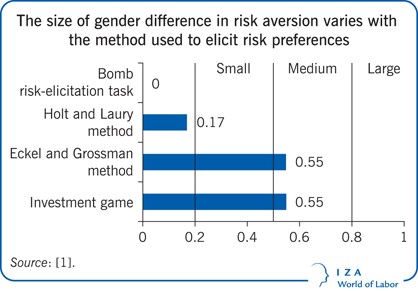
Moreover, recent research shows that gender differences in risk attitudes are neither large nor ubiquitous. Rather, gender explains only a very small fraction of the variance in risk attitudes, and even finding such differences depends on the method used to elicit the risk preferences.

[1] IZA DP No. 8184 (forthcoming in: Management Science)
If risk preferences only play a limited role, if any, in explaining unequal labor market outcomes, this leaves plenty of room for policies aimed at eliminating discrimination and supporting women’s participation in the labor market.

Women ask, but they don’t get

Apart from their disadvantages in career advancement, women typically earn less than men. It is often argued that this may be because (i) women ‘don’t ask’ and (ii) the reason they fail to ask is out of concern for the quality of their relationships at work. This account is difficult to assess with standard labor-economics data sets. Hence a new IZA paper by Benjamin Artz, Amanda H. Goodall and Andrew J. Oswald examines direct survey evidence from Australia.

Using matched employer-employee data from 2013-14, the paper finds that the women-don’t-ask account is incorrect. Once an hours-of-work variable is included in ‘asking’ equations, hypotheses (i) and (ii) can be rejected. “If we find that women are asking and aren’t getting the pay rises, it points the finger toward discrimination,” says Amanda Goodall.

  • Read the complete paper: Do Women Ask? (IZA DP No. 10183)
  • View the coverage in the New York Times and on BBC.

Gender differences in behavior under competitive pressure

While the above studies find male-female differences in competitive behavior to be overrated, evidence from professional sports suggests that substantial gender differences do exist in high-pressure situations. Data on top male basketball (NBA playoffs) and top female basketball players (WNBA playoffs) reveal that men increase risk-taking when they could win the match with a risky strategy. Women, in contrast, reduce their risk-taking in these situations. The less time left in a match, the larger is this gap.

  • Read the paper (IZA DP No. 10011):
    Gender Differences in Risk-Taking: Evidence from Professional Basketball

However, such gender differences seem to disappear when women compete against men. In an analysis of 4,279 episodes of the popular US game show Jeopardy!, this surprising result emerges with remarkable consistency for the probability to (i) respond, (ii) respond correctly, and (iii) respond correctly in high-stakes situations. Even risk preferences in wagering decisions, where gender differences are especially pronounced, do not differ across gender once a woman competes against males. Derived from a large real-life setting, these findings suggest that gender differences in performance and risk attitudes are not gender-inherent, but rather emerge in distinct social environments.

  • Read the paper (IZA DP No. 9669):
    Gender in Jeopardy!: The Role of Opponent Gender in High-Stakes Competition

A third scenario – female competitors exposed to the presence of men without the element of direct competition – is analyzed in a new study that looks at data from the New York City Marathon. Being overtaken by men changes nothing about the anticipated rewards to female performance or the returns to effort in this competitive environment. However, lower-ability female runners are shown to reduce their pace after the initial passing by the fastest running men.

  • Read the paper (IZA DP No. 10184):
    Do Men Matter to Female Competition Even When They Don’t?

Further reading:
IZA World of Labor research on the gender gap and women in the labor market.

Image source: pixabay

Filed Under: Research Tagged With: attitudes, competition, female leadership, gender discrimination, gender gap, risk, risk aversion

Different sleep cycles can explain part of the gender performance gap in education

September 7, 2016 by admin

Girls largely outperform boys academically in middle and high school. Performance gaps begin to arise as early as in third grade, when boys start recording lower reading scores than girls. These gaps continue to permeate and grow through secondary school and eventually result in differences in university enrollment rates. In the United States, for example, girls are increasingly more likely to attend and graduate from post-secondary schools, with nearly 60% of U.S. college students being female.

A recent IZA Discussion Paper by UC Davis researchers Lester Lusher and Vasil Yasenov provides evidence on how gender differences in sleep cycles can help explain this gender performance gap. The authors exploit over 240,000 assignment-level grades collected between 2008 and 2014 in a community in Eastern Europe where students’ schedules alternated between morning and afternoon start times each month due to facility constraints. Relative to girls, they find that boys benefit from the later start time. For classes taught at the beginning of the school day, their estimates explain up to 16% of the gender performance gap.

The researchers explain these outcomes by pointing to sleep studies which suggest that circadian rhythms predispose boys to sleeping later and waking up later, and that girls cope with sleep deprivation better than boys. Given the widespread sentiment that students are not getting enough sleep, these studies suggest that early school start times could be especially detrimental to boys. This raises the question of whether school start times could be handled more flexibly.

  • The study was covered in the Washington Post’s Wonkblog:
    “The powerful thing that happens when the school day starts in the afternoon”

Catering to larks and owls

In a recent interview for the German daily Die Welt, IZA CEO Hilmar Schneider also discusses the need for more flexible handling of school start times. Regardless of gender, he points out that there are two types of students: “There are larks, who are productive in the early morning, and owls, who need until noon to get going.” But Schneider cautions that introducing adapted starting times that serve both types would require vast investments.

Nonetheless, one potential development could be convenient in this regard: Given that daily working times, in general, have been moved back, it would be much easier for families to cope with later school start times than it was in the past.

Classrooms filled with sleep-deprived students

Over the last years, sleep deprivation in the educational context has received much attention among researchers in the IZA community. An IZA World of Labor article by Teny Maghakian Shapiro (Santa Clara University) summarizes the growing literature on the effect of school start times on educational performance.

She underlines the importance of changing sleep patterns pupils experience in adolescence, which, in combination with early school start times, leaves secondary school classrooms filled with sleep-deprived students. Evidence is growing that allowing adolescents to start school later in the morning improves grades and emotional well-being, and even reduces car accidents. Even though adjustments would be costly, the article suggests that changing school start times is one of the easiest to implement and least expensive ways of improving academic achievement.

  • Image source: pixabay

Filed Under: Research Tagged With: education, gender performance gap, school start time, sleep, sleep cycle, sleep deprivation, sleep patterns, student performance

Teacher expectations influence student educational outcomes

September 5, 2016 by admin

Do teacher expectations matter? In particular, can teacher expectations influence student educational outcomes? Yes, says a new IZA paper authored by researchers at Johns Hopkins University’s Department of Economics and American University’s School of Public Affairs.
Scholars, pundits, educators, and policy makers have long speculated whether, and to what extent, teacher expectations create self-fulfilling prophecies that perpetuate black-white gaps in educational achievement and attainment. However, with the exception of experimental studies of the “Pygmalion Effect” in which teachers’ beliefs about student aptitude were experimentally manipulated, credible evidence on the causal relationship between teacher expectations and long-run student outcomes is lacking for two general reasons:

  1. Externally valid data on teachers’ subjective expectations are rarely collected.
  2. Observational analyses of the relationship between teachers’ expectations and student outcomes are plagued by a thorny endogeneity problem. It is often the case that teacher expectations are correlated to students’ outcomes. This could arise for two reasons. On the one hand, teacher expectations may simply be accurate forecasts, in which case teacher expectations do not directly affect student outcomes. On the other hand, incorrect (i.e., biased) teacher expectations could directly affect student outcomes by initiating self-fulfilling prophecies in which investments made in or by students are altered, thereby leading to outcomes that resemble teachers’ initially incorrect beliefs.

Self-fulfilling prophecies

In their IZA paper, Nicholas Papageorge, Seth Gershenson, and Kyungmin Kang address these challenges head-on by developing and fitting a structural econometric model of the education and teacher-expectation production functions to unique, nationally representative survey data of the 2002 cohort of U.S. tenth graders (and their teachers).

The empirical strategy exploits a unique feature of these data: two teachers provide their educational expectations for each student. Ensuing disagreements between teachers about particular students together with information on students’ grades and test scores allows for the identification of students’ objective probabilities of completing college.

Comparing these objective probabilities to teachers’ stated expectations identifies the bias inherent in teachers’ expectations, which are allowed to enter the education production function as inputs that can directly affect the likelihood of college completion via self-fulfilling prophecies.

The analysis yields four main results:

1. Teacher expectations matter

Teacher expectations have causal impacts on the probability that students complete a four-year college degree. The elasticity of the likelihood of college completion with respect to teachers’ expectations is about 0.12, which is consistent with the impact of other K-12 educational inputs on college completion (e.g., class size). This result provides insights into the mechanisms through which the long-run effects of K-12 teachers might operate.

2. Over-optimism may help

Assessing which teachers are more accurate is not necessarily the most salient question when investigating the black-white gap in teacher expectations. This is because on average, all teachers are overly optimistic about students’ ability to complete four-year college degrees. However, the degree of over-optimism is significantly larger for white students than for black students, especially when black students are evaluated by white teachers.

This answers the unresolved question in previous research by the authors, which finds that white and black teachers systematically disagree about particular black students’ potential to graduate college, but does not identify “which teachers are wrong.” More generally, this result highlights an important nuance that is frequently overlooked in discussions of biased beliefs: unbiased (i.e., accurate) beliefs can be counterproductive if there are positive returns to optimism or if there are socio-demographic gaps in the degree of over-optimism, both of which are true in these data.

3. Variations in passiveness

Teachers frequently disagree for transitory, arguably unimportant reasons. For example, when a student behaves passively in English class but not in math class, this affects the English teacher’s expectation but not the math teacher’s expectation. This type of within-student, within-semester variation in passiveness represents transitory, arguably random departures from the student’s baseline (steady-state) level of passiveness.

While the baseline level of passiveness likely does affect educational attainment, daily departures from it should not. This insight is central to the identification strategy employed in both the structural and reduced-form analyses.

4. Hiring more black teachers

Finally, the model is used to conduct two counterfactual, but realistic, policy simulations: hiring more black teachers and de-biasing white teachers. The efficacy of these policies varies with students’ capacities for post-secondary educational success upon entering the tenth grade. Specifically, for black students with low objective probabilities of college completion upon entering the tenth grade, hiring more black teachers is more effective than de-biasing white teachers.

However, neither policy has a particularly large effect on college completion, suggesting that investments earlier in the lifecycle are crucial, which is consistent with prior literature. Nonetheless, the study indicates that achievement gaps can be addressed to some degree even when students are older, albeit with varying degrees of effectiveness. For black students with relatively high (above the median) objective probabilities of college completion, both policies are about equally effective.

Thus, the most effective mix of policies implemented for high school students depends on whether college completion is fairly likely at the time students enter the tenth grade. This information, paired with relative costs, could inform decision-makers as to the optimal mixture of policies.

Filed Under: Research Tagged With: bias, black, college, education, expectations, outcomes, students, teachers, white

Outsourcing of cognitive tasks to blame for polarized labor market, not technology

August 30, 2016 by admin

In recent decades labor markets in many developed countries have become increasingly polarized: middle-wage occupations have been declining, while employment in both high- and low-wage occupations has increased. Many studies point to increasing automation and offshoring of routine middling jobs as the main drivers of this phenomenon; however, little research has focused on these changes at the firm level. Because not all firms have the same characteristics (wage levels, management strategies, etc.), different organizational structures and behavior in firms could be pushing some of this labor market polarization.

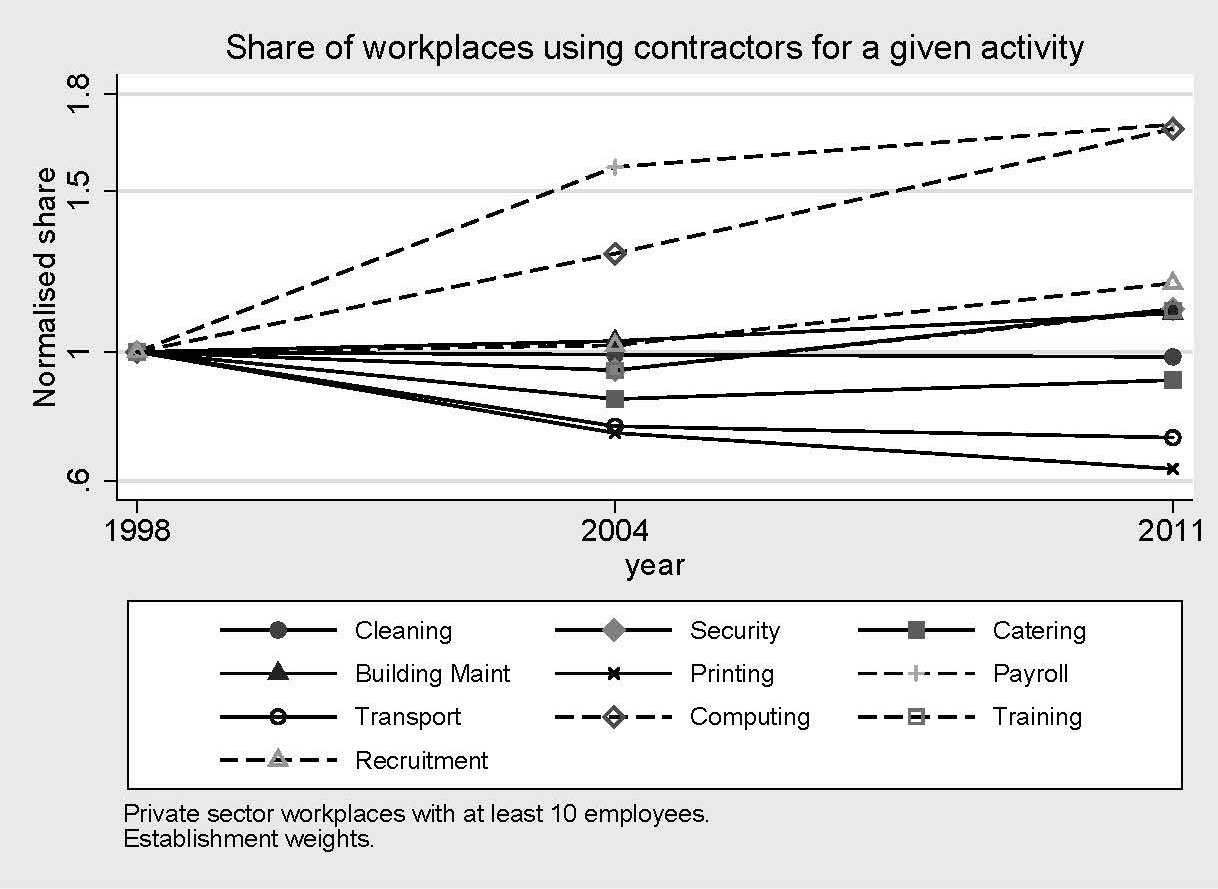
The new IZA discussion paper by Guido Matias Cortes and Andrea Salvatori is the first to look at job polarization in Great Britain using workplace level data rather than individual or industry level data. The authors have new evidence that shows that changes in occupational shares (i.e. the growth in low-paid and high-paid employment at the expenses of middling jobs) are closely linked to changes in specialization at the workplace level. The extent of these changes are remarkable – the proportion of workplaces specialized in a high-skill occupation has increased from 30% to 50% in just over a decade (1998-2011).

Boundaries of the firm redefined

Cortes and Salvatori find little indication that technology is driving these changes through the channels typically emphasized both in academic papers and the popular press, namely the substitution of workers with machines. Instead, the researchers find evidence that this increased specialization at the workplace level is linked to the growth in the outsourcing by firms of cognitive activities, such as payroll and computing services.

The authors explain the importance of their findings:

  1. For the first time job polarization has been shown to be associated with a reallocation of workers across different firms – someone employed in a high-skilled occupation today is much more likely to be working in a workplace specialized in their own occupations than ten years ago. This has potential implications for inequality because other studies have shown that where one works greatly matters for wages and working conditions.
  2. The results suggest that the current debate on the effect of technology on employment is overlooking one important channel through which such an effect can unfold: technology allows for the redefinition of the boundaries of the firm, a phenomenon with implications for both the quality and quantity of jobs.

Filed Under: Research Tagged With: labor market, occupations, offshoring, outsourcing, polarization, skills, specialization, technology, UK, workplace

IZA Fellow Aaron Sojourner serves at U.S. President Council of Economic Advisers

August 26, 2016 by admin

Aaron Sojourner

IZA Research Fellow Aaron Sojourner (University of Minnesota Carlson School of Management) has been appointed as a senior economist on President Barack Obama’s Council of Economic Advisers (CEA). He will serve a one-year term beginning this summer, remaining in the role following the change of administrations next January. His duties include helping to prepare briefings for the president on labor market and education topics, and contributing to the annual Economic Report of the President. One regular task will be to help interpret the “jobs report” that is published each month by the Bureau of Labor Statistics.

Established by Congress in 1946, the CEA is charged with offering the president and his staff objective economic advice on the formulation of both domestic and international economic policy. The council is supported by up to 10 senior economists who focus on different aspects of the economy, selected on the basis of their research expertise and the needs of the council.

Labor markets and education systems critical for prosperity

Sojourner serves as a senior economist specializing in labor economics. His academic research focuses on three areas: policies to promote efficient and equitable development of human capital through investments in early childhood and K-12 education, impacts of labor market institutions, and behavioral consumer finance. The IZA Newsroom recently featured his work on the impact of reputation in the “gig economy” and on the benefits of high-quality early childcare.

“I became a labor economist because I believe well-functioning labor markets and education systems are critical foundations of prosperity for families, communities, and for our nation,” says Sojourner. “Federal policy can strongly influence how well these systems work. I am excited and humbled by this opportunity to serve our country and to help bring our field’s best theory and evidence into policy discussions at this level.”

Filed Under: IZA News Tagged With: behavioral consumer finance, Council of Economic Advisers, early childhood investments, education, labor market institutions

Well-being effects vary for formal and informal childcare

August 23, 2016 by admin

All parents are faced with the difficult decision of how to organize childcare. Parents preferring to return to the labor market early after childbirth usually rely on formal daycare or give the children to the grandparents. Others are convinced that only maternal care is best for their kids’ development. Beyond the labor market aspects of these decisions, however, what kinds of effects do these different options have on the emotional and mental well-being of both the caregivers and the children?

Three recently published IZA Discussion Papers have scrutinized these options and suggest policy solutions that might alleviate some potential pitfalls.

Caretaking grandparents more likely to become depressed

With life expectancy increasing, grandparental caretaking is a common and cheap alternative to formal childcare. While parents are happy to know their children are in safe and familiar hands, grandparents might not necessarily share that joy. IZA Discussion Paper No. 10022 by University of Padova researchers Giorgio Brunello and Lorenzo Rocco reveals that grandparents are more likely to develop depressive symptoms when they have to take care of their grandchildren.

The authors analyzed data from the SHARE survey, a cross-national European data set containing the information of 25,000 Europeans over the age of 50. From the analysis of interview results, they show that 10 additional hours of childcare per month increases the probability of developing depressive symptoms by 4 to 4.3 percentage points. The susceptibility to depression is larger for grandfathers, where the probability ranges between 5.4 to 5.9 percentage points, than it is for grandmothers (3.0 to 3.2 percentage points).

Brunello and Rocco explain that those grandparents with little willingness to devote their time for taking care of their grandchildren are more likely to suffer negative effects. This is particularly the case for grandfathers from Italy, Poland, and Spain, where the traditional division of gender roles makes grandfathers less used to taking care of children than grandmothers.

Intensive mothering adds pressure on higher educated women

Instead of relying on grandparents, some mothers are convinced that only their own personal contact is best for their children’s development. In the United States, intensive mothering continues to dominate the cultural framework. While a large body of research has found that under the right circumstances intensive mothering is beneficial for children, few studies have investigated how mothers themselves are affected.

J. Ignacio Gimenez-Nadal (Universidad Zaragoza) and Almudena Sevilla (QMUL & IZA) sought to fill this research gap and studied the impact of intensive mothering on the well-being of American women. The Spanish researchers wanted to understand the emotions experienced during mothering and find out how these emotions vary by maternal educational attainment and the type of child care activity mothers engage in.

The results, published in the IZA DP No. 10023, show that higher educated mothers report lower happiness and meaning as well as higher levels of fatigue when engaging in mothering activities than less-educated mothers. The gap in well-being does not depend on the type of child care activity and suggests that intensive mothering practices are more likely add pressure to the most educated women, who may subscribe to more time-intensive forms of mothering.

Formal childcare at very young ages may reduce children’s IQ

A third option for mothers is to rely on formal daycare. Enrollment rates in center-based daycare are soaring in countries with a developed labor market, and governments are trying to keep up with the increasing demand. However, the question of how formal daycare affects children’s development, especially if childcare is provided at a young age, has not yet been clearly answered in the academic literature.

IZA DP No. 9756 by University of Bologna researchers Margherita Fort, Andrea Ichino and Giulio Zanella takes up this topic by examining how daycare at age 0–2 affected children’s IQ at age 8–14.

The Italian research team analyzed data from the daycare system in Bologna and compared different groups of children, sorted according to the time spans they attended daycare. They found that one additional month in daycare reduces the children’s IQ by 0.5%. In addition, the negative effect of daycare on IQ is larger and more significant for girls than for boys.

These results – a novelty in the literature – can be explained by the fact that children in daycare experience less one-on-one interaction with adults, an important process known to promote a child’s cognitive development. These interactions should be particularly relevant for girls who, at this early age, are more mature than boys and thus more capable of benefiting from the cognitive stimuli generated by adult-child contacts.

Image source: pixabay

Filed Under: Research Tagged With: caretaking, child development, childcare, cognitive development, daycare, depression, education, formal childcare, grandparents, IQ, mothering, mothers, parents

Backlash against Muslim immigrants after terrorist attacks harms integration and the economy

August 15, 2016 by admin

The recent rise in the number and intensity of fundamentalist Islamic terrorist attacks occurring in several Western cities could, as it has in previous situations, inflame an aggressive socio-political atmosphere against Muslims. How does this affect the integration of Muslim immigrants?

An IZA discussion paper by Ahmed Elsayed (IZA) and Andries de Grip (Maastricht University and IZA) investigates the effect that the violent wave of terrorist attacks that hit Western Europe in 2004-2005 (namely, the Madrid bombings, the assassination of Theo van Gogh, and the London train bombings) had on the lives of Muslim immigrants living there.

Using unique panel data from the Netherlands that oversamples immigrants and collects detailed information on their attitudes and experiences of integration in the host country, the authors show that shortly after the attacks, Muslim immigrants’ attitudes toward integration worsened significantly compared to those of non-Muslim immigrants. Furthermore, no evidence was found of a negative trend in the attitudes of Muslims prior to the attacks.

Segregation and return migration

While, in particular, low-skilled Muslims became more geographically segregated and unemployed after the attacks, high-skilled Muslims were affected most negatively in terms of their attitudes toward integration. The deterioration of attitudes toward integration of high-skilled Muslims could be explained by their higher expectations of integrating within the host country, whereas the increase in geographic segregation of low-skilled Muslims could act as a buffer that mitigates the effect of terrorism on their perceived integration. In a final step, the paper shows that negative attitudes toward integration are associated with a higher intention to permanently re-migrate to the country of origin.

Thus, with some mainstream politicians and popular pundits adopting hostile rhetoric about Islam, the unprecedented atmosphere of outrage being whipped up against Muslims could have a negative impact on the prospective stay of the most productive Muslim immigrants. This could have far-reaching negative economic implications for the knowledge economy of Western societies.

Image source: pixabay

Filed Under: Research Tagged With: attitudes, high-skilled, integration, Islam, migration, Muslim, Netherlands, segregation, terrorism

  • Previous Page
  • Page 1
  • …
  • Page 9
  • Page 10
  • Page 11
  • Page 12
  • Page 13
  • …
  • Page 45
  • Next Page

Primary Sidebar

© 2013–2025 Deutsche Post STIFTUNGImprint | Privacy PolicyIZA