• Skip to primary navigation
  • Skip to content
  • Skip to primary sidebar

IZA Newsroom

IZA – Institute of Labor Economics

  • Home
  • Archive
  • Press Lounge
  • DE
  • EN

admin

Countries benefit from legalizing undocumented immigrants

March 31, 2016 by admin

A new article published on IZA World of Labor finds that legalizing illegal immigrants can boost tax revenues, prevent worker exploitation, reduce crime, and support national security.

Millions of migrants cross borders without authorization each year. The global stock of illegal immigrants has been estimated in the tens of millions, and the refugee crisis is adding to this number. Governments struggle when it comes to dealing with undocumented immigrants. Mass deportation programs violate human rights and are impractical, but legalization is contentious; many people believe that immigrants can hurt the job prospects of native-born workers and impose costs on government and society. However, in the new IZA World of Labor report, Cynthia Bansak (St. Lawrence University and IZA) presents the latest research which shows that countries ultimately benefit from legalizing immigrants.

Legalization allows undocumented immigrants greater mobility, the ability to work, access to health and social services, and equal protection under the law. Research conducted in the US and in Europe indicates that legalization often increases tax revenues, as more immigrants pay taxes or pay higher taxes when incomes rise due to their legal status. Research has also begun to document links between legalization and remittances, consumption decisions, educational investment, and criminal behavior.

To minimize costs to the receiving country, regularization programs can impose waiting periods on eligibility for certain government services. Programs could be phased in so that individuals are initially granted temporary legal status to work and reside in the host country. In a second stage, immigrants who meet specific requirements could then move on to legal permanent residency. Comprehensive legislation can bring undocumented immigrants into the mainstream and deter new unauthorized immigration.

Image source: pixabay

Filed Under: Research Tagged With: illegal immigration, IZA World of Labor, labor mobility, migration, refugee crisis, refugees, tax policy, undocumented immigrants

Turning unemployed into self-employed can be an effective alternative to traditional labor market policies

March 29, 2016 by admin

In order to curb unemployment, OECD countries have made enormous efforts and spent considerable sums on active labor market policies (0.6% of GDP in 2011). Governments have mainly relied on traditional measures such as job creation schemes, training programs, and wage subsidies which have often shown dissatisfactory impacts on income and employment prospects of participants.

A promising alternative to traditional programs are start-up subsidies for the unemployed. This type of program supports people out of work to start their own business, thereby not only bringing these people back into work, but ideally also creating new employment opportunities for others as well. Experiences with start-up subsidies for unemployed are diverse and come from various settings. In a new IZA World of Labor article, Marco Caliendo (University of Potsdam) summarizes scientific evidence on the effectiveness of start-up subsidies in industrialized countries and highlights consequences for policy design.

Start-up subsidies improve labor market outcomes

After reviewing studies from OECD countries, Caliendo concludes that start-up subsidies are an effective active labor market policy that can help participants escape unemployment, increase their human capital and improve their future labor market prospects. Even if the business has failed, program participants’ chances on the labor market are still comparably better than those of other unemployed workers. The positive effects of subsidized start-ups may be even higher for disadvantaged groups, such as women, youth, and low-educated workers.

But subsidies also induce a potential negative bias: On average publicly supported start-ups out of unemployment show weaker business performance and spur less business growth and innovation than other start-ups. However, if policymakers’ main goal is to re-integrate unemployed workers into the labor market, they can neglect weaker business performance. If policymakers seek to establish solid new businesses with strong growth rates and job-creation potential, start-up subsidies for the unemployed might not be the best choice.

As Caliendo shows, recent research identifies several elements of start-up programs for unemployed that contribute to their overall success. The time horizon of the subsidy should be neither too short, in order to allow time to overcome initial problems, nor too long, to avoid moral hazard. To help participants survive the initial stage of self-employment when the business might not yield an adequate income, the financial component should cover basic living costs and social security contributions.

Screening, coaching and mentoring are crucial

Initial screening, including the creation of a credible business plan that is approved by an objective third party, is a further crucial element of success. The screening process has to be sufficiently stringent to prevent windfall gains and to ensure that only those people who are truly interested in starting a business take part in the program.

When these caveats are accounted for, start-up subsidies may have the potential to offer a “double dividend”: they can create not only jobs for the founder but also for further potential employees. In addition, subsidizing start-ups can have a positive impact on structural change, innovation, and technology diffusion. In the end, the success of the program depends on the question if the newly self-employed are able to establish solid business growth. Therefore, program subsidies should also be accompanied by support services, such as coaching and mentoring, which can help develop new businesses and support ambitious entrepreneurs who want to enlarge their business operations.

Image source: pixabay

Filed Under: Research Tagged With: active labor market policies, IZA World of Labor, labor market, OECD countries, self-employment, start-up subsidies, start-ups, unemployed, unemployment

Economic long-term outlooks often too pessimistic

March 21, 2016 by admin

Demographic aging and accompanying shrinking labor forces are common phenomena throughout the developed world. There is a widespread notion that societal aging will put significant pressure on public budgets, a view supported by recent OECD projections. Expenditures for public health are expected to rise, old-age pension systems already are burdened by an imbalance of working and retired population shares. This may threaten governments’ capacities to fund social welfare systems and the provision of other vital public goods, like education or infrastructure.

Such pessimistic outlooks often neglect possible developments on the revenue side of governments’ budgets, and ignore important interrelations between demographic transitions and labor market outcomes. If, for example, a shrinking labor force is becoming better educated at the same time, average wages might increase. Additionally, if there is a scarcity of labor, standard economic theory predicts that wages should increase in order to stimulate labor supply. Future tax revenues may therefore increase despite population shrinkage.

To overcome these limitations to provide a more appropriate outlook, IZA CEO Hilmar Schneider, IZA Fellows Mathias Dolls (ZEW, IZA), Karina Doorley (CEPS, IZA), Alari Paulus (U Essex), Sebastian Siegloch (U Mannheim, IZA), and Eric Sommer (IZA) study fiscal sustainability in the EU by combining population projections for 2030 with micro-based elasticities of labor supply and demand. They consider two demographic projection scenarios, one pessimistic and one optimistic, which differ in the degree of immigration that counteracts against an aging population.

As a key contribution of this study, the authors explicitly model implied wage effects of these demographic projections under consideration of supply and demand elasticities. Supply elasticities (the degree to which an individual adjusts his or her labor supply to changing wage rates) are obtained from Bargain et al (2014) and are differentiated by skill, gender and household type for each EU country. On the demand side, they differentiate own-wage elasticities of demand (firms’ labor demand responses to wage rate changes) by country and skill group, drawing on the meta-analysis by Lichter et al (2015).

Using this setup, the authors are able to estimate the fiscal consequences of the demographic pressure on the balance between sources of public revenue (i.e. personal taxes, social insurance contributions, social transfers, and public pensions) and demography-related expenditures (i.e. health, old-age care, child care, and educational expenditures) and to analyze the impact of an increase in the statutory retirement age, an obvious and widely discussed policy response to demographic change.

The results of the study are striking. Irrespective the pessimistic or optimistic scenario, there are two mega-trends for the future European labor force. While becoming older, EU labor forces are projected to become better educated at the same time (Figure 1), with the consequence of rising average wages throughout Europe.

Figure 1

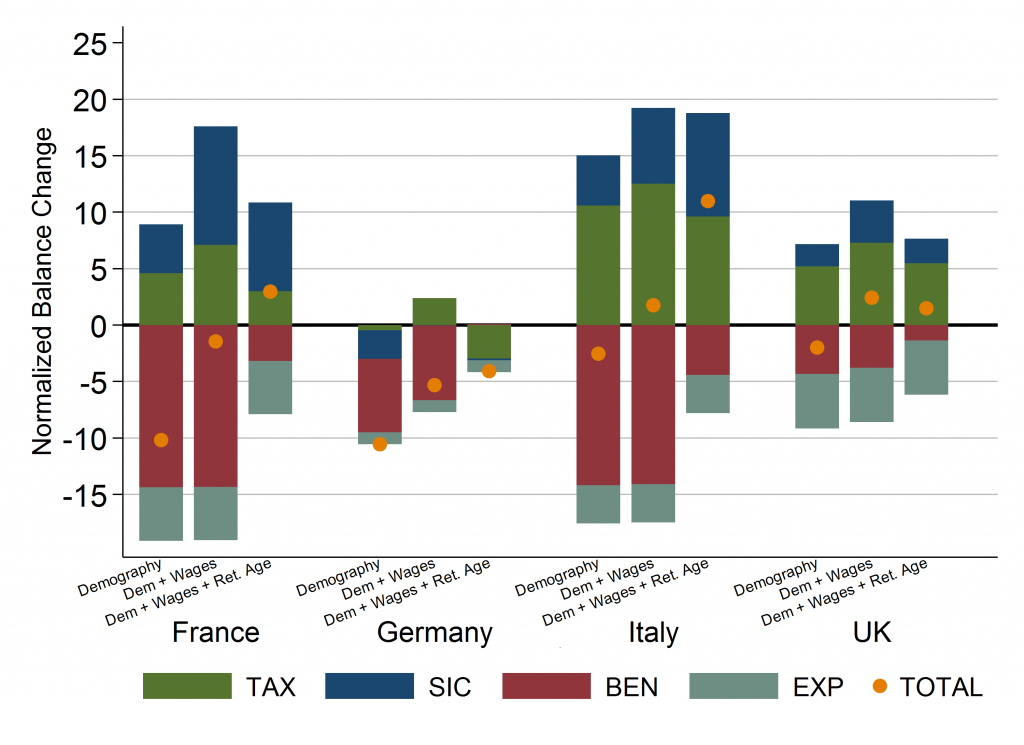
These changes in size and education of the work force have important fiscal consequences. Figure 2 depicts changes in the fiscal balance from 2010 to 2030 decomposed into effects on direct taxes (TAX), social insurance contributions by employers, employees and self-employed (SIC), social transfers and pensions (BEN), as well as other age-related public expenditures for education, child care and health (EXP) [1].

Figure 2

Descriptive results differ greatly by whether wage reactions to demographic pressure are taken into account. Pure demographic effects, ignoring labor market effects (left bar in each country), predict expenditures to grow, and draw fiscal balances below zero (the orange dots represent overall balances). This outcome is however unrealistic, as it does not account for labor market changes as a consequence of changing scarcities on the labor market, i.e. raising wages and tax revenues. If wage reactions are taken into account (middle bar), higher revenues from taxes and contributions drive total balances towards or even above zero, while benefit payments remain rather unchanged. This suggests that ignoring labor market feedbacks with demographic change may lead to fiscal conclusions that are too pessimistic.

Finally, assuming an increase in the statutory retirement age as a likely policy response (in this case uniformly by 5 years between 2010 and 2030), this reform would further improve fiscal balances in the majority of countries, due to lower benefit payments and higher income tax revenues. There is however an attenuating effect, as the UK example demonstrates. While a higher retirement age increases the number of people in work, this may have detrimental effects on average wages, manifesting in lower total revenues. This simple experiment of a substantial increase in the statutory retirement age however shows that, taking labor market effects into account, this may bring fiscal balances close to zero in most EU countries.

In the case of Germany the fiscal balance stays below zero, even after labor market effects and a higher retirement age have been taken into account. This is largely due to the fact that overall population and labor force recede stronger in Germany than in most other European countries. In addition the authors assume only a weak German educational expansion, which leads to weaker positive fiscal effects. But as Figure 2 shows, even the German fiscal balance is much less pessimistic once labor market effects and a higher retirement age are considered.

“Overall, the results paint a less worrying outlook on the fiscal implications of the demographic change. Wage dynamics are highly relevant for the analysis as dramatic demographic shifts may engender important wage adjustments. This highlights the importance of taking interactions between the demand and supply sides of the labor market into account when evaluating retirement reforms – it can be highly misleading to look at static effects only,” says IZA’s CEO Hilmar Schneider.

[1] Figure 2 is based on figure 7 in the IZA Discussion Paper (Dolls et al. (2015): Fiscal Sustainability and Demographic Change: A Micro Approach for 27 EU Countries. IZA Discussion Paper 9618. December 2015.)
Image Source: pixabay

Filed Under: Research Tagged With: demographic aging, demography, economic outlook, education, government budget, population projection, statutory retirement age, wage effects

How (lack of) sleep affects our economic behavior

March 18, 2016 by admin

Today is World Sleep Day! As recent IZA research shows, a good night of sleep is not just a matter of individual well-being but has wider implications for social behavior and economic outcomes. So we suggest you get yourself a big cup of coffee and have a look at some of these findings that may lead you to think differently about your own sleep routines.

Sleep, trust and risk preferences

Economists examine the rational behavior of people (and deviations from it). Rational behavior requires people to be awake so they can tap their cognitive resources. A number of studies published in the IZA discussion paper series shows that insufficient sleep indeed decreases the performance of individuals even in simple tasks.

In a recent IZA discussion paper, David L. Dickinson (Appalachian State University and IZA) and Todd McElroy (Florida Gulf Coast University) analyze the effect of sleep deprivation on interpersonal trust in a controlled lab experiment. 184 test subjects were assigned different sleep schedules over a span of 3 weeks – either a 5-6 hours restricted sleep or an 8-9 hours well-rested schedule. Additionally, the researchers validated the test subjects according to their “circadian rhythm”, i.e. whether they were rather a morning or an evening type. The test subjects were then randomly assigned to either early morning, late evening and intermediate test sessions. In these test sessions, they had to play “trust games” which were used to elicit their contemporary level of interpersonal trust.

The result: Sleepiness, either induced through sleep restriction or through “circadian mismatches” (an evening type forced to play games in the early morning) significantly reduced levels of interpersonal trust, which is known to be a prerequisite for prosocial behavior.

In a related experiment, Dickinson teamed up with Marco Castillo and Ragan Petrie from George Mason University to examine how sleep deprivation, again induced through circadian mismatches, affects choice consistency and risk preferences in simple risky choice games. Experimentally-induced sleep deprivation was shown to significantly alter the risk preference of the players, with sleepy players displaying a larger willingness to take risks.

Sleep, cognitive skills and health

Going beyond the lab in their new IZA discussion paper, Oxford University researchers Osea Giuntella and Wei Han with Fabrizio Mazzonna (Università della Svizzera italiana) show that this relationship between sleep deprivation and cognitive skills also holds in a large health survey, the Chinese Health and Retirement Longitudinal Study. They exploit a quasi-experiment by using differences in sunset.

The idea: Due to circadian rhythms, the human body reacts to environmental light producing more melatonin when darker. Thus, when sunset occurs at a later hour, individuals tend to go to bed later. Because of the geographically broad single standard time zone of China, there are large differences in both sunrise and sunset time between cities, which the researchers can use to assess the effect of sleep on cognitive outcomes.

Increasing sleeping time by one hour significantly increases the scores reported in cognitive tests measuring mental and numerical skills: A one-hour change in sleep duration produces effects on cognitive outcomes ranging from 0.4 to 0.6 standard deviations, a result that is primarily driven by rigid working schedules of the urban population.

In a related study, Guintella and Mazzonna conduct a similar quasi-experiment using the broad time zone of the US to assess the effects of insufficient sleep on general health status and obesity. Again, comparing individuals living on the eastern side of a time zone who go to bed later than comparable individuals living on the opposite border (while working schedules do not account for differences in sunset), they find that sleep deprivation increases the likelihood of reporting poor health status and the incidence of obesity.

The authors conclude that many individuals suffer from a misalignment between social and biological time. Behaviors like eating late, exercising less and dining out contribute to these effects of sleep deprivation on health.

This effect of sleep on health is in part complemented by an IZA discussion paper by Cornell University researchers Lawrence Jin and Nicolas R. Ziebarth, who assess the health effects of daylight saving time using a large data set on hospital admissions in Germany and the US. Their finding shows virtually no effect of “springing forward” in time by one hour in spring.

Contrarily, though, they find an increased share of people reporting excellent health and a sharp decrease of about 8 hospital admissions per 100,000 population on days 1 to 4 after “falling back” one hour in fall, which indicates that sleep may lead to significant, immediate health improvements for people on the margin to getting hospitalized.

Sleep and education

Getting up early to go to school may be the most commonly experienced situation in which the effect of sleep deprivation becomes apparent. It is thus not surprising that sleep deprivation in the educational context has received large attention among researchers. Teny Maghakian Shapiro (Santa Clara University) summarizes the growing literature on the effect of school start times on educational performance in a recent IZA World of Labor article.

The combination of changing sleep patterns in adolescence and early school start times leaves secondary school classrooms filled with sleep-deprived students. Evidence is growing that allowing adolescents to start school later in the morning improves grades and emotional well-being, and even reduces car accidents.

Opponents cite costly adjustments to bussing schedules and decreased time after school for jobs, sports, or other activities as reasons to retain the status quo. In sum, however, the IZA World of Labor article suggests that changing school start times is one of the easiest to implement and least expensive ways of improving academic achievement.

Sleep and the labor market

While it is likely that this negative impact of sleep deprivation also affects individual performance on the job, Christian Pfeifer (Leuphana University Lüneburg and IZA) takes a different perspective on the relationship between labor markets and sleep.

According to his recent IZA discussion paper, working conditions significantly affect sleep quality. More specifically, he shows that employees who perceive their wage as inappropriate or unfair have a 10 percent lower probability to report a “normal” length of sleep (8-9 hours) and a 36 percent higher chance of being diagnosed with sleep disorders.

Image source: pixabay

Filed Under: Research Tagged With: circadian rhythm, cognitive skills, education, health, labor market, labor productivity, numerical skills, risk preferences, sleep, sleep patterns, slepp deprivation

A note from the new Editor-in-Chief: Daniel Hamermesh about IZA World of Labor

March 1, 2016 by admin

I have just begun my tenure as Editor-in-Chief of IZA World of Labor (WoL), and I am thrilled to be part of this enterprise. I have devoted a 50-year career to labor economics, a field increasingly growing in importance and one in which we have accreted a large, new knowledge base over this last half-century. The importance of WoL lies in the fact that it provides an understandable and accessible way of exposing and exploring that knowledge base. Furthermore, by linking that base to policy, it enhances the possibility that what we know will be used to inform policy and—at least as important—will enhance the background knowledge of ordinary citizens, the latter being so important in determining which policies are instituted.

The “one-pagers”—the Elevator Pitch, the Pros and Cons, and the Author’s Main Message—that constitute the front of each article provide a unique format. They enable the reader to grasp, nearly at a glance, the essence of the discussion and evidence on the particular labor issue on which the article focuses. As such, they provide a succinct and easy means of understanding how a policy or more general labor-market issue should be approached.

I refer to “the reader,” but who are the readers at whom is this project is aimed? The majority of WoL entries should be readable by any individual with a secondary-school education. They are NOT designed as technical pieces aimed solely at an audience of specialists. Rather, they are meant to be used by:

  1. Policymakers and their staffs. Whenever a policy issue related to labor markets and labor issues arises, these people should immediately think of WoL and use it to access easily the essential information underlying the policy issue of concern, and advice on how to resolve the issue.
  2. Employers, union leaders and members. These agents are repeatedly called upon to react to policy proposals, often on short notice and quickly. WoL allows them to do this by presenting the best available thought on specific topics.
  3. Journalists spend much of their time finding “experts” to interview about the topic on which they are writing. This potentially costly search often leads them to rely on local experts or other “familiars”, who often are not the leading authorities on the topic. WoL greatly reduces the costs of searching for experts by summarizing expert opinion and providing ready access should the journalist wish to interview the expert.
  4. Intelligent laypeople who wish to learn about a specific labor policy. More citizens have realized that the cost of acquiring information on things that pique their interest has dropped. Accordingly, more are seeking information about these issues, out of general curiosity, out of a desire to be able to speak in an informed manner about an issue with their peers, and out of an interest in becoming better-informed voters. WoL provides the most readily accessible and understandable source of information on these issues of increasing interest.

My ambitions as the new Editor-in-Chief are to refine the remaining topics, to fill in gaps in the existing articles by inviting submissions from new authors on pre-selected topics, and to ensure that the four groups of readers understand how useful and important these articles are to them.

—
Daniel S. Hamermesh, Editor-in-Chief, IZA World of Labor and
Professor of Economics, Royal Holloway University of London

Filed Under: IZA News, Opinion, Videos Tagged With: evidence-based policy advice, IZA World of Labor

Why do many European graduates end up in lower-paid jobs?

February 29, 2016 by admin

Skill mismatch has become an issue of increasing policy concern in the aftermath of the economic crisis, which saw high levels of youth unemployment in the EU economy. Weak labor demand, combined with rising levels of higher education attainment, have increased overeducation rates in many advanced European economies.

Overeducation by population groups

However, the policy debate about the underlying causes and significance of the phenomenon of overeducation is yet unresolved. Part of the wage penalty of overeducated university graduates can be attributed to their lower levels of work experience and training, while mismatch is also naturally higher for young workers at the early stages of their careers.

A new IZA discussion paper by Seamus McGuinness and Konstantinos Pouliakas uses Cedefop European skills and jobs survey data to examine previously unavailable demand-side characteristics, such as the level of skill demand in employees’ jobs.

Using a representative sample of adult employees from 28 EU countries, the analysis shows that job characteristics and the low skill content of their jobs account for an equal share of the wage penalty of overeducated workers as supply-side factors.

Lack of information about skill needs and career prospects of jobs is also an important reason why overeducated tertiary graduates end up in lower-paid jobs. The paper thus highlights that policies that emphasize career guidance and counseling and those that seek to raise job quality can be effective ingredients in mitigating overeducation in European labor markets.

Filed Under: Research Tagged With: career, Europe, graduates, job characteristics, labor market, overeducation, skill content, skills mismatch

Should firms fill vacancies with own workers or outside hires?

February 26, 2016 by admin

Recruitment is one of the most important decisions businesses face. To ensure productivity and profitability remains high it is crucial that the right people are in the right roles within the company. However, there is an important decision to make when recruiting new personnel: Should you recruit internally from existing company talent, or look for an injection of new ideas and skills from external candidates?

Jed DeVaro writes—in his new IZA World of Labor article Internal hiring or external recruitment?—that “Internal hiring should be preferred to external hiring when knowledge and skills specific to the firm are important, when promotions are crucial for motivating current workers, and when the costs of a hiring mistake are particularly large.”

However, internal hiring decisions should be made carefully and consider the implications for employees elsewhere in the job ladder, particularly at the lower levels. This chance to rise within the ranks of a company may have positive effects on the motivation of more junior employees, but promoting from within can then create a chain of job vacancies to fill, with the added costs of recruiting for multiple positions.

External hiring is beneficial as it increases the pool of applicants which may increase firm success in the long run by bringing someone with a different perspective and skill-set into the team. The option of recruiting someone from outside of the business could also discourage employee complacency due to the expectation of promotion once jobs become available up the ladder.

  • Image source: pixabay

Filed Under: Research Tagged With: employees, hiring, insider, job candidates, outsider, promotion, recruiting, vacancy

New forms of work and shady employers: How reputation can discipline the “gig economy”

February 18, 2016 by admin

Uber, Airbnb, TaskRabbit, and other online platforms have drastically reduced the price of micro-contracting and grown a “gig” economy, where workers must more frequently decide which potential employers to trust. Traditionally, workers have used labor unions and professional associations as a venue for exchanging information about working conditions and coordinating collective withdrawal of trade in order to discipline employers.

The rise of new institutions that facilitate information sharing may take up some of this role, a recent IZA discussion paper by Alan Benson, Aaron Sojourner and Akhmed Umyarov (all University of Minnesota) suggests. In two experiments in an online labor market (Amazon’s Mechanical Turk or M-Turk), the authors show that a public, employer-reputation system has value for:

  1. workers who use it to screen potential employers on otherwise unobservable differences, and
  2. employers who can benefit when a better reputation makes it easier to attract more workers of any given quality, basically shifting out the labor supply curve they face.

The experiments provide the first estimates of the value of employer reputation measured outside the lab based on any design more credible than a control function and highlight the under-appreciated struggles workers face in navigating the labor market.

The first experiment tests the validity of the reputations from the perspective of a worker. The researchers act as a worker to assess whether other workers’ public ratings reflect real variation in employer quality. One research assistant (RA) randomly selects tasks from employers who have good reputations, bad reputations, or no reputation and sends them to a second RA who is blind to employers’ reputations. Benson, Sojourner and Umyarov find that, holding work effort fixed, effective wages while working for good-reputation employers is 40 percent greater than effective wages while working for bad-reputation employers.

Employers with bad reputation must post 200% higher wages

The second experiment measures how employers’ reputations affects their ability to recruit workers. We create multiple employers on M-Turk with varying reputations and, holding all else fixed, measure differences in the rate at which they attract workers to posted jobs. Good-reputation employers attract workers about 50 percent more quickly than our otherwise-identical no-reputation employers and 100 percent more quickly than bad-reputation employers. Average quality of work does not differ. This implies employers with better reputations can operate at a faster pace, a larger scale, or be more selective in hiring. Existing estimates of M-Turk wage elasticities imply that posted wages would need to be almost 200 percent greater for bad-reputation employers to attract workers at the same rate as good-reputation employers do.

Most models of the labor market assume workers have perfect information about employer differences and gloss over the difficulty workers face in navigating these matters. The authors of the IZA Discussion Paper propose a simple, equilibrium-search model consistent with their results. Informed-type workers screen employers with bad reputations, and the threat of losing a good reputation and thus losing informed workers discourages employers from engaging in wage theft and other forms of opportunism. In this way, employers’ reputation serves as collateral against wage theft, effectively substituting for the role that formal contracts normally play in the labor market.

Overcoming the information problem

What relevance does this have for labor markets broadly? All workers strive to distinguish which employers will treat them well or ill. Two prospective employers that offer identical employment contracts may actually differ widely in the criteria they apply for raises, promotions, terminations, scheduling, bonuses, task assignment, and many other working and payment conditions. In contingent, undocumented, and low-wage labor markets, concerns are as basic as whether employers will pay for all hours worked or pay at all.

Workers have always made decisions with partial information about employer quality and, so, these forces have always shaped labor markets. Falling communications costs have made it easier for workers to share information and several websites now enable this exchange, including Glassdoor, Turkopticon, Contratados, Kununu, JobeeHive, TheJobCrowd, and the Freelancers Union’s Client Scorecard. Attention to the worker’s information problem suggests innovative directions for policy and institution-building.

Image Source: pixabay

Filed Under: Research Tagged With: employer reputation, employment, employment contracts, gig economy, micro-contracting, online labor market, payment conditions, Sojourner, worker recruitment, working conditions

Investing in early childhood development reduces inequality

February 17, 2016 by admin

Early childhood years are highly formative and often provide the basis for educational, professional and social achievements in adulthood. IZA World of Labor features two recent articles which examine early childhood conditions and their policy implications from different angles: preschool programs and public health interventions.

Already at the age of six, children show differences in their educational development. Kids from low socio-economic status families, many with an immigration background, are often unprepared to enter primary school and run the risk of falling behind. Existing research has shown for some time now that small model preschool programs can lead to substantial improvements in school readiness for children from disadvantaged backgrounds, who would otherwise have little access to high-quality early childhood care or education. This initial evidence confirmed on a small scale that preschool can be an effective way to reduce inequality. But the question has always been whether universal programs provided at scale could also deliver on that promise.

Preschools strongly reduce inequality in child development

As Jane Waldfogel (Columbia University) shows in her IZA World of Labor article, the answer is yes. Publicly provided preschools can strongly reduce such inequality in child development and yield long term positive effects for disadvantaged children. Recent studies show that adults who come from disadvantaged backgrounds and profited from preschool programs in the 1970s and 1980s, have achieved better academic results and underwent a more stable social and emotional development than those without preschools. Assessments from newer universal preschool programs in several US states and cities point in the same direction and complement the evidence on the long-term effectiveness of large scale universal preschool programs.

But for such programs to be effective, policy makers must coordinate with school policies and provide adequate funding. Waldfogel stresses that effective preschool programs require highly educated and trained preschool staff, reasonable class sizes and low teacher–student ratios. She underlines that investment in such conditions pays for itself, because especially for countries where inequality is high and persistent, such as the US, they both raise students’ overall achievement and reduce social inequality.

Moreover, there needs to be complementarity and coordination between preschool and school policies. If children receive a better and more equal education in preschool, the material that is taught in kindergarten and primary school should build on that knowledge. Finally, Waldfogel calls for broader policy coordination and recommends that other policies, such as those aiming at parenting and income support, buttress preschool efforts.

Public health interventions for children have long-term positive effects

The IZA World of Labor article by N. Meltem Daysal (University of Southern Denmark) maintains that investments in early childhood conditions should not only target education, but also health. A large body of empirical research shows that adverse health conditions during early childhood have long-term negative implications. If young children experience circumstances such as poor nutrition, illness, in-utero alcohol exposure, iodine deficiency or psychological stress it is likely to negatively affect not only adult health, but human capital accumulation and economic outcomes during adulthood, too.

For example, an analysis of OECD data revealed a negative correlation between low birth weight and average years of schooling (see graph). In her article, Daysal investigated if early-life medical care and public health interventions are able to ameliorate these effects. Reviewing current research, she finds that both types of interventions may benefit overall child health, reduce child mortality and improve long-term educational outcomes. Special programs designed to eradicate certain child diseases or aiming at educating mothers about child nutrition have shown to raise both health and educational conditions such as school enrollment, attendance, and literacy rates.

However, Daysal emphasizes that not all interventions are universally beneficial. While the evidence is convincing for at-risk children, she found only mixed results with regard to the impact on low-risk children. Thus policymakers should carefully consider potential differences in responses to public health programs across population groups and design public health interventions for those who need it most, such as low-educated or low-income parents. Daysal notes that some medical interventions benefit not only the treated children, but also their siblings. These spillovers should be taken into account when designing policies aimed at improving early childhood health.

Featuring high-quality international research on related issues, IZA is holding a workshop on “Education, Interventions and Experiments” this week.

Image source: pixabay

Filed Under: Research Tagged With: childcare, early childhood, early-life medical care, education, IZA World of Labor, preschool, public health interventions

Why UK income inequality has grown faster than you may think

February 15, 2016 by admin

Income inequality levels and trends are increasingly a subject of public discussion and have been analyzed in depth by economists and other social scientists. Major books about inequality receive wide attention, such as Tony Atkinson’s Inequality: What Can Be Done and Thomas Piketty’s Capital in the Twenty-First Century. Most recently, an Oxfam report made global headlines, revealing that the 62 richest people own the same wealth as half the world.

Productive debate about what is happening to inequality requires reliable estimates. Yet, the two main sources of information – household surveys and tax return data – can provide very different estimates of inequality trends. A new IZA paper by Richard V. Burkhauser, Nicolas Hérault, Stephen Jenkins and Roger Wilkins addresses this problem, demonstrating that it is possible to reconcile and combine tax return and survey data in a manner that exploits the strengths of each source, and thereby provide better answers to questions such as: what has been happening to income inequality since the mid-1990s?

Different data, different definitions, different results

Household survey data are used to compile the UK’s income distribution statistics (published in the annual Households Below Average Income reports), and are also the basis of most of the cross-national comparisons of inequality published by Eurostat (using EU-SILC data) and by the OECD (such as in its recent reports Growing Unequal?, Divided We Stand, and In It Together). The other main source of information about inequality is the World Top Incomes Database, which provides estimates of the share of total income held by the richest 1% and other top income groups for many countries around the world, including the UK.

The estimates are based on personal income tax return data but use different definitions than the survey data. On the one hand, tax return data have much better coverage of top incomes than do household surveys, meaning that survey-based estimates under-record how much inequality is rising during periods when top incomes are growing faster than non-top incomes. On the other hand, survey data estimates use fuller definitions of ‘income’ and the ‘income-sharing unit’, and inequality can be summarized using indices that take account of all incomes from poorest to richest.

Combining the strengths of both sources

The new IZA discussion paper provides improved estimates of UK income inequality trends since the mid-1990s, drawing on the complementary strengths of the two sources. Exploiting the flexibility provided by the unit-record survey data, first, the authors reconcile definitions and derive new variables that use the same definitions as in the tax return data.

Second, they combine data, replacing top incomes in the survey with estimates from the corresponding top income groups in the tax data, thereby better capturing top incomes. The UK Department of Work and Pensions has employed similar methods since the early-1990s with its “SPI adjustment”, but the approach by Burkhauser et al. is much more extensive and is benchmarked against the top income share estimates from the World Top Incomes Database.

Marked increase in UK income inequality

The study shows that there was a marked increase in UK income inequality in the early 2000s that survey-based (and Households Below Average Income report) estimates do not reveal, and the author’s conclusion is robust to changes in the definitions of income and income-sharing unit and the measures they use to summarize inequality.

In addition, their reconciled and combined data provide more comparable estimates of inequality trends in the UK and US than previous comparisons of these countries in the top incomes literature. The authors hope that this will stimulate further research on how to take better account of top incomes in inequality assessments.

Image Source: pixabay

Filed Under: Research Tagged With: data, household survey, income inequality, tax return, UK

  • Previous Page
  • Page 1
  • …
  • Page 13
  • Page 14
  • Page 15
  • Page 16
  • Page 17
  • …
  • Page 45
  • Next Page

Primary Sidebar

© 2013–2025 Deutsche Post STIFTUNGImprint | Privacy PolicyIZA