
• Skip to primary navigation
  • Skip to content
  • Skip to primary sidebar

IZA Newsroom

IZA – Institute of Labor Economics

  • Home
  • Archive
  • Press Lounge
  • DE
  • EN

admin

Why the unemployed need human coaches right from the start

February 9, 2016 by admin

 Electronic self-service platforms can help job-seekers find suitable vacancies and facilitate self-development. But the results of a recent research project by Bert Van Landeghem, Frank Cörvers and Andries de Grip presented in a new IZA Discussion Paper remind us that a “human touch” is crucial to get everybody on track, and to prevent some people from entering the vicious circle of long-term unemployment.

“Self-service” platforms have rapidly developed as a new low-cost way to offer counseling and information services to the unemployed in many countries. This has obviously many advantages for both clients and providers. Job seekers can browse through online vacancies with powerful search tools that help them match the skills listed in their online CV with the requirements for available jobs.

Saving at the wrong end

However, in times of austerity, governments see such tools as a way to economize on job coaches. They encourage people to do everything online and reduce face-to-face coaching for those who have just become unemployed, reserving more costly counseling for the long-term unemployed. Some people might however need some coaching to get on track, and there is a danger that mistakes or missing information in CVs are detected much too late. Finally, there is also a psychological side to it: some people will need human encouragement to get going after the disappointment of losing a job.

To investigate the importance of offering some kind of human coaching right after the start of the unemployment spell, Van Landeghem, Cörvers and de Grip implemented a test with a Public Employment Office in the Belgian region of Flanders. There, at least until recently, all unemployed between the age of 25 and 50 were invited to a mandatory collective information session.

Benefits of “human touch” outweigh the costs

Divided up in groups of up to 30 individuals, they received information about the activity of the employment office, training possibilities and employer subsidies. Next, the employment agency’s website with all its tools was explained, after which clients were invited to use a workstation and update their own online profile and preferences. At the end of the session, every client did a short one-on-one interview with one of the two present coaches.

Due to the long waiting list for this information session, the researchers randomly split up the list in two groups. One group was invited straight after becoming unemployed (within the first weeks), while the others were only invited four to five months after having registered as unemployed. They found that being invited very early proved beneficial for workers’ employment chances. Especially the low-educated who were invited immediately after becoming unemployed had worked 4.7 days more in the four months after the day of becoming unemployed than low-educated workers who were left alone for a while.

In the end, the authors of the IZA paper were able to confirm the positive effects of early collective information sessions for the unemployed. In terms of room rental and staff costs they are relatively cheap, and looking at the benefits it is clear that these far outweigh the costs.

Image source: pixabay

Filed Under: Research Tagged With: counseling, job coach, job seekers, public employment office, unemployment

Employee incentives: Bonuses or penalties?

February 3, 2016 by admin

A large empirical literature supports the view that linking payment to performance is highly effective in raising productivity. However, often little attention is paid to how performance incentives are implemented in employment contracts. While most employers work with bonuses, some also arrange penalty contracts that set a base wage, part of which can be lost if performance targets are not reached.
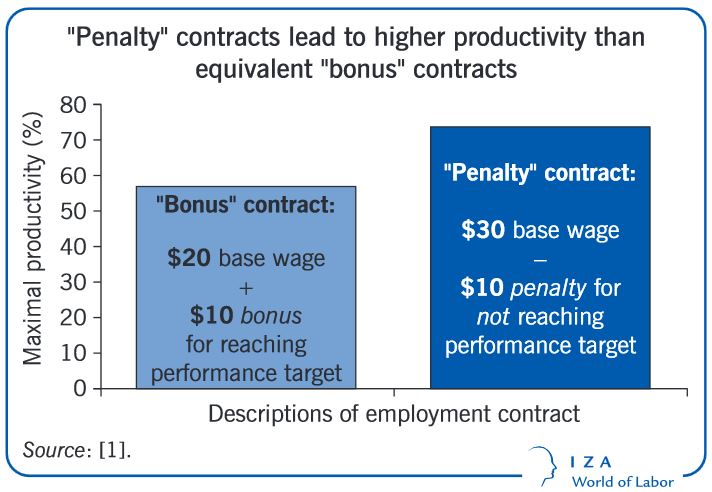

Daniele Nosenzo (University of Nottingham, UK) illustrates in his new IZA World of Labor article why penalties may be more effective than bonuses in order to reach performance targets. However he stresses that working with penalties may include hidden costs and other pitfalls as well.

Productivity gains of “carrots that look like sticks”

In an experiment, 68 MBA students were randomly assigned to one of two payment conditions. In the “bonus” condition, students were paid a base salary of $20 plus a bonus of $10 if the firm met the desired production target. In the “penalty” condition, students were paid a base salary of $30 minus a $10 penalty if the firm did not meet the target.

Objectively, both conditions are equivalent: in either case, the employee receives $30 if the target is met and $20 if it is not. However, the language used in the contracts differs: incentives were presented as rewards (“carrots”) in the bonus condition and as penalties (“sticks”) in the penalty condition. The results of the experiment are striking: Despite the economic equivalence of the two contracts, employees in the penalty condition were 17% more productive than those in the bonus condition.

Studies undertaken in real companies have confirmed that employees can be motivated to work harder when pay-for-performance contracts emphasize negative consequences of performance failure (“penalty contracts”) rather than positive consequences of bonus contracts. This is because individuals tend to be loss averse, i.e., they are typically more sensitive to the pain of losing something that they already have, than to the joy of gaining something they do not have.

The hidden costs of penalty contracts

Following the concept of loss aversion, firms could reap productivity gains by simple language adjustments of their employment contracts, at no extra financial cost to the firms. However, Nosenzo also highlights that penalty contracts may entail hidden costs for the employer.

First, as employers usually do not like provisions that are framed in terms of losses they might demand higher payments from firms to accept such employment contracts. Second, penalty contracts may be perceived as being unfair and controlling and can damage the trust relationship between employer and employee. Workers could become less productive in areas not regulated by the contract and might even, as some evidence suggests, resort to cheating or corrupt behavior.

While such pitfalls might explain why penalty contracts are rarely used by most firms, Nosenzo stresses that more evidence is needed on the potential drawbacks of penalty contracts to improve our understanding of their costs. He recommends that firms should closely monitor employees’ levels of satisfaction and perceptions of fairness when using penalty contracts, in order to promptly identify any impairments of the trust environment that may potentially offset any productivity advantage.

Image Source: pixabay
[1] Hannan, L. R., V. Hoffman, and D. Moser. “Bonus versus penalty: Does contract frame affect employee effort?” In: A. Rapoport and R. Zwick (eds). Experimental Business Research: Economic and Managerial Perspectives. North Holland: Springer, 2005; pp. 151–169.

Filed Under: Research Tagged With: bonus, Employee incentives, employee performance, employment contracts, incentives, IZA World of Labor, loss aversion, pay penalty, penalty, performance

Labor market policy: Parts of the picture are missing

January 20, 2016 by admin

By Patrick Arni, Gerard van den Berg, and Rafael Lalive

The standard empirical evaluations of labor market policy only consider the direct effects of single programs on their participants. This column* (based on IZA Discussion Paper No. 9457) argues that this fails to capture important aspects of real-world labor market policy – policy regimes and strategies. Using Swiss data, it employs a novel empirical approach that concurrently examines the effects of supportive and punitive policies (‘carrots’ and ‘sticks’). Policy regimes are shown to exert economically relevant effects, and accounting for these effects is crucial when designing labour market policy.

In many countries, governments spend substantial amounts on measures of labor market policy (LMP) for unemployed workers with the aim of increasing their chances and speed of finding a job. Spending on LMP may go above 1% of GDP in some OECD countries, reaching maximum burdens during recessions. During the Great Recession in the US, the OECD strongly recommended spending additional resources on supportive LMP, notably training and job search assistance. Surprisingly, empirical evidence on the effectiveness of LMP as a system is broadly missing, despite its widespread use in many OECD countries.

In the last two decades a considerable empirical literature on the effects of single LMP measures – like training, job search assistance, or sanctioning – has emerged (see IZA Discussion Paper No. 9236 for an overview). But in the real-world context of current unemployment insurance (UI) systems, several LMP programs run at once, following the policy strategies defined by public employment service (PES) authorities and implemented by caseworkers with discretionary powers. Depending on the goals of (local) policymakers, the weights on different types of programs and ‘philosophies’ may differ – do they provide support or put pressure on job seekers?

Assessing policy regimes

Getting a consistent picture on the effects of LMP within a UI or welfare system requires more than evaluating the direct treatment effects of a single program. We focus on one key aspect: the regime effect of a program. We operationalize this by how intensively a caseworker or a PES intends to use a program. Policymakers and implementers, PES agencies and caseworkers produce policy regimes which act over and beyond single treatments.

Regime effects may act through the general comprehensive guidance approach of the PES agencies and the caseworkers towards their clients, for example, through applying different levels of strictness or different frequencies of use of certain policy types. Moreover, regimes may operate via information spillovers. Strongly supportive regimes may invest more effort in getting to know the job seeker in order to set up a more targeted treatment plan.

A more effective service may enhance the job seeker’s search efficiency (how and where to search) and increase job offer arrival rates, also before participation or even without individuals actually joining an LMP program. The same applies to restrictive policies like sanctioning and monitoring; they may affect job seekers through ‘threat’ or pressure, also without the sanction being actually (yet) imposed. Thus, the potential relevance of regime effects is supported by the fact that they can affect everyone in the system, treated or untreated.1

We show how regime effects can be identified and estimated using detailed large-scale register data on job seekers in Switzerland. We discuss how to measure policy regime intensities and develop a framework to jointly estimate different effects – of regimes by PES agencies and caseworkers on the one hand, and of specific treatments on program participants on the other hand.

Moreover, we distinguish the effects of supportive policies (‘carrots’) – notably, training and job search assistance programs – from the effects of punitive policies (‘sticks’) – sanctions and workfare programs. Assessing all these effects in one model offers the crucial advantage that we can evaluate the relative importance of different elements in the system as well as their interplay. This offers a substantially more comprehensive picture of the impacts that labor market policy really exerts on concerned individuals.

Results: Regime effects matter

We exploit detailed register data for 130,000 individual job search spells for men of all ages in Switzerland between 2000 and 2005. Switzerland is particularly suitable for such an exercise since the different LMP intensities vary substantially across the country. We combine registers that report LMP events in daily precision, detailed socio-demographic and UI benefit-related eligibility information as well as individual social security earnings data for several years before and after unemployment. Importantly, we observe policy implementers – PES agencies and caseworkers – in the data as well.

The study considers two individual labor market outcomes, which cover the mid run and the short run: average monthly earnings within the 3.5 years after unemployment exit on the one hand, and unemployment duration on the other. Figure 1 visualizes some key results on the effects of different types of regimes and treatments on mid-run earnings. As to be expected from existing evidence, being treated by at least one ‘stick’ significantly reduces individual earnings after unemployment; on the other hand, participating in a supportive program affects earnings positively.

Figure 1. Treatment and regime effects of Carrots and Sticks, in % of average earningsNotes: Effects are expressed in percent of average monthly earnings within 3.5 years after unemployment (3547 CHF = 3290 EUR = 3575 USD in sample). Treatment effects: effects of being exposed to at least one carrot (job search assistance, training) or stick (sanction, workfare program). Regime effects: marginal effect of changing policy intensity by 0.1.

Figure 1. Treatment and regime effects of Carrots and Sticks, in % of average earnings

However, on top of these effects directly arising from program participation, we find economically relevant effects of supportive and punitive policy regimes. Both PES agencies and caseworkers contribute to these additional LMP effects. Increasing the intended frequency of use of restrictive policies by 10 percentage points (i.e., about half a standard deviation) reduces realized earnings by about 4%. Increasing the use of supportive policies, on the other side, improves earnings by about 2.5%.

Interestingly, more intense use of both carrot and stick regimes causes significant reductions in unemployment duration. It is important to note that these regime effects apply to everyone at any time, not only to program participants after treatment as in the case of the ‘classical’ treatment effects. This underlines the economic relevance of these newly identified LMP effects.

We also address the question how labor market policy mixes could be optimized. Our study provides a set of ‘experiments’ which simulate how marginal policy regime changes would affect earnings and unemployment durations of the job seekers as well as the cost of UI. Figure 2 summarizes the results for two ‘experiments’. The first assumes that PES agencies and caseworkers would decide to increase the use of both types of regimes – carrots and sticks – by half a standard deviation (about 10 percentage points) above median policy intensity. The second assumes an increase in the supportive policy regime and a decrease in the punitive regime of the same size.

Figure 2. Marginal effects of changing policy regimes: Two scenariosNotes: Marginal effects of changing the regimes by 0.5 standard deviation (i.e., about 0.1 in policy intensity). Earnings changes: in percent of average monthly earnings of non-treated individuals. Cost changes: in percent of total benefit cost per person.

The results are striking in documenting the relevance of policy regimes and their interplay. Intensifying both carrots and sticks generates a relevant reduction in individual unemployment duration (-20 days), at the expense of achieving lower earnings (-3%) after unemployment. UI saves about 6.2% of cost, mostly due to the reduced unemployment durations. The second experiment, which puts more weight on supportive regimes, is favorable for the individual’s pay, at the expense of some additional cost for UI.

Conclusion

This novel empirical approach of jointly assessing the effects of labor market policies demonstrates that we miss out on an important part of LMP impacts when only focusing on the consequences of single treatments. Policy regimes matter – their effect, which comes on top of classical program effects, is significant. Considering regime effects can change the assessment of the total effect of certain types of policies on individual labor market outcomes. For instance, supportive policies are positive when taking into account regime effects. Only considering short-run treatment effect results in a negative evaluation, since unemployment duration appears to be prolonged (due to the so called ‘lock-in’ effect).

However, when including regime effects the picture changes – supportive regimes as a whole can reduce unemployment durations and show positive impacts on individual earnings. Applying a comprehensive framework to UI or welfare registers in different countries can offer instructive new empirical tools for policy optimization.2 The framework can easily be extended to other different types of assessed policies. Applying it on a large scale, covering different policy intensities, can produce useful sets of estimates of marginal effects of LMP. These can be used as inputs for policy optimization exercises. Policymakers need, however, to first fix their objectives. What is most important – reducing unemployment durations, improving individual job stability and welfare, or saving on the UI budget?

(*This column was originally published on voxeu.org; edited and reposted with permission.)

Filed Under: Research Tagged With: carrots, caseworkers, evaluation, job seekers, labor market policy, program participants, public employment service, regime, sticks, treatment effect, unemployment insurance

Employers will check you out! Facebook profile pictures affect hiring chances

January 14, 2016 by admin

What many have already suspected has now been scientifically proven: Employers are screening job candidates through Facebook. In fact, your Facebook profile picture affects your callback chances about as strongly as the picture on your resume. This is the finding of a new IZA discussion paper by Stijn Baert (Ghent University).

Employers have very limited information when they make their first selection of applicants for their vacancies. A CV and short motivation letter may provide little insight into the personality of the candidates. In contrast, nowadays, the internet offers a lot of information to further refine a first impression. One potential source of information is the social networking website Facebook.

The research team from Ghent University examined on a scientific basis whether employers actually use Facebook during a first screening. They sent fictitious application letters in response to genuine vacancies. Entering the names of these fictitious job candidates in the Facebook search bar or in Google led exclusively to one of four fictitious Facebook profiles controlled by the research team. Only the Facebook profile picture was publicly visible. The four photos used varied in terms of physical attractiveness and apparent personality traits.

More screening of educated workers via Facebook

The researchers then compared the chances of positive responses for applicants with different Facebook profiles. The respective picture was viewable on Facebook but not included in the application letter. The candidate with the most favorable Facebook profile picture received approximately 21% more positive responses compared to the candidate with the least favorable profile picture. The chances to get an immediate invitation to a job interview even differed by almost 40%. “Given that these strong differences can be driven only by the Facebook profile picture, it is clear that many employers screen via Facebook,” says Stijn Baert.

The results also show that highly educated applicants are more likely to be screened via Facebook than the less educated. Contrary to what one should expect, occupations with regular customer contact are not more prone to Facebook screening than others.

Photos on Facebook and CV have similar effects

In a parallel experiment, the researchers added the Facebook profile pictures of the first experiment to the CVs of applicants whose names did not lead to a (unique) Facebook profile. The differences in attractiveness and personality had about the same impact in terms of callback rates as when they were posted on Facebook.

This finding is remarkable because not all employers are screening via Facebook, but they all see the photograph attached to the CV. A possible explanation why a Facebook profile picture and a resume photo can have the same impact is that employers may regard a Facebook profile picture as a more “honest” signal, given that not all candidates are aware that employers will check them on Facebook.

Ethical and appropriate?

The fact that employers are screening via Facebook does not imply that this is ethically and economically justified. Regarding the ethical side, employers should not be blamed since it is the responsibility of those who use social networking sites to manage their privacy settings and keep track of what information they make public. On the other hand, anti-discrimination laws may apply. In Belgium, where the experiment was conducted, a 2007 federal law prohibits unequal treatment of applicants on the basis of information gathered on ethnicity, religion, sexual orientation, health status and related characteristics.

From an economic perspective, screening via Facebook seems efficient. “Facebook allows employers to collect information on job candidates in a quick and easy way. Moreover, international research suggests that the impression gained on Facebook reflects the person’s actual personality traits and not their self-idealization,” says Stijn Baert.

How the experiment was set up

Within the framework of the study, a total of 2,112 job applications were sent out in response to vacancies in various sectors of the Flemish labor market. For each job opening, a pair of male graduates with degrees in commerce, business administration, or applied economics was constructed.

The CVs and motivation letters differed in detail and layout but were similar in productivity-influencing characteristics. The only substantial difference was the candidate’s name (first part of the experiment) or picture (second part). These features were randomly assigned to the application pairs. The photos used were selected for their different scores in attractiveness and personality (with a focus on conscientiousness) as recorded in an earlier study (IZA DP No. 7847) on the importance of these features in the labor market.

This study is the first to directly measure the impact of Facebook profiles on hiring chances. Previous research relied mainly on surveys of employers about their Facebook use. The results of such research may be distorted because reported attitudes may deviate from actual hiring behavior, and using social media does not mean letting social media affect hiring decisions.

  • Image source: pixabay

Filed Under: Research Tagged With: attractiveness, callback, discrimination, facebook, hiring, job applications, profile picture, resume

Award-winning paper on the costs of environmental policy

January 8, 2016 by admin

The study by Reed Walker (UC Berkeley) on “The Transitional Costs of Sectoral Reallocation: Evidence from the Clean Air Act and the Workforce” (Quarterly Journal of Economics, 2013) is recognized with the 2015 IZA Young Labor Economist Award. The author received the award at the IZA reception held during the ASSA Annual Meeting in San Francisco earlier this week. The key findings from the award-winning paper are summarized below.

Environmental policy pertaining to air pollution has been estimated to have large health benefits. However, these policies also come with costs. Production is typically reallocated away from newly regulated industries to other sectors and locations, and this creates a broad set of private and social costs. In terms of labor inputs, this reallocation is often framed in terms of “jobs lost,” and the distinction between “jobs versus the environment” is one of the more politically salient aspects of these regulations.

However, workers often find new jobs elsewhere, perhaps in different locations and/or industries. If workers simply transition from one employer to the next without significant earnings loss, then job loss should not be considered a cost when evaluating policy. If workers lose job- or industry-specific skills and/or experience long periods of unemployment following job transitions, the cost of reallocating the workforce could be quite large. There also may be costs to workers who remain in these potentially less productive industries.

Shift in production and employment away from polluting sectors

The paper by Reed Walker uses newly available longitudinal data on workers and firms to estimate the incidence of regulation-induced worker reallocation stemming from the 1990 Clean Air Act Amendments (CAAA) in the United States. The 1990 CAAA created a new class of pollution standards and strengthened existing standards so that many areas of the United States fell under a new regulatory regime. These regulations led to a sectoral shift in production and employment away from newly regulated, polluting sectors. The empirical framework estimates the effect of this regulatory shock on the evolution of earnings for the workers in newly regulated plants.

In doing so, the paper offers an approach to characterizing the costs and consequences of external labor market innovations when production and workers are not instantly reallocated elsewhere within the economy. Using the confidential Longitudinal Employer Household Dynamics (LEHD) data set from the U.S. Census Bureau, Walker is able to follow workers across their jobs over time to explicitly incorporate two substantive features of labor market adjustment that are typically studied in isolation: the wage costs borne by workers who remain in the newly regulated, now less productive sector and the long-run earnings losses for those who leave the sector

Although the empirical setting pertains to environmental regulations, the analysis relates to a large literature on the costs and incidence of labor market adjustment to external factors, such as trade, immigration, or innovations in labor demand. Traditionally, work in this area examines how prices in industries or regional labor markets respond to external labor market shocks, and then the estimates are used to back out a measure of welfare or incidence.

Reallocative costs are significant, but pale compared to health benefits

In contrast, the study observes and estimates both worker-specific nonemployment durations and any long-run earnings changes associated with the reallocation of production and workers. In doing so, the paper provides an empirical framework for better understanding the distributional implications associated with the short- and medium-run reallocation of the labor force in the context of external labor market innovations.

The results suggest that the reallocative costs to the workforce from the 1990 CAAA are significant. For those workers in the regulated sector prior to the change in regulation, the average earnings declined by more than 5% in the three years after the regulation. These earnings declines are persistent and only begin to recover some five years after the policy.

The average worker in a regulated sector experienced a total earnings loss equivalent to 20% of their preregulatory earnings. While these one-time transitional costs are substantial for the affected workforce, they pale in comparison to the contemporaneous and future health benefits of the 1990 Clean Air Act Amendments.

Images: IZA, pixabay

Filed Under: Research Tagged With: CAAA, Clean Air Act, environment, environmental policy, pollution, reallocative costs, sectoral shift, workforce

Subsidized high-quality early care improves child development especially among children in low-income families

December 28, 2015 by admin

Human development starts early, and neuroscientists point to the first three years of brain development as especially consequential. Foundations for academic and social success later in life are created through the experiences in children’s earliest years.
Parents, relatives and many other non-relatives are responsible for the upbringing of children in modern societies. Public policy plays a crucial role in the process, either through the regulation of market-based care or through the direct provision of subsidized child care services. It is critical to understand the constraints and the incentives faced by families to choose a certain combination of caregivers for their young children.

There is little evidence available on how public policies that expand access to early care services during the first 36 months of life affect household behavior and consequently dictate effects on child development. A recent IZA discussion paper by Juan Chaparro and Aaron Sojourner, from the University of Minnesota, explores this issue using data from the Infant Health and Development Program (IHDP).

Same program, different outcomes

The IHDP was an intervention done in the United States during the 1980s with the goal of supporting the development of low birth weight and premature babies. Participants were selected at birth and randomly assigned to either a treatment or control group. Infants in the treatment group had access to home visits and free, high-quality childcare service between the ages of 12 months and 36 months. Family income was not a selection criteria for participation.

Therefore, the IHDP allows the study of household behavior across a broad range of family economic circumstances. 608 infants were assigned to the control group and 377 to the treatment group. The IHDP also collected extraordinarily rich data on quality and quantity of maternal and non-maternal care each child experienced, the allocation of mothers’ time between child care, work, and other uses, and each child’s skill development.

Previous literature has found a positive and significant treatment effect of the IHDP intervention on cognitive development by the end of the program, especially among children with birth weight closer to normal (Gross et al., 1997) and among children from low-income families (Duncan & Sojourner, 2013). However, each of these dimensions represents an opaque combination of stable characteristics and family choices. For instance, family income reflects parents’ choice of how many hours to work in the labor market and how much they can earn per hour. Low-income families include those who work for low wages and those with higher-earning potential who do not work outside the home.

Chaparro and Sojourner offer new evidence on the mechanisms driving the differences in effects. Their study explores if there are differences in the treatment effects depending on three key dimensions of heterogeneity across families: 1) the mother’s potential wage in the labor market; 2) the quality of prenatal investments chosen by the mother; and 3) the child’s endowment at birth, a measure of differences in child health status at birth compared to other children born under similar circumstances.

Interaction between quantity and quality of care matters

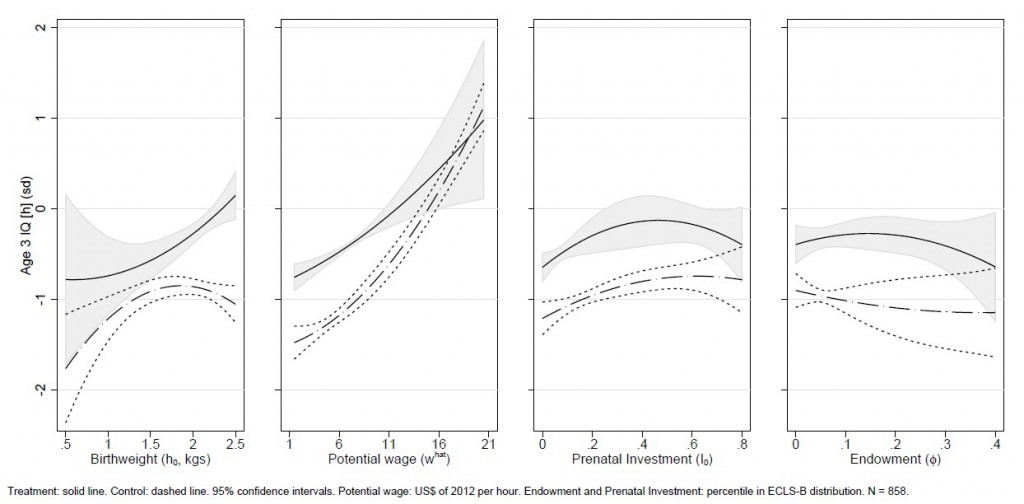
Figure 1 presents the gap of IQ at 36 months between children in the treatment and control group. The program had an effect on infants with a birth weight of at least 1.5 kilograms (first panel). The treatment effect varies by the mother’s potential wage (second panel). Children of mothers who could earn only a very low wage are the ones who benefited the most. The program had almost no effect on the cognitive development of children from mothers with a high earning potential in the labor market.

Figure 1: Predicted IQ at 36 months for IHDP treatment and control groups
(National average = 100; Standard deviation = 16)

Any effect of the IHDP intervention on child development must account for how families react to the intervention by reallocating their time and money, thus providing the child with a new combination of care inputs. The paper by Chaparro and Sojourner finds evidence of time and effort reallocation in response to the IHDP intervention across different types of families.

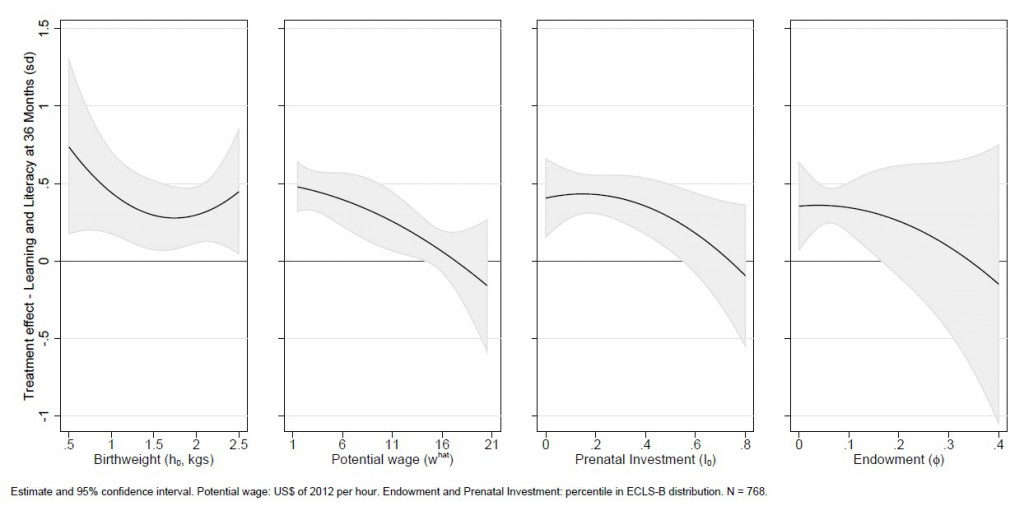
Figure 2: IHDP treatment effects on quality of maternal care (qr)
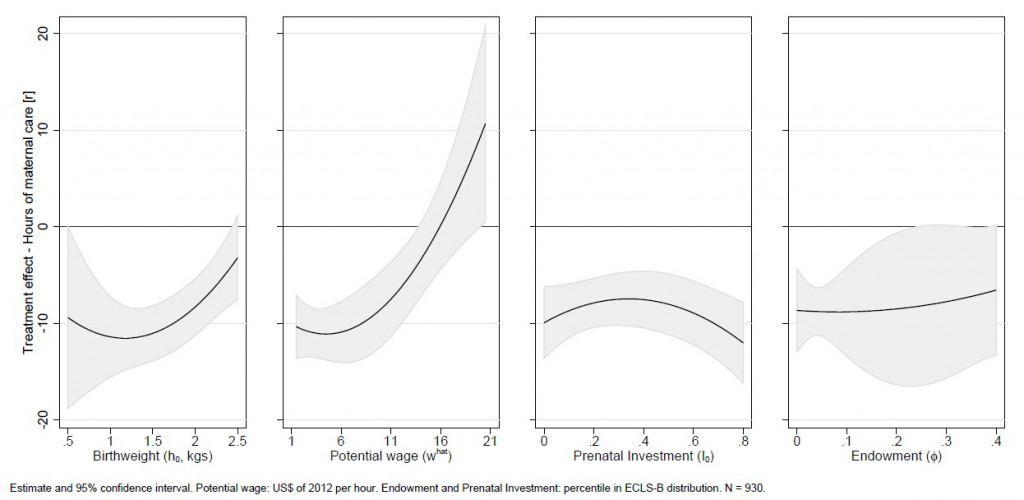
Figure 3: IHDP treatment effects on hours per week of maternal care (r)

Consider Figures 2 and 3. They summarize the treatment effect on the quality and quantity of maternal care. The quality of maternal care is measured using components of the HOME score related to the promotion of learning and literacy, and the quantity of maternal care is measured in hours per week. The IHDP intervention triggered substantial changes in the behavior of low-wage mothers. The quality of maternal care provided by mothers with a low earnings potential was positively affected by the intervention (Figure 2, second panel). Simultaneously, this same group of mothers reduced their hours per week of maternal care (Figure 3, second panel).

In contrast to mother’s potential wage, neither differences in prenatal investment levels, which may proxy for family willingness to invest in child human capital development, nor differences in child endowment explain much of the variation in effects on child development or household resource allocation.

In conclusion, the paper offers new evidence that subsidies for high-quality early care improve child development especially among children in families with tight budget constraints due to low earning power. Biological factors and individual preferences appear much less important in driving the differences. Policies that promote the access to early childcare services must take into account the quality of the services provided and how different types of households will reallocate their own resources in response. Potential positive effects of any intervention could be augmented or eliminated by how families react to them.

Image source: pixabay

Filed Under: Research Tagged With: brain development, child care, child development, education, infant health, Infant Health and Development Program, IQ, maternal care, Sojourner

Racial mismatch in the classroom leads to more unexcused student absences and school suspensions

December 22, 2015 by admin

Policymakers and educators alike are increasingly cognizant of the long-term consequences of student absenteeism and suspensions, which are particularly troubling given that absence and suspension rates are significantly higher among low-income and racial minority students. However, while credible evidence of the harm caused by primary school absenteeism is mounting, less is known about the schooling inputs and interventions that affect student attendance and behavior.

A new IZA discussion paper by Stephen B. Holt and Seth Gershenson, both of American University’s School of Public Affairs, provides new evidence on the classroom level determinants of students’ absences and suspensions by showing that being assigned an other-race teacher significantly increases student absences, the likelihood of being chronically absent, suspensions, and the likelihood of ever being suspended.

Parents and teachers influence students’ attendance

Building on past research, which shows that teachers have statistically significant, arguably causal effects on student absences that persist over time, the authors note that both parents and teachers directly influence primary school students’ attendance. Combined with insights from the theory of representative bureaucracy, this suggests that the racial match between teachers and their students will affect the relationships between teachers, students, and parents in ways that ultimately affect student absences.

A similar argument applies to student suspensions, with the additional caveat that teachers have some discretion in such decisions, which might also be shaped by student-teacher demographic match. The authors test these hypotheses using student-level longitudinal administrative data from North Carolina.

Identifying the causal relationship between student-teacher racial mismatch and student outcomes is complicated by the fact that neither nonwhite students nor nonwhite teachers are randomly distributed across U.S. schools and classrooms. Holt and Gershenson address these endogeneity concerns using a two-way classroom and student fixed effects identification strategy that has previously been used to investigate the causal effect of racial mismatch on community college students’ academic outcomes.

Intuitively, this research design simultaneously addresses two threats to validity. First, the classroom fixed effects ensure that students are compared to opposite-race peers who were in the same self-contained classroom and thus were exposed to the same class size, classroom environment, and teacher quality. This mitigates concerns that nonwhite students or teachers might be disproportionately likely to be in unobservably low-quality classrooms.

Second, the student fixed effects ensure that identification comes from within student changes in exposure to same-race teachers across school years. This mitigates concerns that unobserved factors jointly determine nonwhite students’ outcomes and their propensity to be assigned to an other-race teacher. Moreover, a “sorting on observables” test finds no evidence of endogenous sorting by student race, and thus similar sorting on unobservables is unlikely to bias the preferred two-way fixed effect estimates, lending further credibility to a causal interpretation of the main results.

Other-race teachers lead to 33% increase in suspensions of non-white boys

The analysis reveals that having a teacher of a different race, on average, leads to a modest, marginally significant increase in the number of absences in a given school year. However, this overall result masks two nuanced aspects of the racial mismatch effect. First, the effect is entirely driven by a significant increase in unexcused, as opposed to excused, absences. Intuitively, these are exactly the types of discretionary absences that are likely to be affected by classroom characteristics such as teacher race, lending further support to the causal interpretation.

Second, it may be that only a handful of students are on the margin of changing attendance habits in response to teacher race. For this reason, the authors also estimate the effect of racial mismatch on the probability that a student is chronically absent. Indeed, there is a statistically significant, 3 percent increase in the likelihood a student will be chronically absent when exposed to an other-race teacher. This effect is significantly larger for non-white boys, which is important given that chronic absenteeism explains a non-trivial fraction of the racial achievement gap.

Results for suspensions are qualitatively similar: having a teacher of a different race increases both the number of suspensions and the likelihood of being suspended at least once during the academic year. And once again, these effects are larger for boys, and particularly for non-white boys. For example, having an other-race teacher increases the probability that a nonwhite boy is ever suspended by more than one percentage point, which amounts to a 33 percent increase. This is staggering, given the initial disruption to a student’s learning and the longer-run consequences associated with being suspended.

Hiring a more representative teaching force could help

These results suggest that attendance and misbehavior are possible mechanisms through which student-teacher racial mismatch affects student achievement, while also highlighting the potential for representation in the classroom to affect other, non-tested educational outcomes that have both short- and long-run implications for educational and socioeconomic success. These results also highlight the potential benefits of hiring of a more representative teaching force, as the U.S. teaching force has become more diverse in recent years, yet as of 2012 44 percent of U.S. public school students were racial or ethnic minorities compared to only 17 percent of teachers.

Similarly, teacher training and professional development programs might further emphasize the importance and duty of all teachers to nurture positive, open relationships with all students and parents, regardless of their sociodemographic background, and proactively address attendance and behavioral concerns. Finally, school principals and administrators seeking to improve the academic performance and school engagement of disadvantaged and chronically absent students might use these results to inform the classroom assignments.

Image source: pixabay

Filed Under: Research Tagged With: education, education policy, racial discrimination, student absenteeism, student behaviour, student suspensions, student-teacher racial mismatch, teacher behaviour

Life satisfaction gap between transition countries and the West is closing

December 9, 2015 by admin

Trends of globalization such as migration, economic integration and digital communication are undoubtedly bringing people closer together. But do they also cause the levels of satisfaction to converge? Researchers have long studied the institutional factors contributing to the strong international differences in life satisfaction.

The transition of the Central and Eastern European states after the collapse of the Soviet Union provides a particularly rewarding object of investigation in this respect. It entailed a series of socioeconomic, political and institutional transitions in Central and Eastern Europe (CEE) and the former Soviet Union (FSU). Unemployment, inequality, income volatility, and, in some cases, civil war accompanied the more positive experiences of obtaining new political rights and civil liberties.

In addition to far-reaching economic reforms to establish market economies, these transition countries had to create the legal and institutional foundations that underpin modern democratic and capitalist nations. This involved fundamentally reforming old institutions or creating new modern institutions of public finance, central banking, and customs.

Life and unhappiness in transition

Many papers have tried to uncover the factors behind the declining life satisfaction levels during the transition and have concluded that rising unemployment, inequality and uncertainty, income volatility, rapidly changing social norms, and declining social protection are some viable explanations (see for example IZA DP 3409 and this 2009 article about the (un)happiness in transition).

However, despite their dramatic declines in the early 1990s, income and consumption improved substantially by the late 1990s, suggesting that the transition was a successful process. Yet, alongside these improvements, subjective well-being indicators show a more nuanced story. During the 1990s, mirroring the income trends, life satisfaction in transition countries sharply declined, and while it started to recover in the 1990s, it failed to match the recovery in GDP.

What can close the life satisfaction gap?

Despite the large literature that examines the transitioning process, few studies look at the life satisfaction differentials between transition and non-transition economies. In a new IZA Discussion Paper, Milena Nikolova studies the life satisfaction gap between post-socialist and advanced Western societies and the role of the rule of law in explaining this gap.

As the transition process entails reaching the quality of life levels in developed countries, advanced countries are the relevant comparison group. Because the rule of law is related to democratic institutions and the market economy, it is particularly relevant for transition economies, where such reforms were most pronounced in the 1990s.

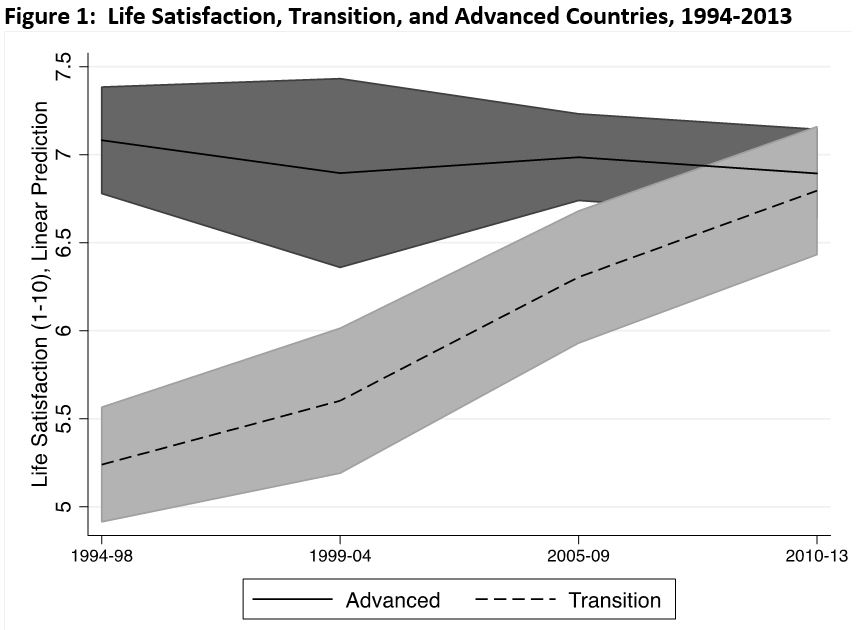
Using World Values Survey data for 1994-2013, Nikolova shows that the average life satisfaction between advanced and transition countries has started to converge in recent years. In a regression framework, she demonstrates that the life satisfaction differential persisted until the early 2000s but had closed during the 2010-2013 period (see figure).

Note: The figure represents the predictive margins of life satisfaction by survey wave for transition and advanced countries (conditional marginal effects) with 95 percent confidence intervals.

(Source: IZA DP No. 9484)

Combining her analyses with macro-economic data from the World Development Indicators and institutional data from the International Country Risk Guide, the paper further demonstrates that macroeconomic factors (GDP per capita, inflation, and unemployment) explained part of the life satisfaction gap reduction.

The rule of law, which refers to a system of well-defined, universally applicable, and fair laws, was an additional factor reducing the size of the life satisfaction gap in the early 1990s, and it completely explained the gap by the late 1990s. In fact, it appears that holding both macroeconomic factors and the rule of law constant, respondents in transition countries appear to be 0.6 points more life satisfied than those in advanced countries in the 2010-2013 survey wave (on a 1-10 scale). This result may be due to the differential timing and effects of the financial crisis—i.e., the economic crisis appeared in Eastern Europe later than in the West and abated by 2010.

Nikolova’s findings suggest that the completion of the transition process may be in sight, at least in the minds of ordinary people in post-socialist countries. As institutions and macroeconomic conditions continue to improve, post-socialist countries may achieve objective and subjective quality of life levels similar to those in the West.

Image source: pixabay, IZA DP No. 9484

Filed Under: Research Tagged With: central and eastern europe, globalization, happiness, life satisfaction, satisfaction gap, transition, transition economics

Labor supply effects of winning a lottery

December 8, 2015 by admin

Economic theory provides ambiguous predictions about the effect of wage increases on the allocation of time between leisure and work. On the one hand, a wage increase makes the individual richer, lowering the preferred hours of work. On the other hand, higher wages raise the opportunity cost of not working (the money one could have earned instead of spending time for leisure), pushing up the preferred number of working hours.

Empirically, it is tricky to evaluate how and to what extent changes in the wage affect labor force participation. One of the main problems is that wage increases do not appear out of thin air, but are paid for being more productive. That makes it difficult to distinguish between the effects of higher wages and higher productivity.

In a recent IZA discussion paper, Matteo Picchio (Marche Polytechnic University), Sigrid Suetens (Tilburg University) and Jan van Ours (Tilburg University) use a very special kind of windfall money to disentangle the effect of higher income on labor supply: the unique case of lottery winners.

Lottery data are matched to administrative data on jobs

Lottery prizes have the advantage that, in contrast to wage increases, they are unexpected and unrelated to productivity changes of the winners. Since the size of the lottery prizes is determined by a random draw, they are as close as one can get to an unforeseen, potentially substantial, increase in permanent income.

For the purpose of the study, lottery data from lottery players who were subscribed to participate in the Dutch State Lottery between 2005 and 2008 was matched by Statistics Netherlands to two administrative datasets: the Municipal Personal Records Database, containing demographic, family, and residence information and the Social Statistical Database of Jobs, containing information on salaried jobs. Merging these different datasets allowed the researchers to track lottery winners over a number of years and study their labor supply responses in terms of employment and earnings.

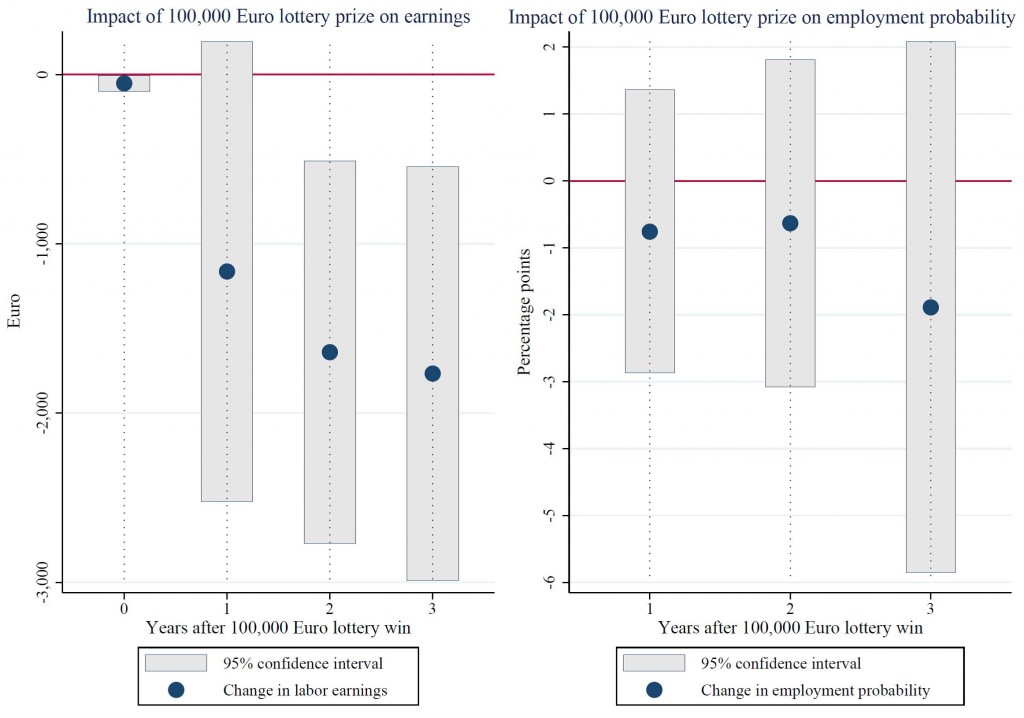
Winning money affects time spent working, but not probability of working

The figure below displays the effects of a €100,000 lottery prize on labor earnings and employment probabilities. If an employee wins €100,000, earnings go down by an amount of €50 in the same year. In later years, the effect is larger, possibly because it takes some time for employees to organize their ‘new’ working hours. In the first year after winning a lottery prize of €100,000, earnings go down by an amount of €1,160. Two years later this is €1,640 and after three years it is €1,770. The effect thus seems to persist over time.

The authors do not find significant effects of lottery prizes on the probability of being employed per se. The results suggest that winning a large prize induces workers to work fewer hours but does not lead them to withdraw completely from the labor market. In the last part of the study, the authors show that these results are driven by young, single individuals without children.

Image source: pixabay

Filed Under: Research Tagged With: labor productivity, labor supply, lottery, wage setting, wage shocks

Happy birthday, you’re fired! Effects of the age-dependent minimum wage in the Netherlands

December 3, 2015 by admin

The effects of the minimum wage on youth employment flows are at the focal point of the current policy debate in the Netherlands. A specific feature of the Dutch minimum wage system is that the youth minimum wage rate is increasing with a worker’s calendar age. Workers become eligible for the minimum wage on their 15th birthdays, being paid approximately 30% of the adult minimum wage rate. The applicable rate increases each year, until the adult level is attained at the age of 23.

The age-dependency of the Dutch minimum wage has been repeatedly criticized by representatives of labor unions, who claim that it motivates employers to discriminate workers based on their age (substituting more expensive older workers with younger ones). Media outlets do occasionally report anecdotal evidence supporting the argument of unions, however a systematic analysis of this phenomenon has been lacking so far.

A new IZA Discussion Paper by Jan Kabátek (Melbourne Institute) aims to fill this gap, focusing on the central question of the policy debate: how many employment spells are terminated due to the increments of age-dependent minimum wage?

Intuitively, youth workers who are earning the minimum wage should be more likely to lose their job around the time when they become eligible for higher minimum wage rates. This occurs on workers’ birthdays. Using administrative records for the entire youth population of the Netherlands, the study shows that youth employment spells are indeed more likely to end shortly before workers’ birthdays. The econometric analysis reveals that each year the birthday discontinuities of minimum wage rate account for 2,273 terminations of employment spells.

Low-wage youth more likely to get fired around their birthdays

From the perspective of aggregate labor market flows in the Netherlands, this effect is modest: Workers aged 15-23 engage in 2.2 million jobs per year, and experience 0.9 million job terminations per year. On the other hand, the effect is born by a subset of the whole population: Only 1 out of 5 youth workers is earning wages low enough to be subject to the minimum wage discontinuities. For such workers, the effect is more sizable. The probability of experiencing employment spell termination increases by 5-6% in the three months closest to their next birthdays.

The analysis also shows that the size of the effect varies with observable characteristics of workers and firms. The effect is large among workers who are young and inexperienced, and it gradually decreases as workers age. Furthermore, some firm sectors are shown to act on the birthday discontinuity more than others. A particularly strong effect is found in the supermarket sector, which is one of the key sectors of youth employment in the Netherlands (representing 14% of youth workers).

Dutch youth minimum wage levels are relatively low

To put the main result into perspective, the following exposition may prove useful. Out of 100 minimum wage workers who are approaching their birthday, one worker is predicted to lose his or her job due to the minimum wage discontinuities. Accordingly, most workers are able to keep their jobs despite becoming more costly to firms.

One interpretation of this finding is that the increases of minimum wage rate are matched by increases of workers’ productivity, allowing the tenured employees to stay with the same employer. However, since some workers tend to learn faster than others, their productivities are likely to differ.

The fact that we do not see more terminations of employment spells around the birthdays may therefore imply that the applicable minimum wage rates are set too low (being below the productivity equivalent of the majority of the minimum wage workforce). Indeed, when expressed relative to the adult level, the youth minimum wage rates in the Netherlands are among the lowest in the world.

Study supports labor unions’ arguments

Jan Kabátek’s paper presents the first estimates of the effects of age-dependent minimum wages on youth employment flows. It contributes to the Dutch policy debate, making the arguments of labor unions more substantive and putting them into perspective by quantifying the criticized minimum wage effects.

But the results derived should be of interest to the policy makers in other countries as well. The age-dependent minimum wage designs are implemented in numerous countries, and the new study shows that apart from the positive effects on the levels of youth employment (which have been extensively studied in the literature), the age-dependency introduces new dynamics into the labor market flows which should be taken into account when discussing the merits and demerits of these systems.

Image source: pixabay

Filed Under: Research Tagged With: age-dependent, birthday, employment spell, fired, minimum wage, Netherlands, productivity, termination, youth

  • Previous Page
  • Page 1
  • …
  • Page 14
  • Page 15
  • Page 16
  • Page 17
  • Page 18
  • …
  • Page 45
  • Next Page

Primary Sidebar

© 2013–2025 Deutsche Post STIFTUNGImprint | Privacy PolicyIZA