• Skip to primary navigation
  • Skip to content
  • Skip to primary sidebar

IZA Newsroom

IZA – Institute of Labor Economics

  • Home
  • Archive
  • Press Lounge
  • DE
  • EN

admin

Can gender differences in computer use explain why boys do worse in school than girls?

September 17, 2015 by admin

Boys perform worse in school than girls, which has been dubbed the “Boy Crisis”. An analysis of the latest data on educational outcomes among boys and girls reveals extensive disparities in grades, reading and writing test scores, and other measurable educational outcomes, and these disparities exist across family resources and race.

Focusing on disadvantaged schoolchildren, a new IZA paper by Robert Fairlie (University of California, Santa Cruz) examines whether time investments made by boys and girls related to computer use contribute to the gender gap in academic achievement. Data from several sources indicate that boys are less likely to use computers for schoolwork. Boys are more likely to use computers for playing games, but less likely than girls to use computers for social networking and e-mail.

[Read more…] about Can gender differences in computer use explain why boys do worse in school than girls?

Filed Under: Research Tagged With: academic achievement, Boy Crisis, computer use, educational outcomes, email, gender gap, grades, home use, homework time, playing games, schoolchildren, schoolwork, social networking, test scores

Economic activity and the spread of viral diseases

September 15, 2015 by admin

Viruses are a major threat to human health. Over the last century, they were responsible for many more deaths than all armed conflicts that took place during that period. From an economic point of view, virus-induced sicknesses hinder economic activity and impose huge costs on society through premature deaths, hospitalization and loss of productivity. But vice versa, economic activity influences the spread of viruses, by increasing interpersonal contacts and social interaction.

In a new IZA discussion paper, Jérôme Adda (Bocconi University) addresses such unintended consequences of economic activity on the spread of infections, and whether counter-measures that limit interpersonal contacts are cost-effective methods to prevent the spread of viruses through social interaction.

[Read more…] about Economic activity and the spread of viral diseases

Filed Under: Research Tagged With: disease, health costs, infections, influenza, interpersonal contacts, school closures, social interaction, strikes, virus

What is the cost of falling victim to violent crime?

September 10, 2015 by admin

Violent crimes, be it physical and sexual assault, robbery or homicide, unfortunately are still common in any society. From an economic point of view, being a victim to a violent crime imposes significant direct monetary costs (through forgone wages and medical care) and intangible indirect costs associated with pain, psychological distress, and a decrease in quality of life. These indirect costs are potentially severe and occurring for a long period. Still, putting a number on these costs is methodologically challenging.

David W. Johnston, Michael A. Shields and Agne Suziedelyte of Monash University, Melbourne, attempt to estimate the impact of violent crime victimization on well-being and to calculate the amount of required compensation. Using Australian survey data, they compare individuals before and after they experienced a violent crime and observe how the victimization is related to drops in self-reported satisfaction with one’s life. Comparing this drop in life satisfaction with correlations between income and life satisfaction then allows the authors to come up with a monetary valuation of being victimized.

[Read more…] about What is the cost of falling victim to violent crime?

Filed Under: Research Tagged With: compensation, economic impact, homicide, income, life satisfaction, robbery, sexual assault, victimization, well-being

Team incentives and performance: Evidence from a retail chain

September 7, 2015 by admin

A simple team bonus can be a powerful instrument for retail firms to react to the strategic challenges posed by the entry of discounters, according to a new IZA Discussion Paper by Guido Friebel, Matthias Heinz, Miriam Krüger, and Nick Zubanov.

In line with the philosophy of evidence-based management, the research team from Frankfurt and Cologne implemented a bonus rewarding teams that surpassed sales targets in a German bakery chain. They used a controlled field experiment in which half of the shops constituted the treatment group that received the bonus, while the other half did not. This allows causal interpretation of the results.

The authors find that the firm boosted sales and operative profits by a large margin. For each euro spent on the bonus, sales increased by 3.8 euros and the operative profit by 2.1 euros. This is the first study that can show the effectiveness of a team bonus in a controlled, field environment. It represents a win-win-win situation for the firms, the workers – and the researchers. It also supports the view that management practices can and should be evaluated by experiments in firms.

Read more in German.

image source: pixabay

Filed Under: Research Tagged With: controlled field experiment, evidence-based management, incentives, operative profits, retail chain, sales targets, team bonus

How setting the right goals can boost business productivity

August 27, 2015 by admin

Businesses require motivated and productive employees. Monetary incentives, such as pay-for-performance schemes are a popular tool to encourage better employee performance. Another effective and much cheaper tool that has proved to lift employee performance is smart goal setting.

Whether assigned by management or self-chosen, goals are powerful motivators for workers, with the potential for boosting productivity in an organization. They work both with and without monetary incentives. However, if not chosen carefully or if used in unsuitable situations, goals can have undesired and harmful consequences, as Sebastian J. Goerg explains in a new IZA World of Labor article.

[Read more…] about How setting the right goals can boost business productivity

Filed Under: Research Tagged With: business, employee motivation, goal-setting approaches, goals, monetary incentives, monitoring, performance, production goals, productivity, project milestones, real-time feedback, risk-taking, SMART, smart goal setting, unethical behavior

African Americans discriminated against in access to U.S. local public services

August 20, 2015 by admin

Requests for information from local public services, like sheriffs’ offices, school districts and libraries, across the United States are less likely to receive a reply if signed by ‘black-sounding’ names, according to new paper by IZA Research Director Corrado Giulietti, co-authored with IZA fellows Mirco Tonin and Michael Vlassopoulos from the University of Southampton.

The study finds that e-mail queries coming from senders with distinctively African American names are less likely to receive an answer than identical e-mails signed by ‘white-sounding’ names. Responses to ‘black-sounding’ senders were also less likely to have a ‘cordial’ tone, that is, respondents were less likely to address the sender by name or with a salutation (such as “Dear” or “Hello”).

[Read more…] about African Americans discriminated against in access to U.S. local public services

Filed Under: Research Tagged With: African American, black, correspondence study, discrimination, ethnicity, public service, race, racial inequality

The long shadow of Stasi spying

August 18, 2015 by admin

Many countries monitor their citizens using secret surveillance systems. According to the Democracy Index 2012, published by the Economist Intelligence Unit, 37 percent of the world population lives in authoritarian states. In many of those countries, large-scale surveillance systems are installed that constantly monitor societal interactions and identify political opponents. Despite the prevalence of surveillance systems around the world, there is little empirical evidence on the social and economic costs of spying.

In a new IZA Discussion Paper, Andreas Lichter, Max Löffler and Sebastian Siegloch aim to estimate the effect of state surveillance on social capital and economic outcomes by using official data on the regional number of spies in the former socialist German Democratic Republic (GDR). The official state security service of the GDR, the Ministry for State Security (Ministerium für Staatssicherheit), commonly referred to as the Stasi, administered a huge network of spies called “unofficial collaborators’” (Informelle Mitarbeiter, IM). These spies were ordinary people, recruited to secretly collect information on any societal interaction in their daily life that could be of interest to the regime.

[Read more…] about The long shadow of Stasi spying

Filed Under: Research Tagged With: authoritarian states, Democracy Index, economic performance, German Democratic Republic, government surveillance, Ministry for State Security, population decline, secret surveillance systems, social capital, spying, stasi, state surveillance, Trust, unofficial collaborators

Measuring historical happiness through digitized books

August 14, 2015 by admin

What are the historical drivers of happiness? To answer this question, a research team from the University of Warwick built an index of subjective well-being for the last 250 years, based on sentiment analysis of millions of digitized books.

By Thomas Hills, Eugenio Proto and Daniel Sgroi

Aiming at national accounts of subjective happiness instead or in addition to traditional measures of economic growth has been promoted by many different actors, like the UN World Happiness Report, the OECD’s Better Life Index, among a number of economists and politicians. While there is a general consensus to better understand subjective well-being and happiness, subjective well-being is a rather young indicator, the systematic measurement of national happiness has only begun in the 1970s.

[Read more…] about Measuring historical happiness through digitized books

Filed Under: Research Tagged With: affective forecasting, digitized books, happiness, history, sentiment analysis, subjective well-being, valence norms, war

Color discrimination remains a big problem in the U.S. — Interview with new IZA JoLE Editor Joni Hersch

August 13, 2015 by admin

A year after the fatal shooting of an unarmed black 18-year-old by a white police officer in Ferguson, the U.S. is still engaged in a difficult debate about race, color and class. The debate goes beyond the question of police violence and is also concerned with issues like housing and jobs. We wanted to know whether discrimination by race or skin color still stands in the way of equal treatment and opportunity – and, by extension, an efficient use of resources – in the labor market.

IZA Research Fellow Joni Hersch, an expert on discrimination who does cutting-edge research at the intersection of law and economics at Vanderbilt University, answered our questions:

Five decades after the Civil Rights Act – and six years into the first black presidency – is color discrimination still an issue in the U.S.?

Joni Hersch: The Civil Rights Act of 1964 protects workers against discrimination in employment on the basis of sex, race, color, national origin, and religion. And yet, discrimination – on the basis of race and color, which are often related but need to be distinguished – remains an important problem in the U.S. today.

[Read more…] about Color discrimination remains a big problem in the U.S. — Interview with new IZA JoLE Editor Joni Hersch

Filed Under: Research Tagged With: African Americans, anti-discrimination laws, color discrimination, discrimination, equal treatment, immigration, pay penalty, police violence, race, sexual orientation discrimination, skin color, social mobility

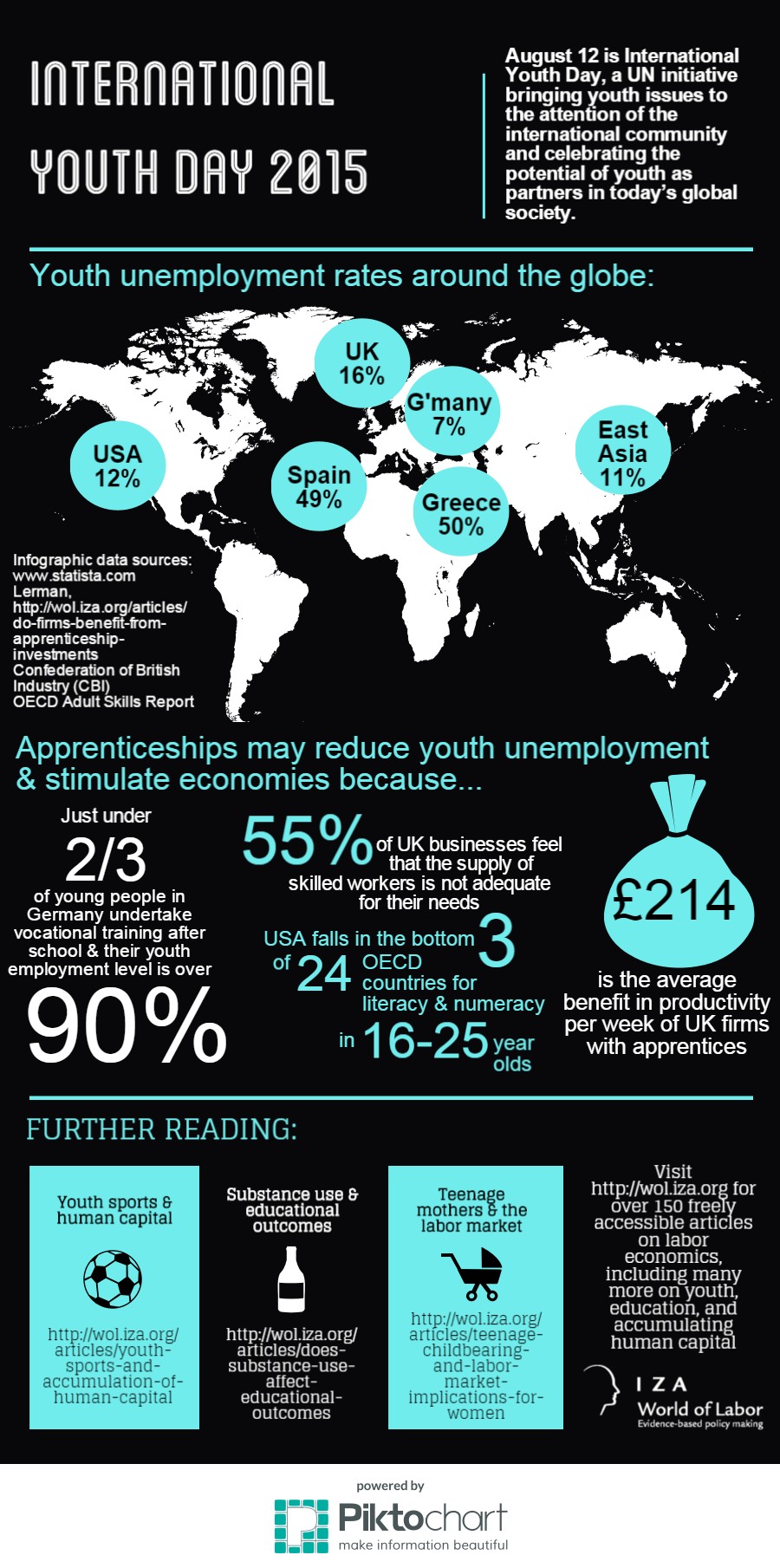
International Youth Day: IZA World of Labor helps create better policies for youth

August 12, 2015 by admin

The theme of this year’s International Youth Day, celebrated on August 12th, is “Youth Civic Engagement.” According to the UN, the engagement and participation of youth is essential to achieve sustainable human development. To create better opportunities for youth to engage politically, economically and socially, and to prevent a “lost generation”, improving the labor market prospects of the world’s youth must become a top policy priority.

To help in formulating good policies and best practices, IZA World of Labor provides decision-makers with relevant and succinct information based on sound empirical evidence.

Read these selected IZA World of Labor articles on youth topics:

  • Youth bulges and youth unemployment (David Lam)
  • Youth labor market interventions (Jochen Kluve)
  • Does vocational training help young people find a (good) job? (Werner Eichhorst)
  • Do youth mentoring programs change the perspectives and improve the life opportunities of at-risk youth? (Núria Rodríguez-Planas)
  • Youth sports and the accumulation of human capital (Michael A. Leeds)
  • The effect of early retirement schemes on youth employment (René Böheim)
  • Does minimum age of employment regulation reduce child labor? (Eric V. Edmonds)

Read also IZA Director Klaus F. Zimmermann’s new post on LinkedIn:

  • Vocational Training Avoids Youth Unemployment?

Filed Under: Research Tagged With: International Youth Day, lost generation, United Nations, young workers, youth, youth unemployment

  • Previous Page
  • Page 1
  • …
  • Page 17
  • Page 18
  • Page 19
  • Page 20
  • Page 21
  • …
  • Page 45
  • Next Page

Primary Sidebar

© 2013–2025 Deutsche Post STIFTUNGImprint | Privacy PolicyIZA