• Skip to primary navigation
  • Skip to content
  • Skip to primary sidebar

IZA Newsroom

IZA – Institute of Labor Economics

  • Home
  • Archive
  • Press Lounge
  • DE
  • EN

admin

Transitioning across gender is related to greater life and job satisfaction

September 14, 2017 by admin

A new IZA World of Labor report finds that after transitioning, trans people experience better mental health, and greater life and job satisfaction. Furthermore, studies show that while becoming a man is related to a small rise in wages, trans-women experience a significant fall in earnings.

Trans people have a gender identity that differs from their assigned sex. In the EU and the US there is a growing population of trans people who start their transition in order to align their inner gender identities with their outward appearance.

IZA fellow Nick Drydakis of Anglia Ruskin University summarizes a number of recent studies on trans identity. Due to transphobia, trans people are exposed to extremely high levels of bias.

Fear of discrimination and violence

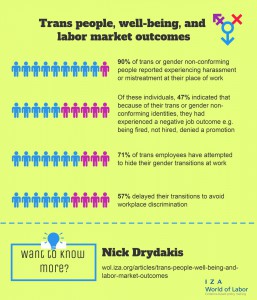
Between 2008 and 2016 the number of murders of trans people globally increased by 96%. Furthermore, in the US, it has been found that trans people face twice the unemployment rate of the general population. A study from the National Center for Transgender Equality reports that 90% of trans or gender non-conforming people reported experiencing harassment or mistreatment at their place of work. In addition, the study states that 71% of trans employees attempted to hide their gender transitions and 57% delayed their transitions to avoid workplace discrimination.

However, trans employees, after having reached the point of passing to their inner gender identity, do not generally experience the bullying and harassment to which they were subjected before transitioning. They experience less depression as well as less psychological distress. Further benefits trans people associate with being trans and accepting their gender identity are: personal growth and resiliency, improvements in their relationships with others, and being inspired to engage in social justice causes.

Research finds that transitioning negatively affects wages for trans women. A study that utilizes US data suggests that becoming a trans woman brings a reduction in hourly earnings of about 32%. Also, an EU study, based on Dutch data, shows a reduction in annual earnings, on the order of 23%. On the other hand, becoming a trans man might positively affect wages.

Legal hurdles

More than half of the EU member states require by law that trans people undergo sex reassignment surgery which entails sterilization before their gender identity is officially recognized. Trans individuals continue to experience severe exclusions when they are unable to obtain identity documents that reflect their gender identity. Many trans people are either not keen on surgery or don’t have the financial means to pay for it.

Nick Drydakis

Drydakis says: “Having to choose between sex recognition and potential sterilization, which occurs in sex reassignment surgeries that include genital reconstruction, is a human rights violation. Trans people should be able to change gender identification on official documents without having to undergo sex reassignment surgery. This policy would minimize employment and societal exclusions for those who are not keen, ready, or financially able to undergo such a surgical procedure. Explicit legal employment protections against discrimination on the grounds of gender identity should become mandatory.”

Read the full IZA World of Labor article:

  • Trans people, well-being, and labor market outcomes

Filed Under: Research Tagged With: discrimination, gender, job satisfaction, labor market outcomes, mental health, trans

Who are the women in the top 1% and how do they make their money?

September 12, 2017 by admin

A lot of attention has been given to rising inequality and, in particular, to the increasing income share going to the top of the distribution in many countries. Researchers have studied many aspects of this development, such as the importance of distinguishing between different sources of income and also to look carefully at the diverse developments across different groups within the top of the income distribution.

However, one aspect that has received little attention is that of gender. How many in the top are women? How has this share developed over time? Are their differences in income composition between top income men and women? Are they different in terms of observable characteristics and in terms of family status?

A new IZA Discussion Paper by Anne Boschini (SOFI, Stockholm University) Kristin Gunnarsson (Uppsala University) and Jesper Roine (SITE, Stockholm School of Economics and IZA) studies these questions for the case of Sweden over the past four decades. Starting in 1974, the authors analyze how the share of women, and the composition of their incomes, in the top of the income distribution has changed over time. Using the longitudinal information, they are also able to study gender differences in mobility in the top as well as how top income men and women differ with respect to age, education, wealth, family status, etc.

Share of women increased, but far from equal

The start of the studied period corresponds to when female labor force participation really took off in Sweden and when a number of reforms aimed at equalizing opportunities for men and women were put in place. The overarching question of the paper is how the process of gradually increased gender equality since the early 1970s has played out in the top of the income distribution.

The authors’ main conclusion is that the presence of women has increased steadily in all top groups since the 1970s, but the share of women is still far from that of men. In the top 10, the share of women has more than doubled from about 12% to 28% while in the top 1 the increase is from about 8% to 16% (excluding realized capital gains; including them increases the share of women significantly). Most of this change is due to more women getting to higher paid jobs.

Capital share less important for women

In terms of income composition, the study finds interesting gender differences. In the 1970s about 30% of total income for women in the top 1 group was based on capital. That share remains about the same today. Relative to men, however, the trend is that capital is becoming less important for women because the importance of capital incomes for men has grown over time.

When studying the share of top income men and women who rely primarily on either labor income or on capital income, it turns out that the relative share of capital-rich women has gone down and the relative share of working-rich women has increased. This pattern is present in all parts of the top decile. In general, top income women also have more wealth than top income men, but this difference has also gone down over time.

The researchers also find gender differences in mobility. Top income women are less likely to stay in the top from one period to the next. This is especially pronounced when including realized capital gains, as these turn out to be of a more transitory nature for women than for men. Over time, though, the mobility differences between top income men and women have decreased.

Most rich women also have rich husbands

Top income men and women are not markedly different in age or education, but there are large difference in terms of family formation. Almost all men in the top 1 group were married in the 1970s, and this is still true today for about 75% of top 1 men. Looking at the income of their partners, most of them were in the P0-60 group in the 1970s. And even though this share has gone down, it remains true that most partners of top income men are not themselves in the top decile group.

Top income women, on the other hand, look very different in these respects. The share of married top women was about 50% in the 1970s and has increased over time to about 60% today. The share of widows has decreased over time from about 20% to 10%, and the share of divorced has increased slightly. In terms of who the top income women are married to, this is almost a mirror image of men’s situation; about 3 in 4 out of the married top 1 women are married to men who are in the top decile group and about 40% have a partner also in the top 1. Almost none of the married top 1 women have a partner with low income (in the P0-60 group).

Overall, the results regarding differences in the role of capital, but also the results showing very different family compositions for top income men and women, both suggest that many of the findings in the top income literature have a clear gender component and that understanding gender equality in the top of the distribution requires studying not only earnings and labor market outcomes, but also other aspects of top income men and women.

Filed Under: Research Tagged With: capital, gender balance, gender disparities, gender gap, income distribution, income inequality, inequality, social mobility, women

Do managers need more masculine or more feminine skills?

September 5, 2017 by admin

 Among top business managers women are still a rare sight. The reasons are complex and subject to heated debates. One controversial explanation suggests that a successful corporate manager needs to have “male” attributes and skills such as risk-taking and competitive behavior. Those who should know best what it takes to excel in top executive positions are the managers themselves.


A recent IZA Discussion Paper by Aarhus University researchers Tor Eriksson, Nina Smith and Valdemar Smith therefore uses data from a survey conducted among managers to examine gender stereotypes and self-stereotyping.

Based on a large field study of around 3,000 Danish managers at all levels (from CEOs to managers at low levels), the authors calculate two measures of gender stereotyping behavior among the managers: (i) Gender stereotyping with respect to what is takes to be a successful manager and (ii) gender self-stereotypes with respect to own managerial abilities. For both measures the researchers tested for eleven items and distinguished between male (determined, have self-control, willing to take risk, competitive, self-confident), female (helpful, social skills, dialogue-oriented), and neutral items (result-oriented, visionary, innovative), which they could rate on a scale from 1 to 5.

Male managers are more masculine gender stereotyping

Among the results are that male managers tend to be significantly more masculine gender stereotyping than their female peers with respect to the role as a successful manager. However, this is not the case for managers who reach the top. Female CEOs have more gender stereotype attitudes than their CEO male colleagues and significantly more masculine stereotypes than other female managers when controlling for other background characteristics. Companies with a stronger focus on work-life-balance policies tend to have less gender-stereotyping managers, regardless of gender.

Moreover, the authors observe “self-stereotyping“, which means that that female managers tend to rate themselves lower than their male peers on the masculine management traits and higher on the feminine management traits. At the same time female managers have stronger beliefs in their “feminine” management skills and weaker beliefs in their “masculine” skills. For the males the authors observe the opposite pattern. An exception are top executives of both genders, who rate themselves higher than other managers on most managerial traits.

According to the authors’ estimates, however, beliefs about own ability accounts for less than ten percent of the observed gender difference in the occupancy of C-level positions. So, what could explain the rest of the gap? The results point to one obvious candidate: the gender-stereotype attitudes of the decision makers in hiring and promotions. Here the study finds clear indications of masculine stereotyping, especially among male managers, both at top executive levels (excluding CEOs) and at lower managerial levels. The authors stress, however, that this is pure speculation, as long as no clear evidence is found that this is an important mechanism.

Image source: pixabay

Filed Under: Research Tagged With: business, CEO, Denmark, executives, gender, gender gap, gender stereotypes, management skills, managers, stereotype

IZA appoints Thomas Dohmen as Research Director

August 31, 2017 by admin

Thomas Dohmen

We warmly welcome Thomas J. Dohmen, who will become Research Director at IZA as of September 1, 2017. Professor Dohmen will retain his chair at the University of Bonn while taking leave to strategically advise IZA and devote more time to his own research. Holger Bonin will continue, also in the function of a Research Director, to coordinate the policy research and advisory activities at IZA, which is headed by Hilmar Schneider.

Thomas Dohmen is an internationally renowned scholar in behavioral and organizational economics. From 2003 to 2007, he was a Senior Research Associate at IZA before serving as Director of the Research Center for Education and Labor Market (ROA) at the University of Maastricht. Since January 2013, he has been a Professor of Applied Microeconomics at the University of Bonn.

“Thomas has been closely affiliated with IZA for many years. Given his in-depth knowledge of the institute and his extensive leadership experience at Maastricht, he is ideally suited to meet the unique challenges of a research institute that aims at reconciling academic excellence with practical relevance,” says Schneider. “He will also play a key role in mentoring our junior researchers, whose career development is immensely important to us.”

Dohmen’s new role will also strengthen IZA’s ties with the University of Bonn and create additional opportunities for joint research activities. “Both sides have a lot to offer. Our closer collaboration will clearly be mutually beneficial,” believes Professor Jürgen von Hagen, Vice Dean of the Faculty of Law and Economics and spokesperson of the economists at the University of Bonn.

Filed Under: IZA News Tagged With: IZA, research, University of Bonn

How home ownership affects displaced workers’ future labor market outcomes

August 25, 2017 by admin

The owner-occupied housing market, alongside the labor market, suffered from strong negative developments in many countries during the Great Recession that started in 2008. In the Netherlands, the owner-occupied housing sector experienced a decline of almost 50% in the number of transactions and a decrease of about 20% in transaction prices.

In the labor market, many workers became unemployed and the number of firm bankruptcies doubled. The literature shows that job displacement generates long-term losses in employment and wages, which are usually explained by losses in firm-specific human capital upon displacement and depreciation of general human capital when unemployed.

However, the focus on losses in human capital ignores the way displaced workers may compensate by using spatial adjustments such as changes in commuting patterns and household moves. In their new IZA Discussion Paper, Jordy Meekes and IZA Fellow Wolter H.J. Hassink (Utrecht University) examine the impact of job displacement on workers’ commuting distance and probability of moving to a different home.

In particular, they examine whether the displacement effects differ among tenants and different types of homeowners. The research of Meekes and Hassink is specifically relevant for policymakers seeking to limit the impact of negative employment shocks or improve workers’ housing situation through subsidizing home-ownership or stimulating mortgage debt.

Job losses result in longer commutes

Using Dutch administrative data, the researchers find significant displacement effects on employment, hourly wages, commuting distance and moving. Compared with non-displaced workers, workers who were displaced are about 20 percentage points less employed two years later. Moreover, the findings show that displaced workers, on average, experience a loss in hourly wages of about 6 percent, face an increase in the commuting distance of about three kilometers and have a 0.06 percentage point lower probability of moving.

Compared to the average, the increase in the commuting distance and the decrease in moving represent about a 20% and 14% change, respectively. Interestingly, the patterns of adjustment change over the worker’s post-displacement period – a longer time since job displacement is associated with a lower loss in employment, a smaller increase in commute, and a higher loss in hourly wage. The results suggest a remarkable pattern: workers who experience a longer time of unemployment after job displacement prefer a smaller increase in the commuting distance to a lower loss in hourly wages.

Mortgage debt influences future employment and commuting

The second part of the study by Meekes and Hassink shows that workers’ housing situation is important for the effects of a job loss on employment, wages and the commuting distance. Compared to other displaced owners and tenants, displaced underwater home-owners (i.e., owners who have a mortgage higher than the property value of their home) experience a 6 percentage point lower loss in employment, but a 1 to 2 percentage point higher loss in wages. In addition, outright owners (i.e. owners who paid off their entire mortgage) experience the highest increase in the commuting distance.

The results therefore suggest that more leveraged workers have a stronger incentive to become employed. Meekes and Hassink argue that the geographic immobility of displaced homeowners (relative to tenants) and underwater owners (relative to other owners) does not seem to hinder post-displacement employment outcomes. In this regard, policies that subsidize home ownership or stimulate mortgage debt do not hamper displaced workers’ future labor market outcomes.

Image source: pixabay

Filed Under: Research Tagged With: commuting, commuting distance, geographic immobility, homeownership, housing, housing market, job displacement, labor market, labor market conditions, unemployment

The impact of repealing “Obamacare” on children’s academic performance

August 22, 2017 by admin

By Michael A. Leeds (Temple University and IZA)

There are many reasons to feel relieved by the recent failure to overturn the Patient Protection and Affordable Care Act, better known as the ACA or “Obamacare.” While attention was rightly focused on the impact that repealing the ACA would have had on the poor, the sick, and the elderly, the repeal could have had severe consequences for another group that was not directly targeted by opponents of the ACA. The cognitive and non-cognitive development of America’s youth, even of boys and girls whose health coverage was not threatened by repeal of the ACA, could have been deeply harmed.


This risk was largely overlooked because it was an unintended consequence of the repeal-and-replace movement. Lost in the debate over Medicaid cuts was the impact such cuts would have had on public schools. Public schools are legally required to provide special education programs for the physically and mentally disabled, for which they rely heavily on Medicaid funding. If Medicaid appropriation levels fell significantly, schools would be forced either to increase their revenues through taxation—never a popular idea—or to cut spending elsewhere. School superintendents have stated that such cuts would likely have forced them to reduce such extracurricular activities as art, music, and athletics.

Participation in athletics increases cognitive and non-cognitive skills

If extracurricular activities lead to greater educational attainment and better labor market outcomes later in life, such cuts might be short-sighted. Some claim, for example, that participation in sports (as well as other extracurriculars) generates greater cognitive skills—the ability to process information and reason, frequently measured by standardized tests. Others claim that athletic participation fosters greater non-cognitive skills. These are the “softer” abilities, such as self-confidence or self-discipline.

Michael A. Leeds

Research on whether athletic participation causes greater skill development is complicated by a number of factors, such as the precise skill being measured and the subset of the population (e.g. men or women) being studied. The most serious difficulty is what econometricians call “the endogeneity problem.” This states that, while it is clear that athletic participation and skills are correlated, it is not obvious which factor causes which.

The most successful approach to dealing with the endogeneity problem in this case has been to use panel data. Panel data follows a group of individuals over time, so that one can view their behavior before and after they undergo a treatment of some kind. In this case, it allows us to see how participation in sports—the “treatment” here—changes youths’ academic performance and behavior.

These studies provide clear evidence that participation in athletics increases cognitive and non-cognitive skills. Moreover, the impact of sports on skill development appears to be greatest among the very young. Elementary school-age children who participate in sports earn higher grades later on, suggesting that they have developed stronger cognitive skills. They also encounter fewer emotional problems, enjoy better physical health, and have a stronger sense of personal well-being, all of which indicate that sports inculcate stronger non-cognitive skills.

The attempts to replace the ACA could thus have consequences that go well beyond insurance markets and health care. If schools were forced to limit extracurricular activities to fulfill their mandates to provide services to children with special needs, they probably would have to cut back on activities that benefit children’s development. The defeat of the attempt to “repeal and replace” thus prevented even more harm than the ACA’s defenders had imagined.

Read Michael A. Leeds‘ IZA World of Labor article:

  • Youth sports and the accumulation of human capital

See also a related article by Michael Lechner:

  • Sports, exercise, and labor market outcomes
Image source: pixabay

Filed Under: Opinion Tagged With: Affordable Care Act, child development, cognitive development, extracurricular activities, health care, Medicaid, Obamacare, Patient Protection Act, USA

Educational choices can help explain income inequality in Germany

August 16, 2017 by admin

Rising levels of income inequality in many developed countries have led to much political and scientific controversy. One of the empirical challenges is to identify the causes and drivers of inequality. A new study by German economists Albrecht Glitz (Universitat Pompeu Fabra and IZA) and Daniel Wissmann (LMU Munich) investigates how shifts in skill premiums – the wage difference between skilled and unskilled workers – can help explain income inequality between different skill and age groups.
Different trends in wage differentials since 1980s

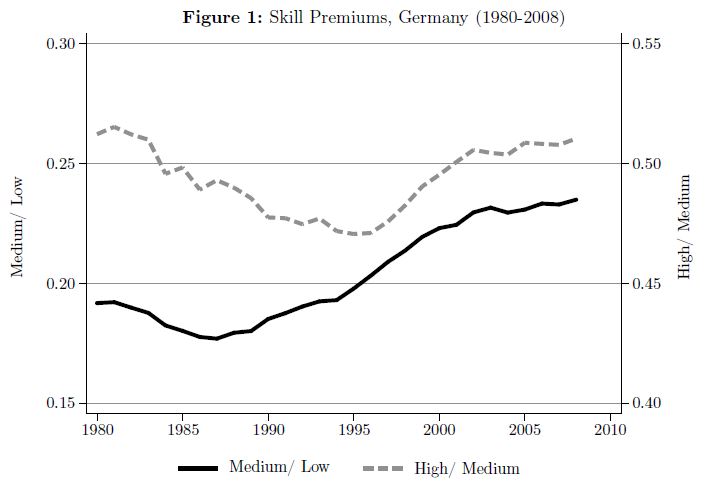
The authors show for Germany that the wage differential between medium (those with vocational training and/or Abitur) and low-skilled workers (those without a post-secondary degree) decreased slightly over the 1980s and then increased by a third from 18% to 24% since the late 1980s (solid line in graph), while the high skill premium, i.e. the wage differential between those holding a college or university degree and those with vocational training, followed a U-shape pattern over the same period (Figure 1).

But not all medium-skilled workers benefited from this rise in the skill premium, which is apparently attributable to a pronounced increase in the medium skill premium of young workers (aged 30 and below).

According to Glitz and Wissmann, these differences in the development of wage premia may simply be due to the relative abundance of workers with a specific skill level. Analyzing long-term education trends in Germany for those born between 1950 and 1981, the authors find a pronounced trend break in the educational attainment of the West-German population: relative to previous trends, the shares of both high- and low-skilled individuals increased while the share of medium-skilled individuals declined markedly.

Fewer medium-skilled workers

For cohorts born after 1965, the share of individuals with completed vocational training decreased strongly and was as large for the 1980s cohorts as it was for the 1940s cohorts, while the share of individuals with tertiary education increased to unprecedented levels and the long-term decline in the share of low-skilled individuals came to a hold.

The authors conclude that a considerable part of recent changes in earnings inequality between different skill groups in Germany are the result of longer term educational choices of the population and hence, ultimately, driven by labor supply. With this explanation, the authors complement recent attempts focusing on demand-side explanations of rising inequality, such as technological change and the role of globalization in the vanishing of manual, routine-intensive occupations.

Image source: Goodluz via Shutterstock

Filed Under: Research Tagged With: education, Germany, high-skilled, income distribution, income inequality, labor market, labor supply, skill premiums, skills, vocational training, wages

Unpaid graduate internships: Career boost or bust?

August 11, 2017 by admin

The rising prevalence of unpaid internships as a gateway to highly competitive careers in law, politics, creative industries, media and publishing, and the sciences, has raised concerns about diminishing social mobility, and raised questions about whether and how interns benefit from the experience.

A recent IZA Discussion Paper by Angus Holford (University of Essex & IZA) uses the Destination of Leavers from Higher Education (DLHE) survey on graduates from English and Welsh universities between 2005 and 2011 to study the returns to taking an unpaid internship six months after graduating from a first degree, on labor market outcomes a further three years later. He compares interns with individuals who went straight into paid work, into further study, or something else, by pairing them each one with a ‘matched’ individual, according to their demographic characteristics and their reported motivations for taking the job or internship they are in.

The results show that, on average, former interns face a salary penalty of approximately £3500 per year compared with those who went straight into paid work, and £1500 compared with those who went into further study. Only compared with those doing ‘something else’ (including traveling or remaining unemployed) do interns gain any significant benefit on average, being 6.4 percentage points more likely to be ‘very satisfied’ with their career.

Outcomes vary by demographic group

Holford also analyzes access to and returns from unpaid internships by demographic characteristics. His findings suggest that there are both advantaged and disadvantaged groups (in terms of expected labor market outcomes after university) who are more likely to be taking an internship. Among the former group are those with parents in professional or managerial jobs, those who went to private schools or ‘elite’ universities, and those graduating with a first or upper second class degree. Among the latter group are Black and ethnic minority graduates, those with disabilities, and from areas with a higher unemployment rate.

The study also finds the negative returns to taking an internship to be significantly smaller for graduates who were privately schooled or with parents in professional occupations. This suggests a segregated market in which the social and financial capital that graduates from higher socio-economic backgrounds can access gives them an advantage in accessing the ‘good’ internships, with a relatively high labor market return.

Holford argues for improving access to and reducing the opportunity cost for students with low socio-economic status of taking relevant experience for ambitious careers during undergraduate degrees, and improving provision of information to students and early graduates about the likelihood of different outcomes from internships in key fields.

Image source: pixabay

Filed Under: Research Tagged With: career, experience, graduate, income, internship, job, salary penalty

GLM|LIC Call for Proposals: Growth and labor markets in low-income countries

August 1, 2017 by admin

The IZA/DFID Programme on Growth and Labour Markets in Low-Income Countries (GLM|LIC) has opened the electronic application portal for Phase IV research proposals. Research projects can be proposed for the following research areas:

  1. Growth and Labour Market Outcomes
  2. Active Labour Market Policies, Labour Market Institutions and Labour Market Frictions
  3. Human Capital and Labour Productivity
  4. Migration and Labour Markets
  5. Labour Market Dimensions of Population Dynamics, Urbanisation, and the Environment

Proposals will be due on October 16, 2017.

https://glm-lic.iza.org/call-phase-iv

Filed Under: Research

IZA continues GLM|LIC program with DFID – new website now online

July 17, 2017 by admin

Since 2011, IZA has been coordinating the “Growth and Labour Markets in Low Income Countries” program on behalf of the British Department for International Development (DFID). The objective is to fund research projects that deliver a significant new body of evidence to help shape future policies in low-income countries.

So far, 31 projects within five topic areas have been supported, generating more than 150 publications. Many of these publications have been featured in in top academic journals and major international conferences. A number of important policy recommendations have come out of the projects, described in the Policy Brief series.

To facilitate access to these findings, the relaunched GLM|LIC website has a number of new features. In addition to information about the supported projects, including working papers, policy briefs, and published articles from the projects, an Evidence Finder makes it easy to locate GLM-LIC research results by topic and country.

Meanwhile, the cooperation between DFID and IZA has been renewed until 2020. The “Call for Proposals” for innovative new research to be funded in the next phase will be posted on August 1.

Filed Under: IZA News, Research

  • Previous Page
  • Page 1
  • …
  • Page 4
  • Page 5
  • Page 6
  • Page 7
  • Page 8
  • …
  • Page 45
  • Next Page

Primary Sidebar

© 2013–2025 Deutsche Post STIFTUNGImprint | Privacy PolicyIZA