• Skip to primary navigation
  • Skip to content
  • Skip to primary sidebar

IZA Newsroom

IZA – Institute of Labor Economics

  • Home
  • Archive
  • Press Lounge
  • DE
  • EN

Mark Fallak

Women face higher earnings losses than men after job displacement

January 17, 2022 by Mark Fallak

Existing research has shown that job displacement leads to large and persistent earnings losses for men, but evidence for women is scarce. In fact, there is more research on how women react to their husband’s job loss than to their own. Using a sample of more than 80,000 displaced workers extracted from German administrative data, a recent IZA paper by Hannah Illing, Johannes F. Schmieder and Simon Trenkle  aims to close this gap in the economic literature.

To achieve a high comparability, the study compares women and men working in very similar jobs. The results show that over the five years after a mass layoff, women’s earnings decline on average by around 35 percent relative to their earnings two years before job loss, compared to men who only lose around 26 percent. As women recover more slowly, the gender gap in earnings losses increases further with time since displacement.

Even full-time wage losses are much higher for women

The study examines a variety of reasons for the higher wage and earnings losses of women. One explanation for the difference in earnings losses is a higher propensity of women to take up part-time or marginal employment following job loss, but even full-time wage losses are almost 50 percent (or 5 percentage points) higher for women than for men.

One reason for the wage losses is sorting into establishments with lower wage premia. In the long run (five years after displacement), women are employed at establishments paying slightly lower wage premia, which in turn explains about a fourth of the gender gap in full-time wage losses. The presence of young children in a household magnifies the gender gap in earnings losses. Women with young children at time of displacement face the largest losses in earnings, wages, and employment, while men with young children have the smallest losses.

The study also examines whether the higher earnings losses for women reflect differences in labor supply or demand. Based on job-preference characteristics elicited by caseworkers at the local UI agency, the authors show that differences in labor supply are important: women are about 11-13 percentage points less likely to exclusively search for a full-time job although most of them had been working full-time before displacement. Nonetheless, the study cannot rule out that demand-side factors, such as employer discrimination against displaced women and mothers, play a role as well.

Filed Under: Research Tagged With: gender pay gap, Germany, household structure, job loss, labor supply

Honoring IZA Young Labor Economist Award Winner Patrick Kline

January 12, 2022 by Mark Fallak

Traditionally, the IZA Young Labor Economist Award (YLEA) is conferred during the Annual Meeting of the Allied Social Science Association (ASSA). Since the event was held online due to the pandemic, IZA organized a virtual cocktail party in honor of Patrick Kline (University of California, Berkeley), who won the award for his research on empirical methodology in labor economics and on the determination of wages.

As chair of the selection committee, IZA Network Director Daniel Hamermesh acknowledged the laureate’s impressive publication record and stressed that “more important than the numbers, one learns something from each of his papers.”

Harvard economist and former YLEA winner Raj Chetty praised Kline’s focus on rigor and his excellent knowledge of statistics in search for answers to real-world problems. The most recent IZA discussion paper co-authored by Pat Kline on systemic discrimination among large U.S employers was mentioned by several of his colleagues as an example of methodologically convincing and highly policy-relevant work.

According to David Autor (MIT), Kline stands out for “making complicated ideas transparent and understandable.” Kerwin Charles, dean of the Yale School of Management, reflected on his long-standing professional relationship with the award-winner, having early on suggested to Kline that he pursue a career in economics, and admitted “there is no other colleague whose judgment I’d trust more.”

Apart from Kline’s qualities as a researcher, many speakers also emphasized his positive influence on faculty members and students. “His energy, curiosity and expertise have a tremendous impact on the people around him,” said Yale economist Joseph Altonji, winner of the 2018 IZA Prize in Labor Economics. There was wide agreement that Kline’s personality and academic work will greatly influence future generations of labor economists.

Filed Under: IZA News Tagged With: IZA Young Labor Economist Award

Minimum wage reduced the gender wage gap in Germany

January 7, 2022 by Mark Fallak

In many countries, women are over-represented among low-wage employees and might thus benefit particularly from wage floors. To find out whether this is indeed the case, a new IZA paper by Marco Caliendo and Linda Wittbrodt analyzes the impact of the German minimum wage introduction in 2015 on the gender wage gap. Germany poses an interesting case study in this context because it has a rather high gender wage gap and set the minimum wage at a relatively high level, affecting more than four million employees.

Based on individual data from the Structure of Earnings Survey, containing information for over one million employees working in 60,000 firms, the authors use a difference-in-difference framework that exploits regional differences in the bite of the minimum wage. They find a significant negative effect of the minimum wage on the regional gender wage gap.

Between 2014 and 2018, the gap at the 10th percentile of the wage distribution was reduced by 4.6 percentage points (or 32%) in regions that were strongly affected by the minimum wage compared to less affected regions. For the gap at the 25th percentile, the effect still amounted to -18%, while for the mean it was smaller (-11%) and not particularly robust.

The results suggest that the minimum wage can indeed reduce gender wage disparities. While the effect is highest for the low-paid, it also reaches up into higher parts of the wage distribution.

Filed Under: Research Tagged With: gender wage gap, Germany, minimum wage, regional bite

Coal phase-out in 2030 – what costs will employees face?

December 15, 2021 by Mark Fallak

The new German government is aiming for an earlier coal phase-out, “ideally” by 2030. The associated job loss was perhaps the most important concern here. Often, only the number of jobs lost is considered – in 2020, for example, there were 9,960 jobs in coal mining, according to the German Federal Employment Agency. But the consequences of such a job loss for individual workers vary widely: a job loss may be followed by a long period of unemployment, a direct job change or early retirement. The new job may be better or worse paid and come with more or less security.

A recent IZA discussion paper by Luke Haywood, Markus Janser, and Nicolas Koch shows which of these factors – unemployment, lower wages, and job security – are most important for workers’ welfare loss. This allows the authors to answer several questions: Who is most affected by job loss? What additional costs will workers face if we bring forward the coal phase-out from 2038 to 2030? What labor market policies can alleviate the welfare costs?

Prime-aged workers face highest losses

For the study, the entire labor market biographies of all employees in the coal industry were analyzed, with a special focus on employees in coal mining. This made it possible to compare salaries in the coal industry with salaries in other industries, in addition to length of employment. The main driver of welfare costs, the study finds, is not income losses due to periods of unemployment after leaving the coal industry, but rather income losses incurred by switching from higher-paying, relatively secure jobs in the coal industry to lower-paying and less secure jobs in other industries. This also explains why neither the younger nor the older workers face the highest losses, but prime-aged workers. These workers have progressed to higher wages, and would continue to receive them for many years without the coal phase-out.

The authors calculate one-third higher welfare costs for an earlier coal phase-out without accompanying measures in 2030 – a total welfare loss of about €2.19 billion. The driver of these additional costs is the age composition of the workforce. An exceptionally large number of employees will retire from the workforce over the coming years. The paper projects that 1,500 employees will retire between 2030 and 2038 – this group now faces welfare costs of job loss with an earlier coal phase-out.

Wage subsidy could reduce welfare costs by over 90 percent

Importantly, the study shows that labor market policy can provide significant relief. However, the currently favored measure – a subsidized early retirement program (“Anpassungsgeld”) – has several disadvantages. First, it is expensive for the state, as it largely replaces existing occupational pensions. Second, it is available only to workers aged 58 and above, although it is middle-aged workers who bear the greatest costs. Third, it contains little incentive for employees to remain active in the labor market. This is problematic as a shortage of skilled workers is currently seen as a great challenge in Lusatia, the region most affected by job losses.

The authors contrast the problematic early retirement policy with a wage insurance scheme (“Entgeltsicherung“). They propose a wage subsidy that would enable employees to maintain their wage level even if they move from the well-paid coal-mining industry to another sector. The government would compensate workers for their wage losses of moving to lower-paid jobs outside the coal industry for a limited period of time – for example, five years.

The German Federal Employment Agency already implemented a similar model for older unemployed workers, thus it appears administratively feasible. Although the measure comes at a cost – about €615 million – it could reduce the welfare costs of the coal phase-out in 2030 by more than 90% while retaining important skilled workers in the affected regions.

Filed Under: Research Tagged With: coal exit, environment, job loss, structural change

What if working from home will stick?

December 1, 2021 by Mark Fallak

The COVID-19 pandemic created the largest experiment in working from home. In a recent IZA discussion paper, Marion Bachelet, Matthias Kalkuhl and Nicolas Koch study how persistent telework may change energy and transport consumption and costs in Germany to assess the distributional and environmental implications when working from home will stick.

Based on data from the German Microcensus and available classifications of working-from-home feasibility for different occupations, the authors calculate the change in energy consumption and travel to work when 15% of employees work full time from home. Their findings suggest that telework translates into an annual increase in heating energy expenditure of 110 euros per worker and a decrease in transport expenditure of 840 euros per worker.

All income groups would gain from telework but high-income workers gain twice as much as low-income workers. The value of time saving is between 1.3 and 6 times greater than the savings from reduced travel costs and almost 9 times higher for high-income workers than low-income workers. The direct effects on CO2 emissions due to reduced car commuting amount to 4.5 millions tons of CO2, representing around 3 percent of carbon emissions in the transport sector.

Filed Under: Research Tagged With: climate, energy, inequality, telework

Labor market programs substantially improve refugee integration in Germany

November 22, 2021 by Mark Fallak

The massive inflows of refugees in 2015/2016 have posed great challenges to Germany’s labor market and society. To assess the success of various integration measures, the Federal Labor Ministry commissioned a research consortium led by IZA to conduct a large-scale evaluation study comprising a causal analysis of administrative data, complemented by survey data and a comprehensive implementation analysis.

The final report (available in German language only) presents findings on the implementation, utilization, effects and economic efficiency of the labor market integration measures for refugees in the time period between September 2017 and December 2020. These measures, specified in the German Social Code (SGB II and SGB III), include seven different program types ranging from vocational training to subsidized employment.

Almost all programs were found to be effective in terms of increasing the length of employment spells and reducing the duration of welfare benefit receipt for program participants compared to non-participants. These effects were most pronounced for measures involving employers, such as temporary wage subsidies and introductory company trainings. A cost-benefit analysis already shows a positive fiscal balance for these programs after 40 months, while the fiscal gains of other measures aimed more at long-term integration through education and training are expected to offset their costs within about five years.

Apart from labor market integration, the evaluation found substantially improved social participation, due also to the language acquisition aspect of the integration programs. Women benefit as much as men but are markedly underrepresented among program participants.

[read more in German]

Filed Under: Research Tagged With: Germany, integration, refugee

Schools may contribute to stemming the pandemic

November 16, 2021 by Mark Fallak

In most German schools, face masks are mandatory at least to some extent. Moreover, all schoolchildren and the few unvaccinated teachers are tested for COVID-19 up to three times a week. A new IZA discussion paper by Ingo E. Isphording, Marc Diederichs, Reyn van Ewijk and Nico Pestel investigates how school re-openings after the summer break have affected the spread of the pandemic.

Since summer holidays are staggered across German states, the researchers were able to compare states where schools opened again after the summer break with states where schools were still closed. To isolate the effect of school re-openings, they controlled for changes in mobility as people increasingly commuted to work again.

The analysis shows that open schools did not accelerate COVID-19 infection rates. While cases among 5 to 14-year-olds did increase temporarily due to positive tests of children who had not been tested during the holidays, there was no longer-run effect on COVID-19 cases in this age group, nor among people aged 60 and over. Most remarkably, infections among 15 to 59-year-olds remained even lower than they would have been if the schools had remained closed.

These findings indicate that mandatory testing in schools promotes the early detection and quarantining of infected children, which contributes to curbing the pandemic also outside of schools. Since COVID-19 cases among children are often asymptomatic yet infectious, keeping schools open with mandatory testing helps identify infected children and prevent them from spreading the disease.

The authors conclude that schools – at least in the German school system where testing, mask-wearing and a set of additional hygiene measures are in place – do not pose a considerable infection risk to children, while at the same time they can help stem the pandemic.

Filed Under: Research Tagged With: COVID-19, pandemic, schools, testing

Profit taxation reduces innovation by firms

November 12, 2021 by Mark Fallak

In retrospect, it is often the genius inventors like Thomas Edison who get praise for humanity’s progress. Most scientists, however, would argue that it is rather the firm which serves as the cradle of groundbreaking new technologies and products. But for firms, research and development (R&D) is not a goal per se – it serves as an instrument to expand, to increase productivity and to assimilate new knowledge.

Beyond the firm itself, positive knowledge spillovers provide benefits to society as a whole. From this perspective, investments in innovation are often too small, as firms struggle to fully monetize the benefits of new ideas, and banks are not always willing to finance risky projects. Active policy is necessary to bring innovation to optimal levels.

In a new IZA discussion paper, Andreas Lichter, Max Löffler, Ingo E. Isphording, Thu-Van Nguyen, Felix Pöge and Sebastian Siegloch estimate the impact of profit taxation of German firms on the level of R&D spending and filed patents (as a proxy of innovation output). The size of this effect is immensely important for the design of tax policy, as profit taxation is an important source of revenue for many countries.

Based on a sample of nearly all R&D active firms in Germany, the authors exploit close to 7,300 local tax changes between 1987 and 2013. Each tax change is interpreted as a single natural experiment, comparing the accompanying change in R&D investment to the level of investment of plants in municipalities where taxes remained unchanged at the same time.

Higher taxes lead to lower R&D spending and fewer patents

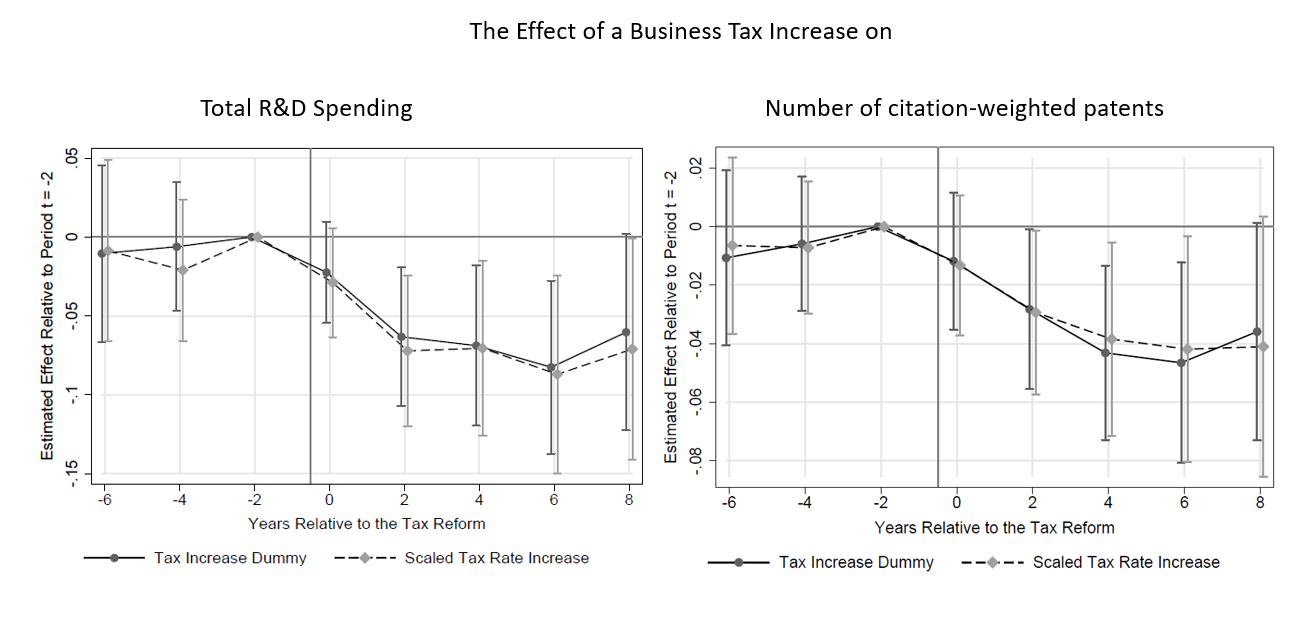
The empirical results indicate that an increase in the local business tax rate has a negative and statistically significant effect on plants’ total R&D expenditures. These reductions in R&D spending are particularly strong among young and credit-constrained firms. A similar negative effect appears about two years later in resulting patents.Despite these notable effects, the authors emphasize that reductions in business taxes are likely not the best policy response to their study’s findings. Instead, “targeted tax incentives for R&D expenditures appear to be the more efficient policy instrument altogether,” as untargeted tax changes affect both innovating and non-innovating firms.

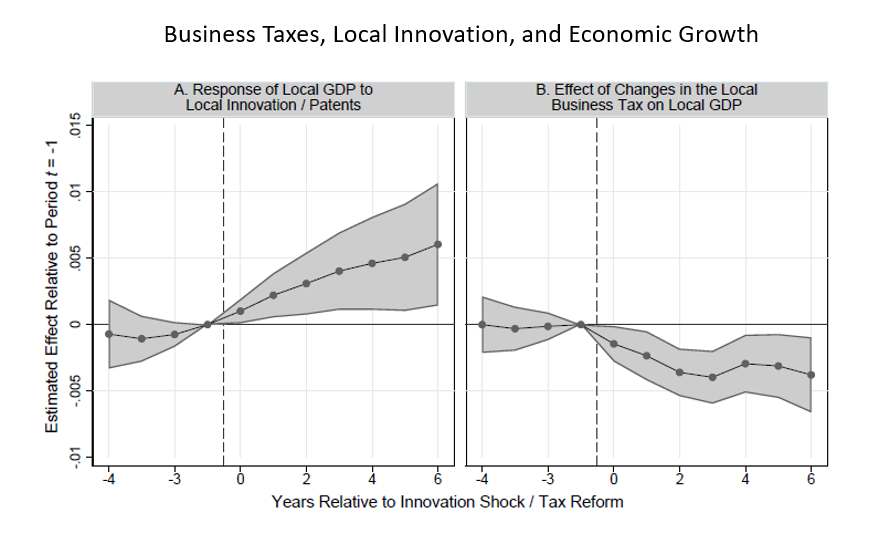
The authors also provide suggestive evidence that local innovation has a positive and lasting effect on municipal economic growth. In contrast, an increase in the local business tax considerably reduces local GDP. Combining these two pieces of evidence with the effect of taxes on innovation, they conclude that around eight percent of the total negative effect of profit taxation on local growth are due to tax-induced reductions in innovation, which highlights the important role of innovation for economic growth.

Filed Under: Research Tagged With: economic growth, firms, innovation, profit taxation, R&D

Fifth Annual IZA Junior/Senior Symposium

November 8, 2021 by Mark Fallak

Reflecting IZA’s mission to provide mentoring and guidance to young labor economists, the annual IZA Junior/Senior Symposium gave selected young scholars the opportunity to present and discuss their current work. Organizers Maia Güell and Daniel Hamermesh had to choose from among over 80 submissions. Three of the papers are summarized below.

How male and female students differ in college major choices

The first presentation focused on the choice of university program in contexts where standardized exams are common. Catalina Franco used data from the nationwide competition in Colombia for coveted spots in the national university that works through scores on a national standardized exam. Similar systems exist in many countries. Prospective students specify their preferences for university specialty and are admitted based on their exam scores. The study demonstrates that women are more likely to choose to enter specialties that admit them quickly, even if that specialty was not their first choice. This gender difference in behavior explains part of women’s relative absence in STEM fields.

How international trade can create new types of jobs

The study presented by Gueyon Kim discussed the role of international trade in stimulating restructuring of the workplace, in the form of jobs/occupations that previously had not existed. She showed that new jobs appear more often in those industries in which employers are most exposed to pressures from international competition. Implicitly, this suggests that international trade produces technical innovation in the structure of the demand for labor, not merely through the destruction of jobs in exposed firms. While others have shown how international trade stimulates technical innovation in terms of patent applications, this is the first paper to show how trade is linked directly to new occupations.

How geographic features affect migration patterns

Riley Wilson demonstrated in his paper how apparently insignificant geographic features sharply affect migration patterns. In the U.S. people are much more likely to move to a county in the state where they reside than to an equally close county in an adjacent state. This implicit barrier cannot be explained by such things as interstate differences in religious affiliation, tax rates, or many other characteristics. Its existence means that a negative shock to a labor market at the edge of a state will not be dissipated by out-migration to a nearby state, and will be slower to re-adjust after a shock. While the analysis is for the U.S., the same border-effect likely applies in regions within European countries, e.g., Scotland vs. England, Bavaria vs. Baden-Wurttemberg, and many others.

Download all the presented papers from the symposium’s online program.

Filed Under: IZA News Tagged With: junior, senior, young scholars

Women in leadership

November 4, 2021 by Mark Fallak

Inspired by this year’s International Women’s Day, the 4th IZA Workshop on Gender and Family Economics focused on “Women in Leadership.” Despite various attempts across countries to increase the share of women in leadership positions in the private and public sector, women still remain strongly underrepresented at this level. Organized by Deborah A. Cobb-Clark and Christian Zimpelmann, the workshop brought together 16 international researchers to present state-of-the art research on the determinants and consequences of this phenomenon.

Impact of gender quotas

The first set of papers was centered around gender quotas for boards. In her keynote speech, Andrea Weber pointed out that such a reform in Italy raised the share of women in corporate boards as expected, but had no spillover effects on the representation of women in top executive or top earnings positions (read more in an earlier IZA Newsroom post).

Joanne Tan presented evidence on a similar French reform. She concluded that while women on lower levels of the firm hierarchy were unaffected by the reform, the wages at upper levels of the firm increased, suggesting a trickle-down effect.

Effects of networking

Francesca Truffa looked at the role of network effects for female careers. Based on administrative data, the study demonstrated that variation in the gender composition in business schools affects the gender gap in senior corporate leadership positions. Specifically, more female peers in one’s MBA section increase the likelihood of entering senior management for women but not for men.

Women in politics

The last section of the the workshop discussed the question how policies of female politicians differ from those of male politicians. Damian Clarke made use of gender quotas to investigate the effect of more female politicians on various health outcomes. The study shows how quotas led to a reduction in maternal mortality of 8 to 10 percent, indicating that on average women seem to set different priorities than men in these positions.

Carmela Accettura studied the role of politicians’ gender in political budget cycles, i.e., the observation that governments tend to increase spending before an election. By comparing mixed-gender mayor races, the paper illustrated that male mayors who are elected by a small margin are more likely to engage in strategic spending at pre-electoral and electoral years, as compared to female mayors.

Taken together, the narrow focus of the workshop led to lively discussions and exchange among the mix of junior and senior researchers and pointed to several policy-relevant conclusions.

For a full list of presentations see the detailed program on our website.

Filed Under: IZA News Tagged With: gender, leadership, women

  • Previous Page
  • Page 1
  • …
  • Page 14
  • Page 15
  • Page 16
  • Page 17
  • Page 18
  • …
  • Page 30
  • Next Page

Primary Sidebar

© 2013–2025 Deutsche Post STIFTUNGImprint | Privacy PolicyIZA