• Skip to primary navigation
  • Skip to content
  • Skip to primary sidebar

IZA Newsroom

IZA – Institute of Labor Economics

  • Home
  • Archive
  • Press Lounge
  • DE
  • EN

Mark Fallak

The 2020 IZA Prize in Labor Economics goes to Lawrence Katz

January 16, 2020 by Mark Fallak

Lawrence F. Katz (Harvard University) will receive the 2020 IZA Prize in Labor Economics for his 35 years of research documenting changes in earnings inequality and showing the role of the expansion of educational opportunity in increasing living standards. Worth 50,000 euros, the IZA Prize is regarded as the most prestigious science award in the field. It will be formally conferred during the EALE/SOLE/AASLE World Conference in Berlin on June 27, 2020.

According to the award statement, “Lawrence Katz is universally recognized in the world of economics as a remarkably imaginative and productive scholar, who combines profound economic research with an interest in current basic and specific issues of public policy. Most important, the same recognition is given to his decency in dealing with other economists, especially junior researchers.”

[download the full statement – PDF]

The IZA Prize Committee consists of seven distinguished economists, five of whom are previous Awardees. “I am absolutely delighted that we are conferring this Prize on Larry Katz. Like others worldwide, my understanding of changes in inequality in rich countries and what has been causing them has been greatly enhanced by his vast oeuvre of research on these subjects,” said IZA Network Director Daniel Hamermesh, who chairs the committee.

[read more about the IZA Prize and previous winners]

Filed Under: IZA News Tagged With: IZA Prize

IZA Young Labor Economist Award presented in San Diego

January 4, 2020 by Mark Fallak

At an IZA Reception during the ASSA 2020 Annual Meeting in San Diego, the 2019 IZA Young Labor Economist Award was conferred  to Leah Platt Boustan (Princeton University) for her historical research on immigration, and to Philipp Kircher (University of Edinburgh and European University Institute) for his work on search, sorting and matching in labor markets [read more about the winners].

Pictured from left to right: Claudia Goldin (member of the IZA Prize Committee), Hilmar Schneider (CEO of IZA), Leah Boustan (co-winner of the Award), Daniel S. Hamermesh (Chair of the IZA Prize Committee).

Filed Under: IZA News Tagged With: IZA Young Labor Economist Award

Are women more willing to accept jobs with lower pay?

December 19, 2019 by Mark Fallak

Few topics in labor economics have received more attention in academic, public and policy debates than the gender pay gap. The IZA Newsroom frequently summarizes new research findings on various drivers of the gap, including the role of discrimination vs. structural differences, or gender differences in wage expectations. Three recent IZA papers have looked into gender differences in quit behavior, job satisfaction, and job preferences – or, more broadly speaking, why women tend to be less pay sensitive than men.

Why men quit and women stay when pay is low

It has long been documented that men are more likely than women to quit their jobs for better pay at another firm. This contributes to the gender wage gap because firms need to pay their male employees relatively more to keep them on board. A new IZA discussion paper by Christian Bredemeier, based on data from a large U.S. household survey, shows that almost all of the gender difference in job quitting behavior can be attributed to gender differences in household earner roles rather than risk aversion or other psychological factors.

“When offered a job that pays, say, 5% more than the current job but is less likeable in terms of other characteristics such as location or working hours, the importance of this 5% pay difference depends on how strongly the household relies on the earnings of the considered individual,” says Bredemeier. As long as men are still the primary earners in most households, the non-pay dimensions of their jobs will receive relatively little weight.

The results thus suggest that firms discriminate by earner status rather than against women per se when they pay men more to keep them from quitting. Since this practice reinforces and perpetuates pay differences between men and women, policies promoting gender equality in the household could play an important role in closing the gender pay gap.

Why women are more satisfied with their jobs

There has been much debate about why a gender gap also exists in job satisfaction, even when a wide range of personal and job characteristics are controlled for. One often cited argument is that women may have lower expectations than men, and therefore report higher satisfaction, even in jobs that may be objectively worse.

However, using unique data for Europe which captures detailed preferences relating to an employee’s job choice (see table below), an IZA discussion paper by Paul Redmond and Seamus McGuinness shows that job preferences explain much of the gender gap in satisfaction.

Two preferences stand out as particularly important: intrinsically liking the work and having a good work-life balance. These preferences are strongly associated with greater job satisfaction and women place a greater emphasis on both of these factors than men. Controlling for these preferences causes the gender gap in job satisfaction to disappear.

Why women are overrepresented in the public sector

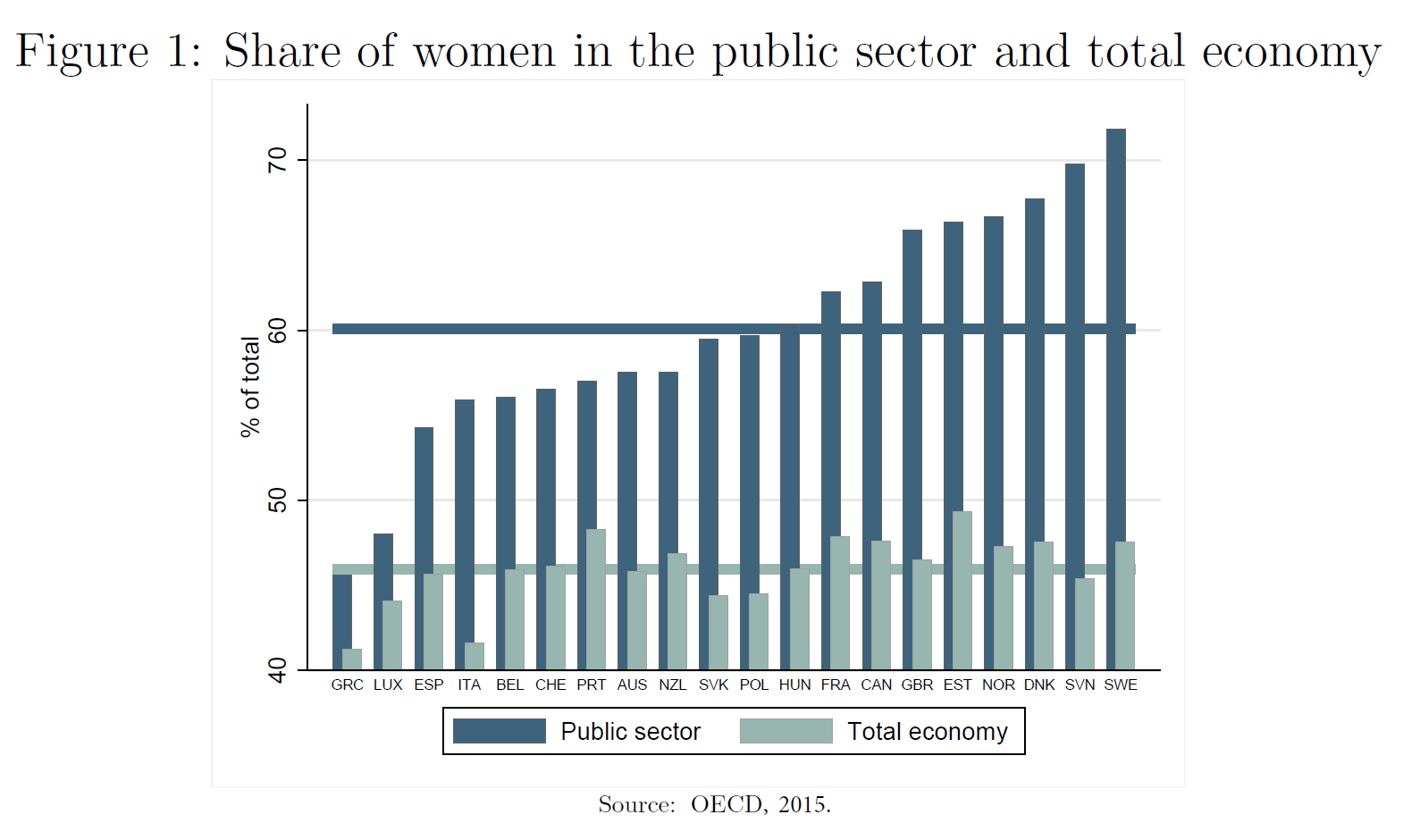
Gender differences in job preferences may also explain why in most countries women are overrepresented in the public sector (see figure). A recent IZA discussion paper by Pedro Maia Gomes and Zoë Kuehn quantifies for four countries how much of the selection of women into the public sector is driven by lower gender wage gaps, better work-life balance, greater job security, or intrinsic preferences for public sector activities.

The authors find that women’s preferences explain 20 percent of the gender bias in France, 45 percent in Spain, 80 percent in the US, and 95 percent in the UK. The remaining bias is explained by differences in public and private sector characteristics, in particular relatively higher wages for female public sector workers that explain around 30 percent in the US and Spain and 50 percent in France. Work-life balance is found to be an important driver only in France and Spain, explaining 20 to 30 percent of the gender bias.

Calculating how much of their wages private sector workers would be willing to sacrifice to face the same job separation rates or working hours as workers in the public sector, the authors find that the work-life balance premium is very high in Spain (25 to 36 percent), high in France and the UK (7 to 15 percent) and lower in the US (7 to 9 percent).

In all countries, the job security premium is much lower, ranging from 1-2 percent in the US and the UK to 3-4 percent in France and Spain, countries with higher unemployment rates. Regarding gender differences, the study finds that women are willing to pay more for work-life balance, while men are willing to pay more for job security. Higher job security in the public sector thus actually reduces the gender bias. This is due to the fact that women in general have a higher “opportunity cost” of working, as well as lower wages, which makes job losses more painful for men.

+++

For related research see also the IZA World of Labor key topic page: “What is the gender divide?”

Filed Under: Research Tagged With: gender, job satisfaction, pay, preferences, public sector, quits, work-life balance

Worker representation in the boardroom increases capital formation

December 13, 2019 by Mark Fallak

A fundamental question societies face is whether and how to involve stakeholders, in particular workers, in corporate decision-making. Many countries, particularly in continental Europe, grant workers formal authority in firms’ decision-making. Such shared governance or codetermination institutions include worker-elected directors on company boards. By contrast, in many liberal market economies such as the United States, firms are legally controlled solely by their owners.

This consensus, along with the idea that corporations ought to primarily benefit their shareholders, has recently been called into question. For example, the Business Roundtable issued a statement in August 2019 on “the purpose of a corporation,” arguing that companies should advance the interests of stakeholders, including employees, rather than following a model of shareholder primacy.

In addition, policy proposals that would mandate worker-elected directors, as in many European countries, have been proposed in the US. For example, two federal bills introduced in 2018, the Accountable Capitalism Act and the Reward Work Act, would mandate that 40% or 1/3, respectively, of the directors of large companies be worker representatives.

What are the consequences of forcing firms to have worker-elected directors in the boardroom?

On the one hand, worker participation may help overcome coordination issues and improve information flows, foster long-term employment relationships, or facilitate the enforcement of implicit contracts. On the other hand, according to the influential “hold-up” hypothesis, granting workers control rights will raise worker bargaining power and thereby discourage capital formation, as capitalists anticipate that labor will grab a larger share of the fruits from investments.

Compelling evidence to adjudicate between these views is scant due to the absence of experiments randomizing shared governance across firms.

Policy reform provides a natural experiment

A recent IZA discussion paper by Simon Jäger, Benjamin Schoefer and Jörg Heining exploits a natural experiment in Germany to provide empirical evidence on the effects of shared governance. The authors study a 1994 reform in Germany, which sharply abolished worker-elected directors in certain new firms and permanently preserved the mandate in others.

Before the law change, all stock corporations had to apportion at least one-third of their supervisory board seats to representatives elected by their workforce. In dual board settings such as Germany’s, the supervisory board appoints, monitors, dismisses, and sets the compensation for the executive board. It is also involved in important decisions, such as large investments.

The 1994 reform abruptly abolished worker-elected directors in newly incorporated stock corporations, so that these firms were formally completely controlled by their shareholders unless reaching a threshold of 500 employees. Importantly, the cohort-based reform permanently locked in shared governance in the incumbent firm cohorts incorporated before the reform for the rest of their lifecycle.

The researchers leverage the natural experiment created by the 1994 reform and compare stock corporations incorporated just before and after the date of the reform. They also compare changes in a placebo group of other corporation types not affected by the reform.

Effects on capital formation, wages, and borrowing costs

A central focus of the study is the effect of shared governance on the production process, with a particular focus on capital formation. Most importantly, the analysis shows that along a variety of measures, shared governance shifts firms toward a more capital-intensive mode of production.

The authors also find less outsourcing in these firms, while output per worker in affected firms increases. Hence, their evidence is inconsistent with the disinvestment prediction of the canonical hold-up mechanism: capital increases rather than decreases when workers get seats on the board.

Regarding the effect on wages, the study finds at best small and statistically insignificant wage increases in shared governance firms, further making the standard hold-up mechanism unlikely to hold. On the financial side, shared governance does not appear to reduce firms’ external-finance capacity. There is no clear effect on profitability or measures of financial constraints.

Leverage is unchanged, although interest payments over debt are slightly reduced, perhaps consistent with the market considering firms with worker involvement in governance to be less risky.

Even though the authors do not find negative profitability effects, they cannot definitively measure the effects of the additional capital formation on shareholders, or whether it reflects yet another agency conflict inside the firm. For example, worker participation may lock in resources into fixed capital at the expense of dividend payouts to the owners.

Workers may also aggravate agency conflicts of an imperfectly incentivized management engaging in empire building and hence overinvestment. Such an interpretation may also help explain why at least individual capitalists may not voluntarily adopt codetermination.

Improved information flows and cooperation

The authors discuss a variety of potential channels that can in principle lead shared governance to raise capital investment, such as improved information sharing or facilitating long-term interactions.

They also show that the disinvestment prediction of the canonical hold-up model is fragile and in fact can be overturned in a simple and perhaps realistic extension, consistent with their main findings. In the model extension, codetermination may increase worker bargaining power over a variety of corporate decisions that also include investment, not necessarily just wages.

In this model, a complete absence of workers in firms’ decision-making leads to underinvestment. Introducing codetermination will raise investment and can bring the economy closer to social efficiency but, beyond a certain level, increases in worker bargaining power may also lead to inefficient overinvestment.

Therefore, the findings leave open the important question whether the additional capital stock brings the overall economy closer to social efficiency, for example if investment is inefficiently low due to market failures.

Validity for other countries may be limited

In terms of external validity to other corporate-governance systems such as the US, the authors note that their experiment occurred against the backdrop of existing establishment-level worker participation through works councils, an institution with a long history in Germany and the second lever of codetermination besides board-level representation.

On the one hand, an interaction between these two codetermination institutions may amplify effects of shared corporate governance through information sharing or by providing the worker-elected directors with leverage beyond their voice and vote on the board. On the other hand, the incremental effect of supervisory board seats could also duplicate some channels by which works councils already affect firm outcomes.

Relatedly, this new research raises the question whether the overall cooperative labor relations in the German context may affect the findings – or whether the shared governance institution under study may have even contributed to this cooperative equilibrium: since the capital side retains the majority of seats, it could always outvote radical labor representatives voicing excessive demands.

Therefore, in systems with minority representation of labor in the board, labor representatives may have an incentive to be moderates in order to wield influence through coalition-building with shareholders.

+++

See also media coverage of this paper by Reuters, Bloomberg, and NPR.

Filed Under: Research Tagged With: capital, codetermination, corporate boards, investment, labor, unions

Changing work arrangements and their implications for workers

December 11, 2019 by Mark Fallak

Although firms have always outsourced work, there is evidence in many advanced economies of recent growth in the use of various types of contract work as an alternative to direct hiring onto firms’ own payrolls. Contract work includes the use of independent contractors and freelancers, among them “gig workers” whose activity is mediated through mobile apps and online platforms; workers supplied by staffing firms; and contract companies whose employees perform tasks previously performed by in-house employees.

Available measures of the scope and nature of changes in the use of these arrangements have important limitations and there is much to learn about what growing reliance on contract work may imply for workers and businesses. The 3rd IZA Workshop on Labor Statistics, organized by Katharine Abraham and Susan Houseman and co-sponsored by the W.E. Upjohn Institute for Employment Research, provided a forum for senior and junior scholars studying these developments to share their research.

Using tax data to study changes in work arrangements

Among the 16 workshop presentations was a paper presented by Andrew Garin, which uses tax data to study the growth in self-employment generally and “gig employment” specifically. Their paper focuses on so-called 1099 workers, named after the tax form that U.S. employers use to report payment of nonemployee compensation to the tax authorities. The authors show that 1099 workers as a share of the U.S. tax workforce grew by nearly 2 percentage points from 2000 to 2016 and highlight the growth since 2013 in the share of workers receiving payments from platform companies. Most of those with platform income, however, are supplementing wage and salary earnings rather than relying on platform income as their primary source of income.

Where and how contract work arrangements are used

Another presentation by Kyung Min Lee reported on an examination of new data from the 2015 Annual Survey of Entrepreneurs (ASE), an employer survey fielded by the U.S. Census Bureau. The ASE data allow an unprecedentedly in-depth examination of firms’ use of contract workers. The authors find that 30% of U.S. firms make at least some use of contract workers, with those workers accounting for 14% of full-time-equivalent work effort.  Relative to full-time employees, contract workers are most likely to be involved in operations, product development and technology development activities, and least likely to be involved in management and human resources activities. New businesses are more likely than established businesses to use contract workers. Interestingly, although they are more likely to hire part-time employees, franchise firms are less likely to make use of contract workers.

Implications of contract work for workers and firms

David Weil, who gave the workshop’s keynote address, spoke about the implications of growing reliance on contract workers and what he has termed the “fissuring”of the labor market. Existing labor market laws and regulations were designed to provide workplace protections for those in traditional employment arrangements, but that protective umbrella generally does not extend to self-employed individuals. Just as important, existing rules may not function well in the increasingly common situation in which a firm subcontracts work to other firms who in turn may rely on their own network of subcontractors.

Weil used the retail industry, and specifically the case of Amazon, to illustrate the growth of such subcontracting arrangements.  He asked the audience to consider as an example what happens if someone working for a subcontractor or as an independent contractor suffers a workplace injury. In such cases the firm at the top of the structure is not formally the person’s employer and, as a result, may be able to avoid any resulting liability. Weil discussed effective strategies for dealing with wage theft and other labor violations associated with the fissured workplace, drawing upon his experience as Wage and Hour Administrator at the U.S. Department of Labor.

See the workshop program for the full set of presentations.

Filed Under: IZA News Tagged With: contract work, labor statistics

Taxing billionaires

December 2, 2019 by Mark Fallak

The United States exhibit vast geographical differences in the degree to which personal income, corporate income and wealth are taxed. There has been much debate in recent years on the costs and benefits of state and local governments imposing high taxes on their richest residents, especially in light of the potential for tax flight.

To add new empirical findings to the debate, a recent IZA discussion paper by Enrico Moretti and Daniel J. Wilson studies the effects of state-level estate taxes on the geographical location of the Forbes 400 richest Americans between 1981 and 2017 and the implications for tax policy.

Billionaires move away from estate tax states

The authors exploit the sudden change created by a 2001 federal tax reform. Before 2001, some states had an estate tax and others didn’t. However, there was also a federal credit against state estate taxes. For the ultra-wealthy, the credit amounted to a full offset. In practice, this meant that the estate tax liability for the ultra-wealthy was independent of their state of residence. As part of the Bush tax cuts of 2001, the credit was eliminated. The estate tax liability for the ultra-wealthy suddenly became highly dependent on state of residence.

The analysis shows that the number of Forbes 400 individuals in estate tax states fell by 35% (or 2.35 billionaires on average) after 2001 compared to non-estate tax states. The authors estimate that $80.7 billion of 2001 Forbes 400 wealth escaped estate taxation in the subsequent years due to billionaires moving away from estate tax states. Especially older billionaires’ geographical location appears to be highly sensitive to state estate taxes.

Estate tax revenues exceed foregone income tax revenue

States therefore face a trade-off in terms of tax revenues: On the one hand, an estate tax on billionaires implies a one-time estate tax revenue gain upon the death of a billionaire in the state. According to the estimates, estate tax revenues sharply increase – by $165 million on average – in the three years after a Forbes billionaire death. On the other hand, this comes at the cost of foregone income tax revenues if estate taxes induce some billionaires to move away.

Surprisingly, the authors find that for most states the benefit of additional revenues from adopting an estate tax significantly exceeds the cost of foregone income tax revenue due to tax-induced mobility. Overall, it is estimated that 28 of 29 states that currently do not have an estate tax and have at least one billionaire would experience revenue gains if they adopted an estate tax on billionaires. The only exception is California, where the personal income top tax rate is very high.

The authors caution, however, that their cost-benefit analysis does not include potential indirect effects on states if billionaire relocation causes relocation of firms and investments as well as a reduction of donations to local charities.

Filed Under: Research Tagged With: billionaires, cost-benefit analysis, estate tax, income tax, mobility, revenue, taxation, wealth

How earthquakes affect social preferences

November 27, 2019 by Mark Fallak

Imagine you have to explain inequalities to your kids. Would you say that differences in income and wealth are a matter of luck? For example, the luck of being born in the right place into the right family. Or would you rather tell your kids that success entirely depends on talent and effort, so they will have to work hard to achieve their goals?

The economics literature believes that what we learn in our young age about what causes success in life will likely inform our preferences on redistributive policies. At the macro level, these beliefs have a remarkable economic and societal impact.

If a society believes that socioeconomic success only depends on merit, and that everyone should fully enjoy the fruits of her work, it will demand low redistribution. If, instead, the belief prevails that wealth is mostly determined by “luck”, such as the fortune of being born in the right place into the right family, society will support higher redistribution thus levying heavier taxes.

But what happens when a person believing in the role of merit suddenly and unpredictably experiences bad luck? Standard economic reasoning suggests she may adjust the expectations on what determines success thereby raising her support for redistribution.

Natural experiment

A recent IZA discussion paper by Giovanni Gualtieri (Italian National Research Council), Marcella Nicolini (University of Pavia), and Fabio Sabatini (Sapienza University of Rome and IZA) answers this question by exploiting evidence from an unfortunate natural experiment, the earthquake that struck central Italy in 2009. The earthquake consisted of a first strong shake that occurred on April 6 and dozens of aftershocks lasting until April 13, seven of which were as destructive as the first one.

To study how the exposure to the shakes affected inhabitants’ preferences about redistribution, the authors match information on the peak ground acceleration (PGA) of each shock recorded by the Italian National Strong Motion Network throughout the L’Aquila earthquake with nationally representative survey data about individual opinions and beliefs that were collected almost two years after the shock. This allows reconstructing the acceleration experienced by each survey respondent during each shake.

PGA is the largest peak acceleration recorded at a given geographic point during a seismic event. Unlike the Richter and moment magnitude scales, it is not a measure of the total energy of the earthquake, but rather of how hard the earth shakes on the surface. It thus provides an objective indicator of the intensity with which residents perceive the shakes.

Multiple shocks

The empirical analysis shows that the average intensity of the shakes registered throughout the L’Aquila earthquake is associated with subsequent stronger beliefs that, for a society to be fair, income inequalities should be leveled by redistribution. The analysis of the single shocks occurred between April 6 and 13, however, reveals that the relationship between redistributive preferences and the intensity of the shakes is triggered only after a certain number of shocks. It is with the sixth shock that the ground acceleration experienced by inhabitants becomes a statistically significant predictor of support for redistribution.

The peak ground acceleration of the three final shocks occurred between April 9 and 13 very well predicts preferences for redistribution, as if some sort of cumulative effect of the shocks has been at stake. Though new in the economics literature, this result recalls psychological theories explaining the different behavioral outcomes of single versus multiple shocks as resulting from a dose-response relationship. To corroborate this result, the authors compare the outcomes of the L’Aquila earthquake with a single-shake earthquake occurred in the province of Parma three months before, finding that the latter had no effect on individuals’ social preferences.

Sizeable effect

The effect is sizeable and economically relevant. To get an idea of the size of the effect, consider that a one standard deviation increase in the average peak ground acceleration of the shakes implies an increase in the likelihood of supporting redistribution by 3.1 percentage points. The standardized beta coefficients suggest that the effect of the average PGA is comparable to that of the other statistically significant covariates, such as political orientation (whose effect is 3.5 percentage points).

Understanding the drivers of redistributive preferences is important because the proportion of people supporting redistribution in turn is a good predictor of the share of GDP spent on social welfare both within and across countries. This study calls for further investigation also in light of the recent, cross-national, rise in populist movements calling for more redistribution, as the authors’ findings support the theory that demand for redistribution is strongly driven not only by selfish motives (i.e., the hope to personally benefit from public welfare spending) but also by a genuine concern with the fairness of social competition.

Filed Under: Research Tagged With: inequality, Italy, natural experiment, redistribution

Why don’t we sleep enough?

November 20, 2019 by Mark Fallak

Despite sleep deprivation being an emerging public health challenge, little is known about the behavioral determinants of sleep choice. Estimates suggest that 50-70 million US adults have a sleep or wakefulness disorder. Some scholars consider it the most prevalent risky behavior in modern societies, and evidence suggests that in many countries people may be sleeping between one and two hours less than what their ancestors used to sleep a hundred years ago.

A new IZA discussion paper by Mallory Avery, Osea Giuntella, and Peiran Jiao investigates sleep choice and the role of commitment devices and monetary incentives to promote healthier sleep habits. The researchers conducted a field experiment among college students and collected data from wearable activity trackers, surveys, and time-use diaries. Eliciting preferences and randomizing incentives to go to bed earlier and sleep longer, they shed light on the role of present bias, overconfidence, commitment, and habit formation in sleep.

College students as a major risk group

Sleep deprivation among college students is increasingly becoming a reason for concern. According to recent statistics published in a report of the National Institute of Health, more than 70% of college students sleep less than eight hours a day, 60% say they are “dragging, tired, or sleepy” at least three days a week, and more than 80% say loss of sleep affects their academic performance.

Understanding the behavioral mechanisms behind sleep choice within this population may help design educational programs and interventions aimed at improving sleep duration and quality, with non-negligible effects on students’ mental health and potential long-lasting effects on both habits and health.

Experiment with wearable activity trackers

The authors recruited 319 participants at the University of Oxford and the University of Pittsburgh. The subjects were given wearable devices to collect data on their sleep, physical activity, and heart rate for 8 weeks.

In the incentive treatments, subjects set bedtime and sleep duration targets for themselves each Monday of the three treatment weeks and were rewarded for each night (Monday through Thursday) that both targets were achieved based on the collected data. The researchers elicited subjects’ time and risk preferences, and integrated the data collected from wearable devices with weekly surveys, time-use diaries, and a follow-up survey conducted three months after the end of the experiment to examine how behavioral mechanisms, such as present bias and overconfidence, affect sleep choice.

Present bias and overconfidence

In total, 63% of the subjects took up some form of commitment. More present-biased subjects reported less sleep at baseline and were more likely to take up commitment devices (+28%). Among present-biased individuals, commitment devices reduced insufficient sleep by at least 25%.

Meanwhile, many subjects were overconfident about their achievement rates, overestimated their own bedtime and sleep duration, over-placed their own sleep duration and quality among peers, and understated personal risk associated with sleep deprivation relative to the risk they predicted for peers. Overconfident subjects were more likely to be sleep deprived at baseline and selected overly optimistic targets. Present-biased individuals were more likely to achieve their targets if they were less overconfident.

Monetary incentives work

The participants responded to monetary incentives by sleeping longer. They were 19% more likely to sleep the recommended number of hours (between 7 and 9) and 23% less likely to sleep less than 6 hours.

By following individuals for eight weeks and surveying them three months after the end of the experiment, the study documents a persistent improvement in sleep, suggesting that temporary incentives could lead to long-run lifestyle changes in the sleep domain. Even after the intervention was removed, the subjects were 16% less likely to sleep less than 6 hours.

The intervention also had effects on sleep regularity, reducing sleep, bedtime, and (more weakly) wake-up time variance. Furthermore, there is suggestive evidence that the intervention improved academic outcomes through positive effects on heart rate efficiency, physical activity, and self-reported health and academic achievement.

Reduced screen time

Based on time-use diaries before, during, and after the intervention, the authors examined how individuals in the treatment group allocated their time when receiving incentives to go to bed earlier and sleep longer. They find no evidence of significant changes in time spent on studying, working, personal care activities, exercising, or socializing.

The only activity that systematically and significantly declined during the intervention was screen time (such as watching TV or videos). Interestingly, among those who complied with the treatment, evening screen time (after 8 pm) declined by 48% during the intervention with respect to baseline, and by about 28% after the incentive was removed.

The authors see these results as particularly noteworthy given the growing evidence that digital temptations and the use of blue light technologies near bedtime severely impair sleep.

In sum, the study shows that commitment devices can effectively help people, particularly those with self-control problems, improve their sleep habits.

+++

For more information about the motivation, findings and relevance of the paper, see also Osea Giuntella’s Twitter thread.

Filed Under: Research Tagged With: behavior, commitment, field experiment, habits, overconfidence, self-control, sleep

How traffic pollution affects children’s academic performance

November 15, 2019 by Mark Fallak

Over 6.4 million children in the U.S. attend public school within 250 meters of a major roadway. Despite a growing body of research on air pollution, academic achievement, and human capital formation, little is known about how a few years of exposure to traffic pollution during childhood might affect educational outcomes.

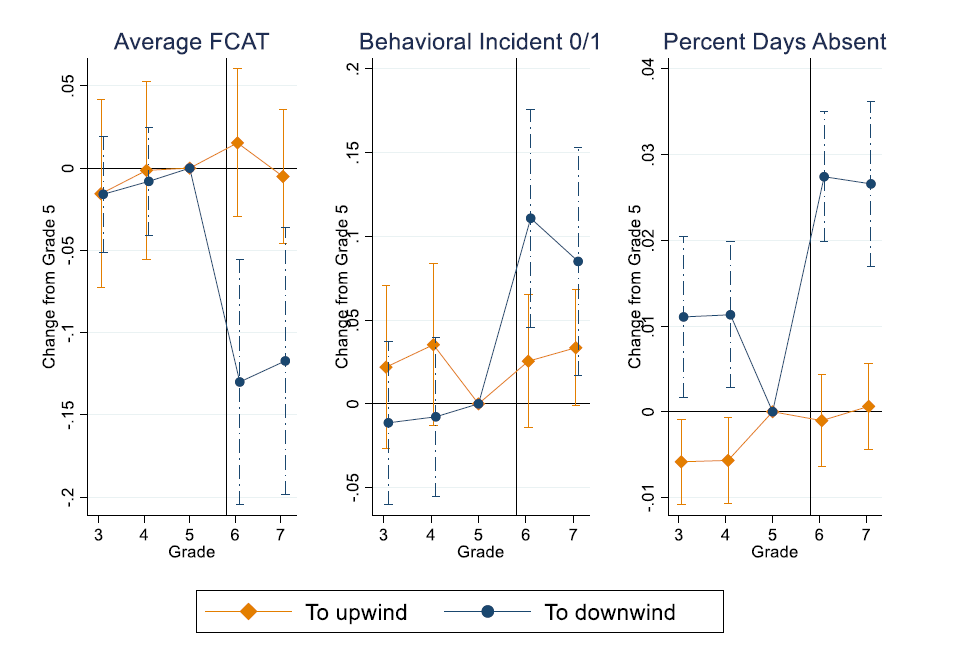
A new paper by Jennifer Heissel, Claudia Persico and David Simon shows the negative effects of traffic pollution on children’s health, absences, test scores and behavioral incidents. The authors follow children who must switch schools from elementary to middle school (or middle to high school) where the first school is upwind of a highway and the second school is downwind of the highway. Both schools are within 0.4 miles of the highway, but one gets more pollution.

The analysis finds that students who move from an elementary/middle school that feeds into a “downwind” middle/high school in the same zip code experience decreases in test scores, more behavioral incidents, and more absences, relative to when they transition to an upwind school (see figure).

The authors suggest that policymakers should think more about where to build schools. Even if the land is cheap, there are large hidden costs to children’s health and development. Also, even within zip codes, microclimates can contribute to inequality in children’s outcomes due to school placement.

Filed Under: Research Tagged With: absences, academic performance, education, pollution, school, test scores

Effects of banning the Islamic veil in public schools

November 14, 2019 by Mark Fallak

Immigration from Muslim countries is a source of tensions in many Western countries. Several countries have adopted regulations restricting religious expression and emphasizing the neutrality of the public sphere. A recent IZA discussion paper by Eric Maurin and Nicolas Navarrete explores the effect of one of the most emblematic of these regulations: the prohibition of Islamic veils in French schools.

In September 1994, a circular from the French Ministry of Education asked teachers and principals to ban Islamic veils in public schools. In March 2004, the parliament took one step further and enshrined prohibition in law.

The paper provides evidence that these new regulations contributed to improving the educational outcomes of female students with a Muslim background and to reducing educational inequalities between Muslim and non-Muslim students.

High school graduation rates improve for Muslim girls

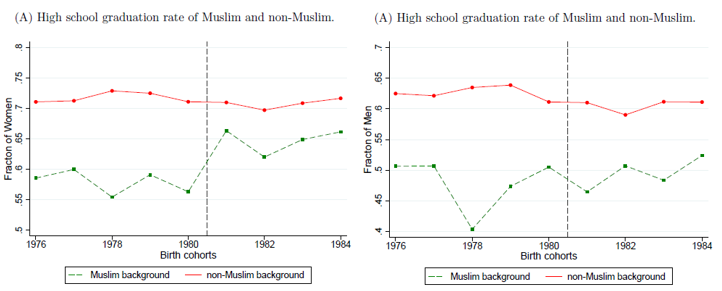
In particular, comparing women with and without a Muslim background shows a marked increase in the proportion of high school graduates in the Muslim group for cohorts born in 1981 and after, namely for cohorts who reached puberty (and the age of wearing the veil) just after the 1994 circular.

A comparison of men with different religious backgrounds shows no similar increase in the proportion of high school graduates in the Muslim group for cohorts born in 1981 and after, consistent with the assumption that the increase observed for women is driven by a policy targeting female students.

The figure below illustrates these trends in high school graduation rates for girls (left panel) and boys (right panel) with and without a Muslim background.

French secularism (laïcité) is often accused of going too far in upholding the principle of the neutrality of the state and the public sphere (including public schools), to the detriment of the exercise of freedom of religion. The findings of the study call for a more nuanced view, suggesting that the very implementation of more restrictive policies in public schools ended up promoting the educational empowerment of some of the most disadvantaged groups of female students.

Nonetheless, the authors point out that the stricter 2004 law did not generate any additional improvements. They also stress that such policies may not have the same effect in other countries.

Filed Under: Research Tagged With: education, freedom, Islam, public schools, religion, veil

  • Previous Page
  • Page 1
  • …
  • Page 24
  • Page 25
  • Page 26
  • Page 27
  • Page 28
  • …
  • Page 30
  • Next Page

Primary Sidebar

© 2013–2025 Deutsche Post STIFTUNGImprint | Privacy PolicyIZA