• Skip to primary navigation
  • Skip to content
  • Skip to primary sidebar

IZA Newsroom

IZA – Institute of Labor Economics

  • Home
  • Archive
  • Press Lounge
  • DE
  • EN

Mark Fallak

Global distribution of (non-)routine work

June 4, 2019 by Mark Fallak

Will robots and artificial intelligence take our jobs? This question has been at the center of an intense public debate on the future of work. In this debate it is often overlooked that the task content of a given job may vary substantially, both within occupations and across countries.

In many countries the share of routine jobs – both cognitive and manual – has declined over time, presumably because such jobs are easily replaced by computers or automation, or can be outsourced to other countries.

Much of the existing research assumes that occupations are more or less the same across countries. But considering the large differences in labor productivity, technology adoption and skills between countries, this assumption appears questionable.

In a new IZA discussion paper, Piotr Lewandowski, Albert Park, Wojciech Hardy, and Yang Du present evidence that occupations are actually quite different in international comparison: Workers in countries with higher technology use, higher skills and broader participation in global value chains tend to perform less routine-intensive tasks.

To quantify the country-specific job tasks, the authors use micro-data collected from large-scale surveys of workers (PIAAC, STEP, and CULS) in 42 countries around the world spanning developed and developing countries.

They develop harmonized measures of occupational task content across occupations and countries. These measures describe the share of routine and non-routine tasks that are performed by workers of a specific job in a specific country to capture differences in job tasks across countries.

More non-routine tasks in developed economies

These differences turn out to be substantial, even within the same occupations. On average, workers in the more developed economies – especially in the high-skilled occupations– perform more non-routine cognitive tasks, both analytical and interpersonal, and fewer routine tasks.

In other words, the routine intensity of tasks performed by managers, professionals and technicians in developing countries is much higher than the routine intensity of tasks performed by their counterparts in the US, Germany or Scandinavian countries.
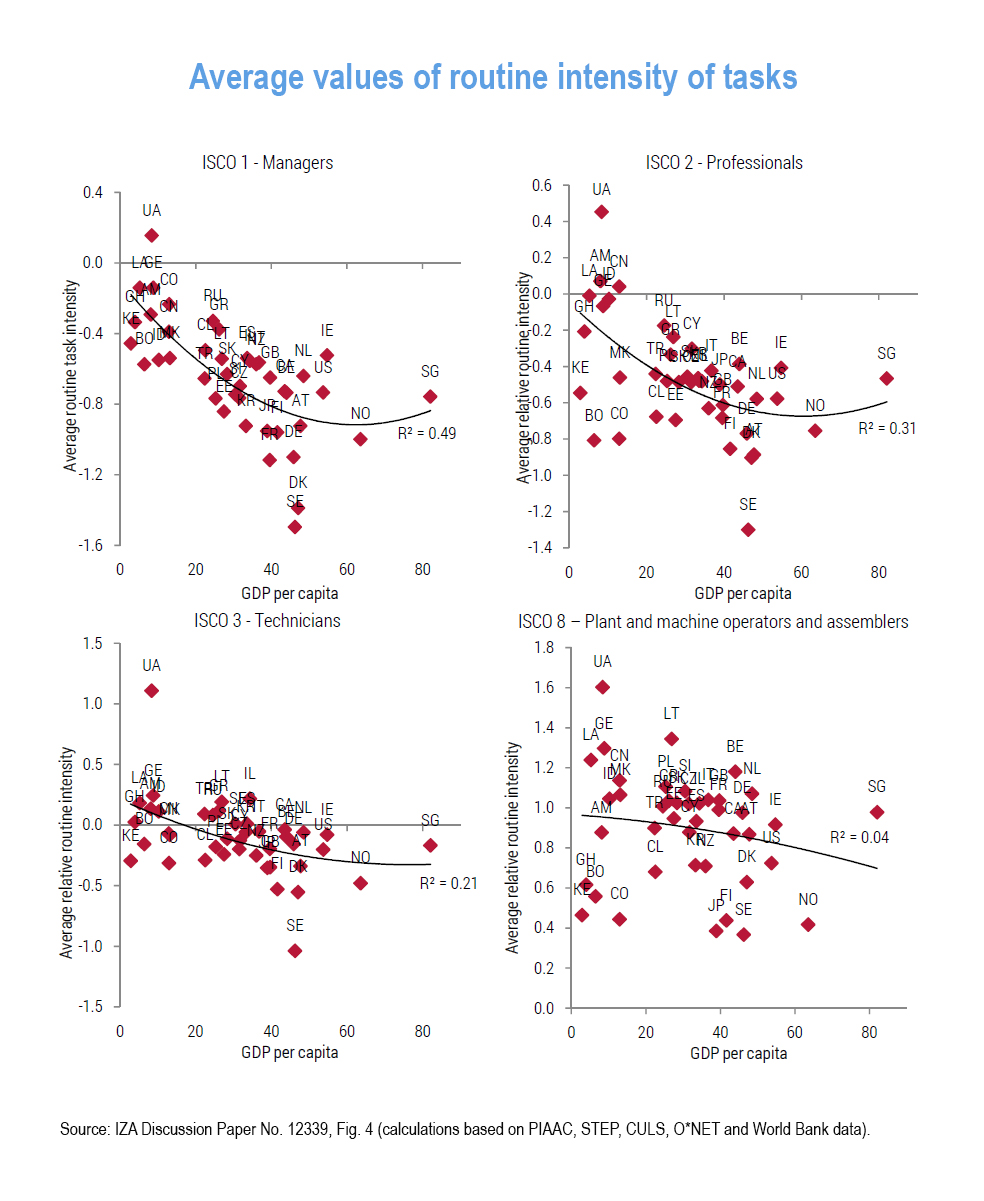
Therefore, studies that assume identical occupations around the world and apply the US-based measures to countries at noticeably lower stage of development will overestimate the importance of non-routine tasks in poor countries. They may also spuriously attribute wage premia enjoyed by these workers to technological change.

At the same time, for middle-skill occupations like clerical workers, and low-skill occupations like plant and machine operators and assemblers, the relative routine intensity of tasks varies considerably across countries but is not systematically related to the country’s level of development.

The role of technology, globalization and skills

The authors attribute the cross-country differences in tasks to three fundamental forces – technology, globalization, and supply of skills. International differences in the use of computers and other technology can best explain the cross-country variation in routine intensity in high-skilled occupations. This highlights the complementarity between non-routine tasks and ICT.

Globalization, in particular specialization of countries in narrow sections of global value chains, contributes the most to cross-country differences in routine intensity among workers in low-skilled and offshorable occupations. This confirms the view that offshoring enables countries to specialize, within industries, according to their abundant factors, so that poorer countries specialize in routine tasks and richer countries specialize in non-routine tasks.

Finally, the supply of skills also plays a role, especially in the low- and middle income countries, where lower supply of skills accounts for a large share of the difference in routine intensity compared to the most advanced countries.

The supply of skills is often overlooked in the studies of tasks that are focused on the most developed countries. However, this new evidence shows that it in the poorer countries it should be accounted for as it may help to understand not only why the shares of high-skilled occupations are low, but also why the tasks performed by workers in given occupations are more routine-intensive.

In sum, the paper stresses that cross-country differences in task content of jobs are sizable. Understanding the extent and nature of these differences is of both scientific and policy relevance, as they reflect differences in the nature of work that can inform future labor market challenges, such as the share of jobs that can be automated.
Filed Under: Research Tagged With: automation, digitalization, future of work, globalization, occupations, routine intensity, skills, task content, technology

Gender promotion gap in central banking

May 24, 2019 by Mark Fallak

Several explanations may account for the lack of women in high-level positions of the economics profession. One possibility is that the pool of potential applicants is male dominated. Despite recent efforts to turn the tide, women remain less prone to study economics, and macroeconomics in particular.

An alternative explanation is that women are less likely to apply for promotions because of gender differences in the preference for competitive environments or in bargaining abilities in the labor market. The presence of children and trade-offs between family and career may also hold back women from pursuing promotions. Finally, there may be gender-based discrimination in promotion decisions.

Which of these explanations is more relevant? And can corporate diversity policies mitigate these biases? Despite a large body of literature on gender differences, there is no agreement on the importance of diversity policies and their impact on labor market outcomes.

Gender wage and promotion gaps driven by presence of children

A new IZA discussion paper by Laura Hospido, Luc Laeven and Ana Lamo analyzes the career progression of men and women at the European Central Bank (ECB), using confidential anonymized personnel data from professional staff of the ECB during the period 2003-2017. The authors find that a wage gap emerges between men and women within a few years of hiring, despite broadly similar entry conditions in terms of salary levels and other observables. One important driver of this wage differential is the presence of children.

The study also finds that women are less likely to be promoted to a higher salary band up until 2010 when the ECB issued a public statement supporting diversity and took several measures to support gender balance. Following this change, the promotion gap disappears. The gender promotion gap prior to this policy change is partly driven by the presence of children.

Women are less likely to apply for promotion

Using 2012-2017 data on promotion applications and decisions, the researchers explore the promotion process in depth, and confirm that during this most recent period women are as likely to be promoted as men. This results from a lower probability of women to apply for promotion, combined with a higher probability of women to be selected conditional on having applied.

Following promotion, women perform better in terms of salary progression, suggesting that the higher probability to be selected is based on merit, not positive discrimination. The authors do not find evidence that the composition of the selection committee, including the fraction of women on the panel, alters these results.

Taken together, these results point to the effectiveness of corporate diversity policies in reducing gender bias in promotions and lend support to supply-side explanations for the existence of remaining gender differences in promotion outcomes. Consistent with this, the analysis finds that women are more likely to apply when they are supported by a mentor.

Study provides a unique and comprehensive analysis of career progression

The paper makes three contributions to the literature. First, it is the first to exploit the complete personnel records of a large organization to analyze gender bias in career progression and promotion decisions. This allows a more comprehensive analysis of career progression across various job levels within an organization, in contrast to much of the literature that focuses on gender differences at corporate board or leadership levels.

Second, in contrast to much of the literature on promotion decisions, the study simultaneously considers the role of promotion applications and decisions when identifying the drivers of the promotion gap. Analyzing promotion decisions without accounting for gender gaps in applications would bias the results. The authors are able to do so because they have information on both promotion applications and decisions, while the existing literature has focused on only one of these dimensions.

Third, the study exploits a change in the ECB’s gender policy to assess the impact of corporate diversity policies on promotion outcomes. While the economics literature has assessed the impact of gender quotas for corporate board seats on corporate decisions, this is the first study to consider the impact of broad-based corporate diversity policies on female labor market outcomes.

“Our results suggest that institutional efforts to reduce the gender promotion gap may have to include measures aimed at lowering the barriers for women to seek and apply for promotion opportunities,” the authors write.

Filed Under: Research Tagged With: corporate diversity policies, European Central Bank, gender gap, promotion

IZA Young Labor Economist Award goes to Leah Boustan and Philipp Kircher

May 13, 2019 by Mark Fallak

We are pleased to announce the 2019 IZA Young Labor Economist Award. This biennial prize is awarded to outstanding labor economists whose Ph.D. was received fewer than 15 years ago. The 2019 Award goes to Leah Platt Boustan (Princeton University) for her historical research on immigration, and to Philipp Kircher (University of Edinburgh and European University Institute) for his work on search, sorting and matching in labor markets.

“The Award thus typifies the tremendous breadth of what is classifiable as labor economics,” said Daniel Hamermesh, who chairs the IZA Prize Committee.  This year’s committee choosing the Awardees further consisted of Oriana Bandiera (LSE), Richard Blundell (UCL), George Borjas (Harvard), Pierre Cahuc (Sciences Po), Chinhui Juhn (Houston) and Shelly Lundberg (UC-Santa Barbara).

The Award contains a small monetary prize, which will be conferred during the IZA Reception at the ASSA Meetings on January 3, 2020, in San Diego, California.

Filed Under: IZA News Tagged With: IZA Young Labor Economist Award

Half of German employees would like to work fewer hours

April 30, 2019 by Mark Fallak

According to a recent survey conducted by IZA in cooperation with the career network XING, about 39% of German employees would choose to reduce their weekly working time by up to 10 hours at lower pay. An additional 8% would even prefer a reduction by more than 10 hours. While 30% are satisfied with their current working hours, 22% would consider working more.

On average, men express a stronger desire to reduce working hours than women, which is likely to reflect the lower part-time rate among male employees. Younger workers and those with a university degree are also more interested in a larger reduction of working hours.

Both job preferences and workplace characteristics have an influence on the desired working time reduction. For example, employees who would prefer a more flexible and mobile work environment tend to express a stronger desire to work fewer hours. However, when employers offer flexible hours and home office use, the gap between actual and desired working hours becomes smaller.

In addition to the representative survey, XING members were also asked about their working time preferences. Linking respondents’ preferences to their XING profiles, which contain information on personal interests and hobbies, suggests that employees who spend much of their leisure time with family activities and traveling would favor a larger reduction of working hours – in contrast to those whose main interests are in sports and politics.

For more details and figures, see the German version.

Filed Under: IZA News Tagged With: flexibility, home office, working time

Firms owned by immigrant entrepreneurs innovate more

April 18, 2019 by Mark Fallak

How do immigrants contribute to the U.S. economy? One relatively understudied dimension of immigrant activity is entrepreneurship. A recent IZA Discussion Paper by J. David Brown, John S. Earle, Mee Jung Kim, and Kyung Min Lee examines measures of innovation for firms owned by entrepreneurs who are foreign-born vs. U.S.-born.

The data come from the Annual Survey of Entrepreneurs, a large random sample survey of U.S. high-tech firms and their owners, and the questions ask about several types of both product and process innovation, several categories of research and development, and copyrights, trademarks and patents. The paper constructs 16 indicators of innovation based upon these variables and compares the performance of immigrant- and native-owned firms for each of them, while controlling for other factors.

The results imply significantly stronger innovation performance by immigrant entrepreneurs for 15 of the 16 measures; the only exception is for copyright/trademark. The immigrant advantage holds for older firms as well as for recent start-ups and for every level of the entrepreneur’s education. The size of the estimated immigrant-native differences in product and process innovation activities rises with detailed controls for demographic and human capital characteristics but falls for R&D and patenting.

Controlling for finance, motivations, and industry reduces all coefficients, but for most measures and specifications immigrants are estimated to have a sizable advantage in innovation. According to the authors, the results suggest that popular accounts of displaced native workers neglect the new ideas brought by immigrants to an economy, with externalities yielding broader benefits.

For more insights on this topic and the role of migrants’ education and skill levels, see also the IZA World of Labor article on “Immigrants and Entrepreneurship”.

Filed Under: Research Tagged With: entrepreneurship, immigration, innvoation

Fourth Annual IZA Junior/Senior Symposium held in Austin, Texas

April 10, 2019 by Mark Fallak

Reflecting IZA’s mission to provide mentoring and guidance to young labor economists, this symposium gave four scholars located at European/Middle Eastern universities and five located in North America the opportunity to present and discuss their current work. Organizers Andrea Ichino and Daniel S. Hamermesh had to choose from among over 100 submissions. Two of the papers are summarized below.

Role models in STEM fields

In his co-authored paper “Female Science Advisors and the STEM Gender Gap”, Pierre Mouganie (American University of Beirut) analyzed the results of an experiment at one university in which first-year students were randomly assigned to advisors. Female students who had female advisors were more likely than other women to choose to major in STEM fields; they were more likely to graduate; and their performance in science courses was better.  The results suggest that role models play an important part in reducing female-male disparities in entrance to and performance in science fields.

Publication bias in labor economics

Abel Brodeur (University of Ottawa), in “Methods Matter: P-Hacking and Causal Inference in Economics”, examined all empirical studies published in 25 leading journals in 2015. The purpose was to see how methods designed to vitiate endogeneity differ in their implicit publication bias—in the extent to which tests of statistical significance depart from what would be expected in the absence of selective publication. The study demonstrates that double-difference and instrumental variables methods are much more subject to publication bias and to “p-hacking” than those using regression discontinuity designs or randomized controlled trials. The results raise concern about both methodology and the validity of large numbers of recent research results in labor economics.

Download all the presented papers from the symposium’s online program.

Filed Under: IZA News Tagged With: junior, senior, young scholars

Work, knowledge and non-hierarchical cooperation

March 22, 2019 by Mark Fallak

The current debate about the future of work mainly evolves around the role of globalization and technological innovation. The key question, however, should not be how many jobs could be lost to machines in the near future, but how firms should adapt their work environment to harness their workers’ full potential, argues Werner Eichhorst in a recent op-ed for the World Commerce Review.

While many routine-heavy occupations – from manufacturing jobs to financial services – will certainly be automated to an extent that is technically feasible, economically efficient and socially accepted, genuinely human traits will gain importance. These include social interaction, creativity, initiative, reasoning and learning, negotiating and coordination, complex problem-solving, analytical, critical thinking, and care. Humans will be able and required to “craft and interpret their jobs more substantially”, writes Eichhorst:

Technology does not change the fact that work is with humans, and humans have to cope with themselves and each other. The fundamentals of human relations, productivity, cooperation, struggles about boundaries remain. What can be seen as of today is the fact the future role of human work challenges the way work has been organized so far. The quality of the outcome, the service or the product, is intimately related to the quality of the work environment, the processes and structures.

Since traditional hierarchies undermine creativity, productivity, and commitment in a broader sense, Eichhorst envisions a concept that draws on the principle of a “workshop, with crafts in many fields but less managerial intervention”:

Craftsmen and craftswomen are attentive, stubborn, experienced, responsible, quality-driven, committed, they know what to do and to adjust incrementally based on intuition and experience. In a workshop, coordination and collaboration are developed in a flexible, less hierarchical way, both community-oriented and autonomy-friendly way at the same time. Of course, this requires independent, skilled individuals on the one hand, and a working climate based on trust.

In such a setting, strict monitoring of workers who can be seen as “mature professionals” should be avoided. At the same time, individual incentives such as bonus and reward systems would be increasingly counterproductive.

To some extent, the reward lies in work itself and co-ownership could become an important source of motivation and commitment. Firms of the future can be seen as collaborative workshops that combine expertise and talents, and share risks. This is better done on par.

According to Eichhorst, this craft-like type of work would be conceivable at different skill levels and in various sectors, beyond high-skilled professional work or traditional crafts. Although some elements of this principle can already be seen in emerging organizational models, many firms are yet reluctant to give up  well-established managerial routines. Eichhorst’s bottom line: “Those who work know what to do. Just let them do their job.”

Filed Under: Opinion Tagged With: cooperation, craft, future of work, human capital, management, technology, Trust, work organization

IZA Fellow Alan Krueger passes away

March 19, 2019 by Mark Fallak

With profound shock and sadness we announce the passing at age 58 of Alan B. Krueger, IZA Research Fellow and co-winner in 2006 of the IZA Prize in Labor Economics.

Alan spent his academic career at Princeton University, most recently as the James Madison Professor of Political Economy. His all-too-short time was studded with fundamental contributions to a variety of central topics in our sub-specialty, including the minimum wage, the economics of education and others.

His public career included service as Assistant Secretary of the Treasury and as Chair of the President’s Council of Economic Advisors.

His newest book, Rockonomics, will be published by Random House later this year and illustrates the tremendous breadth of Alan’s interests and the depth of his scholarship.

Read the full obituary from Princeton University.

Filed Under: IZA News

Immigration and attitudes toward redistribution in Europe

March 15, 2019 by Mark Fallak

In almost every European country, the share of immigrants has increased substantially during the past decades. This has sparked a public debate about economic benefits of immigration and perceived threats to social cohesion. In new IZA discussion paper, Alberto Alesina, Elie Murard and Hillel Rapoport provide empirical evidence on attitudinal shifts against redistribution among European-born voters in response to higher shares of immigrants. The analysis accounts for a number of confounders that have plagued previous cross-country descriptive studies in the context of Europe, such as the the non-random location choices of immigrants or the residential sorting of natives.

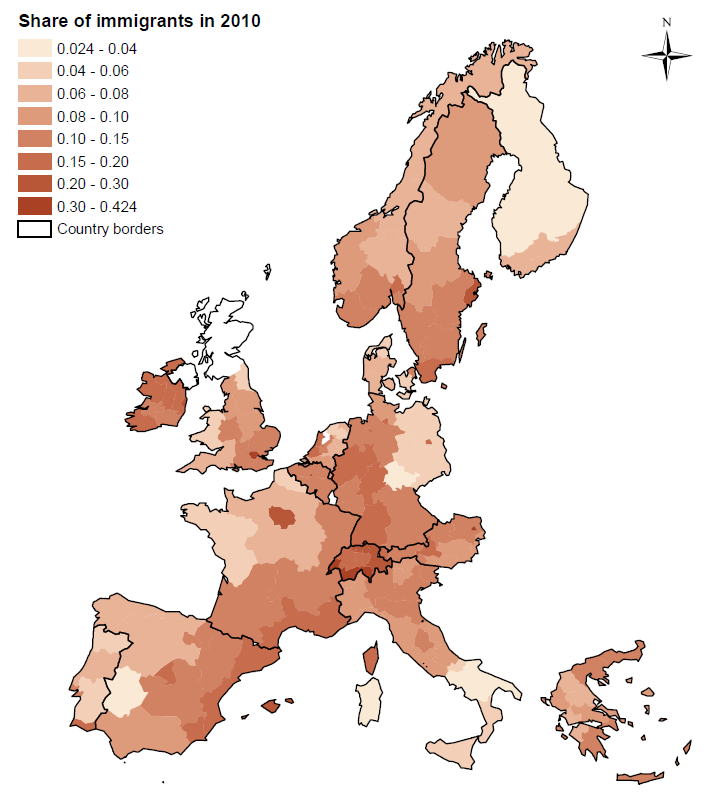
The authors used population census and register data at the regional level for 140 regions in 16 different European countries to paint a picture on immigrant populations across Europe. The share of immigrants varies strongly between these regions as indicated in Figure 1.

Figure 1: Population share of immigrants in 2010 at the regional level

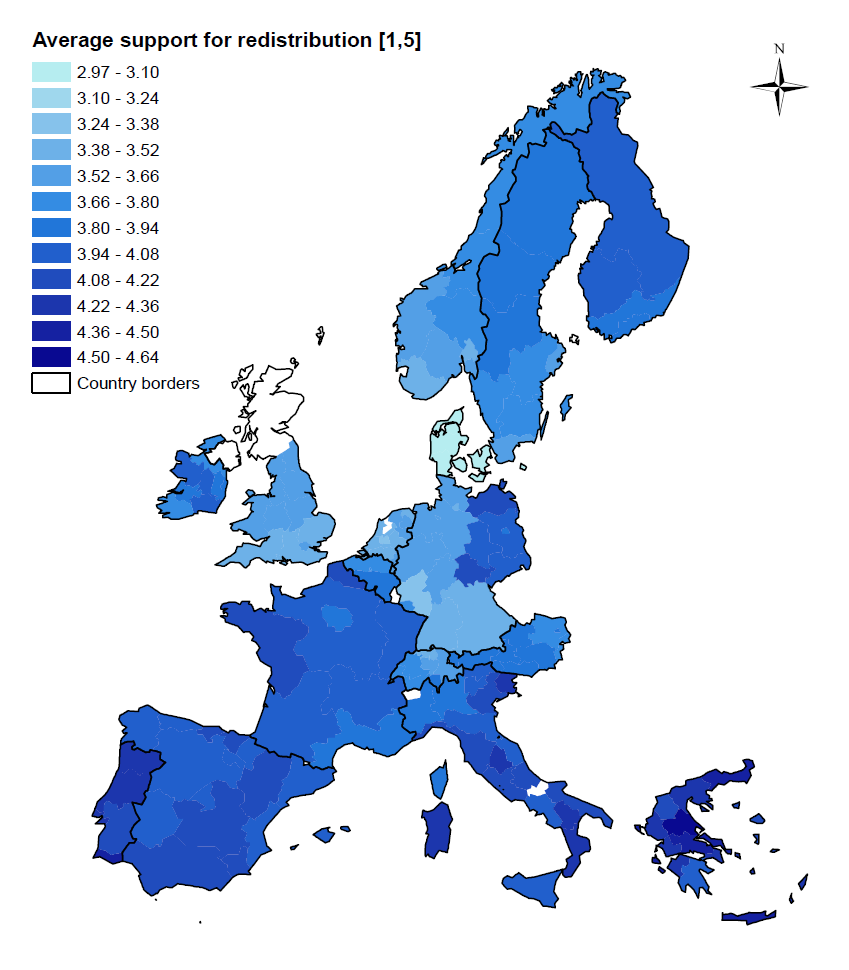
This dataset was then matched with data on preferences for distribution based on the European Social Survey. The biannual survey includes questions on how much responsibility people think governments should have to ensure a reasonable standard of living for the old, the unemployed, as well as to ensure sufficient child care services for working parents. Respondents also reported their views on social benefits. Again, the authors found significant variation in support for a larger welfare state across Europe (Figure 2).

Figure 2: Average support for reduction in income differences at the regional level

Comparing the distribution of immigrants and attitudes for redistribution reveals a close relationship between both variables. Indeed, the empirical analysis confirms that native Europeans display, on average, a lower support for redistribution when the share of immigrants in their region of residence is higher. Center-right voters in countries with large welfare systems are particularly responsive to the perceived share of immigrants. The effect on attitudes is reinforced by high levels of residential segregation, larger cultural differences between natives and immigrants, and lower skill levels among immigrants.

The authors stress, however, that it remains difficult to disentangle whether these results are driven by group loyalty effects or alternative motives such as taxpayers’ fear of having to pay for the benefits of immigrants.

Filed Under: Research Tagged With: attitudes, Europe, immigration, redistribution, welfare

Boundaries betweeen work and leisure are blurring in both directions

March 7, 2019 by Mark Fallak

Employees in Germany devote more than six hours per week to job-related activities outside their regular working hours. On the other hand, they spend an average of over four hours tending to private matters while at work. These are the key findings of a nationally representative survey conducted by IZA in cooperation with XING among 1,859 employees aged 25 to 54.

While digitalization creates new flexibility in terms of home office and remote working, the boundaries of work and leisure continue to dissolve. About 64 percent of the respondents stated that they spend some of their leisure time on professional activities, such as responding to office e-mails or reading business literature. Four out of ten employees spend more than two unpaid hours a week on job-related tasks.

Conversely, two-thirds of respondents said they also engage in non-work activities, such as online shopping or private e-mails, during their working hours. Around 36 percent spend more than two hours of their workweek on private matters. Overall, working after hours from home and doing private things at work roughly balances out for about half of the respondents. Mixing work and leisure, in either of these ways, is more prevalent among male employees and younger workers under age 35.

Presenting the findings at the “New Work Experience” congress in Hamburg, Hilmar Schneider pointed out that overtime work is becoming increasingly difficult to define and measure. “In the digital world of work, the trend is towards trust-based working hours, but also towards lump-sum overtime pay,” says Schneider.

For more details on the IZA/XING survey, see the German version.

Filed Under: IZA News Tagged With: home office, leisure, overtime, work, working hours

  • Previous Page
  • Page 1
  • …
  • Page 27
  • Page 28
  • Page 29
  • Page 30
  • Next Page

Primary Sidebar

© 2013–2025 Deutsche Post STIFTUNGImprint | Privacy PolicyIZA