• Skip to primary navigation
  • Skip to content
  • Skip to primary sidebar

IZA Newsroom

IZA – Institute of Labor Economics

  • Home
  • Archive
  • Press Lounge
  • DE
  • EN

Making sure that SURE works

April 5, 2020 by Mark Fallak

By Werner Eichhorst and Paul Marx

To mitigate the labor market impact of the Corona recession, the European Commission has proposed to the Council a temporary European financial instrument (SURE, Support to mitigate Unemployment Risks in an Emergency). Its goal is to support short-time work and related emergency schemes in EU member states most affected by the crisis.

This instrument, based on art. 122 TFEU, is to be funded through bonds issued by the EU up to 100 billion euros. The supporting funds will be handed over as loans under favorable conditions to those member states suffering heavily from the crisis and using short-time work (or similar measures, particularly for the self-employed) to secure employment and income.

The distribution of the funds depends upon decisions by the Council, upon proposal by the Commission. To this end, the Commission will have to assess requests from the member states and evaluate their situation, in particular the increase of spending on short-time work and similar measures.

While it is conceived as a temporary assistance to member states, there is no fixed end date due to the unpredictable development of the current emergency. However, the scheme will be limited by the available funds. It will be complementary to existing or planned national measures and to other European funds.

SURE can be seen as an ad-hoc European reinsurance of national short-time work schemes. To understand the proposal, two levels have to be distinguished: 1) the general role of short-time work and 2) the genuine European contribution.

Sharing the financial burden of unemployment

Short-time work is a partial unemployment scheme, compensating for hours not worked and not paid due to an inevitable and temporary loss of demand (read more in the IZA World of Labor). The current shutdown of some sectors is a textbook example for its use. It allows for a burden sharing between employers, employees and unemployment funds or government (the exact distribution depends, of course, heavily on the details of the schemes).

It relieves employers from part of the labor cost during the slump, thereby trying to avoid dismissals, maintain employment and stabilize the labor force so that firms can catch up quickly during a phase of economic recovery. Short-time work only makes sense if one can expect a return to ‘normal’ economic activity and increased labour demand in the near future. This is a plausible assumption in the unexpected and (hopefully) temporary Covid-19 recession.

Ideally short-time work schemes provide assistance to firms and workers for as long as the emergency situation lasts. SURE is arguably inspired by the remarkable success of the German short-time work scheme (Kurzarbeit) during the 2008/09 crisis, where it helped avoid job losses in the heavily exposed export sector. It is important to note, however, that the success of Kurzarbeit benefited from a tradition of social partnership in large industrial firms that provided additional working-time and wage flexibility.

Covid-19 crisis differs from previous crises

Now, the situation in Germany and elsewhere is different. The Covid-19 crisis not only affects manufacturing but many small and medium-sized firms in the service sector as well as the self-employed. In these cases, short-time work (and assistance to self-employed outside unemployment insurance) can only work if it is administered in a way that facilitates access by target groups that have no experience with this scheme.

This creates strong demands on the responsible administrative bodies. Hence, while we know that some countries have created or expanded short-time work in response to the 2008/09 crisis and are going even further in the current situation, it will be crucial to what extent the newly affected firms and freelancers can effectively be supported. This might create a dilemma in some countries, because public employment services have to decide between effective monitoring (which will compromise the stabilizing function of the scheme) and a lenient approach (which will make it hard to prevent deadweight losses).

It is noteworthy that for the case of German industry, the application for Kurzarbeit typically requires consent from works councils. This is an additional control mechanism that is absent in countries and sectors with different patterns of industrial relations.

One should also take into account the difficult situation of workers with fixed-term contracts and temporary agency workers. It is the raison d’etre of these jobs to provide flexibility in times of crisis. The experience of 2008/09 tells us that these workers, unsurprisingly, suffer disproportionately from economic shocks.

Short-time work complements dismissal protection

In this context, it is important to appreciate that short-time work is ideal to complement dismissal protection. It allows employers to retain workers at low cost instead of having to shoulder separation costs in the form of severance pay, long notice periods, or law suits.

Temporary workers do not create separation costs and tend to be excluded from this beneficial complementarity. Few employers will extend temporary contracts or assignment of agency workers only to use short-time work. Short-time work therefore risks leaving behind workers that are already vulnerable. An explicit approach to protecting these groups would make the initiative more socially balanced. This is important in particular for the segmented labor markets that exist in some of the heavily exposed countries.

SURE is a timely and necessary expression of European solidarity.

SURE is a timely and necessary expression of European solidarity with the member states, firms and workers that are affected by the crisis in an unprecedented way. There is a short- and medium-term dimension to this. In the short run, the European contribution relieves immediate pressure on national budgets and unemployment funds. Of course, is too early to tell if the funds are sufficient to make a difference and if the national administration can deliver short-time work quickly enough to those in need.

The European initiative does not directly interfere with the diversity of national schemes. Nor is there are an agreement on the precise goals of the intervention. While this is justified by the time pressure involved, it would be important to ensure that European funds do not simply crowd out national spending, but lead to a genuine expansion. This applies in particular to the question of how generous and inclusive national systems are towards low-wage earners, workers on non-standard contracts or vulnerable, economically dependent self-employed.

Hence, the increase in expenditure for short-time work and similar programs that is required to be supported by European loans should also be linked with a sufficient generosity and scope of these programs.

Model for a European unemploymen (re)insurance

Second, in a mid- to long-term perspective, the proposed scheme could not only help stabilize member states’ labor markets now, but also provide a pilot for the introduction of a permanent European unemployment (re)insurance system. The current crisis illustrates how valuable an effective system of automatic stabilizers without the need for cumbersome ad-hoc decision making would be.

Based on our experience with previous crises, the European initiative to expand short-time work is a sensible policy that can help alleviate the Covid-19 shock. Beyond the current crisis, it could be an opportunity to address the pressing questions of how we could organize European solidarity – and how we want to include workers at the margins of Europe’s current employment models.
Filed Under: Opinion Tagged With: corona crisis, COVID-19, employment protection, Europe, short-time work, SURE, unemployment

The Newest Revolution? Happiness!

July 18, 2019 by Dajan Baischew

The emergence and evolution of modern science since the 17th century has led to major breakthroughs in the human condition. The first, the Industrial Revolution, started in the late 18th century and is based chiefly on developments associated with the rise of the natural sciences and brought a marked advance in material living conditions. The second, the Demographic Revolution, began in the latter half of the 19th century, and is largely the result of progress in the life sciences. It is the shift from high to low levels of mortality and fertility. 

IZA Prize laureate Richard Easterlin, pioneering researcher on the relationship between demographic developments, economic outcomes and subjective well-being, develops in a recent IZA discussion paper the rationale for a third revolution, the Happiness Revolution. He also notes the implications of this perspective for the interpretation of international cross-section studies.

Objective circumstances vs. self-reported feelings

Whereas the two prior revolutions are embodied in markers of people’s objective circumstances, real GDP per capita and life expectancy, the principal measure of the Happiness Revolution is people’s self-reported feelings about their lives as a whole, captured in survey questions about their overall happiness and satisfaction with life in general.

The basis of the Happiness Revolution is the development of the social sciences, Easterlin argues. The first and foremost achievement of the social sciences has been to establish widespread public recognition that circumstances like unemployment, poor health, and poverty are the result chiefly of forces beyond an individual’s control, and that collective action is required to help those suffering from such circumstances. Prior to the 20th century, the common belief was that these problems were the result of an individual’s character flaws – laziness, failure to save, dirtiness, drunkenness, gambling, and the like.

Social science and the creation of the welfare state

Economics initially supported such beliefs through its advocacy of laissez-faire, that government should be small and that to intervene in people’s lives would only promote dependency. After severe financial crises and major depressions, however, as the problems of the free market economy became clearer, social sciences put forward policies aimed at stabilizing the economy. At the same time, social policy took shape, eventuating in policies comprising what is now called the “social safety net“. This consists of programs encompassing such things as income support (unemployment insurance, social security, social assistance, and disability benefits), health care, infant and childcare, education including preschool programs, maternity and paternity leave, elderly care, and old-age pensions. 

These economic and social policy initiatives, which are still evolving, are most fully realized in today’s welfare state. The cradle-to-grave safety net of the welfare state addresses the concerns most important, according to national surveys, for personal happiness over the life course—employment and income security, a fulfilling family life, and good health. The extent of a nation’s success in addressing these concerns is captured in measures of happiness—hence the “Happiness Revolution.” 

Happiness as guidance for public policy decisions 

Happiness has begun to nudge aside GDP per capita as a measure of social progress. Easterlin further argues that happiness, unlike GDP, can capture in more comprehensive fashion the varied contributions the social sciences are making to advancing personal well-being. 

The positive cross section relationship between happiness and GDP per capita is sometimes cited as demonstrating that economic growth causes greater happiness. It is hard to reconcile this assertion with the fact that Costa Ricans, whose government introduced safety net policies as early as the 1950s, are as happy as Americans despite a GDP per capita only one-fourth as great. It is also hard to square this view with the nil time series relationship between trends in happiness and GDP per capita. In the United States happiness today is no greater than 70 years ago when real GDP per capita was one-third of its current level; in China life satisfaction in 2015 was about the same as in 1990 despite a roughly fivefold multiplication of real GDP per capita.

The World Happiness Report

The annual World Happiness Report, produced under the auspices of the United Nations, presents happiness estimates for over 150 countries worldwide. The geographic differences in happiness are much like those observed for the Industrial and Demographic Revolutions. On a scale from zero to ten, Western European countries and their offshoots are highest with values reaching as high as 7.5 or more and Sub-Saharan African nations lowest, in the range of 3.0 to 4.0. 

+++

Easterlin’s IZA Prize Volume on “Happiness, Growth, and the Life Cycle” presents his key papers in happiness economics.

Read also an interview in Brain World Magazine:

  • Happiness Economics: Does Wealth Provide Happiness?

Filed Under: Opinion, Research Tagged With: happiness, life satisfaction, social science, social security, subjective well-being

The wrong kind of AI?

June 7, 2019 by Mark Fallak

Artificial Intelligence (AI) is one of the most promising technologies currently being developed and deployed. There is a lot of excitement, some hype, and a fair bit of apprehension about what AI will mean for our security, society and economy. But a critical question has been largely overlooked: are we investing in the “right” type of AI, the type with the greatest potential for raising productivity and generating broad-based prosperity? Daron Acemoglu and Pascual Restrepo provide answers in a recent IZA Discussion Paper.

How technology affects labor

The standard approach to study the impact of new technologies on the nature of production and work presumes that any advance that increases productivity (value added per worker) also tends to raise the demand for labor, and thus employment and wages.

The reality of technological change is rather different, as Acemoglu and Restrepo explain. Many new technologies – those we call automation technologies – do not increase labor’s productivity, but are explicitly aimed at replacing it by substituting cheaper capital (machines) in a range of tasks performed by humans. As a result, automation technologies always reduce the labor’s share in value added (because they increase productivity by more than wages and employment).

In an age of rapid automation, labor’s relative standing will deteriorate and workers will be particularly badly affected if new technologies are not raising productivity sufficiently – if these new technologies are not great but just “so-so” (just good enough to be adopted but not so much more productive than the labor they are replacing). With so-so automation technologies, labor demand declines: the displacement is there, while powerful productivity gains contributing to labor demand are missing.

Automation and new tasks

In a second IZA Discussion Paper Acemoglu and Restrepo analyze the displacement and reinstatement of labor through the creation of new tasks. They develop a framework for understanding the effects of automation and other types of technical changes on labor demand, and use it to interpret changes in US employment over the recent past. They find that the slower growth of employment over the last three decades is accounted for by an acceleration in the displacement effect, especially in manufacturing, a weaker reinstatement effect, and slower growth of productivity than in previous decades.

Why the wrong kind of AI?

Economists tend to place great trust in the market’s ability to allocate resources in the most efficient way. But according to Acemoglu and Restrepo, most experts recognize that the market’s star doesn’t shine as brightly when it comes to innovation. For example, innovation creates externalities, i.e. other players benefit from the innovator’s new technology as well. Markets do not do a good job in the presence of such externalities.

There are additional factors that may have distorted choices over what types of AI applications to develop. One is that if employment creation has a social value, beyond what is in the GDP statistics (e.g. less inequality or happier citizens), which will be ignored by the market. Another factor is related to the tax policies adopted in the United States and other Western nations, which subsidize capital and investment while taxing employment. This makes using machines instead of labor more profitable.

All in all, while Acemoglu and Restrepo find no definitive evidence that research and corporate resources today are being directed towards the “wrong” kind of AI, they see no compelling reason to expect an efficient balance between different types of AI in the market for innovation. If at this critical juncture insufficient attention is devoted to inventing and creating demand for (rather than just replacing) labor, that would be the “wrong” kind of AI from the social and economic point of view. Rather than undergirding productivity growth, employment and shared prosperity, rampant automation would contribute to anemic growth and inequality.

Filed Under: Opinion, Research Tagged With: automation, digitalization, future of work, production, technology

What was the effect of Hartz IV on German unemployment?

April 9, 2019 by Dajan Baischew

By Brigitte Hochmuth, Britta Kohlbrecher, Christian Merkl and Hermann Gartner

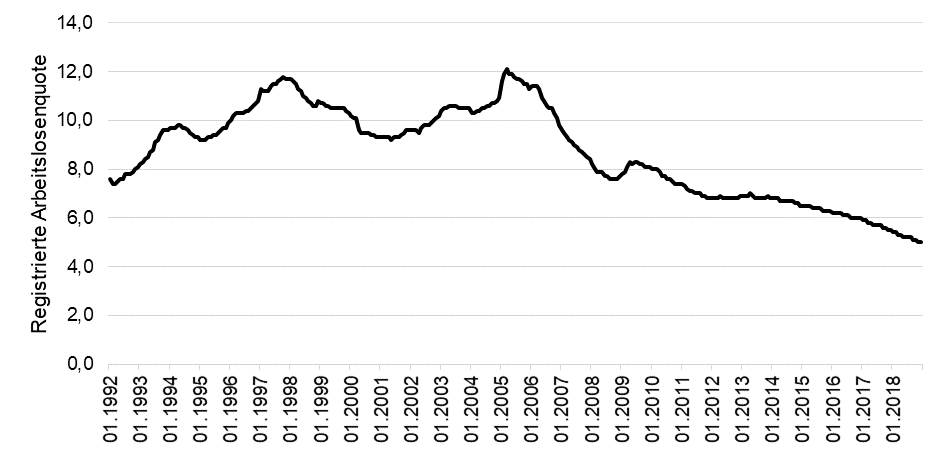
About 15 years ago, Germany implemented the Hartz labor market reforms. Since then German unemployment has dropped substantially (see Figure 1). The most controversial reform step was the so-called “Hartz IV” reform that reduced unemployment benefits for long-term unemployed. While macroeconomists agree that Hartz IV has reduced unemployment, there is no agreement by how much.

Figure 1: Registered Unemployment Rate for Germany, 1992-2018.

In order to quantify the macroeconomic effects of Hartz IV, it is necessary to use model-based simulations. Launov and Wälde (2013), Krebs and Scheffel (2013) and Krause and Uhlig (2012) analyze the effects of the reform on unemployment to employment transitions. However, they come up with very different quantitative results. While according to Launov and Wälde unemployment dropped by 0.1 percentage points due to Hartz IV, Krause and Uhlig find a 2.8 percentage point decline. A key reason for these differences is that each of these studies uses a different decline of the replacement rate for long-term unemployed as model input. The actual decline is difficult to measure due to complex institutional structures.

We avoid this problem by using a novel approach to evaluate the reform. We propose a macroeconomic model in which we distinguish between partial effect and equilibrium effect. We define the partial effect as the direct impact of the reform observed at the individual worker-firm level. Due to the reform, workers are ready to make concessions, e.g. accept lower wages. Thereby, firms are more likely to hire a given job applicant. In our terminology, firms’ selection rate increases.

We measure the selection rate with data from the IAB Job Vacancy Survey. This measure corresponds to the share of suitable applicants hired by plants. Thus, we construct an empirical time series for hiring standards and show that this margin moves procyclically (as predicted by our model). Furthermore, we estimate the partial effect of the Hartz IV reform based on the response of the selection rate and target this effect in our quantitative model. This approach has three advantages: First, in contrast to the job-finding rate (matches over unemployment), the selection rate does not have a structural break in 2005. Second, the selection rate is not contaminated by direct effect of the Hartz III reform. Third, we measure the partial effect directly instead of assuming a certain decline of the replacement rate.

Figure 2 shows that the selection rate increases in booms and decreases in recessions. Market tightness (vacancies divided by unemployment) indicates the state of the business cycle on the labor market. Furthermore, the selection rate increased substantially at the time of the Hartz IV reform. We estimate changes of the selection rate at different aggregation levels and control for business cycle effects. Overall, according to our approach, the partial effect (i.e. increase of the selection rate) led to a decline of unemployment by about one percentage point.

Figure 2: Dynamics of German labor market. For better comparability, each of the time series is normalized to an average of one.

However, the partial effects tells only part of the story. On top of it, there is an equilibrium effect. When unemployed workers are willing to accept a lower wage, firms start posting additional vacancies. More vacancies increase the probability of workers to get in contact with a firm. At the same time, the selection rate increases (partial effect) and thereby the probability that a contact becomes a match. Based on the observed dynamics of the job-finding rate and the selection rate, we determine the relative importance of partial effect and equilibrium effect. It turns out that both effects are similarly important. According to our model simulation, unemployment declined by more than 2 percentage points due to Hartz IV, which corresponds to around one million additional jobs.

Our results regarding the partial effect are in line Price (2018) who uses a causal microeconometric estimation at the worker level. Furthermore, our model simulation can replicate the shift of the Beveridge Curve (joint movement of unemployment and vacancies) in the aftermath of the Hartz IV reform. It has to be noted that our approach delivers a lower bound for the macroeconomic effects of Hartz IV because the reform may also have reduced separations, which we keep constant in our simulation (see Klinger and Weber (2016) and Hartung, Jung and Kuhn (2018)).

Overall, we find substantial effects of the Hartz IV reform on aggregate unemployment. According to our analysis, the reform has created at least one million additional jobs. Our paper only analyzes the positive dimension, which is an important prerequisite for a better understanding of normative aspects.

Filed Under: Opinion, Research Tagged With: Germany, Hartz reforms, labor market, unemployment, unemployment insurance

Work, knowledge and non-hierarchical cooperation

March 22, 2019 by Mark Fallak

The current debate about the future of work mainly evolves around the role of globalization and technological innovation. The key question, however, should not be how many jobs could be lost to machines in the near future, but how firms should adapt their work environment to harness their workers’ full potential, argues Werner Eichhorst in a recent op-ed for the World Commerce Review.

While many routine-heavy occupations – from manufacturing jobs to financial services – will certainly be automated to an extent that is technically feasible, economically efficient and socially accepted, genuinely human traits will gain importance. These include social interaction, creativity, initiative, reasoning and learning, negotiating and coordination, complex problem-solving, analytical, critical thinking, and care. Humans will be able and required to “craft and interpret their jobs more substantially”, writes Eichhorst:

Technology does not change the fact that work is with humans, and humans have to cope with themselves and each other. The fundamentals of human relations, productivity, cooperation, struggles about boundaries remain. What can be seen as of today is the fact the future role of human work challenges the way work has been organized so far. The quality of the outcome, the service or the product, is intimately related to the quality of the work environment, the processes and structures.

Since traditional hierarchies undermine creativity, productivity, and commitment in a broader sense, Eichhorst envisions a concept that draws on the principle of a “workshop, with crafts in many fields but less managerial intervention”:

Craftsmen and craftswomen are attentive, stubborn, experienced, responsible, quality-driven, committed, they know what to do and to adjust incrementally based on intuition and experience. In a workshop, coordination and collaboration are developed in a flexible, less hierarchical way, both community-oriented and autonomy-friendly way at the same time. Of course, this requires independent, skilled individuals on the one hand, and a working climate based on trust.

In such a setting, strict monitoring of workers who can be seen as “mature professionals” should be avoided. At the same time, individual incentives such as bonus and reward systems would be increasingly counterproductive.

To some extent, the reward lies in work itself and co-ownership could become an important source of motivation and commitment. Firms of the future can be seen as collaborative workshops that combine expertise and talents, and share risks. This is better done on par.

According to Eichhorst, this craft-like type of work would be conceivable at different skill levels and in various sectors, beyond high-skilled professional work or traditional crafts. Although some elements of this principle can already be seen in emerging organizational models, many firms are yet reluctant to give up  well-established managerial routines. Eichhorst’s bottom line: “Those who work know what to do. Just let them do their job.”

Filed Under: Opinion Tagged With: cooperation, craft, future of work, human capital, management, technology, Trust, work organization

Who goes on disability when times are tough?

February 15, 2019 by Mark Fallak

By Delia Furtado, Kerry L. Papps and Nikolaos Theodoropoulos

Social Security Disability Insurance (SSDI) is a federal program that was established in 1956 to insure U.S. workers against the risk of being unable to work as a result of a physical or mental disability. It is well established that SSDI applications tend to rise during recessions. One possible explanation for this is that applicants with marginal disabilities only find it worthwhile to apply when their opportunities in the labor market are sufficiently poor. Under this view, those applicants with the lowest costs of applying should be the most likely to apply at all times, but may also be the most sensitive to economic conditions.

In a new IZA discussion paper, we study the take up of SSDI among immigrants for two reasons. The first is that focusing on immigrants allows us to exogenously assign people to ethnic networks based on country of birth. The second is that, even if the out-of-pocket costs of applying are the same, the “social” costs of applying are likely to vary across immigrant communities. For example, immigrants whose compatriots have high levels of SSDI take-up may find it easier to gather information about the application process from others in their networks. In addition, immigrants from countries with strong taboos against leaving the workforce may be marginalized if they apply for SSDI despite having only a relatively minor disability.

Using data from the 2001 to 2016 samples of the American Community Surveys, we show that immigrants from high SSDI take-up countries of origin are more sensitive to economic conditions than immigrants from low take-up countries. We interpret this result as evidence that applicant decisions, as opposed to employer or Social Security Administration decisions, drive the counter-cyclicality of SSDI take-up rates. Additional results suggest that our baseline findings are driven by differential costs of participation by origin group as opposed to differences in eligibility rates or experienced severity of recessions. We supplement our analysis using complementary data from the 2001-2017 Current Population Surveys and show that a similar pattern exists among second generation immigrants, hinting that our results might be generalizable to natives as well.

Work norms and social pressure

We also examine why immigrants in high SSDI take-up groups are more likely to apply for SSDI when jobs become scarce. To provide evidence of the role of social norms, we collect longitudinal data from the 1981-2014 World Values Survey and the European Values Survey on home country attitudes regarding the importance of work, such as whether a person believes work is a duty towards society. We show that during bad economic times, immigrants belonging to ethnic groups with weaker importance of work norms are more likely to take up SSDI. This suggests that social pressure may be an important consideration for people when deciding whether to apply for government assistance during periods of economic hardship.

Our results suggest that the SSDI program is not being used only to provide insurance against the possibility of becoming permanently disabled. It also works as an insurance mechanism against job loss. This is problematic because while recession-induced job losses are mostly temporary, people tend to stay on SSDI once they go on it.

Filed Under: Opinion, Research Tagged With: disability, immigrants, job loss, recession, social security, take-up

What hides behind the German labor market miracle?

December 19, 2018 by Dajan Baischew

A key question in labor market research is how the unemployment insurance system affects unemployment rates and labor market dynamics. A new IZA Discussion Paper by Benjamin Hartung, Philip Jung and Moritz Kuhn revisits this old question studying the German Hartz reforms. The study traces the German labor market miracle back to the reform of the German unemployment insurance system that took place in the mid-2000s and abolished long-term, wage-dependent unemployment benefits.

The analysis highlights changes in separation rates after the unemployment benefit reform as the quantitatively important channel through which the unemployment insurance system affects unemployment rates and labor market dynamics.

The results show that a decrease in separation rates after the reform explains 76% of declining unemployment. Existing studies on the German labor market miracle leave this empirical fact unexplained by focusing on changes in job finding rates. The reduction in separation rates is heterogeneous, with long-term employed, high-wage workers being most affected.

Unemployment would be 50% higher without Hartz IV

The authors use economic theory to causally link the empirical findings to the abolition of long-term, wage-dependent unemployment benefits that was implemented by the Hartz reforms. Using a quantitative labor market model, they find that absent the reform, unemployment rates would be 50% higher today. In this case, German unemployment would have developed similar to labor market trends in Austria.

With respect to the welfare consequences of the labor market reforms, the study shows that long-term employed high-wage workers suffered substantial welfare losses in the absence of compensating transfers. This worker group accounts for almost two-thirds of the German workforce. The separation rates of these workers are the lowest in the labor market, and it might therefore appear as if these workers are very detached from any changes in the unemployment insurance system. However, the paper shows that this is not the case and that, in hindsight, their welfare losses might explain the discontent of a large part of the German electorate with these reforms.

Read a more detailed summary with charts in German.

Filed Under: Opinion, Research Tagged With: Germany, Hartz reforms, labor market reforms, unemployment, unemployment insurance

How Germany is tackling the future of work

November 30, 2018 by Mark Fallak

Digital technologies could have a disruptive effect on future jobs, as well as on the tasks performed by workers and the skills required of them. There may be an even stronger demand for highly skilled workers, but the outlook for those in medium-skilled manufacturing who hold vocational training degrees is more unsure. This is seen as a major challenge for the German economic model, which has emphasized skilled manufacturing and innovation that is more incremental.

Meanwhile, the usual channels German workers use to affect change – collective bargaining and representation at the firm level – are in decline. The rise of platform work and self-employment through the gig economy poses challenges for the social insurance funding model. These are issues that are being raised throughout the industrialized world, including Canada.

To address the implications of digitalization and automation, in 2015 the German government initiated a consultation with a wide range of partners from academia, unions, and the nonprofit and private sectors. The objective was to encourage policy-making that would help prepare German workers, the welfare state and firms for the future economy, with an emphasis on protecting participation in the labor market. A central theme was flexibility – how could workers be supported effectively in this rapidly changing environment?

Work 4.0 policy process

The two-year consultation, which included commissioned research, debates, workshops and public consultations, culminated in a March 2017 in a white paper, Work 4.0. Four main themes emerged during the process: lifelong learning, flexible working environments, health and safety, and protection for the self-employed.

  • First, lifelong learning was seen as essential in order to keep up with rapidly evolving technological developments. Additional (digital) qualifications were expected to be compulsory in almost all sectors and occupations. Hence, a legal right to continuing vocational education and training was discussed as a possible solution. The paper also raised the potential for the development of a “personal activity account,” which would be accorded to citizens at the beginning of their working life. The funds in the account could be used for improving skills, starting a business or taking personal leave during their careers.
  • Second, the white paper acknowledges more flexible working arrangements and employee autonomy in the new world of work. It calls for predictable working schedules, even in highly flexible settings, but also suggests existing legislation be modified to allow workers to choose their own work times. Negotiating agreements on work schedules was raised. For example, demands on worker availability in more flexible working environments could be increasingly important. The white paper also warns of a breakdown of the boundaries between work and private life.
  • Third, health and safety departments must consider the risks of digital work, especially with more Germans working later in life. The report noted the psychological strains of work and the need for healthy work environments that allow for productive employment.
  • Fourth, the lines between employment and self-employed work are blurring. The paper recommended including self-employed individuals in in social insurance, in particular old-age pensions, as a way of stabilizing welfare state funding and establishing a level playing field in the different types of work. In the case of an increase in platform work and new forms of self-employment, protection strategies would be needed that are tailored for employee-like self-employed workers.

The general nature of the white paper reflects the differing interests of the stakeholders involved in the consultation. The German trade unions said it would be important to redefine employment status, enhance social protection coverage and wage formation, and ensure worker participation in emerging new employment models. The employers insisted that existing regulations are generally sufficient and should even be relaxed in some cases, for example, in the allowances made for flexible working time. The government pointed to the need to invest in boosting skills and improving individual prospects for advancement at an early stage, in order to maintain individual employability and minimize the risk of unemployment.

Some of these issues related to Work 4.0 reappear in the current government’s agenda. First, a national strategy on lifelong learning is being developed. Second, steps to increase the social insurance coverage of self-employed workers are being discussed. Third, steps have been taken toward producing legislation on a right to return from part-time to full-time work (under certain conditions). The government has launched a new dialogue on the future of the welfare state that deals with many issues highlighted in the White Paper.

Evidence-based, innovative policy solutions

It’s important to underline that the main issues debated in the context of Work 4.0 have long been part of the discourse on labor market and social policy in Germany. But recently there has been a new sense of urgency in the discussions about technological change and automation. Policy-makers as well as trade unions have strongly advocated linking technological innovation and social innovation. One might think that a co-operative approach among the various actors in the labor market is feasible, as they share an interest in productivity, innovation and jobs, but the prospects of this are limited. Still, there does seem to be a general openness to collect and assess evidence on current developments, allow for experiments, and design innovative policy solutions.

In their discussions of the future of work, Canadian policy-makers and stakeholders should find ways to include the newly emerging and less organized sectors, instead of allowing old interests that are focused on collective bargaining and lobbying to dominate the process. It is also important to identify areas of converging interests early, so that the dialogue on policies is not overly dominated by distributional struggles and is more productive. Nevertheless, when it comes to more concrete steps, viable compromises have to be found.

Editor’s note: This article was published on the PolicyOptions website of the Institute for Research on Public Policy (IRPP), Canada, as part of the Preparing citizens for the future of work special feature.

Filed Under: Opinion Tagged With: automation, digitalization, flexible work environments, health and safety, lifelong learning, platform work, Work 4.0

New education models for the workforce of the future

November 23, 2018 by Mark Fallak

Industry 4.0 is still ongoing, but we can already see some of the most important effects, such as the almost complete robotization of almost all manufacturing production and digitalization of an increasing part of consumption. After the disappearance of the working class, now also white-collar jobs are put under threat together with the middle class of shopkeepers, which was the backbone of retail trade.

A number of more or less worrisome predictions have been made regarding the number of jobs that will disappear, starting from the seminal paper of Frey and Osborne. Their prediction was that 47% of the current jobs will be lost, which is not such a big share if we look retrospectively at the labor market impact of past industrial revolutions. Other scholars have predicted a lower share of job loss. It is clear that most tasks, especially the routine-based ones, within a large number of jobs will disappear. What remains still unclear is whether this will also make the jobs disappear altogether, or whether jobs will dramatically change from the way they are done today.

Rising importance of work-related skills

At the same time, new products, new consumption patterns and therefore new jobs are going to be created. At the moment, it is impossible to predict the exact number and even the field in which they will be created. Looking at the skills that are most under threat today, our educated guess is that the jobs which will survive and even develop further will be those that require a big deal of creativity. Such jobs will need to embody an ever higher level of human capital. And human capital in this case does not only mean general education (especially in the STEM fields) but especially work-related skills and competences.

General work-related competences (adapting to the hierarchical and functional division of labor, teamwork, dealing with customers) can more easily be learned through any kind of work experience, even of relatively short length. In contrast, job-specific competences can be learned only through long periods of on-the-job training. These refer to specific tasks that are done only in a given type of job, such as designing a building or doing the accounting for a company.

Extending the principle of dual education

How should educational systems and school-to-work transition (SWT) regimes be modeled to better serve the needs of Industry 4.0? Although a high level of general education will be important for its training content to develop adaptability, it is not the only component to develop. What will be increasingly important are the work-related skills.

This will require important educational reforms to favor an ever-better integration of educational institutions and the world of work, especially in the countries whose SWT regime is sequential (training after education) rather than dual (education together with training). Educational systems should learn to work with the world of business and thus collaborate with it. School and university rooms need no longer be the only places where human capital is generated. Firms should also become learning and training places again, as they used to be before the first industrial revolution.

The duality principle is the basis for a strong diversification of the supply of education. It should cross through the entire educational system, from high secondary school (work-related learning, vocational education and training, and apprenticeship) to bachelor degrees (professional universities for those who received vocational training, and high-level training or apprenticeships for university students) and post-graduate programs (master programs with on-the-job training, business incubators and training for self-employed and entrepreneurs, and industrial doctorates). In addition, life-long learning should be offered to help those who lose their job or wish to start a new occupation.

Filed Under: Opinion, Research Tagged With: automation, competences, digitalization, dual education, Industry 4.0, skill, training

A data tax for a digital economy

October 23, 2018 by Mark Fallak

The discussion of how to tax the digital economy is in full swing as established principles, such as that of “economic allegiance”, “value-added”, “sales taxes” etc. prove inadequate for taxing companies whose headquarters are in one country but whose profit is made by offering online services to users across the globe.

Where does the company consume publicly-provided goods, and hence where should taxes on it be applied? What is a suitable definition of sales tax when the users of a data-driven internet platform use it without monetary fees? What is a suitable definition of value-added when users are not customers of a platform but whose transaction data on the platform is being harvested for profit?

In the past year German Chancellor Angela Merkel and the leader of the German Social Democratic party Andrea Nahles mentioned planned reforms which will try to “tax big data”. While Merkel’s remarks appear to imply monetary taxes, Nahles’ remarks come closer to a data tax in the form of opening data as a common good very much like a proposal in IZA World of Labor article in 2015 describing the properties of Google Trends data:

“… governments will have to encourage or even legislate for some kind of corporate good practice (for example, in the form of a data tax) to motivate firms with large amounts of data in their proprietary silos to open up the data in aggregate form for the benefit of society, while also protecting their legitimate corporate interests and privacy concerns”.

Nahles proposes “data-for-all-legislation” to force a digital firm to open “an anonymized, representative sample of their data” as soon as “the firm’s market share exceeds a certain limit for a certain amount of time”. This idea is very interesting and policy makers at last facing up to the data revolution is long overdue. While the data part of Nahles’ proposal comes close to a “data tax” proposal, the trigger mechanism is reminiscent of the “NBA draft lottery” which strengthens weaker competitors.

Digitization creates online markets because ICT optimizes the core function of markets: the matching of supply and demand. On occasion so-called “network effects” are essential in optimizing matching. In order, for example, for Uber to match passengers to taxis, it makes use of the fact that it can analyze Big Data to predict when and where the demand will occur. This is associated with winner-take-all phenomena, such as Google dominating the information market, Facebook the private social media market, LinkedIn the professional social media market, etc.

Digital firms in these cases can be seen as “data refineries” of raw data drawn from a country’s human capital (which could be seen as a public good very much like roads and bridges) to produce profitable services. It is therefore natural to think about taxes, but it is more important to pay a “data tax” on top of which others might build competing, complementary, new or public good services. Google’s Trends data might serve as a prototype.

While the search and click microdata remains proprietary (as one might argue it should), aggregate data derived from those data sources (e.g., Google Trends) can help analyze, understand and predict socioeconomic phenomena. This is clearly a valuable public good which in a further twist shows why Google’s self-imposed data-taxing is a clever move. The total knowledge derived from academic research with Google Trends data can be used by the proprietor to improve its search algorithm. In a data dominated economy we need more such intelligence and a properly designed data tax is a strong candidate as a Mechanism to encourage this.

Filed Under: Opinion Tagged With: data tax, digitalization, globalization, Internet

  • Previous Page
  • Page 1
  • Page 2
  • Page 3
  • Page 4
  • Page 5
  • Next Page

Primary Sidebar

© 2013–2025 Deutsche Post STIFTUNGImprint | Privacy PolicyIZA