• Skip to primary navigation
  • Skip to content
  • Skip to primary sidebar

IZA Newsroom

IZA – Institute of Labor Economics

  • Home
  • Archive
  • Press Lounge
  • DE
  • EN

Machine learning in the welfare system

June 23, 2021 by Mark Fallak

A shock to the economy such as that wreaked by the COVID-19 pandemic can lead many to start receiving income support from the government. Some individuals may end up relying on government transfers for protracted periods of time. Such welfare dependency can have demoralizing effects on recipients and create large outlays for governments.

A new IZA discussion paper by Dario Sansone and Anna Zhu shows how machine learning algorithms can be used to predict which individuals are most at risk of becoming long-term welfare recipients. The fusion of high-quality big data and machine learning methods allows these researchers to provide better predictions than commonly used benchmark models. Specifically, they can predict the proportion of time individuals are on income support in the subsequent four years with at least 22% greater accuracy than standard early warning systems.

Machine learning can be successfully applied to large administrative data

Governments increasingly use machine learning to tackle social problems and to make resource-allocation decisions. For example, it has been used to help judges to improve bail-granting decisions, schools to identify students at risk of dropping out, and surgeons to screen patients for hip-replacement surgery. In this study, the authors use data on the full population of Social Security enrollees in Australia.

These data include daily information on the income support receipt patterns of millions of individuals and their household members, as well as other demographic and socio-economic information. The size and richness of the dataset makes it ideal for a machine learning application, allowing the algorithms to achieve high performance by detecting subtle patterns in the data and by identifying new powerful predictors.

The authors’ approach is aimed at complementing existing early intervention programs targeted to long-term welfare receipt. Before governments can implement these programs, they need to know which individuals are most at-risk – a role that can be ably fulfilled by machine learning algorithms. Additionally, these improved predictions may reduce conscious and unconscious biases common in human decision-making. Importantly, the approach is also relatively low-cost to implement since it exploits administrative data already available to practitioners.

Remaining challenges and next steps

Despite their growing popularity, there is still a large degree of skepticism about the impact of adopting such automated systems because of accuracy concerns and bias reinforcement. This is why the authors do not believe their algorithms should replace human expertise but rather act as its complement. For example, caseworkers could focus their attention and time providing personalized service and targeting the appropriate support to individuals that the algorithm identifies as most at risk.

Similarly, identifying individuals who are at-risk is only the first step. Policymakers intending to help suitable individuals promptly leave the welfare system also need to know which interventions work and on whom these interventions are most likely to work. Prediction alone cannot answer these questions: causal estimations such as those obtained from randomized controlled trials are required here, ideally combined with machine learning to identify the sub-population of interest.
Filed Under: Research Tagged With: algorithms, artificial intelligence, Australia, income support, machine learning, welfare dependency

More goals, fewer babies?

June 11, 2021 by Mark Fallak

Anecdotal evidence suggests that successful performance of a football team in major sports competitions sparks a baby boom among fans. International media reported various cases, such as a baby boom in Iceland nine months after the sensational EURO 2016 win against England, or an increase in births in Barcelona after a last-minute goal in the 2009 Champions League semi-final.

However, a new IZA discussion paper by Luca Fumarco and Francesco Principe seems to debunk this myth once and for all, at least as far as the UEFA European Championships and FIFA World Cups are concerned. The authors combine Eurostat data on country-level monthly birth rates for 50 European countries, over a period of 56 years, with national football teams’ performance in international football events. Performance is measured with the ELO rating system used by FIFA to compile the world national teams ranking.

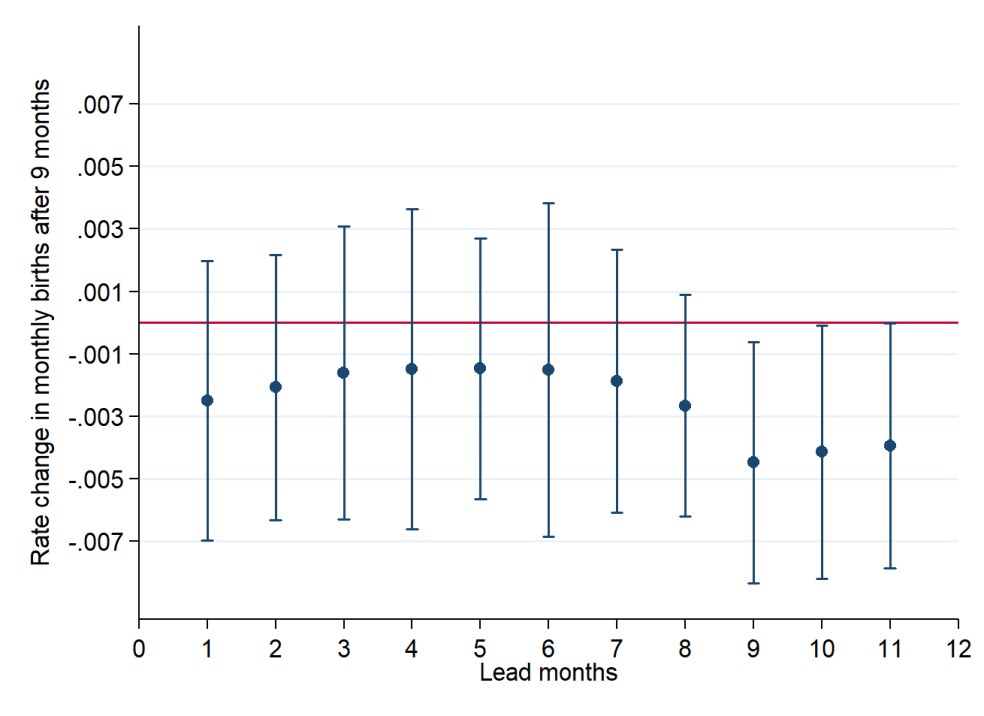
The analysis shows that an increase in national teams’ performance in major competitions does not lead to a baby boom, but is instead associated with a drop in births nine months after the event. As the figure below illustrates, the effect of performance on monthly births is highly statistically significant nine and ten months after the tournament.

Fig. 1: Effect of performance on monthly births

These results, which pass various robustness tests, are also economically significant. For example, in large European countries such as Italy and France, an average performance in an international competition could lead to a decrease by over 1,000 monthly births, nine months after the beginning of the tournament.

According to the authors, a possible explanation might be that a massive increase in the consumption of media and entertainment, followed by extensive celebrations with friends and compatriots, comes at the expense of “intimacy time.” Whether this will also hold for the EURO 2020, which starts today with one year delay and many Covid restrictions on public gatherings still in place, remains to be seen in about nine months from now.

Filed Under: Research Tagged With: baby boom, birth rates, entertainment, fertility, football, intimacy, sports

New research on the economic effects of migration policies

June 9, 2021 by Mark Fallak

In 2020, the number of international migrants across the globe reached a new high of 281 million, equal to 3.6 percent of the world’s population and affecting all regions of the planet. Research on the economic aspects of migration thus could not be timelier. In a new edition of a longstanding and successful series, IZA’s 17th annual migration meeting discussed new and cutting-edge research on a wide variety of migration topics in economics.

This year’s workshop, organized by George Borjas and Marc Witte, focused on the economic drivers and impacts of refugee migration, the integration of immigrants in their host societies, and the impact of migration policies on both sending and receiving countries. After the 2020 migration workshop was canceled due to the pandemic, this year’s edition was the first to be held entirely online.

Many of the 17 presenters analyzed various migration policies and/or natural experiments across the globe, from the US, Mexico, Colombia, to Portugal’s former African Colonies, as well as Italy, and Israel.

Several papers studied the effect of migration-curbing policies in receiving countries on development in the sending countries, as exemplified by Davide Coluccia’s work on “The Economic Effects of Immigration Restriction Policies”. Looking at the Italian mass migration to the U.S. at the beginning of the 20th century, he finds that the American 1921-1924 Immigration Acts led to a population increase in those Italian districts that previously showed large emigration to the U.S. As a consequence, Italian manufacturing firms located in those districts invested less in capital goods, while industrial employment rose due to an abundance of workers. A migration policy enacted in a destination country thus had potential long-run effects on growth and productivity in the sending country.

Obtaining citizenship boosts labor market integration

Another presentation by Yajna Govind analyzed the effect of naturalization of immigrants on their labor market outcomes. The paper exploits a French reform in 2006 that doubled the minimum years of marriage (to a French citizen) required before naturalization, from two to four. From this policy change it can be deducted that obtaining citizenship leads to an increase in annual earnings by almost 30%, driven both by rising working hours and hourly wages. Interestingly, the margins starkly differ by gender: while naturalized men work more hours, naturalized women earn more per hour. For both genders, in any case, naturalization boosts labor market integration.

The immigration experience to America is perhaps best described with a quote from an Italian immigrant in the 1900s:

“I came to America because I heard the streets were paved with gold. When I got here, I found out three things: First, the streets were not paved with gold. Second, they weren’t paved at all. Third, I was expected to pave them.”

In his keynote speech “Streets of Gold: Immigration and the American Dream over two Centuries”, Ran Abramitzky compares immigration to the U.S. one century ago with current immigration patterns. Characterizing the view of the past European mass migration as overly nostalgic, Ran showed that immigrants then and today only partially assimilate to their host country, both economically and culturally. Their children, however, cover a lot of ground to their US-born counterparts and catch up with them in most economic aspects, regardless of the sending country.

Other topics discussed in the workshop’s presentations included how taking the perspective of an immigrant affects natives’ pro-sociality, the impact of immigration on the top 1% income earners in the UK, or the influence of immigration on the creative arts in the US.

Filed Under: IZA News, Research Tagged With: Development, immigration policy, integration, migration

The burden of mandatory waiting periods for abortions

June 9, 2021 by Mark Fallak

Mandatory waiting periods for abortions have proliferated in the United States since the early 1990s. In recent years many states have begun requiring that initial counseling be provided in-person, causing women seeking abortions to have to make two trips to a provider at least one day apart. U.S. courts have opined that mandatory waits “may delay, but do not prohibit abortions” and “are surely a small cost to impose” and hence not an undue burden on women seeking abortions. Yet these opinions have been based on conjecture rather than empirical evidence.

Increase in second-trimester abortions

In a recent IZA discussion paper, Caitlin Myers provides the first empirical evidence on the causal effects of mandatory waiting periods based on thirty years of enforcement variation in the United States. The results suggest that short mandatory waiting periods that do not require two in-person trips have little effect on abortion obtainment, but that lengthier waits and two-trip policies in fact pose substantial obstacles.

The modal woman seeking an abortion is a low-income adult mothers who is credit constrained and experiencing a disruptive life event. The analysis shows that faced with a two-trip waiting period, many of these women experience substantial delays in obtaining an abortion and some are unable to obtain one at all. Two-trip mandatory waits are estimated to increase second-trimester abortions by 19%, reduce total abortions by 9%, and increase births by 2%.

“Burden” rather than “cooling-off period”

The analysis additionally shows that the delays and reductions in abortions caused by two-trip policies are greatest in counties that are far from abortion providers and experiencing high rates of unemployment and poverty. This is consistent with a “burden” interpretation of the result in which high travel distances amplify the costs of two required trips and poor economic conditions reduce the number of women who can afford them.

Filed Under: Research Tagged With: abortion

Loneliness and social isolation in Europe

June 4, 2021 by Mark Fallak

Concerns about loneliness are growing more than ever. Population ageing, the rising number of people living alone, global mobility, changes in working methods and the increased use of digital technologies for communication have led many to suggest that loneliness is becoming more prevalent. Since the outbreak of the COVID-19 pandemic, lockdowns, quarantines, curfews, distancing measures, the cancellation of community activities and events have magnified existing levels of loneliness and social isolation. With the pandemic entering its second year, there are fears that the toll on loneliness could have consequences long after the virus recedes.

The impact of loneliness on individual well-being and social cohesion should not be underestimated. Loneliness has been compared to obesity and smoking in the mortality risks that it entails. It is also associated with physical and psychological health problems. Lonely adults tend to suffer from higher levels of cortisol (the ‘stress hormone’), raised blood pressure, impaired sleep and cardiovascular resistance compared with non-lonely individuals, both in stressful situations and when at rest.

Over time, this translates into chronic inflammation and higher morbidity and mortality rates. Loneliness is also associated with depressive symptoms and with unhealthy behaviors such as smoking and a lack of physical exercise. In an increasingly connected world, lonely and socially isolated people face the double penalty of poorer health and being stigmatized as socially awkward.

Behavioral effects of loneliness create a vicious circle

What is more, feelings of loneliness and social isolation may themselves drive lonely individuals even further away from others, because loneliness affects behavior. Individuals suffering from loneliness and social isolation tend to display lower levels of empathy and feel more threatened by unexpected life situations compared with their non-lonely counterparts.

Although discussions about loneliness are prominent in political debates, and a growing number of newspapers are now talking about a ‘loneliness pandemic’, cross-national evidence on the incidence of loneliness is still limited. A recent IZA discussion paper by Béatrice d’Hombres, Martina Barjaková, and Sylke V. Schnepf  offers a comparative overview of the prevalence and determinants of loneliness and social isolation in Europe in the pre-COVID period.

One-fifth of the European population suffers from social isolation

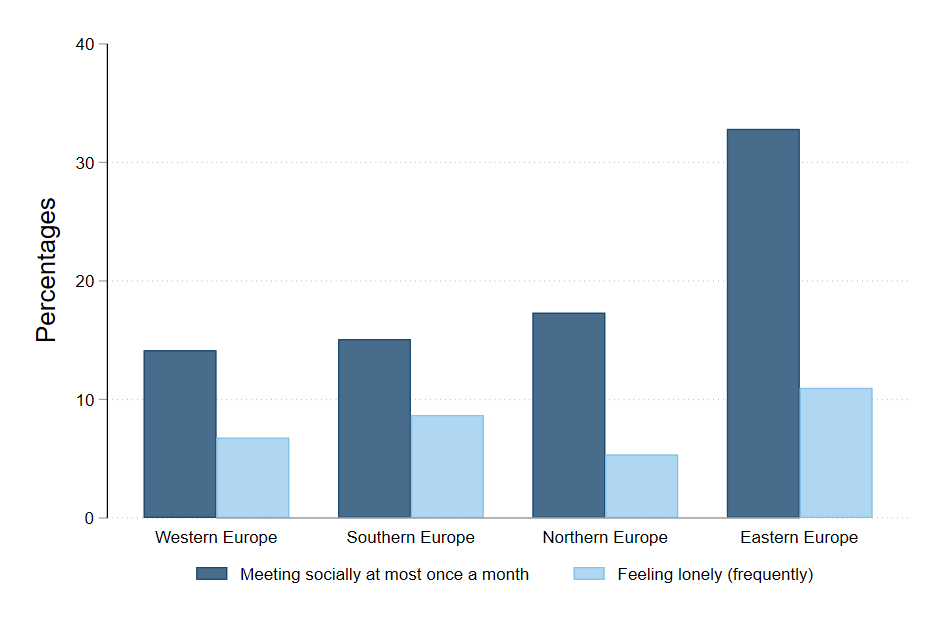
The empirical results indicate that 8.6% of the adult population in Europe suffer from frequent loneliness and 20.8% from social isolation, with eastern Europe recording the highest prevalence of both phenomena. Trends over time do not indicate any change in the incidence of social isolation following the widespread adoption of social media networks from 2010 onwards. The empirical analysis shows that favorable economic circumstances protect against loneliness and social isolation, while living alone and poor health constitute important loneliness risk factors.

Figure: Prevalence of Loneliness and Social Isolation in EU macro regions

Although social isolation increases with age, the elderly do not report more frequent feelings of loneliness than other age groups, all other things being equal. The authors show that the relative contributions of the different objective circumstances included in the empirical analysis — demographic characteristics, economic conditions, living arrangements, health status, religious beliefs and geographical location — to loneliness and social isolation vary substantially.

Forced social distancing may have long-term consequences

Data limitations precluded an investigation of the role of social media in protecting against or increasing the risk of social isolation and loneliness. The authors suggest this should be addressed in future pan-European studies on loneliness. Future research should also examine whether loneliness influences civic behavior and, more broadly, attitudes towards others and general trust, two important components in the functioning of liberal democracies.

Social connections are critical in our daily lives. The distress experienced worldwide over the past year is, in part, driven by limitations on social interactions. The forced social distancing experienced since March 2020 and the economic effects of the pandemic are likely to have long-term consequences. A forthcoming study will evaluate the extent to which the current situation has exacerbated the problems of those who were already lonely and whether the composition of the population most at risk of social isolation and loneliness has changed during this unprecedented period.

Filed Under: Research Tagged With: COVID-19, Europe, loneliness, social isolation

Losing a parent strongly affects teenagers’ mental health

June 2, 2021 by Mark Fallak

Children face many challenges on their path to adulthood. Probably the most difficult situation a child can face is the death of a parent. Children in these circumstances are forced to overcome a likely reduction in family income, a loss of parental guidance and social support, and many other shortfalls that other children do not have to face.

A recent IZA paper by Petri Böckerman, Mika Haapanen and Christopher Jepsen uses administrative data for Finnish citizens born between 1971 and 1986 to estimate the relationship between a parental death between ages 10 and 20 and the likelihood of hospitalization for mental health reasons. While the authors find no clear evidence of increased hospitalization following the death of a parent of a different gender, there are significant effects for boys losing their fathers and girls losing their mothers.

The results show that young men have higher hospitalization for mental health reasons for several years following the death of their father. Depression is the most common cause of hospitalization in the first three years after paternal death, whereas anxiety and, to a lesser extent, self-harm are the most common causes five to ten years after the paternal death.

Similarly, young women have a large increase in hospitalization when their mother dies. This increase is similar in magnitude to the effect for men when their father dies. But for women, the duration of the effect is much shorter.

Apart from the direct health effects, the consequences for educational and career outcomes should not be underestimated. The study finds further evidence of an increase in the use of mental health-related medications and sickness absence as well as substantial reductions in years of schooling, employment, and earnings for children following the death of a parent.

Filed Under: Research Tagged With: mental health, parental death

Zooming to class?

May 28, 2021 by Mark Fallak

During the COVID-19 pandemic, many schools and universities had to pivot to online learning.  However, there is little research on the causal effects of online learning compared to in-person instruction because most colleges and school districts choose to go either all in-person or online, or a hybrid for each student.

A recent IZA discussion paper by Michael S. Kofoed, Lucas Gebhart, Dallas Gilmore, Ryan Moschitto exploits a unique experimental setting at the United States Military Academy at West Point to examine the effects of online learning on student performance. West Point randomizes students into class sections, class hours, and instructors. As a response to the pandemic, the authors were allowed to use this variation to randomly assign students into either an online or in-person class section in a Principles of Economics class.

Large learning gaps for academically at-risk students

Courses at West Point have uniform graded events and lesson plans across instructors, and each instructor agreed to teach half of their teaching load in both modalities. The authors randomized 550 students across twelve instructors in 36 different classrooms. The analysis shows that students assigned to an online classroom received a final grade that was 0.20 standard deviations less than those assigned to an in-person class. This corresponds to a reduction by a half +/- grade.

Demographic data reveal that students who previously had below-average academic ability have the largest learning gaps, including those who were formerly enlisted in the United States Army or attended the preparatory school (similar to a community college). The result is also consistent across NCAA athletes and non-athletes.

Finally, the authors use a post-course survey to explore mechanisms. The responses indicate that online learning greatly reduced concentration, but also whether a student felt connected to their instructor and whether their instructor cared about them. Students also felt less connected to their peers. In sum, the study shows that online coursework reduced academic achievement, increased inequality, and deteriorated the classroom experience during the pandemic.

Read more about the paper in a Twitter thread by @mikekofoed.

Filed Under: Research Tagged With: academic achievement, COVID-19, online learning, students

Working from home may hurt productivity

May 27, 2021 by Mark Fallak

Across the globe, many businesses were forced to abruptly shift to having their employees Work From Home [WFH] during the Covid-19 pandemic. With a year of experience at WFH, there is now significant debate among businesses and policymakers about the extent to which WFH will continue once the pandemic is over. While some businesses (e.g., Facebook) have stated that they plan to continue offering full WFH for select employees, others have reported mixed results and plan to bring employees back to the office.

To date most studies of WFH have relied on survey data. However, such data might be problematic, due to inaccuracies in respondent answers. Moreover, especially during a crisis such as Covid, employees might overstate their productivity out of a concern about their career prospects. A new IZA discussion paper by Michael Gibbs, Friederike Mengel and Christoph Siemroth instead uses rich workplace analytics data to study the effects of the switch to WFH on employee productivity and work times. The data cover 10,000 information technology professionals in a large Asian IT services company. This setting is of particular interest because the industry and occupation have been predicted to be among the most amenable to WFH.

The authors used data from April 2019 through August 2020. This allowed them to compare productivity of the same employees before and during WFH, which began in March 2020.  They were also able to study employee performance, hours worked, networking activity, and other collaboration patterns.

Longer working hours

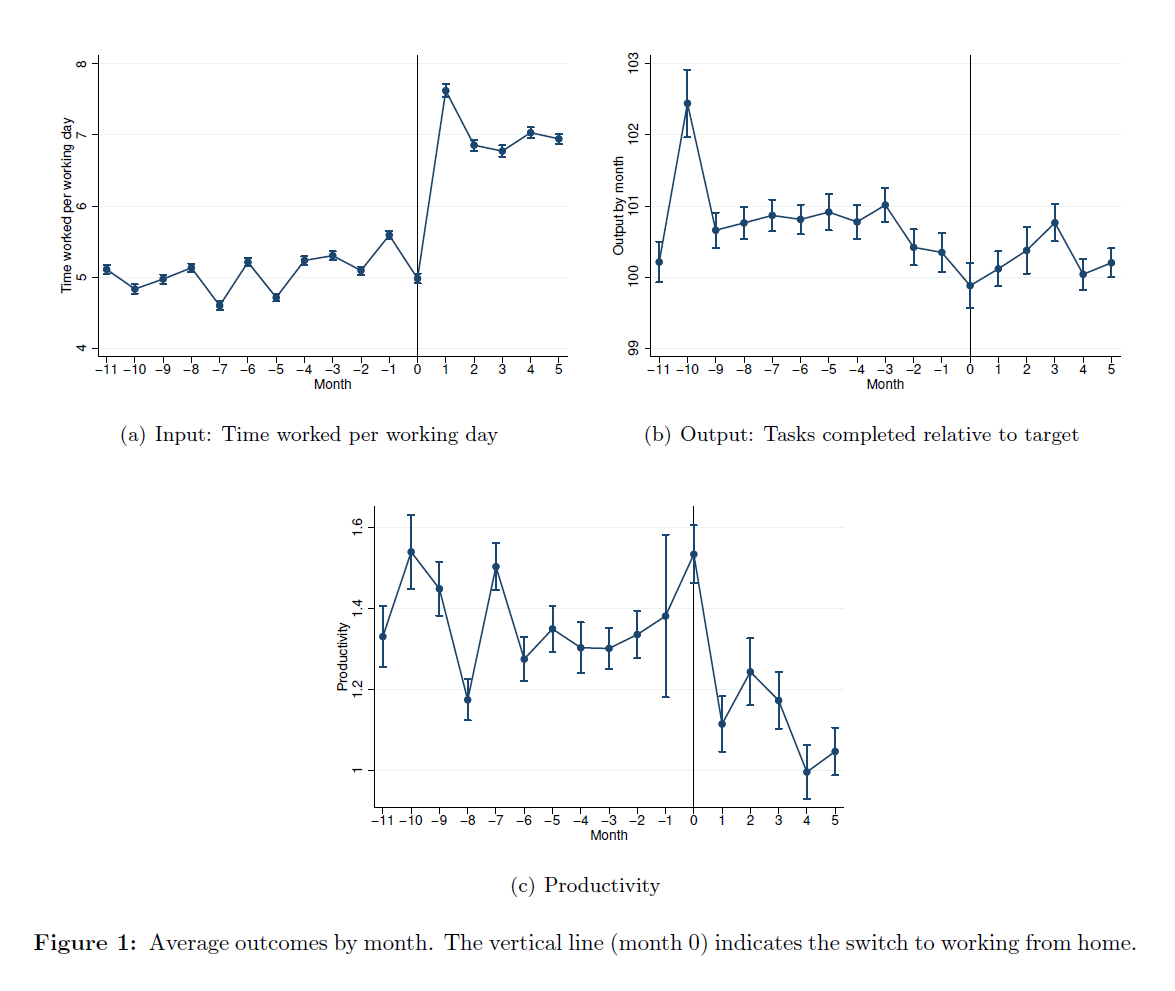
During WFH, the study finds that employees maintained output and achieved goals at approximately the same levels as they did prior to the pandemic. However, in order to maintain this output, on average total work hours increased by about 30%, including an increase of 18% outside of normal business hours. Productivity – measured as output per work hour – declined by about 20%.

The increase in total work hours was not due to time saved by not having to commute. Based on an estimate of commute time for employees, the authors found no statistical association of commute times with changes in work hours and productivity during WFH. Hence, employees with longer commutes prior to WFH did not increase work hours more during WFH.

The researchers were also able to examine how WFH affected workers differently, depending on their characteristics. Employees with children at home experienced a larger drop in productivity, and increased total work hours by more than those without children to compensate. Women fared less well than men in WFH, based on working hours and productivity. However, this was not driven by the presence of children at home. The study also finds that employees with greater company experience performed better. This may indicate that they were able to be more effective during WFH, by drawing on their knowledge of company procedures, and their deeper network of colleagues.

More distractions at home

What explains the drop in productivity? The authors’ explanation is that there were more distractions at home  – especially with children – and that the costs of communication and collaboration were significantly higher during WFH. Employees spent a great deal more time in formal meetings, including teleconferences. They also sent more emails than before. Meetings and other coordination activities  appear to have  been disruptive, as employees had significantly less “focus time” in which they were able to work without interruption. Additional evidence for this view is that employees networked less – they had fewer contacts with colleagues and business units both inside and outside the firm. Moreover, they had fewer meetings with their supervisor, or coaching sessions.

These findings are only for the first phase of WFH. Nevertheless, they provide a cautionary note that WFH is not a perfect substitute for personal interactions in the workplace. Companies will likely have to evolve practices which involve a mix of working from the office and home.

Filed Under: Research Tagged With: collaboration, COVID-19, future of work, output, productivity, remote work, work from home, work hours

Short-time work reduces unemployment and stabilizes aggregate demand

May 20, 2021 by Mark Fallak

Short-time work (STW), a policy that subsidizes working time reductions and thereby aims to prevent firings, is used in almost all OECD countries in the Covid-19 crisis as a labor market stabilizer. In Germany, almost every fifth employee (6 million workers) was affected by STW in spring 2020. When comparing this to the peak during the Great Recession, which was at about 1.5 million, it becomes clear that the use of STW has reached an unprecedented level, and so have public expenditures on these subsidies.

This is not only true for Germany. Equally high numbers were observed in Italy, Spain, France, Belgium, Austria and the UK. For example, the UK introduced the furlough scheme that covered up to almost 9 million workers in May 2020. At the European level, the EU has implemented the “Temporary Support to mitigate Unemployment Risks in an Emergency” (SURE) scheme, which provides financial support of up to 100 billion Euro in the form of loans to member states, specifically to finance the implementation or extension of schemes to preserve employment.

Short-time work reduces income risk and stabilizes demand

In a new IZA discussion paper, Thomas Dengler and Britta Gehrke investigate different mechanism of how this policy stabilizes the aggregate labor market. In particular, they focus on aggregate demand effects next to the direct reduction of labor costs for firms. In a recession when firings increase, employed workers aim to self-insure against rising unemployment risk and reduce their consumption. This fall in demand triggers a further reduction of production and even more firings – a contractionary spiral. Short-time work may break this spiral as it reduces the unemployment and income risk of workers.

Using a dynamic macroeconomic model with incomplete asset markets and labor market search frictions that is calibrated to the German economy, the authors find that a recession that would generate an increase of the unemployment rate by 3 percentage points with STW would increase unemployment by 4 percentage points without STW. Out of the total stabilization of 1 percentage point, 0.2 percentage points is due to the reduction of aggregate demand channel. The effects may be even larger in an economy with on average higher labor market flows such as the US. With higher flows labor market risk is generally larger and the demand channel plays a more prominent role.

Increasing the subsidy to short-time workers is very effective

An increase of the subsidy to short-time workers can provide additional stabilization of consumption demand and hence the aggregate economy. The effects are particularly strong if monetary policy is constrained by the zero lower bound, as it is the case in the current situation. An increase of the subsidy to short-time workers can even be more effective compared to a similar increase of the unemployment benefit replacement rate. Intuitively, the latter generates direct upward pressure on wages via the reservation wage, whereas this effect plays less of a role for short-time compensation.

In sum, these results support that short-time work can be a powerful policy in temporary crisis times to stabilize the labor market. But short-time work should never be a permanent phenomenon. Then, it may trigger biases and inefficiencies. For example, short-time work may hinder the reallocation of labor to growing and productive firms or it may lead to excessive hours reductions.

Moreover, access to short-time work should be strictly limited to firms facing large negative shocks. As another recent IZA study from France shows, take-up by less severely-hit firms during the 2008/2009 recession led to large windfall effects, which significantly increased the cost of the policy per job saved.

Filed Under: Research Tagged With: aggregate demand, consumption, COVID-19, savings, short-time work, unemployment

Measuring labor market conditions

May 19, 2021 by Mark Fallak

Economists and policymakers rely on labor market indicators produced by statistical agencies to gauge the health of economies during recessions and recoveries, to identify labor market trends, and to develop policy responses to problems identified in the data. Yet, the data on which these analyses depend often provide an incomplete, noisy, or even biased picture of labor market conditions. In addition, the rapidity with which the global recession developed during the Covid-19 pandemic has underscored the need for more timely economic data than national statistical agencies typically provide, spurring the use of real-time data from proprietary sources.

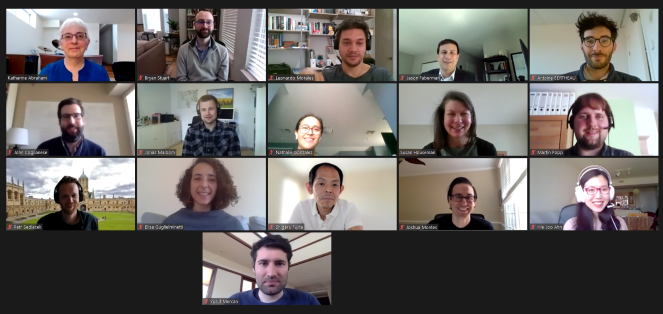
The 4th IZA workshop on labor statistics, organized by Katharine Abraham and Susan Houseman, featured twelve papers that critiqued existing measures of labor market conditions, provided corrected or new measures, and made use of novel data to address substantive labor market questions.

Improving measures of labor market slack

Several workshop papers addressed problems with statistics designed to measure the degree of unemployment and underemployment (or “slack”) in labor markets. The data for calculating the unemployment and the labor force participation rates in the United States come from a monthly household survey in which households are surveyed a total of eight times. This allows one to observe how workers move between being employed, unemployed, and out of the labor force.

Hie Joo Ahn and James Hamilton, however, point to large inconsistencies in the monthly estimates of the unemployment rate and labor force participation rate, on the one hand, and the movements between these labor force states over time.  Part of the problem arises from the fact that the more times survey respondents are interviewed, the less likely they are to report being unemployed or part-time, or to answer survey questions at all, owing to stigma associated with being unemployed or underemployed.  Correcting for these and other problems in the data, Ahn and Hamilton find that the unemployment rate and the labor force participation rate both are underestimated by about 2 percentage points.

Instead of correcting official measures, Jason Faberman, Andreas Mueller, Ayşegül Şahin, and Giorgio Topa propose a new measure, the “Aggregate Hours Gap,” to capture the degree of slack in labor markets. Their measure is derived from questions on desired hours worked in a household survey conducted by the Federal Reserve Bank of New York. They find that their measure performs as well as or better than the unemployment rate in accounting for changes in wages. Their measure also suggests that the recovery following the Great Recession was slower than suggested by the unemployment rate or other measures of labor market slack.

Using proprietary data to measure the economic impacts of Covid-19

Lags in the collection and publication of government data have hampered efforts to provide timely analysis of the impacts the pandemic recession is having on businesses and workers. To assess the widely held belief that small businesses and their workforces have been especially harmed by the recession in the United States, André Kurmann, Etienne Lalé, and Lien Ta use data from Homebase—a company that provides scheduling software primarily to small service-sector businesses—supplemented with business opening and closing information gleaned from Google, Facebook, and other online sources. Contrary to expectations, they find that, while small business employment was especially hard hit in the early stages of the recession, small businesses have rebounded and, on net, have not fared worse than larger businesses during the recession.

Links to these and other papers may be found on the workshop program.

Filed Under: IZA News, Research Tagged With: labor statistics

  • Previous Page
  • Page 1
  • …
  • Page 13
  • Page 14
  • Page 15
  • Page 16
  • Page 17
  • …
  • Page 69
  • Next Page

Primary Sidebar

© 2013–2025 Deutsche Post STIFTUNGImprint | Privacy PolicyIZA